automatic transmission AUDI A4 AVANT 2008 Owner's Manual
[x] Cancel search | Manufacturer: AUDI, Model Year: 2008, Model line: A4 AVANT, Model: AUDI A4 AVANT 2008Pages: 368, PDF Size: 46.19 MB
Page 157 of 368
_______________________________________________________ T:...:.; ra::.:.. n:.:s:.: m
:..:.:.:.: is:::: s::.:.: io::.:.. n:__J""
Swi tching to ma nual s hift pro gra m
- With the selector lever in
D, push lever to the right. The
display will show7
6 5 4 3 2 1 as soon as the selector lever
is switched over. The gear you select wi ll also be h igh
lighted in the
display => page 154, fig. 157.
To up shift
- Push the selector lever forward to the plus position
=> page 154, f ig. 156 G) .
To d ownshift
- P ush the lever to the mi nus positio n
Q.
When accelerating, the transmission will automatically shift into the
next higher gear before the engine reaches the maximum RPM .
When accelerating, if you apply a light throttle, the tiptronic® wil l
automatically shift into the next higher gear to save fuel. If you apply
a heavy throttle, the transmission will stay in gear engaged until
near maximum RPM are reached, or until the driver manually shifts
into a higher gear.
If you take your foot off the accelerator pedal when driving down a
steep incline, the tiptronic ® wi ll downshift from the selected gear
into the next lower gear based on road speed and engine RPM . The
automatic downshifting is interrupted as soon as you apply throttle
again .
[ i ] Tips
• When you shift into the next lower gear, the engine will down
shift only when there is no possibility of over-revving.
• When the kick -down comes on, the transmission will sh ift down
to a lower gear depending on vehicle and engine speeds.
• The tiptronic® is inoperative when the transmission is in the fail
safe mode. •
Controls and equip
ment
Ap plies to vehi cles: with mult it r o ni c™ Cont inuo usly V ariab le Tr ansm iss io n (CV Tl -not
a vail abl e at the t ime of p rin ting
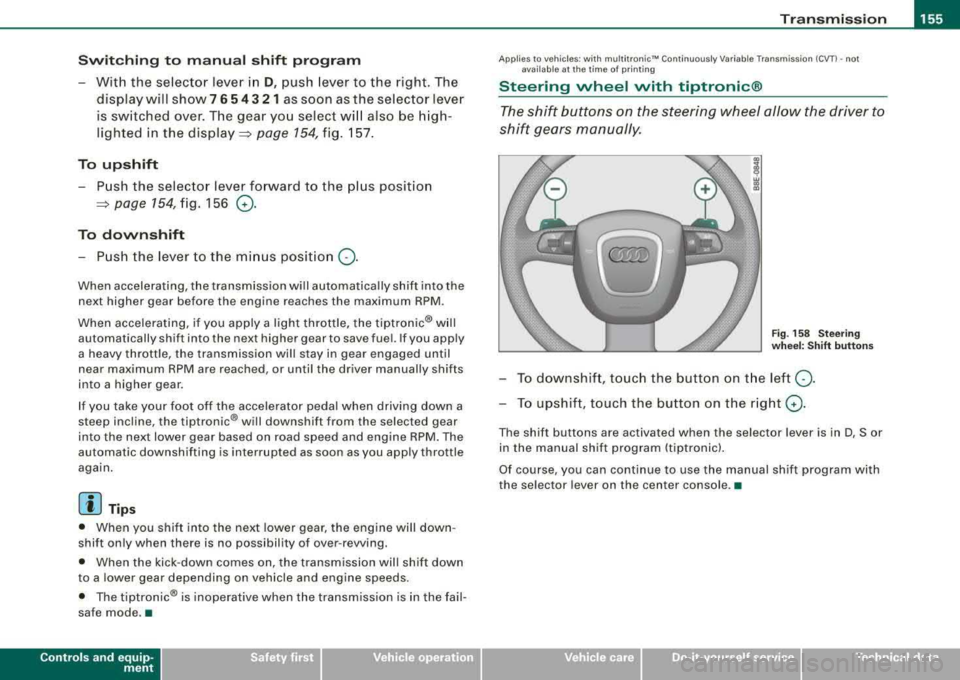
Steering wheel with tiptronic ®
The shift buttons on the steering wheel allow the driver to
shift gears manually .
Fig. 158 Stee ring
w hee l: S hift butt ons
To d ownshif t, touch the button on t he left Q .
To upshift, touch the button on the right G) .
The shift buttons are activated when the selector lever is in D, Sor
in the manual shift program (tiptronicl.
Of course, you can continue to use the manual shift program with
the selector lever on the center console. •
irechnical data
Page 158 of 368
___ T
_ r_a _ n_ s_m _ i_s _s _i_o _n ______________________________________________________ _
Applies to vehicles: w ith mu ltitroni c"" Continu ously Variab le Tr ansmiss ion {CVT I
Fail-safe mode
If the multitronic™ suffers a malfunction the fail-safe
mode maintains minimum driveability.
If there is a malfunction in the system, the automatic transmission
will shift to the fail-safe mode. All the segments in the display will
light up to indicate this condition.
Display inverse
If there's a malfunction in the system , the multitronic will shift to the
fail -safe mode. The entire row of gear selector positions will light up
in the display in inverse colors (light background, dark characters)
to indicate this condition. If there is an electrica l failure, the gear
position indicator row will turn blank. You can continue to drive, but
you should take the vehicle to an authori zed Audi dealer as soon as
possible to have the multitronic checked.
Display flashing
If the display is flashing, a serious malfunction has occurred. Drive
the vehicle in a gentle and cautious manner to the nearest autho
rized Audi dealer and have the problem corrected. •
Page 245 of 368
______________________________________________ D_ ri_v _ i_ n _, g..,_ a_ n_d _ e_ n_ v_i_ro _ n_m_ e_ n_t _____ ffllll
Driving and environment
The first 1,000 miles (1,500 km) and
afterwards
New engine
The engine needs to be run-in during the first 1,000 miles
(1,500 km).
For the first 600 miles (1,000 kilometers):
Do not use full throttle.
- Do not drive faster than 3/4 of the top speed marked on
the speedometer.
- Avoid high engine speeds .
From 600 to 1,000 miles (1,000 to 1,500
kilometers):
- Speeds can gradually be increased to the maximum
permissible road or engine speed.
During and after break-in period
- Do not rev the engine up to high speeds when it is cold.
This applies whether the transmission is in N (Neutral) or
1n gear.
After the break-in period
- Do not exceed maximum engine speed under any
circumstances.
- Upshift into the next higher gear
before reaching the red
area at the end of the tachometer
scale => page 12.
Controls and equip
ment Safety first
Vehicle operation
During the first few hours of driving, the engine's internal friction is
higher than later when all the moving parts have been broken in.
How well this break-in process is done depends to a considerable
extent on the way the vehicle is driven during the first 1,000 miles
(1,500 kilometers).
0 Note
Extremely high engine speeds are automatically reduced. However,
these rpm-limits are programmed for an engine well run-in, not a
new
engine.
~ For the sake of the environment
Do not drive with unnecessarily high engine speeds -upshifting
early saves fuel, reduces noise and protects the environment .•
New tires
If your vehicle is running on new tires, drive particularly
careful for the first 350 miles (500 kilometers) after fitting.
& WARNING
New tires tend to be slippery and must also be "broken-in". Be
sure to remember this during the first 350 miles (500 kilometers).
Brake
gently. Avoid following closely behind other vehicles or
other situations that might require sudden, hard braking.
•
Vehicle care Do-it-yourself service Technical data
Page 253 of 368
![AUDI A4 AVANT 2008 Owners Manual Traile r to win g -______________ _,..,_lflllll
[ i] Tip s
• Do not tow a trailer during the break-in period of your vehicle.
• If you tow a trailer, your Audi may require](/img/6/57552/w960_57552-252.png "AUDI A4 AVANT 2008 Owners Manual Traile r to win g -______________ _,..,_lflllll
[ i] Tip s
• Do not tow a trailer during the break-in period of your vehicle.
• If you tow a trailer, your Audi may require")
Traile r to win g -______________ _,..,_l'flllll
[ i] Tip s
• Do not tow a trailer during the break-in period of your vehicle.
• If you tow a trailer, your Audi may require more frequent mainte
nance due to the extra load
=> page 346 . •
Parking on a slope
Do not park with a trailer on a slope. If it cannot be
avoided, do so only after doing the following:
Wh en p arkin g:
-Apply the foot brake.
- Have someone place chocks under both the veh ic le and
the trailer wheels .
- Wit h chocks in p lace, s lowly release t he brakes until
wheel blocks absorb t he load.
- T urn t he wheels towards the curb .
- Apply the parking brake.
- Place an automatic transmission in
P , respect ively a
manual transmission in first or reverse gear.
Wh en re starting aft er p arking:
- Start the e ngine .
- Shift transmission into gear.
- Re lease the parking brake and slowly pull out and away
from the wheel blocks.
- Stop and have someone retrieve the whee l blocks.
Controls and equip
ment Safety first Vehicle operation
[ i
] Tip s
If you move the selector lever of the automatic transmission to P
before applying the parking brake and before blocking the wheels,
you may have to use more force later to move the lever out of the
P
position .•
Vehicle care Do-it-yourself service Technical data
Page 275 of 368

Checking and filling -
-----------------------------==--------=--
& WARNING (continued)
ment. Wait until no steam or coolant can be seen or heard before
carefully opening the hood.
•
Closing the engine hood
- Pull the hood down until the pressure from the strut is
reduced.
- Let the hood
drop down and latch in place. Do not try to
push
it shut; it may fail to engage =:>& .
& WARNING
A hood that is not completely latched could fly up and block your
view while driving.
• When you close the engine hood, check it to make sure the
safety catch has properly engaged. The hood should be flush with
the surrounding vehicle body parts.
• If you notice while driving that the hood is not secured prop
erly, stop at once and close it. •
Working in the engine compartment
Be especially careful whenever you work in the engine
compartment.
Whenever you must perform any work in the engine compartment,
for example checking and filling different fluids, there is a risk of
injury, burns and accidents. To prevent personal injury always
observe the following WARNINGS . The engine compartment of any
vehicle is a hazardous area
=> & .
• I I • • I
& WARNING
To help avoid injury, before you check anything under the hood:
• Turn off the engine.
• Remove the ignition key .
• Apply the parking brake.
• Move selector lever of automatic transmission to
"P" (Park);
put manual transmission in Neutral.
• Always let the engine cool down. Hot components will burn
skin on contact.
• To reduce the risk of being burned, never open the hood if you
see or hear steam or coolant escaping from the engine compart
ment. Wait until no steam or coolant can be seen or heard before
carefully opening the hood.
• Keep children away from the engine compartment.
• Never spill fluids on hot engine components. They can cause a
fire.
• Never touch the radiator fan. The auxiliary electric fan is
temperature controlled and can switch on suddenly.
• Never open the coolant reservoir cap when the engine is still
warm . The coolant system is pressurized and hot coolant could
spray out.
• Protect your face, hands and arm from steam or hot engine
coolant by placing a thick rag over the cap when you open the
coolant reservoir .
• If work on the fuel system or the electrical system is necessary: -Always disconnect the battery.
- Never smoke or work near heaters or open flames. Fluids in
the engine compartment could start a fire .
- Keep an approved fire extinguisher immediately available.
• To avoid electrical shock and personal injury while the engine
is running or being started, never touch:
- Ignition cables
.,_
Vehicle care
Page 276 of 368

lffll...__C_ h_ e_c _k _ i_n ..::g ,_ a_n_ d_ f_il _li _n....: g==-- --------------------------------------------
& WARNING (continued )
-Other components of the high voltage electronic ignition
system .
• If you must perform a che ck or repair with the engine running:
- Fir st, fully apply the parking brake , move selector lever of
automatic transmission to
" P " (Park ); put manual transmission
in Neutral.
- Alway s use extreme caution to prevent clothing , jewelry , or
long hair from getting caught in the radiator f an, V -belts or
other moving part s, or from contacting hot parts. Tie ba ck hair
before starting , and we ar no clothing that will hang or droop
into the engine.
• Min imize e xposure to emission and chemical hazards
=> & .
& WARNING
California Proposition 65 Warning :
• Engine exhaust , some of its constituents , and certa in vehicle
c omponents contain or emit chemicals known to the State of Cali
fornia to cause cancer and birth defects and reproductive harm . In
addition , certain fluids contained in vehicles and certain products
of component wear contain or emit chemical s known to the State
of California to cause cancer and birth defects or other reprodu c
tive harm.
• Battery posts, terminal s and related accessories contain lead
and lead compounds , chemicals known to the State of California
to cause cancer and reproductive harms . Wash hands after
handling.
0 Note
When a dding f luids, always make sur e tha t they are poured i nto the
prop er container or filler opening, otherwise serious damage to
ve hicle syste ms wi ll occur .
ffi For the sake of the environment
To detect leaks i n time, inspect the veh icle floor pan from unde r
neath regularly. If you see spots from oil or other vehicle fluids, have
your veh ic le i nspected by a n authori zed Audi dealer. •
Engine compartment
Applies to v ehic les: with 2 .0 I tur bo, 4-cy linder -e n gi ne
2 .0 I, 4-cy linder turbo engine (200 hp)
T hese are th e mo st impo rtant items that you ca n check .
Fig . 205 Engine comp artment : 2 .0 I , 4-cylind er turbo
G) Battery ... ..... .. ... .... ... ...... ... .. .. ... .. .
0 Engine oil fil le r cap (
© Engine oil dipstick ( orange) .. .... .. .... .... ... .. .
285
2 78
2 8 4
277 ....
Page 296 of 368
___ T_ ir_e _ s_ a_ n
_ d_ w_ h_ e_ e_ls _________________________________________________ _
&, WARNING (continued)
crashes and serious personal injuries . Have worn or damaged tires
replaced immediately.
• Tires age even if they are not being used and can fail suddenly,
especially at high speeds. Tires that are more than 6 years old can
only be used in an emergency and then with special care and at
low speed.
Glossary of tire and loading terminology
Accessory weight
means the combined weight (in excess of those standard items
which may be replaced) of automatic transmission, power steering,
power brakes, power windows, power seats, radio, and heater, to
the extent that these items are available as factory-installed equip
ment (whether installed or not).
Aspect ratio means the ratio of the height to the width of the tire in percent.
Numb ers of 55 or lower indicate a low sidewall for improved
steering response and better overall handling on dry pavement.
Bead means the part of the tire that is made of steel wires, wrapped or
reinforced by ply cords and that is shaped to fit the rim.
Bead separation
means a breakdown of the bond between components in the bead.
Cord
means the strands forming the plies in the tire.
&, WARNING (continued)
• Never mount used tires on your vehicle if you are not sure of
their "previous history." Old used tires may have been damaged
even though the damage cannot be seen that can lead to sudden
tire failure and loss of vehicle control.
• If you notice unusual vibration or if the vehicle pulls to one side
when driving, always stop as soon as it is safe to do so and check
the wheels and tires for damage.
•
Cold tire inflation pressure
means the tire pressure recommended by the vehicle manufacturer
for a tire of a designated size that has not been driven for more than
a couple of miles (kilometers) at low speeds in the three hour period
before the tire pressure is measured or adjusted .
Curb weight
means the weight of a motor vehicle with standard equipment
including the maximum capacity of fuel, oil, and coolant, air condi
tioning and additional weight of optional equipment.
Extra load tire
means a tire designed to operate at higher loads and at higher infla
tion pressures then the corresponding standard tire. Extra load tires
my be identified as "XL", "xi", "EXTRA LOAD", or
"RF" on the side
wall.
Gross Axle Weight Rating ("GAWR")
means the load-carrying capacity of a single axle system, measured
at the tire-ground interfaces .
Gross Vehicle Weight Rating ("GVWR")
means the maximum total loaded weight of the vehicle.
Page 320 of 368

___ w_ h_ a_t _ d_ o_ l_d _ o_ n_ o_w _ ? ______________________________________________ _
Storing the replaced wheel
- Place the replaced wheel inside the spare wheel well in
the luggage compartment.
- Tighten the knurled retaining screw clockwise to secure
the wheel in place.
- Disengage and lower the floor panel before you close the
luggage compartment lid again.
& WARNING
Loose items in the passenger compartment can cause serious
personal injury during hard braking or in an accident.
• Never store the spare wheel or jack and tools
in the passenger
compartment.
• Always store all jacking equipment, tools, and the spare wheel
in the luggage compartment.
• Tighten the knurled retaining screw for the spare wheel
securely.
[ i] Tips
Check the inflation pressure of the spare tire periodically to keep the
tire ready for use. •
Wheel change
Before changing a wheel
Follow these points for your own and your passenger's
safety when replacing a wheel.
After you experience a tire failure, pull the car well away
from moving traffic and try to reach
level ground before
you
stop ~& .
-All passengers should leave the car and move to a safe
location (for instance, behind the
guardrail) ~& .
-Apply the parking brake firmly ~& .
-Move selector lever to position P on an automatic trans-
mission; put manual transmission in
first gear~& .
-If you are towing a trailer: unhitch the trailer from your
vehicle.
- Take the
tool case and the spare tire ~ page 316 out of
the luggage compartment.
& WARNING
You or your passengers could be injured while changing a wheel if
you do not follow these safety precautions:
• If you have a flat tire, move a safe distance off the road. Turn off
the engine, turn the emergency flasher on and use other warning
devices to alert other motorists.
• Make sure that passengers wait
in a safe place away from the
vehicle and well away from the roadway and traffic.
• To help prevent the vehicle from moving suddenly and possibly
slipping off the jack, always fully set the parking brake and block
the wheel diagonally opposite the wheel being changed . When one
front wheel is lifted off the ground, placing the Automatic Trans-
~
Page 329 of 368

Fuses and bulbs -
----------------
0 Note No. Equipment Amps
• On no account should fuses be repaired (e.g. patched up with tin 13 Steering column module 10
foil or wire) as this may cause serious damage elsewhere in the elec -14 Brake lights 10
trical circuit or cause fire.
15 Instrument cluster, Navigation system 10
• If a fuse blows repeatedly, do not keep replacing it. Instead, have
the cause for the repeated short circuit or overload tracked and Garage door opener
5
fixed.
•
Level, tire pressure control, park assist,
17 light/rain sensor 10
Fuse list Automatic headlight range control, left 5
Fuses which can be replaced. 19 Fog lights, rear fog light 15
20
Not used
No. Equipment Amps
21 Not used
1 Air conditioner 10 Front doors 15
2
Footwell illumination 5 23 Rear doors 15
3 Heated washer jets 5 Central convenience electrical system 20
4 Radiator fan 5 25 Heater blower 30
5
Telephone, oil level sensor, multifunction 10 26 Rear window defogger 30
switch, rear heated Seat, shift gate
27 Socket for trailer towing (controller) 30
6
Air conditioner (air quality sensor), air pressure 5 28 Fuel pump 20 sensor
Electronic Stabilization Program (ESP), brake
29 Not used
7 light switch, clutch pedal switch, steering angle 10 Power sunroof 20
sensor Automatic transmission, mirror dimming, diag-
31 15 8 Telephone 5 nosis socket
9 Brake booster (vacuum pump) 15 Towing assembly 15
10
Automatic headlight beam adjustment, auto -5 33 Cigarette
lighter 20
matic headlight range control, right
Electrical socket 20
11
Airbag 5 35 Luggage compartment socket 20
12
Diagnosis socket 10 Windshield wiper system 30
Do -it -yourself service
Page 332 of 368
lllft!l.,___E
_ m_ e_r-=g =-e_ n_c ..:y:- s_ i_ t _u _a_ t_ i_ o _n_ s _______________________________________________ _
Emergency situations
General
This section i s intended for trained emergency crews and working
personnel who have the necessary tools and equipment to perform
these operations.
•
Starting by pushing or towing
0 Note
Vehicles with an automatic transmission cannot be started by
pushing or towing . •
Starting with jumper cables
If n ece ssary, the eng in e can b e star ted by conne cting it to
the battery of another veh ic le .
If th e engin e shou ld fai l to start because of a discharged or weak
b at te ry, the batt ery can be co nnected t o the ba ttery of
another
ve hic le, us ing a pair of jumper cables to start the engine.
Jumper cables
Use
only jumper cables of sufficient ly large cross se ction to safe ly
c a rry the st ar ter curr ent. Refer to th e m anuf actu rer's specific ations.
Us e on ly j um per ca bles with
isolated term ina l clam ps and prop erly
marked for distinction:
plus (+l cable in most c ases c olored red
minus (- l cable in most cases co lored black .
& WARNING
Batteries contain electricity , acid, and gas . Any of these can cause
very serious or fatal injury. Follow the instructions below for safe
handling of your vehicle 's battery.
• Always shield your eyes and avoid leaning over the battery
whenever possible .
• A discharged battery can already freeze at temperatures just
below 32 °F (0 °Cl. Before connecting a jumper cable, the frozen
battery must be thawed completely , otherwise it could explode.
• Do not allow battery acid to contact eyes or skin . Flush any
contacted area with water immediately .
• Improper use of a booster battery to start a vehicle may cause
an explosion.
• Vehicle batteries generate e xplosive gases . Keep sparks, flame
and lighted cigarettes away from batteries.
• Do not try to jump start any vehicle with a low ac id level in the
battery.
• The voltage of the booster battery must also have a 12-Volt
rating . The capacity (Ahl of the booster battery should not be
lower than that of the discharged battery . Use of batteries of
different voltage or substantially different
" Ah " rating may cause
an e xplosion and personal injury .
• Never charge a frozen battery. Gas trapped in the ice may cause
an explosion .
• Never charge or use a battery that has been frozen . The battery
case may have be weakened.
• Use of batteries of different voltage or substantially different
capacity (Ah ) rating may cause an explosion and injury . The
capacity (Ah l of the booster battery should not be lower than that
of the discharged battery . ..,_