Park AUDI A4 CABRIOLET 2009 Owner's Guide
[x] Cancel search | Manufacturer: AUDI, Model Year: 2009, Model line: A4 CABRIOLET, Model: AUDI A4 CABRIOLET 2009Pages: 340, PDF Size: 77.32 MB
Page 219 of 340

& WARNING (c ont in u ed)
ext ra sa fe ty a fforded by the ABS tempt you into t ak in g ex tr a risks .
The ABS cannot overco me th e law s of ph ysics.
[ i J Tips
• If ABS is not funct ioning properly, a warning light will come on.
See
=> page 20.
• If a fau lt occurs in the ABS, the EDL is also not funct ion ing . This
is indicated by the ABS warning light.
Brake assistant
T he brake assistant is designed to achieve the optimum
braking effect.
The brake assistant helps to increase the effective braking power
and thus to achieve a shorter stopping distance . If the driver
presses the brake pedal very quick ly, the brake assistant automati
cally boosts the braking force to the maximum level, up to the point
where the anti -lock brake function (ABS) intervenes to stop the
wheels from locking. You should then keep the brake pedal pressed until the vehicle has braked to the required speed. The brake assis
tant switches itself off as soon as you re lease the brake peda l.
The brake assistant will not be operative if there is a malfunction in
the ABS .
& WARNING
Please remembe r that the accident risk always in cre a se s if you
dri ve to o fa st, e spe cially in cor ner s o r on a slipp ery road , or if you
follow th e vehicle ahead of you too clos ely. An increased a ccident
ri sk ca nnot be comp en sa ted even b y the brake assista nt , s o
alwa ys maintain a safe spe ed . •
Controls and equip ment Safety first Vehicle operation
Int
ellig ent tec hnol ogy
Servotronic® -advanced power
steering system
The power steering systems uses the power of the
running engine to allow precise steering with little effort.
The advanced Servotronic ® power steering system senses the road
speed and electronically adjusts power assistance to provide
comfortab le and safe steering response exactly matched to the
vehicle speed.
Power steering will not work if the engine is off. As a result, the
steering whee l wil l be hard to turn .
The power steering fluid level is checked during the schedu led
maintenance services.
0 Note
If there is an electronic ma lfunction, servotronic will still function
like a conventional power steer ing system, providing a constant
steering support force that is no longer proportionate to the vehicle
speed. This is most noticeable when tu rning the steering whee l at
low speeds (for examp le when parking), -more effort wil l be
requi red than usual.
• Be aware of the different than usual steering response and
adjust you r steering force accordingly .
• Have the problem checked and set right by an Audi dealer as
soon as possible .
[ i J Tips
• When the engi ne is running, never hold the steering whee l
turned all the way to the right or to the left for longer than 15
seconds. The power steering pu mp will overheat the hydraulic fluid
if you keep holding the steering wheel turned a ll the way. This is
likely to damage the power stee ring system.
~
Vehicle care Do-it-yourself service Technical data
Page 229 of 340
![AUDI A4 CABRIOLET 2009 Owners Guide [ i ] Tip s
• Do not tow a trailer during the break-in period of your vehicle.
• If you tow a trailer, your Audi may require more frequent mainte
nance due to the ex](/img/6/57553/w960_57553-228.png "AUDI A4 CABRIOLET 2009 Owners Guide [ i ] Tip s
• Do not tow a trailer during the break-in period of your vehicle.
• If you tow a trailer, your Audi may require more frequent mainte
nance due to the ex")
[ i ] Tip s
• Do not tow a trailer during the break-in period of your vehicle.
• If you tow a trailer, your Audi may require more frequent mainte
nance due to the ex tra load=>
page 316 . •
Parking on a slope
---'--------------------
Do not park with a trailer on a slope. If it cannot be
avoided, do so only after doing the following:
Wh en p arking :
-Apply the foot brake.
- Have someone p lace chocks under both the veh ic le and
the trailer wheels .
- Wit h chocks in p lace, s low ly release t he brakes until
wheel blocks absorb t he load.
- T urn t he wheels towards the curb .
- Apply the parking brake .
- Place an automatic transmission in
P , respect ively a
manual transmission in first or reverse gear.
Wh en restarting after p arking :
- Start the e ngine .
- Shift transmiss ion into gear.
- Re lease the parking brake and slowly pull out and away
from the w heel blocks.
- Stop and have someone retr ieve t he wheel blocks.
Controls and equip
ment Safety first Vehicle operation
Tr
aile r to wing
[ i ] Tip s
If you move the selector lever of the automatic transmission to P
before applying the parking brake and before blocking the wheels,
you may have to use more force later to move the lever out of the
P
position .•
Vehicle care Do-it-yourself service Technical data
Page 232 of 340
___ C _l_e _a _ n_ in_g ~_ a_n _ d ____ p ____ r_ o _t _e _c_ t_ i_o _n _____________________________________________ _
Cleaning and protection
General information
Regular care preserves vehicle value.
Any automob ile is exposed to industria l fumes, corrosive road salt,
muddy dog feet, etc . A well cared for Audi can look like new many
yea rs a fter purchase. Regu lar and correct care wil l co ntribut e to
maintaining the beauty and value of your Audi.
Furthermore , good care may be a condition for substantiating a
warranty claim should co rros ion damage or paint defect s occur .
Your authorized Audi dea ler has a variety of dedi cated vehicle- care
product s
and can advise which ones to use for cleani ng the exterio r
and interior of your vehicle.
Whethe r you use products recom mended by A udi or other co mmer
cially availab le cleaning agents, please make sure you app ly them
correctly.
& WARNING
• Cleaning agents may be poisonous. Keep them out of the reach
of children .
• Heed all caution label s.
• Always read directions on the container before u sing any
p roduct. Follow the direction s carefully .
• Most chemical cleaners are concentrated and have to be
d iluted.
• Use spot removing fluids only in well ventilated areas .
• Do not use gasoline , kerosene , die sel fuel , na il polish remo ver
or other volatile fluids . They may be toxic, flammab le or hazardous
in other way s. Do not wash , wax or dry the vehicle with the igni
tion on or the eng ine running.
& WA RNIN G (continued )
• Do not clean the unde rsides of chassis , fenders , wheel cover s,
etc . without protecting your hands and arms. You may cut yourself
on sh arp -edged metal part s.
• Moisture and ice on brake s may impair braking eff iciency
=> page 215 , "General info rmation ". Test the brakes ca refully each
time you wash the vehicle.
cleaning products should not disposed of in the household waste. •
Care of exterior
Washing
Frequent washing pro tects the vehi cle.
The bes t protection aga inst envi ron mental influences is frequent
washing and waxing .
Ho w o ften t his is required depends on:
• How much the vehicle is used
• Where the vehic le is parked (garage, in the ope n under t rees,
etc.)
• The sea so nal and wea the r condi tions
• Environmental influences
The longe r bir d droppings, i nsects, tree resin, road and indust ria l
grime, tar, soot, road salt and other materials remain on the vehicle
b ody, the mo re las ting thei r des tructive effects will be . _,,,
Page 239 of 340
Cleaning and protection 1111111
------------------------------------=-----=----------
•
Ap plies t o vehi cles : wi th C ast allo y wh eels
Cast (light) alloy wheels
Cast (light) alloy wheels require special care .
-Wash the wheels w ith a sponge or hose brush every
other week .
- For deep cleaning after wards, use on ly a dedicated
acid
free cast alloy wheel c leaner .
- Rub a co at of
liquid wax onto t he rims every three m onth.
Be sure t o reach and tre at all parts of the rim .
To preserve the decorative appearance of the cas t alloy whee ls,
some special care is necessary . In addition to road dirt and salt,
brake du st is also corr osive. If left on f or to o long, brake dust can
cause pitting .
U se only specia l
acid-free cleaners formulated for alloy rims. Safe
p roducts are available at your Aud i dea ler . N ever leave the cleaner
on the rims longer than specified on the label. If not rinsed off
promp tly, the acid conta ined in so me cleaners can attack the
threads on the wheel bolts .
Never use abrasive or metal po lishing cleaning agents . If the protec
tive coating has been chipped, e .g. by kicked up road dirt, touch it
up as soon as possib le .
& WARNING
• Moisture and ice on br akes may affect braking efficiency
=> page 215 , "General infor mation ". Te st the br ake s c arefully ea ch
time you wash the vehicle .
• Alw ay s read and heed all WARNINGS and ot her informat ion
=> page 2 30 . •
Body cavity sealing
T he body c avity seali ng does not need to be checke d.
A ll body cavities which could be affected by corrosion have been
given thorough protecti on a t the fact ory.
This sealing does not require any inspection or add itional treat
ment . If any wax shou ld seep out of the cavity when the ambient
temperature is high, it can be removed with a p lastic scraper and a
suitable solvent.
& WARNING
Solvents can be dangerous.
• Benz ine is fla mmable and to xic. If you use benz ine for removing
the wax, keep sparks, flame and lighted cigarettes away . Never
dump benz ine on the ground , into open stream s or do wn sewage
drains .
• Be sure to ob ser ve all safety and environmental regulations .
Follow all in structions on the container.
• Always read and heed all WARNINGS and the information
=> page 230. •
Chassis
Have the undercoating checked for damage from time to
time.
The lower body she ll of your Audi is a lso thoroughly pro tected
against corrosion.
Any damage to the u nde rcoating caused by road ha za rds sh ould be
repaired promptly .
& WARNING
Too much undercoating in the wrong pla ces can cause a f ire .
Ve hic le care
Page 242 of 340
___ C_ le_ a _ n_i_n ~g _ a_ n_ d __ p_r _o _t _e _c_ t_ i_o _n ___________________________________________ _
in pores, folds, and seams can have an abrasive effect and can
damage the leather surface as well as weaken seams.
The leather should be cleaned regularly as needed . After having
been used for a relatively long time, your leather seats will acquire
a rich aged finish. This is a characteristic of natural leather and a
sign of true quality.
In order to maintain the value of this natural product over the life of
your vehicle, you should follow the recommendations below :
0 Note
• To keep your leather from bleaching out, do not allow it to be
exposed to bright sunlight for long periods of time. If you have to
leave the vehicle parked outside for long periods, cover the leather
to protect it from direct exposure to sunlight.
• Sharp objects on clothing, such as zippers, rivets or sharp pieces
on belts can leave permanent scratches or scrape marks on the
surface of the leather .
[ i ] Tip s
• After each time you clean the leather and at regu lar intervals, use
a leather preservative creme that contains UV -blockers and that
works into the leather. This creme will nourish and moisturize the leather, helping it to breathe and stay supple . It also helps to build
up a protective coating on the surface .
• Clean the leather every 2 -3 months, and clean any areas that get
soiled.
• Remove fresh marks made by ballpoint pens, ink, lipstick, shoe
polish, etc . as soon as possible.
• Preserve the color of the leather as needed by using a special
colored leather care creme to touch up areas of uneven color .•
Ap plies to vehi cles: w it h n atu ral leather
Cleaning and caring for leather upholstery
and trim
Natural leather requires special care and attention.
Norm al c leaning
- Clean soiled areas with a slig htly mo istened cotton or
woolen cloth.
Mor e stubborn dirt
- More stubborn dirt can be removed using a cloth satu
rated with a mild soap solution (2 tablespoons mi ld
liquid soap).
- Never allow the soap solution to saturate the leather, and
make certain that no water soaks into the seams .
Wipe off the soap solution with a soft, dry cloth.
Cl eaning spot s
- Remove fresh wate r-ba sed spots (such as coffee, tea,
juices, blood) w ith an absorbent c loth or paper towe l.
- Remove fresh greas e or oil-ba sed spots (such as butter,
mayonnaise, chocolate) with an absorbent cloth or paper
towel, or use the c leaner from the leather care kit if the
spot has not yet penetrated into the surface of the leather.
- Use an oil/grease dissolving spray, if oil /gr ease spots
h ave dried on .
- Remove specific kinds of spots (ballpoint pen, felt
marker, fingernail polish, water-based paint, shoe polish,
etc.) with a spot remover specifically formulated for leather . .,_
Page 249 of 340
•
Refuelling procedure
-Insert the fue l nozzle from the gaso line pump i nto the
fue l fi ller neck as far as it w il l go.
- Select a medium refue lling rate so that the nozzle
swi tches off automatica lly w hen the tank is ful l.
Putting the fuel cap back on
-Aft er fillin g yo ur ta nk, twist th e fue l fille r cap clockw is e
unt il you hear a de finit e cli ck .
- Cl ose the fue l fille r flap.
To avo id fu el sp illing or evapora ting from the fuel tan k always close
fu el filler cap p rop erly and co mplet ely . An i mprope rly clo sed fue l
fi ller cap may a lso cause a messa ge in the dr iver in fo rm ation display
=>
page 27 or cause the MIL lamp=> page 27 to come on.
,& WARNING
Improper refueling or handling of fuel can cause fire, explosion
and severe burns .
• Fuel is highly flammable and can cause severe burns and other
injuries .
• Failure to shut the engine off while refueling and /or to insert
the pump nozzle fully into the fuel filler ne ck could cause fuel to
spray out of filler neck or to overflow. Fuel spray and overflowing
fuel can cause a fire .
• Never use a cellular telephone while refueling . The electromag
netic radiation can cause sparks that can ignite fue l vapors and
c ause a fire .
• Never get ba ck into your vehicle wh ile refueling . If in e xcep
tional circumstan ces you must get ba ck in your vehicle while refu
eling , make certain that you close the door and touch metal to
di scharge static electricity before touching the filler nozzle again.
Fu el supply and filling your fu el tank
& W ARNING (continued )
Static electricity can cause sparks that can ignite fuel vapors
released during refueling .
• Never smoke or have an open flame anywhere in or near your
vehicle when refueling or filling a portable fuel container.
• For your safety , we strongly recommend that you do not travel
with a portable fuel container in your vehicle. The container , full or
empty may leak and could cause a fire , especially in a crash .
• If, under e xcept ional circumstances , you must transport a
portable fuel container, please observe the following:
-Never fill a portable fuel container while it is anywhere
in or
on the vehicle (for example , in the luggage compartment , or on
the trunk) . Static electricity can build up while filling and can
ignite fuel vapors causing a fire.
- Always place a portable fuel containe r on the ground before
filling.
- Always keep the filler nozzle completely inside the portable
container before and during filling .
- If filling a portable container made of metal , the filler nozzle
must always be in contact with the container. Thi s will help
prevent static ele ctricity from discharging and cause a fire.
- Never spill fuel inside the vehicle or luggage compartment .
Fuel vapors are h ighly flammable .
- Always observe local and state/provincial laws regarding the
use , storage and transportation of fuel conta iners.
- Make certain the fuel container meets indu stry standards
(ANSI / ASTM F852-86).
0 Note
If any fuel has spil led onto the car , it should be removed immedi -
ate ly to prevent da mage to the pa int. _,.
Vehic le care
Page 252 of 340
-~_C_ h_e _c _ k_ i_ n ...:::g:;..._ a_n_ d_ f_ i_ll _in ....;g:::;.._ ___________________________________________ _
Closing the engine hood
-Pull t he hood down until the pressure from the strut is
reduced.
- Let t he hood
drop down and latch in place. Do not try to
push it shut;
it may fai l to engage ~& .
& WARNING
A hood that is not completely latched could fly up and block your
view while driving.
• When you close the engine hood, check it to make sure the
safety catch has properly engaged. The hood should be flush with
the surrounding vehicle body parts.
• If you notice while driving that the hood is not secured prop
erly, stop at once and close it. •
Working in the engine compartment
Be especially careful whenever you work in the engine
compartment.
Whenever you must perform any work in the engine compartment,
for example checking and filling different fluids, there is a risk of injury, burns and accidents. To prevent personal injury always
observe the following WARNINGS. The engine compartment of any
vehicle is a hazardous area
~ 6 .
& WARNING
To help avoid injury, before you check anything under the hood :
• Turn off the engine.
• Remove the ignition key.
• Apply the parking brake.
& WARNING (continued)
• Move selector lever of automatic transmission to "P" (Park);
put manual transmission in Neutral.
• Always let the engine cool down. Hot components will burn
skin on contact.
• To reduce the risk of being burned, never open the hood if you
see or hear steam or coolant escaping from the engine compart
ment. Wait until no steam or coolant can be seen or heard before
carefully opening the hood .
• Keep children away from the engine compartment.
• Never spill fluids on hot engine components. They can cause a
fire.
• Never touch the radiator fan. The auxiliary electric fan is
temperature controlled and can switch on suddenly.
• Never open the coolant reservoir cap when the engine is still
warm. The coolant system is pressurized and hot coolant could
spray out.
• Protect your face, hands and arm from steam or hot engine
coolant by placing a thick rag over the cap when you open the
coolant reservoir.
• If work on the fuel system or the electrical system is necessary :
- Always disconnect the battery .
- Never smoke or work near heaters or open flames. Fluids in
the engine compartment could start a fire.
- Keep an approved fire extinguisher immediately available.
• To avoid electrical shock and personal injury while the engine
is running or being started, never touch :
- Ignition cables
- Other components of the high voltage electronic ignition
system.
• If you must perform a check or repair with the engine running:
~
Page 253 of 340
_____________________________________________ C_h_ e.::...::. c.:..k .:..in ;..:.:= g:.....:.; a.:..n :....:d ::....:. f.:.:il .:.:li .:..n :.::g:!-- ----J-
& WARNING (conti nued )
-First , fully apply the parking brake , move selector lever of
automatic transmis sion to "P " (Park) ; put manual transmiss ion
in Neutral.
- Always u se extreme caut ion to prevent clothing, jewelry , or
long hair from getting caught in the radiator fan, V-belts or
other moving parts , or from conta cting hot parts. Tie back hair
before starting , and wear no cloth ing that will hang or droop
into the engine.
• Minimize exposure to emission and chemical hazards
~ & .
& WARNING
California Proposition 65 Warning :
• Engine exhaust , some of its constituents , and certa in vehicle
components contain or emit chemicals known to the State of Cali
fornia to cause cancer and birth defects and reproductive harm . In
addition , certain fluids contained in vehicles and certain produ cts
of component wear contain or emit chemicals known to the State
of California to cause cancer and birth defects or other reproduc
tive ha rm .
• Battery post s, terminals and related acces sories contain lead
and lead compounds , chemicals known to the St ate of California
to cause cancer and reproductive harms. Wash hands after
handling.
0 Note
When adding f luids, always make sure that they are poured into the
p roper container o r filler opening, otherwise se rio us damage to
vehicle systems will occur .
W For the sake of the environment
To detect lea ks i n tim e, inspect t he v ehi cle floor pa n from u nde r
neath regularly. If you see spots from oil or other vehicle fluids, have
y o ur v ehicl e inspected by an author ized Au di dea ler. •
Engine compartment
App lies to veh icles: with 2 .0 I turbo, 4-cylinder •engine
2.0 I , 4-cylinder turbo engine (200 hp )
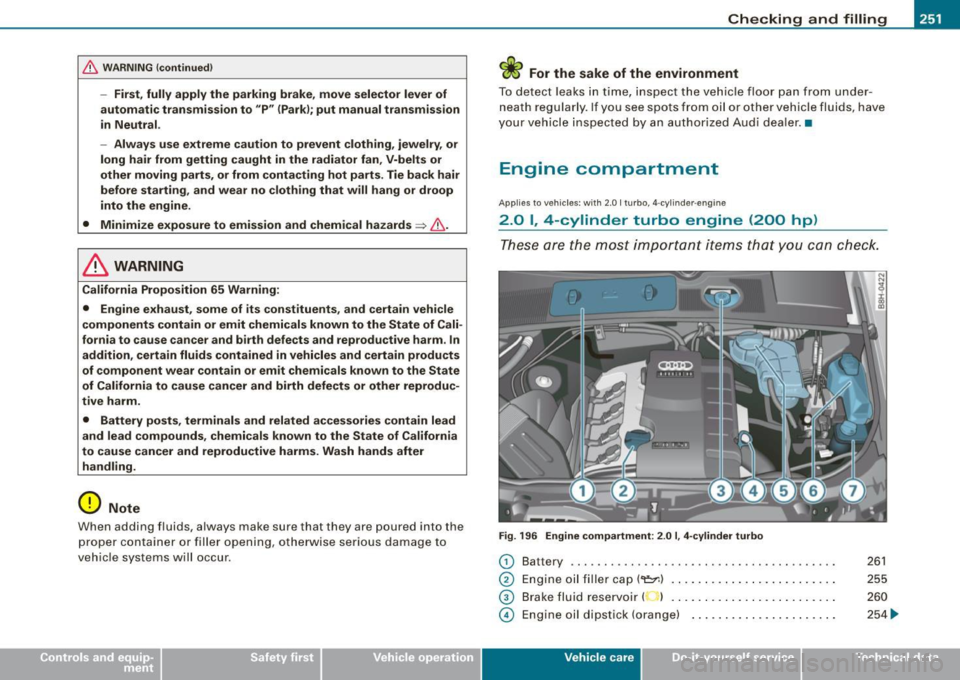
The se are th e m ost important items that you can check .
Fig. 196 Engine comp art m ent : 2 .0 I, 4-cy lind er turbo
G) Battery ..................................... •..
0 Engine oi l fi lle r ca p ('1:::r.l ..... ... ... ....... .... .. .
© Bra ke fluid reservoir ( ) ..... ... .... ... ... ... .. . .
© Engine oil dipstick (orange) ........ .......... ... .
Vehic le care
N
N
I
261
255
2 60
25 4 ...
irechnical data
Page 257 of 340
Checking and filling -_____________ _______::;____;;:;;____...j
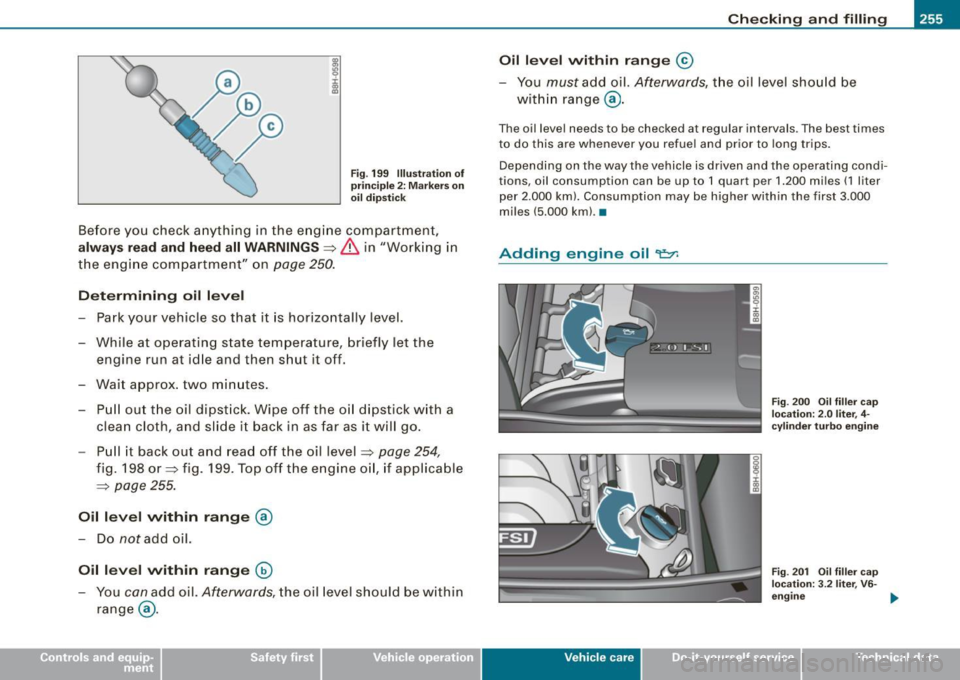
Fig. 199 Illustration of
principle 2: Markers on
oil dipstick
Before you check anything in the engine compartment,
always read and heed all WARNINGS=> & in "Working in
the engine compartment" on
page 250.
Determining oil level
Park your vehicle so that it is horizontally level.
- While at operating state temperature, briefly let the
engine run at idle and then shut it off.
- Wait approx. two minutes.
- Pull out the oil dipstick. Wipe off the oil dipstick with a
clean cloth, and slide it back in as far as it will go.
- Pull it back out and read off the oil level
=> page 254,
fig. 198 or:::> fig. 199. Top off the engine oil, if applicable
=> page 255.
Oil level within range @
- Do not add oil.
Oil level within range G)
- You con add oil. Afterwords, the oil leve l should be within
range @.
Oil level within range ©
-You must add oil. Afterwords, the oil level should be
within range @.
The oil level needs to be checked at regular intervals . The best times
to do this are whenever you refuel and prior to long trips.
Depending on the way the vehicle is driven and the operating condi
tions, oil consumption can be up to 1 quart p er 1.200 miles (1 liter
per 2.000 km). Consumption may be higher within the first 3.000
miles (5.000 km). •
Adding engine oi l 'e::1':
Vehicle care
Fig . 200 Oil filler cap
loc ation: 2.0 liter, 4-
cylinder turbo engine
Fig . 201 Oil filler cap
location: 3.2 liter , VG-
engine _,,
irechnical data
Page 262 of 340
•---=C:.:h..:. e=-= c..:.k :..:.in =-=-= g~ a..:.n :.:d::....:. f.:.:il .:.:li ..:.n :..::g:!..- ___________________________________________ _
0 Note
• Coolant pollutes the environment and could cause an engine
fire. Excess coolant will be forced out through the pressure relief
valve in the cap when the engine becomes hot.
• If, in an emergency, only water can be added, the correct ratio
between water and antifreeze~
page 257must be restored as soon
as possible.
<£> For the sake of the environment
Drained coolant should not be reused. Always dispose of used
coolant while observing all environmental regulations. •
Radiator fan
The radiator fan switches on automatically by itself.
The radiator fan is driven by the engine via the V-belt. The viscous
clutch regulates the speed of the fan according to the temperature
of the coolant.
An auxiliary electric radiator fan* switches on and off depending on coolant temperature and other vehicle operating conditions.
After you switch the engine off, the auxiliary fan can continue running for up to 10 minutes - even with the ignition off. It can even
switch on again later by itself~&, if
• the temperature of the engine coolant rises due to the heat
build -up from the engine in the engine compartment, or
• the engine compartment heats up because the vehicle is parked
in intense sunlight.
& WARNING
• To reduce the risk of personal injury never touch the radiator
fan .
_& WARNING (continued)
• The auxiliary electric fan is temperature controlled and can
switch on suddenly even when the engine is not running .
• The auxiliary radiator fan switches on automatically when the
engine coolant reaches a certain temperature and will continue to
run until the coolant temperature drops. •
Brake fluid
Checking brake fluid level
The brake fluid level can be checked with a quick glance.
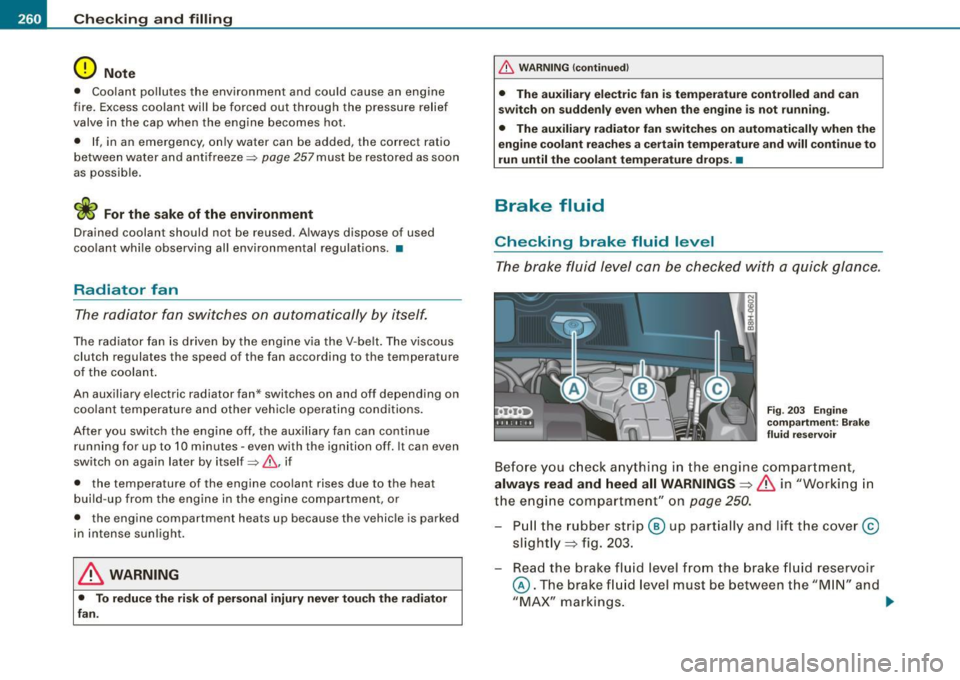
Fig. 203 Engine
compartment: Brake
fluid reservoir
Before you check anything in the engine compartment,
always read and heed all WARNINGS:::::, & in "Working in
the engine compartment" on
page 250.
Pull the rubber strip@ up partially and lift the cover @
slightly :::::, fig. 203.
- Read the brake fluid level from the brake fluid reservoir
©. The brake fluid level must be between the "MIN" and
"MA X" markings. _..