Park AUDI A4 CABRIOLET 2009 Service Manual
[x] Cancel search | Manufacturer: AUDI, Model Year: 2009, Model line: A4 CABRIOLET, Model: AUDI A4 CABRIOLET 2009Pages: 340, PDF Size: 77.32 MB
Page 265 of 340
_____________________________________________ C_h_ e_ c _ k_in -= g_a _ n_d _ f_il _li _n """g ;;..._____..
Working on the battery
Be especially careful when working on or near the battery.
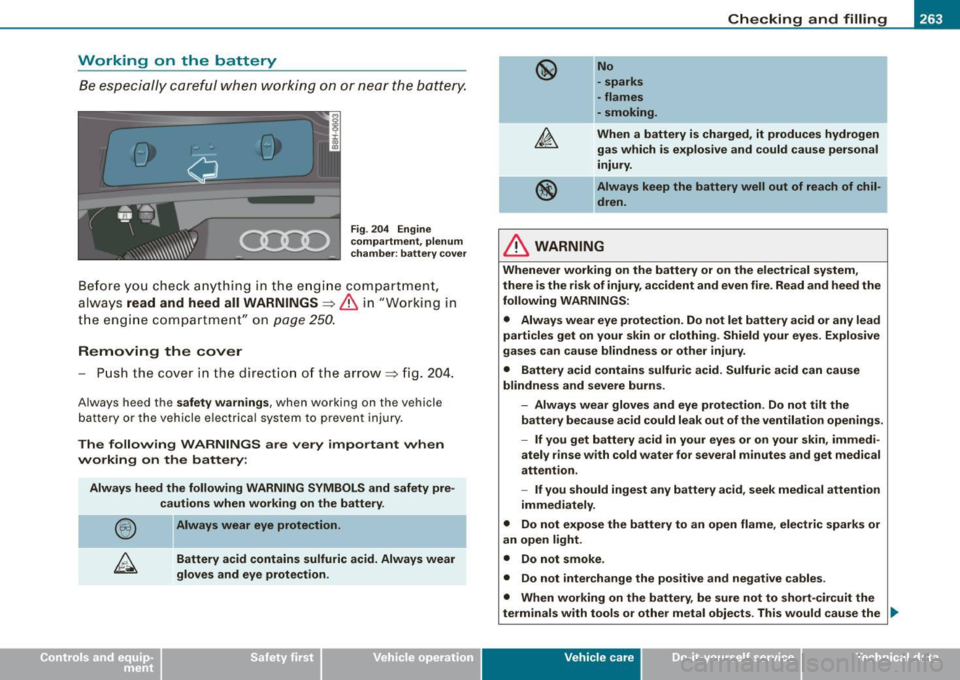
•·•·•·•
Fig. 204 Engine
compartment, plenum
chamber : battery cover
Before you check anything in the engine compartment,
always read and heed all WARNINGS=>
& in "Working in
the engine compartment" on
page 250.
Removing the cover
-Push the cover in the direction of the arrow => fig. 204.
Always heed the safety warnings, when working on the vehicle
battery or the vehicle electrical system to prevent injury.
The following WARNINGS are very important when
working on the battery:
Always heed the following WARNING SYMBOLS and safety pre
cautions when working on the battery .
®
Always wear eye protection.
Battery acid contains sulfuric acid. Always wear
gloves and eye protection.
No
- sparks
- flames
- smoking.
When a battery is charged, it produces hydrogen
gas which is explosive and could cause personal
injury.
Always keep the battery well out of reach of chil
dren.
& WARNING
Whenever working on the battery or on the electrical system,
there is the risk of injury, accident and even fire. Read and heed the
following WARNINGS:
• Always wear eye protection. Do not let battery acid or any lead
particles get on your skin or clothing. Shield your eyes. Explosive
gases can cause blindness or other injury.
• Battery acid contains sulfuric acid. Sulfuric acid can cause
blindness and severe burns .
- Always wear gloves and eye protection. Do not tilt the battery because acid could leak out of the ventilation openings .
- If you get battery acid in your eyes or on your skin, immedi
ately rinse with cold water for several minutes and get medical
attention.
- If you should ingest any battery acid, seek medical attention
immediately.
• Do not expose the battery to an open flame , electric sparks or
an open light.
• Do not smoke.
• Do not interchange the positive and negative cables .
• When working on the battery, be sure not to short-circuit the
terminals with tools or other metal objects. This would cause the .,,.
Vehic le care irechnical data
Page 267 of 340

_____________________________________________ C_h_ e_ c_k _in ---= g'--- a_n _d_ f_il _li _n ....:g=-------"'
•
If t he electrolyte level is be low the "min" level, have an authorized
w or ksho p fil l the ba tte ry ce ll wit h
distilled water.
0 Note
Do not over fill th e batt ery, ot he rwi se ba ttery acid will overflow
through the vent opening. This can damage the paint and cause
cor rosion .•
Battery charging
Starting the e ngin e requi res a well charge d ba ttery.
- Always read and heed all WARNINGS~ & in "Working
o n th e b attery" on
page 263 and ~ ,& .
- S witch off the ignitio n an d all elec trical co nsu mers .
- Make sur e th e are a is well ventilat ed whe n y ou c harge
t h e ba ttery .
- Co nn ect cha rger cables. Charger cables must always be
connected POSITIVE
G) to POSITIVE G) and NEGATIVE Q
to NEGATIVE Q .
- Sw itch o n the cha rge r.
- Make s ure the c har ging rate is not ove r 6 amps.
- Tur n o ff the cha rger ~ ,& .
- Disco nnect t he charg er ca bles .
- Conne ct both batter y ca bles to the b attery if n ecessa ry-
first plu s, th en minus .
It is not necessary to re move t he bat tery from th e eng in e compart
ment, and it is also not necessa ry to disconnect the cab les. Norma
lly, a battery should be charged at no more than 10 percent
o f its rate d capaci ty.
For example, a char ging current of 4 .5 amps wou ld be used on a
battery rated at 45 Ah . Rated capacity of the battery in you r vehicle
i s list ed o n the batt ery housi ng.
T he battery caps should
not be opened when charging a battery.
& WARNING
Charging a battery can be dangerous .
• Always follow the operating instructions provided by the
battery charger manufacturer when charging your battery .
• Never charge a frozen battery . It may e xplode because of gas
trapped in the ice . Allow a frozen battery to thaw out first .
• Do not reuse batter ies which were frozen . The battery housing
may have cracked and weakened when the battery froze .
• Charge the battery in a well ventilated area . Keep away from
open flame or electrical spark. Do not smoke. Hydrogen gas gener
ated by the battery is explosive .
• To reduce the danger of explo sion, never connect or di sconnect
c harger cables while the charger is operating.
• Fast charging a battery is dangerous and should only be
attempted by a competent techni cian with the proper equipment .
• Battery acid that may spill during charging should be washed
off with a solution of warm water and baking soda to neutralize
the acid .
0 Note
Never use a fas t char ger as a booster to start the eng ine. Th is wi ll
seriously damage sensitive electronic components, such as control
units, relays, rad io, etc., as w ell as th e battery c harg er. •
Ve hic le care
Page 276 of 340
lffll,.___T_ ir_e_ s _ a_ n_d_ w_ h_ e_e _ l_s _________________________________________________ _
& WARNING
• Incorrect tire pressures and/or underinflation can lead to a
serious or fatal accident.
• Incorrect tire pressures and/or underinflation cause increased
tire wear and can affect the handling of the vehicle.
• Incorrect tire pressures and/or underinflation can also lead to
sudden tire failure, including a blowout and sudden deflation,
causing loss of vehicle control. •
Checking tire pressure
The correct tire pressure for the tires originally installed
on your vehicle is listed on the tire pressure label located
either on driver's side 8-pillar or inside the fuel filler flap.
The recommended tire pressures are on the tire pressure label and
in the table=>
page 271, "Cold tire inflation pressure ". This means
that the pressure must be checked and adjusted when the tire has
not been driven for more than a couple of miles (kilometers) at low
speeds during the previous three hours. Air in the tires expands
when the tire heats up as a result of internal friction as it flexes in
use. The tire pressure is higher when the tire has warmed up than
when it is "cold."
It is the inflation pressure in a "cold " tire that counts . Therefore, you
should never let air out of a warm tire to match "Cold tire inflation
pressure" recommendations=>
page 271. The tires would then be
underinflated and could fail suddenly.
The tire pressure label on your Audi lists the recommended cold tire
inflation pressures for the new, original equipm ent tires that were
on your vehicle at the time it was manufactured. For the location of
the label =>
page 271, fig. 207.
Most tires lose air naturally over time. They can also lose some air if
you drive over a pothole or hit a curb while parking. It is usually not possible to see whether the radial tires used today are underinflated
just by looking at them.
Therefore, be sure to check tire pressures at least once a month and always before going on a long trip. Make sure to take the number of
people and the amount of luggage into account when adjusting tire
pressure for a trip -even one that you would not consider to be
"long." See=>
page 275, "Tires and vehicle load limits" for more
impor tant information .
Always use an accurate tire pressure gauge when checking and
adjusting inflation pressures . Check all of the tires and be sure not
to forget the spare tire. If the pressure in any tire is too high when
the tire is "cold," let air out of the tire slowly with the edge of the tire
gauge and keep checking the pressure until you reach the pressure
that is correct for the load (passengers and luggage) and kind of
driving you plan to do.
If the pressure in any tire is too low, note the difference between the
pressure in the cold tire and the pressure you need and add the air
that you need to reach the correct pressure for the vehicle load
(passengers and luggage) for the tires on your vehicle as listed on
the on your vehicle and in this manual and the kind of driving you
plan to do.
Never exceed the maximum inflation pressure listed on the tire
sidewall for any reason.
Remember that the vehicle manufacturer, not the tire manufacturer,
determines the correct tire pressure for the tires on your vehicle.
It is important to check the tire pressure when the tires are cold.
• Read the required tire pressure from the tire pressure label. On
USA vehicles, the tire pressure label is located on the driver's side
B-pillar . On Canada vehicles, the tire pressure label is located either
on the driver's side 8 -pillar or inside the fuel filler flap.
• Turn the valve stem cap counter-clockwise to remove it from the
tire valve.
• Place the air pressure gauge on the valve. .,_
Page 295 of 340

_____________________________________________ W_ h _a_t _ d_ o_ l _d _o _ n_o_ w_ ?_ . _ ..... 19111
•
& WARNING (continued)
pressure table - risk of accident! Use the highest tire pressure in
the table.
• Do not drive faster than 50 mph (80 km/h) - risk of accident!
• Avoid full-throttle acceleration, sharp braking, and fast
cornering - risk of accident!
• Never drive using more than one space-saving spare wheel -
risk of accident!
• Normal summer or winter tires must not be fitted on the space
saving spare wheel rim. •
Wheel change
Before changing a wheel
Follow these points for your own and your passenger's
safety when replacing a wheel.
-After you experience a tire failure, pull the car well away
from moving traffic and try to reach level ground before
you stop => & .
- All passengers should leave the car and move to a safe
location (for instance, behind the guardrail)=>& .
- Apply the parking brake firmly=>&.
- Move selector lever to position Pon an automatic trans-
mission; put manual transmission in first gear =>& .
- If you are towing a trailer: unhitch the trailer from your
vehicle.
- Take the tool case and the spare tire=>
page 290 out of
the luggage compartment.
& WARNING
You or your passengers could be injured while changing a wheel if
you do not follow these safety precautions:
• If you have a flat tire, move a safe distance off the road. Turn off
the engine, turn the emergency flasher on and use other warning devices to alert other motorists .
• Make sure that passengers wait in a safe place away from the
vehicle and well away from the roadway and traffic.
• To help prevent the vehicle from moving suddenly and possibly
slipping off the jack, always fully set the parking brake and block
the wheel diagonally opposite the wheel being changed. When one
front wheel is lifted off the ground, placing the Automatic Trans
mission in "P" (Park), or engaging a gear in a manual transmission
will
not prevent the vehicle from moving .
• Before you change a wheel, be sure the ground is level and firm.
If necessary, use a sturdy board under the jack.
• After installing the spare wheel, make sure that you remount
the flat tire/wheel in its storage area properly and tighten the
knurled retaining screw securely. •
Changing a wheel
When you change a wheel, follow the sequence described
below step-by -step and exactly in that order.
1. Remove the decorative wheel cover*. For more details
see also =>
page 294, "Decorative wheel covers" or
=>
page 295, "Wheels with cap-covered wheel bolts".
2. Loosen the wheel bolts=>
page 295.
3. Locate the proper mounting point for the jack and align
the jack below that point=>
page 296.
4. Lift the car with the jack=> page 296. _,..
Do-it-yourself service
Page 303 of 340
![AUDI A4 CABRIOLET 2009 Service Manual _________________________________________________ F_ u_ s_ e_s _ a_n _ d_ b_ u_lb _ s ____ llll
[ i ] Tip s No . Equipm ent Amps
You are wel l adv ised to keep a supply of spare fuses in you](/img/6/57553/w960_57553-302.png "AUDI A4 CABRIOLET 2009 Service Manual _________________________________________________ F_ u_ s_ e_s _ a_n _ d_ b_ u_lb _ s ____ llll
[ i ] Tip s No . Equipm ent Amps
You are wel l adv ised to keep a supply of spare fuses in you")
_________________________________________________ F_ u_ s_ e_s _ a_n _ d_ b_ u_lb _ s ____ llll
[ i ] Tip s No . Equipm ent Amps
You are wel l adv ised to keep a supply of spare fuses in your vehic le.
15 Instrument c luster, Navigation system 10
Fuses with the proper ampere ratings are available at your Audi 16 Garage door opener 5
dea ler. •
17 Level , tire pressure control , park assist, 10 light/rain sensor
Fuse list Automatic headlig ht range control, left 5
Fuses which con be replaced. 19 Fog lights 15
Vacant
N o. Equipm ent Amps
21 Vacant
1 Air conditioner 10
22 Doors 15
2 Footwell illumination 5 23 Vacant
3 Heated washer jets 5 Central convenience electrical system 20
Radiator fan 5 25 Heater blower 30
5
Telephone, oil level sensor, multifunction 10 Rear window defogger 30 switch, rear heated seat, shift gate
Air conditioner (air quality sensor), air pressure
27 Socket for tra iler towing (controller) 30
6 5
sensor 28 Fuel pump 20
Electronic Stabil izat ion Program (ESP), bra ke 29 Vacant
7 light switch, clutch peda l switch, steering angle 10
sensor
30 Power top control un it 30
8 Telephone 5 31
Automatic transmission, mirror dimming, diag-15 nosis socket
9 Brake booster (vacuum pump) 15 Towing assembly 15
10
Automatic headl ight beam adjustment, auto -5 33 Cigarette
lighter 20 matic headlight range control, right
34 Electrical socket 20
11
Airbag control unit, front passenge r seat recog -10 nition USA (bladder mat) 35 Luggage compartment socket 20
Diagnosis socket 10 Windshield wiper system 30
13
Steering c olumn module 10
37 Pump for windshie ld an d head light washer* 30
14
Brake lights 10
system
• Do-it-yourself service
Page 306 of 340
111!1.___E_ m __ e_r -=g :...e_ n_ c-=y _ s_ i_t _u _a _t_ i_o _n_ s _______________________________________________ _
Emergency situations
General
This chapter is intended for trained emergency crew s and working
personnel who have the necessary tools and equipment to perform
these operations. •
Starting by pushing or towing
0 Note
Vehicles with an automatic tran smission cannot be started by
push ing o r towing . •
Starting with jumper cables
If n ece ssa ry, th e engin e ca n be sta rte d by conne cti ng it to
the battery of another veh ic le .
If the engin e should fai l to start because of a discharge d or weak
b at te ry, the batt ery can be con nected t o the batt er y of
another
ve hic le, using a pair of jumper cables to start the engine.
Jumper cables
Use
only jumper cables of suffici ently large cross section to safely
c arry the st ar ter curre nt. Refer to th e m anuf actu rer's sp ec ificati ons.
Use on ly j umper ca bles with
isolated termi na l clam ps and properly
marked fo r distinct ion :
plus (+l cable in mo st c ases c olor ed red
minus (-l cable in most cases colored black.
& WARNING
Batteries contain electricity , acid, and gas. Any of these can cause
very serious or fatal injury. Follow the instructions below for safe
handling of your vehicle 's battery .
• Always shield your eyes and avoid leaning over the battery
whenever possible .
• A discharged battery can already freeze at temperatures just
below 32 °F (0 °C). Before connecting a jumper cable, the frozen
battery must be thawed completely, otherwise it could explode.
• Do not allow battery acid to contact eyes or skin . Flush any
contacted area with water immediately.
• Improper use of a booster battery to start a vehicle may cause
an explosion.
• Vehicle batteries generate e xplosive gases . Keep sparks , flame
and lighted cigarettes away from batteries.
• Do not try to jump start any vehicle with a low acid level in the
battery.
• The voltage of the booster battery must also have a 12-Volt
rating . The capacity (Ahl of the booster battery should not be
lower than that of the discharged battery . Use of batteries of
diffe rent voltage or substantially different "Ah " rating may cause
an explosion and personal injury .
• Never charge a frozen battery. Gas trapped in the ice may cau se
an explosion .
• Never charge or use a battery that has been frozen . The battery
case may have be weakened.
• Use of batteries of different voltage or substantially different
capacity (Ah ) rating may cause an explosion and injury . The
capacity (Ahl of the booster battery should not be lower than that of the discharged battery . ...
Page 307 of 340

______________________________________________ E_ m_ e_r -=g :...e _ n_ c __a. y_ s_it _u_ a_ ti_o _ n_ s _ __,11111
& WARNING (continued)
• Before you check anything in the engine compartment, always
read and heed all WARNINGS~ page 242, "Engine compartment".
0 Note
• Applying a higher voltage booster battery will cause expensive
damage to sensitive electronic components, such as control units,
relays, radio, etc .
• There must be no electrical contact between the vehicles as
otherwise current could already start to flow as soon as the positive
(+) terminals are connected.
[ i] Tips
The discharged battery must be properly connected to the vehicle's
electrical system. •
Use of jumper cables
Make sure to connect the jumper cable clamps in exactly
the order described below!
Fig. 225 Jump·
starting with the
battery of another
vehicle : A -discharged
vehicle battery, B -
booster battery
Vehicle with discharged battery:
- Turn off lights and accessories, move lever of automatic
transmission to
N (Neutral) or P (Park) and set parking
brake.
Connect POSITIVE (+) to POSITIVE (+) (red)
1. Connect clamp of plus cable to positive(+) terminal G)
~ fig. 225 of discharged vehicle battery@.
2. Connect clamp on opposite end of cable to positive(+)
terminal
® of booster battery@.
Connect NEGATIVE (-) to NEGATIVE (-) (black)
3. Connect clamp of minus cable (black) to negative( -)
terminal
0 of booster battery@.
4. Connect clamp on opposite end of negative cable to the
negative( -) terminal © of the discharged vehicle battery
@.
- Check that all screw plugs on the battery cells are
screwed in firmly. If not, tighten plugs prior to
connecting clamp on negative battery terminal.
Starting the engine
- Start the engine of the vehicle with the booster battery.
Run the engine at a moderate speed.
- Start engine with discharged vehicle battery in the usual
manner.
- If the engine fails to start: do not keep the starter
cranking for longer than 10 seconds. Wait for about 30
seconds and then try again. .,,.
~ehicle care Do-it-yourse lf service Technical data
Page 320 of 340
___ C_ o_n_ s_ u_m _ e_ r_ ln_ f_o _r_m _ a_ t_ i_o _n ______________________________________________ _
& WARN ING (continued )
• The engine compartment of any motor vehicle is a potentially
hazardous area . Never reach into the area around or touch the
radiator fan . It is temperature controlled and can sw itch on
suddenly -even when the engine is off and the ignition key has
been removed . The radiator fan switches on automatically when
the coolant reaches a certain temperature and will continue to run until the coolant temperature drops .
• Always remove the ignition key before anyone gets under the
vehi cle .
• Always support your vehicle with safety stands if it is neces
sary to work underneath the vehicle . The jack suppl ied with the
vehicle is not adequate for this purpose and could collapse causing serious personal injury .
• If you must work underneath the vehicle with the wheels on
the ground, always make sure the veh icle is on level ground , that
the wheels are always securely blocked and that the engine
cannot be sta rted .
• Always make sure the transmission selector lever (automatic
transmission) is in "P " (Park position ) or Neutral (manual transm is
sion) and the park brake is firmly applied.
W For the sake of the environment
• Cha ng ing t he e ngine sett ings will adverse ly aff ect em iss ion
l eve ls. This is detrimenta l to the environment and increases fuel
co nsu mp tio n .
• Always observe environmental regu lations when disposing of
ol d eng ine oil, u sed br ake fluid , d irty e ngin e coo la nt , spe nt batter ies
or worn out tires.
• Undeployed airba g modu les and prete nsioners might be classi
fied as Perchlorate Material -specia l handling may apply, see
www .dtsc.ca .gov/ hazar douswaste/perc hlorat e. When the vehic le o r
parts of the restraint system including airbag modules safety be lts
w it h pr eten sion ers ar e sc ra p pe d, a ll ap pli cab le la w s and reg ula- tions must be observed. Your authorized Audi dealer is familiar with
t
hese requi re m ents and we re co m mend th at you h ave your dealer
perform this service for you .•
Additional accessories,
modifications and parts replacement
Additional accessories and parts
replacement
Always consult an author ized Audi dealer before
pu rchasin g acc ess ori es.
Your vehicle incorporates the latest safety design features ensuring
a high standa rd o f act ive and passiv e safety .
T his saf ety coul d be compromised by non -approved changes to the
vehic le . F or t his reason, if parts have to be replace d, p lease obse rve
t h e f ollow ing po ints when i nsta lling addi tio na l acc essor ies:
App roved Aud i accessories and genuine Audi pa rts a re avai lab le
fr om autho rize d Aud i dea lers.
T hese dealers also have the necessary fac ilities, tools and trained
spec ia lists t o ins tal l the part s and accessor ie s pr oper ly .
& WARNING
Using the wrong spare parts or using non -approved accessories
can cause serious personal injury.
• Use only accessorie s expressly approved by Audi and genuine
Audi spare parts.
• These parts and accessories have been specially designed to
be used on your vehicle .
• Never install accessories such as telephone cradles or
beverage holders on airbag covers or within the airbag deploy-
Page 326 of 340

llffl __ A_l-=- p _h_ a_ b_e _t_ic _ a_l _in _ d_e _x ____________________________________________ _
A
Accessories . . . . . . . . . . . . . . . . . . . . . . . . 318
Acoustic park assist . . . . . . . . . . . . . . . . . 122
Adaptive Light Air outlets
Climate controls .. .... ...... ..... 115
How should I adjus t the air outlets to de
frost my windows as quickly as
possible? . . . . . . . . . . . . . . . . . . . . . . 115 Warning/indicator lights
... ... .... .. 20
When must the system be inspected? . ..
179
All Wheel Drive ... .... .... ...... .... 218
Alloy wheels . . . . . . . . . . . . . . . . . . . . . . . 237
defective ............. ........ .. . 34 Air quality sensor .
.... .... .... .... .. 114 All-whee l drive
adaptive light .. ... .... .... ... ...... . 79 Air recirculation
............... ..... 113
Winter tires .. ......... .... .... .. 284
Adding Engine coolant ... .... .... ...... .
259
Engine oi l ..... .... ... .... .... .. .
255
Windshield washer fluid .... .... . .
266
Additiona l accessories .. ...... ...... . 318
Additives Engine oil . ..... .. ..... ... ...... . 255
Adjusting Instrument cluster illumination .. .... 15
Steering wheel co lumn .... ... .... 118
Adjusting the seats
Manual seats ...... .... ........... 94
Advanced Airbag System . . . . . . . . . . . . 172
Children ... ........... .... ... ... 191
Components ...... .... .......... 175
Front airbags . . . . . . . . . . . . . . . . . . . . 173
How the components work together 176
Monitoring . . . . . . . . . . . . . . . . . . . . . . 179
Weight -sensing mat . .... ... .. .... 191
Air conditioning
See Climate controls . . . . . . . . . . . . . . 110
Air distribution Clima te con trols ... .... ... .... ... 114 Climate controls
...... ...... ... .. 114 Alternator
When should I use the air recircu lation?
114
Air ventilation in the glove compartment ...
108
Airbag system ..... ... .... ..... . 168, 188
Care ... ... .... .... .... .... .... .. 182
Child restraints .............. .... 192
Components (front airbags) .. ... ... 175
Danger of fitting a child safety seat on the
front passenger seat . . . . . . . . . . . . 170
Disposal . . . . . . . . . . . . . . . . . . . . . . . . 182
Front airbags . ....... ..... .... ... 172
How do the front airbags work? . . . . 177
How many airbags does my vehicle have? 175
Important safety instructions on the knee
airbag system .... .... .... .... .. 186
Important things to know ... .... .. 168
Indicator light ... .......... ... ... 179
Knee airbags .... . .. .. ........... 184
Monitoring .... .... .... .... .... .. 179
PASSENGER AIR BAG OFF light ..... 180
Repairs . . . . . . . . . . . . . . . . . . . . . . . . . 182
Side airbags . . . . . . . . . . . . . . . . . . . . . 187
See Generator . . . . . . . . . . . . . . . . . . . . 22
Anti -freeze
S ee Engine coolant system .. ...... 257
Anti-glare inside day-night mirror ...... 88
Anti-lock brake system How the ABS system works . .... ... 216
Warning/indicator lights ........... . 20
An ti- Slip Regulation System (ASR)
How the sys tem works .. ... .... ... 214
Anti-Theft Alarm System Tilt sensors ..... ....... ..... ...... 58
Anti-theft alarm system .. .. .. .... .... . 57
Anti -theft systems
Electronic immobilizer ......... .... 49
Armrest Adjusting ...... .... ..... .. ..... . 100
Storage bin
Ashtray 100
Front ....... .................... 104
Rear .......... .... .... ........ .. 105
Asterisk What does it mean when something is marked with an asterisk? . ..... ... .. 6
Audi Service Repair Manuals and Literature 316
Page 329 of 340

Alph ab eti ca l ind ex --------------=-----
Convertible locking retractor
Activating ...... ... .. .... ...... .. 202
Deactivating .. ... ..... ..... .. ... . 203
Using to secure a child safety seat 200 ,
202
Convertible top ........ .... .... .... .. 61
Coolant system
Cooling System 257
Expansion tank ... .... ...... .... .. 258
cornering light . .......... .. .... .... .. 79
Cruise control .. ... ... ...... ...... .. 123
Changing a stored sp eed . .... .... . 124
Setting and storing a vehicle speed . 124
Switching off .................... 125
Switching off temporari ly .. ........ 124
Switching on .... .... .... ...... .. 124
Warning/indicator lights ... ... .... .. 20
Cruising range .. .... .... .... ...... ... 37
Cupholder . ... .. ...... ..... .. .. .... 104
D
Data . .... ... . ... .. ... ... .... ..... . 314
Data recorder ... .... ...... ..... .... . 212
Date dis play . . . . . . . . . . . . . . . . . . . . . . . . . 14
Daytime running lights ... .. ... .. ... ... 78
Declaration of compliance Cell phone package .. .. .... .... ... 320
Elect ronic immobilizer . ..... .. .... 320
Homelink® universal remote con trol 320
Remote control key .. .... .... .... . 320
Tire pressure monitoring system ... 320
Controls and equip
ment Safety first
def
Dublicate key ... ...... ... .. . ... .... .. 47
What does this mean when it appears in
Dynamic shift program ....... ... ... . . 136
the trip odometer display? .. ...... . 15
Defogging the windows . ....... ..... . 116
E
Defrosting the windows .. ... ..... ... . 116
Determining correct load lim it ... .... . 276 ECON
Digi tal clock ............. .. ... ... .... 14 When should I use ECON?
... .... .. . 113
Setting the time ......... .... .... .. 14 EDL
Digital compass . ... ... . ... ... .. .... .. 90 See Electronic differential lock (EDU . 213
Dimensions ..... .... .... .... .... ... 313 Electric roof .
..... ... ..... .. .... .... . 61
Dipstick Electrically heated front seats .
.. .... .. 116
Reading the dipstick properly ...... 254 Electronic differential lock
Distance ... .... ... ... .. ... .... .... .. 38 Warning/indicator
lights ..... ... .... 20
Doors, power locks ........ ....... .... 53
Driver Electronic differ
ential lock (EDU
How the system works ...... .. .... 213
See S eating position .. ... ... ... ... 148 Electronic immobilizer ..
.. .. . .. .. .. 15, 49
Driver information dis play
Miles (kilometers) to empty .. .. ... .. 26 Electronic power control
EPC warning/indicator light ......... 22
Parking brake warning ... ... ..... .. 30 Electronic sp
eed limiter ..... .. .... .... 28
D river information sys.tern . .... ...... .. 24 Electronic stabilization program (ESP)
Driver information messages .. .... .. 29 How the system works ...
..... .. .. 212
Fuel filler cap . .. . ........ ....... .. 27 Elec
tronic stabiliza tion program (ESP)
Menu button .... . .. .. .... .... .... . 40 Warning/indicator lights
.... ...... .. 22
Menu display .... ... .... .... . ... .. 39 Emerg
ency flasher ... .... ... .. ....... 82
Open door or rear lid warning ...... . 26 Warning/indicator
lights .... ...... .. 21
Outside temperatu re disp lay ... ..... 25
Emergency locking . .... .... ... .. .. . .. 55
Sound system display .... .... .... .. 25
Emergency starting ..... ....... .. .... 304
Driver's seat memory ... .... .... ..... 101
Emergency towing . .. ... .. .. .... .... 306
Recalling a seat position .... .... ... 102
Engine
Storing a seat position ... ... .... .. 102
4-cylinder (200 hp) . ... .. .. .... .. .. 251
Driving messages ...... ........ ..... . 29
6-cylinder (255 hp) . ... .. .. .... .. .. 252
Driving safely . ... .. . ... .. .... .... ... 146
Compartment .... ... .. ...... .... . 251
Driving time . .... ...... .... ... .. .... . 37 Coolant ...
.. ... .... .... .... ..... 257
Vehicle operation Vehicle care Do-it-yourself service Technical data