warning light AUDI A4 CABRIOLET 2009 Workshop Manual
[x] Cancel search | Manufacturer: AUDI, Model Year: 2009, Model line: A4 CABRIOLET, Model: AUDI A4 CABRIOLET 2009Pages: 340, PDF Size: 77.32 MB
Page 137 of 340
Transmission -
----------------
Applies to vehi cles : wit h m ultit r o ni c® Con tin uous ly Variab le Tra nsmi ssion (CVTl
Automatic Shift Lock (ASL)
The Automatic Shift Lock safeguards you against acciden
tally shifting into a forward or the reverse gear and
causing the vehicle to move unintentionally.
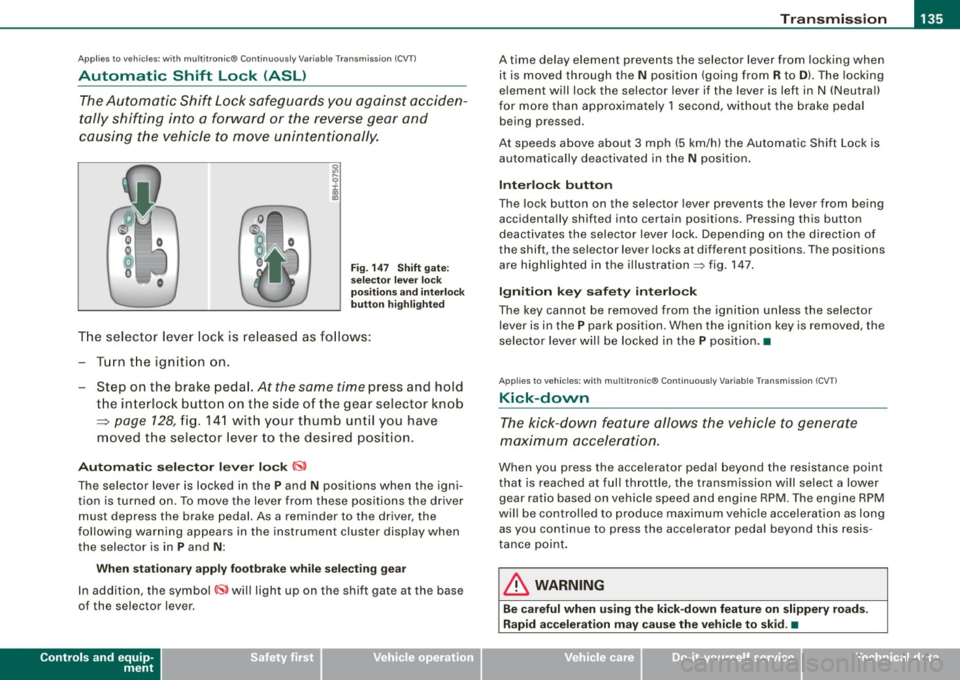
Fig. 147 Shift gate:
selector lever lock
positions and interlock
button highlighted
The selector lever lock is released as follows:
-Turn the ignition on.
- Step on the brake pedal.
At the same time press and hold
the interlock button on the side of the gear selector knob
=> page 128, fig. 141 with your thumb until you have
moved the selector lever to the desired position.
Automatic selector lever lock CS,
The selector lever is lock ed in the P and N positions when the igni
tion is turned on. To move the lever from these positions the driver
must depress the brake pedal. As a reminder to the driver, the
following warning appears in the instrument cluster display when
the selec tor is in
P and N :
When stationary apply footbrake while selecting gear
In addition, the symbol~ will light up on the shift gate at the base
of the selector l ever.
Controls and equip
ment
A time delay element prevents the selector lever from locking when
it is moved through the
N position (going from R to D). The locking
element will lock the selector lever if the lever is left in N (Neutral)
for more than approximately 1 second, without the brake pedal
being p ressed .
At speeds above about 3 mph (5 km/h) the Automatic Shift Lock is
automatically deactivated in the
N position.
Interlock button
The lock button on the selecto r lever prevents the lever from being
acc identally sh ifted into certain positions. Pressing this button
deactivates the selector lever lock. Depending on the direction of
the shift, the sel ector lever locks at different positions . Th e positions
are highlighted in the illustration=> fig. 147.
Ignition key safety interlock
The key cannot be removed from the ignition unless the selector
lever is in the
P park posit ion . Wh en the ignition key is removed , th e
selector lever will be locked in the P position. •
Applies to vehicl es : wit h mu lt itro nic® Co nti nuous ly V ariab le Tra nsmi ssion ( CVTl
Kick-down
The kick-down feature allows the vehicle to generate
maximum acceleration.
Wh en you press the accel erator pedal beyond the res istance point
that is reached at full throttle , the transmission will select a lower
gear ra tio based on veh icle speed and engin e RPM . The eng ine RPM
will be controlled to produce maximum vehicle acceleration as long as you cont inu e to press the accelerator pedal beyond this resis
tance point.
& WARNING
Be careful when using the kick-down feature on slippery roads.
Rapid acceleration may cause the vehicle to skid . •
Page 149 of 340
________________________________________________ D_r_iv _ i _n...: g=--- S_ a_ fe--= ly'---------"'
- Make sure that all lights and signals are operating
correctly.
- Make sure that the tire pressure is correct.
- Make sure that all windows are clean and afford good
visibility to the outside.
- Secure all luggage and other items carefully~
page 107.
-Make sure that nothing can interfere with the pedals.
- Adjust front seat, head restraint and mirrors correctly for
your height.
- Instruct passengers to adjust the head restraints
according to their height.
- Make sure to use the right child restraint correctly to
protect children~
page 190, "Child Safety".
- Sit properly in your seat and make sure that your passen
gers do the same
~ page 92, "General recommenda
t ions" .
- Fasten your safety belt and wear it properly. Also instruct
your passengers to fasten their safety belts properly
~ page 159. •
What impairs driving safety?
Safe driving is directly related to the condition of the
vehicle, the driver as well as the driver's ability to concen
trate on the road without being distracted.
The driver is responsible for the safety of the vehicle and all
of its occupants. If your ability to drive is impaired, safety
risks for everybody in the vehicle increase and you also
Controls and equip
ment Safety first Vehicle operation
become a
hazard to everyone else on the road ~& .There
fore:
- Do not let yourself be distracted by passengers or by
using a cellular telephone.
- NEVER drive when your driving ability is impaired (by
medications, alcohol, drugs, etc.I.
- Observe all traffic laws, rules of the road and speed limits
and plain common sense.
- ALWAYS adjust your speed to road, traffic and weather
conditions.
- Take frequent breaks on long trips. Do not drive for more
than two hours at a stretch.
- Do NOT drive when you are tired, under pressure or when
you are stressed.
& WARNING
Impaired driving safety increases the risk of serious personal
injury and death whenever a vehicle is being used. •
Vehicle care Do-it-yourself service Technical data
Page 150 of 340
___ D_ r_ i_v _in -= g'- S _ a_f _e _ly.:,._ ______________________________________________ _
Proper occupant seating positi·ons
Proper seating position for the driver
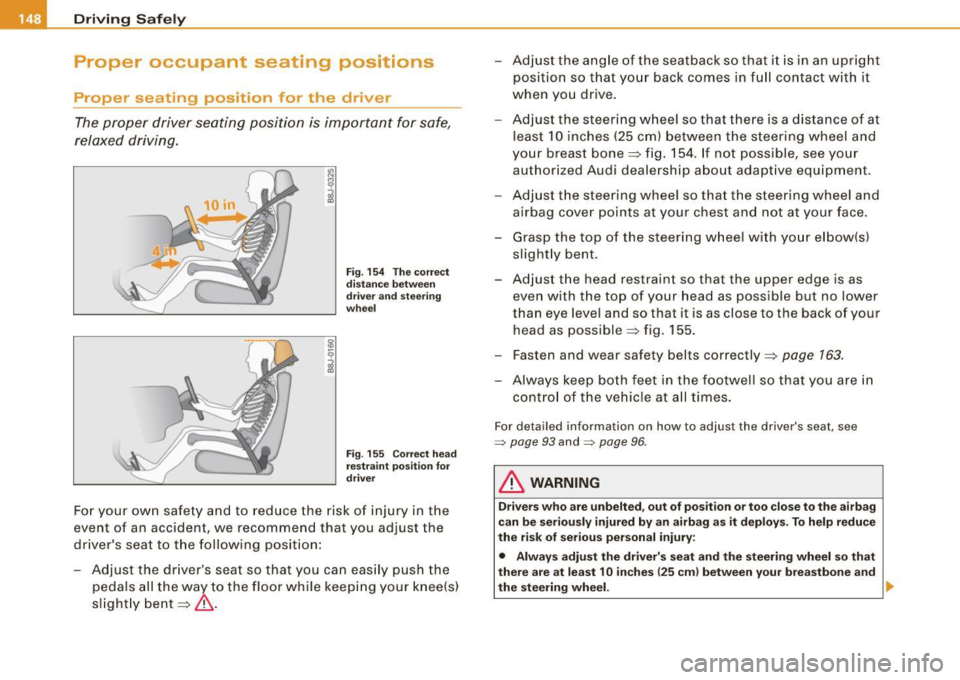
The proper driver seating position is important for safe,
relaxed driving.
Fig. 154 The correct
distance between
driver and steering
wheel
Fig . 155 Correct head
restraint position for
driver
For your own safety and to reduce the risk of injury in the
event of an accident, we recommend that you adjust the
driver's seat to the following position:
- Adjust the driver's seat so that you can easily push the
pedals all the way to the floor while keeping your knee(s)
slightly bent=:>& . - Adjust the angle of the seatback so that
it is in an upright
position so that your back comes in full contact with it
when you drive.
- Adjust the steering wheel so that there is a distance of at
least 10 inches (25 cm) between the steering wheel and
your breast bone=:> fig. 154. If not possible, see your
authorized Audi dealership about adaptive equipment.
- Adjust the steering wheel so that the steering wheel and
airbag cover points at your chest and not at your face.
- Grasp the top of the steering wheel with your elbow(s)
slightly bent.
- Adjust the head restraint so that the upper edge is as
even with the top of your head as possible but no lower
than eye level and so that it is as close to the back of your
head as possible =:> fig. 155.
- Fasten and wear safety belts correctly=:>
page 163.
- Always keep both feet in the footwell so that you are in
control of the vehicle at all times.
For detailed information on how to adjust the driver's seat, see
=> page 93 and :::::, page 96 .
& WARNING
Drivers who are unbelted, out of position or too close to the airbag
can be seriously injured by an airbag as it deploys. To help reduce
the risk of serious personal injury:
• Always adjust the driver's seat and the steering wheel so that
there are at least 10 inches
125 cm) between your breastbone and
the steering wheel. ...
Page 161 of 340
_______________________________________________ S_a _f _e _t -=-y _ b_ e_lt _s ______ lffllll
Safety belts
General notes
Always wear safety belts!
Wearing safety belts correctly saves lives!
This chapter explains why safety belts are necessary, how
they work and how to adjust and wear them correctly.
- Read all the information that follows and heed all of the
instructions and WARNINGS.
& WARNING
Not wearing safety belts or wearing them improperly increases
the risk of serious personal injury and death.
• Safety belts are the single most effective means available to
reduce the risk of serious injury and death in automobile acci
dents. For your protection and that of your passengers, always
correctly wear safety belts when the vehicle is moving.
• Pregnant women, injured, or physically impaired persons must
also use safety belts . Like all vehicle occupants, they are more
likely to be seriously injured if they do not wear safety belts. The
best way to protect a fetus is to protect the mother -throughout
the entire pregnancy. •
Number of seats
Your vehicle has a total of four seating positions : two in the front
and two in the rear. Each seating posi tion has a safety belt .
Controls and equip ment Safety first
Vehicle operation
& WARNING
Not wearing safety belts or wearing them improperly increases
the risk of serious personal injury and death.
• Never strap more than one person, including small children,
into any belt. It is especially dangerous to place a safety belt over
a child sitting on your lap.
• Never let more people ride in the vehicle than there are safety
belts available.
• Be sure everyone riding in the vehicle is properly restrained
with a separate safety belt or child restraint. •
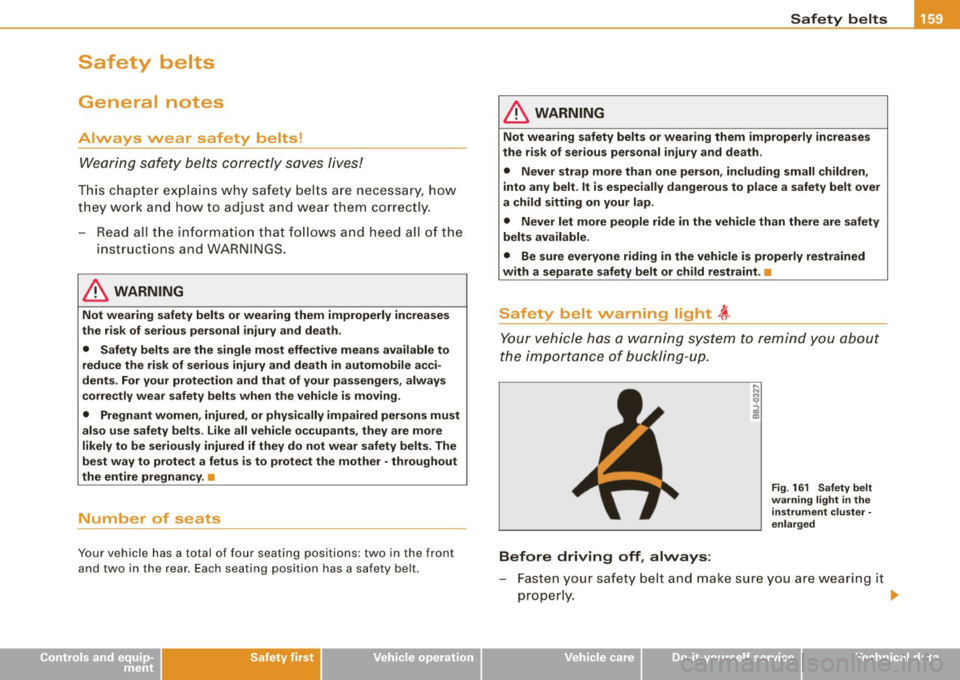
Safety belt warning light ~
Your vehicle has a warning system to remind you about
the importance of buckling-up.
Before driving off, always:
Fig. 161 Safety belt
warning light in the
instrument cluster ·
enlarged
- Fasten your safety belt and make sure you are wearing it
properly. .,
Vehicle care Do-it-yourself service Technical data
Page 162 of 340
___ S_a_ f_ e_ t-= y_ b_e_ l_ t _s _______________________________________________ _
- Make sure that your passengers also buckle up and prop
er ly wea r th eir sa fe ty be lts.
Protect your children with a child restraint system appro
pria te for t he size and age o f the children.
The warning light~ in the instrument cluster lights up when the
ignition is switched on as a reminder to fasten the safety belts. In
addition, you will hear a warning sound.
After the ignition is switched on, the warning tone will come on for about 6 seconds a long w ith a-~ warning light in the instru ment
cluster if the driver has not fastened his safety belt . As soon as the
driver has fastened his safety belt, the warning tone will stop and
the warning light will go out .
I f the driver has not buckled -up within about 24 seconds after the
warn ing tone has stopped, the warn ing tone will sound again for
about 6 seconds. The warning tone will sound repeated ly for about
6 seconds at 24 second intervals unti l the driver has buckled-up . The
safety belt warning system is active for about 5 minutes and during
this time the wa rning light in the instrument c luster will stay on.
Fa sten you r safety belt no w and make sure that your pa ssengers
also properl y put on the ir saf ety belts. •
Why safety belts?
Frontal collisions and the law of physics
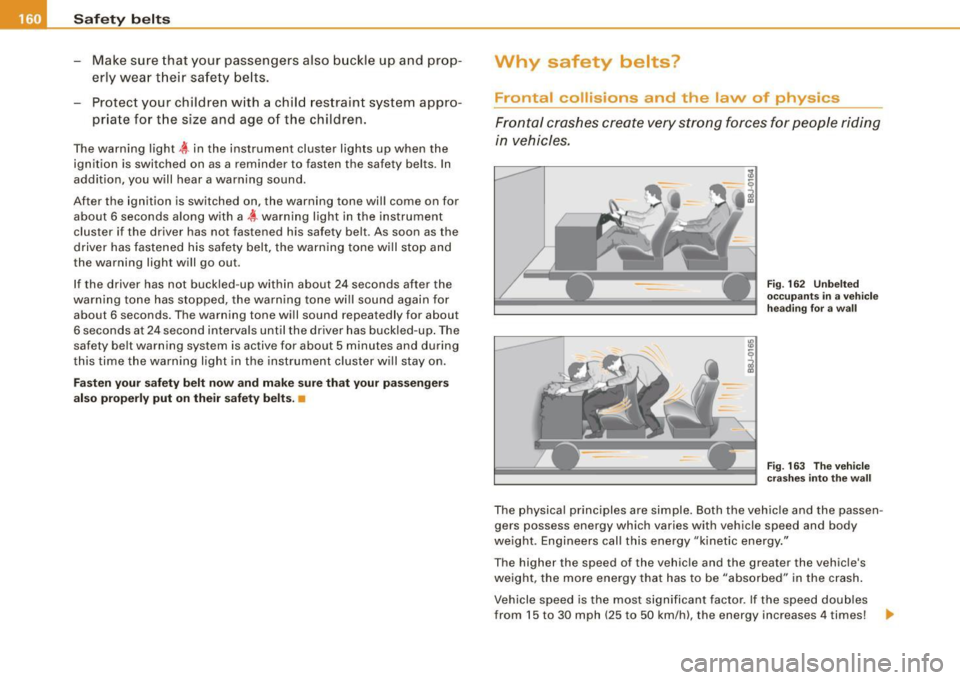
Frontal crashes create ve ry strong forces for pe ople ri ding
in vehicles.
Fig . 16 2 Unbel ted
occ upants in a ve hicle
h ead in g fo r a wall
F ig . 16 3 T he vehi cle
c ras he s in to t he wa ll
The physica l principles are simple. Both the vehicle and the passen
gers possess energy which varies with vehicle speed and body
we ight . Engineers call this energy "kinetic energy ."
The higher the speed of the vehicle and the greater the vehicle's
we ight, the mo re energy that has to be "absorbed" in the crash .
Vehicle speed is the most significant factor. If the speed doub les
from 15 to 30 mph (25 to 50 km/h), the energy increases 4 times!
~
Page 166 of 340
-Safety belts ___ .:,__ _____________________________________ _
Automatic safety belt retractors
Every safety belt is equipped with an automatic belt retractor on the
shoulder bel t. This featu re locks the bel t when the belt is pulled out
fast, during hard braking and in an accident. The belt may also lock
when you drive up or down a steep hill or through a sharp curve. During normal driving the bel t lets you move freely.
Safety belt pretensioners
The safety belts are equipped with a belt pretension er that helps to
tighten the safety belt and remove slack when the pretensioner is
activated. The function of the pretensioner is monitored by a
warning light:::::, page
20, "Airbag system @;".
Switchable locking feature
Every safe ty belt except the one on the driver seat is equipped with
a switchable locking feature that must be used when the safety belt
is used to attach a child seat . Be sure to read the important informa
tion about this feature:::::, page
200.
& WARNING
Improperly positioned safety belts can cause serious injury in an
accident :::::,
page 164, "Safety belt position" .
• Safety belts offer optimum protection only when the seat back
is upright and belts are properly positioned on the body.
• Never attach the safety belt to the buckle for another seat.
Attaching the belt to the wrong buckle will reduce safety belt
effectiveness and can cause serious personal injury.
• A passenger who is not properly restrained can be seriously
injured by the safety belt itself when it moves from the stronger
parts of the body into critical areas like the abdomen.
• Always lock the convertible locking retractor when you are
securing a child seat in the vehicle :::::,
page 202. •
Safety belt position
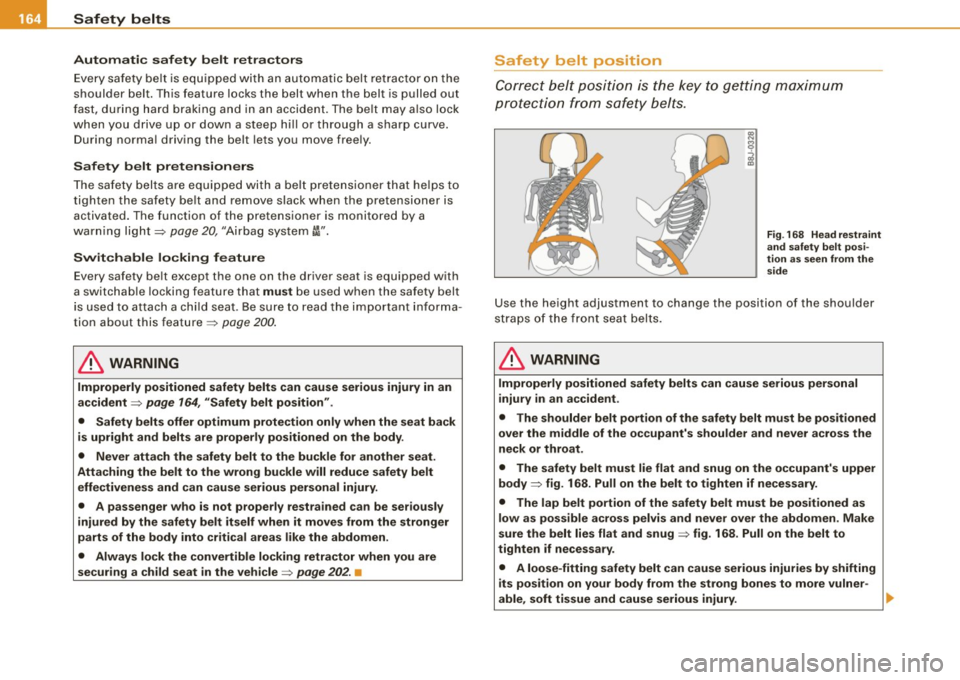
Correct belt position is the key to getting maximum
protection from safety belts.
Fig . 168 Head restraint
and safety belt posi
tion as seen from the
side
Use the height adjustmen t to change the position of the shoulder
straps of the front seat belts.
in. WARNING
Improperly positioned safety belts can cause serious personal
injury in an accident .
• The shoulder belt portion of the safety belt must be positioned
over the middle of the occupant's shoulder and never across the
neck or throat.
• The safety belt must lie flat and snug on the occupant's upper
body
:::::> fig. 168. Pull on the belt to tighten if necessary.
• The lap belt portion of the safety belt must be positioned as
low as possible across pelvis and never over the abdomen. Make
sure the belt lies flat and snug :::::, fig. 168. Pull on the belt to
tighten if necessary.
• A loose-fitting safety belt can cause serious injuries by shifting
its position on your body from the strong bones to more vulner-
able, soft tissue and cause serious injury. ..,.
Page 172 of 340
___ A_ ir_b _ a_ g~ s_ y_s _t _e _m _________________________________________________ _
Child restraints on the front seat - some
important things to know
- Be sure to read the important information and head the
WARNINGS for important details about children and
Advanced Airbags~
page 190.
Even though your vehic le is equipped with an Advanced Airbag
System, make certain that a ll children, especia lly those 12 years and
younger, a lways ride in the back seat properly restrained for their
age and size . The airbag on the passenger side makes the front seat
a potentia lly dangerous place for a child to ride. The front seat is not
the safest p lace for a chi ld in a forward -facing child safety seat. It
can be a very dangerous place for an infant or a child in a rearward
facing seat.
The Advanced Airbag System in your vehicle has been certified to
comply with the Requirements of United States Federal Motor
Vehicle Safety Standard 208 as applicab le at the time your vehicle
was manufactured.
Th e Standard requires the front airbag on the passenger side to be
turned off ("suppressed") if a chi ld up to about one year of age
restrained in one of the rear-facing or forward-facing infant
restraints listed in Federa l Motor Vehicle Safety Standard 208 with
which the Advanced Airbag System in your vehicle was certified has been instal led on the front passenger seat. For a listing of the child
restraints that were used to certify compliance with the US Safety
Standard =>
page 192.
The PASSENGER AIR BAG OFF light in the instrument panel tells you
when the front Advanced Airbag on the passenger side has been
t urned off by the electronic control unit.
Each time you turn on the ignition, the
PASSENGER AIR BAG OFF
light will come on for a few seconds and:
• will stay on if the front passenger seat is not occupied, •
will stay on if there is a small child or child restraint on the front
passenger seat,
• will go off if the front passenger seat is occupied by an adult as
registered by the weight-sensing mat=>
page 179, "Monitoring the
Advanced Airbag System" .
The
PASSENGER AIR BAG OFF light comes on when the control unit
detects a tota l weight on the front passenger seat that requires the
front airbag to be turned off.
If the total weight on the front passenger seat is more than that of
a typical 1 year -old child but less than the weight of a small adult,
the fron t airbag on the passenger side can deploy (the
PASSENGER
AIR BAG OFF
light does not come on). If the PASSENGER AIR BAG
OFF
light does not come on, the front airbag on the passenger s ide
has not been turned off by the electronic contro l unit and can
deploy if the control unit senses an impact that meets the condi
tions stored in its memory.
For example, the airbag may deploy if:
• a small ch ild that is heavier than a typical 1 year-o ld child is on
the front passenger seat (regardless of whether the child is in one
of the child safety seats listed =>
page 192), or
• a child who has outgrown chi ld restraints is on the front
passenger seat .
If the front passenger airbag is turned off, the
PASSENGER AIR BAG
OFF
light comes on in the instrument cluster and stays on.
The front airbag on the passenger side may
not deploy (the
PASSENGER AIR BAG OFF light does not illuminate and stay lit) even
if a small adult or teenager, or a passenger who is not sitting upright
with their back against a non -reclined backrest with their feet on the
vehicle floor in front of the seat is on the front passenger seat
=>
page 148, "Proper seating position for the driver".
If the front passenger airbag deploys, the Federal Standard requires
the airbag to meet the "low risk" deployment criteria to reduce the
risk of injury through interaction with the airbag. "Low risk" deploy
ment occurs in those crashes that take p lace at lower decelerations .,.
Page 173 of 340
Airbag system -----------------=~-
as defined in the electronic contro l unit:::::, page 18 0, "P ASSENG ER
A IR BAG OFF lig ht".
A lways remember, a ch ild safety s eat or infant carrier insta lled on
the front seat may be struck a nd knocked out of position by the
rap id ly infl atin g p ass eng er's ai rba g in a front al co llision . The air bag
co uld greatly reduce the effectiveness of the chi ld re st raint and
e v en s erio usl y inju re the chi ld during inflati on.
F or this reason, and because the bac k seat is t he safest plac e for
c hi ldr en -w he n prop erly res train ed acc ordi ng to th eir age a nd size
- w e stro ng ly recomme nd that c hildren a lways s it in t he bac k seat
::::;, page 190, "Chil d Safe ty" .
& WARNING
A child in a rearward -facing child safety seat installed on the front
passenger seat will be seriously injured and can be killed if the
front airbag inflates - even with an Advanced Airbag System.
• The inflating ai rbag will hit the child safety seat or infant
carrier with great force and will smash the child safety seat and
child against the ba ckrest , center arm rest , door or roof.
• Always install rear-facing child safety seats on the rear seat. • If you must install a rearward facing child safety seat on the
front passenger seat because of exceptional circumstances and
the PASSENGER AIR BAG OFF light does not come on and stay on,
immediately install the rear-facing child safety seat in a rear
seating position and have the airbag system inspected by your
Audi dealer .
• Forward-facing child safety seats installed on the front
passenger's seat may interfere with the deployment of the airbag
and cause serious personal injury to the child .
& WARNING
If, in exceptional circumstances , you must install a forward-facing
child restraint on the front passenger's seat:
Controls and equip ment Safety first
Vehicle operation
& WARNING (continued)
• Always make sure the forward-facing seat has been designed
and certified by its manufacturer for use on a front seat with a
passenger front and side airbag .
• Never put the forward -facing child restraint up against or very
near the instrument panel .
• Always move the passenger seat into its rearmost position in
the seat's fore and aft adjustment range, as far away from the
airbag as possible before installing the forward-facing child
restraint. The backrest must be adjusted to an upright position.
• Make sure that the PASSENGER AIR BAG OFF light comes on
and stays on all the time whenever the ignition is switched on.
& WARNING
To reduce the risk of serious injury, make sure that the PASSENGER
AIR BAG OFF light will be displayed whenever a child restraint is installed on the front passenger seat and the ignition is switched
on.
• If the PASSENGER AIR BAG OFF light does not stay on , perform
the checks described :::::,
page 179, "Monitoring the Advanced
Airbag System" .
• Take the child restraint off the front passenger seat and install
it properly at one of the rear seat positions if the PASSENGER AIR
BAG OFF light does not stay on .
• Have the airbag system inspected by your Audi dealer immedi
ately .
• Always carefully follow instructions from child restraint manu
facturers when installing child restraints .
& WARNING
If, in exceptional circumstances, you must install a forward or
rearward-facing child restraint on the front passenger's seat :
Vehicle care Do-it-yourself service Technical data
Page 176 of 340
___ A_ ir_b _ a_ g~ s_ y_s _t _e _m _________________________________________________ _
When a person is detected on the front passenger s eat, wei ghing
mo re tha n th e to ta l w eigh t of a c hild th at is a bout 1 year old
r estra in ed in one of th e rear -faci ng or forward -fac ing infa nt
r e str aints (lis ted i n Fede ra l M otor Veh icle Safe ty Sta ndard
2 08 with
which the Advanced Airba g Syst em in your vehic le was certified),
the fro nt a irbag on the pas senge r side may or may not dep loy.
Th e
PASSENGER AIR BAG OFF lig ht comes on when th e elect ro ni c
control unit detects a total weight on the front passenger seat that
r e qui re s th e front airbag to b e tu rn ed off. If the
PASSENGER AIR BAG
OFF
light does not come on, the front airbag on the passenger side
h as not been tu rned off by the co ntro l unit and can dep loy i f the
control unit senses an impact that meets the conditions stored in its
m emo ry .
I f the t otal we ight on the fro nt passe nger seat is more than t hat o f
a typical
1 year -old, but less than the we ight of a sma ll adult, the
fr ont airba g on the passen ger side may dep loy (the
PASSENGER AIR
BAG OFF
li ght does not come onl.
For example , the airbag may deploy if:
• a sma ll child that is heav ie r th a n a t ypica l 1 year-old ch ild is on
the front passenger seat (regardless of whether the chi ld is in one
o f th e c hild sa fety seats listed~
page 192),
• a ch ild who has ou tg rown chi ld restrain ts is o n the front
p asse nger seat.
I f the front passenge r airbag is turned off, the
PASSENGER AIR BAG
OFF
l ig ht in the ce nter of t he i nstrum ent panel wi ll co me on and stay
on.
T he fr ont airb ag o n the pa ssenger side ma y
not deploy ( the
PASSENGER AIR BAG OFF li g ht does not illu mina te and stay l it) i f:
• a small adult o r teenager is on the front passenger seat
• a passe nge r w ho is no t sitt ing uprig ht wi th their bac k aga inst a
non -reclined bac krest with their fee t on the veh icle floor in front of
the seat is on th e fr on t pass enger s eat.
I f the front passenger ai rbag deploys, the Federa l Standard requires
th e a irbag to m eet th e "low r isk" dep loy ment criter ia to he lp redu ce the risk of injury throu
gh interact ion with the airbag. "Low risk"
d ep loy ment o ccurs in th ose cra shes that ta ke pla ce a t low er dec el
erations as defined in the electronic contro l unit~
page 17 9.
Always remember: Even though your vehic le is equipped with
A dva nced Ai rbags , the sa fest place fo r chi ld re n i s p roperly
restra ined on the back seat. Please be s ure to read the important
i nfo rmatio n in th e sect io ns t hat follow and b e su re to hee d all o f the
WAR NINGS.
& WARNING
To reduce the risk of injury when an airbag inflates , always wear
safety belts properly.
• If you are unrestrained, leaning forward , sitting sideways or out
of posit ion in any way, your risk of injury is much higher.
• You will also receive serious injuries and could even be killed if
you are up against the airbag or too close to it when it inflates -
even with an Advanced Airbag=> page 168 .
& WARNING
A child in a rearward -facing child safety seat installed on the front
passenger seat will be seriously injured and can be killed if the
front airbag inflates -even with an Advanced Airbag System.
• Although the Advanced Airbag System in your vehicle is
designed to turn off the front airbag when a rearward -facing child
restraint has been installed on the front passenger seat , nobody
can absolutely guarantee that deployment is impossible in all
conceivable situations that may happen during the useful life of
your vehicle.
• The inflating airbag will hit the child safety seat or infant
carrier with great force and will smash the child safety seat and
child against the backrest , center arm rest , door, or roof .
• Alway s install rearward -facing child restraints in the back seat . •
Page 177 of 340

Airbag system -----------------=~-
& WARNING (continued)
• If you must install a rearward facing child safety seat on the
front passenger seat because of exceptional circumstances and
the PASSENGER AIR BAG OFF light does not come on and stay on,
immediately install the rear -facing child safety seat in a rear
seating position and have the airbag system inspected by your
Audi dealer.
_& WARNING
If, in exceptional circumstances, you must install a forward-facing
child restraint on the front passenger's seat:
• Always make sure the forward-facing seat has been designed
and certified by its manufacturer for use on a front seat with a
passenger front and side airbag .
• Never put the forward-facing child restraint up against or very
near the instrument panel.
• Always move the passenger seat into its rearmost position in
the seat's fore and aft adjustment range, as far away from the
airbag as possible, before installing the forward-facing child
restraint. The backrest must be adjusted to an upright position.
• Make sure that the PASSENGER AIR BAG OFF light comes on
and stays on all the time whenever the ignition is switched on. •
Advanced Airbag System components
The front passenger seat in your vehicle has a lot of very important
parts of the Advanced Airbag System in it. These parts include the
weight-sensing mat, sensors, wiring, brackets, and more. The func
tion of the system in the front passenger seat is checked by the elec
tronic control unit when the ignition is on. The control unit monitors
the Advanced Airbag System and turns the airbag indicator light on
when a malfunction in the system components is detected. The
function of the airbag indicator light is described in greater detail
Controls and equip ment Safety first Vehicle operation
below.
Because the front passenger seat contains important parts
of the Advanced Airbag System, you must take care to prevent it
from being damaged. Damage to the seat may prevent the
Advanced Airbag for the front passenger seat from doing its job in
a crash.
The front Advanced Airbag System consists of the
following:
• Crash sensors in the front of the vehicle that measure vehicle
acceleration/deceleration to provide information to the Advanced
Airbag System about the severity of the crash.
• An electronic control unit, with integrated crash sensors for front
and side impacts. The control unit "decides" whether to fire the
front airbags based on the information received from the crash sensors. The control unit also "decides" whether the safety belt
pretensioners should be activated.
• An Advanced Airbag with gas generator for the driver inside the
steering wheel hub.
• An Advanced Airbag with gas generator inside the instrument
panel for the front passenger .
• A weight-sensing mat under the upholstery padding of the front
passenger seat cushion that measures the total weight on the seat.
The information registered is sent continuously to the electronic
control unit to regulate deployment of the front Advanced Airbag on
the passenger side.
• An airbag monitoring system and indicator light in the instru
ment cluster ~
page 179.
• The PASSENGER AIR BAG OFF light comes on and stays on in the
center of the instrument panel~
page 180, fig. 174 and tells you
when the front Advanced Airbag on the passenger side has been
turned off .
• A sensor below the safety belt latch for the front seat passenger
to measure the tension on the safety belt. The tension on the safety
belt and the weight registered by the weight -sensing mat help the
control unit "decide" whether the front airbag for the front _,.
Vehicle care Do-it-yourself service Technical data