wheel AUDI A4 CABRIOLET 2009 Workshop Manual
[x] Cancel search | Manufacturer: AUDI, Model Year: 2009, Model line: A4 CABRIOLET, Model: AUDI A4 CABRIOLET 2009Pages: 340, PDF Size: 77.32 MB
Page 270 of 340
-~_T_ ir_e_ s_ a_ n_d _ w_ h_ e_e _l_s _________________________________________________ _
Contact a dealership if you would like to replace damaged whee l
cove rs.
& WARNING
Never loo sen the screws on rim s with threaded rim rings* -danger
of accident!
& WARNING
New tires or tires that are old , worn or damaged cannot provide
maximum control and braking abil ity .
• New tires tend to be slippery and must be broken in. To reduce
the risk of losing control , a collision and serious per sonal injurie s,
drive with special care for the first 350 miles (560 km ).
Glossary of tire and loading terminology
Accessory weight
means the co mbined we ig ht (in excess o f those standar d ite ms
which may be rep laced) of automatic transmission, power stee ring,
power b rakes, power win dows, power seats, ra dio, a nd heater, to
the extent that these items are avai lab le as factory- installed equip
m ent (w hether i nstalled or not).
Aspect ratio
means the ratio o f the he ight to t he wid th of the t ire in perce nt.
N umbers of 5 5 or lower indicate a low sidewall for improved
steer ing respo nse and bette r overall handl ing on dry pave ment.
Bead
means the part of the tire that is made of stee l wires, wrapped or
reinforced by p ly cords and that is shaped to fit the rim.
& W ARNING (continued )
• Driving with worn or damaged tires can lead to loss of control,
sudden tire failure, including a blowout and sudden deflat ion ,
crashes and serious personal injuries . Have worn or damaged tires
replaced immediately.
• Tires age even if they are not being used and can fail suddenly,
e specially at high speeds. Tires that are more than 6 years old can
only be used in an emergen cy and then with special care and at
low speed.
• Never mount used tires on your vehicle if you are not sure of
their "p revious history. " Old used tire s may have been damaged
even though the damage cannot be seen that c an lead to sudden
tire failure and lo ss of vehicle control.
• If you notice unusual vibration or if the vehicle pulls to one side
when driv ing , always stop as soon as it is safe to do so and check
the wheels and tires for damage . •
Bead separation
m eans a brea kdow n of the bond be tween compo ne nt s in the bead.
Cord
means the strands forming the plies in the tire .
Cold tire inflation pressure
means the tire pressure recommended by the vehic le manufacturer
fo r a tire of a des ig nated size tha t h as not bee n dr iven for more than
a coup le of mi les (ki lometers) at low speeds in the three hour period
b ef or e the ti re pressu re is mea sured o r adj usted. _,,
Page 272 of 340
-~_T_ ir_e_ s_ a_ n_d _ w_ h_ e_e _l_s _________________________________________________ _
Rei nf orced tire
means a tire designed to operate at higher loads and at higher inf la
tion pressures then the corresponding standard tire. Reinforced
tires my be identified as "XL",
"xi", "EXTRA LOAD", or "RF" on the
sidewall.
Rim
means a metal support for a tire or a tire and tube assembly upon
which the t ire beads are seated.
R im di am eter
means nomina l diameter o f the bead seat. If you change your wheel
size, you wi ll have to purchase new tires to match the new rim diam
eter.
R im size des ig nati on
means rim diameter and width.
Rim width
means nominal distance between rim flanges .
Sidewall
means that portion of a tire between the tread and bead.
Speed rating (le tter code )
means the speed at which a tire is designed to be driven for
extended periods of time . The ratings range from 93 mph ( 150 km/h)
to 186 mph (298 km/h)~
page 281. You may not find this informa
tion on a ll tires because it is not required by law .
The speed rating letter code, where appl icable, is molded on the tire
sidewal l and indicates the maximum permissible road speeds~
&
in "Winter tires" on page 284 .
Tire pres su re m onitoring s yste m*
means a system that detects when one or more of a vehicle's tires
are underinflated and i lluminates a low tire pressure warning te ll
tale .
Trea d
means that portion of a tire that comes into contact with the road .
Trea d se parati on
means pulling away of the tread from the tire carcass .
Treadw ear indi cato rs (TWI)
means the projections within the princ ipal grooves designed to give
a visual indication of the degrees of wear of the tread. See
~ page 278, "Tread Wear Indicator (TWI)" for more informatio n on
measuring tire wear.
Uniform Tire Q uality Gra ding
is a tire information system developed by the United States National
Highway Traffic Safety Administration (N HTSA) that is designed to
help buyers make relative comparisons among tires. The U TQG is
not a safety rating and not a guarantee that a tire wil l last for a
prescribed number of miles or perform in a certain way. It simply
gives tire buyers additiona l information to combine wit h other
considerations, such as price, brand loyalty and dea ler recommen
dations. Under UTQG, tires are graded by the tire manufacturers in
three areas: treadwear, traction and temperature resistance . The
UTQG information on the tires, molded into the sidewalls.
U.S . D OT T ir e Ident ifi ca tion Num ber (T IN )
This is the tire's "serial number" It begins with the le tters "DOT" and
indicates that the tire meets all federa l standards . The next two
numbers or letters indicate the plant where it was manufactured,
and the last four numbers represent the week and year of manufac
ture. For example,
D OT ... 2 209 ...
means that the tire was produced in the 22th week of 2009 . The
other numbers are marketing codes that may o r may not be used by
the tire manufacturer . This information is used to contact
consumers if a tire defect requires a reca ll. -.,
Page 274 of 340
-Tires and wheels
P'U:1-------------------
warmed up than when it is "cold." It is the inflation pressure in a
"cold" tire that counts. Therefore, you should never let air out of a
warm tire to match "cold tire inflation pressure" recommendations .
The tires would then be underinflated and could fail suddenly.
Maintaining proper tire pressure is one of the most important
things you can do to help avoid sudden tire failure. Underinflated
tires are a major cause of sudden tire failure. Keeping tires at the
right pressure is also important for safe and responsive vehicle
handling, traction, braking and load carrying.
Tire pressures are
particularly important when the vehicle is being driven at higher
speeds, and then especially when heavily loaded even within the
permissible load-carrying capacities approved for your vehicle .
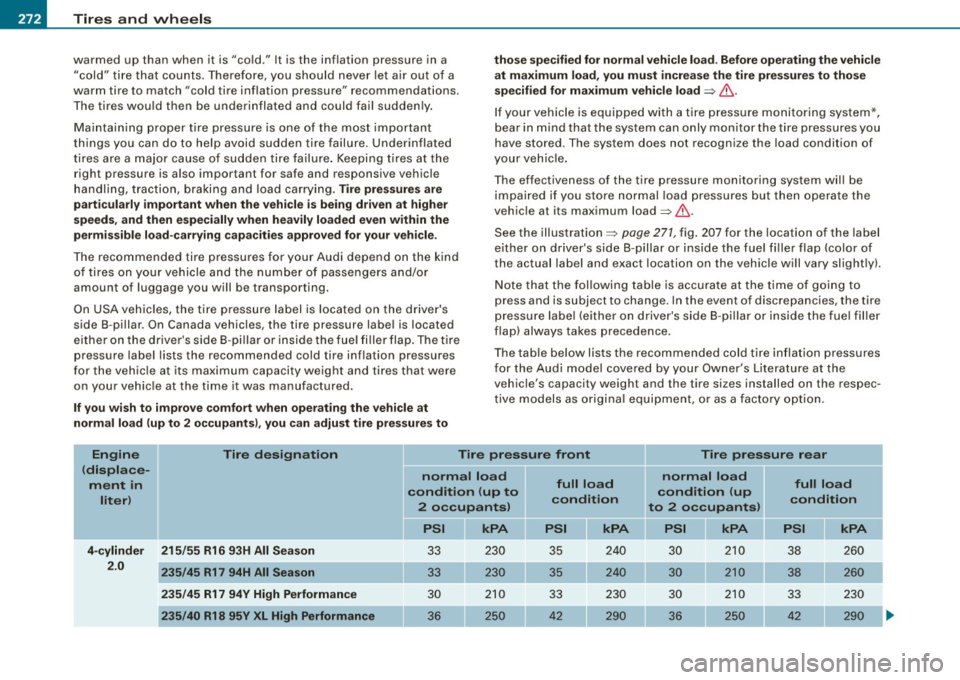
The recommended tire pressures for your Audi depend on the kind
of tires on your vehicle and the number of passengers and/or
amount of luggage you will be transporting.
On USA vehicles, the tire pressure label is located on the driver's
side B-pillar . On Canada vehicles, the tire pressure label is located
either on the driver's side B-pillar or inside the fuel filler flap. The tire
pressure label lists the recommended cold tire inflation pressures
for the vehicle at its maximum capacity weight and tires that were
on your vehicle at the time it was manufactured.
If you wish to improve comfort when operating the vehicle at
normal load (up to 2 occupants), you can adjust tire pressures to
-
those specified for normal vehicle load. Before operating the vehicle
at maximum load, you must increase the tire pressures to those
specified for maximum vehicle load
=> & .
If your vehicle is equipped with a tire pressure monitoring system *,
bear in mind that the system can only monitor the tire pressures you
have stored. The system does not recognize the load condition of
your vehicle.
The effectiveness of the tire pressure monitoring system will be
impaired if you store normal load pressures but then operate the
vehicle at its maximum load=>&.
See the illustration =>
page 271, fig. 207 for the location of the label
either on driver's side B-pillar or inside the fuel filler flap (color of
the actual label and exact location on the vehicle will vary slightly).
Note that the following table is accurate at the time of going to
press and is subject to change. In the event of discrepancies, the tire
pressure label (either on driver's side B-pillar or inside the fuel filler
flap) always takes precedence .
The table below lists the recommended cold tire inflation pressures
for the Audi model covered by your Owner's Literature at the
vehicle's capacity weight and the tire sizes installed on the respec
tive models as original equipment, or as a factory option.
Engine
(displace
ment in liter) Tire designation
Tire pressure front Tire pressure rear
4-cylinder
2.0 215/55 R16 93H All Season
235/45 R17 94H All Season
235/45 R17 94Y High Performance
235/40 R18 95Y XL High Performance
normal load
condition (up to
2 occupants)
PSI
33
33
30
36
kPA
230
230
210
250
full load
condition
PSI
35
35 33
42
II kPA
240
240
230
290
normal load
condition (up
to 2 occupants)
PSI
30
30
30
36
JI kPA
210
210
210
250
11 full load
condition
PSI
38
38
33
42
JI kPA
260
260
230
290
I
Page 275 of 340
Tires and wheels -
----------------
•
Engine Tire designation Tire pressure front Tire pressure rear
(displace- normal load normal load
ment in full load
full load
liter ) c
ondit ion (up to
condition c
ondition (up
condition
2 occupants ) to 2 occupants)
PSI kPA PSI kPA PSI kPA PSI kPA
6 -cylinder 215 /55 R16 93H All Season 35 240
38 260
30 2
10
38 260
3.2
235/45 R17 94H All Season 35 2
4 0
38 260 30 2
10
38 260
235/45 R17 94V High Performance 30 2 10 3 3 230 30 2 10 33 230
235 /40 R18 95V XL High Performance 41 280 46 320 41 280 4 6 320
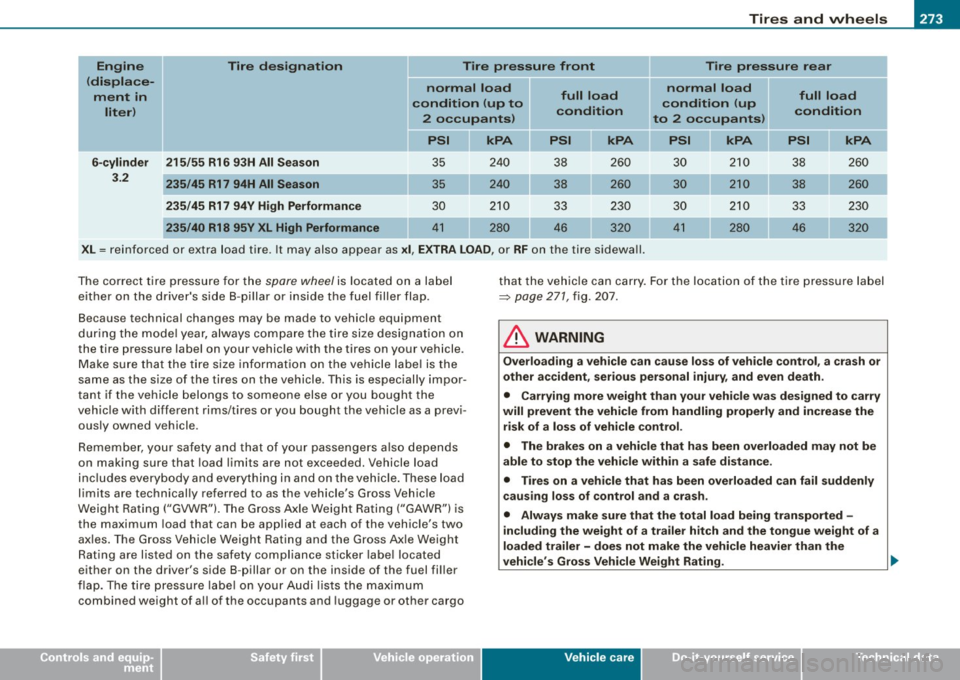
XL= reinforced or extra load tire. It may also appear as x i, EXTRA LOAD , or RF on the tire sidewa ll.
The correct tire pressure for the
spare wheel is located on a label
either on the dr iver's side B-pilla r or i nside the fuel filler flap.
Because technical changes may be made to vehicle equipment
dur ing the mode l year, a lways co mpare the tire size designatio n on
the tire pressure label on your vehicle with the tires on your vehicle .
Make sure t hat the tire s ize informa tion o n the vehi cle labe l is the
same as the size of the tires on the vehicle . This is especially impor
t a nt if th e ve hicle belo ngs to someone else or you bough t the
vehic le with different rims/tires or you bought the vehicle as a previ
ously owned vehicle.
Re member, your safety and that of your passeng ers a ls o depends
on making sure that load limits are not exceeded. Vehicle load
inc lude s every body and everyt hin g i n and o n the vehic le . These load
limits are techn ically referred to as the vehicle's Gross Vehic le
Weight Ra tin g ("GVWR") . The Gross Axle Weig ht Ra ting ("GAWR") is
the maximum load that can be applied at each of the veh icle's two
ax les . The Gross Vehic le W eight Rating and the Gross Ax le Weight
Rating are listed on the safety compliance sticker label located
either on the driver's s ide 8 -pillar or on the inside of the fuel fi ller
fl ap. T he ti re pressure labe l on your Aud i lists the max imum
combined weight of a ll of the occupants and luggage or other cargo that the vehicle can car
ry. Fo r the l ocat io n of the tire pressure la bel
=> page 271, fig. 207.
LJ}. WARNING
Overload ing a vehicle can cause loss of vehi cle cont rol , a crash or
other ac cident , serious per sonal injury , and even death .
• Carrying more weight than your vehicle wa s designed to carry
will prevent the vehicle from handling properly and increase the
risk of a loss of vehicle control .
• The brakes on a vehicle that has been overloaded may not be
able to stop the vehi cle within a safe dist ance.
• Tires on a vehicle that has been overloaded can fail suddenly
cau sing lo ss of control and a crash .
• Always make sure that the total load being transported -
including the weight of a trailer h itch and the tongue weight of a
loaded trailer -does not make the vehicle heavier than the
vehi cle 's Gross Vehicle Weight Rating . .,,_
Vehic le care
Page 277 of 340

Tires and wheels -
----------------
•
• The tire pressures should only be checked and adjusted when
t he t ires are co ld . The s lightly raised press ures of warm tires must
not be reduced .
• Adjust t he tire p re ssure to the load you are carrying.
• Reinstall the va lve stem cap on the valve.
When should I check the tire pressure?
The correc t tire p re ssur e is espec ially i mportant at high speeds. The
pressure should there fore be c hecked at least once a month and
a lways before starting a journey. Do not forget to check the tire pres
su re for t he spare whee l::::>
page 291.
When should I adjust the tire pressures?
Adjust the ti re pressur e to the load you are carrying. A fter chang in g
a wheel
or replacing whee ls you have to adj ust t he t ire pressure s on
a ll whee ls. In addition, o n ve hicles w ith t ire pressure monito ring
system * you must then store the new tire pressures in the system
=> page 41.
& WARNING
Incorrect tire pres sures and /or underinflation can lead sudden tire
failure, loss of control , collision, serious personal injury or even
death .
• When the warning symbol ( appears in the instrument
cluster , stop and inspect the tires .
• Incorrect tire pressure and /or underinflation can cause
increased tire wear and can affe ct the handling of the vehicle and
stopping ability .
• Incorre ct tire pressures and /or underinflat ion can also lead to
sudden tire failure, including a blowout and sudden deflation,
causing loss of vehi cle control.
• The driver is responsible for the correct tire pressures for all
tires on the vehicle . The appli cable pre ssure values are located on
a sticker on the driver 's side 8-pillar or on the inside of the fuel
filler flap .
& WARNING (continued )
• Only when all tires on the veh icle are filled to the correct pres
s ure, the tire pressure monitoring system * can work correctly .
• The use of incorrect tire pressure values can lead to accidents
or other damage . Therefore it is essential that the driver observe
the specified tire pressure values for the tires and the correct pres
sures for the function of the tire pressure monitoring system*.
• Alway s inflate tires to the recommended and corre ct tire pres
sure before driving off.
• Driving with underinflated tires bend more , letting them get
too hot resulting in tread separation , sudden tire failure and loss
of control.
• Excessive speed and /overloading can cause he at build -up ,
sudden tire failure and loss of control.
• If the tire pressure is too low or too high , the tires will wear
prematurely and the vehicle will not handle well.
• If the tire is not flat and you do not have to change a wheel
immediately, drive at reduced speed to the nearest service station
to che ck the tire pressure and add air as required .
0 Note
Driving without valve stem caps can cause damage to the tire
valves. To p revent this, a lways make sure tha t factory installe d va lve
stem caps on al l wheels are securely mounted on the va lve .
<£> For the sake of the environment
Underinflated tires wi ll a lso increase the fue l consumption. •
Tires and vehicle load limits
There are limits to the amount of load or weight that any vehic le and
any tire can carry. A vehicle that is overloa ded wil l n o t handle well _,.
Vehic le care
Page 279 of 340
Steps for Determining Correct Load Limit
1. Locate the statement "THE COMBINED
WEIGHT OF OCCUPANTS AND CARGO SHOULD NEVER EXCEED XXX KG OR XXX
LBS"on your vehicle's placard (tire infla
tion pressure label)=>
page 271, fig. 207.
2. Determine the combined weight of the
driver and passengers that will be riding
in your vehicle.
3. Subtract the combined weight of the
driver and passengers from
"XXX" kilo
grams or
"XXX" pounds shown on the
sticker=>
page 271, fig. 207.
4. The resulting figure equals the available
amount of cargo and luggage load
capacity. For example, if the
"XXX"
amount equals 1400 lbs. and there will
be five
150 lbs. passengers in your
vehicle, the amount of available cargo
and luggage load capacity is
650 lbs.
( 1400- 750 (5 x 150) = 650 I bs.)
Tires and wheels 1111111
5. Determine the combined weight of
luggage and cargo being loaded on the
vehicle. That weight may not safely exceed the available cargo and luggage
load capacity calculated in Step
4.
6. If your vehicle will be towing a trailer,
load from your trailer will be transferred
to your vehicle. Consult this manual to
determine how this reduces the avail
able cargo and luggage load capacity of
your vehicle.
- Check the tire sidewall (=>
page 279,
fig. 211) to determine the designated
load rating for a specific tire. •
Vehic le care
Page 280 of 340
___ T_ i_ r_e _s_ a_ n_ d_ vv_ h_ e_ e _ ls _________________________________________________ _
Tire service life
The service life of tires depends on a lot of different things
including proper installation and balancing, correct tire
pressure and driving style .
(r------,')
l "------J)
Tread Wear Indicator ( TWll
ij
:c ., m
Fig. 209 Tire tre ad:
t read wear ind ica to rs
(TW IJ
Fig . 2 10 Rot ati ng tire s
for mo re even w ear
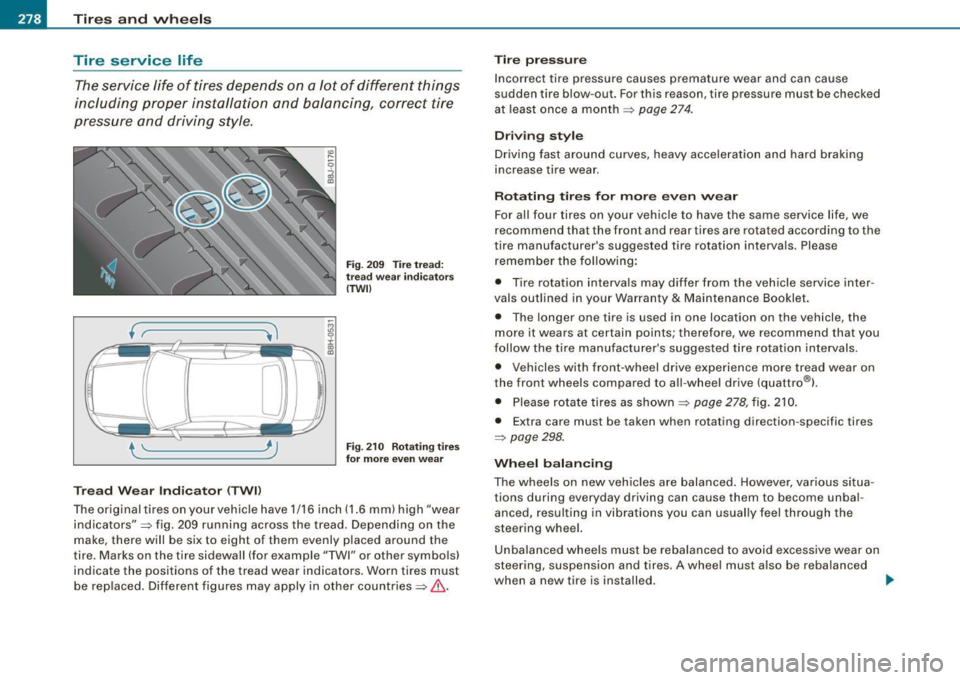
The orig inal tires on your vehic le have 1 /16 inch (1.6 mm) high "wear
indicators "~ fig. 209 running across the tread . Depending on the
make , there will be six to eight of them evenly p laced around the
tire . Marks on the tire sidewall (for example "TWI" or other symbo ls)
indicate the positions of the tread wear indicators . Worn tires must
be replaced. Dif ferent figures may apply in other countries~&.
Tire pre ssure
Incorrect tire pressure causes premature wear and can cause
sudden tire blow-out . For this reason , tire pressure mus t be checked
at least once a month~
page 274.
Driving style
Driving fast around curves, heavy acce leration and hard braking
increase tire wear .
Rotating t ires for more even wear
For all four tires on your vehicle to have the same service life, we
recommend that the front and rear tires are rota ted according to the
tire manufacturer's suggested tire rotation interva ls . Please
remember the following:
• Tire rotation interva ls may differ from the vehicle service inter
vals out lined in your Warran ty
& M aintenance Booklet .
• The longer one tire is used in one locat ion on the vehicle, the
more it wears at certain po ints; therefore, we recommend that you
follow the tire manufacturer 's suggested t ire rotation intervals .
• Vehicles with front -wheel drive experience more tread wear on
the front wheels compared to al l-wheel drive (quattro®) .
• Please rotate tires as shown ~
page 278, fig. 210 .
• Extra care must b e taken wh en rotat ing dir ection -specific tires
~ page 298.
Wheel balan cing
The wheels on new vehicles are balanced. However, various situa
tions during everyday dr iving can cause them to b ecome unbal
anced, resulti ng in vibra tions you can usually feel through the
ste ering whee l.
Unbalanced wheels must be rebalanced to avoid excessive wear on
steering , suspension and tires . A wheel must also be reba lanced
when a new tire is installed.
~
Page 281 of 340

__________________________________________________ T_ ir_e _ s_ a_ n _ d_ w_ h_ e_ e_ls _ _____,ffllll
In correct wheel alignment
Inc orrect wheel alignment can cause excessive tire wea r, impairing
the saf ety of the vehicle . If tires s how excessive wear , have the
whee l alig nment chec ked by an autho rized A udi deale r or q ualif ied
workshop .
All Wheel Drive
Vehicles with quattro ® must always have tires of the same si ze ,
cons tructi on and tread type . For details see => page 218 .
& WARNING
Sudden tire failure can lead to loss of control, a crash and serious
personal injury!
• Never drive a vehicle when the tread on any tire is worn down
to the wear indi cators .
• E specially in wet and slick driving situations , a preferably large
profile depth of the tires is necessary , and an approximately
similar profile depth of the front and rear axle tire s.
• The diminished driving safety , caused by too small of a tire
profile , is negatively perceivable especially in handling , in danger
of hydroplaning when driving through deep puddles and ponds ,
when driving around curve s, and in braking behavior.
• Worn t ires are a safety hazard , they do not grip well on wet
roads and increase your risk of "hydroplaning " and loss of control.
• Always keep chemicals that can cause tire damage , such a s
grease , oil , gasoline and brake flu id away from tires.
• Tires age even if they are not being used and can fail suddenly ,
espe cially at high speeds . Tires that are more than 6 years old can
only be used in an emergency and then with special care and at
lowe r speeds.
• Never mount used tire s on your vehicle if you are not sure of
their "previous history ." Old u sed tires may have been damaged
even though the damage cannot be seen that can lead to sudden
tire failure and los s of vehicle control. •
New tires and replacing tires and wheels
New tires and wheels ha ve to be bro ken in.
Fig. 211 Tire spe cification cod es on the sidewall of a tir e
No. Description
©
@
@
@
©
©
Passenger car tire (where applicable)
Nominal w id th of tire in mi llimeters
Ratio of height to width (aspect ratio)
Radia l
ii Rim diameter code
Load index an d sp eed ra ting
Vehic le care irechnical data
Page 282 of 340

-~_T_ ir_e_ s_ a_ n_d _ w_ h_ e_e _l_s _________________________________________________ _
0
©
@
U.S. DOT tire identification number
Sever snow conditions
Tire ply composition and materials used
Maximum load rating
Treadwear, traction and temperature grades Maximum permissible inflation pressure
The tires and rims are essential parts of the vehicle's design. The
tires and rims approved by Audi are specially matched to the char acteristics of the vehicle and can make a major contribution to good
road holding and safe handl ing when in good condition and prop
erly inflated =>& .
We recommend that al l work on tires and wheels be performed by
an authorized Audi dealer . They are familiar with recommended
procedures and have the necessary special too ls and spare parts as
we ll as the proper facilities for disposing of the o ld tires .
Authorized Audi dealers have the necessary information about tech
n ical requirements for insta lling o r changing tires and rims .
Repl ac ing t ires and wheels
Tires should be replaced at least in pairs and not individually (for
example both front tires or both rear tires together).
On vehicles with tire pressure moni toring system*, be sure to read
and heed the information=>
page 287.
Always buy replace ment radia l tires tha t have the same specifica
tions as the tires approved for your vehicle by Audi . Replacement
tires must always have the same load rating specification as the
original equipment or approved optional tires listed in the table
=>
page 271.
A udi -appr oved specificat ion tires a re specially matched t o your
vehic le and its load limits, and can contribute to the important road- holding, driving characteristics, and safety of the vehicle
. T he tab le
( =>
page 271) lists specifications of the tires approved for the Audi
models covered by your Owner's Literature.
The tire pressure label located either on driver's side B -pi llar or
insi de the fuel filler flap(=>
page 271, fig. 208) lists the specifica
tions of the original equipment tires installed on your vehicle at the
time it was manufactured.
Federa l law requires tire manufacturers to place standardized infor
mation on the sidewa ll of all tires=>
page 279, fig. 211. This informa
tion identifies and descr ibes the fundamenta l characteristics, the
quality grade of the tire and a lso prov ides a tire identification
number for safety standa rd certif ication and in case o f a recall.
Tire sp ecifi cations
Knowledge of tire specifications makes it easier to choose the
correct t ires. Rad ial tires have the tire specifications mar ked on the
sidewal l, for example:
P235 / 45 R 18 95 Y
This c onta ins the fo llowing informatio n:
P Indicates the tire is fo r passenger cars (where appl icab le)
2 3 5 Nominal tire width in mm of the tire from sidewall edge to s ide -
wa ll edge. In general, the larger the number, the wider the tire
45 Height/width ratio in percent (aspect ratio)
R Tire construction: Radial
18 Rim d iameter c ode (in inches)
95 Load rat ing code
V Speed rating letter code
X L (or "xi", "EXTRA LOAD" or "RF") indicates that the tire is a "Rein
forced" or an "Ex tra Load" ti re
M +S (or "M/S") Indicates that the tire has some mud and snow capa
bility
The ti res cou ld also have the information of direction of rotation
=>
page 267 .
Page 283 of 340
__________________________________________________ T_ ir_e_ s_ a_ n_d _ w_ h_ e_ e_l_s _ ...... ffllll
•
Tire manufacturing date
The manufacturing date is also indicated on the tire sidewall
(possibly on ly on the
inner side of the wheell:
"DOT ... 2209 ... " means, for example, that the tire was produced in
the 22th week of 2009.
Speed rating (letter code)
The speed rating letter code on the wheels indicates the maximum
permissible road speeds =:,
& in "Winter tires" on page 284.
P up to 93 mph (150 km/h)
Q up to 99 mph (158 km/h)
R upto 106mph(170km /h)
S upto110mph(180km/h)
T upto118mph(190km/h)
U up to 124 mph (200 km/h)
H upto130mph(210km/h)
V up to 149 mph (240 km/h)
31
Z over 149 mph (240 km/h)3
l
W up to 168 mph (270 km/h)31
Y up to 186 mph (298 km/h)3
l
Your vehicle is normally factory equipped with tires, which possess
excel lent driving characteristics and give your Audi opt imum
driving comfort. An electronic speed limiter=:,
page 28will normal ly
prevent your vehicle from going faster than the tire speed ratin g
=:>& .
U.S. DOT Tire Identification Number (TIN ) and tire
manufacture date
This is the tire's "serial number". It begins with the le tters "DOT"
and indicates that the tire meets all federal standards. The next two
numbers or letters indicate the plant where it was manufactured,
and the last four numbers represent the week and year of manufac-
31 For tires with a maximum speed capability over 149 mph (240 km/h), tire
m anufacturers so metimes use the letters "ZR."
ture. For example, the numbers 2209 mean that the tire was
produced in the 22th week of 2009. The other numbers are
marketing codes that may or may not be used by the tire manufac
turer . This information is used to contact consumers if a tire defect
requires a recall.
Tire ply composition and materials used
The number of plies indicates the number of layers of rubber-coated
fabric in the tire. In general, the greater the number of plies, the
more weight a tire can support. Tire manufacturers also must indi
cate the materials in the tire, which include steel, nylon, polyester,
and others.
Maximum Load Rating
This number indicates the maximum load in kilograms and pounds
that can be carr ied by the tire .
Tire quality grading for treadwear, traction, and
temperature resistance
Tread wear, traction and temperature grades=:, page 283.
Maximum Permissible Inflation Pressure
This number is the greatest amount of air pressure that should ever
be put in the tire under normal driving conditions.
Replacing tires or rims on vehicles equipped with tire
pressure monitoring system*
The wheels on your vehicle are equipped with a sensor which
constantly monitors the air pressure inside the tire, and then trans
mits this information to the tire pressure monitoring system*. If you
are going to replace the wheel rims on your vehicle, make sure the
new rims also have these sensors . The sensors must be compatible
with the tire pressure monitoring system* on your vehic le .
If you install rims, which do not have the sensors, or have sensors
which are not compatible, then the tire pressure monitoring
system* wil l not work properly. In this case, the tire pressure moni -.,_
Ve hic le care