radio AUDI A4 SEDAN 2013 Owner's Guide
[x] Cancel search | Manufacturer: AUDI, Model Year: 2013, Model line: A4 SEDAN, Model: AUDI A4 SEDAN 2013Pages: 294, PDF Size: 73.71 MB
Page 231 of 294
(D Note
Never use a fast charger as a booster to
start the engine . This will seriously dam
age sensitive electronic components, such
as control units, relays, radio, etc ., as well
as the battery charger .
Battery replacement
The new battery must have the same specifi
cations and dimensions as the original equip
ment battery .
Intelligent energy management in your vehi
cle is responsible for d istributing the electr i
cal energy throughout your vehicle
c::>
page 190 . The intelligent energy manage
ment system w ill keep the engine battery
charged bette r then vehicles w ithout t his sys
tem. To make sure the additional electr ica l en
ergy is available once again after you have
changed the battery, we recommend that you
install batteries of the same type and manu
facture only (the same as those installed at
the time your vehicle was delivered). Specifi
cations are listed on the bat tery hous ing. Your
author ized Audi dealer must code the battery
in the energy management system to enable
you to use the energy management functions
correctly after replac ing the battery .
If it is not possible to use a battery of this
type, the new battery must have the same ca
pacity, voltage (12 volts) , amperage, con
struction and plug sea ling.
When insta lling the battery, make sure the ig
nition and all electr ical consumers are turned
off.
(D Note
Make sure the ventilation hose on the s ide
of the battery is connected , othe rwise
fumes or battery ac id can leak out .
@ For the sake of the environment
Because of the problem of proper d isposal
of a battery, we recommend your author
ized Aud i dealer change the battery for
Checkin g and fillin g 229
you. Batteries contain sul fur ic acid and
l ead and must always be disposed of prop
erly in comp liance with a ll environmental
regulations. Disposing of vehicle batter ies
i mproperly is very dangerous to the envi
ronment .
Windshield/headlight*
washer container
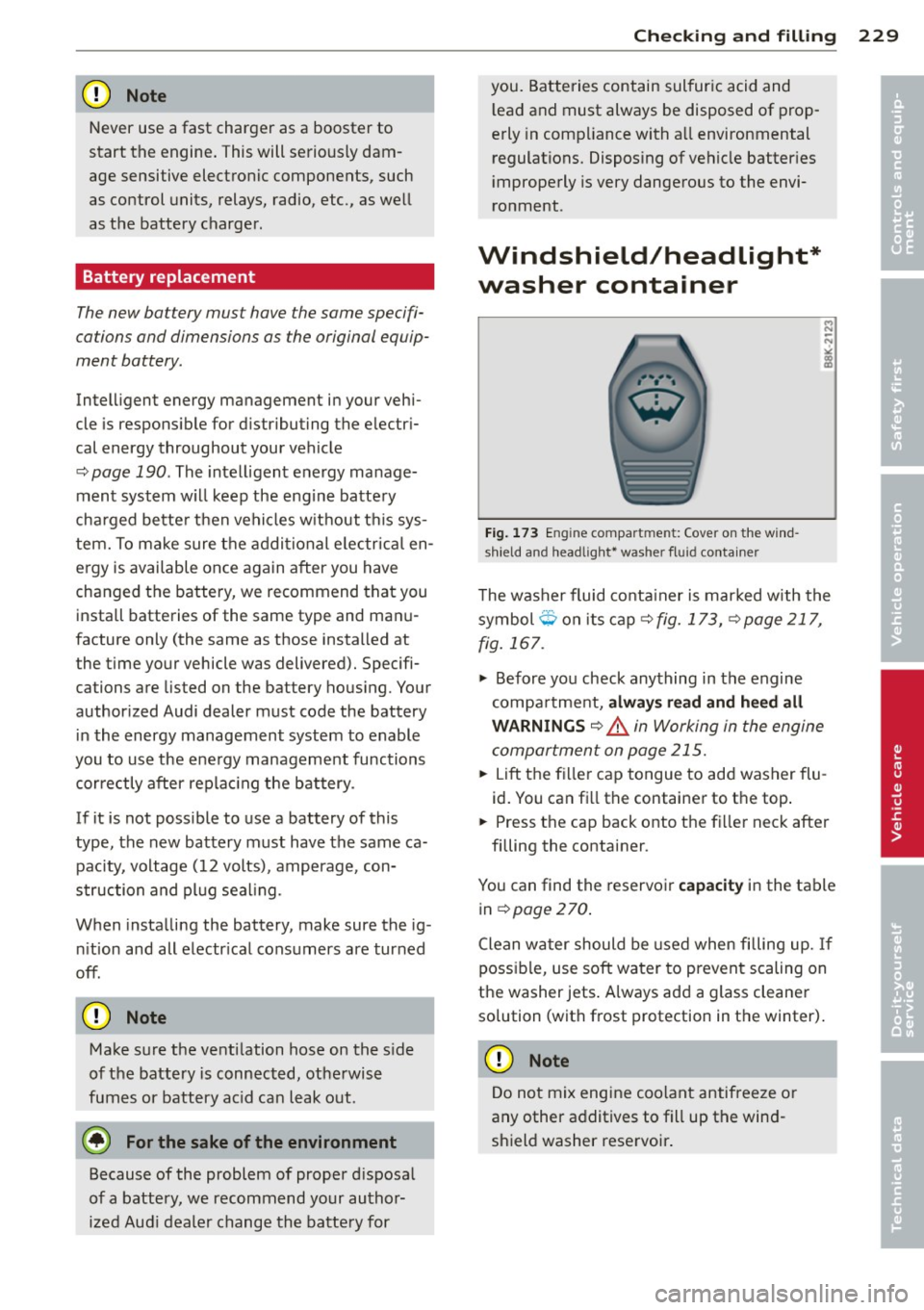
Fig. 173 En gin e compart men t: Cove r on the w ind
s hi eld an d headligh t* was her fl uid conta iner
The washer fluid container is marked w ith the
symbol
Q on its cap c::> fig. 173, c::> page 217,
fig. 167 .
.,. Before you check anything in the engine
compa rtment,
always read and heed all
WARNINGS
c::> .&. in Working in the engine
compartment on page 215.
.,. Lift the f iller cap tongue to add washer flu
id. You can fi ll the container to the top .
.. Press the cap back onto the fi ller neck after
filling the container .
You can find the reservoir
capacity in the table
in c::>
page 2 70 .
Clean water should be used when filling up. If
possib le, use soft water to prevent scaling on
the washer jets . Always add a glass cleaner
solution (with frost protection in the winter) .
(D Note
Do not mix engine coolant antifreeze or
any other additives to fill up the wind
shield washer reservoir .
•
•
Page 233 of 294
-Never mount used tires on yo ur vehicle if
you are not sure of their "previous histo
ry." Old used tires may have bee n dam
aged even though the damage cannot be
seen that can lead to sudden tire failure
and loss of vehicle control.
Glossary of tire and loading terminology
Accessory weight
means the comb ined weight (in excess of
those standard items wh ich may be rep laced)
of automati c transmission, power steering,
power br akes, power wi ndows, power sea ts,
radio, and heater, to the ex tent that these
items are avai lab le as factory -installed equip
ment (whether installed or not).
Aspect ratio
means the ratio of the height to the w idt h of
the tire in percent. Numbers of 55 or lower in
d icate a low sidewall fo r improved s teer ing re
sponse and better overall handling on dry
pavement.
Bead
means the pa rt of the t ire that is made of
s teel wires, wrapped or re inforced by ply cor ds
and that is shaped to fit the r im.
Bead separation
means a b reakdown of the bond between
components in the bead.
Cord
means the strands forming the plies in the
tire.
Cold t ir e infl ation pr essure
means the tire pressure recommended by the
vehicle manufacturer for a t ire of a designated
size that has not been dr iven for more than a
couple of miles (kilometers) at low speeds in
the three hour period before the tire pressure i s measu red or adjusted.
Tire s an d wheel s 231
-If you notice un usua l vibration or if the
veh icle pulls to one side when driv ing, a l
ways stop as soon as it is safe to do so and check the wheels and tires for dam
age.
Curb weight
mea ns the weight of a motor ve hicle w ith
standard equipment includ ing t he maximum
capa city of fuel, o il, and coolant, ai r cond i
tion ing a nd addi tional weig ht o f optiona l
equipment .
Extra load tire
means a tire design to operate at higher loads
and at higher inflation pressures than the cor
respondi ng s tanda rd tire. Extra load tires may
be identified as "X L", "xl", "EXTRA LOAD", o r
"R F" on the sidewall .
Gross Axle Weight Rating ( "GAWR ")
mea ns the load-carrying capacity of a single
axle system, measured at the tire-ground in
te rfaces.
Gross Vehicle Weight Rating ( "GVWR ")
means the maximum total loaded we ight of
t h e ve hicle.
Groo ve
means the space between two adjacent tread
ribs.
Load rating (code )
means the maximum load tha t a t ire is rated
to carry for a given inflation pressure. Yo u
may not find this information on all tires be
ca use it is not required by law.
Maximum load rating
me ans the load r ating for a tire at the maxi
mum pe rm issi ble inflat ion pressure for that
ti re .
•
•
...
Page 251 of 294
When the malfunction indicator is illuminat
ed, the system may not be able to detect or
signal low tire pressure as intended. TPMS
malfunctions may occur for a variety of rea
sons, including the installation of replace
ment or alternate tires or whee ls on the veh i
cle that prevent the TPMS from funct io ni ng
p roperly . Always check the T PMS malfunct ion
tellta le afte r replacing one or more t ires or
wheels on your veh icle to ensure that the re
p lacement or a lternate tires and wheels allow
the TPMS to continue to function properly .
Tire pressure indicator appears
Applies to vehicles: with tire pressure monitoring system
The tire pressure indicator in the instrument
cluster informs you if the tire pressure is too
low or if there is a system malfunction.
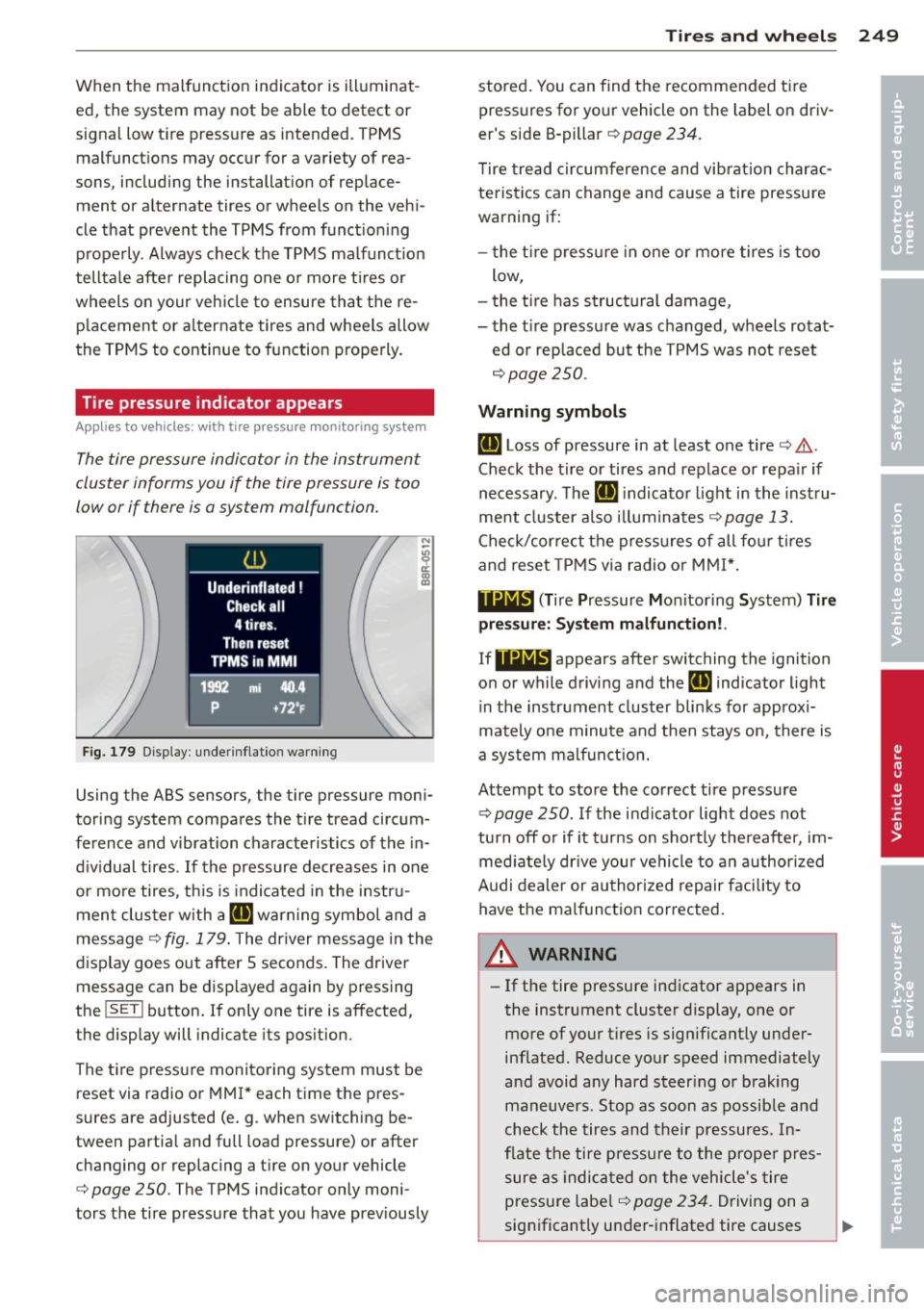
Fig. 179 Display : underinflatio n warning
Using the ABS sensors, the tire pressure moni
toring system compares the t ire tread circum
ference and vibration characteristics of the in
d iv idual tires . If the pressure decreases in one
or mo re tires, th is is indicated in the instru
ment clus ter with a
IE warning symbol and a
message ¢
fig. 179. The driver message in the
display goes out after 5 seconds. The driver message can be displayed again by pressing
the
! SET ! button. If only one tire is affected,
the display will indicate its pos ition.
The tire pressure monitoring system must be reset via radio or MMI* each time the pres
sures are adjusted (e.g . when switching be
tween partia l and full load pressure) or after
changing or replacing a t ire on your vehicle
¢
page 250. The TPMS indicator only moni
tors the tire pressure that you have prev iously
Tire s an d wheel s 249
stored . You can find the recommended t ire
pressures for yo ur vehicle on the label on driv
er's side B-pillar ¢
page 234.
Tire tread circum ference and vibration charac
teristics can change and cause a tire pressure
warning if:
- the t ire p ress ure in one or more tires is too
low,
- t he t ire has structural damage,
- the t ire pressure was changed, wheels rotat-
ed or replaced but the TPMS was not reset
¢ page 250.
Warning symbo ls
IE Loss of pressure in at least one tire¢.&,.
Check the tire or tires and replace or repa ir if
necessary. The
IE indicato r light in the inst ru
ment cluster a lso illuminates
c::!;> page 13.
Check/correct the press ures of all fou r tires
and reset TPMS via radio o r MMI*.
119;~, (T ir e Pressure Mon itoring System) Tire
pre ssure: Syst em malfun ction!.
If 11Nlf:1 appears afte r switching the ignition
on or while driving and the
IE indicator light
i n the instrument cluster blinks fo r approx i
mately one minute and then stays on, there is
a system malf unct ion.
Attempt to store the correct tire pressure
¢ page 250 . If the ind icator light does not
tu rn off o r if it turns on sho rtly the reafter, im
med iate ly dr ive your vehicle to a n author ized
Audi dealer or au thorized repair faci lity to
have the malfunc tion corrected .
A WARNING
-=
-If the tire pressure indicator appears in
the instrument cluster display, one or
more of your t ires is significant ly under
inflated. Reduce your speed immediately
and avoid any hard steer ing or braking
maneuvers. Stop as soon as possible and
check the tires and their pressures. In
flate the tire p ressure to the prope r pres
sure as indica ted on the vehicle's tire
pressu re labe l
¢page 234. Driving on a
significantly under-i nflated tire causes
•
•
Page 252 of 294
250 Tires and wheels
the tire to overheat and can lead to tire
failure. Under-inflation also is likely to
impair the vehicle's handling and stop
ping ability .
- The driver is responsible for maintaining
the correct tire pressures. You must
check the tire pressures regularly .
- Under certain conditions (such as a spor
ty driving style, winter conditions or un paved roads), the pressure monitor indi
cator may be delayed .
-Ask your authorized Audi dealer if run flat tires may be used on your vehicle.
Your vehicle registration becomes invalid
if you use these tires when not permit
ted. Damage to your vehicle or accidents
could also result.
@ Tips
- The tire pressure monitoring system
stops working when there is an ESC/ABS
malfunction.
- Using snow chains may result in a system
malfunction.
- The tire pressure monitoring system on
your Audi was developed using tires with the "AO" or "RO" identification on the
tire sidewall ¢
page 241. We recom
mend using these tires.
Reset tire pressure monitoring system
Applies to vehicles: with tire pressure monitoring system
If the tire pressure is adjusted, wheels are ro
tated or changed, the TPMS must be reset via
radio or MMI*.
11> Before resetting the TPMS, the current pres
sures of all four tires must correspond to
the specified values. Adjust the tire pressure and reset the pressure in the tire pressure
monitoring system according to the load
you are carrying
¢ page 234.
11> Turn on the ignition.
11> Select : the ICARI function button > Tire
pressure monitoring > Store now .
Or
i,. Select: the ICARI function button > Car sys·
terns
control button > Servicing & checks> Tire pressure monitoring
> Store tire pres
sures.
@ Tips
Do not store the tire pressure if there are
snow chains on the tire.
Page 262 of 294
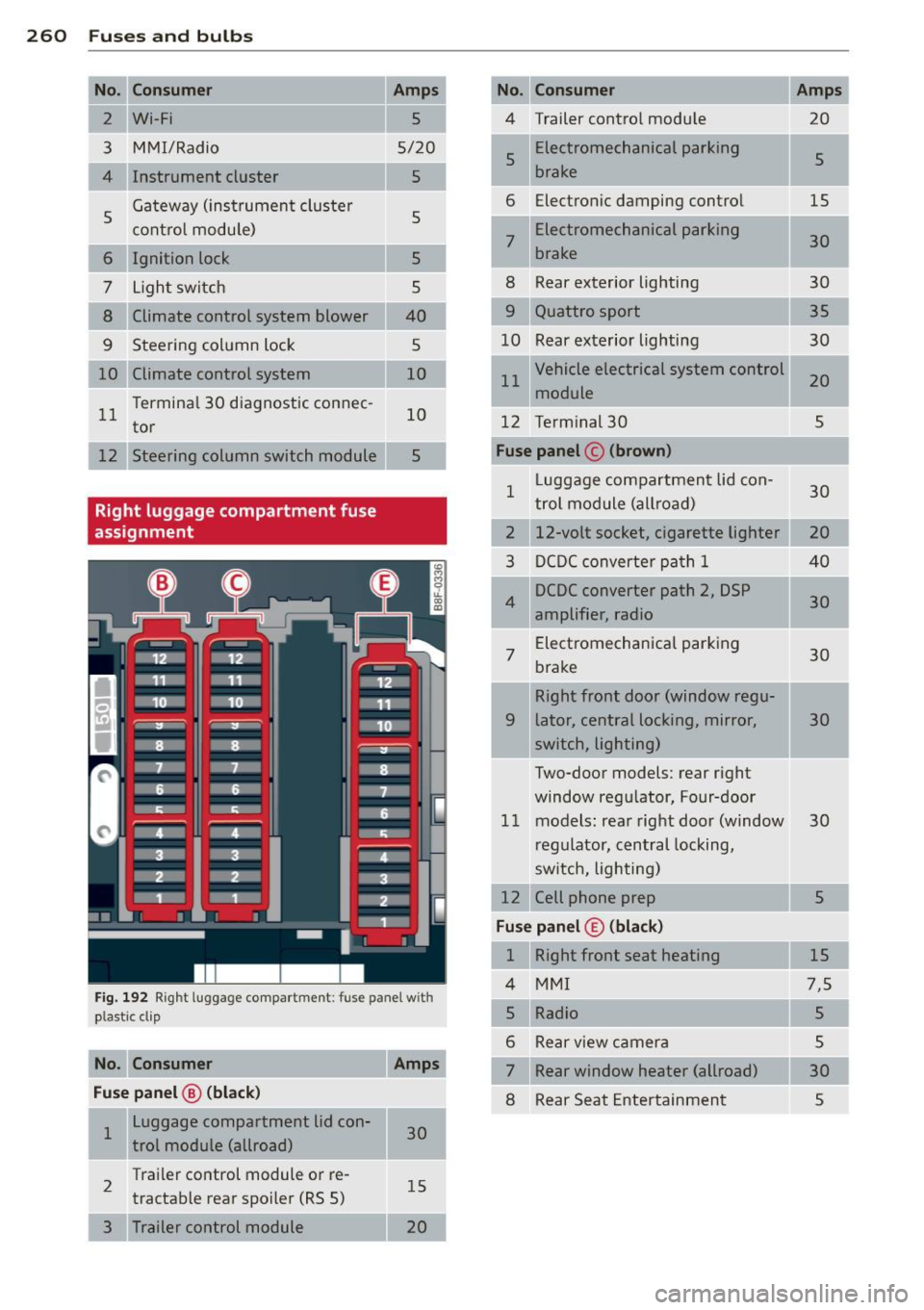
260 Fuses a nd bulb s
I
-No. Consumer
2 Wi-Fi
3 MMI/Radio
4 Instrument cluster
5 Ga
teway (instrument cluster
control module)
6 Ignition lock
7 L igh t switch
8 Climate control system blower
9 Steer ing column lock
10 Climate control system
11 Termina
l 30 diagnostic connec-
tor
12 Steering column switch module
Right luggage compartment fuse
assignment
Amps
5
5/20
5
5 5
5
40 5
10
10
5
Fig. 192 R ig ht l uggag e compar tmen t: fu se pan el w ith
plas tic cl ip
No. Con sumer Amps
Fu se pan el
@ (bl ack )
1 Luggage compartment lid con-
30
trol module (allroad)
2 Trail
er control module or re-
15
tractable rear spoiler (RS 5)
3 Trailer control module
20
No . Consumer
4 Trailer contro l modu le
5 Electromechanical parking
5
brake
6 Elec tronic damping control
15
--
7 Electromechanical parking
30
brake
8 Rear exterior lighting 30
9 Quattro sport
10 Rear exterior lighting
11 Vehicle electrical system control
20
module
12 Te rminal 30 5
Fuse panel© (brown )
1 L
uggage compartment lid con-
30
trol module (all road)
2 12-volt socket, cigarette lighter
20
3 DCDC converter pa th 1 40
4 DCDC converter path 2, DSP
30
amplifier , radio
7 Electromechanical parking
30
b rake
Right front door (window regu-
9 lator, central locking, mirror, 30
switch, lighting)
Two-door models : rear righ t
window regu lator, Four-door
11 models : rear right door (window
30
regulator, central locking,
switch, lighting)
Cell phone prep 5
Fuse panel © (blac k)
1 Right front seat heating
15
4 MMI 7,5
5 Radio 5
6 Rear view camera 5
7 Rear window heater (allroad)
30
8 Rear Seat Entertainment 5
Page 264 of 294
262 Emergency situations
Emergency situations
General
This chapter is intended for trained emer
gency crews and working personnel who
have the necessary tools and equipment to perform these operations.
Starting by pushing or
towing
Q;) Note
Vehicles with an automatic transmission
cannot be started by pushing or towing.
Starting with jumper
cables
If necessary , the engine can be started by
connecting it to the battery of another vehi
cle.
If the engine should fail to start because of a
discharged or weak battery, the battery can be
connected to the battery of
another vehicle,
using a
pair of jumper cables to start the en
gine .
Jumper cables
Use only jumper cables of sufficiently
large cross section to carry the starter current
safely. Refer to the manufacturer's specifica
ti ons.
Use only jumper cables with
insulated termi
nal clamps which are distinctly marked :
plus(+) cable in most cases colored red
minus (-) cable
in most cases colored black .
A WARNING
Batteries contain electricity, acid, and gas.
Any of these can cause very serious or fatal
injury. Follow the instructions below for
safe handling of your vehicle's battery.
- Always shield your eyes and avoid lean
ing over the battery whenever possible. -
A discharged battery can freeze at tem
peratures just below 32 °F (0 °C). Before
connecting a jumper cable, you must
thaw the frozen battery completely, oth
erwise it could explode.
- Do not allow battery acid to contact eyes
or skin . Flush any contacted area with
water immediately .
- Improper use of a booster battery to
start a vehicle may cause an explosion.
- Vehicle batteries generate explosive gas
es . Keep sparks, flame and lighted ciga
rettes away from batteries .
- Do not try to jump start any vehicle with
a low acid level in the battery .
- The voltage of the booster battery must
also have a 12-Volt rating. The capacity
(Ah) of the booster battery should not be
lower than that of the discharged bat
tery . Use of batteries of different voltage
or substantially different "Ah" rating
may cause an explosion and personal in
jury.
- Never charge a frozen battery. Gas trap
ped in the ice may cause an explosion.
- Never charge or use a battery that has
been frozen. The battery case may have
be weakened.
- Use of batteries of different voltage or
substantially different capacity (Ah) rat
ing may cause an explosion and injury.
The capacity (Ah) of the booster battery
should not be lower than that of the dis
charged battery.
- Before you check anything in the engine
compartment, always read and heed all
WARNINGS¢
page 208, Engine com
partment.
@ Note
- Applying a higher voltage booster bat
tery will cause expensive damage to sen
sitive electronic components, such as
control units, relays, radio, etc.
- There must be no electrical contact be
tween the vehicles as otherwise current
could already start to flow as soon as the
positive(+) terminals are connected. ..,.
Page 270 of 294
268 General information
General information Explanation of
technical data
Some of the technical data listed in this man
ual requires further explanation .
The technical data for your vehicle is listed in
the charts starting on
r:::> page 2 70. This sec
tion provides general information, notes and restrictions which apply to this data .
Vehicle identification
The key data is given on the vehicle identifica
tion number (VIN) plate and the vehicle data
sticker.
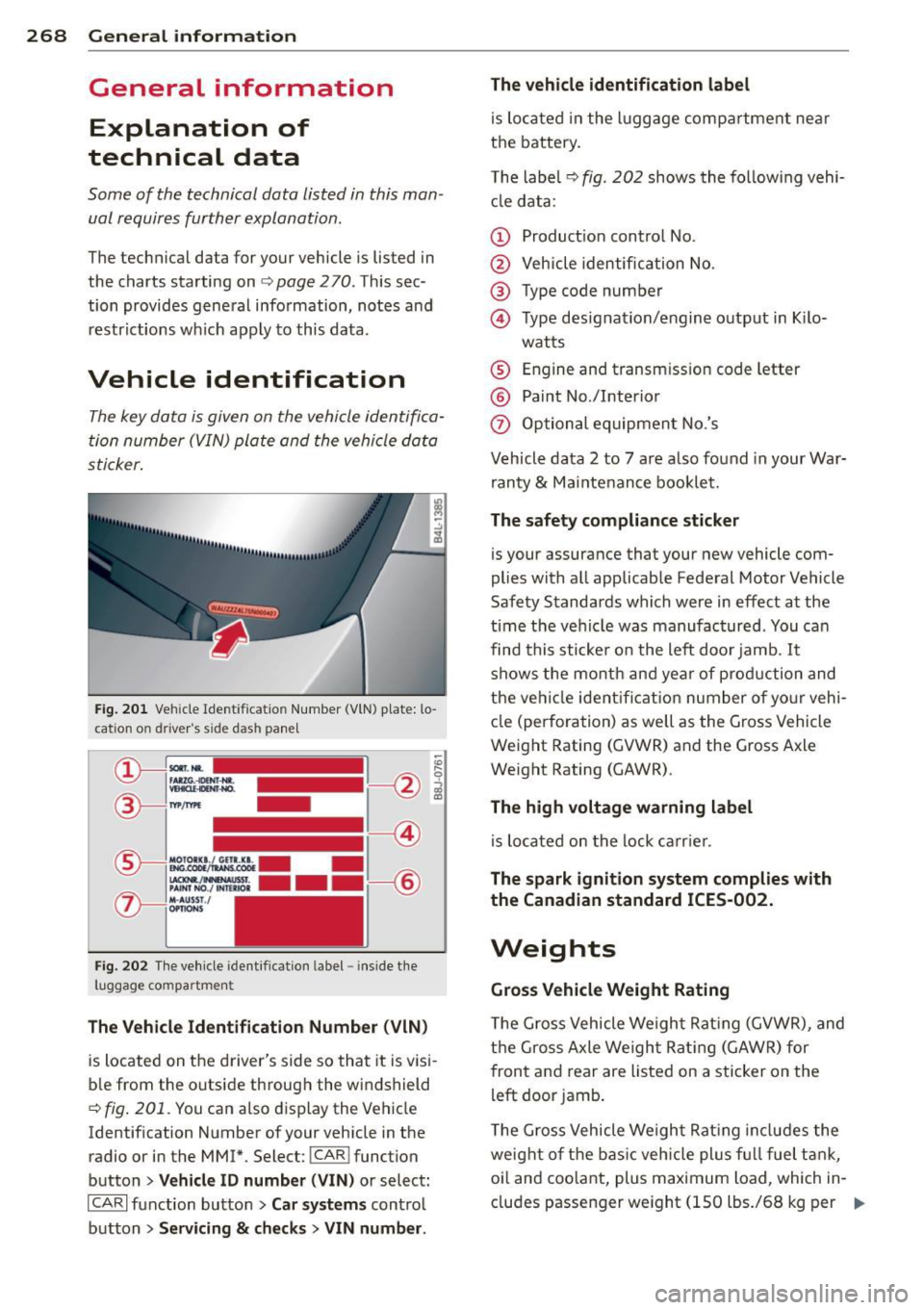
Fig. 201 Veh icle Ide ntific atio n Number (VlN) p late: lo
cation on driver 's sid e das h panel
Fig. 202 The vehicle identi fication label -inside the
luggage co mpa rtmen t
The Vehicle Identification Number (VIN)
is located on the driver's side so that it is visi
ble from the outside through the windshield
r:::> fig . 201 . You can also display the Vehicle
Identification Number of your vehicle in the
radio or in the MM!*. Select :
!CAR ! function
button
> Vehicle ID number (VIN) or select:
ICARI function button > Car systems control
button
> Servicing & checks > VIN number . The
vehicle identification label
is located in the luggage compartment near
the battery .
The label¢
fig. 202 shows the following vehi
cle data :
(D Production control No .
@ Vehicle identification No.
® Type code number
@ Type designation/engine output in Kilo-
watts
® Engine and transmission code letter
@ Paint No./Interior
(f) Optional equipment No.'s
Vehicle data 2 to 7 are also found in your War
ranty
& Maintenance booklet.
The safety compliance sticker
is you r assurance that your new vehicle com
plies with all applicable Federal Motor Vehicle
Safety Standards which were in effect at the
time the vehicle was manufactured . You can
find this sticker on the left door jamb.
It
shows the month and year of production and
the ve hicle ident ification number of your vehi
cle (perforation) as well as the Gross Vehicle
Weight Rating (GVWR) and the Gross Axle
Weight Rating (GAWR) .
The high voltage warning label
is located on the lock carr ier .
The spark ignition system complies with
the Canadian standard ICES-002.
Weights
Gross Vehicle Weight Rating
The Gross Vehicle Weight Rating (GVWR), and
the Gross Axle Weight Rating (GAWR) for
front and rear are Listed on a sticker on the
left door jamb.
The Gross Vehicle Weight Rating includes the
weight of the basic vehicle plus full fuel tank,
oi l and coolant, plus maximum load, wh ich in
cludes passenger weight (150 lbs./68 kg per
Ill>
Page 277 of 294
Technical Modifications
Our guidelines must be complied with when technical modifications are made.
Always consult an authorized Aud i dealer be
fore starting work on any modifications.
This will he lp ensure that vehicle function,
performance and safety are not impaired
¢ .&. .
Attempting to work on electronic components
and the software used with them can cause
malfunctions. Beca use of the way electronic
components are interconnected with each
other, such malfunctions can also have an ad
verse affect on other systems that are not di rectly involved. Th is means that you r isk both
a substantial reduction in the operational
safety of you r vehicle and an inc reased wea r of
vehi cle parts¢ _&..
Author ized Audi dealers w ill perform th is
wo rk in a professiona l and competent ma nner
or, in spec ial cases, refer you to a p rofessional
company that specializes in such mod ifi ca
tions .
_& WARNING
t= -
Improper repairs and modifications can
change the way vehicle systems wo rk and
cause se rious personal injury.
0 Note
If emergency repairs must be perfo rmed
elsewhere, have the ve hicle examined by
an authorized A udi dealer as soon as possi
ble.
Con sumer In formation 275
Declaration of
Compliance, Telecom
munications and
Electronic Systems
Radio Frequency Devices and Radiocommuni
cation Equipment User Manual Notice.
The manufact urer is not responsib le for any
radio or TV interference caused by unauthor
ized modifications to this equipment.
Device s
The following devices each comply wi th FCC
Part 15 .19, FCC Part 15.2 1 and RSS -Gen Iss ue
1:
- Adaptive cr uise con trol*
- Conven ience key*
- Aud i side assist*
- Cell phone package*
- Electron ic immobilizer
- Homelink ® universal remote control *
- Remote control key
- Tire press ure moni toring sys tem*
FCC Part 15.19
This device complies with part 15 of the FCC
Ru les . Operation is subject to the follow ing
two conditions:
(1) This device may not cause harmful i nter
ference, and
(2) this device must accept any interference
received, including interference that may
cause undes ired operation.
FCC Part 15.21
CAU TION:
Changes or mod ifi cat ions not expressly ap
proved by t he party responsible for compli
ance could vo id the user's autho rit y to ope rate
the eq uipment .
RSS-Gen Issue 1
Operation is subject to the fo llow ing two con
di tions:
•
•
...