airbag AUDI A4 SEDAN 2013 Workshop Manual
[x] Cancel search | Manufacturer: AUDI, Model Year: 2013, Model line: A4 SEDAN, Model: AUDI A4 SEDAN 2013Pages: 294, PDF Size: 73.71 MB
Page 178 of 294
176 Child Safety
-The inflating airbag will hit the child
safety seat or infant carrier with great
force and will smash the child safety seat and child against the backrest, center
armrest, door or roof.
- Always install rearward-facing child safe
ty seats or infant carriers on the rear
seat.
- Forward-facing child safety seats or in
fant carriers installed on the front pas
senger's seat may interfere with the de
ployment of the airbag and cause serious
injury to the child.
-It is safer to install a forward-facing
child safety seat on the rear seat.
- Always read and heed all WARNINGS
whenever using a child restrained in ave
hicle is being used
¢page 165. Special
precautions apply when installing a child
safety seat on the front passenger seat
¢ page 145, Child restraints on the front
seat -some important things to know.
A WARNING
-
Always take special precautions if you
must install a forward or rearward -facing
child restraint on the front passenger's
seat in exceptional situations:
- Whenever a forward or rearward-facing
child restraint is installed on the front
passenger seat, the
PASSENGER AIR
BAG OFF
light must come on and stay on
whenever the ignition is switched on.
- If the PASSENGER AIR BAG OFF light
does not come on and stay on, perform
the checks described ¢
page 155, Moni
toring the Advanced Airbag System.
- Take the child restraint off the front pas
senger seat and install it properly at one
of the rear seat positions if the
PASSEN
GER AIR BAG OFF
light does not stay on
whenever the ignition is switched on.
- Improper installation of child restraints
can reduce their effectiveness or even
prevent them from providing any protec
tion. -
An improperly installed child restraint
can interfere with the airbag as it de
ploys and seriously injure or even kill the
child .
- Always carefully follow the manufactur
er's instructions provided with the child
safety seat or carrier.
- Never place additional items on the seat
that can increase the total weight regis
tered by the weight-sensing mat and can
cause injury in a crash .
A WARNING
-Forward-facing child restraints:
- Always make sure the forward -facing
seat has been designed and certified by its manufacturer for use on a front seat
with a passenger front and side airbag.
- Never put the forward-facing child re
straint up, against or very near the in
strument panel.
- Always move the passenger seat into its
rearmost position in the seat's fore and
aft adjustment range, as far away from
the airbag as possible before installing
the forward-facing child restraint. The backrest must be adjusted to an upright
position .
-Make sure that the PASSENGER AIR BAG
OFF
light comes on and stays on all the
time whenever the ignition is switched
on .
A WARNING
-
Rearward-facing child restraints:
- A child in a rearward-facing child safety
seat installed on the front passenger
seat will be seriously injured and can be killed if the front airbag inflates -even
with an Advanced Airbag System .
- The inflating airbag will hit the child
safety seat or infant carrier with great
force and will smash the child safety seat and child against the backrest, center
armrest, door or roof.
Page 179 of 294
-Always be especially careful if you must
install a rearward facing child safety seat
on the front passenger seat in exception
al circumstances.
- A tight tether strap on a rearward-facing
child restraint attached to the front pas
senger seat can put too much pressure
on the weight-mat in the seat and regis
ter a heavier weight in the Advanced Air
bag System. The heavier weight regis
tered can make the system work as
though an adult were on the seat and de ploy the Advanced Airbag when it must
be suppressed causing serious or even
fatal injury to the child.
- Make sure that the
PASSENGER AIR BAG
OFF
light comes on and stays on all the
time whenever the ignition is switched
on.
- If the PASSENGER AIR BAG OFF light
does not come on and stay on, immedi
ately install the rearward-facing child
safety seat in a rear seating position and
have the airbag system inspected by your
authorized Audi dealer.
Activating the convertible lock ing
retractor
Use the convertible locking retractor to se
cure a child restraint.
Always heed the child safety seat manufactur
er's instructions when installing a child re
straint in your vehicle. To activate the conver
tible locking retractor:
.. Place the child restraint on a seat, prefera
bly on the rear seat.
.. Slowly pull the belt
all the way out.
.. Route it around or through the child re
straint belt path¢.&,_.
.. Push the child safety seat down with your
full weight to get the safety belt really tight.
.. Insert the belt tongue into the buckle for
that seating position .
.. Guide the safety belt back into the retractor
until the belt lies flat and snug on the child
safety seat .
Child Safety 177
.. You should hear a "clicking" noise as the
belt winds back into the inertia reel. Test the
convertible locking retractor by pulling on
the belt. You should no longer be able to
pull the belt out of the retractor. The con
vertible locking retractor is now activated .
.. Make sure that the red release button is fac
ing away from the child restraint so that it
can be unbuckled quickly.
.. Pull on the belt to make sure the safety belt
is properly tight and fastened so that the
seat cannot move forward or sideways more
than one inch (2.5 cm).
A WARNING
Using the wrong child restraint or an im
properly installed child restraint can cause
serious personal injury or death in a crash.
- Always make sure that the safety belt re-
tractor is locked when installing a child
safety seat. An unlocked safety belt re
tractor cannot hold the child safety seat in place during normal driving or in a
crash.
- Always buckle the child safety seat firmly
in place even if a child is not sitting in it.
A loose child safety seat can fly around
during a sudden stop or in a crash.
- Always make sure the seat backrest to
which the child restraint is installed is in
an upright position and securely latched
into place and cannot fold forward. Oth
erwise, the seatback with the child safety
seat attached to it could fly forward in
the event of an accident or other emer
gency situation .
-Always read and heed all WARNINGS whenever using a child restrained in ave
hicle is being used
¢ page 165. Special
precautions apply when installing a child
safety seat on the front passenger seat
¢ page 145, Child restraints on the front
seat -some important things to know .
-
•
•
Page 184 of 294
182 Child Safet y
-Never attac h a tether strap to a tie-down
hook in the luggage compartment .
- Never use c hild restraint tether ancho
rages to secure safety belts or other
kinds of occupant restra ints .
- Never secure or attach any l uggage or
other items to the LATCH lower ancho
rages or to the tether anchors.
- If a tether or other strap is used to at
tac h a child restraint to the front passen
ger seat, make sure that it is not so
t ight, that it causes the weight -sensing
mat to measu re more weight than is ac
tua lly on the seat.
- The heav ier weight reg istered can make
the Advanced Airbag System wo rk as
though an adult we re on the seat and de
ploy the Advanced A irbag when it m ust
be s uppressed causing ser ious or even
fatal inj ury to the child.
- If you mus t install a rearward f acing
child safety seat on the front passenger
seat because of exceptional circ umstan
ces and the
PASSENGER AIR BAG OFF
light does not come on and stay on, im
mediately install the rear-facing child
safety seat in a rear seating position a nd
have the a irbag system inspected by you r
Audi dealer.
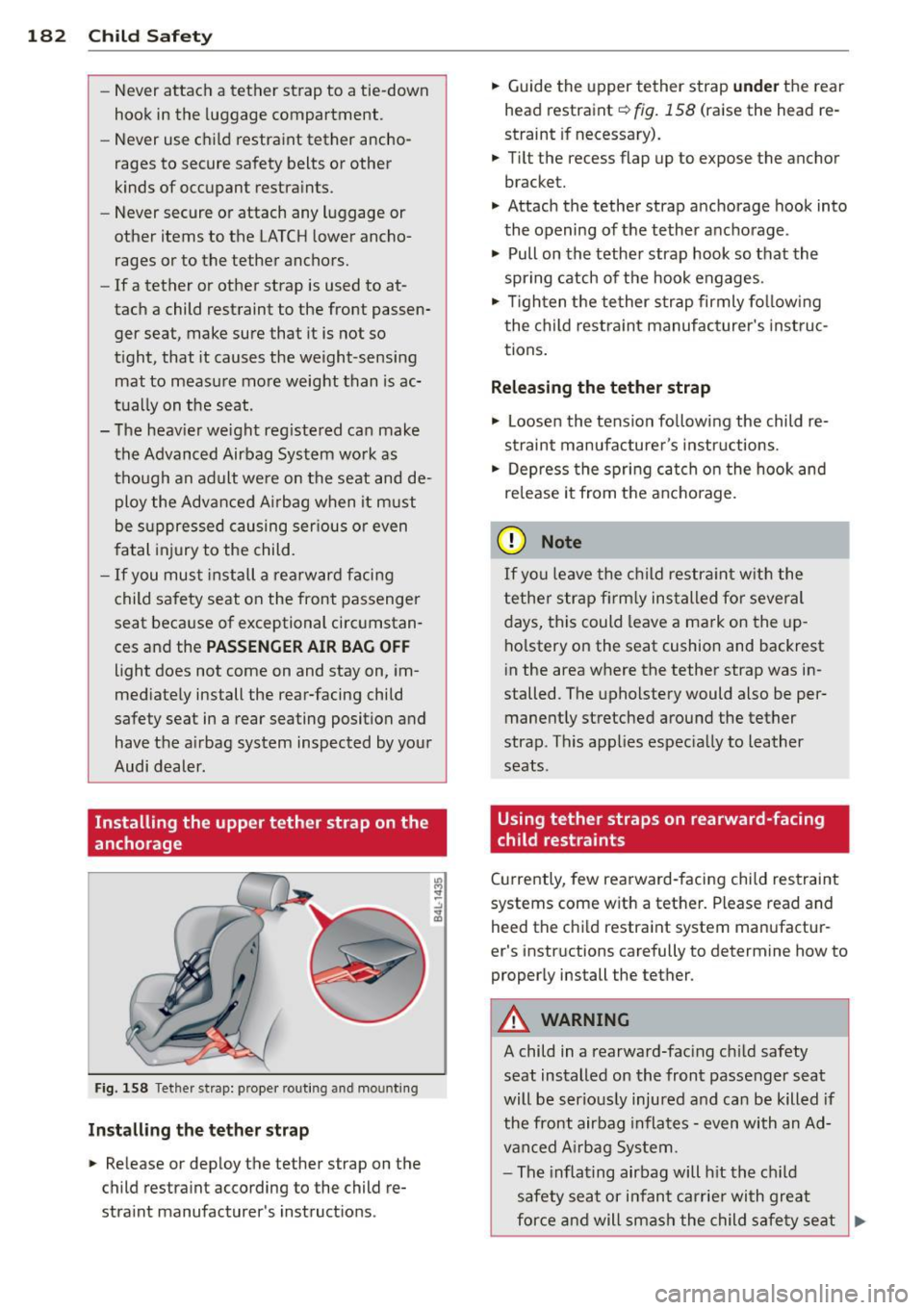
Installing the upper tether strap on the
anchorage
F ig . 1 58 Tethe r strap: prope r rou ting and mounting
Installing the tether strap
.,. Release or deploy the tether strap on the
child restra int acco rding to the child re
straint manufacturer's instruct ions . .,.
Guide the upper tether strap
under the rear
head restraint co
fig. 158 (raise the head re
straint if necessary).
.,. Tilt the recess flap up to expose the anchor
bracket.
.,. Attach the tether strap anchorage hook into
the opening of t he tether anchorage.
.,. Pull on the tethe r strap hook so that the
spri ng catch of the hook engages .
.,. Tight en t he te ther s tra p firmly fo llow ing
the child restraint manufac turer's instruc
tions .
Releasing the tether strap
.,. Loosen the tens ion fo llowing the child re
s traint manufa cture r's instr uctions.
.,. Depress the spring c atc h o n the hook and
release it from the ancho rage.
(D Note
If yo u leave the child restr aint w ith the
tethe r strap firm ly ins talled for several
days, this could leave a ma rk on the up
ho lstery on the seat cushion and backrest
i n the area where the tether strap was in
stalled. The upholstery would also be per
manently stretched around the tether
strap . This applies espec ia lly to leather
seats .
Using tether straps on rearward-facing
child restraints
Currently, few rearward-facing child res traint
systems come w ith a tether. Please read and
heed the c hild restra int system man ufactur
er 's instr uctions carefully to determine how to
properly install the tether .
A WARNING
-
-
A child in a rearward-fac ing ch ild safety
seat installed on the front passeng er seat
will be s erious ly inju re d and ca n be killed if
the fr ont air bag infla tes -even with an Ad
va nced A irbag Sys tem .
- Th e inflating airbag will h it th e chi ld
safety sea t or infant c arrie r wi th gre at
for ce and will sma sh the child s afety seat
~
Page 185 of 294
and child against the backrest, center
armrest, or door .
- A tight tether or other strap on a rear
ward-fac ing c hild restra int attached to
the front passenger seat can put too much pressure on the weight-mat in the
seat and register a heavier weight in the
Advanced Airbag System . T he heav ie r
we ight registe red ca n make th e system
wor k as thoug h an adu lt were on t he seat
and dep loy the A dvanced Airbag when i t
must be suppressed ca using serious or
even fatal injury to the child.
- If you mus t inst all a rearw ard facing
child safety seat on the front passenger
seat because of exceptional circ umstan
ces and the
PASSENGER AIR BAG OFF
light does not come on and stay on, im
med iate ly install the rearward-facing
child safety seat in a rear seat ing pos i
t io n and have the airbag system inspect
ed by you r a uthorized Audi dea le r.
Additional Information
Sources of information about child
restraints and their use
There are a number of sources of additional
information about ch ild restrai nt select ion, in
stallat ion and use:
NHTSA advises that t he best child safety seat
is the one that fits y our child and fits i n your
ve hicle, and that you w ill use correctly and
consis tently.
Try before you buy !
U.S National Highway T raffic Safety Admin
istration
T e l. : 1-888-327-4236 (T TY : 1-800-424-9153)
www.nhtsa.gov
National SAFE KIDS Campaign
Te l.: (202) 662 -0600
www.safekids.o rg
Child Sa fet y 183
Safety BeltSafe U.S.A
Tel.: (800) 7 45 -SAFE (English)
T el.: (800) 747-SANO (Span ish)
www.carseat.org
Transport Canada Information Centre
Tel.: 1 -800-333-0371 or ca ll
1 -6 13-998-86 16 if yo u are in the Ottawa a rea
http://www .tc.gc.ca/eng/roadsafety/
menu.htm
Audi Customer Relation s
Tel.: (800) 822-2834
•
•
Page 186 of 294
184 Intelligent technology
Intelligent technology
Notice about data
recorded by vehicle
control modules
Your veh icle is not equipped with an Event Da
ta Recorde r (EDR), ins talled by some manu
facture rs fo r the express p urpose of capturing
data for retrieval after an accident or cras h
event . EDR's are sometimes ca lled "crash re
corders".
Some state laws restr ict the retr ieval or down
loading of data stored by EDR's that were in
stalled in a vehicle for the express purpose of retrieving data after an accident or crash
event without the owner's consent.
A ltho ugh yo ur vehicle is not equ ipped wit h an
EDR, it is equipped with a number of electron
ic control modules for various vehicle systems
such as, for examp le, eng ine f unction, em is
sion control, as well as for the airbags and
safety belts.
These electronic contro l modules also record
vehicle-re lated data during norma l vehicle op
erat ion for diagnostic and repa ir purposes.
The recording capacity of the electronic con
trol modules is limited to data (no sound is re
corded) and only a small amount of data is ac
tually recorded ove r a ve ry limited pe riod of
time and stored when a sys tem faul t or o ther
cond ition is sensed by a cont ro l u nit. Some of
the data then stored may re late to vehicle
speed, direction, braking as we ll as restraint
system use and performance in the event of a
crash or other condit ion. Stored data can only
be read and downloaded w ith special equip
ment.
Electronic Stabilization
Control (ESC)
Description
ESC helps to improve road holding and vehicle
dynamics to help reduce the probability of
skidd ing and loss of ve hicle control. It works
only when the eng ine is running. ESC detects certain difficult driving situat
ions, including
when the vehicle is beginning to spin (yaw)
o ut of control and he lps you to get the veh icle
back under control by se lectively braking the
whee ls, and/or reducing eng ine power and
providing steer ing ass istance to he lp hold the
vehicle o n the dr iver's intended course. The in
dicator light
G) in the inst rument cluster
blinks when ESC is ta king action to help yo u
control the veh icle.
ESC has limitations.
It is importa nt to remem
ber that ESC cannot overcome the laws of
physics. It wi ll not always be able to help out
under a ll cond it ions you may come up aga inst.
F or example, ESC may not always be able to
help you master situations where there is a
s u dden change in the coefficient of friction of
the road surface. When there is a section of
dry road that is sudden ly covered w ith water,
s lush or snow, ESC cannot perform the same
way it wou ld on the dry surface . If the ve hicle
hydroplanes (rides on a cushion of water in
stead of the road surface), ESC will not be
able to help you steer the vehicle because con
tact with the pavement has been in terrupted
and the vehicle cannot be braked or steered .
D uring fast cornering, particularly on winding
roads, ESC cannot always deal as effectively
with difficult driving situations than at lower
speeds. When towing a trailer, ESC is not able
to help you regain control as it would if you
were not tow ing a trailer.
Always adjust your speed and driving style to road, traffic; and weather condit ions. ESC can
not override the vehicle's physical limits, in
crease the availab le tract ion, or keep a ve hicle
on the road if road departure is a result of
drive r inattent io n. Instead, ESC imp roves the
poss ibil ity of keeping the vehi cle under con
trol and on the road during ex treme maneu
vers by using the d river's steering inputs to
help keep the vehicle going in the intended di
rection . If you are traveling at a speed that
ca uses you to run off the road before ESC can
provide any assistance, you may not experi
ence the benefits of ESC.
Page 208 of 294
206 Cleaning and protec tio n
Open Velcro fasteners on your clothing can
damage the seat cover. Please make sure
that Velcro fasteners are closed.
Plastic parts and instrument panel
Always use a clean cloth moistened in clear
water to clean these areas . For pers istent dirt
use an Audi approved
so lv ent-fr ee plastic
cleaner/protectant.
_& WARNING
So lvents can change the propert ies of
some plastics and make it harder for the
airbag to dep loy.
-
- Never clean the instr ument pane l or the
surface of airbag modules with cleaning
products that contain solvents.
- Products containing solvents w ill make
the surface o f this part porous.
- Serious injur ies can result if plastic pa rts
come loose when the airbag is deployed .
- Always read and heed all WARN INGS and
other information
¢page 199.
(D Note
Cleaning agents contain ing solvents will
attac k the mater ial and can change the
way it behaves.
Natural leather
Appl ies to vehicles: with natural leather
Audi makes great efforts to maintain the
properties, natural look and feel of interior
leather.
General
We offer many different types of leather on
our veh icles . Most are differe nt types of nappa
l eather, which has a smooth surface and
comes in var ious co lors .
The intensity of the color determines the v isu
al character istics and appearance .
If the sur
face of the leather has a typical natural look,
the n the leather is a nappa leat her that has been left in a relative
ly natura l condition . This
leather offers particularly good comfort and
breathes we ll. Fine veins, closed grains, insect
bites, skin fo lds, and s ubt le variations in color
rema in v is ible. These character istics demon
strate that the material is natural.
Natura l nappa leather is not covered by a co l
or finish. It is therefore more sensit ive to soil
ing and wear, which is someth ing you need to
consider if children, animals or other factors
mig ht prove to be part icularly hard o n the
l eather .
By contrast, leather types that are covered by
a colored finish layer are more durable. This has a positive effect on the leather's resist
ance to wear and soiling in da ily use . On the
othe r hand, the typica l charac teristics of natu
ral le a the r are barely o r not appa rent. Howev
er, th is does not mean that the leather itse lf
is of inferior quality.
Care and handling
Because of the exclusive nature of the types of
leather that Aud i uses and their uniq ue p rop
erties (such as sens itivity to oils, grease, soil
ing, etc.), yo u w ill need to be somewhat ca re
ful with these leathers, and a certain type of care is requi red . For example, dark clothing
mater ials can disco lor leather seats (especia l
ly if such clothing is damp and was not dyed
correct ly). Dust and dirt particles in pores,
folds, and seams can have an abrasive effect
and can damage the leather surface as well as
wea ken seams .
The leather should be cleaned regularly as needed . After hav ing been used for a relat ively
long time, your leather seats will acq uire a
rich aged fi nish. This is a character istic of nat
ur al leathe r and a s ign of true quality.
In order to maintain the value of this natural
product over the life of your veh icle, you
shou ld follow t he recomme ndat io ns be low: ..,.
Page 228 of 294
226 Check ing and filling
Have the battery checked when you take your
vehicle in for service. You are well advised to replace a battery that is older than 5 years.
W ith certa in types o f airbag deployment, the
battery is disconnected from the vehicle elec
trica l system for safety reasons¢
& in Re
pair, core and disposal of the airbags on
page 158.
Disconn ect ing the battery terminal s
Some vehicle functions (power window regu
lators, for example) are lost if the battery ter
minals are disconnected . These functions have
to be re learned after the battery terminals are
connected again. To prevent this, the battery
should only be disconnected from the vehicle
electrical system when absolutely necessary
for repairs .
Vehicles not dri ven fo r lo ng p eriod s
If you do not drive your vehicle over a period
of several days or weeks, electrical compo
nents are gradually cut back or switched off.
This reduces energy consumption and main
tains starting capabil ity over a longer period
¢ page 190.
Some of the conven ience functions may not
operate, such as the inter ior lights or the
power seat adjustment. The conven ience
functions will be ava ilable again when you
turn on the ignition and start the eng ine.
Winter operati on
During the winter months, battery capacity
tends to decrease as temperatu res drop . This
is because more power is also consumed while
start ing , and the headlights, rea r window de
fogger, etc., are used more often .
Avoid unnecessary power consumption, par
ticularly in c ity traffic or when traveling on ly
short distances. Let you r authorized Audi
dea ler check the capacity of the vehicle bat
tery before winter sets in
¢ page 228. A well
charged batte ry w ill not only prevent sta rting
prob lems when the weather is cold, but wi ll
a lso last longer.
(D Tips
If your vehicle is left standing for seve ral
weeks at extremely low temperatures, the
vehicle battery sho uld be removed and
stored where it w ill not freeze . This will
prevent it from be ing damaged and having
to be replaced .
Working on the battery
Be especially careful when working on or near
the battery.
The battery is located in the luggage compart
ment under the floor. Before you check any
t hi ng in the luggage compartment,
read and
heed all WARNINGS
¢ ,& .
Always heed the safety warnings , when work
ing on the vehicle battery or the vehicle e lec
trical system to prevent injury.
Th e follo wing WARNINGS are very
important when working on the battery :
Al ways heed the follo wing WARNING SYM
BOLS and safety prec aution s when working
on the battery .
® Always wear eye protection .
,0,. Battery acid contains sulfuric acid . Al
~ way s wear glov es and ey e prot ectio n.
~ No
\!SI -sparks
-flames
-smoking.
A Wh en a battery is charged , it produ ce s
~ hydro gen gas which is e xplosi ve and
c o uld cau se pe rson al injur y.
~ Always keep the battery well out of
'if!:11 reach of children .
_& WARNING
Whenever working on the battery or on
the electrical system, there is the risk of
injury, accident and even fire . Read and
heed the following WARNINGS:
-
Page 261 of 294
Fuses and bulbs 259
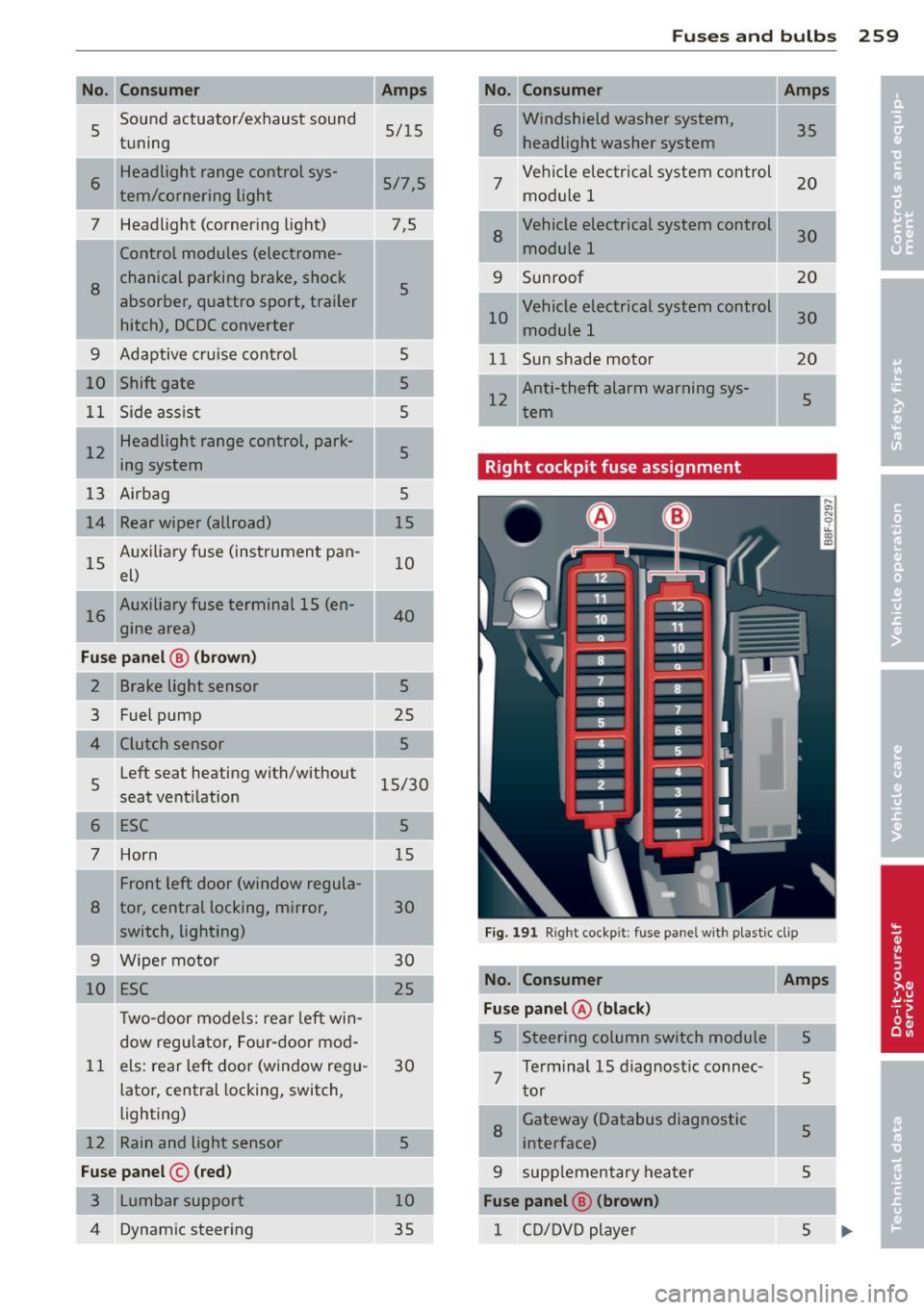
-No. No. Consumer Amps
5 Sound
actuato r/exhaust sound
5/15
tuning 6
Windshield washer system,
35
headlight washer system
.
6 Headlight range control sys-
5/7,5
tern/cornering light 7 Vehicle electrical system control
20
module 1
7 Headlight (cornering light) 7,5
Control modules (electrome-
8
Vehicle electrical system control
30
module 1
'
8
chanical parking brake, shock
5
absorber, quattro sport, trailer
hitch), DCDC converter 9 Sunroof 20
10 Vehicle electrical system control
30
module
1
9 Adaptive cruise control 5
11 Sun shade motor 20
10 Shift gate
5
11 Side assist 5 12 Anti-theft alarm
warning sys-
5
tern
I 12 Headlight range control, park-
5
ing system
Right cockpit fuse assignment
13 Airbag 5
14 Rear wiper (allroad) 15
15 Auxiliary fuse (instrument pan-
10
el)
I 16 Auxiliary fuse terminal 15 (en-
40
gine area)
Fuse panel @ (brown)
2 Brake light sensor 5
3 Fuel pump
25
4
5 Left seat
heating with/without
15/30
seat ventilation
6
7 Horn Front left door (window regula-
8 tor, central locking, mirror, 30
switch, lighting)
Fig. 191 Right cockpit : fuse panel with plastic cl ip
9 Wiper motor 30
10 ESC 25
No. Consumer Amps
Two-door models: rear left win-Fuse panel @ (black)
dow regulator, Four-door mod- 5 Steering column switch module 5
11
els:
rear left door (window regu-
30
lator, central locking, switch, 7 Terminal 15 diagnostic connec-
5
tor
lighting)
12 Rain and light sensor 5
8
Gateway (Databus diagnostic
5
interface)
-..
Fuse panel © (red) 9 supplementary heater 5
3
Fuse panel @ (brown)
4 Dynamic steering
1 CD/DVD player 5
Page 276 of 294
274 Con sum er Inf ormation
-Always make sure the transmission se
lector lever (automatic transmiss ion) is
in "P" (Park position) or Neutral (manual
transmission) and the park brake is firm
ly applied.
@) For the s ake of the environment
-Changing the engine settings w ill ad
versely affect emission levels. This is det
rimental to the environment and increas
es fuel consumption .
- Always observe environmental regula
tions when disposing of old engine oil,
used brake fluid, dirty engine coolant,
spent batteries or worn out tires.
- Undeployed airbag modules and preten
s ioners might be classified as Perchlo
rate Material -spec ial handling may ap
ply, see www.dtsc.ca .gov/hazardous
waste/perch lorate. When the veh icle or
parts of the restraint system including
airbag modules safety belts with preten
sioners are scrapped, all app licable laws
and regulations must be observed . Your
authorized Audi dealer is familiar with
these requirements and we recommend
that you have your dealer perform this
serv ice for you .
Additional accessories,
modifications and
parts replacement
Additional accessories and parts
replacement
Always consult on authorized Audi dealer be
fore purchasing accessories.
Your veh icle inco rporates the latest safety de
sign featu res ensuring a high standard of ac
tive and passive safety.
This safety could be compromised by non-ap
proved changes to the veh icle. For this reason ,
if pa rts have to be replaced , please observe
the following points when installing addition
a l accessories: Approved Audi accessories and genuine Audi
parts are available from authorized Audi deal
ers.
T hese dea lers a lso have the necessary facili
ties, tools and trained specialists to install the parts and acc essories proper ly .
A WARNING
-Using the wrong spare parts or using non-
approved accessories can cause damage to
the veh icle and ser ious personal injury.
- Use on ly accessories express ly approved
by Audi and genuine Audi spare parts
- These parts and accessories have been
specially designed to be used on your ve
h icle .
- Never install accessories such as tele
phone crad les or beverage ho lders on a ir
bag covers or within the airbag deploy
ment zones . Do ing so will increase the
risk of injury if a irbags are triggered in an
accident!
- Before you check anything in the engine
compa rtment, always read and heed a ll
WARNINGS
9 page 208 .
(D Note
-If items other than genu ine Audi spare
parts, add-on equipment and accessory
items are used or if repair work is not
performed accord ing to specified meth
ods, this can resu lt in seve re damage to
your vehicle's eng ine and body (such as
corrosion) and adversely affect yo ur vehi
cle's warranty .
- If emergency repairs must be performed
elsewhere, have the vehicle examined by
an authorized Audi dealer as soon as
possible .
- The manufacturer cannot be held liable
for damage wh ich occ urs due to failure
to comply with these stipu lations.
Page 279 of 294
A
Accessories . . . . . . . . . . . . . . . . . . . . 60, 274
AC (automatic climate control) ... .. .. .. 69
adaptive cruise control Vehicles with manual transmission 99
Adaptive cruise control ...... .. .. .. .. .. 97
C leaning sensors/camera ... ... .. .. . 201
Messages .. ................ ... ... 105
Request for driver intervention . . . . . . . 103
Setting the driving program .. .. .. .. . 102
Adaptive dampers .......... .. .. .. .. . 111
Adaptive light ................ ... ... . 44
Adaptive Light (defective) ......... .. .. 22
Adding Engine coolant ........... .. .. .. .. .
Engine oil .. ................ ... .. .
Windshield washer fluid ......... .. .
Additional accessories
Additives 223
220
229
274
Engine oil .. ............. .... .. .. . 220
Adjustable steering column ... ... .. .. .. 72
Adjusting Air distribution (automatic climate con-
trol) . . . . . . . . . . . . . . . . . . . . . . . . . . . . . . 70
I nstrument illumination ... .. .. .. .. .. 47
Steering column .................... 72
Temperature (automatic climate control) 70
Airbag Warning/indicator lights ... .. .. .. .. .. 20
Airbag system . . . . . . . . . . . . . . . . . 144 , 161
Advanced Airbag System ....... ... .. 148
Advanced Airbag System components . 151
Care . .. ... . .... ... ..... ..... .. ... 157
Children . .. ............. .... .. .. . 166
Child restraints ........... .. .. .. ... 167
Components (front airbags) . . . . . . . . . 151
Danger of fitting a child safety seat on
the front passenger seat . . . . . . . . . . . . 145
Disposal . .. .. ........... .. .. .. ... 157
Front airbags . . . . . . . . . . . . . . . . 148, 149
How do the front airbags work? . . . . . . 153
How many airbags does my vehicle
have? 151
How the Advanced Airbag System com-
ponents work together .... .. .. .. .. . 152
Important things to know .. .. .. .. .. . 144
Index 277
Indicator light ..... ............... 155
Monitoring . ... .... ............... 155
PASSENGER AIR BAG OFF light ....... 155
Repairs ... .. .. .. ................. 157
Safety instructions ................. 157
Side airbags ..... .. ............... 159
Side curtain airbags .. .... .. .... .... 162
Weight-sensing mat ............... 166
When must the system be inspected? . 155
all-wheel drive .. .. ................. 189
Alloy wheels .. .... .. ............... 204
All wheel drive Winter tires . .. .. .... ........... .. 245
Anti-free ze
refer to Engine coolant system ... .. .. 222
Anti-lock braking system ............ . 184
Warning/indicator lights ............ . 19
Anti-slip regulation ................. 184
Anti-theft alarm warning system ... .. .. . 32
Anti-theft systems Electronic immobilizer ............... 38
Armrest .. .. .. .. .. .. . ... ...... ... .. . 56
Ashtray ...... .. .. .................. 59
Asterisk What does it mean when something is
marked with an asterisk? . . . . . . . . . . . . . . 6
Audi braking guard
refer to braking guard . ........... .. . 97
Audi drive select . . . . . . . . . . . . . . . . . . . . 111
Adaptive dampers .. .............. . 111
Description . . . . . . . . . . . . . . . . . . . . . . . 111
Dynamic steering . .... ......... .. .. 111
Setting the driving mode ........ .. .. 112
Sport differential . .... ............. 111
Audi Service Repair Manuals and Litera-
ture 272
AU TO
Automatic climate control . . . . . . . . . . . . 70
Automatic headlights . ...... ... .. .. . 44
Auto Lock ... ... .... ................ 32
Automatic belt retractor ............. 139
Automatic car wash
refer to Washing . .. ........... .... 200
Automatic climate control Air vents . . . . . . . . . . . . . . . . . . . . . . . . . . 70
Operation . . . . . . . . . . . . . . . . . . . . . . . . . 69
Setup ........ .. .. . ............... 71
•
•