ABS AUDI A5 2015 Owner´s Manual
[x] Cancel search | Manufacturer: AUDI, Model Year: 2015, Model line: A5, Model: AUDI A5 2015Pages: 264, PDF Size: 66.83 MB
Page 161 of 264
M N
0 loo
rl I.O
"' N
"' rl
BAG OFF light does not stay on whenever
the ignition is switched on.
Booster seats and safety belts
Properly used booster seats can help protect
children weighing between about 40 lbs . and 80
lbs. (18 kg and 36 kg) who are less than 4 ft .
9
in. (57 inches/1.45 meters) tall.
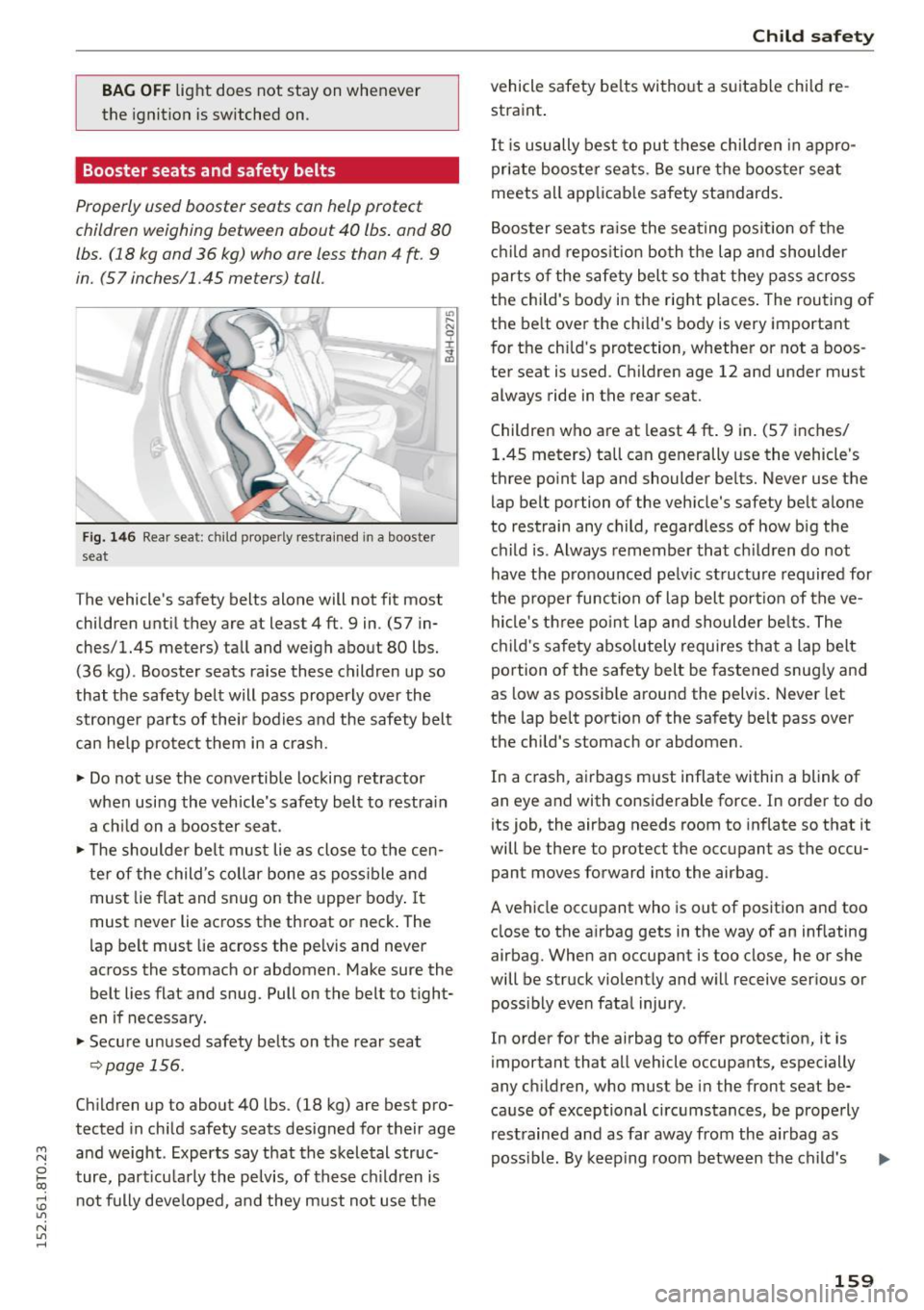
Fig. 1 46 Rea r seat : child p roper ly rest ra ined in a booster
seat
The vehicle's safety belts alone will not fit most
children until they are at least4
ft. 9 in . (57 in
ches/1.45 meters) tall and weigh about 80 lbs.
(36 kg). Booster seats raise these children up so
that the safety belt will pass properly over the
stronger parts of their bodies and the safety belt
can he lp protect them in a crash.
.,.. Do not use the convertible locking retractor
when using the vehicle's safety belt to restra in
a ch ild on a booster seat .
.,.. The shoulder be lt must lie as close to the cen
ter of the child's collar bone as poss ible and
must lie flat and snug on the upper body .
It
must never lie across the throat or neck. The
l ap belt must lie across the pe lvis and never
across the stomach or abdomen . Make sure the
belt lies flat and snug. Pull on the belt to tight
en if necessary.
.,.. Secure unused safety belts on the rear seat
<=> page 156.
Children up to about 40 lbs. (18 kg) are best pro
tected in ch ild safety seats des igned for their age
and weight . Experts say that the skeletal struc
ture, part icu larly the pe lvis, of these ch ildren is
n ot fully deve loped, and they m ust not use t he
Chil d sa fe ty
vehicle safety be lts without a suitable chi ld re
straint .
It is usually best to put these chi ldren in appro
priate booster seats. Be sure the booster sea t
meets a ll applicab le safety standards.
Booster seats ra ise the seating posit ion of the
c h ild and re pos it ion bo th the lap and shoulder
parts of the safety belt so that they pass across
the child's body in the right places . The routing of
the be lt over the child 's body is very important
for the ch ild's protection, whether or not a boos
ter seat is used. Children age 12 and under must
always ride in the rear seat.
Children who are at least 4
ft . 9 in. (57 inches/
1.45 meters) tall can generally use the vehicle's
three po int lap and shoulder be lts. Never use the
lap belt portion of the vehicle's safety belt a lone
to restrain any child, regardless of how big the
c hi ld is. Always remember that ch ildren do not
have the pronounced pe lv ic st ructu re required for
the proper func tion of lap belt port io n of the ve
hicle 's th ree po int l ap and shoulder be lts. The
ch ild 's sa fety abso lutely requires that a lap belt
portion of the safety belt be fastened snug ly and
as low as possib le around the pelvis . Never let
the lap belt portion of the safety belt pass over
the child's stomach or abdomen.
In a crash, airbags must inflate within a blink of
an eye and with considerable force. In order to do
its job, the airbag needs room to inflate so that it
will be there to protect the occupant as the occu
pant moves forward into the airbag .
A vehicle occ upant who is out of position and too
close to the a irbag gets in the way of an inflating
airbag. When an occupant is too close, he or she
will be struck violently and w ill receive serious or
poss ibly even fata l injury .
In order for the airbag to offer protection, it is
important that all vehicle occupants, especially
any children, who must be in the front seat be
cause of exceptional circumstances, be properly
rest rained and as far away from the airbag as
poss ible. By keep ing room between th e ch ild's
II>-
159
Page 172 of 264
Smart Technolog y
shared, ple ase see your contract with the
wireless telecommunications provider and the "About Aud i connect" tab in your vehicle's
MMI*:
I MENU ! button > Audi connect > About
Audi conne ct .
Electronic Stabilization
Control (ESC)
Description
ESC helps to improve road holding and vehicle
dynamics to help reduce the probability of sk id
d ing and loss of veh icle control.
It works only
when the engine is runn ing . ESC detects certain
d ifficult driving situations, including when the ve
h icle is beginn ing to sp in (yaw) out of control and
he lps you to ge t the vehicle back u nder cont rol by
selectively braking the wheels, and/or reducing
engine power and providing steering assistance
to help hold the vehicle on the driver's intended
course. The indicator light
liJ in the instrument
cluster blinks when ESC is taking action to help
you control the veh icle.
ESC has limitations. It is important to remember
that ESC cannot overcome the laws of physics. It
will not always be able to help out under all con
d itions you may come up against. For example,
ESC may not always be able to help you master
situations where there is a sudden change in the
coefficient of friction of the road surface. Whe n
there is a section of d ry road that is s uddenly cov
ered wi th wa ter, s lush or snow, ESC cannot per
form the same way it wou ld on the d ry surface . If
the vehicle hydroplanes (rides on a cushion of wa
ter instead of the road surface), ESC wi ll not be
ab le to he lp you steer the veh icle because contact
with the pavement has been i nterrupted and the
ve hicle cannot be braked or steered. Dur ing fast
cornering, particula rly on w inding roads, ESC
cannot a lways deal as effect ively with d iff icu lt
d riving situat ions than at lower speeds. When
towing a trailer, ESC is not able to he lp yo u regain
con trol as it wou ld if yo u were not towing a trail
er .
A lways adjust you r speed and dr iving style to
road, traffic and weather conditions. ESC cannot
override the vehicle's physical limi ts, increase the
170
available traction, or keep a vehicle on the road if
road departure is a result of driver inattention .
Instead, ESC improves the possibility of keeping
the ve hicle under control and on the road dur ing
extreme maneuvers by using the dr iver's steering
i nputs to help keep the vehicle going in the in
tended direction. If you are traveling at a speed
that causes you to run off the road before ESC
can p rov ide any assistance, you may not expe ri
ence the benefi ts of ESC.
ESC is switched o n all the time. In ce rtain s itua
tions when you need less traction, you can switch
off ASR by p ress ing the button [!]¢
page 171,
fig. 153 or ¢page 171, fig. 154. Be s ure to
swi tch ASR on again when you no longe r need
l ess traction .
The following system s are integrated in the ESC:
Anti- lock braking s ystem (ABS )
ABS prevents the wheels from locki ng up when
braking. The vehicle ca n still be steered even dur
i ng hard braki ng . Apply steady pressure to the
brake pedal. Do not pump t he pedal. A pu lsing in
t h e b ra ke peda l ind icates that the system is he lp
i ng yo u to b ra ke the vehicle.
Brake assist system
The brake ass ist system can decrease brak ing dis
ta nce. It increases braking power when the d river
presses the bra ke peda l quickly in emergency sit
u at ions. You must press and hold t he b ra ke peda l
u nt il t he s ituation is ove r. In vehicles with adap
tive cru ise contro l*, the bra ke assist system is
more sensitive if the distance detected to the ve
hicle ahead is too sma ll.
Anti-slip regulation (ASR )
ASR reduces eng ine power when the d rive wheels
begin to spi n and adap ts the force to the ro ad
cond it ions . This makes it eas ie r to start, acce le r
ate and drive up hills.
Electronic differential lock (EDL)
The EDL bra kes whee ls that a re spinn ing and
t ransfers the dr ive power to the othe r drive wheel
o r whee ls if the ve hicle is equippe d wi th a ll-wheel
drive*. T his function is not available at higher
speeds .
Page 173 of 264
M N
0 loo
rl I.O
"' N
"' rl
In extreme cases, EDL a utomatica lly switches off
to help keep the brake on the braked whee l from
overheating. EDL w ill switch on again automati
cally when conditions have returned to normal.
Steering re commendat ion
The ESC helps to stabilize the ve hicle by chang ing
the steering torque.
I n vehicles with dynamic steeri ng*, ESC also
h e lps to stabilize the steering in critical s itua
tions .
Electronic interaxle differential lock* /
sel ectiv e wheel torque control*
The electron ic in teraxle d iffe ren tial lock (front
wheel drive) or the selective wheel torq ue contro l
(all wheel drive) operates when driving through
curves. The front whee l on the ins ide of the cu rve
or both whee ls on the inside of the curve are
braked selectively as needed. Thi s allows more
precise driving in curves. The applicable system
may not activate when driving in wet or snowy
conditions .
_&, WARNING
- The ESC and its integrated systems cannot
overcome the laws of physics. This is espe
ci al ly impo rtant on slippe ry or wet roads. If
the sys tems begin acting to stabilize your
Switching on/off
Smart Technology
veh icle, you shou ld immediately change
your speed to matc h the road and traffic
conditions. Do not let the increased safety
provided by these systems tempt you to
take risks . Do ing so will increase the risk of a
loss of vehicle control, collision and serious
personal injuries.
- Always adapt your speed to road, traffic and
weather conditions. The risk of losing con
trol of the vehicle inc reases when dr iving
too fast, espec ially through curves and on
slippery or wet roads, and when dr iving too
close to vehicles up ahead . The ESC and its
integrated systems cannot a lways prevent
coll isions -there is sti ll a risk of accidents!
- Always accelerate with special care on even,
smooth su rfaces such as those that are wet
or covered with ice and snow. The drive
wheels can spin even with these assistance
systems that can not always help to reduce
the risk of loss of vehicle cont rol.
{!) Tips
-ABS and ASR only work correct ly when a ll
four wheels are equipped w ith ident ica l
tires. Different tire sizes can lead to a reduc
tion in engine power.
- You may hear noises when the systems de
scribed are working.
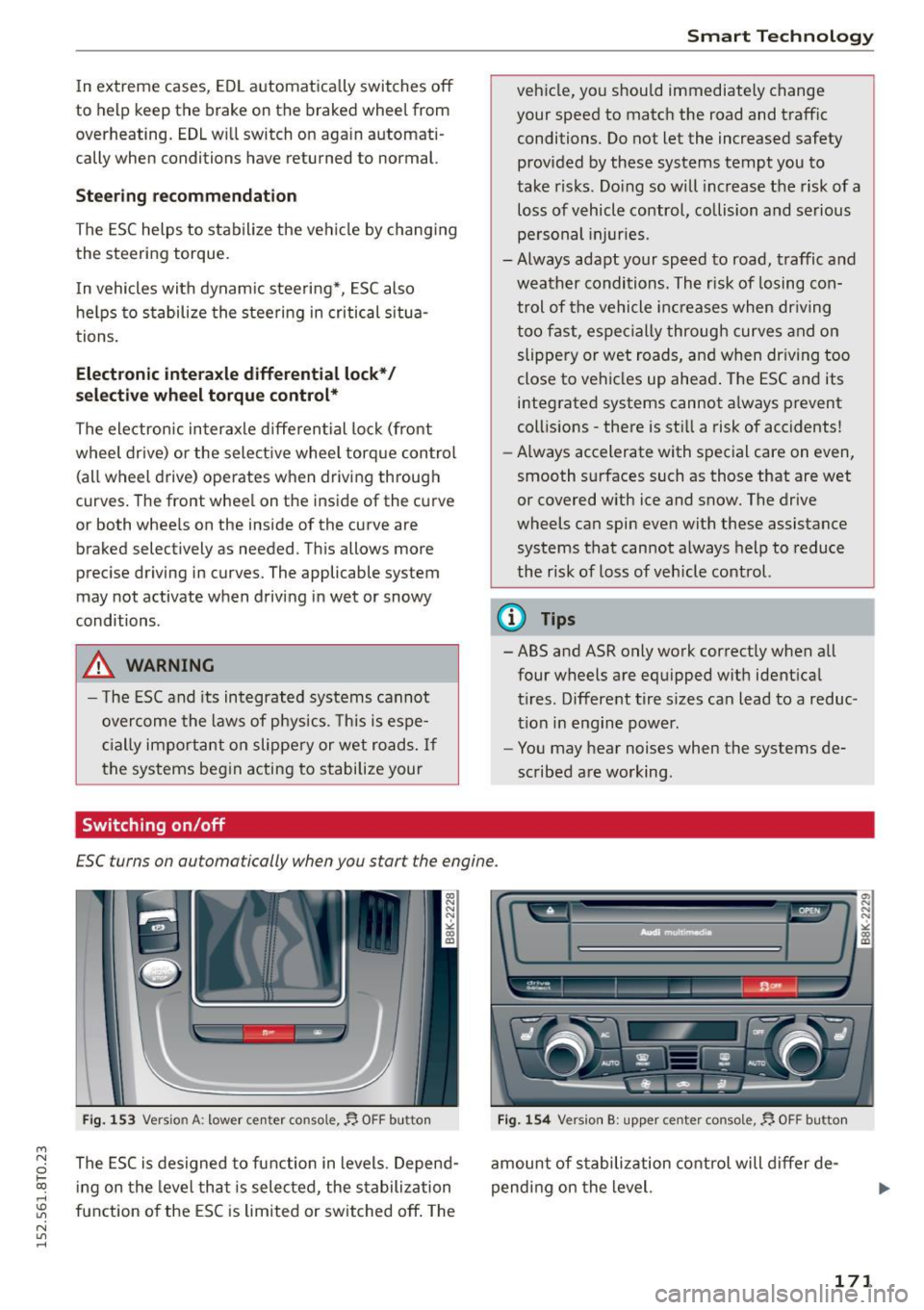
ESC turns on automatically when you start the engine.
Fig. 153 Version A: lowe r ce nter console,~ OFF button
The ESC is designed to function in levels. Depend
i ng on the level that is selected, the stabilization
function o f the ESC is limited or switched off . The
F ig. 154 Versio n B: uppe r ce nter console,~ OFF button
amount of s tabilization control will differ de
pend ing on the level.
a, N N N ,.: CX) m
171
Page 183 of 264

M N
i? co ,...., \!) ..,.,
N ..,., ,....,
Trailer mode Driving with a trailer
General information
Your Audi was designed primarily for passenger
transportation.
If you plan to tow a tra iler, p lease remember that
the additiona l load will affect durability, econo
my and performance .
T railer towing not on ly places more stress on the
vehicle, it also calls for more concentrat ion from
the driver .
F or this reason, a lways fo llow the operating and
d riving instructions provided and use common
sense.
Technical requirements
Traile r hitch
Use a weight-carrying hitch conforming to the
gross trailer weight. The hitch must be suitable
for your vehicle and trailer and must be mounted
securely on the veh icle 's chassis at a technically
sound
location . Use on ly a tra iler hitc h with a re
movable ba ll mou nt. Always chec k w ith the t ra il
e r hitch m anu fac tur er to make sure that you a re
using the co rrec t hitch.
Do not use a bumper hitch .
The hitch must be installed in such a way that it
does not in terfere with the impact-absorbi ng
bumper system. No mod ificat ions should b e
mad e to the vehicle exhaust and brake systems .
Fr om time to t ime, c hec k t hat a ll h itch mou nti ng
bo lts remain sec urely fastened .
When you are no t tow ing a trailer,
remove the
trai ler hitch ball mount . Th is prevents the hitc h
fr om caus ing damage should you r vehicle be
s truck from behind¢,&. .
Trailer brakes
If yo ur tra iler is equipped w it h a braking system,
check to be s ure that it conforms to all regu la
tions.
Trailer mode
T he trailer hyd raulic brake system must not be di
rect ly connected to the ve hicle's hydraulic b rake
system ¢.&. .
Safety chains
Alw ays use s afety ch ains be tween your ve hicle
and t he tra ile r.
Trailer lights
Tra ile r li ghts must meet all regulations. Be sure
to check w it h your author ized Audi deal er for cor
r e ct w iring, sw itches, and relays.
Mirrors
If you are unable to see the traffic behind you us
i ng the regular o uts ide mirrors, then you
must in
sta ll extended mirrors .
It is importa nt that you
always have clea r vision to the rea r.
_&. WARNING
- I f a trai ler has elec trical brake s please note
th at these b ra kes are not acti va ted by the
factory -fitted contro l unit -ris k of acci dent!
- After removing the t railer hi tch, do n ot store
it in your vehicle . In case o f su dden braking,
the hi tch could fly forward and injure you or
your passe ngers.
Operating instructions
Maximum traile r weight
A trai ler for you r vehicle is limited to a typical
class 1 or class 2 trailer.
Trailer load distribution
B e sure the load in the t ra iler i s held secure ly in
pla ce to prevent it from sh ifting forw ard , back
war d or sideways .
Never allow a passenger to ride in a trailer¢.&.
in Driving in struc tion s on page 182.
Engine cooling system
Towing a trailer makes the engine work harder . It
is important that the cooling system's pe rform
ance is up to the additional load . Ma ke s ure that
t h e coo ling system has enoug h fluid.
IIJJ,
181
Page 185 of 264
Trailer mode notes
Important to know
Your vehicle hand les differently when tow ing a
trailer because of the additional weight and dif
ferent weight distribution. Safety, performance
and economy will greatly depend on how careful
ly you load your trailer and operate your rig.
Before you actually tow your trailer, practice
turning, stopping and backing up in an area away
from traffic. Keep practicing until you have be
come completely familiar with the way your vehi
cle-trailer combination behaves and responds.
Backing up is difficult and requires practice. Back
ing up with a trailer generally requires steering
action opposite to that when backing up your ve hicle without a trailer .
Maintain a greater distance between your vehicle
and the one in front of you. You wi ll need more
room to stop. To compensate for the trailer, you
will need a larger than normal turning radius.
When passing, remember that you cannot acce l
erate as fast as you normally would because of
the added load. Make sure you have enough room
to pass. After passing, allow plenty of room for
your trailer before changing lanes again.
Avoid jerky starts, sharp turns or rapid lane
changes.
(D Tips
- Do not tow a trailer during the break-in peri
od of your vehicle.
- If you tow a trailer, your A udi may require
more frequent maintenance due to the ex
tra load
¢ page 244 .
Parking on a slope
Do not park on a slope with a trailer. If it cannot
be avoided, do so only after doing the following:
When parking:
~ .. Apply the foot brake.
~ .. Have someone place chocks under both the ve-
~ hide and the trailer wheels . ..,.,
N ..,., ,....,
Trailer mode
.. With chocks in place, slowly release the brakes
until the wheel chocks absorb the load.
.. Turn the whee ls towards the curb .
.. App ly the parking brake.
.. Place an automatic transmission* in P, respec
tively a manual transmission in first or reverse
gear .
When restarting after parking:
.. App ly the foot brake.
.. Start the engine.
.. Move the selector lever to D/S, respectively a
manual transmission in first gear .
.. Release the parking brake and slowly pull out
and away from the wheel chocks.
.. Stop and have someone retr ieve the wheel
chocks .
(D Tips
If you move the selector lever of the automat
ic transmission* to P before applying the
parking brak e and before blocking the wheels,
you may have to use more force later to move
the lever out of the P position.
183
Page 202 of 264
Checking and F ill in g
The brake fluid reservoir is located at the rear
partition of the engine compartment on t he left
side
c!,> page 193.
The fl uid level may drop slightly after some time
due to the automatic adjustment of the brake
pads. This is not cause for alarm.
If the b ra ke fluid level fal ls considerably below
the "MIN" mark, the brake warn ing/indicator
light (U.S. models:
1111 , Canadian models: . )
will come on
c!,> page 15 . Do not contin ue to oper
ate the vehicle . The complete brake system
should be thoroughly checked by an author iz ed
Aud i dealer or qualified workshop and the cause
corrected . If the brake fluid level is too low, the
brake warning/ind icator light w ill illuminate .
Contact an authorized Audi dealer
i mmed iately .
{D) Tips
The brake fluid reservoir is located under
neath the cove r.
Changing brake fluid
Have the brake fluid changed by an experienced
technician .
Brake fluid absorbs moist ure from the a ir. If the
water content in the brake fluid is too high, cor rosion in the brake system may result after a peri
od of time . The boiling point of the brake flu id
w ill also decrease conside rably and dec rease
b rak ing perfo rmance.
Therefore, the brake flu id must be changed
e ve ry
two year s.
Always use new brake fluid w hich con
forms to Fede ral Motor Vehicle Standard "FMVSS
1 16 DOT 4".
The brake fluid rese rvoir can be difficult to reach,
therefo re , we recommend that you have the
b rake fluid changed by your author ized
Audi
dealer .
Your dealer has the correct too ls , the
right brake fluid and the know-how to do t his for
you.
A WARNING
- B rake fluid is poisonous. It must be stored
on ly in the closed original container out of
the reach of children!
200
- Brake fail ure can resu lt from o ld or inappro
priate brake fluid. Observe these precau
tions:
- Use only b rake fluid that meets SAE spec i
f ica tion
J 170 3 and conform s to Federa l
Motor Vehicle Standard 116. Always check
with yo ur autho rized Audi dea le r to make
su re you are using the correct brake fl uid.
The correct type of brake flu id is also ind i
cated on the brake fluid reservoir.
- The brake fl uid must be new. Heavy use of
the brakes can cause a vapor lock if the
brake f luid is left in the system too long.
This can seriously affect the efficiency of
the brakes as well as your safety. This
could result in an acc ident.
(D Note
Brake fluid will damage the paint of your vehi
cle.
@ For the sake of the env ironment
Because of the prob lem of prope r disposal of
brake fluid as well as the special tools re
qu ired and the necessary expert ise, we rec
omme nd that you have the brake flu id
changed by you r autho rized Aud i dea le r.
Battery
, General information
U nder normal operating conditions, the battery
i n your Audi does not need any maintenance.
Wi th
high outside temperatures or long daily
drives we recommend that you have the e lectro
lyte level checked by an a uth orized Aud i deale r o r
qualified workshop . The electrolyte leve l should
a lso be checked each time the batte ry is c ha rged
c:!,> page 202.
Have the battery checked when yo u take your ve
hicle in for service . You a re well adv ised to re
pla ce a battery that is older tha n 5 years.
With certain types of airbag deployment, the bat
te ry is disconnected from the veh icle elect rical
system for safety reasons
c:!,> & in Repair, care
and disposal of the airbags on page 1 42.
Page 203 of 264
M N
i? co ,...., \!) 1.1'1
N 1.1'1 ,....,
Disconnecting the battery terminals
Some vehicle functions (power window regula
tors , for example) are lost if the battery termi
nals are disconnected. These functions have to be
re learned after th e battery terminals are con
nected again. To prevent this, the batte ry should
only be disconnected from the ve hicle electrical
system when absolutely necessary for repairs.
Vehicles not driven for long periods
If you do not drive your vehicle over a period of
several days or weeks, e lectrica l components are
gradually cut back or switched off. This reduces
energy consumption and maintains starting ca pability over a longer period
c:> page 175 .
Some of the conven ience functions may not oper
ate, such as the interior lights or the power seat
adjustment. The convenience functions will be
available aga in when you turn on the ignition and
start the engine.
Winter operation
During the winter months, battery capacity tends
to decrease as temperatures drop. This is because
more power is also consumed while s tart ing, and
the headlights, rear window defogger, etc ., are
used more often .
Avoid unnecessary power consumption, part icu
larly in city traffic or when traveling only short
d istances . Let your authorized Aud i dealer check
the capacity of the vehicle battery before w inter
sets in ¢
page 202 . A well charged battery will
not only prevent starting problems when the
weather is cold, but will also last longer.
(D Tips
If your vehicle is left standing for severa l
weeks at extremely low temperatures, the ve
hicle battery should be removed and stored
where it will not freeze. This will prevent it
from being damaged and having to be re placed.
Checking and Filling
Working on the battery
Be especially careful when working on or near
the battery.
The battery is located in the luggage compart
men t under the floor. Before you check anything
in the luggage compartment ,
read and heed all
WARNINGS
c:> .&_ .
Always heed the safety warnings, when working
on the vehicle battery or the vehicle electr ical
system to prevent injury .
The following WARNINGS are very important
when working on the battery :
Always heed the following WARNING SYM-
BOLS and safety precautions when working on
the battery.
®
Always wear eye protection.
A
Battery acid contains sulfuric acid. Al-
ways wear gloves and eye protection.
@
No
- sparks
- flames
- smoking.
~
When a battery is charged, it produces
hydrogen gas which is explosive and
could cause personal injury.
®
Always keep the battery well out of reach
of children.
A WARNING
= -
Whenever working on the battery or on the
e lectr ical system, there is the risk of injury,
accident and even f ire. Read and heed the fol
lowing WARNINGS:
- Always wear eye protection . Do not let bat
tery ac id or any lead particles get on your
skin or clothing. Shield your eyes. Exp losive
gases can cause blindness or other in jury.
- Battery acid conta ins sulfuric acid . Sulfuric
acid can cause blindness and severe burns.
- Always wear g loves and eye protection. Do
not tilt the battery because acid could leak
out of the ventilation openings. ...,
201
Page 215 of 264
_& WARNING -
-Only use tire/rim combinations and suitable wheel bolts
that have been approved by
Audi. Otherwise, damage to
the vehicle and an accident
could result.
- For technical reasons, it is not
possible to use tires from oth
er vehicles -in some cases,
you cannot even use tires from
the same vehicle model.
- Make sure that the tires you
select have enough clearance
to the vehicle. Replacement
tires should not be chosen simply based on the nominal
size, because tires with a dif
ferent construction can differ
greatly even if they are the
same size. If there is not
enough clearance, the tires or
the vehicle can be damaged
and this can reduce driving
safety and increase the risk of
an accident.
-Only use tires that are more
than 6 years old when abso
lutely necessary and drive
carefully when doing so.
-If you install wheel covers on
the vehicle, make sure they al low enough air circulation to
Wheels
cool the brake system. If they
do not, this could increase the
risk of an accident.
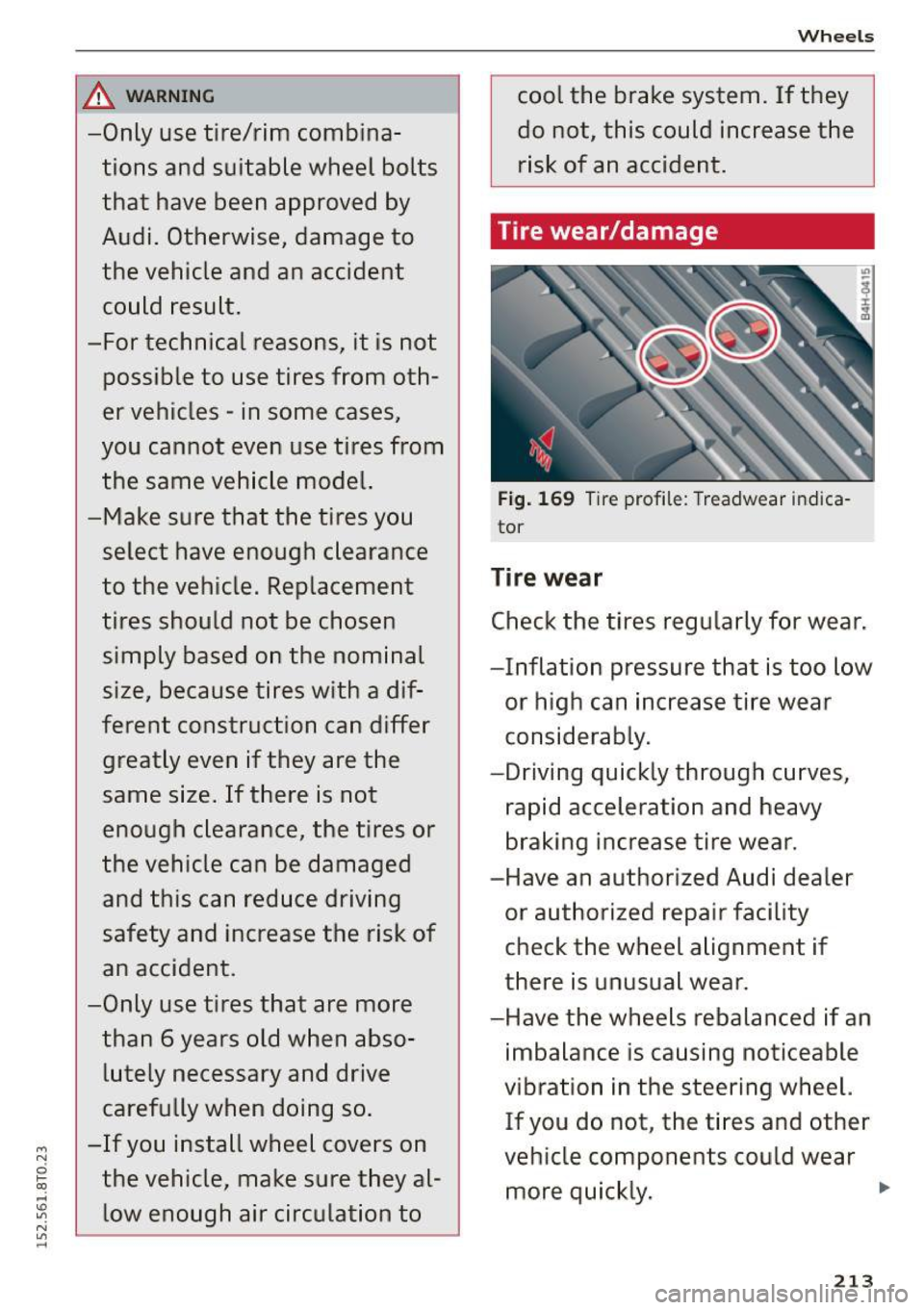
Tire wear/damage
Fig. 169 Tire profile: Treadwear indica
tor
Tire wear
Check the tires regularly for wear.
- Inflation pressure that is too low
or high can increase tire wear
considerably.
-Driving quickly through curves,
rapid acceleration and heavy
braking increase tire wear.
- Have an authorized Audi dealer
or authorized repair facility
check the wheel alignment if
there is unusual wear.
-Have the wheels rebalanced if an imbalance is causing noticeable
vibration in the steering wheel. If you do not, the tires and other
vehicle components could wear more quickly.
213
...
Page 225 of 264

also reduces fuel efficiency and tire tread life,
and may affect the vehicle's handling and stop
ping ability .
Please note that the TPMS is not a substitute for
proper tire maintenance, and it is the driver's re
sponsibility to maintain correct tire pressure,
even if under-inflation has not reached the level
to trigger illumination of the TPMS low tire pres
sure telltale.
Your vehicle has also been equipped with a TPMS malfunction indicator to indicate when the sys
tem is not operating properly. The TPMS mal
function indicator is combined with the low tire pressure telltale . When the system detects a
malfunct ion, the telltale will flash for approxi
mately one minute and then remain continuously
illuminated. This sequence will continue upon
subsequent veh icle start-ups as long as the mal
function exists.
When the malfunction indicator is illuminated,
the system may not be able to detect or signal
low tire pressure as intended. TPMS malfunctions
may occur for a variety of reasons, including the
installation of replacement or alternate tires or
wheels on the vehicle that prevent the TPMS
from functioning properly. Always check the
TPMS malfunction telltale after replacing one or more tires or wheels on your vehicle to ensure
that the replacement or alternate tires and
wheels allow the TPMS to continue to function properly.
Wheels
If the Tire Pressure Monitoring System
indicator appears
Appl ies to vehicles : wi th t ir e p ress ure mo nito rin g system
The tire pressure indicator in the instrument
cluster informs you if the tire pressure is too low
or if there is a system malfunction.
Fig. 172 Instrument cluster: i ndicator light with message
Using the ABS sensors, the tire pressure monitor
ing system compares the tire tread circumference
and vibration characteristics of the individual
tires .
If the pressure changes in one or more
tires, this is indicated in the instrument cluster
display with an indicator light
[I] and a message .
If only one tire is affected, the location of that
tire will be indicated .
The tire pressures must be stored in the Infotain
ment system again each time the pressures
change (switching between partial and full load
pressure) or after changing or replacing a tire on
your vehicle ¢
page 224. The tire pressure moni
toring system only monitors the tire pressure you have stored. Refer to the tire pressure label for
the recommended tire pressure for your vehicle
r=> page215, fig.171.
Tire tread circumference and vibration character
istics can change and cause a tire pressure warn
ing if:
- the tire pressure in one or more tires is too low .
- the tire has structural damage.
- the tir e was replaced or the tire pressure was
changed and it was not stored ¢
page 224.
-the spare t ire* is installed.
Indicator lights
[I] Loss of pressure in at least one tire¢.& .
Check the tires and replace or repair if necessary .
liJJ,-
223
Page 235 of 264
M N
0 loo
rl I.O
"' N
"' rl
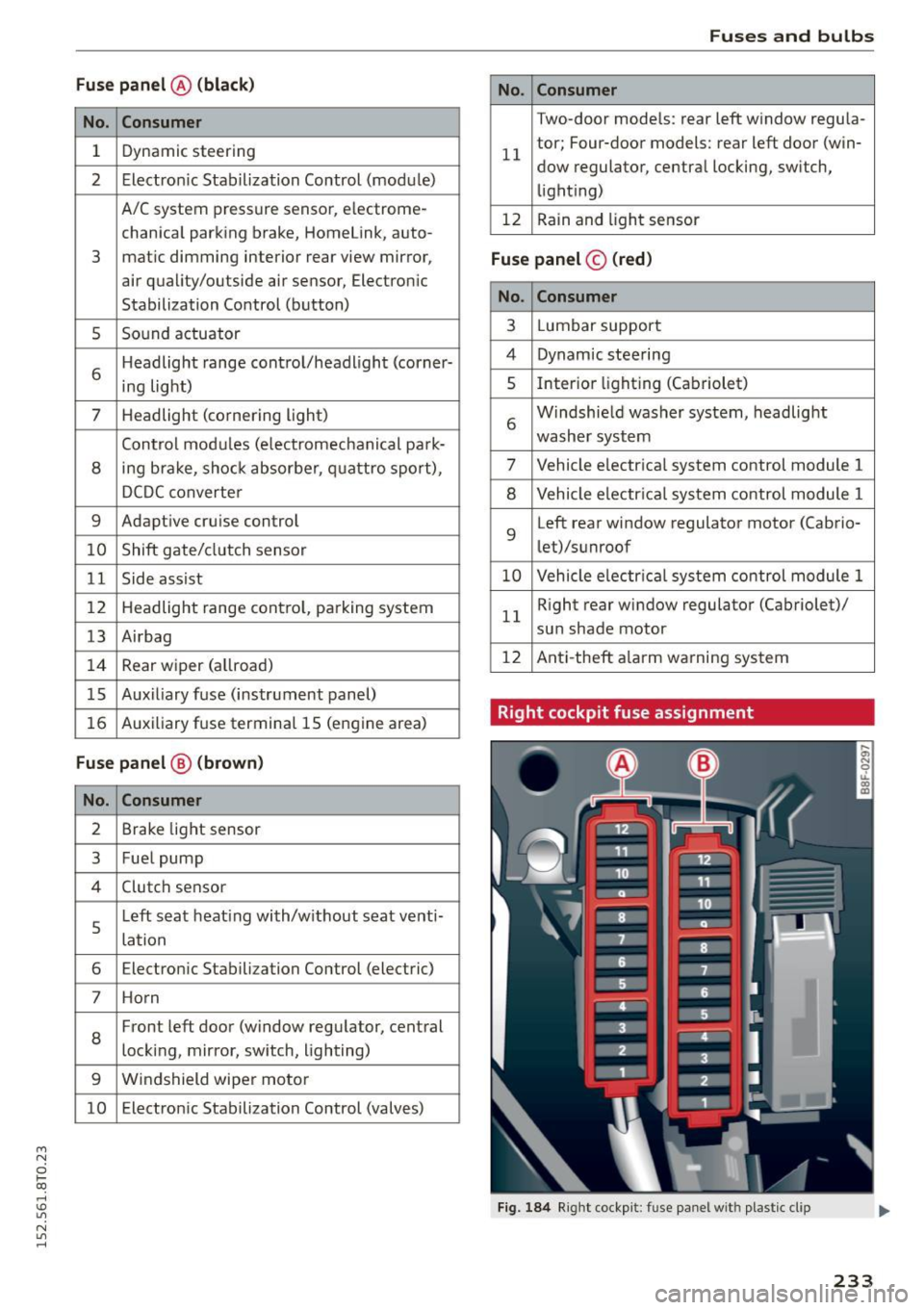
Fu se pa nel @ (black )
No. Consumer
1 Dynamic steering
2 Electron ic Stabilization Control (module)
A/C system pressure sensor, electrome-
chanical parking brake, HomeLink, auto-
3 mat
ic dimming interior rear view mirror,
air quality/outside air sensor, Electron ic
Stabilization Control (button)
s Sound actuator
6 Headlight range control/headl
ight (corner-
ing light)
7 Headlight (cornering light)
Control modu les (electromechanical park-
8 ing brake, shock absorber, q uattro sport),
DCDC converte r
9 Adaptive
cruise control
10 Shift gate/clutch sensor
11 Side assist
1 2 Headlight range cont ro l, parking system
13 Airbag
14 Rear
wiper (a llroad)
15 Auxiliary fuse (instrument panel)
16 Auxiliary
fuse termina l 15 (engine area)
Fuse p anel @ (brown )
No. C onsumer
2 Brake light sensor
3 Fuel pump
4 Clutch sensor
5
Left seat heating with/without seat venti-
lation
6 Electronic Stabilization Control (electric)
7 Ho rn
8
Front left door (window regulator, central
locking, mirror, switch, lighting)
9 Windshield wiper motor
10 Electronic Stabilization Control (valves) Fu
ses a nd bulb s
No. Consumer
Two-door mode ls: rear left window regula-
11 tor; Four-door
models: rear left door (win-
dow regulator, central locking, switch,
light ing)
12 Rain and l
ight sensor
Fuse panel © (r e d )
No . Con sumer
3 Lumbar support
4 Dynamic steering
5 Inter
ior l ight ing (Cabriolet)
6 Windshie
ld washer system, headlight
washer system
7 Vehicle electrica l system control module 1
8 Vehicle electr ica l system control module 1
9 Left rear
window regulator motor (Ca brio-
let)/su nroof
10 Vehicle electr ica l system co ntrol module 1
11 Right rear
window regulator (Cabriolet)/
sun shade motor
12 Anti-theft
alarm warning system
Right cockpit fuse assignment
Fig. 184 Right cockpit: fu se panel with plastic cl ip
233