wheel AUDI A5 2015 Owner´s Manual
[x] Cancel search | Manufacturer: AUDI, Model Year: 2015, Model line: A5, Model: AUDI A5 2015Pages: 264, PDF Size: 66.83 MB
Page 174 of 264

Smart Technology
The following situations are exceptions where it
may be usefu l to switch on sport mode to allow
the wheels to spin : -
Rocking the vehicle to free it when it is stuck
- Driv ing in deep snow or on loose ground
- Dr iv ing with snow chains
Sport mode on ESC/ASR off Sport mode off or
ESC /ASRon
Behavior
The ESC and ASR stabiliza- The stabilization funct ion is The full stabilization func-
tion fu nct ions are limited not
available¢ ,&.. ESC and
tion of the ESC and ASR is
¢ ,&. .
ASR are switched
off. available again.
Operation Press the I!> OF F! button Press and hold the I!> OF FI Press the I!> OF F! button
briefly . button longer than 3 sec-again.
onds .
Indicator II turns on. JI and lf'lii•li~ turn on. II turns off or II and
lights lf'lii•l~~ turn off.
Driver mes- Stabilization control (ESC): Stabilization control (ESC): Stabilization control
sages Sport. Warning! Re stricted off. Warning! Restricted (ESC):
On
stability stability
It is only possible to turn off the ASR up to 30
mph (SO km/h) for veh icles wi th front whee l
drive . At about
45 mph (70 km/h) it automatica l
ly turns on again. It is possible to turn
off the
ASR at any speed for vehicles with all whee l
drive.
A WARNING
-
You should only sw itch sport mode on or
switch ESC/ASR
off if your driving ab ilities and
road condit io ns perm it .
- The stabilization function is limited when
sport mode is switched on. The dr iv ing
wheels could spin and the veh icle cou ld
swerve, especially on slick or slippery road
surfaces.
- There is no vehicle stabilization when ESC/
ASR are switched
off.
(D Tips
ESC/ASR cannot be switched off or sport
mode cannot be switched on when cruise con
trol or adaptive cru ise control* is sw itched on .
172
Braking
What affects broking efficiency?
New brake pads
During the first 250 miles (400 km), new brake
pads do not possess their full braking effect, they
have to be "broken in" first¢,&. . You can com
pensate for this slightly reduced braking power
by pushing harder on the brake pedal. Avoid
heavy braking loads during the break-in period.
Operating conditions and driving habits
The brakes on today's automobiles are still sub
ject to wear, depending largely on operating con
ditions and driving habits~,&. . On vehicles that
are either driven most ly in stop-and -go city traf
fic or are driven hard, the brake pads should be
checked by your authorized Audi dealer more of
ten than specified in the
Warranty & Mainte
nance booklet .
Failure to have your brake pads
i nspected can result in reduced brake perform
ance .
On steep slopes, you should use the braking ef
fect of the engine . This way, you prevent unnec
essary wear on the brake system. If you must use
your brakes, do not hold the brakes down contin
uously. Pump the brakes at intervals.
Page 175 of 264
Operating noise
Noises may occur when braking depending on the
speed, braking force and outside conditions such
as temperature and humidity.
Effect of water and road salt
In certain situat ions, for example after driving
through water, in heavy ra in, after overn ight con
densat ion or after washing your car, the braking
effect can be reduced by moisture or ice on the
brake rotors and brake pads. The brakes must be
dried first with a few carefu l brake applications.
At higher speeds and with the w indshie ld w ipers
turned on, the brake pads press against the brake
rotors for a short amount of time. This occurs at
regular intervals without the driver noticing and
provides for better brake response time under
wet conditions.
The effectiveness of the brakes can be reduced
when the vehicle is driven on a salt-covered road
and the brakes are not used. Likewise, you clean
off accumulated salt coating from brake discs
and pads with a few cautious applications of the
brake ¢.& .
Corrosion
There may be a tendency for dirt to build up on
the brake pads and corros ion to form on the discs
if the car is not driven regularly or only for short
tr ips with little use of the brakes.
If the brakes are not used frequently, or if corro
sion has formed on the discs, it is advisab le to
clean off the pads and discs by braking firmly a
few t imes from a moderately high speed¢.&.
Faults in the brake system
If you should notice a sudden increase in brake
pedal trave l, then one of the two brake circuits
may have failed
c:> .& .
Low brake fluid level
Malfunctions can occur in the brake system if the
brake fluid level is too low. The brake fluid leve l is
~ monitored e lectronically.
i? co ,...., \!) ..,.,
N ..,., ,....,
Smart Technology
Brake booster
T he brake booster increases the pressure that you
generate w ith the brake pedal.
It works on ly
when the engine is running
.c:> .&
Brake lining wear status
Brake lining wear may be checked by visual in
spect ion of the condition of the brake pads
through the openings in the wheel. If necessary,
the wheel may be removed for this inspection
c:> page 226, Replacing wheels.
_8 WARNING "'---
-New brake pads don't have the best stop
pin g power and must be "broken-in" during
the initial 250 miles (400 kilometers). You
can compensate for this by press ing the
brake pedal more firmly. This also applies
later when new pads are installed.
-
- You shou ld perform braking maneuvers for
the purpose of cleaning the brake system
only if road conditions permit. Other road
users must not be put at r isk -you may
cause an acciden t!
- Before descending a steep grade, reduce
speed and shift transmission into a lower
gear or lower driving range. Do not ride the
brakes or hold the pedal down too long or
too often . This could cause the brakes to get
hot and diminish braking efficiency.
- Do not "ride the brakes" by resting your foot
on the pedal when you do not intend to
brake. This may cause the brakes to over
heat, premature wear and increased stop
p in g distance.
- Under certain cl imatic and operat ing condi
tions such as passing through water, dr iv ing
in heavy rain or after washing the vehicle,
the effectiveness of the brakes can be re
duced. In winter, ice can accumulate on the
b rak e pads, linings, discs and drums. Care
fully apply brakes for a test. Brakes will dry
and ice coatings will be cleaned off after a
few careful brake applications.
- Driving for an extended period of time on
salt -covered roads wi thout using your
brakes can a lso affect braking efficiency .
173
Page 176 of 264
Smart Technolog y
Clean off accumulated salt coating from
brake discs and pads w ith a few carefu l
brake applications .
- If you damage the front spoiler, or if you in
stall a d ifferent spoiler, be sure the air flow
to the front brakes is not obstructed. Other
wise the brake system could overheat reduc
ing the effectiveness of the entire brake sys
tem.
- Failure of one brake c ircuit will impair the
braking capab ility result ing in an increased
stopp ing distance. Avoid driving the veh icle
and have it towed to the nearest autho rized
Audi dealer or qualified workshop.
- Never let the vehicle ro ll to a stop with the
engine shut off .
- If the brake booster is not work ing, the
brake pedal must be pressed considerably
harder to make up for the lack of booste r as
sistance .
Electro-mechanical
power assist, dynamic
steering
The electro-mechanical power assist helps the
driver when steering.
Power steering adapts electronically based on
the vehicle speed .
Indicator lights and me ssages
• Stee ring defe cti ve! D o not dr ive vehicle!
If this indicator light tu rns on and stays on and
this message appears, the power steering may
have fai led .
Do
not contin ue driving. See yo ur authorized
Aud i dealer o r a qua lified repair facility for assis
tance.
l ;r- ij Dynami c steering : S ys te m fault! You can
c on tinu e dr iving
If the indicator light turns on and the message
appears, the steer ing may be more difficult to
move or mo re sensitive than us ual. The steer ing
wheel may also be at an ang le when dr iv ing
straight.
174
Drive slowly to your authorized Audi dea ler or
qualified workshop to have the ma lf u nction cor
rected.
' -r, ij Dynamic ste ering: i nitializing
If this driver message appears and the indicator
li ght is flashing on the i nstrume nt pane l, dynam
i c steer ing* is being rein it ia lized . After sta rting
the engine, the steer ing whee l w ill move sligh tly.
Re-initialization might be necessary if the steer
ing whee l was moved hard to th e left and right
whi le the vehicle was not moving . The display
goe s out as soon as initiali zation is comp lete.
A WARNING
,-
H ave the dynamic steering* system malfunc-
tion repaired as soon as possible by an author
ized Audi dealer or qualified workshop - r isk
of accid ent!
@ Tips
- If the . or 'T fl indicator light only stays on
for a short time, you may cont inue driving.
- The dynamic steering* stab ility system s are
not availab le in the event of a system mal
function .
- For add itional information on dynamic
steering*, refer to<=> page 102 .
Driving with your quattro
Applies to vehicles : wit h all -w hee l drive
With all-wheel drive , all four wheels are driven .
General information
With a ll-wheel drive, power is distrib uted to a ll
fo ur wheels . This happens automatica lly depend
i ng on your driving style and the road conditions
at the t ime . See also <=> page 1 70 .
A center d ifferential distributes the driving power
variab ly to the front and rear ax le. It works to
gether w ith select ive whee l torque control , which
activates when drivi ng throug h curves
¢ page 171 . W ith the sport diffe rential*, power
distribution to the rear wheels is var iable and can
be ad justed with d rive select ¢ page 102 .
1111-
Page 177 of 264
M N
i? co ,...., \!) ..,.,
N ..,., ,....,
The all-wheel drive concept is designed for high
engine power . Your vehicle is exceptionally pow
erful and has excellent driving character istics
both under normal driving conditions and on
snow and ice. Always read and follow safety pre
cautions <=>
,&.
Winter tire s
When driving in the winter, your vehicle with all
wheel drive has an advantage, even with regular
tires. In winter road conditions it may be advisa
ble to mount w inter tires (or all-season tires) for
improved driveability and braking: these tires
must be mounted on
all four wheels. See also
<=> page 220, Winter tires.
Tire chains
Where tire chains are mandatory on certain
roads, this normally also applies to vehicles with
all-wheel drive <=>
page 220, Snow chains.
Replacing wheels/tires
Vehicles with all-wheel drive must a lways have
tires of the same size. Also avoid tires with differ
ent tread depths. For details see page
<=>
page 212, New tires or wheels.
Off-Road driving?
Your Audi does not have enough ground clear
ance to be used as an off-road vehicle. It is there
fore best to avoid rough tracks and uneven ter
rain as much as possible. Also refer to
<=>page 177.
A WARNING
Always adjust your driving to road and traffic
conditions. Do not let the extra safety afford
ed by all-wheel drive tempt you into taking
extra risks.
- Although the all-wheel dr ive is very effec
t ive, always remember that braking capacity
is limited by tire traction. You should there
fore not drive at excessive speeds on icy or
slippery road surfaces.
- On wet road surfaces, be careful not to dr ive
too fast because the front wheels could be
gin to slide on top of the water (aquap lan
ing). If this shou ld occur, you will have no
Smart Technology
warning from a sudden increase in engine
speed as with a front-wheel drive vehicle.
Always drive at speeds which are suited to the road conditions -risk of crash.
Energy management
Starting ability is optimized
Energy management controls the distribution of
electrical energy and thus optimizes the availa
bility of electrical energy for starting the engine.
If a vehicle with a conventional energy system is
not driven for a long pe riod of time, the battery
is discharged by idling current consumers (e.g.
i mmobil izer). In certain circumstances it can re
su lt in there being insufficient energy available to
start the engine.
Intelligent energy management in your vehicle
hand les the distribution of electrical energy.
Starting ability is markedly improved and the life
of the battery is extended.
Basically, energy management consists of
bat
tery diagnosis , idling current management
and
dynamic energy management.
Battery diagnosis
Battery diagnosis continuously determines the
state of the battery . Sensors determine battery
vo lta ge, battery current and battery tempera
tu re. This determines the current state of charge
and the power of the battery.
Idling current management
Idling current management reduces energy con
sumption whi le the vehicle is standing. With the
ignition switched off, it contro ls the energy sup
ply to the various electrical components. Data
from battery diagnosis is considered.
Depending on the battery's state of charge, indi
vidual consumers are gradually turned off to pre
vent excessive discharge of the battery and thus
maintain starting capability .
Dynamic energy management
While the vehicle is being driven, dynamic energy
management distr ibutes the energy generated ..,.
175
Page 185 of 264
Trailer mode notes
Important to know
Your vehicle hand les differently when tow ing a
trailer because of the additional weight and dif
ferent weight distribution. Safety, performance
and economy will greatly depend on how careful
ly you load your trailer and operate your rig.
Before you actually tow your trailer, practice
turning, stopping and backing up in an area away
from traffic. Keep practicing until you have be
come completely familiar with the way your vehi
cle-trailer combination behaves and responds.
Backing up is difficult and requires practice. Back
ing up with a trailer generally requires steering
action opposite to that when backing up your ve hicle without a trailer .
Maintain a greater distance between your vehicle
and the one in front of you. You wi ll need more
room to stop. To compensate for the trailer, you
will need a larger than normal turning radius.
When passing, remember that you cannot acce l
erate as fast as you normally would because of
the added load. Make sure you have enough room
to pass. After passing, allow plenty of room for
your trailer before changing lanes again.
Avoid jerky starts, sharp turns or rapid lane
changes.
(D Tips
- Do not tow a trailer during the break-in peri
od of your vehicle.
- If you tow a trailer, your A udi may require
more frequent maintenance due to the ex
tra load
¢ page 244 .
Parking on a slope
Do not park on a slope with a trailer. If it cannot
be avoided, do so only after doing the following:
When parking:
~ .. Apply the foot brake.
~ .. Have someone place chocks under both the ve-
~ hide and the trailer wheels . ..,.,
N ..,., ,....,
Trailer mode
.. With chocks in place, slowly release the brakes
until the wheel chocks absorb the load.
.. Turn the whee ls towards the curb .
.. App ly the parking brake.
.. Place an automatic transmission* in P, respec
tively a manual transmission in first or reverse
gear .
When restarting after parking:
.. App ly the foot brake.
.. Start the engine.
.. Move the selector lever to D/S, respectively a
manual transmission in first gear .
.. Release the parking brake and slowly pull out
and away from the wheel chocks.
.. Stop and have someone retr ieve the wheel
chocks .
(D Tips
If you move the selector lever of the automat
ic transmission* to P before applying the
parking brak e and before blocking the wheels,
you may have to use more force later to move
the lever out of the P position.
183
Page 187 of 264
M N
i? co ,...., \!) 1.1'1
N 1.1'1 ,....,
-To reduce the risk of cuts, protect yourself
from sharp metal components when wash
ing the underbody or the inside of the wheel
housings.
- After washing the vehicle, the braking effect
may be delayed due to moisture on the
brake rotors or ice in the w inter . The brakes
must be dried first w ith a few careful brake
applications.
(I) Note
- If you wash the vehicle in an automatic car
wash, you must fold the exterior m irrors in
to reduce the risk of damage to the mirrors. Power folding exterior mirrors* must only
be fo lded in and out us ing the power folding
f u nct ion.
- To prevent pa int damage, do not wash the
vehicle i n direct sunlight .
- To reduce the risk of damage to the surface,
do not use insect removing sponges, k itche n
sponges or similar items.
- Matte finish painted vehicle components:
- To reduce the risk of damage to the sur-
face, do not use polishing agents or hard
wax.
- Never use protective wax.
It can destroy
the matte finish effect.
- Do not place any stickers or magnetic
signs on vehicle parts painted with matte
finish pa int. The paint could be damaged
when the stickers or magnets are re
moved.
@ For the sake of the environment
On ly wash the vehicle in facilit ies specially de
signed for that purpose. This will reduce the
risk of dirty water contam inated with o il from
entering the sewer system .
Placing your vehicle out
of service
If you wou ld like to take your vehicle out of serv
ice for a longer time, contact you r authorized
Audi dealer or qualified repair facility. They will
adv ise you of important measur es, such as corro-
Care and cleaning
sion p rotection , maintenance and storage proce
dures . Also follow the information about the bat
tery
C) pag e 200.
185
Page 207 of 264
Wheels
Wheels and Tires
General information
.,.Che ck your tires regularly for
damage (punctures, cuts, cracks
and bulges). Remove foreign ob
jects from the tire tread.
.,. If driving over curbs or similar
obstacles, drive slowly and ap
proach the curb at an angle.
.,.Have faulty tires or rims re
placed immediately.
"'Protec t your tires from oil,
grease and fuel.
.,.Ma rk tires before removing
them so that the same running direction can be maintained if
they are reinstalled .
.,.Lay tires flat when storing and
store them in a cool, dry location
with as little exposure to light as
possible.
(D Note
-Please note that summer and
winter tires are designed for
the conditions that are typical
in those seasons. Audi recom
mends using winter tires dur
ing the winter months. Low
temperatures significantly de crease the elasticity of summ
er tires, which affects traction
Wheels
and braking ability. If summer
tires are used in very cold tem
peratures, cracks can form on
the tread bars, resulting in
permanent tire damage that
can cause loud driving noise
and unbalanced tires.
-Burnished, polished or
chromed rims must not be
used in winter driving condi
tions. The surface of the rims
does not have sufficient corro
sion protection for this and
could be permanently dam
aged by road salt or similar
substances.
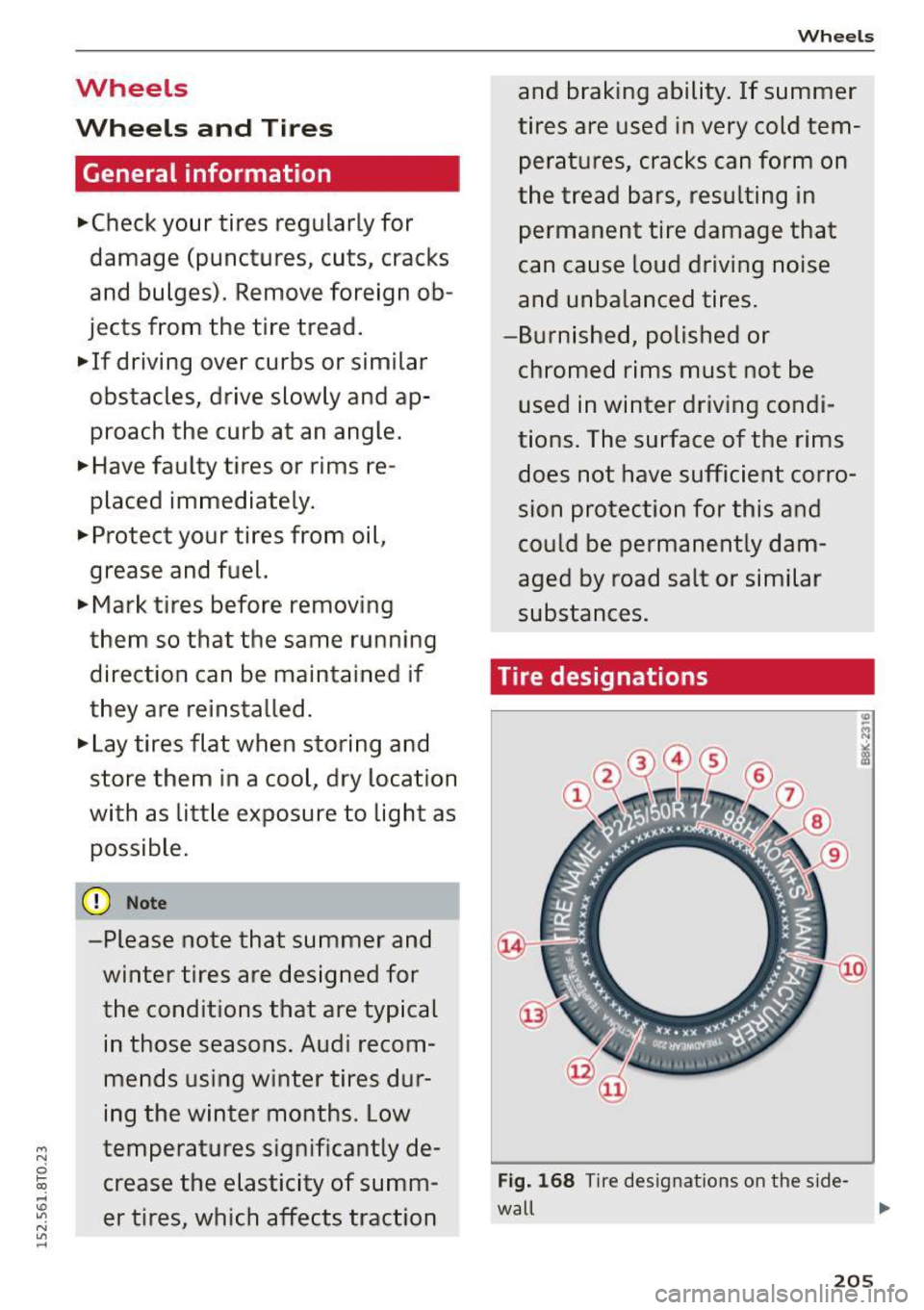
Tire designations
Fig. 168 T ir e designations on the sid e-
wall ,..
205
Page 208 of 264
Wheels
(D Tires for passenger vehicles
(if applicable)
P indicates a tire for a passenger
vehicle. T indicates a tire desig
nated for temporary use .
@ Nominal width
Nominal width of the tire be
tween the sidewalls in millime
ters . In general: the larger the
number, the wider the tire.
@ Aspect ratio
Height/width ratio expressed as a
percentage.
@ Tire construction
R indicates a radial tire.
® Rim diameter
Size of the rim diameter in inches .
@ Load index and speed rating
The load index indicates the tire's
load-carrying capacity.
The speed rating indicates the
maximum permitted speed
¢ & in
W inter tires on page 220 .
"EXTRA LOAD", "xl" or "RF" indi
cates that the tire is reinforced or
is an Extra Load tire.
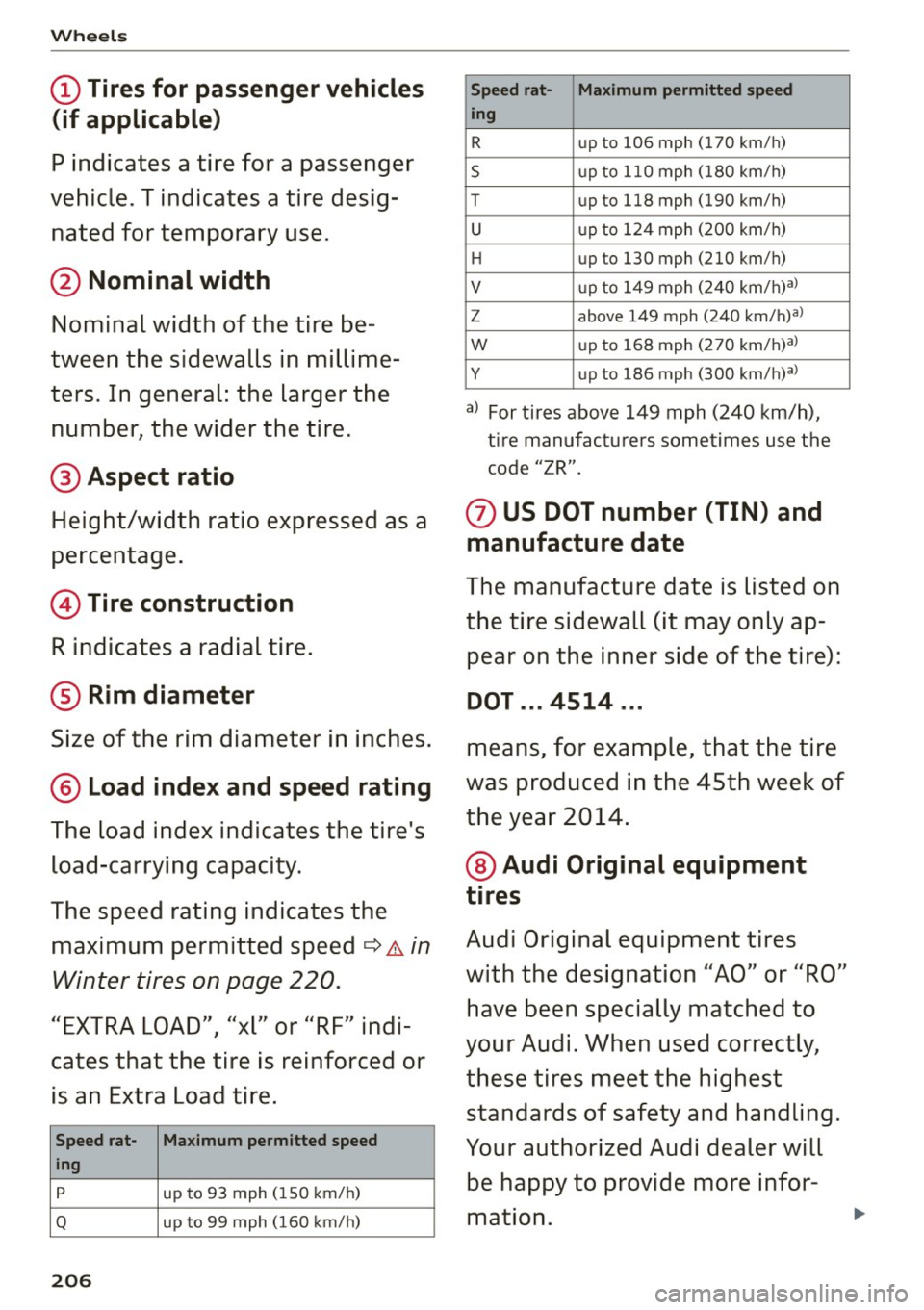
Speed rat- Maximum permitted speed
ing
p
up to 93 mph (150 km/h)
Q up to 99 mph (160 km/h)
206
Speed rat- Maximum permitted speed
Ing
R up to 106 mph (170 km/h)
s up to 110 mph (180 km/h)
T up to 118 mph (190 km/h)
u up to 124 mph (200 km/h)
H up to 130 mph (210 km/h)
V up to 149 mph (240 km/h)a>
z above 149 mph (240 km/h)a)
w up to 168 mph (270 km/h)a)
y up to 186 mph (300 km/h)a)
a) For tires above 149 mph (240 km/h),
tire manufacturers sometimes use the
code "ZR".
(J) US DOT number (TIN) and
manufacture date
The manufacture date is listed on
the tire sidewall (it may only ap
pear on the inner side of the tire) :
DOT ... 4514 ...
means , for example, that the tire
was produced in the 45th week of
the year 2014.
@ Audi Original equipment
tires
Audi Original equipment tires
with the designation "AO" or "RO"
have been specially matched to
your Audi. When used correctly,
these tires meet the highest standards of safety and handling.
Your authorized Audi dealer will
be happy to provide more infor
mation.
Page 210 of 264
Wheels
Bead
means the part of the tire that is
made of steel wires, wrapped or
reinforced by ply cords and that is
shaped to fit the rim .
Bead separation
means a breakdown of the bond
between components in the bead.
Cord
means the strands form ing the
plies in the tire.
Cold tire inflation pressure
means the tire pressure recom
mended by the vehicle manufac
turer for a tire of a designated
size that has not been driven for
more than a coup le of miles (kilo
meters) at low speeds in the three
hour period before the tire pres
sure is measured or adjusted .
Curb weight
means the weight of a motor ve
hicle with standard equipment in
cluding the maximum capacity of
fuel, oi l, and coolant , air condi
tioning and additional weight of optional equipment.
E x tra load tire
means a tire des igned to operate
at higher loads and at higher in-
208
flation pressures than the corre
sponding standard tire . Extra load
tires may be identified as "XL",
"xl", "EXTRA LOAD", or "RF" on
the sidewall.
G ross A xle Weight Rating
("GAWR ")
means the load-carrying capacity
of a single axle system , measured
at the tire-ground interfaces .
Gross Vehicle Weight Rating
( "GVWR" )
means the max imum total loaded
weight of the vehicle .
Groove
means the space between two ad
jacent tread ribs .
Load rating (code )
means the max imum load that a
tire is rated to carry for a given in
flation pressure . You may not find
this information on all tires be cause it is not required by law.
Ma ximum load rating
means the load rating for a tire at
the maximum permissible infla
tion pressure for that tire .
Maximum loaded vehicle
w eight
means the sum of: ...
Page 212 of 264
Wheels
"XL" "xl" "EXTRA LOAD" or "RF" I I I
on the sidewal l.
Rim
means a metal support for a tire
or a tire and tube assembly upon
which the tire beads are seated .
Rim diameter
means nominal diameter of the
bead seat. If you change yo ur
wheel size , you w ill have to pur
chase new tires to match the new rim diameter .
Rim size designation
means rim diameter and width.
Rim width
means nomina l distance between
rim flanges .
Sidewall
means that port ion o f a t ire be
tween the tread and bead .
Speed rating (letter code)
means the speed at which a tire is
designed to be driven for extend
ed periods of t ime. The rat ings
range from 93 mph (150 km/h)
to 186 mph (298 km/h)
¢ table
on page 206 .
You may not find
this information on all tires be
cause it is not required by la w.
2 10
The speed rating letter code ,
where applicable , is mo lded on
the tire sidewall and indicates the maximum permiss ible road
speeds
¢ .&. in Winter tires on
page 220.
Tire pressure monitoring
system*
means a system that detects
when one or mo re of a ve hic le's
tires are under inflated and illumi
na tes a low tire p ressu re warning
tellta le .
Tread
means that portion of a tire that
comes into contact w ith the road.
Tread separation
means pu lling away of the tread
from the t ire carcass.
Treadwear indicators (TWI)
means the projections wi thin the
principal grooves designed to give
a visua l indication of the deg rees
of wear of the tread . See
¢ page 214 , Treadwear indicator
for mo re information on measur
ing t ire wear.