oil level AUDI A5 CABRIOLET 2010 User Guide
[x] Cancel search | Manufacturer: AUDI, Model Year: 2010, Model line: A5 CABRIOLET, Model: AUDI A5 CABRIOLET 2010Pages: 364, PDF Size: 86.51 MB
Page 286 of 364

lffllL____.::C::..: h~ e~c :.:::k :..:.i :..: n ~g !.....::: a~n .:..:d:......:. f..:.:il ::l:.:..:i n:....:..i! gl.._ ________________________________________ _
0 Note
Driv ing with an i nsufficient o il level is likely to cause severe damage
to the engine .
[I) Tips
• The oil pressure warning display 'e:r. is not an ind icator of the oil
level. Do not rely on it . Instead, check the oil level in your engine at
regular intervals, preferably each time you refuel, and always
before going on a long trip.
• If you have the impression your eng ine consumes excessive
amo unts of o il, we re commen d that yo u cons ult an aut ho riz ed Aud i
dealer to have the cause of your concern properly diagnosed . Keep in
m ind th at the accurate measure ment o f oil consumption re quires
great care and may take some time. An author ized Audi dealer has
ins truc tions about how to meas ure o il consumption acc ura tely .•
Checking the engine oil level
Fig . 22 1 MMI D isplay :
Oil level indi cat or
Read oil level
- Select : Funct ion button (C AR]> Oil level.
- Park you r veh icle so that it is horizont ally level. -
Shut t he engine off whe n it is at o perating temp eratu re.
- W hile at operat ing state te mperatu re, br ie fl y let the
eng in e r un at id le and then shut it o ff.
- W ait approx. two m inutes.
- Read the oi l leve l in t he MM I Di splay=> fig. 221. A dd
eng ine o il if the bar of the oi l leve l indicato r is nea r "m in"
=> page28 5
The oil leve l needs to be c hecke d at regular interva ls. The best times
t o do this a re whe neve r you refuel and prior to long tr ips.
Depend ing on the way the vehicle is drive n and the operating condi
ti ons, oil consumpt io n can be up to a 1/ 2 quart pe r 6 00 m iles (0 .5
liter per 1000 km). Consumption may be higher w ithin the first 3000
mi les (50 00 km).
(I) Tips
The oil leve l ind icator in the MM I Display is only an in forma tion
display . If the o il level is too low, a m inimum oi l warning appea rs in
the inst rument cl uster . Ad d oil ~
page 285 . If the hood has been
opened, the c urrent oil leve l is shown in the ins trument cluste r th e
next time the ignition is sw itched on .•
Page 287 of 364

___________________________________________ C_ h _ e_c _k _ i_n -=g ~ a_n _ d_ f_i _ll _i _ n -=g =--- ......J•
Adding engine oil
'e::1.
Fig . 222 En gin e
c om par tm ent: Oil filler
cap lo catio n
Before you c hec k a nythi ng in th e eng ine co mpart ment ,
always read and heed all WARNINGS=> & in "Working in
the e ngi ne compar tmen t" on
page 280.
- Unscr ew the cap~ to the eng in e oil fillin g ho le
=> fig. 222 .
- Care fu lly top of f wi th th e ap pro priate oil i n 0.5 liter doses.
- Screw the cap back o n the fil ling hole a nd close t he eng ine
hood .
- Check t he oi l leve l agai n after two minu tes=>
page 28 4.
- To p off the oil aga in , if nece ssary.
& WARNING
• While topping off, the oil must not come in contact with hot
engine parts -fire hazard!
• The oil filler cap must be properly secured to prevent oil from
being sprayed on the hot engine and exhaust system when the
engine is running -fire hazard!
• If your skin ha s come in contact with the eng ine oil , you must
s ubsequently cleanse it thoroughly .
Vehicle OP-eration
0 Note
• Chec k the oil leve l using t he radio o r the MMI*. If the message
Please reduce oil level appears, contact yo ur authorize d Au di dea ler
or o ther qual ifie d wo rks hop to have ex cess oil ex trac ted if nece ss ar y.
• Audi does not recommend the use of oil additives. They may
damage the engine and adver se ly affect your New Vehicle
Warranty.
<£' For the sake of the environment
• Under no circumstances can the o il come in contact with the
sewage netwo rk o r the soil.
• Observe and fo llow legal reg ulations when dis pos ing of empty oi l
conta iners .•
Changing the eng ine oil
We recommen d th at have your oil chan ged by an autho
rized Audi dealer or a qualifi ed service stat ion .
Before you check anything in the e ng ine compartment, always read
and heed all WARNINGS~
& in "Wo rking in the eng ine com pa rt
me nt" o n
pag e 280.
The eng ine oil must be changed according to the intervals specified in
your Warran ty
& M ain tena nce book let. This is very import ant beca use
the lubricating propert ies of oil d iminish grad ually dur ing norma l
vehicle use .
U nder som e circumstances the eng ine oil s hou ld be chang ed mo re
frequently. C hange o il more often if you drive most ly short dista nces ,
operate the vehicle in dusty a reas o r under p redom inan tly s top-and
g o traffic conditions, or have your ve hicle where temperatures remain
below freezing for e xtended per iods. .,
Vehicle care Do-it-yourselt service Technical data
Page 290 of 364

-~_C_ h_e _c_ k_ i_ n ....: g:::e._ a_ n _ d_ f_il _l _in _ g =- --------------------------------------------
The expansion tank in your vehicle is equipped with an electric coolant
level sensor.
When the coolant level is too low, the warn ing light in the Auto-Check
System ~
page 29 will blink until you add coolant and the level has
been restored to normal. Even though there is an electric coolant
level sensor, we still recommend you check the coolant level from
time to time.
Coolant loss
Coolant loss may indicate a leak in the cooling system. In the event of
coo lant loss, the cooling system should be inspected immed iate ly by
your authorized Audi dealer .
It is not enough merely to add coolant.
In a
sealed system, losses can occur only if the boiling point of the
coolant is exceeded as a result of overheating.
& WARNING
The cooling system is under pressure and can get very hot. Reduce
the risk of scalding from hot coolant by following these steps.
• Turn off the engine and allow it to cool down.
• Protect your face, hands and arms from escaping fluid and
steam by covering the cap with a large, thick rag.
• Turn the cap slowly and very carefully in a counter-clockwise
direction while applying light, downward pressure on the top of
the cap.
• To avoid being burned, do not spill antifreeze or coolant on the
exhaust system or hot engine parts. Under certain conditions, the
ethylene glycol in engine coolant can catch fire.
0 Note
Do not add any type of radiator leak sealant to your vehicle's engine
coo lant. Adding radiator repair fluid may adverse ly affect the func
tion and performance of your cooling system and could result in
damage not covered by your New Vehicle Limited Warranty.•
Adding coolant
Be very careful when adding engine coolant.
Before you check anything in the engine compartment,
always read and heed all WARNINGS::::::> & in "Working in
the engine compartment" on
page 280.
-Turn off the engine .
- Let the engine cool down.
- Place a thick rag over the coolant expansion tank
=> page 287, fig. 223 and carefully turn the cap counter
clockwise ::::,
&.
- Add coolant .
- Twist the cap on again
tightly.
Replacement engine coolant must conform to exact specifications
~ page 286, "Coolant". Even in an emergency, if coolant additive
G12 ++, G12+ or G12 is not available, do not use a different additive.
Use plain water instead until you can get the correct additive and can
restore the correct ratio. This should be done as soon as possible .
If you have lost a considerable amount of coolant, then you should
add cold antifreeze and cold water only when the engine is cold.
Always use
new engine coolant when refilling.
Do not fill coolant above the ''MAX" mark. Excess coolant will be
forced out through the press ure re lief va lve in the cap when the
eng ine becomes hot .
& WARNING
• The cooling system is under pressure and can get very hot.
Reduce the risk of scalding from hot coolant by following these
steps.
-Turn off the engine and allow it to cool down. _.,
Page 292 of 364

___ C_h_ e_ c _ k_in -= g'--a_ n_d _ f_il _l _in """'g=--- ------------------------------------------
Brake fluid
Checking brake fluid level
The brak e flu id l evel c an be checke d with a quick gl ance.
F ig . 2 24 Engi ne
comp artme nt: Br ak e
fluid re ser voi r
Before you check anythi ng in the eng ine compart ment ,
always read and heed all WARNINGS~ & in "Working i n
the e ngine compar tment" on
page 280 .
- Read the bra ke flu id level from the bra ke fluid reservoir
~ page 29 0, fig . 224. The bra ke fluid level must be
between the "MI N" and " MAX" m ark ings.
T he bra ke fluid reservoir is located at the rear partition of the engine
compartmen t on the left side=> page 281 .
The flu id level may drop slightly after some time due to the auto
m atic adjus tment o f th e br ake pad s. This is no t ca use for alarm.
If the b ra ke fl uid leve l falls considerably below the "MIN" mark, t he
brake warn ing/i nd icator light ( U.S. models:
BRAKE , Canadia n models:
«D> ) will come on=> page 17 and=> page 28 . Do not continue to
operate t he vehicle. The complete brake system should be thoro ughly
c hec ked by an au thor ized Aud i deale r or q ualified works hop a nd the
cause corrected.
If the b rake fluid level is too low, the brake wa
rning/ind icator light will illum inate. Contact a n author ized Aud i
de aler
immediately .
W Tips
The b rake fl uid reservo ir is located un derneath the cover .•
Changing brake fluid
Hav e th e b rake fluid chang ed by an experi enc ed techni
c ia n.
Br ake flui d ab sorbs mois ture from the air. If the wate r cont en t in the
brake flu id is too hig h, corros ion in the brake system may result after
a period of time. The boil ing po int of the brak e fl uid w ill also de cre as e
considera bly and d ecrease b raking performance .
T herefo re, the brake f lu id m ust be c hanged
every two years . Always
use new br ake fluid w hich confo rm s to Federal Motor Veh icle Sta n
dard "F MVSS 116 DOT 4".
T he bra ke fl uid r eserv oir ca n be diffi cult t o rea ch, there fore, we
recommend that you have the brake f lu id changed by yo ur autho rized
Audi dealer. Your dealer has the correct tools , the rig ht bra ke fl uid
and the k now -how to do t his for you .
& WARNING
• Brake fluid is poisonous. It must be stored only in the closed
original container out of the reach of children!
• Brake failure can result from old
or inappropriate brake fluid.
Observe these precautions:
-Use only brake fluid that meets SAE specification
J 1703 and
conform s to Federal Motor Vehicle Standard 116 . Always che ck
with your authorized Audi dealer to make sure you are using
the correct brake fluid. The correct type of brake fluid is also indicated on the brake
fluid reservoir . ~
Page 351 of 364
___________________________________________ A_ l::.. p _h _a_ b_ e_t _ic _a_ l_ in_ d _ e_x __ _
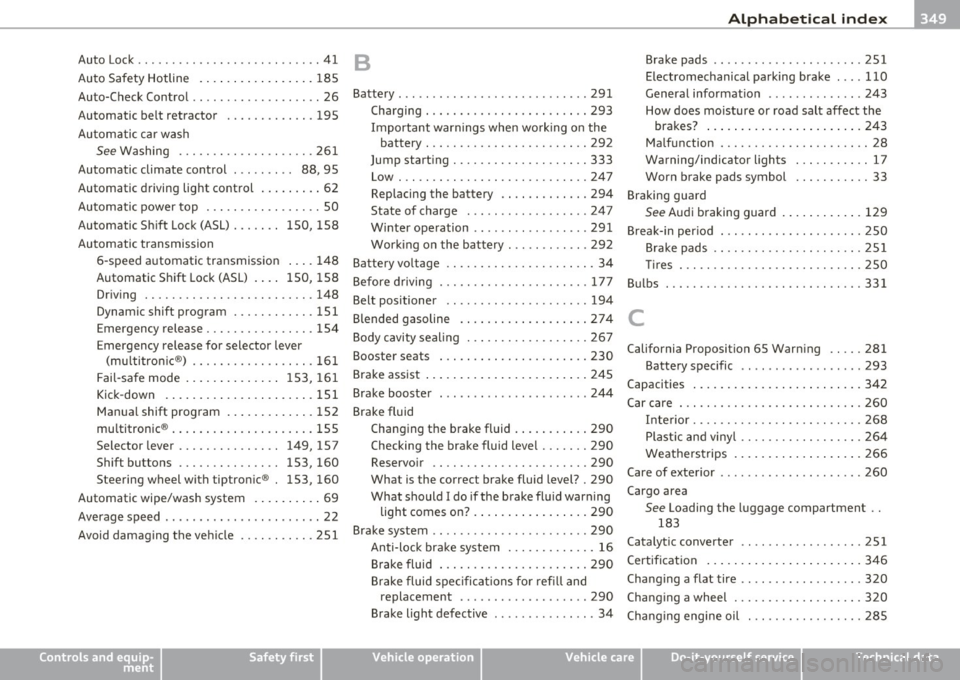
Auto Lock .. .. ... ..... ... ... ... .. .. .. 41
Auto Safety Hotline ... ... ... . .. ..... 185
Auto-Check Control .. ..... ... .... ... .. 26
Automatic belt retractor .......... ... 195
Automatic car wash See Washing ......... .... .. .... . 261
Automatic climate control . . . . . . . . . 88, 9S
Automatic driving light control ......... 62
Automatic power top ..... .. .. .. .... .. SO
Automatic Shift Lock (ASL) ... .. .. 150, 158
Automatic transmission 6-speed automatic transmission ... . 148
Automatic Shift Lock (ASL) .... 150, 158
Driving ...... ...... .. .. .. .. .. .. . 148
Dynamic shift program ... .... .. ... 151
Emergency release ............. .. . 154
Emergency release for selector lever
(mu ltitron ic®) ............... .. . 161
Fail-safe mode .............. 153, 161
Kick-down ...................... 151
Manual shift program ............. 152
multitronic ® ..................... 155
Selector lever ........... .. .. 149, 157
Shift buttons ....... .. .. .... 153, 160
Steering wheel with tiptronic ® . 153, 160
Automatic wipe/wash system .......... 69
Average speed .. ....... .... .. .. .. .. .. 22
Avoid damaging the vehicle .. .. .. .. .. . 251
Controls and equip
ment Safety first
B
Battery
... .. ... ... ................. 291
Charging . .. .. .. .... .. .. ... ... .. . 293
Important warnings when work ing on the
battery ..... ........... ...... .. 292
Jump starting . ........... ........ 333
Low ... .. .. .. .... .... .. ......... 247
Replacing the battery .. .. .. .... ... 294
State of charge ..... .. ... ...... .. 247
Winter operation ..... ..... ....... 291
Working on the battery .... .... .... 292
Battery voltage .. ........... ...... .. . 34
Before driving .. ... .... .. .. .. .. ..... 177
Belt positioner .. .. .... .. ... ... ..... 194
Blended gasoline ................ ... 27 4
Body cavity sealing . ................. 267
Booster seats ... .. ...... .. ......... 230
Brake assist ..................... ... 245
Brake booster . ........ ... .......... 244
Brake fluid
Changing the brake fluid ........... 290
Checking the brake fluid level ..... .. 290
Reservoir .. .. .. .... .... ......... 290
What is the correct brake fluid level? . 290
What should I do if the brake fluid warning light comes on? . ... ... .......... 290
Brake system .. .. .. ..... .... ........ 290
Anti-lock brake system . .. .......... 16
Brake fluid ... .... ............... 290
Brake fluid specifications for refill and
replacement ................... 290
Brake light defective ....... .... ... . 34 Brake pads
.. .. .... ..... .... .... . 251
Electromechanical parking brake .... 110
General information .............. 243
How does moisture or road salt affect the
brakes? ... .... .............. .. 243
Malfunction .............. .... .. .. 28
Warning/indicator lights ....... .. .. 17
Worn brake pads symbol ........... 33
Braking guard
See Audi braking guard ............ 129
Break-in period ... .. .. .............. 250
Brake pads .. ...... ........... .. . 251
Tir es ... .. .. ................. .. . 250
Bulbs ................ .. .... .... .. . 331
C
California Proposition 65 Warning .. ... 281
Battery specific .................. 293
Capacities ......................... 342
Car care .. .... .............. ...... . 260
Interior ............ .. .. .. .. .. .. . 268
Plastic and vinyl .... ............. . 264
Weatherstrips ............ .. .. .. . 266
Care of exterior ... .... .. . .. .. .. .. .. . 260
Cargo area
See Loading the luggage compartment ..
183
Catalytic converter .. ..... ........... 251
Certification ......... .............. 346
Changing a flat tire .. ................ 320
Changing a wheel ...... ...... .... .. . 320
Changing engine oil ... .. .. ......... . 285
Vehicle operation Vehicle care Do-it-yourself service Technical data
Page 354 of 364

-Alphabetical inde x lffi'f ___,__ ______________ _
Emergency release
Selector lever ............ ... .. ..
154
Emergency starting .. ..... .......... 333
Emergency towing ..... ............. 336
Eme rgency unlocking
Ignition key .. .. .. .. ...... ........
39
Energy management ................ 247
Battery power ................ ... 249
Driver notification ............. ... 249
Engine
Compartment . ...... .... .... .. ..
281
Coolant ............ .... .. .... .. 286
Hood . ............. .... ...... .. 279
Starting ..................... ... 106
Starting with jumper cables ..... ... 333
Stopping . ...................... 107
Engine compartment
Safety instructions ............ ...
280
Working the engine compartment .. 280
Engine coolant system
Malfunction .......... ...... .. ....
29
Radiator fan ........ .... .. .. .. .. 289
Engine coolant temperature
Temperature gauge ............ .. .. 8
Engine cooling system ............ ...
286
Adding coolant ... ............... 288
Checking coo lant level . .. ....... .. 287
Checking the engine coolant level . .. 287
Engine data ...... .......... ...... .. 342
Engine hood
Closing .................. .... ...
280
How to release the hood .. ....... .. 279
Engine oil . ..... ....... ... .. .. .. ... 282
Add ing ....... ... .. .. .. .. ....... 285
Additives .. ..... ... .. .. ......... 285
Changing .. .... .. .... .. .. .. .. .. . 285
Check o il level ...... .... .. .. .. .. . 284
Consumption . .. .. .. .. .... .. ..... 284
Oil consumption .......... .. .. .. . 283
Oil grades .... ................ .. 282
Specification and viscosity ... ... .. . 282
Engine oil level ................... ... 35
Engine oil pressure
Malfunction ... ................. ..
30
Engine oil sensor defective ............ 35
Engine speed limitation ............... 35
Environment
Break-in period ............ ..... .
250
Catalytic converter ........ .. .. .. . 251
Disposing of your vehicle battery . .. .
294
Driving at high speeds ..... ...... . 253
Driving to minimize pollution and noise ..
252
Fuel ........................... 276
Fuel economy ................... 252
Leaks under your vehicle .......... . 280
Letting the vehicle stand and warm up ...
253
Proper disposal of d rained brake fluid 290
Proper disposal of drained engine coo lant
288
Proper disposal of d rained engine oil 285
Recycl ing used engine o il .. . .. .. .. . 285
Unleaded fuel ............ .. .... . 274
What should I do with an old battery?
294
Environmental note
Rear window defogger ........ .
92, 100
EPC
See Electronic power control . . . . . . . . 13
ESP
See Electronic stabilization program (ESP)
240
Event Data Recorder (EDR) 240
Exhaust ta il pipes
Cleaning ........... ...... .... ..
267
Expansion tank .. .. .. .. ............. 287
F
Fan .................. .. .... .... 91,98
Radiator . ........... ...... .... .. 289
Fastening
Booster seats ............ .... . ..
230
Convertible child safety seats ...... 228
Infant seats .. .. ................ . 227
Flat tire
Changing .......................
320
Floor mats ..... ...... .. . .. .. .. .. .. 183
Fog lights .................. ..... ... 63
Folding the rear seat backrests .. ...... . 84
Foot pedals . ........... ...... .... .. 182
For the sake of the environment
Gasoline fumes and the environment
276
Refueling ................ ... .. .. 276
Saving fuel by early upshifting ........ 9
Front airbags Description .. ...... .............
204
How they work ...... .. .... .. .. .. 209