open gas tank AUDI A5 CABRIOLET 2014 Owners Manual
[x] Cancel search | Manufacturer: AUDI, Model Year: 2014, Model line: A5 CABRIOLET, Model: AUDI A5 CABRIOLET 2014Pages: 286, PDF Size: 70.4 MB
Page 205 of 286
@ Tips
It may take longer to start the engine
when the outside temperature is very cold.
If possible, use winterized fuel if tempera
tures are below freezing.
Gasoline additives
A major concern among many auto manufac
turers is carbon deposit build-up caused by
the type of gasoline you use.
Although gasoline grades differ from one manufacturer to another, they have certain
things in common. All gasoline grades contain
substances that can cause deposits to collect
on vital engine parts, such as fuel injectors
and intake valves. Although most gasoline
brands include additives to keep engine and
fuel systems clean, they are not equally effec
tive.
Aud i recommends using TOP TIER Detergent
Gasoline. For more information on TOP TIE R
Detergent Gasoline, please go to the officia l
website (www.toptiergas .com) .
Afte r an extended pe riod of using inadequate
fuels, built-up carbon deposits can rob your
engine of peak performance.
CD Note
- Damage or malfunction due to poor fuel
quality is not covered by the Audi New
Vehicle Limited Warranty.
- Do not add aftermarket fuel additive
products to your fuel tank.
Fuel tank
Fuel filler neck
The fuel filler neck is located on the r ight rear
side panel behind the fuel filler flap.
If the power locking system should fail, you
can sti ll open the flap manually - for detailed
instructions see
c:> page 205.
You can find the fue l tank capacity of your ve
hicle in
c:> page262.
Fuel supply and filling your fuel tank 203
The label on the inside of the fuel fi lier f lap
te lls you the correct fue l for your vehicle. For
more information about fuel specifications,
see
c:> page 201.
Your vehicle fue l tank has an on -board refue l
ling vapor recovery system. This feature helps
to prevent fuel vapors from escaping from the
tank and polluting the environment while you
refuel your vehicle. In order to fill the tank
proper ly while protecting the environment,
please follow this refueling procedure careful
ly.
_&. WARNING
Under normal operating conditions, never
carry additional fuel containers in your car.
Gas canisters and other containers used to
transport fuel can be dangerous. Such con
tainers, fu ll or empty, may leak and could
cause a fire in a collision. If you must
transport fuel to use for your lawn mower,
snow blower, etc., be very careful and al
ways observe local and state laws regard
ing the use, transportation and storage of
such fuel containers. Make certain the con
tainer meets industry standards (ANSI/
ASTM F852 - 86).
CD Note
Never drive your veh icle until the fuel tank
i s completely empty. The irregu la r supply
of fue l can cause misfiring. Gasoline cou ld
enter the exhaust system and damage the
catalytic converter.
•
•
Page 206 of 286
204 Fuel suppl y and filli ng your fu el t ank
Refuelling
Fig. 169 Rig ht rear veh icle s ide: Open ing t he fuel fille r
fl ap
Fig. 170 Fu el fi ller fla p w ith attached fuel c ap
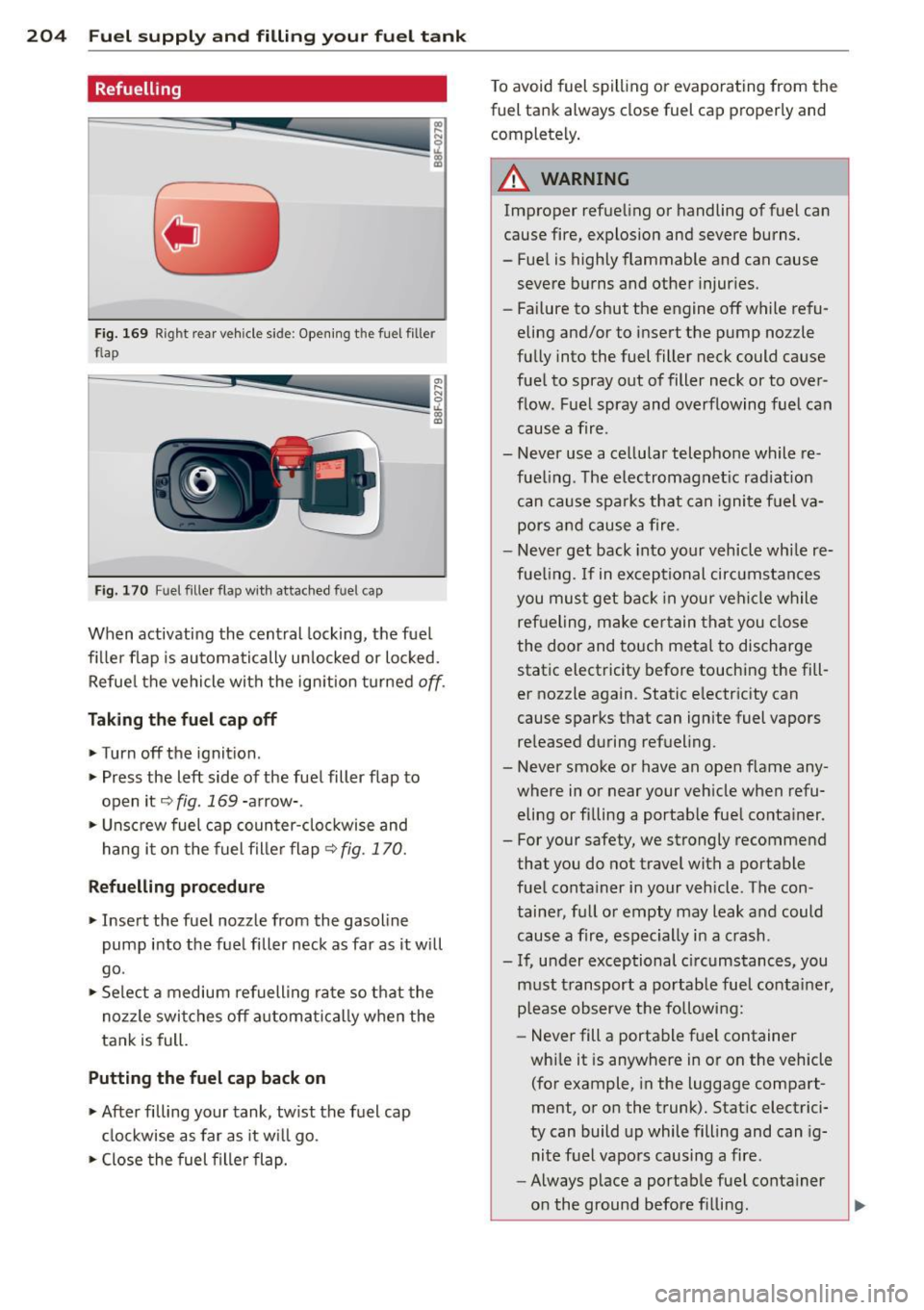
When activating the central lock ing, the fuel
fi ller flap is automatically un locked or loc ked.
Refue l the vehicle with the ig nition turned
off .
Tak ing th e fuel cap off
~ Turnoff the ignition .
~ Press the left side of the fuel filler flap to
open it
c::> fig. 169 -arrow- .
~ Unscrew fuel cap counter-clockwise and
hang it on the fuel filler flap
~ fig . 170.
Refu elling proc edure
~ Insert the fuel no zzle from the gasoline
pump into the fuel filler nec k as far as it will
go .
~ Select a medium refuelling ra te so that the
nozzle swi tches off a utomatica lly when the
tank is full.
Putting the fuel cap back on
~ After filling your tank , tw ist the fuel cap
clockwise as far as it w ill go .
~ Close the fuel fil le r flap. T
o avoid fuel spill ing or evaporating from the
fuel tank always close fuel cap properly and
completely .
A WARNING
-Im proper refueling or handling of fuel can
cause fire, explosion and severe burns.
- Fue l is highly flammable and can cause
severe burns and other injur ies.
- Failure to shut the engine off while refu
eling and/or to insert the pump noz zle
fully into the fuel filler neck could cause fuel to spray out of filler neck or to over
f low . Fuel spray and overflowing fuel can
cause a fire .
- Never use a cellular telephone while re
fueling . The electromagnet ic rad iat io n
can cause sparks that can ignite fuel va
pors a nd cause a fire .
- Never get back into your vehicle wh ile re
fue ling.
If in exceptional circumstances
you mus t get back in your vehi cle while
ref ueling, make ce rtain that you close
the door and touch meta l to discharge
static electricity before touching the fill
er nozzle again . Static e lectr icity can
cause sparks that can ignite fuel vapors re leased during refueling .
- Never smoke or have an open flame any
where in or near your veh icle when refu
eling or filling a portable fue l conta iner .
- For your safety, we strongly recommend
that you do not travel with a portable
fue l conta iner in your vehicle . The con
tainer, fu ll o r empty may leak and could
cause a fire, especially in a crash .
- If, u nder exceptional c ircumstances, you
must transport a portable fuel conta iner,
p lease observe t he follow ing:
- Never fill a portable f uel container
whi le it is anywhere in or on the vehicle
(for example, in the luggage compart
ment, or on the trunk). Static electrici
ty can build up while filling and can ig
ni te f uel vapors causing a fire .
- Always place a portab le fue l conta iner
on the ground before fi lling.
Page 276 of 286
274 Index
Tank system .......... ... .. .. .... .. 21
Unlocking the fue l filler flap by hand .. 205
Fu el economy messages (eff iciency pro-
g ram) . .. .. .. ............. .. .. .. .. .. 27
Fuel filler flap Unlock ing the fuel filler flap by hand . . 205
Fuses Assignment . . . . . . . . . . . . . . . . . 250, 252
Replacing .. ............. .. .. .. ... 250
G
Garage door opener (Homelink)
117
Gas discharge lamps ........ .. .. .... . 253
Gauges Eng ine coolant temperature .. .. .. .... 10
Fuel gauge .... .. .. ...... .. .. .. .. .. 12
Tachometer . . . . . . . . . . . . . . . . . . . . . . . 11
General illustration
Instruments and controls . . . . . . . . . . . . . 8
Generator Warning/ indicato r lights ... .. .... .. . . 17
Glossary of tire and loading terminology 223
Glove compar tment . . . . . . . . . . . . . . . . . . 66
Valet park ing ... .... ..... .. .. .. .. .. 40
GPS controlled clock .......... .. .... . . 12
Gross Vehicle Weight Rating (GVWR) ... 261
H
Headlights
Clea ning ... ... .. .. ...... .. .. .. .. . 196
C leaning system ... ..... .. .. .. .. ... . 56
D efe ctiv e . . . . . . . . . . . . . . . . . . . . . . . . . 21
H ead light range con tro l . . . . . . . . . . . . . 22
L eft hand drive, righ t hand drive ... .. . . 53
Travel mode . . . . . . . . . . . . . . . . . . . . . . . 53
Hea dlight washer reservoir .. .. .. .. ... 220
Head restraints .............. .. .... . 124
Adjusting . . . . . . . . . . . . . . . . . . . . 63, 124
Heated exterior m irrors . . . . . . . . . . . . . . . . . . . . 54
rear window ............. .. .. .... .. 71
seats .. .. .. ..................... .. 71
windshie ld washer spray noz zles . . . . . . 56
Heating ..... ... .......... .. .. .... .. 69
He avy clothing and safety belts ... .. .. . 135
High beam ................ .. .. .... .. 52 High voltage warning label
......... .. 261
Hill descent control . . . . . . . . . . . . . . . . . . 89
Homelink (remote control)
Hood 117
Opening .. .... .. .. ........... .. .. 206
Release lever .... ... .......... .. .. 206
Horn .. ..... ... .. .. ... ....... ... .. .. 8
How are child restraint system anchors re-
lated to child safety ............. .... 175
How many airbags does my vehicle have? 147
How often should I check my tire pres-
su res? . .. .. .. .. .. .. ............. .. 229
How safety belt pretens ioners work .. .. 138
Hydroplaning ..... ... .......... .. .. 232
I
Ignition
switching on/off .... ........... .. .. . 74
Ign it ion key
Eme rgency unlock ing ... .. ... ..... .. . 34
lg n it ion lock . . . . . . . . . . . . . . . . . . . . . . . . 7 4
Indicator lig ht ... ... .......... .. .. . 18
Malfunction . . . . . . . . . . . . . . . . . . . . . . . 22
Immobilizer . . . . . . . . . . . . . . . . . . . . . . . . 12
Important thin gs to do before driving .. 121
Improperly worn safety belts ........ .. 138
Indicator lights .. .. ... .......... .... . 13
Airbag system . . . . . . . . . . . . . . . 150, 151
Dynamic steering .... .......... .. .. 184
PASSENGER AIR BAG OFF ........... 151
also refer to Warning/indicator lights .. 13
Infant seats ...... ............. .... 167
Installing child safety seats Safety belts . . . . . . . . . . . . . . . . . . . . . . 171
Instruments Adjusting the lighting .......... ..... 54
Instruments and controls .......... .. . 10
General illustration . . . . . . . . . . . . . . . . . . 8
Interior lights
Front ..... .. .. .. ............... ... 54
Rear ......... ................... . 54
Intermittent (windshield wipers) .... .. . 56
J
Jump-starting . .. .. ............. .. .. 255