ESP AUDI A5 CABRIOLET 2015 User Guide
[x] Cancel search | Manufacturer: AUDI, Model Year: 2015, Model line: A5 CABRIOLET, Model: AUDI A5 CABRIOLET 2015Pages: 268, PDF Size: 66.88 MB
Page 53 of 268
M N
ci LL co
rl I.O
"' N
"' rl
the windshield in this a rea in order to
prevent malfunctions or failures .
- Some exterior lighting functions can be ad
ju ste d~
pa ge 51 .
-When yo u remove your key from the igni tion
while the vehi cle's ligh ts are turned o n, a
buzzer sounds as long as t he driver 's door is
open.
- In coo l o r dam p weather, t he inside of the
h eadlights, turn sig nals and tail lights can
fog over d ue to the temperature difference
between the inside and outs ide. They will
clea r shortly after switching them on. T his
does not affect t he service li fe of the light
i ng.
- In the event of a light sensor malfunction,
the driver is not ified in the instr ume nt clus
te r display~
page 21.
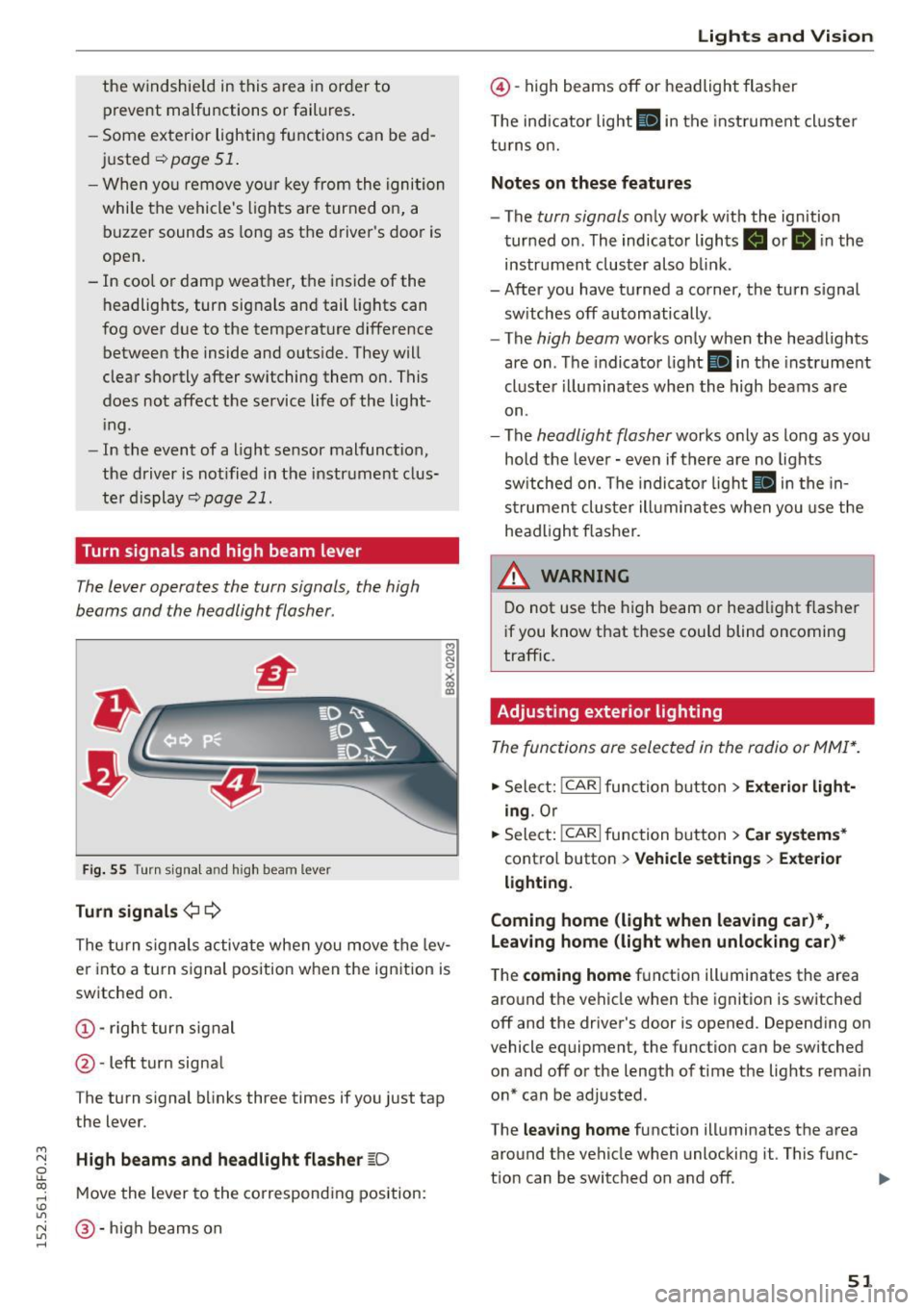
Turn signals and high beam lever
The lever operates the turn signals, the high
b eams and the headlight flasher.
Fi g. 55 Tu rn signa l and high beam lever
Turn signals ¢ Q
g N
0
~ CD
The turn signals activate when you move the lev
er into a turn s ignal position when the ignition is
switched on.
@ -righ t tur n signal
@ -left turn signa l
The turn s ignal b links three times if you just tap
the lever.
High beams and headlight flasher
[0
M ove the lever to the corresponding position:
@ -high beams o n
Lights and Vis ion
@ -high beams off or headlight flasher
T he ind icator light
II in t he inst rument cl uste r
tu rns on.
Notes on these features
- The
turn signals on ly wor k w ith the ign ition
tur ned on. The indicator ligh ts . or
II in the
instr um ent clus ter also b link.
-After you have tu rned a corner, the turn s ignal
sw itches off automatically.
- The
high beam works on ly when the headlights
are on . T he indicator light
II in the instrument
cluste r illuminates whe n the high beams a re
on.
- The
headlight flash er works o nly as long as yo u
hold the leve r - even if there are no lights
sw itched on . The indica to r li ght
II in the in
s trumen t cluste r ill umin ates when you use t he
head light flasher.
,&. WARNING
D o not use t he h igh beam or hea dlight flashe r
i f you know that these could blind oncoming
traffic.
Adjusting exterior lighting
The func tions are selected in the radio or MMI* .
.,. Select: !CAR I func tion b utton > Exterior light
ing .
Or
.,. Sele ct: !~C_A _R~ I function b utton > Car systems *
contro l butto n > Vehicle settings > Exterior
lighting .
Coming home (light when leaving car )*,
Leaving home (light when unlocking car)*
The
coming home f u nction illuminates the area
aro und t he vehicle when the ignition is switched
off and the driver's door is opened. Depend ing on
vehicle equipment, the function can be switched o n and off o r the length of t ime t he lig hts rema in
on* can be adjusted .
The
leaving home function illuminates t he area
around th e vehicle when unloc kin g it. This func-
t ion can be switched on and off. ""
51
Page 56 of 268
Lights and Vision
Q/P -Adjusting the left/right exterior mirror .
Move the knob in the des ired direction.
4ill -Heat ing the m irror g lass depending on the
outside temperature*.
.9 -Folding exterior mirrors* . In the Infotain
ment system, you can select if the mirrors fold in
automatically when you lock the vehicle
¢ page 34.
Front passenger's exterior mirror tilt
function*
To help you see the curb when backing into a
parking space, the surface of the mirror t ilts
slightly . Fo r this to happen, the knob must be in
the position for the front passenger 's outside
mirror.
You can adjust the tilted mirror su rface by turn
ing the knob in the des ired direction . When you
move out of reverse and into another gear, the
new mirror position is stored and assigned to the
key you are using.
The mirror goes back into its origina l position
once you drive forward faster than 9 mph (15 km/h) or turn the ignition off.
A WARNING
Curved mirror surfaces (convex or spherical*)
increase your field of view. Remember that
vehicles or other objects will appear smaller
and farther away than when seen in a flat mir
ror. If you use this mirror to estimate distan
ces of following vehicles when changing
lanes, you cou ld estimate incorrectly and
cause an accident.
(D Note
-If the mirror hous ing was moved by force
(for example, by running into an object
when maneuvering the vehi cle), the mirror
must be folded all the way in using the pow
er folding function. The mirror housing
must not be moved back into place by hand
because this would impair the function of
the mirror mechanism.
- If you wash the vehicle in an automatic car
wash, you must fold the exterior mirrors in
54 to reduce
the risk of damage to the mirrors.
Never fold power folding exterior mirrors*
by hand. Only fold them in and out using
the power controls.
(D Tips
-If the power adjusting function malfunc
tions, the g lass in both mirrors can be ad
justed by pressing on the edge of it by hand.
- The exterior mirror settings are stored with
the memory function* ¢
page 63.
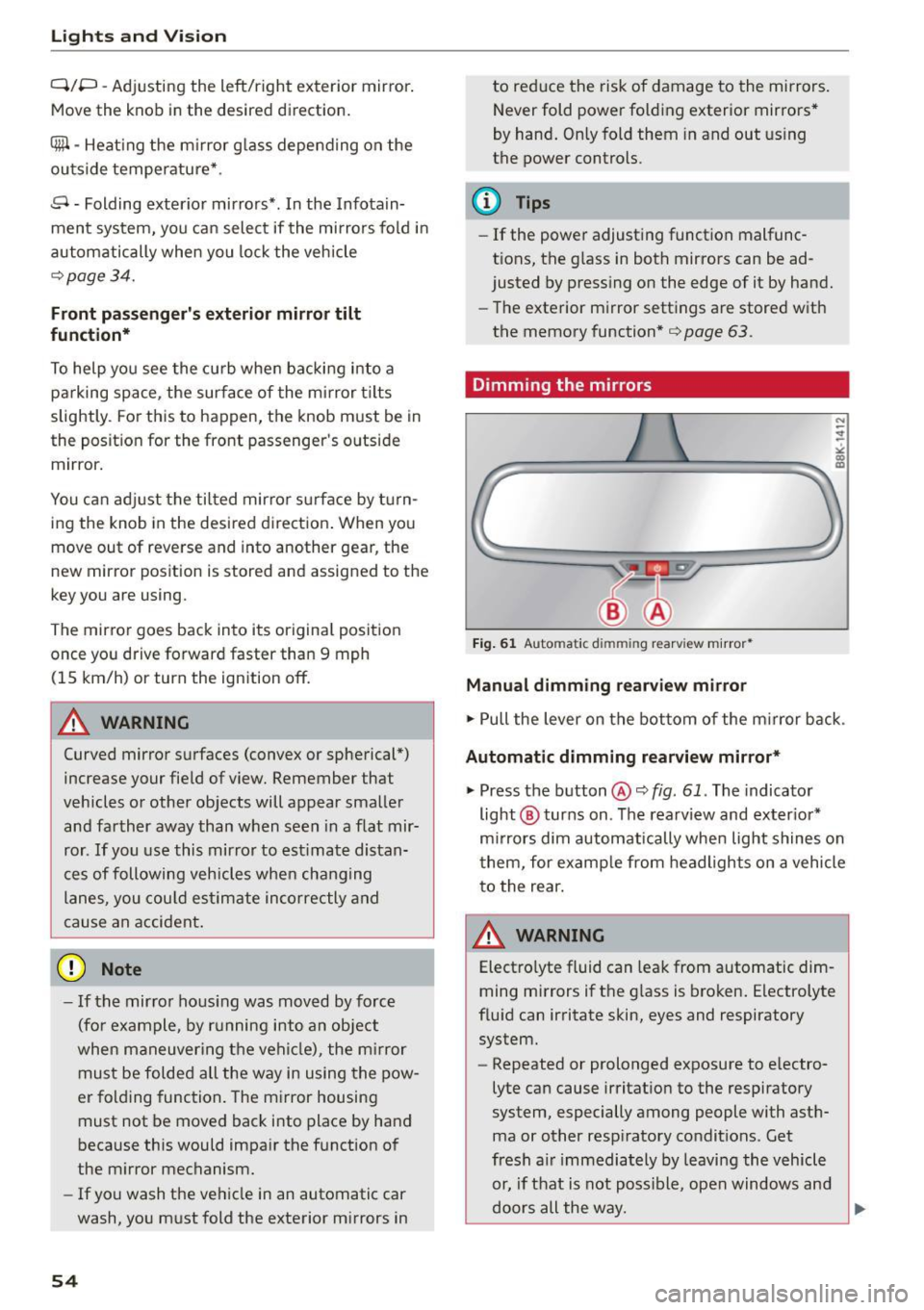
Dimming the mirrors
Fig. 61 Auto mat ic dimmin g rearv iew mirro r•
Manual dimming rearview mirror
.,. Pull the lever on the bottom of the m irror back .
Automat ic dimming rearview mirror*
.,. Press the button@¢ fig. 61. The indicator
light @ turns on . The rearview and exter ior*
mirrors dim automatically when light shines on
them, for example from headlights on a vehicle
to the rear.
~ WARNING
Electro lyte fluid can leak from automatic dim
ming mirrors if the glass is broken. Electrolyte
fluid can irritate skin, eyes and respiratory system.
- Repeated or prolonged exposure to e lectro
lyte can cause irritation to the respiratory
system, especially among people with asth
ma or other resp iratory conditions . Get
fresh a ir immediately by leaving the vehicle
or, if that is not possible, open windows and
doors all the way.
~
Page 58 of 268
Ligh ts a nd Vi sion
th e afterwipe operation. The afterwipe function
is reactivated the next time the ignition is switch
ed on.
Clean ing the headlights*. The headlight washer
system* operates only when the headlights are
on.
If you move the lever to pos ition @ , the
headlights are washed in intervals.
A WARNING
- The rain sensor is only intended to assist the
driver . T he driver is still responsible for
manually switching the wipers on according
to the v is ibility conditions .
- The w indshield may not be treated w ith wa
ter -repelling windsh ield coating agents . Un
favorable condit ions, such as wetness, dark
ness, low sun, can result in increased g lare.
Wiper b lade chatter is also possible.
- Properly functioning w indshield w iper
blades are required for a clear view and safe
dr iv ing ¢
page 56, Replacing windshield
wiper blades .
(D Note
-In the case of frost, check whether the
windsh ield wiper b lades are frozen to the
windsh ield. Sw itching on the windsh ield
wipers can damage the wiper blades!
- Prior to using a car wash, the winds hield
wiper system m ust be switched off (lever in
position @). T his helps to prevent uninten
tiona l switching on and damage to the
windshield wiper system .
@ Tips
-The windshield wipe rs are switched off
when the ignition is turned off. Activate the
windshield wipers after the ignition is
switched back on by moving the windsh ield
wiper lever to any pos it ion.
- Worn or dirty windshie ld w iper blades result
i n streaking. This can affect the rain sensor*
funct ion. Check your windshield wiper
blades regularly .
- The washer fluid nozzles of the windshield
washer system are heated at low tempera
tures when the ignit ion is on.
56
- W hen stopping temporarily, (e .g. at a traffic
light) the set speed of the windshield wipers
is automat ica lly reduced by one speed.
Cleaning windshield wiper blades
Clean the windshie ld w iper blades when they be
gin to leave streaks . Use a soft cloth and glass
cleaner to clean the windshield w iper blades .
.. Place the windshie ld wiper a rms in the service
position. Refer to ¢
page 56.
.. Lift the wiper arm away from the front window .
A WARNING
Dirty windshield wiper b lades can impair your
view. This can lead to accidents.
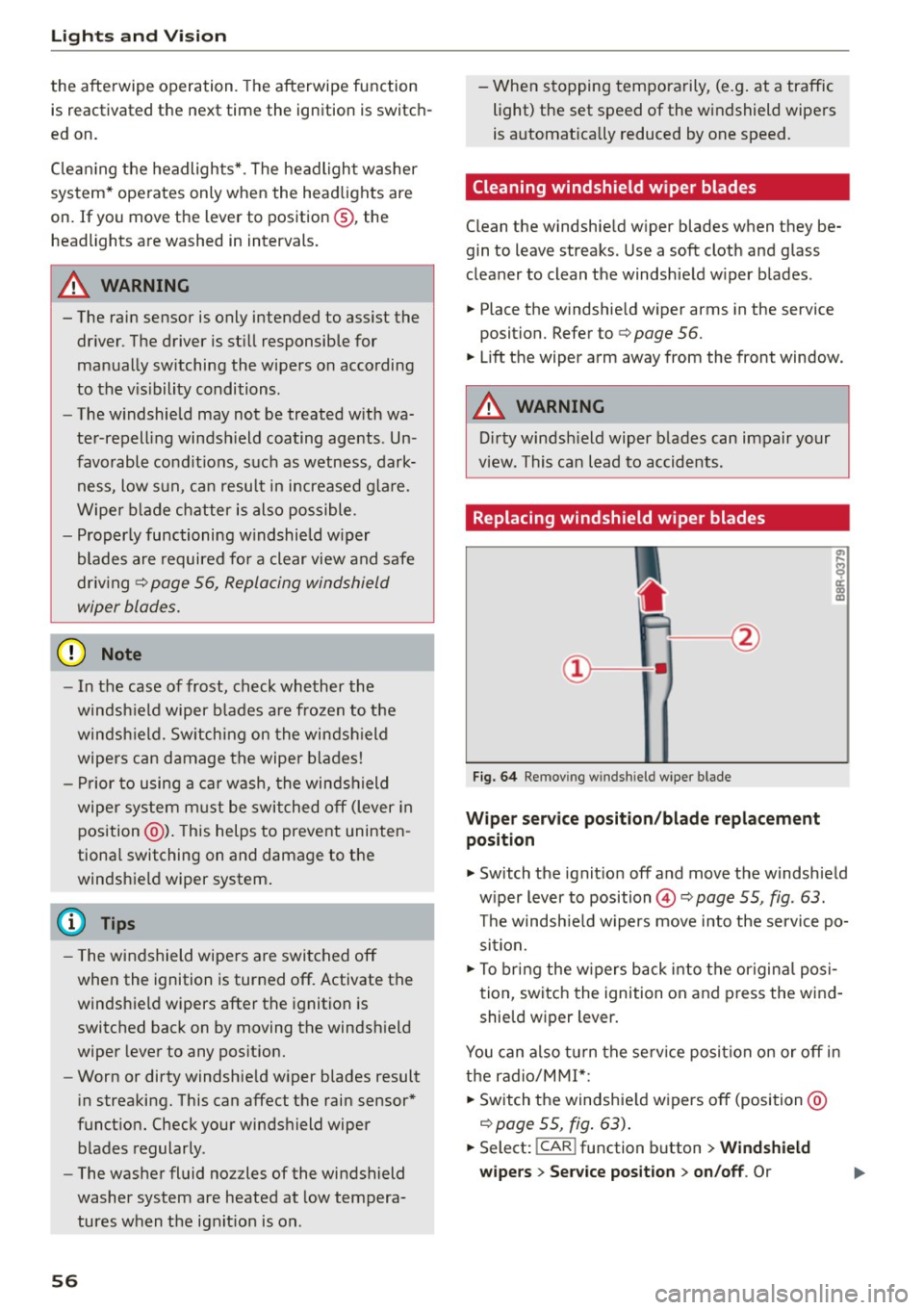
· Replacing windshield wiper blades
Fig. 64 Re mov ing w in d shi eld w iper blade
Wi per s ervice position /bla de replacement
posit ion
.. Switch the ignit ion off and move the windshield
w iper lever to position @¢
page 55, fig . 63.
T he windsh ie ld w ipers move into the service po
sition.
.. To bring the w ipers back into the origina l posi
tion, switch the ignition on and press the wind
shield w iper lever.
You can also tu rn the se rv ice position on or off in
t h e radio/M M!*:
.. Switch the windshie ld wipers off (position @
¢page 55, fig . 63) .
.. Select: !CAR ! function button > Windshield
wiper s
> Ser vice po sition > on /off . Or
Page 61 of 268
M N
ci u.. co ,...., \!) 1.1'1
N 1.1'1 ,....,
Seats and storage
General information
Why is your seat adjustment so important?
The safety belts and the airbag system can only
provide maximum protection if the front seats are correctly adjusted.
There are various ways of adjusting the front
seats to provide safe and comfortable support
for the driver and the front passenger. Adjust
your seat properly so that:
- you can easily and quickly reach all the switches
and controls in the instrument panel
- your body is properly supported thus reducing
physical stress and fatigue
- the safety belts and a irbag system can offer
maximum protection
¢ page 132.
In the following sections, you will see exactly
how you can best adjust your seats.
There are special regulations and instructions for installing a child safety seat on the front pas
senger's seat. Always follow the information re
garding child safety provided in¢
page 152,
Child safety.
A WARNING -
Refer to¢ page 113, Driving safety for im
portant information, t ips, suggestions and
warnings that you should read and follow for
your own safety and the safety of your pas senge rs.
A WARNING
Incorrect seating position of the dr iver and all
other passengers can resu lt in serious person
al injury.
- Always keep your feet on the floor when the
vehicle is in motion -never put your feet on
top of the instrument pane l, out of the win
dow or on top of the seat cushion. This ap
plies especially to the passengers . If your
seating pos it ion is incorrect, you increase
the risk of injury in the case of sudden brak
ing or an accident. If the airbag inflates and
Seat s and stor age
the seating position is incorrect, this cou ld
result in personal injury or even death.
- It is important for both the driver and front
passenger to keep a distance of at least
10 inches (25 cm) between themselves and
the steering wheel and/or instrument panel.
If you're sitting any closer than this, the air
bag system cannot protect you properly. In
addition, the front seats and head restraints must be adjusted to your body height so
that they can give you max imum protect ion.
- Always try to keep as much distance as pos
sible between yourself and the steer ing
wheel or instrument pane l.
- Do not adjust the driver's o r front passeng
er 's seat while the veh icle is moving. Your
seat may move unexpectedly, causing sud
den loss of vehicle control and persona l in
jury.
If you adjust your seat whi le the vehicle
is moving, you are out of position.
Driver's seat
The correct seat position is important for safe
and relaxed driving.
We recommend that you adjust the dr iver's seat
in the following manner:
"' Adjust the seat in fore and aft direction so that
you can eas ily push the pedals to the floor
while keeping your knees slightly bent¢.&,
in
Why is your seat adjustment so important? on
page 59.
"' Adjust the seatback so that when you sit with
your back against the seatback, you can still
grasp the top of the steering wheel.
"' App lies to veh icles w ith adjustable head re
straints: Adjust the head restraint so the upper
edge is as even as possible with the top of your
head.
If that is not possible, try to adjust the
head restra int so that it is as close to th is posi
t ion as possible ¢
page 62.
A WARNING
Never place any objects in the driver's foot
well. An object could get into the pedal area
and interfere with pedal funct ion. In case of
-
59
Page 62 of 268
Seats and storag e
sudden braking or an accident, yo u wo uld not
be able to brake or accelerate.
Front passenger's seat
Always move the front passenger seat into the rearmost position.
To avo id contact w it h the airbag wh ile i t is de
p loying, do not sit any closer to the inst rument
panel than necessary and always wear the three
point safety belt provided adjusted correctly. We
recommend that you adjust the passenger's seat in the following manner:
.,. Bring the backrest up to an (a lmost) upright
position .
Do not ride with the seat reclined .
.,. Applies to vehicles with adjustable head re
straints: Adjust the head restra int so the upper
edge is as even as poss ible with the top of your
head. If that is not possib le, try to adjust the
head restraint so that it is as close to this posi
tion as poss ible
¢ page 62.
.,. Place your feet on the floor in fron t of the pas
senger's seat.
Front seats
Power seat adjustment
Applies to veh icles: w ith power adj ustable seats
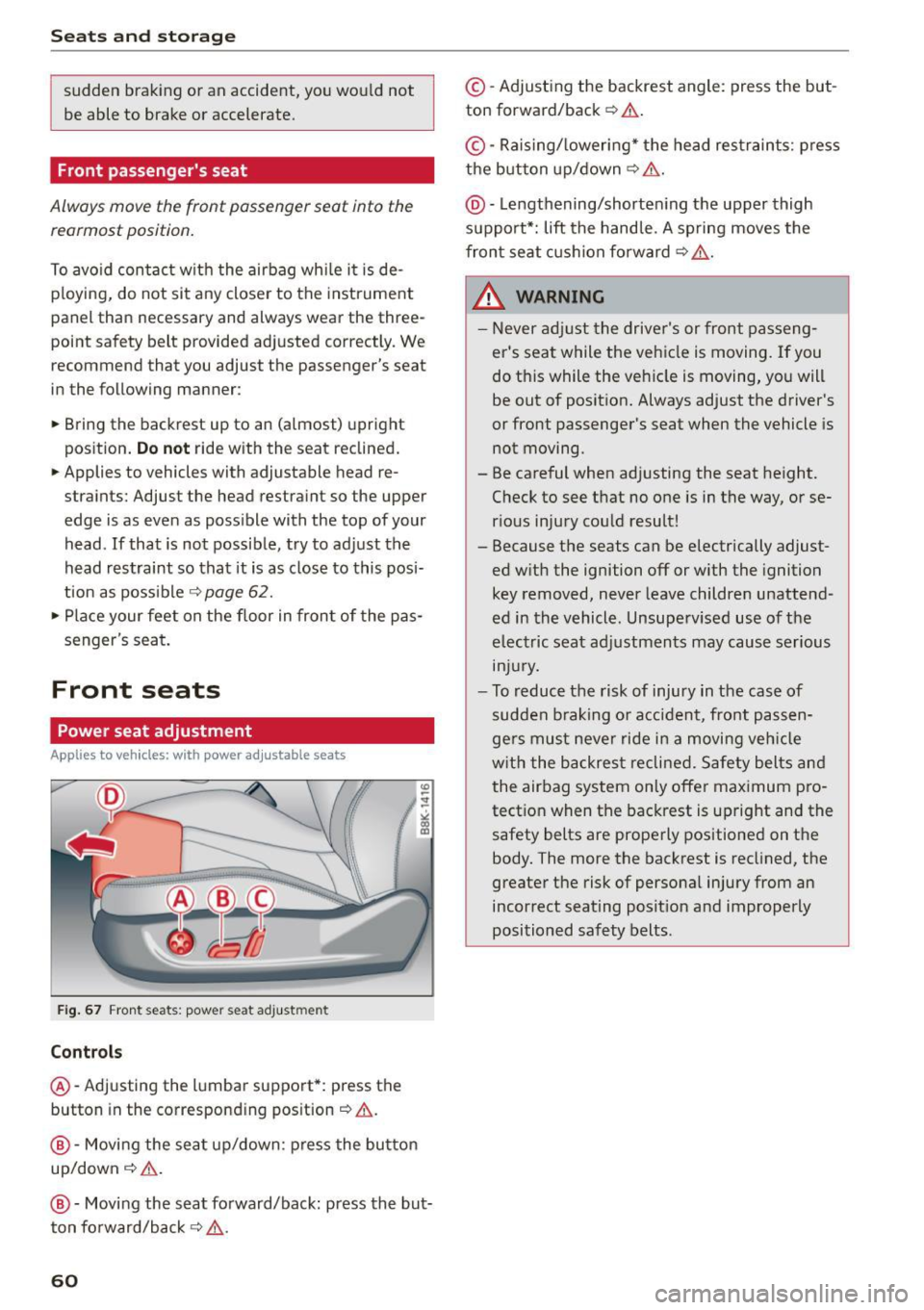
F ig . 67 Front seats : power seat adju stment
Controls
@-Adjusting the l umbar support*: press the
button in the correspond ing pos ition¢ .&.
@-Movi ng the seat up/down: press the button
up/down~ &.
@ -Moving the seat forward/back: press the but
ton fo rward/back
~ 11:-:,. .
60
©-Adjusting the backrest angle: press the but
ton forward/back ¢.& .
©-Raising/ lowering* the head res traints: p ress
the button up/down~ &.
@ -Lengthening/shorte ning the upper thigh
support*: lift the hand le. A sp ring moves the
fron t seat c ushion fo rward ¢
,&..
& WARNING -
-Never ad just the driver's or front passeng
er's seat while the vehicle is moving. If you
do this while the veh icle is moving , yo u will
be out of posit ion. Always adjust the driver 's
or front passenger's seat when the vehicle is
not moving .
- Be careful when adjusting the seat height. Check to see that no one is in the way, or se
r ious injury cou ld result!
- Because the seats can be electrically adjust
ed w ith the ignition off or with the ignition
key removed, never leave childre n unattend
ed in the vehicle. Unsuperv ise d use of the
electric seat adj ustments may cause serious
m Ju ry.
- To reduce the risk of injury in the case of
sudden b raking or accident, fro nt passen
ge rs must neve r ride in a moving veh icle
w it h the backres t reclined. Safety bel ts an d
the air bag system on ly offer ma ximum pro
tect io n when the backrest is upright and the
safety belts are properly positioned on t he
body. The more the backrest is recl ined, the
greater the risk of persona l injury from an
incorrect seating posit ion and improperly
positioned safety belts.
Page 63 of 268
Power easy entry function
Applies to vehicles: with power adj ustable seats
The easy entry function makes it easier for the
rear passengers to enter and leave the vehicle .
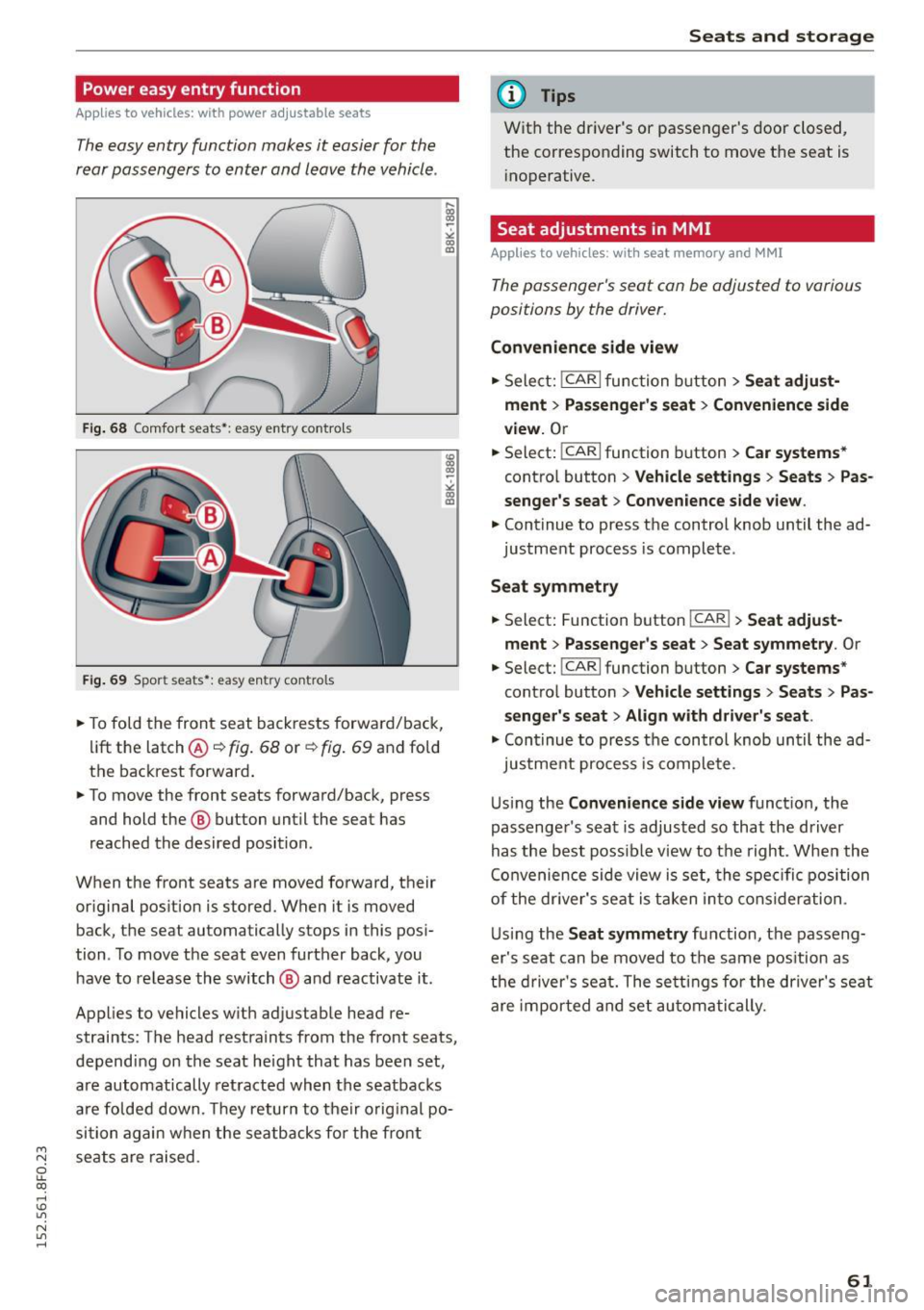
Fig. 68 Comfort seats•: easy ent ry cont ro ls
F ig. 69 Spor t seats •: easy entry controls
.. To fold the front seat backrests forwa rd/back,
li ft the latch @r::!> fig. 68 or r::!> fig. 69 and fold
the bac krest forward .
.,. To move the front seats forward/back, press
and hold the@ button until the seat has
reached the desired position .
When the front seats are moved forward, their or iginal pos ition is stored. When it is moved
back, the seat automatically stops in this posi
tion . T o move the seat even further back, you
have to re lease the switch @ and reactivate it.
Applies to vehicles w ith adj ustab le head re
straints : The head restraints from the front seats,
depending on the seat height that has been set,
are automatically retracted when the seatbacks
a re folded down. They return to their orig inal po
sition again when the seatbacks fo r the front
~ seats are raised . ci LL co
rl I.O
"' N
"' rl
Seats and storage
(D Tips
With the driver's or passenger's door closed,
the corresponding switch to move t he seat is
i noperative.
Seat adjustments in MMI
Appl ies to vehicles: with seat memory and MMI
The passenger 's seat can be adjusted to various
positions by the driver.
Conven ience side view
.,. Sele ct: jCAR I function b utton > Seat adju st
ment > Passenger' s seat > Convenience side
view.
O r
.. Select: I CAR I function button > Car systems*
contro l button > Vehicle settings > Seats > Pa s
senger 's seat > Con venience side v iew .
.,. Continue to press the control knob until the ad
justment process is complete .
Seat symmetry
.. Select: Function button !CAR !> Seat adjust
ment > Passenger's seat > Seat symmetry .
Or
.. Select: jcAR I function button> Car systems *
control button > Vehicle settings > Seats > Pas
s eng er's seat > Align with driv er' s s eat .
.,. Cont inue to press the control knob until the ad-
justme nt process is comple te .
Us ing the
Conveni ence side view function, the
passenge r's sea t is adjusted so that the driver
has the best poss ible view to the right . When the
Co nvenience side view is set, the spe cific position
of the dr iver's se at is taken in to consideration .
U sing the
Seat symmetry function, the passeng
er's seat can be moved to the same pos ition as
the d river's sea t. The se tti ngs for the driver's seat
are imported and se t au tom atic ally.
61
Page 70 of 268

Warm and cold
Warm and cold Climate control system
Description
The climate control system warms, cools and
adds humidity to the air in the vehicle interior. It
is the most effective when the windows and pow
er top are closed.
If there is a build-up of heat in
side the vehicle , ventilation can help to speed up
the cooling process.
In all heating mode functions except
defrost, the
blower only switches to a higher speed once the
engine coolant has reached a certain tempera
ture.
Condensation from the cooling system can drip
and form a puddle of water under the vehicle.
This is normal and does not mean there is a leak.
Pollutant filter
The pollutant filter removes pollutants such as
dust and pollen from the air.
The air pollutants filter must be changed at the
intervals specified in your Warranty & Mainte
nance booklet, so that the air conditioner can
properly work.
If you drive your vehicle in an area with high air pollution , the filter may need to be changed
more frequently than specified in your Audi War
ranty
& Maintenance booklet. If in doubt, ask
your authorized Audi Service Advisor for advice.
Key coded settings
The climate control settings are automatically
stored and assigned to the remote control key
that is in use . These settings are different when
the power top is open or closed.
_& WARNING
Reduced visibility is dangerous and can cause
accidents.
68
- For safe driving it is very important that all
windows be free of ice, snow and condensa
tion.
- Completely familiarize yourself with the
proper use and function of the heating and
ventilation system and especially how to de
fog and defrost the windows .
- Never use the windshield wiper/washer sys
tem in freezing weather until you have
warmed the windshield first, using the heat
ing and ventilation system . The washer solu
tion may freeze on the windshield and re
duce visibility .
(U;) Note
- If you suspect that the air conditioner has
been damaged, switch the system off to
avoid further damage and have it inspected
by a qualified dealership.
- Repairs to the Audi air conditioner require
special technical knowledge and special
tools. Contact an authorized Audi dealer for
assistance.
@ For the sake of the environment
By reducing the amount of fuel you use, you
also reduce the amount of pollutants emitted
into the air.
(D Tips
- Keep the air intake slots (in front of the
windshield) free from ice, snow and debris in order to maintain the proper function of
the climate control system.
- The energy management system may switch
the seat heating* or rear window defroster
off temporarily. These systems are available
again as soon as the energy balance has
been restored.
- Air escapes through vents under the rear
window. When placing items of clothing on
the luggage compartment cover, ensure
that the openings are not covered.
Page 83 of 268
M N
ci LL co
rl I.O
"' N
"' rl
Cruise control system
Switching on
The cruise control system makes it possible to
drive at a constant speed starting at 20 mph (30
km/h) .
0
f
®t
0
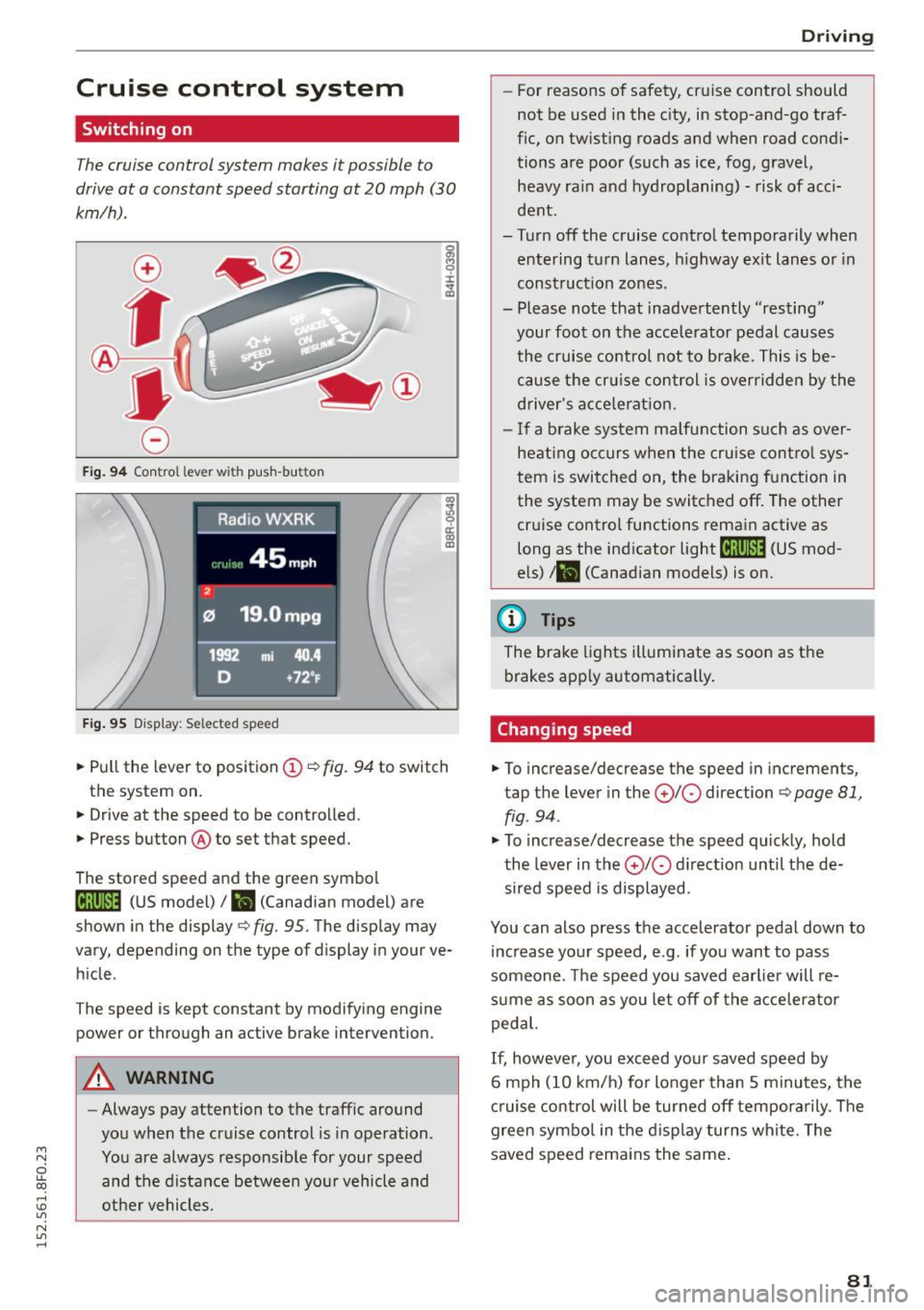
Fig. 94 Control lever with push-bu tton
Fig. 95 Display : Selected speed
al M 0 ±
ti
~ 0 er: a,
"'
• Pull the lever to position (D ¢ fig. 94 to switch
the system on.
• Drive at the speed to be controlled.
• Press button @to set that speed.
The stored speed and the green symbol
[lj;(i )~i4 (US model)/ l'I (Canadian model) are
shown in the display ¢
fig. 95. The display may
vary, depending on the type of display in your ve
hicle .
The speed is kept constant by modifying engine
power or through an active brake intervention.
A WARNING
-Always pay attention to the traffic around
you when the cruise control is in operation.
You are always responsible for your speed and the distance between your vehicle and
other vehicles.
Driving
- For reasons of safety , cruise control should
not be used in the city, in stop-and-go traf
fic, on twisting roads and when road condi
tions are poor (such as ice, fog, gravel, heavy ra in and hydroplaning) - risk of acci
dent .
- Turn off the cruise control temporarily when entering turn lanes , highway exit lanes or in
construction zones.
- Please note that inadvertently "resting" your foot on the accelerator pedal causes
the cruise control not to brake. This is be
cause the cr uise control is overridden by the
driver's accele rat ion.
- If a brake system malfunction such as over
heating occurs when the cruise control sys
tem is switched on, the braking function in
the system may be switched off . The other
cruise control functions remain active as
long as the ind icator
light til;rnM4 (US mod
els)
t l'I (Canadian models) is on.
(D Tips
The brake lights illuminate as soon as the
brakes apply automatically.
Changing speed
• To increase/decrease the speed in incremen ts,
tap the lever in the
(£)10 direction ¢ page 81,
fig . 94 .
"'To increase/decrease the speed quickly, hold
the lever in the
010 direct ion until the de
sired speed is displayed.
You can also press the accelerator pedal down to increase your speed, e.g . if you want to pass
someone . The speed you saved earlier will re
sume as soon as you let off of the accelerator
pedal.
If, however, you exceed your saved speed by
6 mph (10 km/h) for longer than 5 minutes, the
cruise control will be turned off temporarily . T he
green symbo l in the display turns white. The
saved speed remains the same .
81
Page 90 of 268

Automatic transmi ssion
Appli es to v ehicle s w ith a S tronic- / tiptronic
t ra nsm ission
When you depress the acce lerator pedal beyond
the resistance po int, the automatic transmiss ion
downshifts into a lower gear, dependi ng o n ve hi
cle speed and engi ne speed. The ups hift into the
next h igher gea r tak es place once the max imum
specified engine speed is r eached.
A WARNING
Please note that the drive whee ls can spin if
kick-down is used on a smooth slippery road -
there is a r is k of s kidding.
Launch Control Program
Applies to vehicles: with S tronic
The Launch Control Program provides the best
acceleration possible when starting from a stop.
Requirement: The engine must be at operating
temperature and the steering wheel must not be
turned.
"' Press the
!.!1 O FF I button ¢ page 171 while the
engine is runn ing . The
II indicator light illumi
nates in the instrument cluste r and
Stabil iza
tion contr ol (ESC ): Sport . Warning ! Restricte d
s tabilit y
appears in the d river informat ion sys
tem display.
"' Move the selecto r lever to the D/S position to
select sport mode (S) or select the
d ynamic
driving mode in drive select * ¢page 104.
"'Press the brake peda l strongly with your left
foot and hold it down for at least 1 second.
"' At the same time, press the accelerator pedal
down completely with your right foot until the
engine reaches and maintains a h igh RPM .
"' Remove your foot from t he brake pedal wit hin 5
seconds¢
& -
A WARNING
-Always adapt you r driving to the traffic flow.
- Only use the La unch Control P rog ram when
road and t ra ffi c condi tions a llow i t and oth
er dr ivers will not be endangered or annoyed
by your driving and the vehicle's accelera
t ion .
88
-Please note that the driving wheels can spin
and the vehicle can b reak away when sport
mode is switched on, espec ially when the
road is slippery.
- Once you have accelerated, you should
sw itch sport mode
off by pressing the
I;-; OFFI button.
(D Tips
- The transmission temperature may increase
signif icant ly after using the Launch Control
Program. If that happens, the program may
not be availab le for a few minutes . It will be
available again after a cool-down per iod .
- When accelerating using the Launch Control
program, a ll vehicle parts are subject to
heavy loads. This can result in increased
wea r.
Transmission malfunction
Applies to vehicles: wi th mul titronic/ 5 tronic/t iptronic
rm Transmi ssion : Pres s brak e pedal and sele ct
gear again.
Press the brake peda l and select the desired se
l ector lever position again. You ca n then cont inue
driv ing.
rm Transmission overh eating : Plea se dri ve con
servativel y.
The transm ission temperature has increased s ig
nificantly due to the sporty driving manner . Drive
i n a less spo rty manne r unt il the temperatu re re
turns to the norma l range and the ind icator light
switches of.
rm Tran smission ma lfun ction: You can continue
driv ing
There is a system malfunct ion in the transmis
s ion. You may conti nue driving. Drive to your au
thorized Audi dea ler or qua lified repa ir facility
soon to have the malfunction corrected.
rm Transmission malfunction: Lim ited d riving
functional ity
There is a system malfunct ion i n the t ransmis-
s ion. The transm ission is switching to emergency
mode. This mode on ly shifts into certain gears or .,.
Page 92 of 268

Audi adapt ive cru ise control and brak ing gu ard
Audi adaptive cruise
control and braking
guard
Introduction
App lies to veh icles: w ith Audi adaptive cruise co ntrol
The adaptive cruise control system assists the
d river by regu lating veh icle speed and he lp ing to
maintain a set distance to the vehicle ahead,
within the limits of the system. If the system de
tects a moving vehicle up ahead, adaptive cruise control can brake and then accelerate your vehi
cle. This helps to make driving more comfortable
on long highway stretches.
The braking guard system can warn you about an impending collision and initiate brak ing maneu
vers
c> page 96.
Adapt ive cruise control and braking guard have
technical limitations that you must know, so p lease read this section carefully, understand
how the system works and use them properly at
all times.
General information
General information
A pp lies to veh icles: w ith Audi adaptive cruise control
Fig. 103 Fro nt of the vehicle: Position of radar sensor
The area that contains the radar sensor
c::> fig. 103 must never be covered by stickers or
other objects or obstructed with dirt, insects,
snow or ice that w ill interfere with the adaptive
cru ise control system and braking guard. Fo r i n
formation on cleaning, refer to
c::> page 184. The
same appl ies for any modifications made in the
front area.
90
The function of the adaptive cruise contro l sys
tem and braking guard is limited under some
cond it ions:
- Objects can on ly be detected when they are
within sensor range
,=;, page 92, fig. 106.
- T he system has a limi ted ability to detect ob
jects that are a short d istance ahead, off to the
side of your vehicle or moving into your lane.
- Some k inds of veh icles are hard to detect; for
example motorcycles, vehicles with high
ground clearance or overhanging toads may be
detected when it is too late or they may not be
detected at all.
- When driving through curves
c::> page 91 .
- Stationary objects c::> page 91.
& WARNING
-Always pay attention to traffic when adaptive
cruise control is switched on and braking
guard is active. As the driver, you are still re
sponsible for starting and for maintaining
speed and distance to other objects. Braking
guard is used to assist you . The driver must
a lways take action to avo id a collis ion. The
driver is always responsible for braking at the
correct t ime.
- I mprope r use of adaptive cru ise con tro l can
cause collisions, o ther accidents and serious
personal injury.
- Never let the comfort and conven ience that
adapt ive cr uise control and brak ing guard
offer distrac t you from the need to be alert
to traffic cond it ions and the need to remain
in fu ll control of your vehicle at all times,
- Always remember that the adaptive cruise
contro l and brak ing guard have limits - they
will not slow the vehicle down or maintain
the set distance when you dr ive towards an
obstacle or something on or near the road
that is not moving, such as vehicles stopped in a traff ic jam, a stalled or disab led vehicle.
If registered by the radar sensor, vehicles or
obstacles that are not moving can trigge r a
co llision warning and if confirmed by the
video camera, a n acute collision warning.
IJI,-