ECO mode AUDI A5 CABRIOLET 2017 Owner's Manual
[x] Cancel search | Manufacturer: AUDI, Model Year: 2017, Model line: A5 CABRIOLET, Model: AUDI A5 CABRIOLET 2017Pages: 266, PDF Size: 66.64 MB
Page 145 of 266
a:,
a:,
...... N r--. N ...... 0
0
LL 00
(D Tips
If the weight-sensing mat in the front passen
ger seat detects an empty seat, the front air
bag on the passenger side will be turned off,
and
P ASS ENGER AIR B AG OFF will stay on.
Repair , care and disposal of the airbags
Parts of the a irbag system are installed at many
d ifferent p laces on your Aud i. Installing, remov
ing, servicing o r repa iring a part in an area of the
vehicle can damage a pa rt of an airbag system
and prevent that system from working properly in a co llision.
There are some importa nt things you have to
know to make sure that the effectiveness of the
system w ill not be impaired and that discarded
components do not cause injury or pollute the
environment.
A WARNING
Improper care, serv icing and repair proce
dures can increase the r isk of personal injury
and death by preventing an airbag from de
ploying when needed or deploying an airbag
unexpectedly :
-
-Never cover, obstruct, or change the steer
ing wheel horn pad or a irbag cover or the in
strument panel or mod ify them in any way .
- Never attach any objects such as cupholders
or telephone mountings to the surfaces cov
er ing the airbag units .
- For cleaning the horn pad or instrument panel, use only a soft, dry cloth or one mois
tened with plain water. Solvents or cleaners
cou ld damage the a irbag cover or change
the stiffness or strength of the mater ial so
that the airbag cannot dep loy and protect
properly.
- Never repair, adjust, or change any parts of
the airbag system.
- All work on the stee ring wheel, instr ument
pane l, front seats or electrical system (in
cluding the installation of audio equipment,
cellu lar telephones and CB radios, etc .)
must be performed by a qualified technician
Airb ag sys tem
who has the training and special equ ipment
necessary.
- For any wo rk on the airbag system, we
strong ly recommend that you see your au
thorized Audi dealer or qualified workshop .
- Never modify the front bumper or parts of
the vehicle body.
- Always make sure that the side a irbag can
inflate without interference:
- Never install seat covers or replacement
upholstery ove r the front seatbacks that
have not been specifica lly approved by
Audi .
- Never use addi tional seat cushions that
cove r the areas where the side airbags in
flate.
- Damage to the orig inal seat cove rs or to
the seam in the area of the s ide airbag
module must a lways be repaired immedi
ate ly by an authorized Aud i dealer.
- The airbag system can be activated only
once . A fter an airbag has inflated, it must
be replaced by an authorized Audi dealer or
qualified technic ian who has the technical
information, t raining and spec ial equ ipment
necessary.
- The airbag system can be deployed only
once . After an airbag has been deployed, it
must be replaced with new rep lacement
parts des igned and approved especially for
your Aud i model version. Replacement of
comp lete airbag systems or airbag compo
nents must be performed by qualified work
shops only. Ma ke sure that any airbag serv
ice act ion is en tered in your Aud i Wa rranty
& Maintenance booklet under AIRBAG RE
PLACEMENT RECORD.
- In accidents when an airbag is dep loyed, the
vehicle battery separates the alternator and
the starter from the veh icle electrical sys
tem for safety reasons w ith a pyrotechnic
circu it interrupter.
- Wo rk on the pyrotechnic c ircuit inte rrupt
er must on ly be performed by a qu alified
dealer -risk of an acc ident!
- If the vehicle or the circuit interr upter is
scrapped, all applicable safe ty p recautions
must be followed .
143
Page 154 of 266
Child safet y
and typical 1 year -old child have been sto red in
the co ntrol unit of the Advanced Airbag System.
When a chi ld restra int is being used on the front
passenger seat with a typical 1 year-old child, the
Advanced Airbag System compares the we ight
measured by the we ight sensing mat with the in
formation stored in the electronic control unit.
The electronic control un it also registers the ten
sion on the front passenger safety belt. The ten
sion on the safety belt for the fro nt passenger
seat will be d ifferent for an adult w ho is p roperly
using the safety belt as compared to the tension
on the belt w hen it is used to attach a ch ild re
s tra int to the sea t. The senso r below the la tch for
t he safety belt for the front sea t passenger
measures the tension on the belt. The inp ut from
this senso r is then used with the weight to "de
cide", whether there is a child restra int w ith a
typical 1 year-old child on the front passenge r
seat and whether or not the a irbag must be
turned off.
Child restraints and Advanced Airbags
Regard less of the child restra int tha t you use,
make su re that it h as been cert ified to meet Safe
ty Standa rds and has been certified by its manu
facture r for use wi th an a irba g. A lways be sure
t hat the chi ld restrain t is properly insta lled at
one of the rear seating positions . If in exception
al c ircumstances yo u m ust use it on the front
passenger seat, carefully read all of the informa
tion on child safety and Advanced Airbags and heed a ll of the app licab le WARNINGS . Make cer
tain tha t the child res tra int is correc tly recog
n iz ed by the we ight-sens ing mat inside the front
passenger seat, that t he fron t passe nger a irbag
is t urned off and tha t the airbag st atus is always
corre ct ly sign aled by the
PASSENGER AIR BAG
OFF li ght .
M any types and mo dels of child res traints have
been available ove r the ye ars, new mode ls are in
troduce d regularly inco rpora ting new and im
p roved designs and o lder mode ls are taken o ut of
product ion . Chi ld restraints a re not standardized .
Ch ild restraints of the same type typ ica lly have
d ifferent weights and s izes and d ifferent 'foot
prints,' the size a nd shape of the bottom of t he
152 ch
ild restraint t hat sits on the seat, when they
a re installed on a vehicle seat . These differences
make it virtua lly impossib le to certify comp liance
with the requirements for advanced a irbags w ith
each and every child restra int that has ever been
sold in the past or wi ll be sold over the course of
t h e usefu l life of your vehicle .
For t his reason, the United States National High
way Traffic Safety Admin istrat ion has published a
li st of specific type, makes and mode ls of ch ild
res tra ints tha t must be used to certify compli
ance of the Advanced Airbag System in your ve hi
cl e w ith the s uppression requirements of Federa l
Mot or Ve hicl e Safety St and a rd 208. These child
r es tra ints are :
Subpart A- Car bed child restraints
Model Manufactured on or
after
A ngel Guard Angel Se pte mber 2 5, 20 07
Ride AA 2403F OF
Subpart B - Rear-facing child restraints
Model Manufactured on or
after
Century SmartFit 4543 December 1, 1999
Cosco Arriva September 25, 2007
22-013PAW and base 22- 999WHO
Evenflo Discove ry Ad- December 1, 1999
just R ight 212
E ven flo Firs t Choi ce December
1, 1 999
2 04
Grace I nfant 8457 December 1, 1999
Grace Sn ugride September 25, 2007
Peg Perego Primo Viag- September 25, 2007
g io SIP I MUNOOUS
Subpart C -Forward-facing and convertible
child restraints
Model Manufactured on or
after
Br itax Roundabo ut September 25, 2007
E9L02xx
Cosco Tou riva 0 2519 December 1, 1999
...
Page 171 of 266
It is only possible to turn off the ASR up to 30
mph (SO km/h) for vehicles with front wheel
drive. At about 45 mph (70 km/h) it automatical
ly turns on again. It is possible to turn off the
ASR at any speed for vehicles w ith all whee l
drive .
A WARNING
You should only switch sport mode on o r
switch ESC/ASR
off if your driving abilities
and road conditions permi t.
- The s tabilization function is limited when
sport mode is sw itched on. The driving
w heel s co uld spi n and the vehicle cou ld
swerve, es peci ally on s lick o r slip pery road
s u rfaces.
- T here is no vehicle st abiliz ation when ESC/
ASR a re swi tched of f.
{D) Tips
ESC/ASR cannot be sw itched off or sport
mode can not be switched on when c ruise con
t rol or adaptive c ruise contro l* is switched on .
Notice about data
recorded by the Event
Data Recorder and
vehicle control modules
Event Data Recorder
This vehicle is equipped wi th an Event Data Re
corde r (E DR). The main purpose of an EDR is to
reco rd, in ce rtain c rash o r ne ar cras h-like sit ua
tions, such as an a irbag deployment or hitting a
road obstacle , data that will assis t in understand
ing how a vehicle's systems performed. The EDR
is designed to record data re lated to veh icle dy
namics and safety systems for a short period of
time, typically 30 seconds or less. The EDR in this
vehicle is designed to record such data as:
- How vario us systems in you r vehicle were oper
at ing;
- Whether or not the driver and passenger safety
gi belts were buckled/fastened; ......
~ - How fa r (if at all) the driver was depressing the
N ~ acce le rato r and/o r bra ke peda l; and,
0 LL 00
Intellig ent Technology
- How fast the vehicle was traveling.
T hese data can help p rovide a bette r understand
i ng of the circumst ances in w hich cras hes and in
ju ries occu r. NOTE: EDR data ar e recorded by your
vehicle on ly if a non -trivial crash s ituation occurs;
no data are reco rded by the ED R under norma l
driv ing cond itions and no persona l data (e .g .,
name, gender, age, and crash location) are re
corded. However, other parties, such as law en
forcement, could comb ine the EDR data with the
type of personally identify ing data rout inely ac
quired d uring a c rash investigation .
To read data recorded by an EDR, special equ ip
ment is required, and access to the vehicle or the
E DR is needed . In addition to the ve hicle manu
factu rer, other part ies, such as law e nfo rcement,
t h at have the special equipment, can rea d the in
f o rmat io n if they have a ccess to the vehicle or the
ED R.
Some sta te laws restrict the retrieval o r down
l oad ing of data sto red by ED Rs ins talled in a veh i
cl e for the exp ress p urpose of re triev ing da ta af
ter an acci dent or crash event without the own
er 's consent .
Audi will not a ccess the EDR and/or sim ila r data
o r g ive it to o thers -
- unless the veh icle owne r (or lessee if the vehi
cle has been leased) ag rees; o r
- upon the official request by the police; or
- upon the order of a court of law or a govern-
ment agency; or
- for the defense of a lawsuit through the jud ic ia l
discovery process.
-Aud i may a lso use the data fo r research abo ut
veh icle operation and safety perfo rmance or
prov ide the data to a third party for research
purposes witho ut ide ntify ing the specific veh i
cle or i nfo rmat ion about the ident ity of its own
er or lessee and only afte r th e re co rded veh icle
d ata has been a ccessed.
Vehicle control modules
You r vehicle is also equ ipped w ith a number of
electronic cont rol modules for various vehicle
systems, such as e ngine ma nagement, em iss ion
c o ntro l, airbags , a nd safety be lts . .,,.
169
Page 172 of 266
Intelligent Technology
These electronic control modules record data
dur ing normal vehicle operation that may be
needed by trained technicians for diagnostic and
repair purposes. The recording capability of these
modules is l imited to data (no sound is record
ed). Only a small amount of data is actually re
corded over a very limited per iod of time, or stor
ed when a system fau lt is detected by a control
mod ule. Some of the data stored may re late to
ve hicl e speed, dire ct ion, or brak ing, as well as re
stra int system use and performance in the event
of a crash. Stored data can also only be read and
downloaded with special equipment that is di rectly connected to the veh icle.
@ Tips
Your vehicle may be equipped with Audi con
nect. Your use of certain Audi connect fea
tures requires wireless services that are pro
vided by a third party wire less te lecommuni
cations provider. For detai ls regarding how in
formation obtained through Audi connect is collected, processed, t ransmitted, used, and
shared, please see your contract with the
w ireless te lecommunica tions p rovider and the
"About Aud i connec t" tab in your vehi cle's
M M I:
!MENUI b utton> Audi connect > About
Audi conne ct.
Braking
What affects broking efficiency?
New brake pads
During the fi rs t 250 miles (400 km), new b rake
pads do not possess the ir full braking effect, they
have to be "broken in" first ¢.& . You can com
pensate for this s light ly reduced bra king power
by pushing harde r on the brake pedal. Avoid
heavy braking loads during the break-in period .
Operating conditions and driving habits
The brakes on today's automobiles a re st ill s ub
ject to wea r, depending la rgely on ope rating con
ditions and driving habits¢.&, . On vehicles that
are either dr iven most ly in stop-and-go city traf
f ic or are driven hard, the brake pads should be
checked by your authorized Aud i dea ler more of
ten than specified in the
War ranty & Mainte-
170
nance booklet . Failure to have your brake pads
inspected can result in reduced brake perform
ance.
On steep slopes, you should use the bra king ef
fect o f the engine. This way, you prevent unnec
essary wear on the brake system. If you must use
your brakes, do not ho ld the brakes down contin
uously. Pump the brakes at intervals.
Ope rating nois e
Noises may occu r when braking depen ding on the
speed, braking force and outside conditions such
as temperature and h umidity.
Effect of water and road salt
In certain si tuations, for examp le after d riving
t hr ough water, in heavy rain, after over nigh t con
densa tion or after washing your car, the brak ing
effect can be reduced by moisture or ice on the
brake rotors and brake pads . The brakes must be
dried f irst with a few careful brake app lications.
At higher speeds and w ith the windshield wipe rs
turned on, the brake pads press against the brake rotors for a short amount of time . This occurs at
regu lar intervals without the dr iver not icing and
provides for better brake response t ime under
wet cond itions .
The effectiveness of the brakes can be reduced
when the vehicle is driven on a salt-covered road
and the brakes are not used. Likewise, you clean
off accumulated salt coating from brake discs
and pads with a few caut ious applications of the
brake ¢.& .
Corrosion
There may be a tendency for dirt to build up on
the brake pads and corrosion to form on the discs
i f the car is not driven regularly or only for short
trips with little use of the brakes .
If the brakes are not used frequently, or if corro
s io n has formed on the discs, it is advisable to
clean off the pads and discs by braking firmly a
few times from a moderately high speed ¢ .& .
Page 179 of 266
a:,
a:,
...... N r--. N ...... 0
0
LL 00
on necessary precautions e.g. co rrosion preven
tion, maintenance and storage . Pay attention to
addit ional information concerning the battery .
Refer to
¢ page 203 .
Economical and environ
mentally-friendly driving
General
Your personal style of driving will determine the
economy of your vehicle, as well as exhaust and
noise levels.
F ue l economy, environmenta l impact, and we ar
on your engine, brakes and tires la rgely depend
on three factors :
- you r persona l dr iving sty le
- operating conditions
- technical lim itations
If you anticipate what you need to do next and
drive economically, you can eas ily cut your fue l
consumption by
10-15 percen t. This section will
g ive you some tips on how you can help the envi
ronment and yo ur pocketbook .
(!) Tips
The consumpt ion estimates as published by
ENVIRONMENTAL PROTECTION AGENCY (EPA) and Transport Canada may not cor re
spond to your actual consumption on the
road, which will va ry depending upon vehicle
load and speed, road and wea ther condi tions,
t rip length, etc.
Drive smoothly and keep a lookout ahead
Vehicles use the most fuel when they are acceler
ating.
" Avoid unnecessary accelerating a nd braking .
Veh icles use the most fuel when they are acceler
ating . If you anticipate what is going to happen
next , you will need to brake less and, thus, accel
e rate less . let the vehicle coast wheneve r possi
b le -fo r example when yo u see that the next traf
fic light is red.
Driving and the envir onment
Avoid full throttle
Driving at moderate speeds saves fuel and im
proves your mileage .
"Try and keep well below your car 's maximum
speed.
Acce lerating gently reduces fuel consumption,
engine wear, and does not disturb the environ
ment.
Fuel consumption, exhaust emissions and engine
noise increase disproport ionately at high speeds.
If you drive at approximately three quarters of
top speed, fuel consumption will be reduced by
one half. Never drive faster than the posted
speed limit and weather cond itions permit .
Reducing unnecessary idling
Even when your car is jus t idling it burns up fuel.
" Shut the eng ine off when you are not driving
the vehicle.
" Do not warm up the vehicle by lett ing the en-
gine run at idle.
It makes sense to shut off the engine in traffic
jams, when waiting for trains to pass at railroad cross ings, or at traff ic lights that have long waits
on red . Turning the engine off for just
30 -40 sec
onds saves more f uel than is burned starting the
. . engine again.
It takes a long time for the eng ine to warm up
fully when it is running at idle . However, wear
and noxious emissions are especially h igh when
the engine is warming up . So yo u should dr ive
away as soon as you start the eng ine and avoid
runn ing at high rpms w hile the engine is st ill
warming up .
(D Note
Do not leave eng ine idling unattended after
s tart ing. If wa rning lights sho uld come on to
i ndicate improper operation, they would go
unheeded . Extended idling also prod uces
heat, which could resu lt in overheating or
other damage to the vehicle or other proper
ty .
177
Page 201 of 266
a:,
a:,
...... N r--. N ...... 0
0
LL 00
Cooling system
Coolant
The engine coolant performs two functions: it
keeps the engine from overheating and it pro
tects the engine from freezing in the winter .
The cooling system is sealed and generally re
quires little attention.
T he cooling system has been filled at the factory
with a permanent coolant which does not need to
be changed . The coolant consists of a mixture of
specially condit ioned water and the manufactur
er's glycol-basedcoolant add itive G 13 antifreeze
with anticorrosion additives (SO% for USA mod
e ls; 60% for Canadian mode ls). This m ixture
both ass ures the necessa ry frost protection and
protects metal components in the engine's coo l
ing system from corrosion and scaling .
It also
raises the boiling point of the coolant.
Do not red uce the concent ration of the coolant in
the summer by adding p lain water.
The propor
tion of coolant addit ive mu st be at least 50 %
but not more than 60 %
to mainta in antifreeze
protection and cooling efficiency. If the coolant
frost protection is too low, the coolant could
freeze and damage the vehicle heating and en
g ine cooling system .
For year-round driving, antifree ze is added at the
factory for temperatures down to :
- -31° F(- 3S°C)USA
- - 40 ° F ( - 40 °C) Canada.
If you must add coolant, use a m ixture of water
and coolant addit ive. M ixing the coolant additive
with d istilled water is recommended .
_& WARNING
Before you check anythi ng i n t he engine com
partment, always read and heed all WARN
INGS
¢ .&. in Working in the engine compart
ment on page 193 .
(D Note
-Befo re winter se ts in, have the coo lant
checked to see if the coolant additive in your
vehicle is sufficient to meet the cl imate con -
Check ing and Filling
ditions. This is especially important if you
live in a region where the winter is extreme
ly cold. If necessary, increase the proportion
of coolant additive to 60%.
- When adding coolant additive to your cool
ing system, remember :
- We recommend us ing only coolant add i
tive G12+ + or G13 for yo ur vehicle. This
coolant addit ive is avai lab le at aut horized
A udi dealers . O ther types of antifree ze can
significantly reduce corrosion pro tect ion .
The resulting corrosion can cause a loss of
coolant and serious engine damage.
- Do not add any type of radiator leak sealant
to your vehicle's engine coolant. Adding ra
diator repair fluid may adversely affect the
function and performance of your cooling system and cou ld resu lt in damage not cov
ered by your New Veh icle Limited Warra nty .
Checking the engine coolant level
The engine coolant level can be checked with a
quick glance.
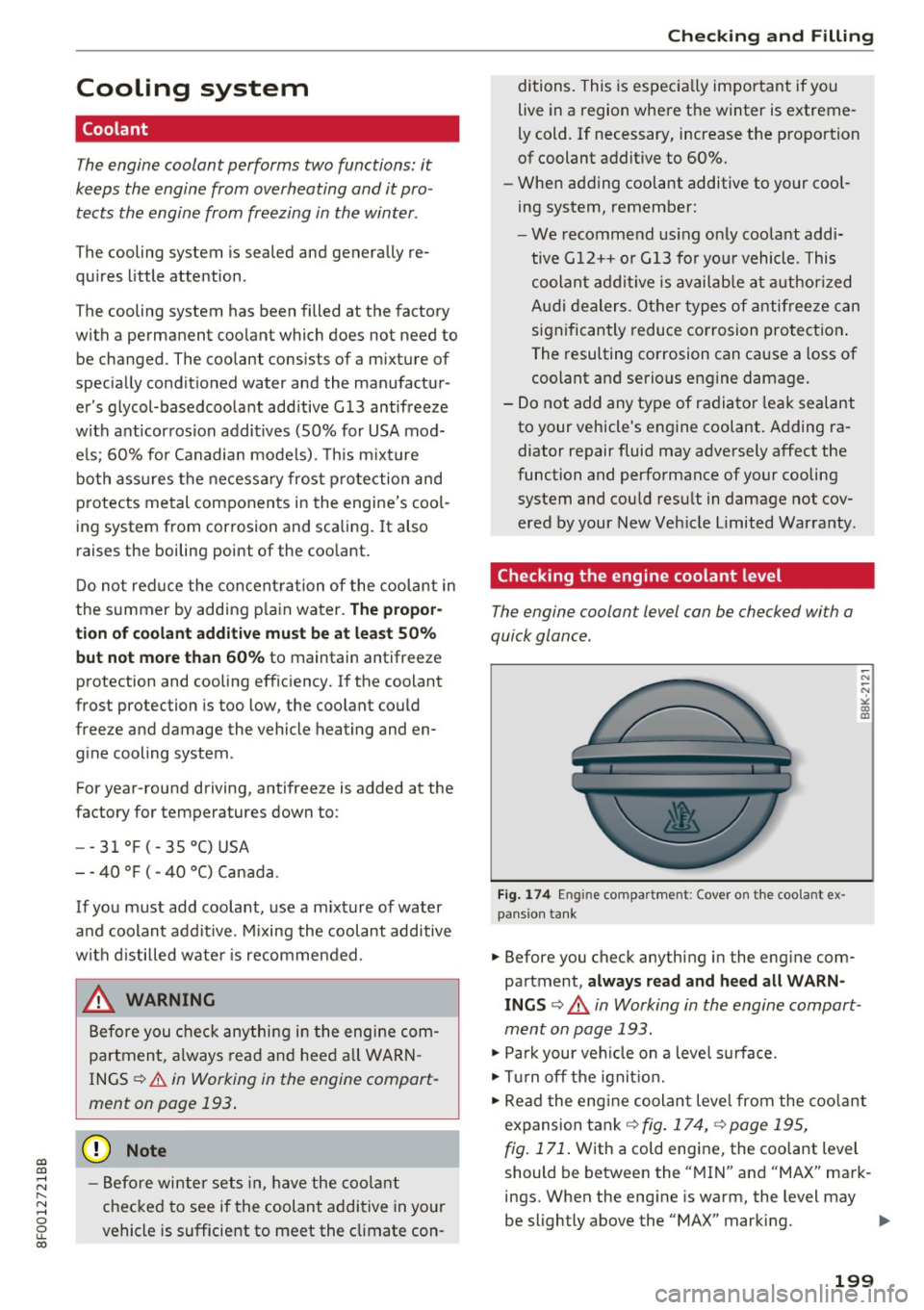
Fi g. 1 74 Engin e compar tmen t: Cover o n the coo la n t ex
pansion tank
.. Before you check anything in the eng ine com
partment,
always r ead and heed all WARN
INGS ¢ ,A in Working in the engine compart
ment on page 193 .
.. Par k your veh icle on a leve l sur face.
.. Tur n off t he ignit io n .
.. Read the eng ine coolan t leve l from the coo lant
expansion tank
¢ fig . 174, ¢page 195,
fig. 171 .
With a cold engine, the coo lant level
should be b etween the "MIN" and "MAX" mark
ings. When the eng ine is warm, the level may
be slightly above the "MAX" marking. .,..
199
Page 204 of 266
Checking and Filling
Brake fluid
Checking brake fluid level
The brake fluid level can be checked with a quick
glance.
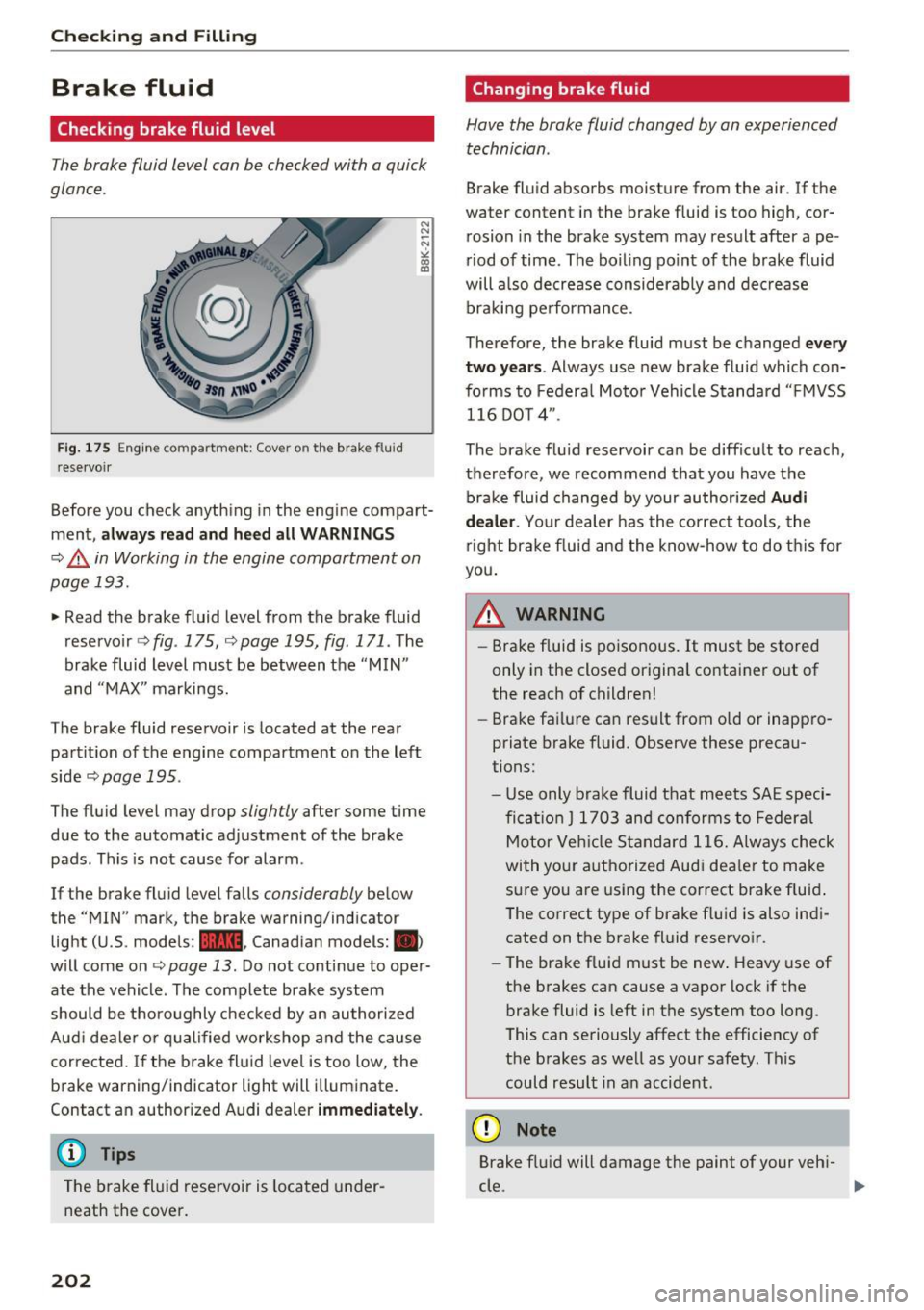
Fig. 175 Engine compartment: Cover on the brake fluid
r eservoir
Before you check anything in the engine compart
ment,
always read and heed all WARNINGS
¢ A in Working in the engine compartment on
page 193.
., Read the brake fluid level from the brake fluid
reservoir
<=> fig . 175, ¢page 195, fig . 171 . The
brake fluid level must be between the
" MIN"
and "MAX " markings.
The brake fluid reservoir is located at the rear
partition of the engine compartment on the left
side
¢ page 195.
The fluid level may drop slightly after some time
due to the automatic adjustment of the brake
pads . This is not cause for alarm .
If the brake fluid level falls
considerably below
the ' 'MIN" mark, the brake warning/indicator
light (U .S. models:
1111 , Canadian models: 1111)
will come on¢ page 13 . Do not continue to oper
ate the vehicle . The complete brake system
should be thoroughly checked by an authorized
Aud i dealer or qualified workshop and the cause
corrected . If the brake fluid level is too low, the
brake warning/indicator light w ill illuminate.
Contact an author ized Audi dealer
immediately.
(D} Tips
The brake fluid reservoir is located under
neath the cover.
202
Changing brake fluid
Have the brake fluid changed by an experienced
technician .
Brake fluid absorbs moisture from the air. If the
water content in the brake fluid is too high, cor
rosion in the brake system may result after ape
riod of time . The boiling po int of the brake fluid
will a lso decrease considerably and decrease
braking performance.
Therefore , the brake fluid must be changed
every
two years .
Always use new brake fluid which con
forms to Feder-al Motor Vehicle Standard "FMVSS
116 DOT 4 ".
The brake fluid reservoir can be difficult to reach ,
therefore, we recommend that you have the
brake fluid changed by your author ized
Audi
dealer .
Your dealer has the correct tools, the
right brake fluid and the know-how to do this for
you.
A WARNING
- Brake fluid is poisonous. It must be stored
only in the closed original container out of
the reach of children!
- Brake fai lure can result from o ld or inappro
priate brake fluid. Observe these precau
tions:
- Use only brake fluid that meets SAE speci
fi cation
J 1703 and conforms to Federal
Motor Veh icle Standard 116. Always check
with your authorized Audi dealer to make
sure you are using the correct brake f luid .
The correct type of brake f luid is also indi
cated on the brake fluid reservoir.
- The brake fluid must be new . Heavy use of
the brakes can cause a vapor lock if the
brake fluid is left in the system too long .
This can seriously affect the efficiency of
the brakes as well as your safety. This
could result in an accident.
(D Note
Brake fluid will damage the paint of your vehi-
cle .
lilJJ,
Page 216 of 266

Wheels
positions. Refer to the table
¢
page 218 for the number of
people that correspond to the ve
h icle normal load.
New tires or wheels
Audi recommends having all work
on tires or wheels performed by
an authorized Audi dealer or au
thor ized Audi Service Facility.
These facilit ies have the proper
knowledge and are equipped with
the required tools and replace ment parts.
.,. New tires do not yet have the
optimum gripping properties .
Drive carefully and at moderate
speeds for the first 350 miles
(500 km) with new tires.
1>-Use ti res of the same construc
tion , size (rolling circumference)
and as close to the same tread
pattern as possible on all four
wheels.
1>-0o not replace tires individually.
At least replace both tires on the
same axle at the same time.
1>-Audi recommends that you use
Audi Original Tires. If you would like to use different tires, please
note that the tires may perform
differently even if they are the
same size ¢
.&..
214
1>-Ifyou would like to equip your
vehicle with a tire/rim combina
tion that is different from what
was installed at the factory, con
sult with an authorized Audi
dealer or authorized Audi Service Facility before making a pur
chase ¢,&. .
The spare tire* is different from
the regular tires installed on the
vehicle -for example, if winter
tires or wide tires are installed -
so only use the spare tire* tempo
rarily in case of emergency and
drive carefully while it is in use. It
should be replaced with a regular
tire as soon as possible.
On
all wheel drive vehicles, all
four wheels must be equipped
with tires that are the same brand and have the same construction
and tread pattern so that the
drive system is not damaged by
different tire speeds . For this rea
son, in case of emergency , only
use a spare tire* that is the same
circumference as the regular
tires.
! WARNING
- Only use tire/rim combina
tions and suitable wheel bolts
that have been approved by .,.
Page 225 of 266

a:,
a:,
...... N r--. N ...... 0
0
LL 00
of snow, snow chain s can imp air handling and
damage the t ires, and t he chains will quickly be
destroyed.
A WARNING
Using incorrect snow chains or installing snow
chains incorrect ly can result in loss of vehicle
co ntrol, which increases the risk of an acc i
dent .
Snow chains can damage the r ims/wheel cov
ers* if the chains come into d irect contact
w ith them. Remove the wheel covers* first.
Use coated snow chains .
@ Tips
When using snow chains, it may be useful to
switch on sport mode
¢ page 168.
Low aspect ratio tires
Your Aud i is factory-equipped with low aspect ra
t io ti res. These t ires have been tho rough ly tested
a n d been se lected specifically fo r yo ur model for
t he ir superb performance, road feel and handling
under a variety o f driving conditions. Ask your au
thor ized Audi dealer for more details .
The low aspect ratio of these t ires is indicated by
a numera l of
55 or l ess in the tire 's size designa
tion. The numera l represents the rat io o f the
tire's sidewall height in relat ion to its tread width
expressed in pe rcentage. Conventional t ires have
a height/w idth rat io of 60 or more.
The performan ce of low- aspect- ratio tire s is par
ticularl y sensiti ve to imp roper inflat ion pres
sure . It is therefore import ant that low a spect
ratio tires are infl ated to the specified pressure
and that the inflation pre ssure is regularl y
checked and mainta ined . Tire pre ssure s shoul d
be checked at least once a month and alwa ys
befor e a long t rip
¢ page 217.
What you can do to avoid tire and rim
damage
Low aspect rat io tires can be damaged more easi
ly by impact with potho les, curbs, gull ies or
Wh eel s
ridges on the road, particular ly if the tire is un
deri nflated.
In orde r to min imi ze the occurrence of imp act
damage to the tires of yo ur vehicle, we recom
mend that you observe the following preca u
tions:
- Always ma intain recommended inflat io n pres
sures. Check yo ur ti re pressure every 2,000
miles (3,000 km) and add air if necessary .
- Dr ive ca refully on roads w ith po tholes, deep
gullies or ridges . The impac t from dr iving
through or over such obstacles can damage
your tires. Impact with a curb may a lso cause
damage to your tires.
- After any impact, immediate ly inspect your
tires or have them inspected by the nearest au
thorized Audi dealer. Replace a damaged tire as
soon as possible.
- Inspect your tires every 2,000 m iles (3,000 km)
for damage and wear. Damage is not a lways
easy to see . Damage can lead to loss of air and
underinflation, wh ic h could eventually cause
tire fa ilure. If you believe that a tire may have
been damaged, replace the tire as soon as pos
sib le.
- These tires may wear more quickly than others .
- Please also remember that, while these tires
delive r responsive ha ndling, they may ride less
comfortably a nd make more noise than other
choi ces.
Reduced perfo rmance in winter /cold se ason
conditions
All tires are des igned for certai n purposes. The
low aspect ratio, ultra high performance tires
o rigi na lly installed o n your veh icle are intended
f or maximum dry and wet road per formance and
handling . They are not suitable for co ld, snowy or
icy weather conditions . If you drive under those
c ircumstances, you should equip your vehicle
with all-season or winter tires, which offer better
tract ion under those conditions. We suggest you
use the recommended snow or all-season tires
spec ified for your veh icle, or their equiva lent .
Refer to¢
page 222 for more detailed informa
t ion regarding winter tires.
223
Page 239 of 266
a:,
a:,
...... N r--. N ...... 0
0
LL 00
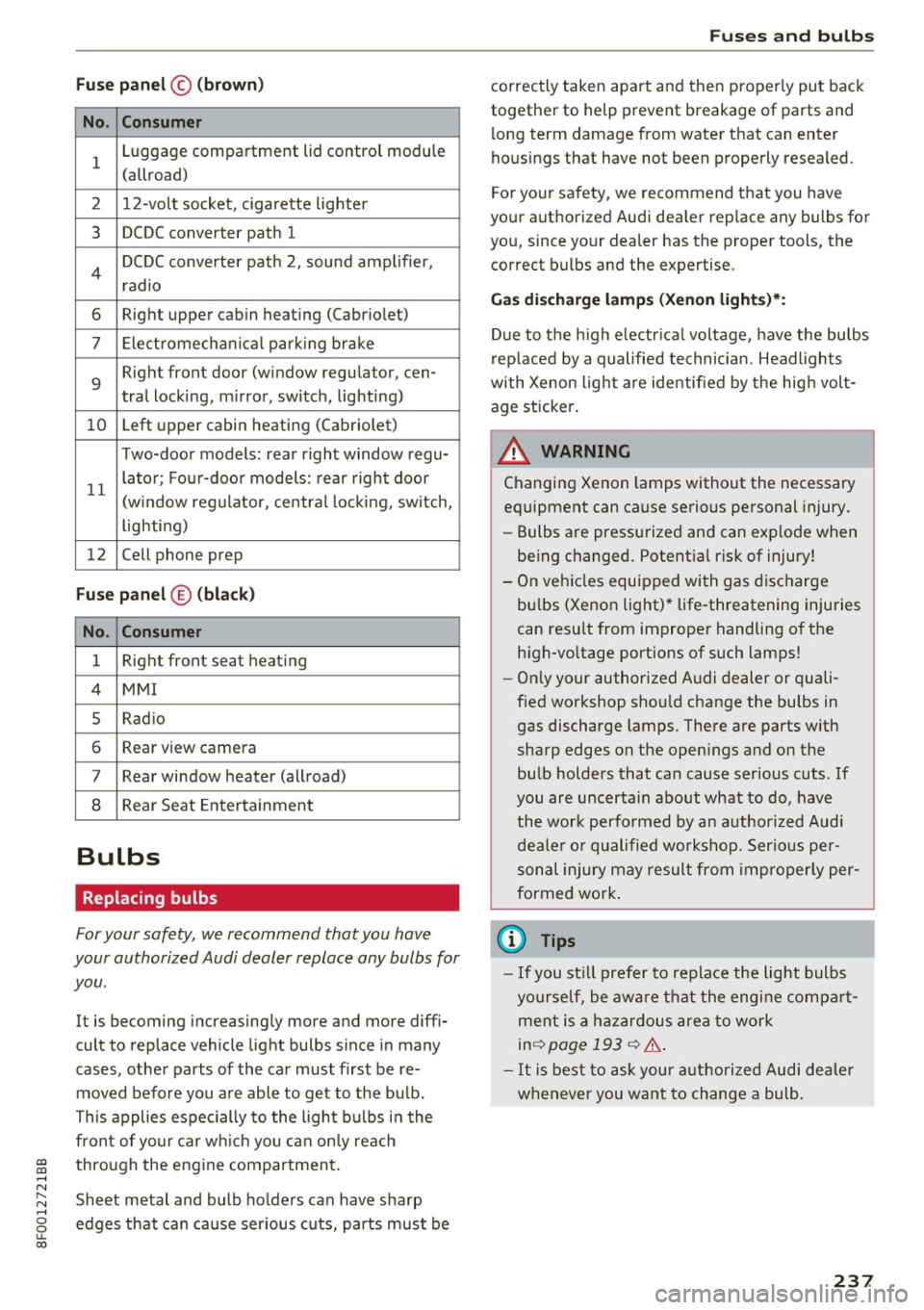
Fuse panel© (brown)
No . Consumer
1 Luggage compartment lid control module
(allroad)
2 12-volt socket, cigarette lighter
3 DCDC converter path 1
4 DCDC converter path 2, sound amplifier,
radio
6 Right upper cabin heating (Cabriolet)
7 Elect romechan ical park ing brake
9
Right front door (window regulator, cen-
tral locking, m irror, switch, lighting)
10 Left
upper cabin heating (Cabriolet)
Two-door models: rear r ight window regu-
11 lator; Four-door models:
rear right door
(w indow regulator, central locking, switch,
lighting)
12 Cell phone prep
Fuse panel ® (black )
No . Consumer
1 Right front seat
heating
4 MMI
5 Radio
6 Rear view camera
7 Rear window heater (allroad)
8 Rear Seat Entertainment
Bulbs
Replacing bulbs
For your safety, we recommend that you have
your authorized Audi dealer replace any bulbs for
you .
It is becoming increasingly more and more diffi
cult to replace vehicle light bulbs since in many
cases, other parts of the car must first be re
moved before you are able to get to the bu lb.
This applies especially to the light bulbs in the
front of your car which you can only reach
through the eng ine compartment.
Sheet metal and bulb ho lders can have sharp
edges that can cause serious cuts, parts must be
Fuses and bulbs
correctly taken apart and then properly put back
together to help prevent breakage of parts and
long term damage from water that can enter
hous ings that have not been properly resealed.
For your sa fety, we recommend that you have
your authorized Audi dea ler replace any bulbs for
you, since your dealer has the proper tools, the
correct bulbs and the expertise.
Gas discharge lamps (Xenon lights)*:
Due to the high e lectr ica l voltage, have the bulbs
replaced by a qualified technician. Headlights
with Xenon light are identified by the high volt
age sticker .
A WARNING
Changing Xenon lamps without the necessary
equipment can cause serious personal injury.
- Bulbs are pressurized and can explode when
being changed . Potential risk of injury!
- On vehicles equipped with gas discharge
bu lbs (Xenon light)* life-threatening injuries
can resu lt from improper handling of the
high -vo ltage portions of such lamps!
- Only your authorized Audi dealer or quali
fied workshop shou ld change the bulbs in
gas discharge lamps. There are parts w ith
sharp edges on the openings and on the bulb holders that can cause serious cuts . If
you are uncerta in about what to do, have
the wor k performed by an authorized Audi
dealer or qualified workshop. Serious per
sonal injury may result from improperly per
formed work.
(D Tips
- If you st ill prefer to replace the light bulbs
yourself, be awa re that the engine compa rt
ment is a hazardous area to work
inq page 193 q &,.
- It is best to ask your authorized Audi dealer
whenever you want to change a bulb.
237