control AUDI A5 CABRIOLET 2017 Repair Manual
[x] Cancel search | Manufacturer: AUDI, Model Year: 2017, Model line: A5 CABRIOLET, Model: AUDI A5 CABRIOLET 2017Pages: 266, PDF Size: 66.64 MB
Page 115 of 266
a:,
a:,
...... N r--. N ...... 0
0
LL 00
For detailed information on how to adjust the
driver's seat, see
¢ page 58.
A WARNING
Drivers who are unbelted, out of position or
too close to the airbag can be seriously in
jured by an airbag as it unfolds. To help re
duce the risk of serious personal injury:
- Always adjust the driver's seat and the
steering wheel so that there are at least 10 inches (25 cm) between your breastbone
and the steering wheel.
- Always hold the steering wheel on the out
side of the steering wheel rim with your
hands at the 9 o'clock and 3 o'clock posi
tions to help reduce the r isk of personal in
jury if the driver's airbag inflates.
- Never hold the steering wheel at the
12 o'clock position or with your hands at
other positions inside the steering wheel
rim or on the steering wheel hub. Holding
the steering wheel the wrong way can cause
serious injuries to the hands, arms and head
if the driver's airbag deploys.
- Pointing the steering wheel toward your
face decreases the ability of the supplemen
tal driver's airbag to protect you in a colli sion.
- Always sit in an upright position and never lean against or place any part of your body
too close to the area where the airbags are located .
- Before driving, always adjust the front seats
and head restraints properly and make sure
that all passengers are properly restrained.
- Never adjust the seats while the vehicle is
moving . Your seat may move unexpectedly
and you could lose control of the vehicle .
- Never drive with the backrest reclined or
tilted far back! The farther the backrests are
tilted back, the greater the risk of injury due
to incorrect positioning of the safety belt
and improper seating position.
- Children must a lways ride in child safety
seats¢
page 150. Special precautions ap
ply when installing a child safety seat on the
front passenger seat ¢
page 130.
Driving safety
Proper seating position for the front
passenger
The proper front passenger seating position is
important for safe, relaxed driving.
For your own safety and to reduce the risk of in
jury in the event of an acc ident, we recommend
that you adjust the seat for the front passenger
to the following position:
" Move the front passenger seat back as far as
possible . There must be a minimum of 10 in
ches (25 cm) between the breastbone and the
instrument panel¢.&, .
"Adjust the angle of the seatback so that it is in
an upright position and your back comes in full
contact with it whenever the vehicle is moving.
" Applies to vehicles with adjustable head re
straints : Adjust the head restraint so the upper
edge is as even as possible with the top of your
head . If that is not possible, try to adjust the
head restraint so that it is as close to this posi
tion as possible .
" Keep both feet flat on the floor in front of the
front passenger seat.
" Fasten and wear safety belts correctly
¢page 125.
For detailed information on how to adjust the
front passenge r's seat, see ¢
page 57.
A WARNING ~
Front seat passengers who are unbelted, out
of position or too close to the airbag can be
seriously injured or killed by the airbag as it unfolds. To help reduce the risk of serious
personal injury:
- Passengers must always sit in an upright po
sition and never lean against or place any
part of their body too close to the area
where the airbags are located .
- Passengers who are unbelted, out of posi
tion or too close to the airbag can be seri
ously injured by an airbag as it unfolds with
great force in the blink of an eye.
-Always make sure that there are at least 10 inches (25 cm) between the front passen
ger's breastbone and the instrument panel.
113
Page 118 of 266
Driving sa fe ty
the a irbag dep loys and injure you or yo ur
passengers.
Pedal area
Pedals
The pedals must always be free to move and
must never be interfered with by a floor mat or
any other object.
Make sure that all pedals move freely without in
terference and that noth ing prevents them from
retu rni ng to the ir origi nal positions.
Only use floor mats that leave the pedal area free
and can be secured with floor mat fasteners.
If a brake circuit fails, increased brake pedal trav
el is required to br ing the veh icle to a full stop.
_&. WARNING
Peda ls that cannot move free ly can cause loss
of vehicle control and increase the risk of seri
ous inj ury.
- Never place any objects in the driver's foot
well. An object could get into the pedal area
and interfere w ith pedal function . In case of
s u dden brak ing o r an accident, you would
not be ab le to bra ke or accelerate!
- Always make sure that nothing can fa ll or
move into the dr ive r's footwell.
Floor mats on the driver side
Always use floor mats that can be securely at
tached to the floor mat fasteners and do not in
terfere with the fre e movement of the pedals .
... Make sure that the floor mats are properly se
cured and cannot move and interfere with the
peda ls ~ .&_ .
Use on ly floor mats that leave the pedal area un
obstructed and that are firmly secured so that
they cannot slip o ut of pos ition . Yo u ca n obtain
suitable floo r mats from you r authorized Aud i
dea le r.
F loor mat fasteners are insta lled in your Audi.
116
Floor mats used in your vehicle must be attached
to these fasteners. Properly securing the floor
mats will prevent them from slid ing into posi
tions that could interfere with the pedals or im
pair safe operat ion of your vehicle in other ways.
_&. WARNING
Pedals that ca nnot move freely can res ult in a
loss of vehicle co ntro l and increase the r isk of
serious pe rsonal injury.
-Always make sure that floo r mats a re prop
erly secured.
- Never p lace or install floor mats o r other
floor coverings in the vehicle that cannot be
proper ly sec ured in place to prevent them
from s lipping and interfer ing wi th t he ped
al s or the ab ili ty to cont ro l t he vehicle.
- Never p lace or ins tall floor mats o r other
floor coverings on top of a lready installed
floor m ats. Addi tional floor ma ts and o ther
cover ings will reduce the size o f th e pedal
area and interfere with the pedals.
- Always proper ly re insta ll and se cure floo r
mats tha t have been taken ou t for cleaning.
- Alway s make sure th at o bje cts canno t fall
into the driver foo twell whi le the vehicle is
mov ing. Objects can become trapped under
the brake pedal a nd accelerator pedal caus
ing a loss o f vehicle control.
Storing cargo correctly
Loading the luggage compartment
All luggage and other objects must be properly
stowed and secured in the luggage compart
ment .
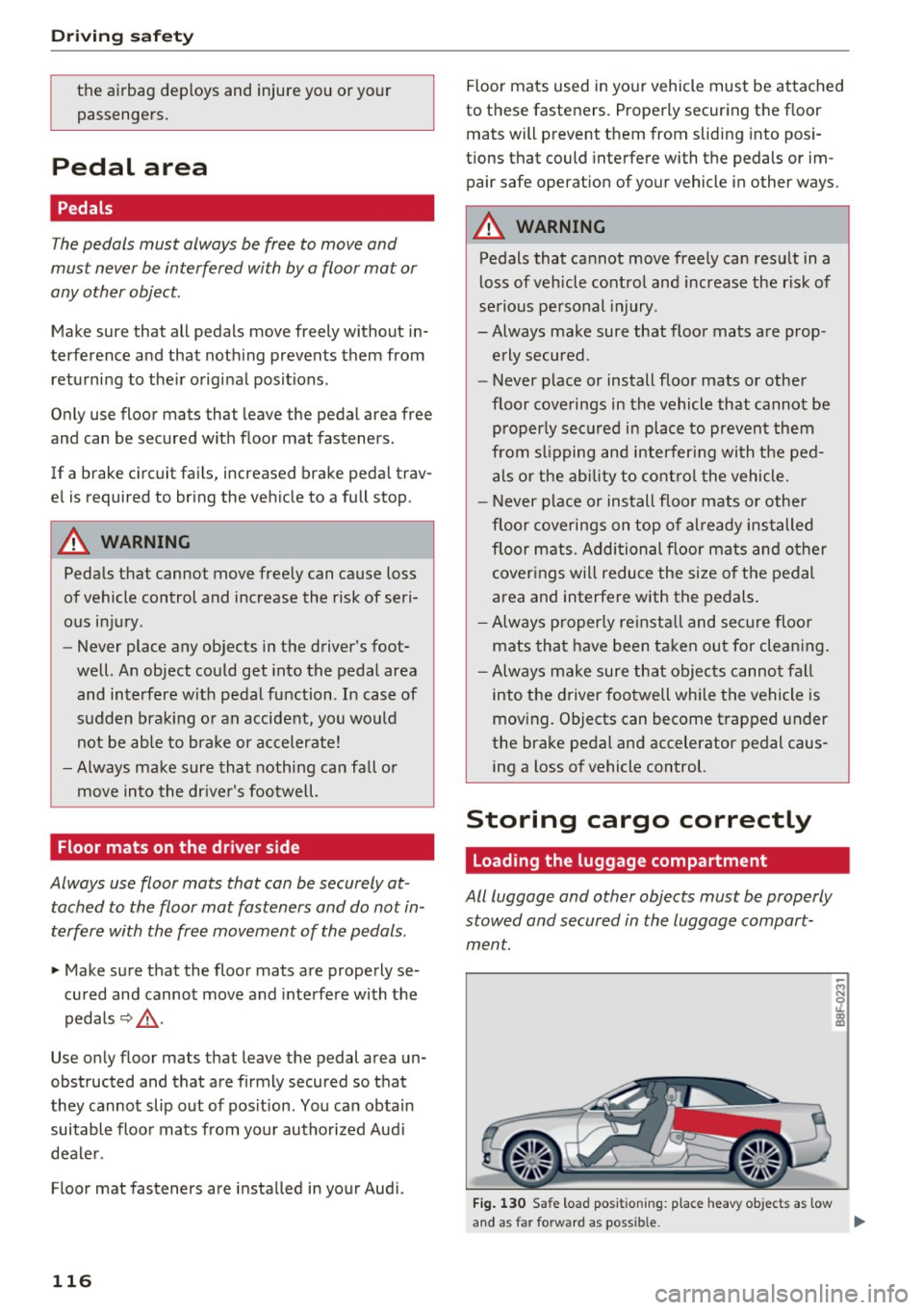
Fig. 13 0 Safe load pos it ion ing: p lace heavy objects as low
-M N 0 oL CD m
an d as far forwa rd as possible. .,.
Page 122 of 266

Driving safety
-the safety belts with belt tensioners
- the windshield frame
- the rollover sensors
The active rollover protection system provides
additional safety in the event of a rollover. With
in milliseconds, sensors deploy two rollbars lo
cated behind the headrests in the rear seats
¢fig. 132 .
The rollbars, reinforced windshield frame and
belt tensioners help protect front and rear pas
sengers in the event of a rollover.
The rollover protection system functions when
the power top is both open and closed.
A WARNING
Do not use the area behind the rear seat
headrests
¢fig. 131 as a storage area. This is
the area where the rollbars deploy.
If the roll
over protection system is triggered, objects
placed there can be propelled through the ve
hicle and make it more difficult for the roll
bars to deploy. This increases the risk for seri
ous or life-threatening injuries.
When is rollover protection deployed?
Rollover protection deploys in o collision or roll
over.
Depending on the collision, sensors throughout
the vehicle and the control module trigger the
ro llov er system to deploy.
Fo r safety reasons, rollover protection also de
ploys during front, side and rear collisions above
a certain level of severity.
120
Retracting rollover protection
Fig. 133 Deployed rollbar wit h release loop.
Fig. 134 Deployed rollbar wit h power top frame facing up
ward .
If the rollover protection has triggered but the
vehicle was not involved in an accident, you can
retract the rollover protection yourself in an
emergency. Drive to your authorized Audi dealer
or qualified repair facility immediately to have
the malfunction corrected.
With the power top open
... Pull the loop upward in the direction of the ar
row and hold it in place~
fig. 133.
... Slide the rollbar down.
... Release the loop just before the rollbar reaches
its end position by approximately 1-2 in. (3-5
cm) .
.,. Press the rollbar down until it stops .
.,. Make sure the rollbar is secure before releasing
it .
.,. Close the cover @¢
fig. 134 .
.,. Repeat the procedure on the other rollbar.
With the power top closed
... Switch the ignition on .
.,. Press the convertible switch to adjust the con-
vertible frame until it is vertical¢
fig. 134. .,._
Page 134 of 266
Airbag syste m
safety seat. It can be a very dangerous p lace for
an infant or a child in a rearward-facing seat.
The Advanced Airbag System i n your veh icle has
been ce rt ified to comp ly with the requirements
of United States Federal Motor Vehicle Safety
Standard (FMVSS)
208, as well as Canada Motor
Veh icle Safety Standard (CMVSS)
208 as applica
b le at the time your vehicle was manufactured.
According to requirements, the front Advanced
Airbag System on the passenger s ide has been
certified for "suppression " for infants of about
12 month old and younger and for "low risk de
p loyment " for children aged
3 to 6 years o ld (as
defined in the standard).
The
PA SSENGER AIR BAG OFF light in the instru
ment panel tells you when the front Advanced
Ai rbag on the passenger side has been tu rned off
by the elect ronic cont rol unit.
Each t ime you tur n on the ignit ion , the
PASSEN
GER AIR BAG OFF
light will come on fo r a few
seconds and :
- will stay on if the front passenger seat is not
occupied,
- will s tay on if there is a small c hild or child re
straint on the front passenger seat,
- will go off if the front passenger seat is occu
pied by an adult as reg istered by the weight
sensing mat¢
page 140 , Monitoring the Ad
vanced Airbag System .
The PAS SENGER AIR BAG O FF light comes on
when the control unit detects a total we ight on
the front passenger seat that requires the front
airbag to be turned off.
If the tota l weight on the front passenger seat is
more than that of a typical 1 year -old child but
less than the we ight of a small adult, the front
a irbag on the passenger side can deploy (the
PAS SENGER AIR BAG OFF light does not come
on) .
If the PAS SENGER AIR BAG OFF light does
not come on, the front a irbag on the passenger
side has not been turned off by the electronic
control unit and can deploy if the control unit
senses an impact that meets the condit ions stor
ed in its memory.
For e xample, the airbag may deploy if:
132
- a small chi ld that is heavier than a typica l 1
year-o ld child is on th e front passenger seat
(regard less of whether the child is in one of the
child safety seats listed¢
page 152), or
- a child who has outgrown c hild restraints is on
the front passenger seat.
If the front passenger a irbag is t urned off, the
PASSENGER AIR BAG OFF light comes on in the
instrument cluster and stays on.
The fro nt airbag on the passenge r side may
not
deploy (the PAS SENGER AIR BAG OFF light does
not ill uminate and stay lit) even if a small adu lt
or teenager, or a passenger who is not sitting up
right with thei r back against a non-recl ined back
rest with the ir fee t on the vehicle floor in front of
the sea t is on the fron t passenger sea t
<=> page 112, Proper seating position for the driv
er .
If the front passenger a irbag deploys, the Feder
al Standard requires the airbag to meet the "low
risk" deployment cr iteria to reduce the r isk of in
jury through interaction w ith the airbag . "low
risk " deployment occurs in those crashes that
take place at lowe r de cele rations as defined in
the e lec tronic co ntro l unit ¢
page 140, PASSEN
GER AIR BAG OF F light.
Always remembe r, a chi ld safety seat or infant
c ar rie r ins talled on the front seat may be s truck
and knocked ou t of posit ion by t he rap idly i nflat
i ng passenge r's airbag in a frontal coll is ion . The
airbag could greatly red uce the effectiveness of
the child restraint and even seriously injure the child during inflation.
Fo r th is reason, and beca use the back seat is the
safest place for children -when properly restrain
ed according to their age and size -we strongly
recommend that children always sit in the back
seat
c> page 150, Child safety .
A WARNING
A child in a rearward-facing child safety seat
installed on the front passenger seat will be
seriously injured and can be killed if the front
a ir bag inflates - even with an Advanced Airbag
Sys tem.
Ill>
Page 136 of 266
Airbag syste m
Front airbags
Description of front airbags
The airbag system can provide supplemental
protection to properly restrained front seat occu
pants.
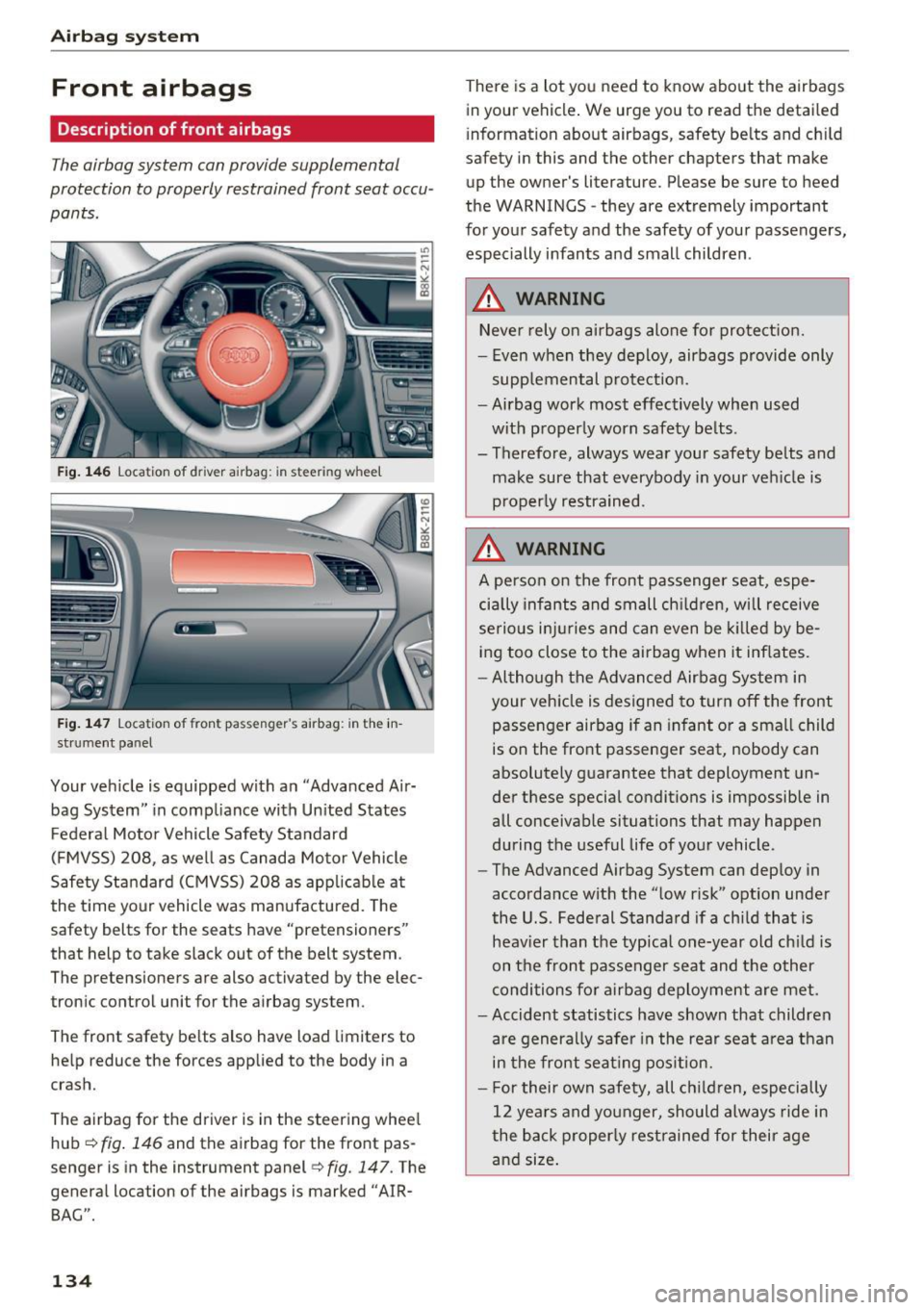
Fig. 146 Location of driver airbag: in steering whee l
Fig. 147 Location of front passenger's airbag: in the in
strument panel
Your veh icle is equipped with an "Advanced Air
bag System" in compliance with Un ited States
Federa l Motor Vehicle Safety Standard
(FMVSS)
208, as well as Canada Motor Vehicle
Safety Sta ndard (CMVSS)
208 as app licable at
the time your vehicle was manufactured. The
safety belts for the seats have "pretensioners"
that help to take slack out of the belt system.
The pretensioners are also activated by the elec
tronic control unit for the airbag system.
The front safety be lts also have load limiters to
help reduce the forces applied to the body in a
crash.
The airbag for the driver is in the steering wheel
hub
<=>fig . 146 and the airbag for the front pas
senger is in the instrument panel<=>
fig. 147. The
general location of the airbags is marked "AIR
BAG".
1 34
There is a lot you need to know about the airbags
in your vehicle . We urge you to read the detailed
i nformation about airbags, safety belts and child
safety in this and the other chapters that make
up the owner's literature. Please be sure to heed
the WARNINGS -they are extremely important
for your safety and the safety of your passengers,
especially infants and small children .
.&_ WARNING -
Never rely on airbags alone for prote ct ion.
- Even when they deploy, airbags provide only supp lemental protection.
- Airbag work most effectively when used with properly worn safety be lts.
- Therefore, always wear your safety belts and make sure that everybody in your veh icle is
properly restrained .
.&_ WARNING
A person on the front passenger seat, espe
cially infants and small ch ildren, wi ll receive
serious inju ries and can even be killed by be
ing too close to the airbag when it inf lates.
- Although the Advanced Airbag System in
-
your vehicle is designed to turn off the front passenger airbag i f an infant or a small child
is on the front passenger seat, nobody can
absolutely guarantee that deployment un
der these special conditions is impossible in
all conceivable situations that may happen
during the useful life of your vehicle.
- The Advanced Airbag System can deploy in
accordance with the "low risk" option under
the U.S. Federal Standard if a child that is
heav ier than the typical one-year old ch ild is
on the front passenger seat and the other
conditions for airbag deployment are met.
- Accident statistics have shown that children are generally safer in the rear seat area than
in the front seat ing pos ition.
- For their own safety, all chi ld ren, especially
12 years and younger, should always ride in
the back proper ly restrained for their age
and size .
Page 137 of 266
a:,
a:,
...... N r--. N ...... 0
0
LL 00
Advanced front airbag system
Your vehicle is equipped with a front Advanced
Airbag System in compliance with Un ited States
F edera l Motor Vehicle Safety Standard 208, as
well as Canada Motor Vehicle Safety Standard
(CMVSS) 208 as applicable at the time your vehi
cle was manufactured .
The front Advanced Airbag System supp lements
the safety belts to provide additional protection
for the driver 's and front passenger's heads and
upper bodies in frontal crashes . The airbags in
f late only in frontal impacts when the veh icle de
cele rat ion is high enough.
The front Advanced Airbag System for the front
seat occupants is not a substitute for your safety be lts . Rather, it is part of the overall occupant re
s tra int system in your vehicle. Always remember
that the airbag system can on ly help to protect
you, if you are sitting upr ight, wear ing your safe
ty belt and wear ing it prope rly . This is why you
and your passengers must always be prope rly re
stra ined, not just beca use the law req uires yo u to
be .
The Advanced Airbag System in your veh icle has
been ce rtified to meet the "low r is k" requi re
ments fo r 3 and 6 ye ar-old children o n the pas
senger side and very sma ll adults on the drive r
side . The low risk dep loyment cr iteria are intend
ed to help reduce the risk of injury through inter
action with the front a irbag that can occur, for
examp le, by being too close to the steering wheel
and instrument panel when the airbag inflates .
In addition , the system has been certified to
comp ly with the "suppression" requi rements of
the Safety Standard, to turn off the front a irbag
for i nfants 12 months old and younger who are
restrained on the front passenger seat in child re
stra ints that are listed in the Standa rd
¢ page 152, Child restraints and Advanced Air
bags.
"Suppress ion" requ ires the front a irbag on the
passenger side to be turned off if:
- a ch ild up to about one year of age is restra ined
on the front passenger seat in one of the rear
facing or forward -fac ing infant restra ints listed
Airb ag sys tem
in Federal Motor Veh icle Safety Standard 208
with which the Advanced Airbag System in your
veh icle was certif ied. For a List ing of the child
restraints that were used to certify your vehi
cle's compliance with the US Safety Standard
¢ page 152,
-weight less than a threshold level stored in the
con trol un it is detected on the front passenger
seat .
When a person is detected on the front passen ger seat, weighing more than the total weight of
a chi ld that is about
1 year old restra ined in one
of the rear-facing or forward -fac ing infant re
straints (listed in Federal Motor Veh icle Safety
Standard 208 with w hich the Advanced A irbag
System in your veh icle was certified), the front
airbag on the passenge r side may o r may not de
ploy .
T he
PAS SENGER AIR BAG OFF lig ht comes o n
whe n the elect ronic con trol uni t detects a tota l
weight on the fron t passenger sea t th at req uires
the front a irbag to be turned off . If the
PASSEN
GER AIR BAG OFF
light does not come on, the
front airbag on the passenger side has not been
turned off by the control unit and can dep loy if
the control unit senses an impact that meets the
condit io ns stored in its memory .
If the total weight on the front passenger seat is
more than that of a typica l 1 year-old, but less
than the weight of a small adult, the front airbag
o n the passenger s ide may deploy (the
PAS SEN
GER AIR BAG OFF
light does not come on) .
For example , the ai rb ag may deploy if :
- a small ch ild that is heav ier than a typ ica l 1
yea r-o ld child is on the front passenger seat
(regard less of whether the child is in one of the
child safety seats listed
¢ page 152),
- a child who has outgrown c hild restraints is on
the front passenger seat.
If the front passenge r a irbag is t urned off, the
PASSENGER AIR BAG OFF light in the center of
the instr ument pane l wi ll come on and stay on .
T he front airbag on the passenger s ide m ay
not
deploy (the PASSENGER AIR BAG OFF light does
not illuminate and stay lit) if: ..,.
135
Page 138 of 266
Airbag syste m
-a small adu lt or teenager is on the front pas
senger seat
- a passenger who is not sitting upright with
their back against a non -reclined backrest with
their feet on the vehicle floor in front of the
seat is on the front passenger seat.
I f the front passenger airbag dep loys, the Feder
al Standard requires the airbag to meet the "low
risk" deployment criteria to help reduce the risk
of injury through interaction with the airbag.
"Low risk" deployment occurs in those crashes
that take place at lower decelerations as def ined
in the electronic control unit.¢
page 140
Alway s remember: Even though your vehicle is
equ ipped w ith Advanced Airbags, the safest place
for children is properly restrained on the back
seat . Please be sure to read the important infor
mat ion in the sections that follow and be sure to
heed a ll of the WARN INGS.
A WARNING
To red uce the risk of inj ury when an ai rbag in
fla tes, a lways wear safety bel ts p roperly.
- If you are unrestrained, leaning fo rwa rd, s it
t ing s ideways or o ut of pos ition in any way,
yo ur risk of in jury is much h igher .
- Yo u will also re ceive serious injur ies and
could even be killed if you are up aga inst the
airbag or too close to it when it inflates -
even with an Advanced Airbag¢
page 130.
A WARNING
A child in a rearward-facing chi ld safety seat
installed on the front passenger seat wi ll be
ser iously injured and can be killed if the front
airbag inflates - even w ith an Advanced Airbag
System.
- Although the Advanced A irbag System in
your vehicle is designed to turn off the front
airbag when a rearward-facing child re
straint has been installed on the front pas
senger seat, nobody can absolutely g uaran
tee that deployment is impossible in all con
ceivable s ituations that may happen during
the usef ul life of your vehicle .
- The inflating a irbag w il l hit the child safety
seat or infant c arrier wi th great force and
136
w ill smash the child safety seat and child
aga inst the back rest, center armrest, door,
or roof.
- Always install rearward-facing child re
straints in the back seat.
- If you must install a rearward facing child
safety seat on the front passenger seat be
cause of exceptional circumstances and the
PASSENGER AIR BAG OFF light does not
come on and stay on, immediately install
the rea r-facing child safety seat in a rear
seating posi tion and have the ai rbag system
inspected by your au thori zed Au di dealer.
A WARNING
If, in exceptional ci rcums tances, you must in
stall a forw ard-facing child res traint on the
front passenger's seat:
- Always make sure the forward-fa cing sea t
has been des igned and certified by its man
ufacturer for use on a front seat with a pas
senger front and side airbag.
- Never put the fo rward -facing child restraint
up against or very nea r the instrument pan ·
el.
-Always move the passenge r seat into its
rearmost position in the seat's fo re and aft
ad justment range, as far away from the a ir
bag as poss ible, before install ing the for
ward-facing chi ld restraint. The backrest
m ust be adjusted to an upr ight position.
- Make sure that the
PASSENGER AIR BAG
OFF
li ght comes on and stays on all t he time
wheneve r the ign it ion is switched on.
Advanced Airbag System components
The fro nt passenge r seat i n your veh icle has a lot
of ve ry important parts of the Advanced A irbag
System i n it. These parts incl ude t he weight
sens ing mat, senso rs, wir ing, bracke ts, and
more . The f unction o f the system in the front
passenger seat is checked by the electro nic con
tro l unit when the ignition is on . The control unit
monitors the Advanced Airbag System and turns
the airbag ind icator light on when a malfunction
i n the system components is detected. The func-
tion of the a irbag ind icator light is described in .,_
Page 139 of 266

a:,
a:,
...... N r--. N ...... 0
0
LL 00
greater detail below. Because the front passen
ger seat contains important parts of the Ad
vanced A irbag System, you must take care to pre
vent it from being damaged. Damage to the seat
may prevent the Advanced Airbag for the front
passenger seat from doing its job in a crash .
The front Ad vanced Airb ag S ystem con sis ts
of the follo wing :
-Crash sensors in the front of the vehicle that
measure vehicle acceleration/decelerat io n to
provide information to the Advanced Airbag
System about the severity of the crash .
- An electronic control unit, with integrated
crash sensors for front and side impacts . The
contro l unit "decides" whether to fire the front
airbags based on the information received from
the crash sensors. The control unit also "de
cides" whether the safety be lt pretensioners
shou ld be activated.
- An Advanced Airbag with gas generator and
contro l valve for the driver inside the steering
whee l hub .
- An Advanced Airbag with gas generator and
contro l valve inside the instrument pane l for
the front passenger.
- A weight -sensing mat under the upho lstery
padding of the front passenger seat cushion
that measures the total weight on the seat . The
information registered is sent continuously to
the electron ic control unit to regulate deploy
ment of the front Adva need A irbag on the pas
senger side.
- An airbag monitoring system and indicator
light i n the instrument cluster
¢page 140.
-A sensor in each front seat registers the dis
tance between the respective seat and the
steering wheel or instrument panel. The infor
mation reg istered is sent cont inuous ly to the
electronic control unit to regulate deployment
of the fro nt Adv a need A irbags.
- T he
PASS EN GE R AIR BAG OFF light comes on
and stays on in the center of the instrument
pane l¢
page 140, fig . 149 and tells you when
the front Advanced Airbag on the passenge r
side has been turned off.
- A sensor below the safety belt latch fo r the
front seat passenger to meas ure the tension on
Airb ag sys tem
the sa fety belt. The tension on the safety belt
and the weight registered by the weight-sens
ing mat help the control unit "decide" whether
the front airbag for the front passenger seat
should be turned off or not¢
page 131, Child
restraints on the front seat -some important
things to know.
- A sensor in the safety belt latch for the driver
and for the front seat passenger that senses
whether that safety belt is latched or not and
transmits this information to t he electronic
cont rol un it.
_& WARNING
Damage to the front passenge r seat can pre
vent the front airbag from working properly.
- Imp roper repair or disassembly of the front
passenger and driver seat will p revent the
Advanced Airbag System from f unctioning
properly.
- Repairs to the front passenger seat must be
performed by qualified and properly trained
workshop personne l.
- Never remove the front passenger or driver
seat from the vehicle.
- Never remove the upholstery from the front
passenger seat.
- Never d isassemble o r remove par ts from the
seat o r disconnect w ires from it.
- Never carry sh arp objects in your pocke ts or
p lace them on the seat. If the weight-sens
ing mat in the passenger seat is punctu red
it cannot work proper ly.
- Never carry things on your lap or carry ob
jects on the passenger seat. S uch items can
increase the weight reg istered by the
weight-sensing mat and send the wrong in
formation to the airbag control unit.
- Never store items under the front passenger
seat. Parts of the Advanced Airbag System
under the passenger seat could be dam
aged, p reventing them and the airbag sys
tem from working p roper ly.
- Never p lace seat covers or replacement up
holstery that have not been specifically ap
p roved by A udi on the front seats.
- Seat covers can prevent the Advanced A ir
bag System from recognizing chi ld
137
Page 140 of 266
Airbag syste m
restraints or occupants on the front passen
ger seat and prevent the side airbag in the
seat backrest from deploying properly.
- Never use cushions, pillows, blankets or
similar items on the front passenger seat.
The additional padding will prevent the
weight-sens ing mat in the seat from accu
rately reg istering the ch ild restraint or per
son on the seat and prevent the Advanced
Airbag System from funct ioning prope rly.
- If you must use a child restraint on the front
passenge r seat and the child restraint man
ufact urer's instructions require the use of a
towel, foam cushion or something else to properly position the chi ld restraint, make
certain that the
PASSENGER A IR BAG OFF
light comes on and stays on whenever the
child restraint is installed on the front pas
senger seat.
- If the
PAS SENGER AIR BAG O FF light does
not come on and stay on, immediately in
stall child restraint in a rear seating position and have the airbag system inspected by
you r authorized Aud i deale r.
How the Advanced Airbag System
components work together
The front Advanced Airbag System and the side
ai rbags supplement the protection offered by the
front three-point safety belts with pretensioners and load limiters and the adjustable head re
stra ints to help reduce the r isk of injury in a wide
range of accident and crash situations. Be sure to
read the important information about safety and heed the WARNINGS in th is chapter .
Deployment of the Advanced Airbag System and
the activation of the safety belt pretensioners de
pend on the deceleration measured by the crash
sensors and registered by the electronic control
unit . Crash severity depends on speed and decel
eration as we ll as the mass and stiffness of the
vehicle or object involved in the crash.
On the passenger s ide, regardless of safety belt
use, the a irbag will be t urned off if the weight on
the passenge r seat is less than the amount p ro
g rammed in the e lectron ic cont rol unit . T he front
1 38
airbag on the passenger side will also be turned
off if one of the child safety seats that has been
certified under Federal Motor Vehicle Safety
Standard 208 has been recogn ized on the seat.
The
PAS SEN GER AI R BA G OFF light comes on
and stays on to te ll you when the front Advanced
Airbag on the passenger side has been turned off
¢ page 131, Child restraints on the front seat
some important things to know .
.&_ WARNING
To reduce the risk of injury when an airbag in
f lates, always wear safety belts properly.
- I f you are unrestrained, leaning forward, sit
ting sideways or ou t of position in any way,
your ris k of injury is much highe r.
- You will a lso receive ser ious injuries and
could even be killed if yo u are up against the
airbag or too close to i t when it inflates -
even with an Advanced Airbag
r::!;>page 130.
More important things to know about front
airbags
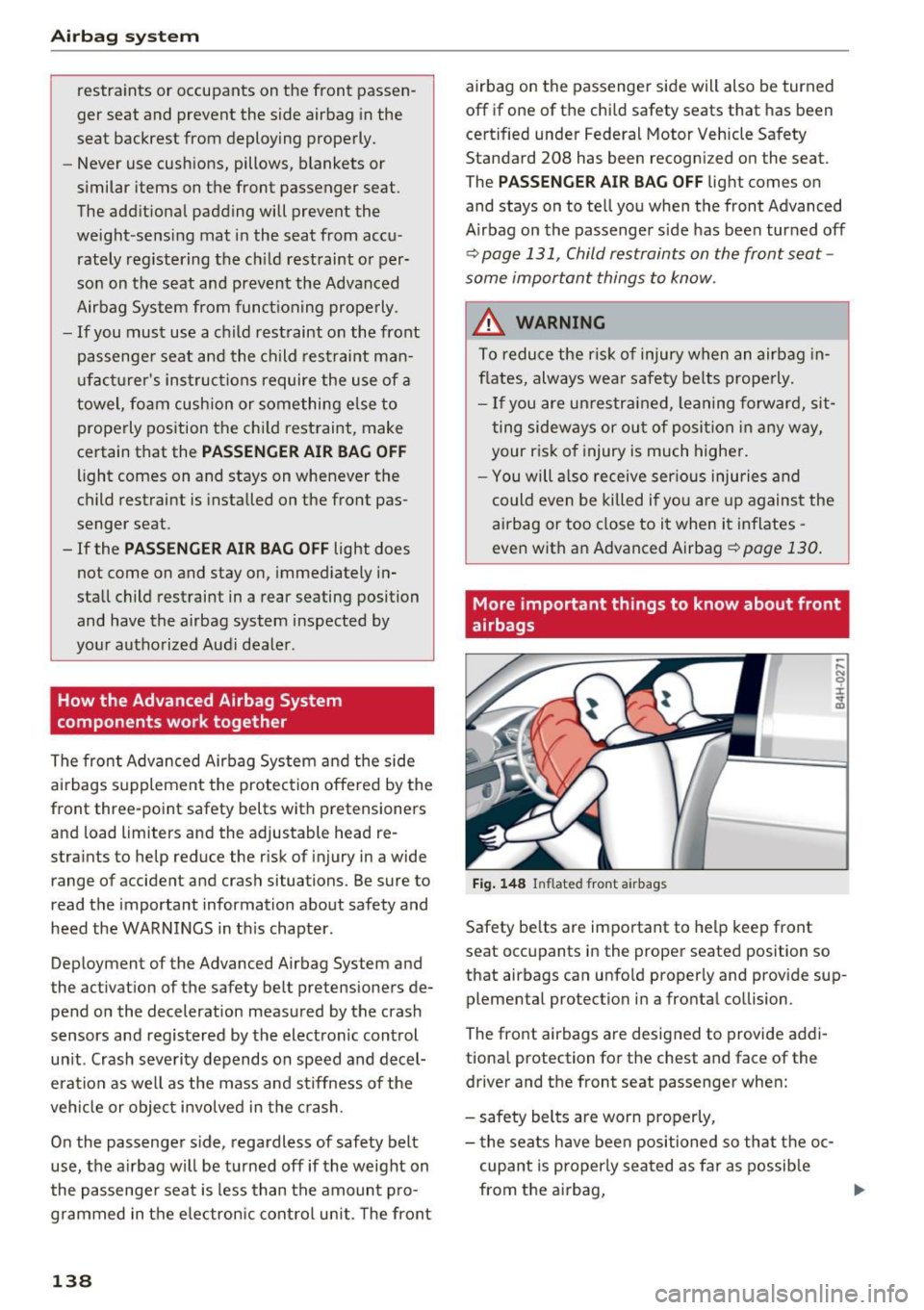
Fig. 14 8 Inflated front a irbags
-,... N 0 :i: ;;i;
Safety be lts are important to help keep front
seat occupants in the proper seated position so
that airbags can unfo ld properly and prov ide sup
plemental protection in a fronta l co llision.
The front airbags a re designed to provide addi
tional protection for the chest and face of the driver and the front seat passenger when:
- safety belts are worn properly,
- t he seats have been positioned so that the oc-
cupant is properly seated as far as possib le
from the airbag,
Ill-
Page 143 of 266

The PASSENGER AIR BAG O FF light is located in
the c enter of the instrument panel¢
fig. 149 .
The PASS ENGER AIR BAG OFF light will come on
and stay on to tell you when the front Advanced
Airbag on the passenger side has been turned off
by the el ectronic control unit . Each time you turn
on the ignition, the
P ASSENGER AIR BAG OFF
light will flash for a few seconds and:
- will stay on if the front passenger seat is not
occupied,
- will stay on if the re is a sma ll child or child re
straint on the front passenger seat,
- wi ll go out if the front passenge r seat is occu
pied by an adult as registered by the weight
sensing mat .
The
PA SSENGER AIR BAG O FF light mu st c ome
on and sta y on
if the igni tion is on and
- a car bed has been insta lled on the front seat,
o r
- a rearward-facing child restrai nt has been in
stalled on the front passenger seat , or
- a forward -facing child restra int has been instal
led on the front passenger seat, or
- the weight reg istered on the front passenger
seat is equal to or less than the comb ined
weight of a typical 1 yea r-o ld restrained in one
of the rear-facing or forward-fac ing infant re
strain ts listed in Federal Motor Vehicle Safety
Standard 208 w ith which the Advanced A irbag
System in your vehicle was certified.
I f the front passenger seat is no t occupied, the
fron t air bag w ill not deploy, and the
PASSENGER
AIR BAG OFF
light will stay on . Never install a
rearward -fac ing child restraint on the front pas
senger s eat, the safest p lace for a child in any
kind of child restraint is at one of the seating po
sitions on the rear seat ¢
page 131, Child re
s train ts on the front sea t-some impor tan t
things to know
and ¢ page 1 SO, Child safety .
If the PASSENGER AIR BAG OFF light comes on
when one of the condit ions listed above is met,
be sure to check the light regularly to make cer-
gi tain that the PASSENGER AIR BA G OFF light ......
~ stays on cont inuously whenever the ign ition is
~ on . If the PASSENGER A IR BAG OFF lig ht does
0 LL 00
Airb ag sys tem
not appear and not stay on all the time, stop as
soon as it is safe to do so and
- react ivate the system by tur ning t he ignit ion
off and then t urn ing it on again ;
- remove and re insta ll th e chi ld restrain t. M ake
sure that the chi ld restraint is properly ins ta l
led and that the safety belt for the front pas
senger seat has bee n correct ly routed around
the child restraint as desc ribed in the c hild re
straint manufacture r's instruct ions;
- make sure that the convertible locking retrac
tor on the safety belt for the front passenge r
seat has been activated and that the safety belt
has been pulled tight. The belt must not be
loose or have loops of slack so that the sensor
below the safety belt latch on the seat can do its job
¢ page 159.
-make sure that th ings that may increase the
weight of the child and ch ild safety seat are not
be ing transported on the front passenger seat ;
- make sure that the safety belt tens ion sensor is
not b locked . Shake the safety belt la tch on the
front passenger seat bac k and forth;
- If a strap or tether is being used to tie the child
safety seat to the front passenger seat, make
sure that it is not so tight t hat i t causes the
weight-sensing mat to me asu re more weight
than is actua lly on the sea t.
If the PASSENGER AIR BAG OFF light still do es
not come on
and does not stay on co nti nuously
(whe n the ignition is switched on),
- take the child restraint off the front passenge r
seat and install it p roper ly at one of the rear
seat pos itions . Have the airbag system inspect
ed by yo ur au thori zed Aud i deale r immedi ately .
- move the child to a rear seat pos ition and ma ke
sure that t he chi ld is proper ly rest rained in a
child restra int that is appropr iate for its s ize
and age .
T he
PASSENGER AIR BAG OFF lig ht should NOT
come on when the ignit io n is on and an adu lt is
s itting in a prope r seat ing pos ition on the front
passenge r seat. If the
PASSENGER AIR BAG OFF
light comes on and stays on or flashes for about
5 seconds whi le dr iv ing, under these c ircumstan-
ces, make sure that :
Ill-
141