battery AUDI A5 COUPE 2010 User Guide
[x] Cancel search | Manufacturer: AUDI, Model Year: 2010, Model line: A5 COUPE, Model: AUDI A5 COUPE 2010Pages: 360, PDF Size: 84.39 MB
Page 52 of 360
Opening and closing
& WARNING
• Never close the windows and thepanoramic tilting sunroof
inattentively and without checking -there is risk of injury.
• You must always watch when the windows are being raised so
that no one can be trapped. If you release the key, the closing
action is immediately canceled.
• Always read and heed WARNING~
& in "General description"
on
page 41 . •
Correcting window regulator malfunction
After disconnecting the vehicle battery, the one-touch up
and down feature must be activated again.
- Pull and hold the power window switch until the window
is completely closed.
- Release the switch.
- Pull the switch again for one second. The automatic closing/opening is now reactivated. •
Valet parking
Through the "valet parking" feature the luggage compart
ment of your vehicle is secured from unauthorized access
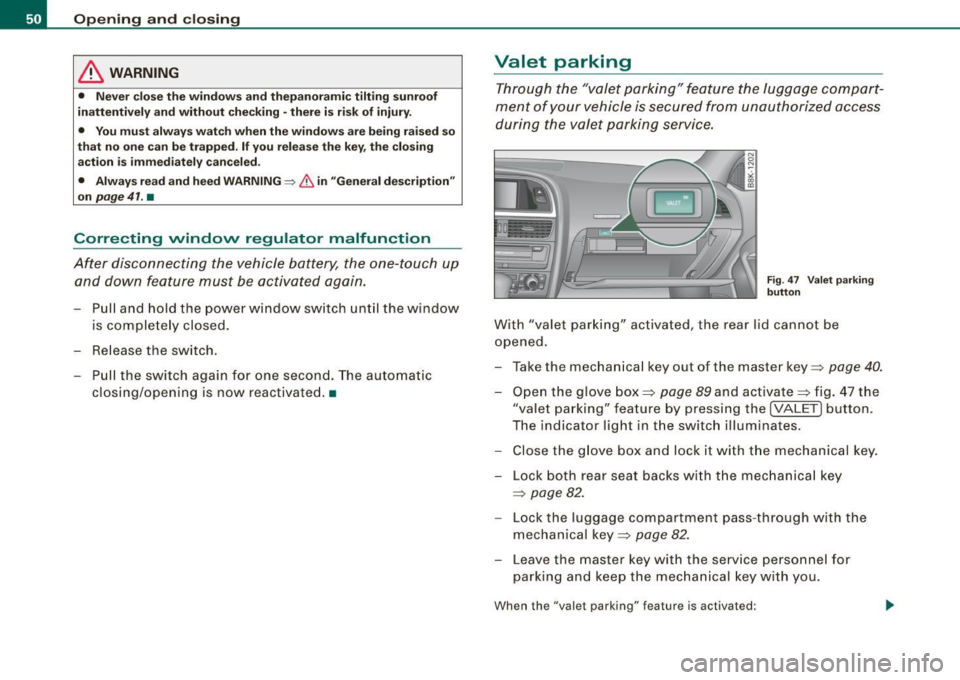
during the valet parking service.
Fig . 47 Valet parking
button
With "valet parking" activated, the rear lid cannot be
opened.
- Take the mechanical key out of the master key=>
page 40.
- Open the glove box=> page 89 and activate => fig. 47 the
"valet parking" feature by pressing the [VALET] button.
The indicator light in t he switch illuminates.
- Close the glove box and lock it with the mechanical key.
- Lock both rear seat backs with the mechanical key
=> page 82.
-Lock the luggage compartment pass -through with the
mechanical key=>
page 82.
-Leave the master key with the service personnel for
parking and keep the mechanical key with you.
When the "valet parking" feature is activated:
Page 61 of 360

Interior lights
Front interior lights
The front interior lights also contain reading lights for the
driver and passenger.
M N N
-
!
Fig. 58 Headliner :
Front interior lights
The rocker switch @~fig . 58 for operating the interior
lighting has the following functions:
Door contact switch
- Place the switch @ in the middle position.
Interior light switched on
- Place the switch@ in posit ion
I.
Interior light switched off
- Place the switch @in position 0 .
Front reading lights
«~
- Press one of the switches ® to turn the right or left
reading light on or off .
Contro ls and eq uip
ment
Clear vision
With the door contact switch turned on, the interior lights turn on
as soon as you unlock the vehicle or open the doors. The lighting is
also turned on when the ignition key is removed. The lights go out
about 30 seconds after the doors are closed . When the vehicle is
locked or when the ignition is turned on, the interior lights are
turned off.
When a door is open, the interior lights are turned off after about 10
minutes to preven t draining of the battery .
The brightness of the lights is controlled automatically by a dimmer
when they are switched on and off. •
Rear interior lights
There are reading lights in the rear for the passengers.
Q)
Fig. 59 Headliner : R ea r
reading lights
The reading lights are switched on and off using the buttons "< ~. •
Vehicle care I I Technical data
Page 90 of 360
Seats and storage
Before you purchase any accessories, always read and follow the
information in=> page 341, "Additional accessories and parts
replacement".
& WARNING
• Use care when using the cigarette lighter. Inattentive or unsu
pervised use of the cigarette lighter can cause burns -risk of
injury!
• The cigarette lighter works when the ignition is switched off or
with the ignition key removed . Children should never be left unsu
pervised in the vehicle, or there could be risk of fire!
• The power outlets and therefore the electrical accessories
connected to them operate only with the ignition on. Improper use
of the outlets or of electrical accessories can lead to serious inju
ries or cause a fire. For this reason, children should never be left
unattended in the vehicle -they could be injured!
0 Note
• To avoid damaging the socket, only use plugs that fit properly .
• Only use the cigarette lighter socket as a power source for elec
trical accessories for short durations . Use the sockets* in the
vehicle when a power source is needed for longer durations.
[ i] Tips
When the engine is off and accessories are still plugged in and are
on, the vehicle battery can still be drained .•
Storage
General overview
There are numerous places to store items in your vehicle.
Glove compartment => page 89
Storage compartment in the roof =>
page 89
Coat hooks => page 89
- -Storage in the trim panels in the luggage
compartment
& WARNING
• Always remove objects from the instrument panel. Any items
not put away could slide around inside the vehicle while driving or
when accelerating or when applying the brakes or when driving around a corner .
• When you are driving make sure that anything you may have
placed in the center console or other storage locations cannot fall
out into the footwells. In case of sudden braking you would not be
able to brake, depress the clutch or accelerate.
• Any pieces of clothing that you have hung up must not interfere
with the driver's view. The coat hooks are designed only for light
weight clothing. Never hang any clothing with hard, pointed or
heavy objects in the pockets on the coat hooks . During sudden
braking or in an accident - especially if the airbag is deployed -
these objects could injure any passengers inside the vehicle . •
Page 99 of 360

The climate controls are a combination of heating, ventilation and
cooling sys tems, which automa tica lly reduce humidity and cool the
air inside your vehic le .
The climate contro l automatically maintains a temperature once it
has been set. The temperature of the air from the vents, fan speed
(air volume) and air distribution are also automatica lly adjusted. The
system also takes into account strong sunsh ine so that manual
adjustment is not necessary . So in almost all cases,
a ut oma tic mode
offers the best co nditions for the comfort of the occupants at all
times of the year~
page 99.
Please note the following :
Turn on the air conditioner to reduce hum idity in the veh ic le. This
a lso prevents the windows from fogging up.
When the outside temperature is high and the air is very humid,
c onden sation from the evaporator may drip under the vehicle . T his
is normal and does no t indicate a leak.
If the outside temperature is low, the fan norma lly on ly switches to
a higher speed once the engine coo lant has warmed up sufficiently .
The air conditioner temporarily switches off when you drive off from a standstill using fu ll throttle to save engine power .
The compressor also switches off if the coolant temperature is too high, so that the engine can be adequately cooled under extreme
loads.
Du st and poll en filte r
The dust and pollen filter (a combined particle filter and activated
cha rcoal fi lter) reduces or prevents outside air pol lut ion (dust, or
pollen) from entering the vehic le .
The dust and pollen filter must be changed at the intervals specified
in your Maintenance booklet, so that the air conditioner can prop
erly work .
I f you drive your vehicle in an area with a high degree of a ir pollu
tion, the filter may need to be changed more frequent ly than speci-
Controls and equip
ment
W arm and cold
fied in your Audi Warranty & Maintenance book let. If in doubt, ask
your authori zed Aud i Service Advisor for advice .
Key recognition
The cu rrent climate contro l settings are automatically stored and
assigned to the remote key
Energ y mana gement
To prevent the battery from being discharged and to restore the
balance of energy, components which require large amounts o f
energy are temporarily cut back or switched off~
page 241.
Hea tin g systems in particu lar req uire a great dea l of energy. I f you
notice, for examp le, that the rear window heater is not heating, then
it has been temp orarily cut back or switched off by
energy manage
ment .
These systems are available again as soon as the energy
balance has bee n res tored .
& WARNING
Redu ced vi sibilit y is dangerou s and c an cau se a ccidents .
• For safe driving it is very important th at all windows be free of
ice , snow and conden sation .
• Completely familiari ze yourself with the proper use and fun c
tion of the heating and ventilation sy stem and e speci ally how to
defog and defrost the windo ws.
• Never use the wind shield wiper /w asher sy stem in freezing
w ea ther until you have warmed the wind shield first , using the
heating and ventil ation sy stem . The wa sher solution m ay fre eze
on the w ind shield and r edu ce v isibilit y.
0 Note
• If you suspect that the climate contro l system has been
damaged, switc h the system off to avoid fur ther damages, and have
it inspected by a qualified dealership. .,_
I • •
Page 144 of 360
• .___A_ u_ d_ i_s_ i_ d _e_ a_ s_ s_is _ t __________________________________________________ _
When driving through a curve, it is possible that side assist may
register a vehicle two lanes over, and the signal on the outside
mirror will light up.•
Applies to veh icles: with side assist
Lane width
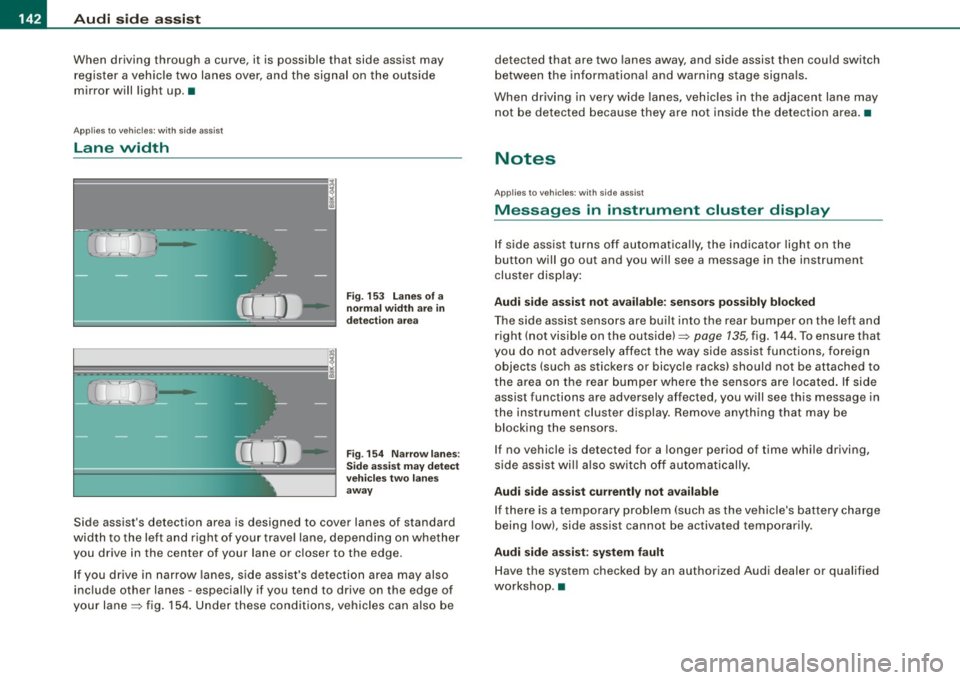
Fig. 153 Lanes of a
normal width are in
detection area
Fig. 154 Narrow lanes :
Side assist may detect
vehicles two lanes
away
Side assist's detection area is designed to cover lanes of standard
width to the left and right of your travel lane, depending on whether
you drive in the center of your lane or closer to the edge.
If you drive in narrow lanes, side assist's detection area may also
include other lanes -especially if you tend to drive on the edge of
your lane=> fig. 154. Under these conditions, vehicles can also be detected that are two
lanes away, and side assist then could switch
between the informational and warning stage signals.
When driving in very wide lanes, vehicles in the adjacent lane may
not be detected because they are not inside the detection area. •
Notes
Applies to vehicles: with side assist
Messages in instrument cluster display
If side assist turns off automatically, the indicator light on the
button will go out and you will see a message in the instrument
cluster display:
Audi side assist not available : sensors possibly blocked
The side assist sensors are built into the rear bumper on the left and
right (not visible on the outside)=? page 135, fig, 144. To ensure that
you do not adversely affect the way side assist functions, foreign
objects (such as stickers or bicycle racks) should not be attached to
the area on the rear bumper where the sensors are located. If side
assist functions are adversely affected, you will see this message in
the instrument cluster display. Remove anything that may be
blocking the sensors.
I f no vehicle is detected for a longer period of time while driving,
side assist will also switch off automatically.
Audi side assist currently not available
If there is a temporary problem (such as the vehicle's battery charge
being low), side assist cannot be activated temporarily.
Audi side assist: system fault
Have the system checked by an authorized Audi dealer or qualified
workshop. •
Page 156 of 360
• ..__T_ ra_ n_s_ m_ i_ s _s_ i_ o _n ___________________________________________________ _
0 Note
If the transmission switches to fail-safe mode, you should take the
vehicle to an authorized Audi dealership as soon as possible to have
the condition corrected .•
A pplies to veh icles : with aut om at ic transmi ssio n
Emergency release of the selector lever
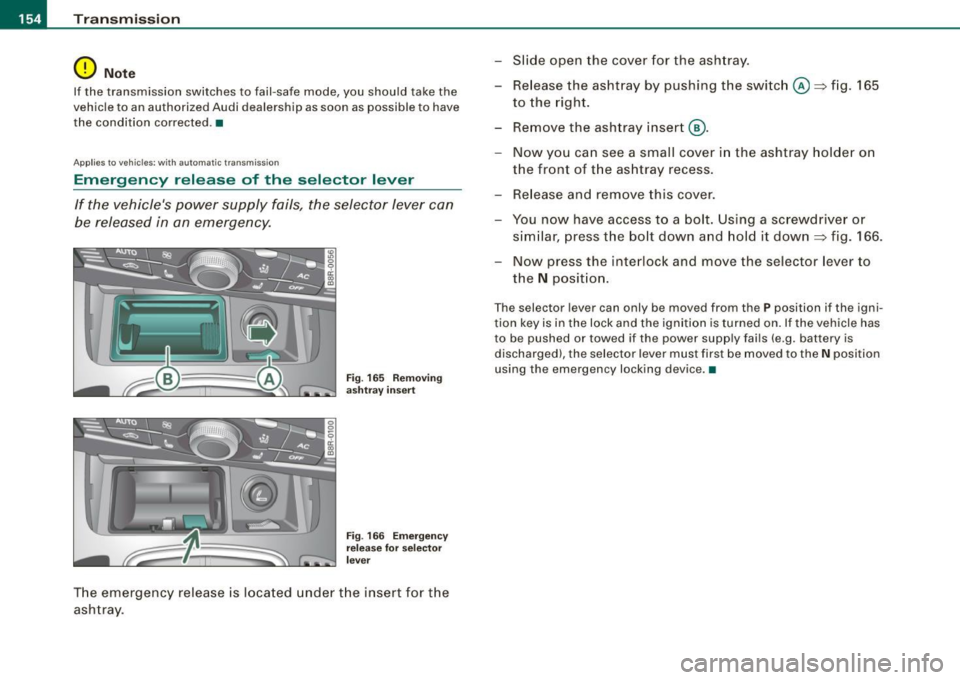
If the vehicle's power supply fails, the selector lever can
be released in an emergency.
Fig. 165 Removing
ashtray insert
Fig. 166 Emergency
release for selector
lever
The emergency release is located under the insert for the
ashtray . -
Slide open the cover for the ashtray.
- Release the ashtray by pushing the switch@~ fig. 165
to the right.
- Remove the ashtray insert @.
- Now you can see a small cover in the ashtray holder on
the front of the ashtray recess.
- Release and remove this cover.
- You now have access to a bolt . Using a screwdriver or
similar, press the bolt down and hold it down ~ fig. 166.
Now press the interlock and move the selector lever to
the
N position.
Th e selector le ve r can only be moved from th e P position if the igni
tion key is in the lock and the ignition is turned on. If the vehicle has
to be pushed or towed if the power supply fails (e.g. battery is
discharged), the selector lever must first be moved to the
N position
using the emergency locking device. •
Page 205 of 360

_______________________________________________ .=_A ::_ i :.:.r ~b ~a:=.; 9!:!...: S~ y[: s~ t~ e:::_ m ~ --""
& WARNING (continued )
• Always make sure that the side airbag can inflate without inter
ference :
- Never install seat covers or replacement upholstery over the
front seatbacks that have not been specifically approved by
Audi.
- Never use additional seat cushions that cover the areas
where the side airbags inflate.
- Damage to the or iginal seat covers or to the seam in the area
of the side airbag module must always be repaired immedi
ately by an authorized Audi dealer.
• The airbag system can be activated only once. After an airbag
has inf lated , it must be replaced by an authorized Audi dealer or
qualified technician who has the technical information , training
and special equipment necessary .
• The airbag system can be deployed only once . After an airbag
has been deployed, it must be replaced with new replacement
parts designed and approved especially for your Audi model
version. Replacement of complete airbag systems or airbag
components must be performed by qualified workshops only .
Make sure that any airbag service action is entered in you r Audi
Warranty
& Maintenance booklet under AIRBAG REPLACEMENT
RECORD .
• In accidents when an airbag is deployed , the vehicle battery
separates the alternator and the starter from the vehicle electrical
system for safety reasons with a pyrotechnic circuit interrupter.
-Work on the pyrotechnic circuit interrupter must only be
performed by a qualified dealer -risk of an accident!
- If the vehi cle or the circuit interrupter is scrapped, all appli
c able safety precautions must be followed .
Controls and equip ment Safety first Vehicle operation
<£' For the sake of the environment
U
ndep loyed airbag modu les a nd p retens ioners mi ght be c lassified
as Perch lorate Mate rial -sp ecia l handling may apply, see
www .dtsc.ca.gov/ haza rdous waste/perc hlorate. W hen the vehicle or
parts of the restraint system including airbag modules safety be lts
w it h pre ten sio ne rs are scrapped, a ll appl ica ble l aws and re gula
tions must be observed. Your authorized Audi dealer is familiar with
t hese re qu irements and we rec om men d th at you h ave yo ur dealer
perform this service for you. •
Other things that can affect Advanced Airbag
performance
Changing the vehicle 's suspension system can change the way that
t he Adva nced Airb ag Sys te m per form s in a crash . For e xamp le,
u sing ti re -rim combinations not approved by Audi, lowering the
ve hicle , c hangi ng th e s tif fness of the sus pension , in cluding the
springs, suspension struts, shock absorbers etc. can change the
forc es that are meas ured by the ai rbag se nso rs a nd se nt to t he ele c
tronic control unit. Some suspension chan ges can, for examp le,
i nc rea se t he for ce le v e ls mea sur ed by the se nso rs and make th e
ai rbag system dep lo y in cras hes in w hich it wou ld not d ep loy if the
changes had not been made . Other kind s of changes may reduce
th e force l eve ls measured by t he sensors and prevent t he airba g
from deploy ing when it should .
Th e sen so rs in the s afet y b elt buckle fo r the driv er and front
passen ger seat tell the electronic control module if the safety belt is
l a tc h e d or n ot. If the safet y b elt i s bei ng use d, th e fr ont ai rb ag will
dep loy at a s lightly hi gher rate of vehic le dece leration than if the
safet y belt is not be ing u sed . The refo re, in a partic ular coll isi on, it i s
poss ible t hat an airbag will not deploy at a s eati ng position where
the safety be lt i s being used b ut wi ll inf late at the pos ition where the
sa fety belt is not being used. I t is im porta nt t hat nothi ng i nterf ere
with the safety belt b uckles so that the sens ors can send the correct
i n fo rm ati on about sa fety belt use to the elect ron ic contro l u nit. .,.
Vehicle care Do-it-yourself service Technical data
Page 243 of 360

& WARNING (continued)
vehicle. Always drive at speeds which are suited to the road condi
tions -risk of crash. •
Energy management
Starting ability is optimized
Energy management controls the distribution of electrical
energy and thus optimizes the availability of electrical
energy for starting the engine .
If a vehicle with a conventional energy system is not driven for a
long period of time , the battery is discharged by idling current
consumers (e.g . immobilizer) . In certain circumstances it can result
in there being insufficient energy available to start the engine.
Intelligent energy management in your vehicle handles the distribu
tion of electrical energy. Starting ability is markedly improved and
the life of the battery is extended.
Basically, energy management consists of
battery diagnosis, idling
current management
and dynamic energy management .
Battery diagnosis
Battery diagnosis continuously determines the state of the battery.
Sensors determine battery voltage, battery current and battery
temperature. This determines the current state of charge and the
power of the battery.
Idling current management
Idling current management reduces energy consumption while the
vehicle is standing . With the ignition switched off, it controls the
energy supply to the various electrical components. Data from
battery diagnosis is considered.
Controls and equip ment Safety first Vehicle operation
Intelligent technology
Depending
on the battery's state of charge, individual consumers
are gradually turned off to prevent excessive discharge of the
battery and thus maintain starting capability.
Dynamic energy management
While the vehicle is being driven, dynamic energy management
distributes the energy generated according to the needs of the indi
vidual components. It regulates consumption, so that more elec
trical energy is not being used than is being generated and ensures
an optimal state of charge for the battery.
[ i] Tips
• But even energy management cannot negate the limits of
physics. Consider that the power and life of a battery are limited.
• If starting ability is threatened, you are informed by a warning
~ page 242, "Driver notification in the instrument cluster
display". •
What you should know
The highest priority is given to maintaining starting capa
bility.
The battery is severely taxed in short-distance driving, in city traffic
and during the cold time of year. Abundant electrical energy is
required, but only a little is generated. It is also critical if the engine
is not running and electrical components are turned on. In this
instance energy is being consumed but none is being generated.
It is in precisely these situations that you will notice energy manage
ment actively regulating the distribution of energy.
Vehicle stands for an extended period
If you do not drive your vehicle over a period of several days or
weeks, electrical components are gradually cut back or switched off.
This reduces energy consumption and maintains starting capability
over a longer period.
Vehicle care Do-it-yourself service Technical data
Page 244 of 360

llffl __ ln_ t _e_ ll-'"ig ...,_ e_ n_t _t_ e_ c_ h _ n_o _ l_o _,.g= y,_ __________________________________________ _
Take into consideration that when you unlock your vehicle, some
convenience functions, such as the remote key or power seat
adjustment, may not be available. The convenience functions will be
available again when you turn on the ignition and start the engine.
With the engine turned off
If you listen to the radio, for example, with the engine turned off or
use other MMI functions, the battery is being discharged .
If starting capability is jeopardized due to energy consumption, the
following warning appears in the MMI display :
Please start engine, otherwise system will switch off in
3 minutes.
The warning indicates that the system will be turned off automati
cally after 3 minutes. If you wish to continue using the functions,
you have to start the engine .
With the engine running
Although electrical energy is generated when the vehicle is being
driven, the battery can become discharged. This happens mostly
when little energy is being generated and a great deal consumed and the battery's state of charge is not optimal.
To bring the energy balance back into equilibrium, consumers
which require especially large amounts of energy are temporarily
cut back or switched off. Heating systems in particular require a
great deal of energy. If you notice, for example, that the heated
seats* or the heated rear window are not heating, they have been
temporarily cut back or switched off. These systems will be available
again as soon as the energy balance has been restored.
You will also notice that engine idle speed has been increased
slightly . This is normal and not a cause for concern. By increasing
engine idle speed the additional energy required is generated and
the battery is charged.
Driver not ification in the instrument cluster
d isplay
If battery power drops into the range where it can limit the ability of
the engine to start, this is shown in the instrument cluster display
with the following driver message:
'-' Low battery charge: battery will be charged while driving
This notification reminds you that the starting capability of the
engine may be limited. As soon as you start driving again, the
battery will be recharged and the notification will go out.
Driver notification appears and goes out again
If this driver notification appears after the ignition is turned on or
while driving and it goes out again after a while, the battery has
been adequately recharged.
Driver notification appears and does not go out again
If this driver notification appears after the ignition is turned on or
while driving and does not go out again, the battery's state of
charge is not in the optimal range . Starting ability is restricted . Have
the battery checked as soon as possible by an authorized Audi
dealer or qualified workshop. •
Page 273 of 360
Checking and filling IJI
--------------~-
•
Closing the engine hood
-Pull the hood down until the pressure from the struts is
reduced .
- Let the hood
drop down and latch in place. Do not try to
push it shut;
it may fail to engage => &.
& WARNING
A hood that is not completely latched could fly up and block your
view while driving.
• When you close the engine hood, check it to make sure the
safety catch has properly engaged. The hood should be flush with
the surrounding vehicle body parts.
• If you notice while driving that the hood is not secured prop
erly, stop at once and close it. •
Working in the engine compartment
Be especially careful whenever you work in the engine
compartment.
Whenever you must perform any work in the engine compartment,
for example checking and filling different fluids, there is a risk of injury, burns and accidents. To prevent personal injury always
observe the following WARNINGS. The engine compartment of any
vehicle is a hazardous area
~ & .
& WARNING
To help avoid injury, before you check anything under the hood :
• Turn off the engine.
• Remove the ignition key.
• Apply the parking brake .
& WARNING (continued)
• Move selector lever of automatic transmission to "P" (Park);
put manual transmission in Neutral .
• Always let the engine cool down. Hot components will burn
skin on contact.
• To reduce the risk of being burned, never open the hood if you
see or hear steam or coolant escaping from the engine compart
ment. Wait until no steam or coolant can be seen or heard before
carefully opening the hood .
• Keep children away from the engine compartment.
• Never spill fluids on hot engine components . They can cause a
fire.
• Never touch the radiator fan. The auxiliary electric fan is
temperature controlled and can switch on suddenly.
• Never open the coolant reservoir cap when the engine is still
warm. The coolant system is pressurized and hot coolant could
spray out.
• Protect your face, hands and arm from steam or hot engine
coolant by placing a thick rag over the cap when you open the
coolant reservoir.
• If work on the fuel system or the electrical system is necessary:
- Always disconnect the battery.
- Never smoke or work near heaters or open flames. Fluids in
the engine compartment could start a fire .
- Keep an approved fire extinguisher immediately available.
• To avoid electrical shock and personal injury while the engine
is running or being started, never touch :
- Ignition cables
- Other components of the high voltage electronic ignition
system.
• If you must perform a check or repair with the engine running: ..,
Vehicle care
I t •