cooling AUDI A5 COUPE 2010 User Guide
[x] Cancel search | Manufacturer: AUDI, Model Year: 2010, Model line: A5 COUPE, Model: AUDI A5 COUPE 2010Pages: 360, PDF Size: 84.39 MB
Page 100 of 360
Warm and cold
• Repairs to the Audi ai r conditioner require special technical
know ledge and special tools. Contact an authorized Audi dea ler for
assistance.
[ i ) Tips
• To avoid adversely affecting hea ting and cooling performance
and to preven t condensation on the windows, the air intake in front
of the windshield must be free of ice , snow and leaves.
• The air flowing out of the ven ts and throughout the vehicle 's
entire interior is d ischarged at the rear of the vehicle . Make sure tha t
the outle t slots are not cover ed by clothing, etc .
• Climate control works mos t effectively if the windows and the
panoramic s liding /ti lting sunroof * are closed. Howeve r, if the in te
rior of a parked vehicle is extremely hot from the sun, briefly
opening the windows can speed up the cooling process. •
App lies to ve hicles : w it h D elux e auto matic cli mate co ntrol plu s
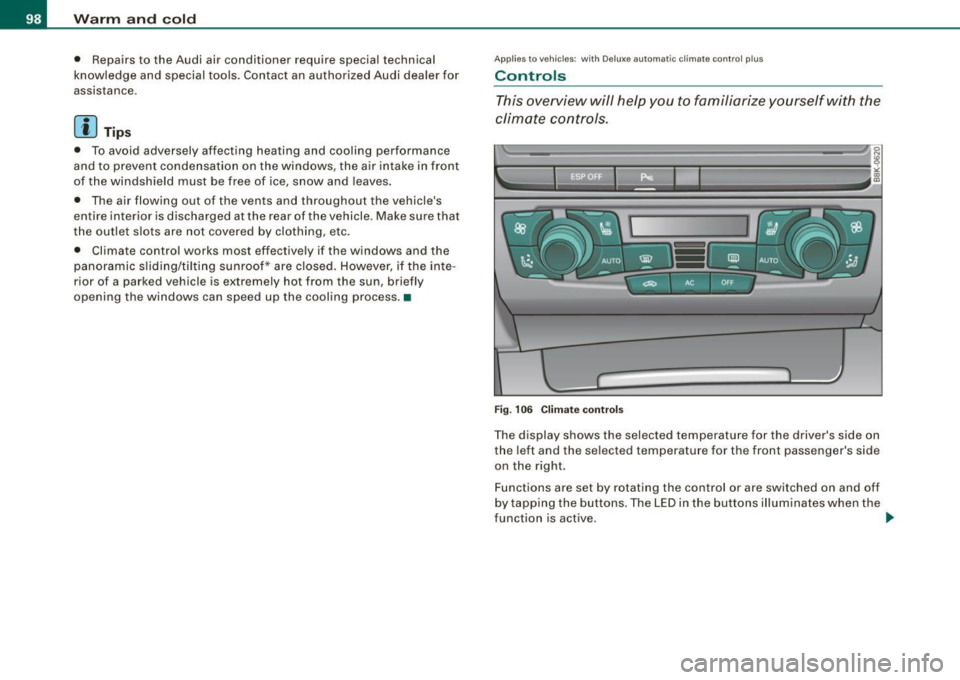
Controls
This overview will help you to familiarize yourself with the
climate controls.
F ig . 106 Climate control s
The display shows the selected temperature for the driver's side on
the left and the selected temperature for the front pas senger's side
on the right.
Functions are set by rotating th e control or are switched on and off
b y tapping the buttons . The LED in the bu ttons illum inates when the
function is active . ..,_
Page 101 of 360
![AUDI A5 COUPE 2010 User Guide Button( sl
!OFF]
IAUTOI
-
Temperature regu
lator
1 a l
Temperature regu
lator 2a>
-
1-= 1bi
Mea nin g
Turns on and off
Automatic operation -
drivers side/ front pas-
senge rs](/img/6/57582/w960_57582-100.png "AUDI A5 COUPE 2010 User Guide Button( sl
!OFF]
IAUTOI
-
Temperature regu
lator
1 a l
Temperature regu
lator 2a>
-
1-= 1bi
Mea nin g
Turns on and off
Automatic operation -
drivers side/ front pas-
senge rs")
Button( sl
!OFF]
IAUTOI
-
Temperature regu
lator
1 a l
Temperature regu
lator 2a>
-
1-= 1bi
Mea nin g
Turns on and off
Automatic operation -
driver's side/ front pas-
senge r's side
-
Temperature selection -
driver's side
Temperature selection -
front passenger's side
-Fan -dr iver's side/ front
passenger's side
Recirculation mode
Air distribution -driver's
side / front passenger's
si de
Defrost
Rear window defogger
Turns cooling system on
and off P
ag e
=> page 99
=> page 99
=> page 100
=> page 100
=> page 701
=> page 701
=> page 702
=> page 102
=> page 102
-
al The regu lator is a lso used to set the fan speed, air distr ibution and seat
he ating .
bl The symbol may appear sl ightly differen t in some mo dels .
[ i J Tip s
• The gril le on the controls=> page 98, fig. 106 must remain unob
structed and must not be taped over. Measuring sensors are located
behind it. •
Controls and equip
ment
W arm and cold
Ap plies to veh ic les : with D elux e a uto mat ic clim ate co ntr ol plus
Turning the climate control on and off
Briefly press [ OFF], or press [AUTO I to turn the climate
contro l
on.
- Press the I OFF] button for at least 2 seconds to t urn the
climate control
off and to block the air supply from the
outside.
"OFF" appears in the d isp lay.
Climate contro l turns on again when you press the te mp era tur e
re gulat or•
Ap plies to v ehicles : wit h De luxe aut om at ic c lim ate co ntro l plu s
Automatic mode [AUTO)
The standard operating mode for all times of the year.
Turning on automat ic mod e
Set the temperature between 60 °F (+ 16 °C) and 84 °F
(+28 °C).
- Press the [AUTO I button.
Automatic mode ensures constant temperatures in the interior and
dehumidifies the air inside the vehic le. Air temperature, volume and
distr ibution are controlled automatica lly to reach or ma intain the
desired interior temperature as quick ly as possible . Fluctuations in
exterior temperature and the effects of temperature from the posi
tion of the sun are compensated for automatically .
This opera ting mode works on ly in an adjustab le te mperature range
of 60°F ( + 16°C) to 84 °F ( +28 °C). If a temperature below 60°F ( + 16 °C)
is selected ,
LO appears in the display . At temperatures above 84° F
( + 28°C),
HI is displayed. At both extreme settings, climate control
runs continuously at maximum cooling or heating power . There is
no temperature regulation .•
I • •
Page 104 of 360
• .___w __ a _r _m _ a _n_d_ c_ o _ ld __________________________________________________ _
You can adjust the air distribution so that air flows from specif ic
vents. In position
:0 air flows only to the windows, in position :J, it
flows to the driver or passenger , and in position
!-0 it flows to the
footwell. There are additional combinations available to adjust air
dis tribution as needed .
To regulate a ir distribution automat ically, switch to [AUTO] .
When the MMI display is turned on, the air distribution setting appears for a few seconds on the screen=>
page 101, fig. 112. •
Applies to ve hicles: w ith Delu xe automa tic c lima te con tro l plus
Defrost [@ I
The windshield and side windows are defrosted or cleared
of condensation as quickly as possible.
- Press the 1@ 1 button to turn on the defroster .
- Press the
[@ j button again, or press the [ AUTO j button to
turn it off.
Temperature is controlled automatically. The maximum amount of
air flows mainly from the vents below the windshield.
Pressing the [@] button switches off recirculation mode. •
Applies to ve hicles: w ith Deluxe au to m ati c cli mate con tro l plus
Rear window defogger [CiWj
The rear window defogger clears the rear window of
condensation.
- Press the ICiW ] button to turn the rear window defogger on
and off.
The rear window defogger works only when the engine is running.
The indicator light in the button illuminates when the rear window
defogger is on. The
rear window defogger is switched off automatically after 10 to
20 minutes, depending on the outside temperature.
The rear window defogger can be turned on permanently by
pressing the
[Cial] button for more than two seconds. This remains
stored until the ignition is switched off . A rear window defogger that
was switched on also remains stored for 15 m inutes after the igni
tion is switched off.
If the engine is restarted within these 15 minutes , the rear window
defogger is activated for 10 to 20 minutes, depending on outside
temperature. When a vehicle is parked for a short time , the rear
window defogger does not need to be manually activated again.
~ For the sake of the environment
As soon as the rear window is clear, you should switch the rear
window defogger off. The reduced power consumption has a bene
ficial ef fect on fuel consumption .•
Ap plies to veh ic les: w ith Delux e au tomatic c limate co ntrol p lu s
AC mode [AC ]
Turning AC off
- Press the IACI button.
Turning AC on
- Press the IACj button again.
The cooling system is turned on in AC mode. The heating and v enti
lation system is controlled automatically .
[ i] Tips
If the LED in the switch does not illuminate after AC mode has been
turned on( = turning th e AC off), there is a fault in an air -conditioning .,_
Page 105 of 360
___________________________________________________ W_ a_ r_m _ a_ n_d_ c_ o_ ld _ __.11111
component. Please consult a authorized dealership if there is an
operating problem. •
Applies to v ehicl es: with De lux e autom atic c lim ate contro l plus
Air vents
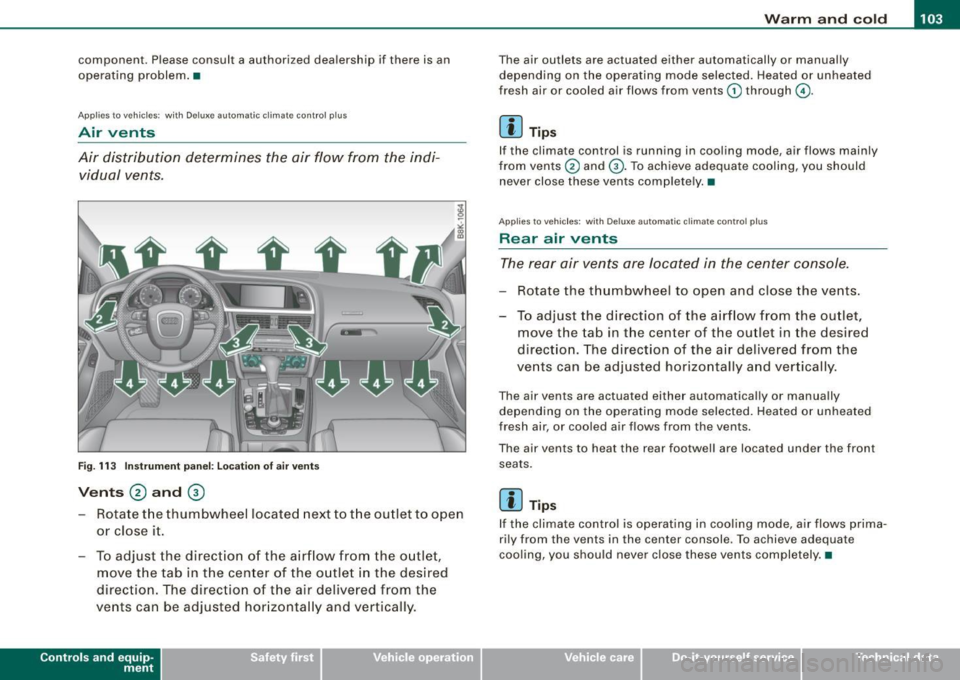
Air distribution determines the air flow from the indi
vidual vents.
Fig. 113 Instrument panel: Locat ion of air vents
Vents @ and ®
- Rotate the thumbwheel located next to the outlet to open
or close it.
- To adjust the direction of the airflow from the outlet,
move the tab in the center of the outlet in the desired
direction . The direction of the air delivered from the
vents can be adjusted hor izontally and vertically .
Contro ls and eq uip
ment
The air outlets are actuated either automatically or manual ly
depending on the operating mode selected. Heated or unheated
fresh air or cooled air flows from vents
G) through G).
[ i ] Tips
If the climate control is running in cooling mode, air flows mainly
from vents
0 and G). To achieve adequate cooling, you should
never close these vents comp lete ly. •
Applies to ve hic les : with Deluxe automa tic clima te cont ro l p lus
Rear air vents
The rear air vents are located in the center console.
Rotate the thumbwheel to open and close the vents.
To adjust the direction of the airflow from the outlet,
move the tab in the center of the outlet in the desired
direction. The direction of the air delivered from the
vents can be adjusted horizontally and vertically.
The air vents are actuated either automatically or manually
depending on the operating mode selected. Heated or unheated
fresh air, or cooled air f lows from the vents.
The air vents to heat the rear footwell are located under the front
seats .
[ i ] Tips
If the climate control is operating in cooling mode, air flows prima
rily from the vents in the center console . To achieve adequate
cooling, you should never close these vents completely. •
Vehicle care I I irechnical data
Page 106 of 360

• .___w __ a _r _m _ a _n_d_ c_ o _ ld __________________________________________________ _
Applies to vehic les: with Deluxe automatic c limate con tro l plu s
Economical use of the climate control system
Economical use of the climate control system helps save
fuel.
When the climate control system is working in cooling
mode, engine performance is reduced and fuel consump
tion is affected. To keep the time the climate control system
is on as short as possible, you should do the following:
- To save fuel, turn off cooling mode by pressing the AC
button (indicator light goes out).
- In addition, if you open the window or the panoramic
sliding/tilting sunroof * while driving, turn off cooling
mode by pressing the AC button (indicator light goes
outl.
- If the vehicle is extremely hot due to the heat of the sun,
briefly open doors and windows.
c£> For the sake of the environment
When you save fuel, you reduce emissions from the vehicle. •
Deluxe automatic climate control
plus - basic settings
Applies to vehic les : with Deluxe automatic climate contro l plus
General information
The basic climate control settings can be adjusted in the
radio or
MM/* .
Fig . 114 MMI display:
Setup climate control
- Select: Function button [CAR]> Control button AC.
The following functions can be selected:
• Automatic recirculat. =>
page 104
• Synchronization=> page 105 •
Applies to veh icles: w ith Deluxe automatic clima te co ntrol p lus
Automatic recirculation
An air quality sensor detects increased concentrations of
pollutants in the outside air and automatically switches
to recirculation mode.
We recommend that you always keep automatic recirculati on ON to
prevent polluted outside air from entering the vehicle interior. .,_
Page 251 of 360

Trailer load d is trib ut ion
Be sure the load in the trailer is held securely in place to prevent it
from shifting forward, backward or sideways.
Ne ver allo w a passen ger to rid e i n a tr ailer => & in "Driving instruc
tions" on
page 249.
En gin e c ool ing syst em
Towing a trailer makes the engine work harder. It is important that
the cooling system 's performance is up to the additiona l load. Make
sure that the cooling system has enough flu id.
Ti re press ure
When towing a trailer, inflate the tires of your vehicle to the cold tire
pressure listed under "Full load" on the labe l located either on the
driver's side B-pillar (visible when the door is open} or inside the fuel
filler flap . Inflate trailer tires to trai ler and tire manufacturers' spec
ifications.
Ligh ts
The headlight settings should be checked with the trailer attached
before driving off . Check to make sure both vehicle and trailer lights
are working properly .
Safe ty c hain s
Be sure trailer safety chains are properly connected from the trailer
to the hitch on the vehicle. Leave enough slack in the chains to
permit turning corners. When you install safety chains, make sure
they will not drag on the road when you are driving.
The chains should cross under the trailer tongue to prevent it from dropping in case of separation from the hitch.
Controls and equip
ment Safety first Vehicle operation
Tr
aile r t owing
Driving instructions
Driving with a trailer always requires extra care and
consideration.
To obtain the best possible handling of veh icle and trailer,
please note t he following :
Do not tow a loaded trailer when your car itself is not
loaded .
- Be especia lly careful when passing other vehicles .
Observe speed l imits .
Do not drive at the maximum permissible speed.
Always apply brakes early.
Monitor the temperature gauge.
W eight distrib utio n
Towing a loaded trailer with an empty car results in a h ighly
unstable distribution of weight . If this cannot be avoided, drive at
very low speeds only to avoid the risk of losing steering control.
A "balanced" rig is easier to operate and control. This means that
t he tow vehicle should be loaded to the extent possible and permis
sible, while keeping the trailer as light as possib le under the circum
stances . Whenever possible, transfer some cargo to the luggage
compartment of the tow vehicle whi le observing tongue load
requirements and vehicle loading considerations.
S pee d
The higher the speed, the more difficu lt it becomes for the d river to
control the rig. Do not drive at the maximum permissible speed.
Reduce your speed even more if load, weather or wind conditions
are unfavorable -particularly when going downhill .
Reduce vehicle speed
i mmed iatel y if the trailer shows the slightest
sign of swaying .
Do not try to st op the swa ying b y accelerating.
Vehicle care Do-it-yourself service Technical data
Page 279 of 360
___________________________________________ C_ h_e _c_ k_ i_n _g _ a_n _d_ f_il _li _n _g __ fflllll
•
& WARNING (continued)
• When removing the oil drain plug with your fingers, stay as far
away as possible. Always keep your forearm parallel to the ground
to help prevent hot oil from running down your arm.
• Drain the oil into a container designed for this purpose, one
large enough to hold at least the total amount of oil
in your engine.
• Engine oil is poisonous. Keep it well out of the reach of children.
• Continuous contact with used engine oil is harmful to your
skin. Always protect your skin by washing oil off thoroughly with
soap and water.
0 Note
Never mix oil additives with your engine oil. These additives can
damage your engine and adversely affect your Audi Limited New
Vehicle Warranty.
<£> For the sake of the environment
• Before changing your oil, first make sure you know where you
can properly dispose of the used oil.
• Always dispose of used engine oil properly. Do not dump it on
garden soil, wooded areas, into open streams or down sewage
drains.
• Recycle used engine oil by taking it to a used engine oil collec
tion facility in your area, or contact a service station. •
Engine cooling system
Coolant
The engine coolant performs two functions: it keeps the
engine from overheating and it protects the engine from
freezing in the winter.
The cooling system is sealed and generally requires little attention.
The cooling system has been filled at the factory with a permanent
coolant which does not need to be changed. The coolant consists of
a mixture of water and the manufacturer's glycol -basedcoolant
additive G12++ antifreeze with anti corrosion additives (50% for USA
models; 60% for Canadian models). This mixture both assures the
necessary frost protection and protects metal components in the
engine's cooling system from corrosion and scaling. It also raises
the boiling point of the coolant.
Do not reduce the concentration of the coolant in the summer by
adding plain water.
The proportion of coolant additive must be at
least 50% but not more than 60%
to maintain antifree ze protection
and cooling efficiency. If the coolant frost protection is too low, the
coolant could freeze and damage the vehicle heating and engine
cooling system.
For year-round driving, antifreeze is added at the factory for temper
atures down to:
• -31 °F
! -35 °ci usA
• - 40°F ( - 40°CJ Canada.
You can mix the G12++ coolant additive with other additives (G12 +
or G12) . Always check with your authorized Audi dealer .
& WARNING
Before you check anything in the engine compartment, always
read and heed all WARNINGS
~ & in "Working in the engine
compartment" on
page 271.
Vehicle care I t •
Page 280 of 360

___ C_h_ e_ c_k _in --== g'-- a_n _d_ f_il _li _n ..:::g:::..- ___________________________________________ _
0 Note
• Before winter sets in, have the coolant checked to see if the
coolant additive in your vehicle is sufficient to meet the climate
conditions. This is especia lly important if you live in a region where
the winter is extremely cold. If necessary, increase the proportion of
coo lant additive to 60%.
• When adding coolant additive to your coo ling system,
reme mber:
- We recommend using only coolant additive G12+ + (check the
label) for your vehicle. This coolant addit ive is ava ilable at autho
rized Audi dealers . Other types of antifreeze can significantly
reduce corrosion protection . The resulting corrosion can cause a
loss of coolant and serious engine damage.
• Do not add any type of radiator leak sealant to your vehicle's
engine coolant . Adding radiator repair fluid may adverse ly affect the
function and performance o f your cooling system and cou ld result
in damage not covered by your New Vehicle Limited Warranty. •
Checking the engine coolant level
The engine coolant level can be checke d with a quick
glance.
Fig . 2 25 Engine
c omp artmen t: Coo la n t
e xpan sion tank
Be fo re y ou c heck anything in the e ngine compar tm en t,
always read and heed all WARNINGS==> & in "Working in
the eng ine compartment" on
page 271.
Tur n off the ignitio n.
- Let the engine coo l down.
P lace a th ick rag ove r the coola nt expans io n tank
==> fig. 225 and carefully twist th e cap counter-c lockwise
==> & .
Read t he e ngin e coola nt level i n the open coo la nt expan
sion tank==> fig. 225. W ith a cold eng ine, the coolant leve l
sho uld be bet ween the "m in" and "max" markings. W hen
t h e eng ine is warm, the level may be slightly above the
"max" marking .
The location of the coolant expansion tank can be seen in the
engine compartment illustration=>
page 272.
To obtain an accurate read ing, the engine must be switched off .
The expansion tank in your vehicle is equipped with an e lectric
coo lant leve l sensor.
When the coolant leve l is too low, the warning light in the Auto
Check System =>
page 30will blink until you add coolant and the
level has been restored to normal. Even though there is an electric
coo lant level sensor, we still recommend you check the co olant level
from t ime to time.
C oolant loss
Coolant loss may indicate a le ak in the cooling system . In the event
of coo lant loss, the co oling system should be inspec ted i mmedi
ately by your authorized Audi dealer. It is not enough mere ly to add
coo lant.
In a
s ealed system, losses can occur on ly if the boi ling point of the
coo lant is exceeded as a result of overheating. ...
Page 281 of 360

___________________________________________ C_ h_e _c_ k_ i_n _g _ a_n _d_ f_il _li _n _g __ ll'I
•
& WARNING
The cooling sy stem i s under pre ssure and can get very hot . Redu ce
the risk of scalding from hot coolant by following these steps.
• Turn off the engine and allow it to cool down .
• Protect your face, hands and arms from escaping fluid and
ste am by cover ing the cap with a large , thick rag .
• Turn the cap slowly and very carefully
in a counter -clockwise
dire ction while applying light , downward pressure on the top of
the cap .
• To avoid being burned, do not spill antifreeze or coolant on the
e x haust system or hot engine parts . Under certain conditions, the
ethylene glycol in engine coolant can catch fire .
0 Note
Do not add any type of radiator leak sea lant to your vehicle's engine
coolant. Adding radia to r repa ir flu id may advers ely affect the fu nc
tion and performance of your coo ling system and could res ult in
damage not covered by y our New Vehic le Lim ited War ra nty .•
Adding coolant
B e very care ful when ad ding e ngine cool ant.
Be for e you check a nything in the engine com partmen t,
always read and heed all WARNINGS~ & in "Work ing in
t h e eng ine compa rtment" on
page 271 .
-Tur n o ff th e en gine.
- Let the e ng in e cool d own.
- Plac e a thi ck rag over the coo la nt expansion tank
~ page 2 78 , fig. 2 25 and carefully tur n t he cap coun te r
cl ockwi se
~ &.
Add coo lan t.
- Twist the cap on aga in
tightly.
Replacement engine coolant must conform to exact specifications
~ page 2 77, "C oolant". Even in an eme rgency, if co olant addi tive
G12+ +, G12 + or G12 is not availab le, do not use a different additive.
U se pla in water ins tead until you can ge t the c orrect add itive and
can res tore the correc t rat io. Th is shou ld be done as soon as
p os sible.
I f y ou hav e los t a co ns ide rab le amou nt of coo la nt, then y ou should
add cold antifreeze and cold water only when the engine is cold .
A lways use
new e ngine c oolant w he n r efil ling .
D o not fill coolant a bove the " MAX" mark. Excess coola nt w il l be
forced out through the pressure relief va lve in the cap when the
eng ine becomes hot.
& WARNING
• The cooling system is under pressure and can get very hot .
Reduce the risk of scalding from hot coolant by following these
steps.
-Turn off the engine and allow it to cool down .
- Protect your face , hands and arms from escaping fluid and
steam by covering the cap with a large , thick rag .
- Turn the cap slowly and very carefully in a counter -clockwise
direction while applying light, downward pressure on the top
of the cap.
- To avoid being burned, do not spill antifreeze or coolant on
the exhau st system or hot engine parts. Under certain condi
tions, the ethylene glycol in eng ine coolant can catch fire .
• Antifreeze is poisonous. Always store antifreeze in its original
container and well out of the reach of children .
• If you dra in the coolant , it must be caught and safely stored in
a proper container clearly marked "poison ".
~
Vehicle care I t •
Page 348 of 360

llffl __ A_l.:. p _h_ a_ b_e _t _ic _ a_l _in _ d_e _x ____________________________________________ _
Care of exterior ... .. ... ... ... ... ... . 252
Cargo area
See Loading the luggage compartment ..
175
Cargo net .... .... ................... 79
Catalytic converter . . . . . . . . . . . . . . . . . . 244
Center armrest Adjusting ........................ 78
Storage compartment ........ .... . 78
Certification . . . . . . . . . . . . . . . . . . . . . . . 342
Changing a flat tire .. .... .... ....... 312
Changing a wheel ................... 312
Changing engine oi l ...... .... .... ... 276
Chassis Undercoating . . . . . . . . . . . . . . . . . . . . 258
Checking Engine coolant level .. ...... ...... 278
Checking tire pressure .... .... .... ... 293
Child restraint system anchors ........ 227
Child restraints Danger of using child restraints in the
front seat . . . . . . . . . . . . . . . . . . . . . . 190
Where can I get additional information
about child restraints and their use? ...
232
Child safety ................... .... . 213
Convertible locking retractor . . . . . . . 223
Important safety instructions for using
child safety seats .... .... ... .... 216
Important things to know when driving with chi ldren ................... 213
Installing a child restraint using the
LATCH system .................. 229 Lower
anchorages ... ...... ...... . 228
Mounting and releasing the anchorage hook .. .............. ....... ... 229
Tether anchors .. ...... .... .... .. 230
Tether straps ........ ....... ..... 230
Child safety seats ... ........... ..... 218
Booster seats .. ... .... ........ ... 221
Convertible chi ld seats ............ 219
Convertible locking retractor . ...... 223
Danger of using child restraints in the
front seat . . . . . . . . . . . . . . . . . . . . . . 190
How do I properly install a child safety
seat in my vehicle? ........ ...... 216
Infant seats ...... ........ ....... 218
Installing ....................... 223
LATCH system . . . . . . . . . . . . . . . . . . . 229
Safety instructions .... ...... ..... 216
Cigarette lighter ........ ....... ...... 87
Cleaning Alcantara® (synthetic suede) . ..... 262
Engine compartment ....... ... ... 263
Fabrics and fabric coverings ..... .. 259
Instrument panel ................. 260
Interior .. .... .... ... .. .... .... .. 259
Leather ......................... 261
MMI display ..................... 259
MM I termina l .. ... .... .... .... ... 259
Plastic and vinyl .. .. ......... ... . 256
Plastic parts . . . . . . . . . . . . . . . . . . . . . 260
Safety be lts ...... ....... ........ 263
Trim strips . ........... .... ...... 255
trim strips ... .. ........ .... ... ... 256
Cleaning and protection .. ........ ... 252
Clock ........ .... ...... ....... ...... 10 Coat hooks
. . . . . . . . . . . . . . . . . . . . . . . . . . 89
Co ld tire inflation pressure .... ....... 291
Compact spare tire .................. 311
See also Spare tire ........ ...... .. 311
Compass mirror . ...... .. .... .... .... 67
Comp liance ...... .... ....... .... ... 342
Consumer Information .... ... ... . 177, 339
Contacting NHTSA ... .... .... .... ... 177
Convenience closed ... ....... ........ 49
Convenience key ..................... 44
START ENGINE STOP button ... 110, 111
Starting engine .... ....... .... ... 110
Switching engine off .............. 111
Switching on ignition ............. 11
O
Unlocking and locking vehicle ... ... . 44
Convenience opening ...... ........... 49
Convertible child safety seats ...... ... 219
Convertible locking retractor Activating .. ....... .... ...... .... 225
Deactivating ..................... 226
Using to secure a child safety seat .. 223,
225
Coolant system ..................... 277
Cooling System Expansion tank .... ........... ... 278
Cornering light ...................... 57
Cruise contro l
Changing speed . ...... .... .... .. 116
Preselect speed .. ...... ..... .. ... 116
Switching off ... .. .... .... .... ... 116
Switching on ...... ........... ... 115
Warning/indicator lights ... .. ...... . 15
Cruising range ................... .... 23