seat adjustment AUDI A5 COUPE 2010 User Guide
[x] Cancel search | Manufacturer: AUDI, Model Year: 2010, Model line: A5 COUPE, Model: AUDI A5 COUPE 2010Pages: 360, PDF Size: 84.39 MB
Page 193 of 360

__________________________________________________ A_ i_ r _b _a...; g::- s_ y=--- s_t _e _m __ _
as defined in the electronic control unit~ page 200, "PASSENGER
AIRBAG OFF lig ht" .
A lways remember, a chi ld safety seat or infant carrier insta lled on
the front seat may be struck and knocked out of position by the
rap id ly i nfla ting pass enger 's airbag in a frontal c olli sion . The airba g
co uld greatly reduce the effectiveness of the chi ld re straint and
e ven s eriously in ju re the chi ld dur ing infla tion.
F or this reason, and because the bac k seat is the safest place for
chi ldr en -when prop erly res traine d acc ordi ng to th eir age an d size
- w e stro ngly recom mend that c hildren a lwa ys s it in th e bac k seat
~ page 213, "Chil d Safe ty ".
& WARNING
A child in a rearward-facing child safety seat installed on the front
passenger seat will be seriously injured and can be killed if the
front airbag inflates - even with an Advanced Airbag System.
• The inflating airbag will hit the child safety seat o r infant
carrier with great force and will smash the child safety seat and
child against the backrest , center armrest , door or roof.
• Always install rear-facing child safety seats on the rear seat.
• If you must install a rearward facing child safety seat on the
front passenger seat because of exceptional circumstances and
the PASSENGER AIR BAG OFF light does not come on and stay on,
immediately install the rear-facing child safety seat in a rear
seating position and have the airbag system inspected by your
authorized Audi dealer.
• Forward-facing child safety seats installed on the front
pa ssenger's seat may interfere with the deployment of the airbag
and cause serious personal injury to the child .
& WARNING
If, in exceptional circumstances , you must install a forward-facing
child restraint on the front passenger's seat:
Controls and equip ment Safety first
Vehicle operation
& WARNING (continued)
• Always make sure the forward-facing seat has been designed
and certified by its manufacturer for use on a front seat with a
passenger front and side airbag .
• Never put the forward-facing child restraint up against or very
near the instrument panel .
• Always move the passenger seat into its rearmost position in
the seat's fore and aft adjustment range, as far away from the
airbag as possible before installing the forward-facing child
restraint. The backrest must be adjusted to an upright position .
• Make sure that the PASSENGER AIR BAG OFF light comes on
and stays on all the time whenever the ignition is switched on.
& WARNING
To reduce the risk of serious injury, make sure that the PASSENGER
AIR BAG OFF light will be displayed whenever a child restraint is
installed on the front passenger seat and the ignition is switched
on.
• If the PASSENGER AIR BAG OFF light does not stay on , perform
the checks described
~ page 199 , "Monitoring the Advanced
Airbag System" .
• Take the child restraint off the front passenger seat and install
it properly at one of the rear seat positions if the PASSENGER AIR
BAG OFF light does not stay on .
• Have the airbag system inspected by your authorized Audi
dealer immediately .
• Always carefully follow instructions from child restraint manu
facturers when installing child restraints .
& WARNING
If, in exceptional circumstances, you must install a forward or
rearward-facing child restraint on the front passenger's seat :
Vehicle care Do-it-yourself service Technical data
Page 220 of 360
___ C_h_ i_ld _ S_ a_ f_ e_ t-= y'------------------------------------------------
& WARNING (continued)
- Always move the front passenger seat into the rearmost
position of the passenger seat's fore and aft adjustment range ,
and as far away from the airbag as possible before installing
the child restraint .
- Always make sure that nothing prevents the front
passenger's seat from being moved to the rearmost position in
its fore and aft adjustment range .
- Always make sure that the backrest is in the upright posi
tion.
• Always buckle the child safety seat firmly in place even if a
child is not sitting in it. A loose child safety seat can fly around
during a sudden stop or in a collision .
• Always read and heed all WARNINGS whenever using a child
restrained in a vehicle is being used=>
page 179, "Safety belts ",
=> page 188, "Airbag system" and => page 213, "Child Safety".
& WARNING
To reduce the risk of serious injury, make sure that the PASSENGER
AIR BAG OFF light comes on and stays on whenever a child
restraint is installed on the front passenger seat and the ignition
is switched on .
• Take the child restraint off the front passenger seat and install
it properly at one of the rear seat positions if the PASSENGER AIR
BAG OFF light does not stay on.
• Have the airbag system inspected by your authorized Audi
dealer immediately.
& WARNING
A child in a child restraint installed with the LATCH lower anchor
ages or with the standard safety belt on the rear seat may play
& WARNING (continued)
with unused rear seat safety belts and become entangled
resulting in serious personal injury and even death.
• Always buckle unused rear seat safety belts out of reach of chil
dren in child seats and properly activate the convertible locking
retractor so that the child cannot unreel the safety belt from the
retractor. •
Child safety seats
Infant seats
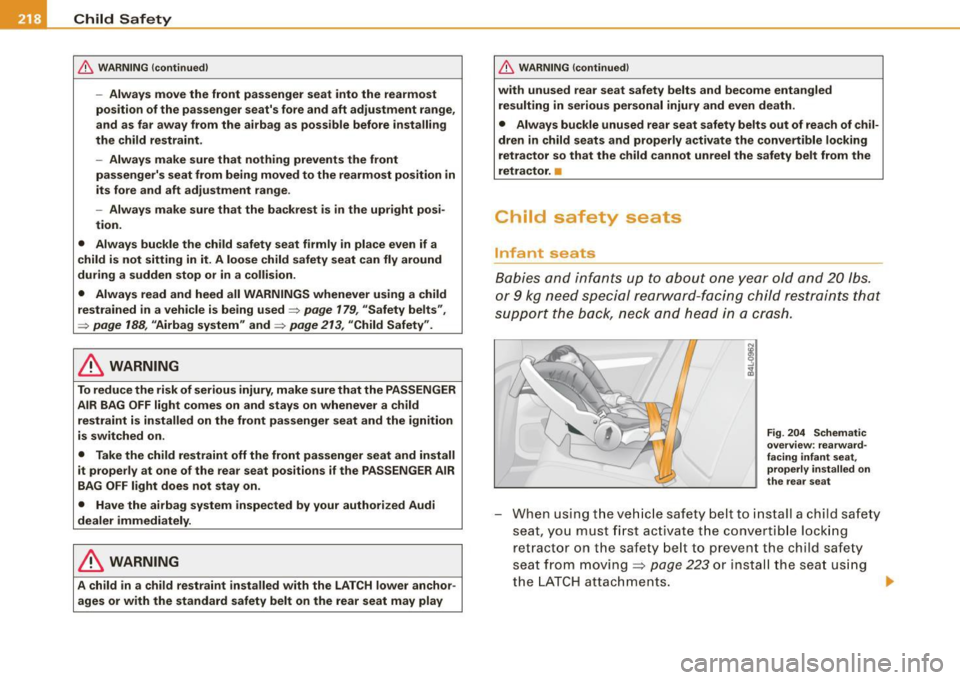
Babies and infants up to about one year old and 20 lbs.
or 9 kg need special rearward-facing child restraints that
support the back, neck and head in a crash.
Fig . 204 Schematic
overview: rearward
facing infant seat,
properly installed on
the rear seat
-When using the vehicle safety belt to install a child safety
seat, you must first activate the convertible locking
retractor on the safety belt to prevent the child safety
seat from moving=> page
223 or insta ll the seat using
the LATCH attachments. ..,_
Page 223 of 360
& WARNING !continued)
• Always follow the manufacturer's instructions provided with
the child safety seat or infant carrier.
• Always move the front passenger seat into the rearmost posi
tion of the passenger seat's fore and aft adjustment range, and as
far away from the airbag as possible before installing the child
restraint.
• Always make sure that nothing prevents the front passenger's
seat from being moved to the rearmost position in its fore and aft
adjustment range .
• Always make sure the backrest is in an upright position .
• Make sure that the PASSENGER AIR BAG OFF light comes on
and stays on all the time whenever the ignition is switched on.
• If the light does not stay on, perform the checks~
page 199,
uMonitoring the Advanced Airbag System ".
• Take the child restraint off the front passenger seat and install
it properly at one of the rear seat positions if the PASSENGER AIR
BAG OFF light does not stay on whenever the ignition is switched
on. •
Safety first
Child Safety
Booster seats and safety be lts
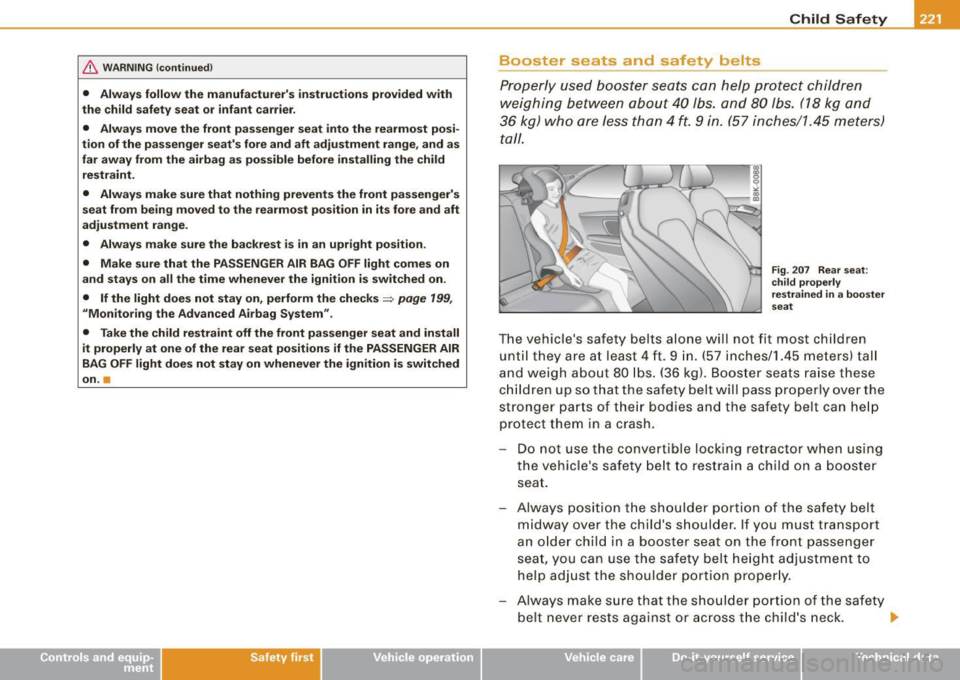
Properly used booster seats can help protect children
weighing between about 40 lbs. and 80 lbs. (18 kg and
36 kg) who are less than 4
ft. 9 in. (57 inches/1.45 meters)
tall.
Fig . 207 Rear seat :
child properly
restrained in a booster
seat
The vehicle 's safety belts alone will not fit most children
until they are at least 4 ft. 9 in. (57 inches/1.45 meters) tall
and weigh about 80 lbs. (36 kg). Booster seats raise these
children up so that the safety belt will pass properly over the
stronger parts of their bodies and the safety belt can help
protect them in a crash.
- Do not use the convertible locking retractor when using
the vehicle 's safety belt to restrain a child on a booster
seat.
- Always position the shoulder portion of the safety belt midway over the child's shoulder. If you must transport
an older child in a booster seat on the front passenger
seat , you can use the safety belt height adjustment to
help adjust the shoulder portion properly.
- Always make sure that the shoulder portion of the safety
belt never rests against or across the child's neck.
I)),
Vehicle care I I irechnical data
Page 226 of 360
-Child Safety -------=---------------------------------------
& WARNING (continued )
• It is safer to install a forward-f acing child safety seat on the rear
seat.
• Always read and heed all WARNINGS whenever using a child
restrained in a vehicle is being used=>
page 213 . Special precau
tions apply when installing a child safety seat on the front
passenger seat:::::,
page 190 , "Child restraints on the front seat -
some important thing s to know ".
& WARNING
Always take special precautions if you must install a forward or
rearward-facing child restraint on the front passenger's seat in
exceptional situations :
• Whenever a forward or rearward -facing child restraint is
installed on the front passenger seat , the PASSENGER AIR BAG
OFF light must come on and stay on whenever the ignition is
switched on.
• If the PASSENGER AIR BAG OFF light does not come on and stay
on , perform the checks described=>
page 199, "Monitoring the
Advanced Airbag System ".
• Take the child restraint off the front passenger seat and install
it properly at one of the rear seat positions if the PASSENGER AIR
BAG OFF light does not stay on whenever the ignition is switched
on .
• Improper installation of child restraints can reduce their effec
tiveness or even prevent them from providing any prote ction .
• An improperly installed child restraint can interfere with the
airbag as it deploys and seriously injure or even kill the child .
• Always carefully follow the manufacturer's instructions
provided with the child safety seat or carrier .
• Never place additional items on the seat that can increase the
total weight registered by the weight-sensing mat and can cause
injury in a crash .
& WARNING
Forward-facing ch ild restraints :
• Always make sure the forward-facing seat has been designed
and certified by its manufa cturer for use on a front seat with a
passenger front and side airbag .
• Never put the forward-facing child restraint up , against or very
near the instrument panel.
• Always move the passenger seat into its rearmost position in
the seat's fore and aft adjustment range , as far away from the
airbag as possible before installing the forward-facing child
re straint. The backrest must be adjusted to an upright position.
• Make sure that the PASSENGER AIR BAG OFF light comes on
and stays on all the time whenever the ignition is switched on.
& WARNING
Re arward -facing child restraints :
• A child in a rearward -facing child safety seat installed on the
front passenger seat will be seriously injured and can be killed if
the front airbag inflates -even with an Advanced Airbag System.
• The inflating airbag will hit the child safety seat or infant
carrier with great force and will smash the child safety seat and
child against the backrest , center armrest , door or roof .
• Always be e specially careful if you must install a rearward
facing child safety seat on the front passenger seat in exceptional
circumstances .
• A tight tether strap on a rearward-facing child restraint
attached to the front pas senger seat can put too much pres sure
on the weight -m at in the seat and register a heavier weight in the
Advanced Airbag System. The heavier weight registered can make
the system work as though an adult were on the seat and deploy
the Advanced Airbag when it must be suppressed causing ser ious
or even fatal injury to the child.
Ill-
Page 244 of 360

llffl __ ln_ t _e_ ll-'"ig ...,_ e_ n_t _t_ e_ c_ h _ n_o _ l_o _,.g= y,_ __________________________________________ _
Take into consideration that when you unlock your vehicle, some
convenience functions, such as the remote key or power seat
adjustment, may not be available. The convenience functions will be
available again when you turn on the ignition and start the engine.
With the engine turned off
If you listen to the radio, for example, with the engine turned off or
use other MMI functions, the battery is being discharged .
If starting capability is jeopardized due to energy consumption, the
following warning appears in the MMI display :
Please start engine, otherwise system will switch off in
3 minutes.
The warning indicates that the system will be turned off automati
cally after 3 minutes. If you wish to continue using the functions,
you have to start the engine .
With the engine running
Although electrical energy is generated when the vehicle is being
driven, the battery can become discharged. This happens mostly
when little energy is being generated and a great deal consumed and the battery's state of charge is not optimal.
To bring the energy balance back into equilibrium, consumers
which require especially large amounts of energy are temporarily
cut back or switched off. Heating systems in particular require a
great deal of energy. If you notice, for example, that the heated
seats* or the heated rear window are not heating, they have been
temporarily cut back or switched off. These systems will be available
again as soon as the energy balance has been restored.
You will also notice that engine idle speed has been increased
slightly . This is normal and not a cause for concern. By increasing
engine idle speed the additional energy required is generated and
the battery is charged.
Driver not ification in the instrument cluster
d isplay
If battery power drops into the range where it can limit the ability of
the engine to start, this is shown in the instrument cluster display
with the following driver message:
'-' Low battery charge: battery will be charged while driving
This notification reminds you that the starting capability of the
engine may be limited. As soon as you start driving again, the
battery will be recharged and the notification will go out.
Driver notification appears and goes out again
If this driver notification appears after the ignition is turned on or
while driving and it goes out again after a while, the battery has
been adequately recharged.
Driver notification appears and does not go out again
If this driver notification appears after the ignition is turned on or
while driving and does not go out again, the battery's state of
charge is not in the optimal range . Starting ability is restricted . Have
the battery checked as soon as possible by an authorized Audi
dealer or qualified workshop. •
Page 284 of 360

-~_C_ h_e _c _ k_ i_n ...:::g::;...._ a_n_ d_ f_ i_ll _in -'g:::;.._ ___________________________________________ _
Have the battery checked when you take your vehicle in for service.
You are well advised to replace a battery that is older than 5 years.
With certain types of airbag deployment, the battery is discon nected from the vehicle electrical system for safety reasons=>
& in
"Repair, care and disposal of the airbags" on
page 202.
Disconnecting the battery terminals
Some vehicle functions (power window regulators, for example) are
lost if the battery terminals are disconnected. These functions have
to be relearned after the battery terminals are connected again . To
prevent this, the battery should only be disconnected from the
vehic le electr ical system when absolute ly necessary for repairs .
Vehicles not driven for long periods
If you do not drive your vehicle over a period of several days or
weeks, electrical components are gradually cut back or switched off.
This reduces energy consumption and maintains starting capability
over a longer period=>
page 241.
Take into consideration that when you unlock your vehicle, some
convenience functions, such as the master key remote function or power seat adjustment, may not be available. The convenience
functions will be available again when you turn on the ignition and start the engine .
Winter operation
During the winter months, battery capacity tends to decrease as
temperatures drop . This is because more power is also consumed
while starting, and the headlights, rear window defogger, etc., are
used more often.
Avoid unnecessary power consumption, particularly in city traffic or
when traveling only short distances . Let your authorized Audi dea ler
check the capacity of the vehicle battery before winter sets in
=>
page 284 . A well charged battery will not only prevent starting
problems when the weather is cold, but will also last longer.
[ i ] Tips
If your vehicle is left standing for several weeks at extremely low
temperatures, the vehicle battery should be removed and stored
where it will not freeze. This will prevent it from being damaged and
having to be replaced. •
Working on the battery
Be especially careful when working on or near the battery.
The battery is located in the luggage compartment under
the floor. Before you check anything in the luggage
compartment,
read and heed all WARNINGS =:>& .
Always heed the safety warnings, when working on the vehicle
battery or the vehicle electrical system to prevent injury.
The following WARNINGS are very important when
working on the battery:
Always heed the following WARNING SYMBOLS and safety pre
cautions when working on the battery.
Always wear eye protection .
Battery acid contains sulfuric acid. Always wear
gloves and eye protection.
Page 323 of 360
Fuses and bulbs -
------------------
Fuse Location, Instrument Panel left
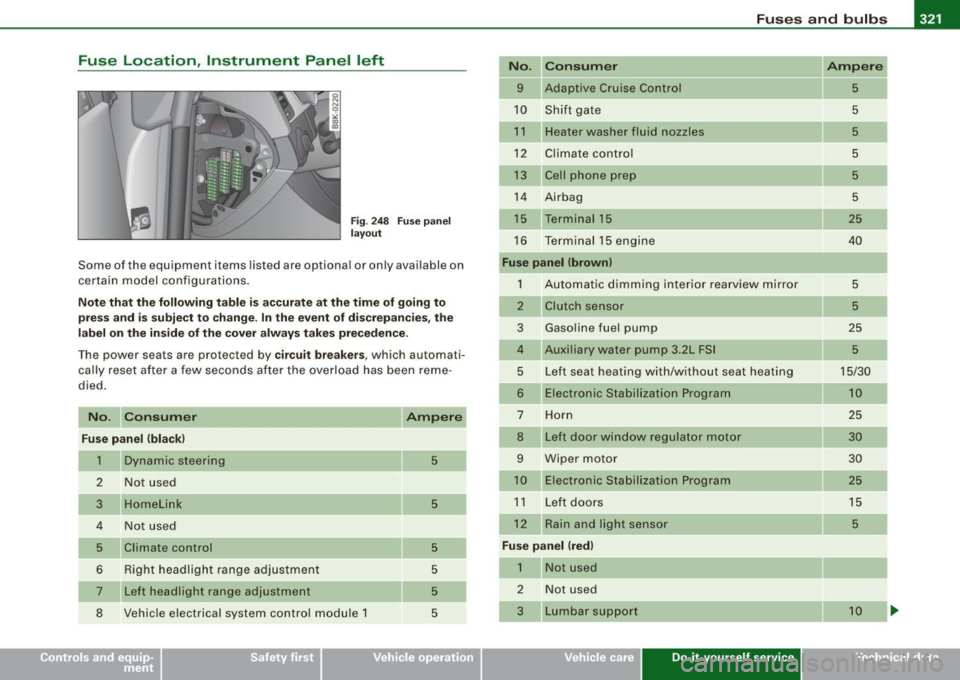
Fig . 248 Fuse panel
layout
Some of the equipment items listed are optional or only available on
certain model configurations.
Note that the following table is accurate at the time of going to
press and is subject to change. In the event of discrepancies, the
label on the inside of the cover always takes precedence.
The power seats are protected by circuit breakers , which automati
cally reset after a few seconds after the overload has been reme
died.
No. Consumer
Fuse panel (black)
1 Dynamic steering
2 Not used
3 Homelink
4 Not used
5 Climate control
6 Right headlight range adjustment
___ ,
7 Left headlight range adjustment
8 Vehicle electrical system control module 1
5
5
5
5
5
5
No.
9
10
11
12
13
14
16
Consumer
Adaptive Cruise Control
Shift gate
Heater washer fluid nozzles
Climate control
Cell phone prep
Airbag
Terminal 15
Te rminal 15 engine
Fuse panel (brown)
1 Automatic dimming interior rearview mirror
2
3
5
6
7
8
9
Clutch sensor
Gasoline fuel pump
Auxiliary water pump 3.2L FSI
Left seat heating with/without seat heating
Electronic Stabilization Program
Horn
Left door window regulator motor
Wiper motor Electronic Stabilization Program
11 Left doors
12 Rain and light sensor
Fuse panel Ired)
1
2
Not used
Not used
Lumbar support
Vehicle care Do-it-yourself service
Ampere
5
5
5
5
5
5
25
40
5
5
25
5
15/30 10
25
30 30
25
15
5
10
irechnical data
Page 349 of 360

Alphab eti ca l ind ex 111111 ____________________________ ...:.....=.!:..:....:.=.::::...::...::.:....::....:.: __ _
Cup holders ... .. ...... . .... .. .. .... . 86
D
Data 337
Data recorder . ..... .. .. .... .... .... . 234
Date display ....... .... .... .......... 10
Daytim e running l ights ........ .... .... 55
Declaration of compliance Adaptive cruise control .. ......... . 342
Audi side assist . .. .. . ... ... . ... .. 342
Ce ll phone package . ..... .... .... . 342
Convenience key ..... .... ....... . 342
Electronic immobilizer . ..... .. .... 342
Hom elink® universal remote control 342
Remote control k ey .. .. .. .... .... . 342
Tire pressure monitoring syste m ... 34 2
Defective light bulb warning .... . ... ... 35
Defrosting the windows .. .... .... . 95, 102
Defrosting windows . .... .... ... .. 95, 102
De luxe automat ic climate contro l .... ... 90
Air distribution . ...... .... .. .... ... 94
Air ven ts (rear) ... .... .... .. . .... .. 96
Automatic mode . .. .. .. ... ..... ... 92
Controls ... .. ...... .. .... ..... ... 9 1
Defrost . ...... .. .... .... ..... .. .. 95
Description ... ... .... .... ...... ... 90
Economical use .. .... ...... ..... .. 96
Fan ........... .... .... .... .... ... 93
Rear window defogger ... .... ..... . 95
Recirculation mode .... .. .... .... .. 94
Temperature . ...... ....... .. ... ... 93
Turning on and off ... .... ... .... .. 92
Controls and equip
ment Safety first
Deluxe automatic c
limate control p lus ... 96
Air distribu tion ... .... ...... ...... 101
Air vents ........... .... ...... ... 103
Air vents (rear) ...... .... ... .. .... 103
Au toma tic mode . .... .... .... ... .. 99
Au tomatic recircu lation ...... .... . 104
Basic settings .. .. ... .... .... ... .. 104
Controls ... .. .... .... ... .. .. ..... 98
Defrost . . . . . . . . . . . . . . . . . . . . . . . . . 102
Description ... .. .. .... .... .... ... . 96
Economical use .. .... .... .... .... 104
F an .. .... .... ...... ....... .. .... 100
Rear window defogger .... ... ..... 102
Recirculation mode ......... .... .. 101
Synchroniza tion .................. 105
Temperature . .............. .... .. 100
Turn ing on and off .... .... .... .... . 99
Determining corr ect load limit ... .... . 296
Digita l clock ... .. .. .... .... .... ... .. . 10
Digi tal compass ........... ....... .... 67
Digital speedometer .... .... .. .. .... .. 20
Dimensions ........ ... .. .... ... .... 336
Doors Emerg ency locking ......... .... ... 47
Driver information sys.tern ... ... ... ... . 18
Defective light bulb warning ... ... .. 35
Digital speedometer ...... ... .... .. 20
Driver information messages ...... .. 28
Open door or rear lid warning .. .... . 21
Outside temperatu re disp lay .. ... ... 19
Sound system display . ........ .... . 19
Driver seat
See Seating posit ion ...... .... .... 1 70 Driver's seat memory
Activa ting remote con trol key . .... .. 76
Driving lights .. ...... .... ... .... .. . .. 53
Driving messages .... .... .... ...... .. 28
Driving safely ........ .... ..... .. ... . 168
Driving through water ... .. .. .... .... . 244
Driving time ..... ... . .... ...... ... .. . 23
Dup licate key . .... .. .... ... .... .... .. 38
Dust and pollen fi lter
De luxe au tomatic c limate control pl us 96
Dust filter Deluxe automatic c limate contro l .. .. 90
Deluxe automatic c limate control plus 96
Dynamic steering . .... ... ..... 13, 33, 144
E
Easy entry function ... .... ... ...... 72, 7 4
Electrical seat adjustment
See Seat adjustment . .... . .... .. .. . 72
Electromechanica l parking brake
Emergency braking ... .... .... .... 114
Ma lfunction . .... .... .... .... .... 115
Operation .... .... ... ... ... .. .... 112
Parking ... .... .... ... ........ ... 113
Releasing and c losing ..... .... ... . 112
Starting ass ist .... .... ... .... .... 113
Starting from rest ... .. .. .. .... ... 113
Starting off wi th a traile r ... .... .... 114
Warni ng/indicator lights .. ...... ... . 16
Electron ic differential lock (EDU
How the system works .. ...... .. .. 235
Warning/ind ica tor lights .. ...... ... . 15
Vehicle operation Vehicle care Do-it-yourself service Technical data
Page 355 of 360
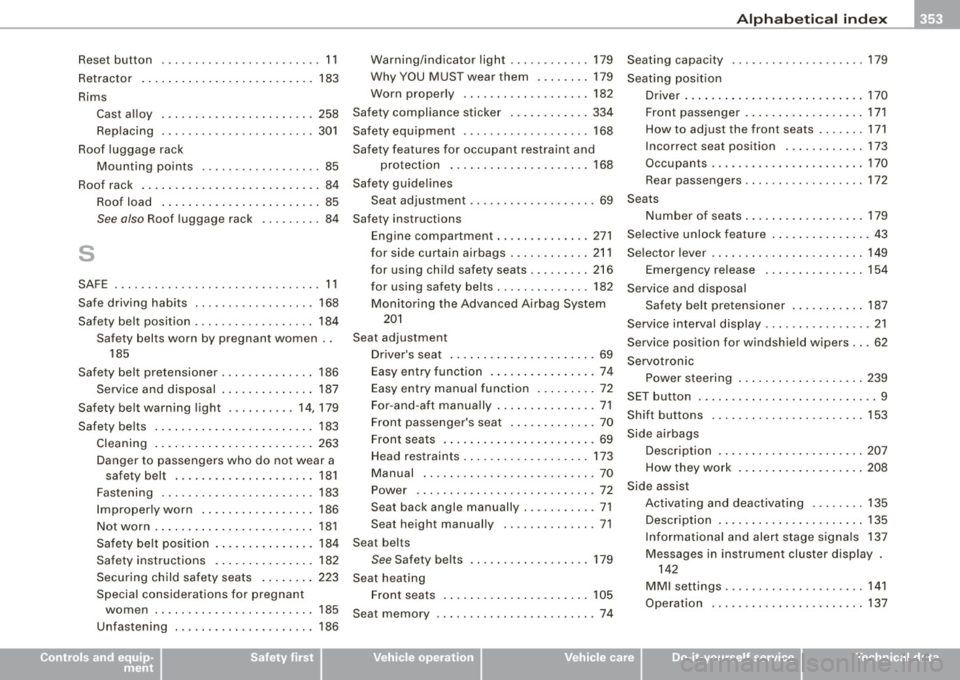
Alphabetical index -
-------------=----
Reset button ... ...... .. ... ... . .. .. .. 11
Retractor ................. ......... 183
Rims Cast al loy ..... .. .... .... ..... .. . 258
Replacing ... .... ..... .. .... .... . 301
Roof luggage rack
Mounting points .................. 85
Roof rack ........... ...... .... .... .. 84
Roof load ...... ...... ...... ...... 85
See also Roof luggage rack ... .... .. 84
s
SA FE ... .... .... .... .... ... .... .... . 11
Safe driving hab its .. .... .... ... .... . 168
Safe ty belt position . . . . . . . . . . . . . . . . . . 184
Safety belts worn by p regnant women ..
185
Safety belt pretensioner ... .... .... ... 186
Service and disposal .............. 187
Saf ety b elt warning light .... .... .. 14,179
Safety belts . . . . . . . . . . . . . . . . . . . . . . . . 183
Cleaning ..... .... .... ........... 263
Danger to passengers who do not wear a
safe ty belt . .... .... ..... .. ... .. 181
Fastening ... .... .... .... ... .... . 183
Improperly worn ..... .... ........ 186
Not worn . . . . . . . . . . . . . . . . . . . . . . . . 181
Safety belt position ...... .... ..... 184
Safety instructions . ......... .... . 182
Securing child s afety seats ........ 223
Special considerations for pregnant women ....... .... .... ......... 185
Unfastening ..... ... ..... ...... .. 186
Controls and equip
ment Safety first
Warning
/indicator light .... ........ 179
Why YOU MUSTwearthem ... .... . 179
Worn properly ..... .... .... .... .. 182
Safety compliance sticker . .... ... .... 334
Safety equipment .... .... ..... .. .... 168
Safe ty fea tures for occupant restraint and
protection ... .. ........ .... ... . 168
Safety guidelines Seat adjustment ... ...... ... ... ... . 69
Saf ety instructions
Engin e compartm ent . .... .... ..... 271
for sid e curtain airbags . .......... . 211
for using child safety seats ....... .. 216
for using safety be lts .... .......... 182
Moni toring the Advanced Airbag System
201
Seat adjustment Driver's seat ........ ...... ... .... . 69
Easy entry function ........... ... .. 74
Easy entry manual function .. ..... .. 72
For -and -aft manua lly ..... ..... ... .. 71
Front passenger's seat .. .... ..... .. 70
Front seats ...... .. .. .... .... .... . 69
Head restraints ... ..... ... ..... .. . 173
Manual .. ...... .... ... .. ..... ... . 70
Power ....... .. .... .... .... .... .. 72
Seat back angle manually ........ ... 71
Seat height manually . ........ .... . 71
Seat belt s
See Safety belts
Seat heating 179
Front seats ...... .. .. .... .... .... 105
Seat memory ...... .. ... ... ..... .... . 74 Seating capacity
.... ..... .. . .... .. . . 179
Seating position Driver ......... ....... .. .. .... ... 170
Front passenger . ...... .. . .... .. .. 171
How to adjust the front seats ... .... 171
Incorr ect seat position .... .... .... 173
Occupan ts ... ... .. .... ...... .... . 170
Rear passengers . ...... .. . .... .. .. 172
Seats Number of seats .... .... .. .... .... 179
Se lect ive unlock feature ...... .... ..... 43
S elector le ve r .. .. .... ..... .. .... .... 149
Emergency release ...... .... ..... 154
Service and disposal
Safety belt pretensioner . ...... .... 187
Service interval display ... .... .... ... .. 21
S erv ice pos ition for w indsh ield wipers . .. 62
Servotronic Power steering .. ...... ....... .... 239
SET button . ...... .. .... .... ..... .. ... 9
Shift buttons ..... .. .... .... .... .... 153
Side airbags Description . ...... .... ....... .... 207
How they work .. ...... .... ... .. .. 208
Side assist Activating and deactivating .... .... 135
Description . ..................... 135
Informational and alert stage signals 137
Messages in instrument cluster display .
142
MMI settings ............... ...... 141
Operation .... .... ... ... ... .. .... 137
Vehicle operation Vehicle care Do-it-yourself service Technical data