door lock AUDI A5 COUPE 2010 Owner's Manual
[x] Cancel search | Manufacturer: AUDI, Model Year: 2010, Model line: A5 COUPE, Model: AUDI A5 COUPE 2010Pages: 360, PDF Size: 84.39 MB
Page 113 of 360

On the road -
----------------
engine again . Moreover, you cannot lock the vehicle from the
ou tside with the key.
S hift to P, other wise v ehicle can roll a way. Doors d o not lo ck if lev er
i s not in
P.
This message appears for safety reasons along with a warning
signal. It appears if the selector lever for the automatic transmission
is not in the P position when switching off the ignition with the
I START ENG INE STOP I button. Move the selec tor lever to the P
position, otherwise the vehicle is not secured against rolling away.
You a lso cannot lock the vehic le using the locking button on the
door handle or using the remote key .
Convenience key defective ! Use ign it ion lock
This message appears if the vehicle has to be started not with the
I S TART ENG IN E STOP I button bu t with the ignition key .
& WARNING
• Nev er allow the engine to run in confined spaces · danger of
asphy xia ti on.
• Never turn off th e engine until th e vehicl e ha s come to a
c omplete stop .
• The br ake boo ster and servotronic only work when the engine
is running . With the ignit ion turned off , you have to apply m ore
force wh en ste ering or braking. Since you cannot steer and stop
norm ally , th is c an lead to accidents and serious injuries.
0 Note
• Avoid high engine rpm, ful l throttle and heavy engine loads unti l
the engine has reached operating temperature -o therwise you risk
engine damage .
• The engi ne cannot be started by pushing or tow ing the vehic le .
• I f the engine has been under heavy load for an extended period,
heat builds up in the engine compa rtment after the engine is
Controls and equip
ment
switched off -there is a risk of damaging the engine . Allow the
engine to run at idle for about 2 minutes be fore switch ing it off .
[ i ] Tips
If you open the driver's door with the ign it ion switched on, a buzzer
sounds and the message
Ign itio n is on appears in the instrument
c luster display. Sw itc h t he ign ition off .•
Ap plies to ve hic les: w it h con venie nc e key
Switching engine off with th e
[START ENGINE STOP] button
-Bring you r vehi cle to a comp lete st op.
- Automat ic transm ission*: Move the selector lever to the
P or N position .
-Press the[S TA RT EN GINE S TO P] button => page 110,
fig. 118.
Em ergen cy OFF fun ction
If necessary, the engine can be sw itc hed off wit h the selector lever
in the
R , D or S* positions . To do so, step on the brake pedal and
press and hold the
I S TA RT ENGINE ST OP I button (vehicle speed
must be less than 6 mph/ 10 km/h.
& WARNING
• Never turn off the engine unt il the vehicle h as come to a
complete s top.
• The brake boo ster and servotroni c on ly wor k when the eng ine
is running . With the ignition turned off , you have to apply more
for ce when stee ring or braking . Since you cannot steer and stop
norm ally, t his can lead to accident s and seriou s injuries .
~
I • •
Page 115 of 360

On the road -
----------------
& WARNING
If a gear or a drive range (automatic transmission) is engaged with
the vehicle stationary and the engine running, you must in no
instance accelerate or release the clutch carelessly . Otherwise the
vehicle will start to move immediately -risk of an accident.
0 Note
If the symbol (CD) in the display or the indicator light BRAKE (USA
models)/ {(i)) (Canada models) in the instrument cluster flashes, there
is a malfunction in the brake system. By pressing the
[SET] button,
you can bring up a driver message which explains the malfunction in more detail. If the driver message
Parking brake! appears, there
is an operating malfunction in the parking brake which you should
have repaired immediately by an authorized Audi dealer or other
qualified workshop ~
page 29.
[ i] Tips
• You can apply the parking brake at any time -even with the igni
tion turned off. The ignition must be turned on in order to release
the parking brake.
• Occasional noises when the parking brake is applied and
released are normal and are not a cause for concern.
• When the vehicle is parked, the parking brake goes through a
self -test cycle at regular intervals. Any associated noises are
normal. •
Parking
Various rules apply to prevent the parked vehicle from
rolling away accidentally.
Parking
- Stop the vehicle with the foot brake.
Controls and equip
ment
- Pull the switch to apply the parking brake.
- Automatic transmission*: Move the selector lever to
P.
- Turn the engine off=:,& .
- Manual transmission: Shift into 1st gear.
In addition on inclines and grades
-Turn the steering wheel so that your vehicle will roll
against the curb in case it should start to move.
& WARNING
• When you leave your vehicle -even if only briefly -always
remove the ignition key. This applies particularly when children
remain in the vehicle. Otherwise the children could start the
engine, release the parking brake or operate electrical equipment
(e.g. power windows). There is the risk of an accident.
• When the vehicle is locked, no one -particularly not children
should remain in the vehicle. Locked doors make it more difficult
for emergency workers to get into the vehicle -putting lives at
risk. •
Starting from rest
The starting assist function ensures that the parking
brake is released automatically upon starting.
Stopping and applying parking brake
-Pull the switch to apply the parking brake.
Starting and automatically releasing the parking
brake
-When you start to drive as usual, the parking brake is
automat ically released and your vehicle begins to move . .,..
I • •
Page 178 of 360
___ o_ r_iv _ i _n....; g::;_ S_ a_f _e _ly=-- -------------------------------------------------
Loose items in the luggage compartment can shift
suddenly, changing vehicle handling characteristics. Loose
items can also increase the risk of serious personal injury in
a sudden vehicle maneuver or in a collision.
- Distribute the load evenly in the luggage compartment.
- Always place and properly secure heavy items in the
luggage compartment as low and as far forward as
possible
~ fig. 183.
Secure luggage using the tie-downs provided~
page 79.
- Make sure that the rear seat back is securely latched in
place.
& WARNING
Improperly stored luggage or other items can fly through the
vehicle causing serious personal injury in the event of hard braking or an accident. To help reduce the risk of serious personal injury:
• Always put objects , for example, luggage or other heavy items
in the luggage compartment.
• Always secure objects in the luggage compartment using the
tie-down eyelets and suitable straps.
& WARNING
Heavy loads will influence the way your vehicle handles. To help
reduce the risk of a loss of control leading to serious personal
injury:
• Always keep in mind when transporting heavy objects, that a
change in the center of gravity can also cause changes in vehicle
handling:
-Always distribute the load as evenly as possible.
& WARNING (continued)
-Place heavy objects as far forward in the luggage compart
ment as possible.
• Never exceed the Gross Axle Weight Rating or the Gross
Vehicle Weight Rating specified on the safety compliance sticker on the left door jamb. Exceeding permissible weight standards
can cause the vehicle to slide and handle differently.
• Please observe information on safe driving~
page 168.
& WARNING
To help prevent poisonous exhaust gas from being drawn into the
vehicle, always keep the rear lid closed while driving.
• Never transport objects larger than those fitting completely
into the luggage area because the rear lid cannot be fully closed.
• If you absolutely must drive with the rear lid open, observe the
following notes to reduce the risk of poisoning:
-Close all windows,
- Close the panoramic tilting sunroof*,
- Open all air outlets in the instrument panel,
- Switch off the air recirculation,
- Set the fresh air fan to the highest speed.
& WARNING
Always make sure that the doors, all windows, the panoramic
tilting sunroof* and the rear lid are securely closed and locked to
reduce the risk of injury when the vehicle is not being used.
• After closing the rear lid, always make sure that it is properly
closed and locked.
• Never leave your vehicle unattended especially with the rear lid
left open. A child could crawl into the vehicle through the luggage
compartment and close the rear lid becoming trapped and unable .,_
Page 222 of 360
___ C_h_ i_ld _ S_ a_ f_ e_ t-= y'------------------------------------------------
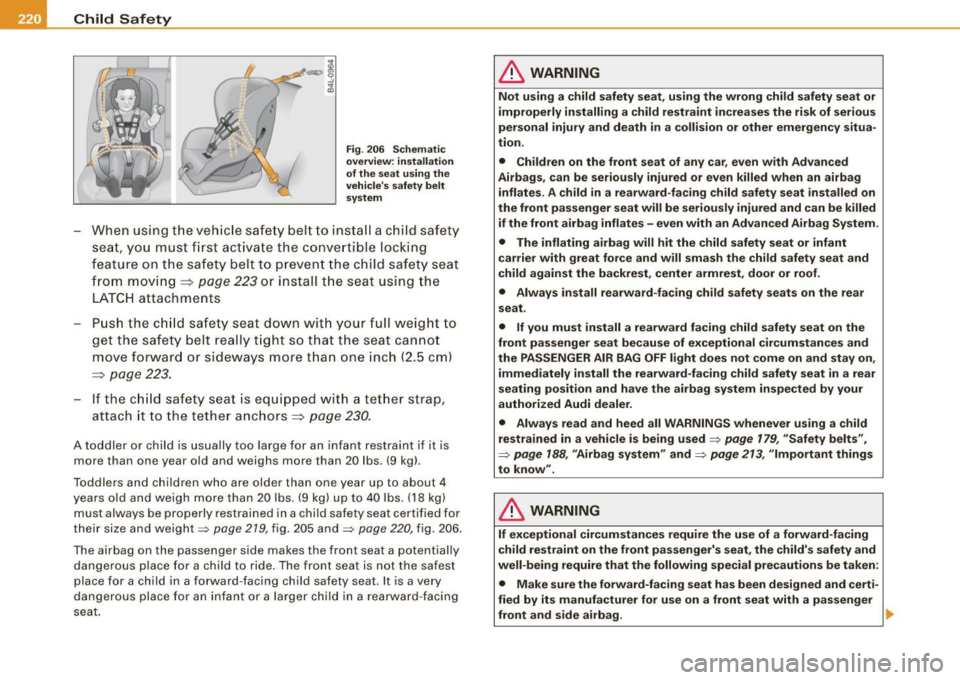
Fig. 206 Schematic
overview: installation
of the seat using the
vehicle's safety belt
system
- When using the vehicle safety belt to install a child safety
seat, you must first activate the convertible locking
feature on the safety belt to prevent the child safety seat
from moving ==>
page 223 or install the seat using the
LATCH attachments
- Push the child safety seat down with your full weight to
get the safety belt really tight so that the seat cannot
move forward or sideways more than one inch (2.5 cm)
==> page 223.
If the child safety seat is equipped with a tether strap,
attach it to the tether anchors==>
page 230.
A toddler or child is usually too large for an infant restraint if it is
more than one year old and weighs more than 20 lbs. (9 kg) .
Toddlers and children who are older than one year up to about 4
years old and weigh more than 20 lbs. (9 kg) up to 40 lbs . (18 kg)
must always be properly restrained in a child safety seat certified for
their size and weight~
page 219, fig. 205 and~ page 220, fig. 206.
The airbag on the passenger side makes the front seat a potentially
dangerous place for a child to ride. The front seat is not the safest
place for a child in a forward-facing child safety seat . It is a very
dangerous place for an infant or a larger child in a rearward -facing
seat.
& WARNING
Not using a child safety seat, using the wrong child safety seat or
improperly installing a child restraint increases the risk of serious
personal injury and death in a collision or other emergency situa
tion.
• Children on the front seat of any car, even with Advanced
Airbags, can be seriously injured or even killed when an airbag
inflates. A child in a rearward-facing child safety seat installed on
the front passenger seat will be seriously injured and can be killed
if the front airbag inflates -even with an Advanced Airbag System.
• The inflating airbag will hit the child safety seat or infant
carrier with great force and will smash the child safety seat and
child against the backrest , center armrest, door or roof.
• Always install rearward-facing child safety seats on the rear
seat.
• If you must install a rearward facing child safety seat on the
front passenger seat because of exceptional circumstances and
the PASSENGER AIR BAG OFF light does not come on and stay on,
immediately install the rearward-facing child safety seat in a rear
seating position and have the airbag system inspected by your
authorized Audi dealer .
• Always read and heed all WARNINGS whenever using a child
restrained in a vehicle is being used~
page 179, "Safety belts",
~ page 188, "Airbag system" and~ page 213, "Important things
to know".
& WARNING
If exceptional circumstances require the use of a forward-facing
child restraint on the front passenger's seat, the child's safety and
well-being require that the following special precautions be taken:
• Make sure the forward-facing seat has been designed and certi
fied by its manufacturer for use on a front seat with a passenger
front and side airbag.
~
Page 225 of 360

Child Safety -
--------------------''----
& WARNING (continued )
• If you must install a booster seat on the front passenger seat
because of exceptional c ircumstances the PASSENGER AIR BAG
OFF light must come on and stay on , whenever the ignition is
switched on.
• If the PASSENGER AIR BAG OFF light does not come on and stay
on , perform the checks described
=> page 199 , "Monitoring the
Advanced A irbag System ".
• Take the ch ild restraint off the front passenger seat and install
it properly at one of the rear seat positions if the PASSENGER AIR
BAG OFF light does not stay on wheneve r the ignition is switched
on .
• Always read and heed all WARNINGS whenever using a child
restrained in a vehicle is being used=>
page 179, "Safety belts",
=> page 188, "Airbag system " and => page 213 , "Important things
to know ".•
Installing a child safety seat
Securing a child safety seat using a safety
belt
S a fety belt s fo r the rear seats and the front passen ger 's
sea t can be l ocked with t he convert ib le lock ing retra cto r
t o prope rly s ecure child saf ety s ea ts .
The s afe ty bel ts e merge ncy lo cking re trac to rs fo r th e rea r sea ts
safety belts and for the front pass enger's seat safety belt have a
c o nve rtible loc king re tr ac tor fo r child r estrai nts. The sa fe ty b elt
must be loc ked so that be lt webbin g cannot unr eel. The re trac tor
c an be activa te d to lock the safety be lt and prevent the safet y belt
w ebbi ng fr om l oos en ing up dur in g n orm al dr ivi ng . A chi ld sa fety
seat can only be properly insta lled when t he safety be lt is locked so
th at th e child and chil d sa fet y seat will sta y in p lace .
Controls and equip ment Safety first Vehicle operation A
lways remember: Even though your vehic le is equipped with an
A dva nce d Airb ag sys tem, all chi ld re n, e sp ec ially those 12 yea rs a nd
youn ger, should a lways ride in the back seat prop erly restrained for
t hei r age and weigh t.
& WARNING
Improperly installed child safety seats increase the risk of serious
personal injury and death in a collision .
• Always make sure that the safety belt retractor is locked when
installing a child safety seat . An unlocked safety belt retractor
cannot hold the child safety seat in place during normal driving or
in a crash .
• Always buckle the child safety seat firmly in place even if a
child is not sitting in it . A loose child safety seat can fly around
during a sudden stop or in a collision .
• Always make sure that the rear seat backrest to which the
center rear safety belt is attached is securely latched whenever
the rear center safety belt is being used to secure a child restraint.
• If the backrest is not securely latched , the child and the child
restraint will be thrown forward together with the backrest and
will strike parts of the vehicle interior. The child can be seriously injured or killed.
• Never install rearward -facing child safety seats or infant
carriers on the front passenger seat . A child will be seriously
injured and can be killed when the passenger airbag inflates.
• The inflating airbag will hit the child safety seat or infant
carrier with great force and will smash the child safety seat and
child against the backrest , center armrest , door or roof .
• Always install rearward -facing child safety seats or infant
c arriers on the rear seat .
• Forward-facing child safety seats or infant carriers installed on
the front passenger's seat may interfere with the deployment of
the airbag and cause serious injury to the child . ..
Vehicle care Do-it-yourself service Technical data
Page 256 of 360
___ C_ le_ a _ n_i_n ~g _ a_ n_ d __ p_r _o _t _e _c_ t_ i_o _n ___________________________________________ _
0 Note
• Never try to remove d irt, mud or dust if the surface of the vehicle
is dry . Never use a dry cloth or sponge, since this cou ld scratch your
vehic le's paint or w indows.
• Never wash your car in bright sunlight. Drops of water act as
magnify ing lenses and may damage your paint.
• When you wash your car in the winter : if you rinse your vehicle
with a hose, be careful not to aim the stream of water directly at
locks, or at door or hatch openings -they can freeze shut.
• Never use sponges designed to remove insects, or any kitchen
scouring sponges or similar products. They can damage your paint
finish .
• Never use a dry cloth or sponge to c lean the head ligh ts. Only use
wet cloths or sponges to prevent scratches . It is best to use soapy
water.
For the sake of the environment
In the interest of the environment, the vehicle should on ly be
washed in specia l wash bays. •
Washing your vehicle with a power washer
Cleaning the exterior of your car with a high -p ressure
power washer is safe as l ong as y ou observe a few simple
rules .
-Before using the power washer, make s ure you have read
and understood the WAR NINGS=::;,
& in "General infor
mati on" o n
page 252.
-Always follow the operating instructions for the power
washer. - Make sure that the jet o
n the spray hose pro duces a "fan
sha ped sp ray".
D o
not hold the spray nozzle too close to soft materials.
When cleaning the vehicle with a power washer always follow the
operating instructions. This applies particula rly to the
operating
pre ssure
and the spraying di stance . Maintain a sufficient distance
to soft materia ls such as rubber hoses and sound/vibration dead
ening materia ls (part icularly on the underside of the engine hood).
Do not use a jet which sprays water in a
direct stream or one that
has a
rotating jet.
Water temperature should not exceed 140 °F (60 °Cl.
& WARNING
Never wash tire s with a jet that sp ra ys water in a dir e ct stream .
Thi s could cau se invisible damage to the tire s and we ake n them ,
eve n if th e spra y is from a re lativel y lo ng dis tanc e an d f or a sh o rt
time . Damaged and weakened tire s can f ail and cau se ac cident s
a nd per sona l injur y.
0 Note
To avoid damaging your vehicle, always make sure that there is
suffic ient distance between the spray head and soft materia ls like
rubber hoses, plastic parts and sound -deadening materials . Never
aim the spray head at the same p oint for a long time . This also
applies to cleaning headlights and painted bumpers . Remember :
the c loser the nozzle is to the surface of the material, the greater the
stress on the mater ial. •
Page 261 of 360
_____________________________________________ C_ l_ e _a_ n_ in_ g_a _ n_d_ p_ r_ o_ t _e_ c_t _io _ n __ lfll
•
& WA RNIN G (continu ed )
• Do not apply additi onal undercoating or ru stproofing on or
ne ar the exhau st manifold , ex haust p ipe s, cat alytic con verter or
heat shields . While driving, the s ub stan ce used for under coating
c ould overhe at and cau se a fire.
• Alway s read a nd heed all WARNINGS and other information
=> page 2 52 . •
Care of interior
A pp lies to veh ic le s: wit h MMI
MMI display
-Cle a n the MMI display with a soft c lean clo th and an LCD
cleane r.
The MM I disp lay can be c leaned with a professionally ava ilable "LCD
cleaner" . Th e cloth should be s lightly dampened with the c leaning
fluid to clean the display.
0 Note
To avoid scratching the MMI display, you should never c lean it dry .•
A pplies to veh ic les : wit h MMI
MMI terminal
- First clean t he MMI terminal with a brush to remove dust
f rom the housing .
- Th en wipe the MMI terminal with a clean, soft, s lig htly
d a mp cloth.
The MM I terminal should be c leaned with a brush first so that no
dirt is trapped between the buttons and the housing . We recom
mend giving the MMI terminal a fina l wipe with a c loth moistened
with wa ter and dish washing detergent .
0 Note
To prevent damage, make sure that no f luid ever gets into the MM I
terminal. •
Aluminum trim
Use only neutral -pH products to remove spo ts and deposits from
a luminum surfaces . Chrome care products and alka line cleaners
wi ll attack aluminum surfaces and can damage them over time .
& WARNING
Alway s re ad and heed all WARNING S and other information
=> page 252.•
Fabrics and fabric coverings
Fabrics and fabric coverings (e .g . seats, door trim pane ls, etc.l
shou ld be c leaned at regular intervals with a vacuum cleaner . T his
removes surface dirt partic les which could become embedded in
the fabric through use . Steam cleaners should not be used, because
the steam tends to push the dirt deeper into the fabric and lock it
there.
Normal cleaning
Generally, we recommend using a soft sponge or a lint -free
microfiber c loth to the clean fabric . Brushes should on ly be used for
carpets and floor mats , since other fabric surfaces could be harmed
by b rushes. .,,
Vehicle care I t •
Page 270 of 360

Fuel supply and filling your fuel tank Refuelling procedure
- Insert the fuel nozzle from the gasoline pump into the
fuel filler neck as far as it will go.
- Select a medium refuelling rate so that the nozzle switches off automatically when the tank is full.
Putting the fuel cap back on
- After filling your tank, twist the fuel cap clockwise as far
as it will go.
- Close the fuel filler flap.
To avoid fuel spilling or evaporating from the fuel tank always close
fuel cap properly and completely.
& WARNING
Improper refueling or handling of fuel can cause fire, explosion
and severe burns.
• Fuel is highly flammable and can cause severe burns and other
injuries.
• Failure to shut the engine off while refueling and/or to insert
the pump nozzle fully into the fuel filler neck could cause fuel to
spray out of filler neck or to overflow. Fuel spray and overflowing
fuel can cause a fire.
• Never use a cellular telephone while refueling. The electromag
netic radiation can cause sparks that can ignite fuel vapors and
cause a fire.
• Never get back into your vehicle while refueling. If in excep
tional circumstances you must get back in your vehicle while refu eling, make certain that you close the door and touch metal to
discharge static electricity before touching the filler nozzle again.
Static electricity can cause sparks that can ignite fuel vapors
released during refueling.
& WARNING (continued)
• Never smoke or have an open flame anywhere in or near your
vehicle when refueling or filling a portable fuel container.
• For your safety, we strongly recommend that you do not travel
with a portable fuel container in your vehicle. The container, full or
empty may leak and could cause a fire, especially in a crash.
• If, under exceptional circumstances, you must transport a
portable fuel container, please observe the following:
-Never fill a portable fuel container while it is anywhere in or
on the vehicle (for example, in the luggage compartment, or on
the trunk). Static electricity can build up while filling and can
ignite fuel vapors causing a fire.
- Always place a portable fuel container on the ground before
filling.
- Always keep the filler nozzle completely inside the portable
container before and during filling.
- If filling a portable container made of metal, the filler nozzle
must always be in contact with the container. This will help
prevent static electricity from discharging and cause a fire.
- Never spill fuel inside the vehicle or luggage compartment. Fuel vapors are highly flammable .
- Always observe local and state/provincial laws regarding the
use, storage and transportation of fuel containers.
- Make certain the fuel container meets industry standards
(ANSI / ASTM F852-86l.
0 Note
If any fuel has spilled onto the car, it should be removed immedi -
ately to prevent damage to the paint. _.,
Page 271 of 360
<£> For the sake of the environment
As soon as the correctly operated nozzle switches off automatically
for the first time, the tank is full. Do not try to add more fuel because
fuel may spill out. In addition, the expansion space in the fuel tank
will be filled -causing the fuel to overflow when it becomes warm
and pollute the environment.
[ i] Tips
• Running your engine while refuelling may cause vapors to
escape or even cause fuel to spill out of the tank. This would then
shut off the fuel nozzle before the tank is full.
• Do not refuel your vehicle with the ignition turned on. The fuel
gauge may otherwise not indicate the correct fuel level after refuel
ling .
• The fuel filler flap of your vehicle is not locked when you lock the
vehicle from the inside .•
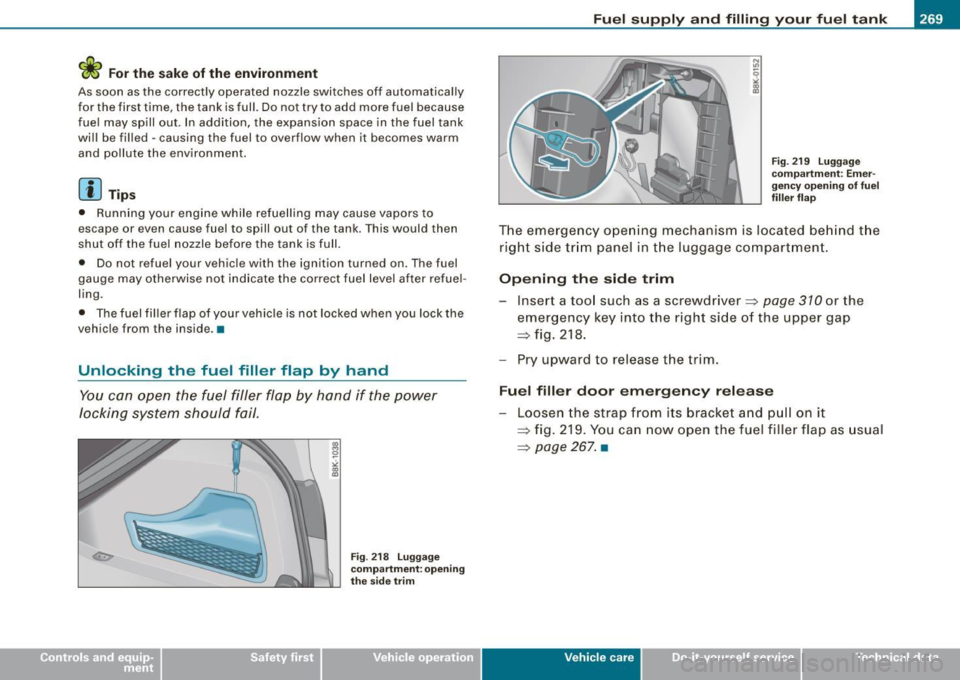
Unlocking the fuel filler flap by hand
You can open the fuel filler flap by hand if the power
locking system should fail.
Fig . 218 Luggage
compartment : opening
the side trim
Fuel supply and filling your fuel tank
Fig. 219 Luggage
compartment: Emer
gency opening of fuel
filler flap
The emergency opening mechanism is located behind the
right side trim panel in the luggage compartment.
Opening the side trim
- Insert a tool such as a screwdriver=:>
page 310 or the
emergency key into the right side of the upper gap
=:> fig. 218.
- Pry upward to release the trim.
Fuel filler door emergency release
- Loosen the strap from its bracket and pull on it
=:> fig. 219. You can now open the fuel filler flap as usual
=:> page 267. •
Vehic le care I I irechnical data
Page 337 of 360
General information -
----------------
left door jamb. It shows the month and year of production and the
vehicle identification number of your vehicle (perforation) as well as
the Gross Vehicle Weight Rating (GVWR) and the Gross Axle Weight
Rating (GAWR).
The high voltage warning label
is located on the lock carrier.
The spark ignition system complies with the Canadian
standard ICES-002. •
Applies to vehicles: with MMI
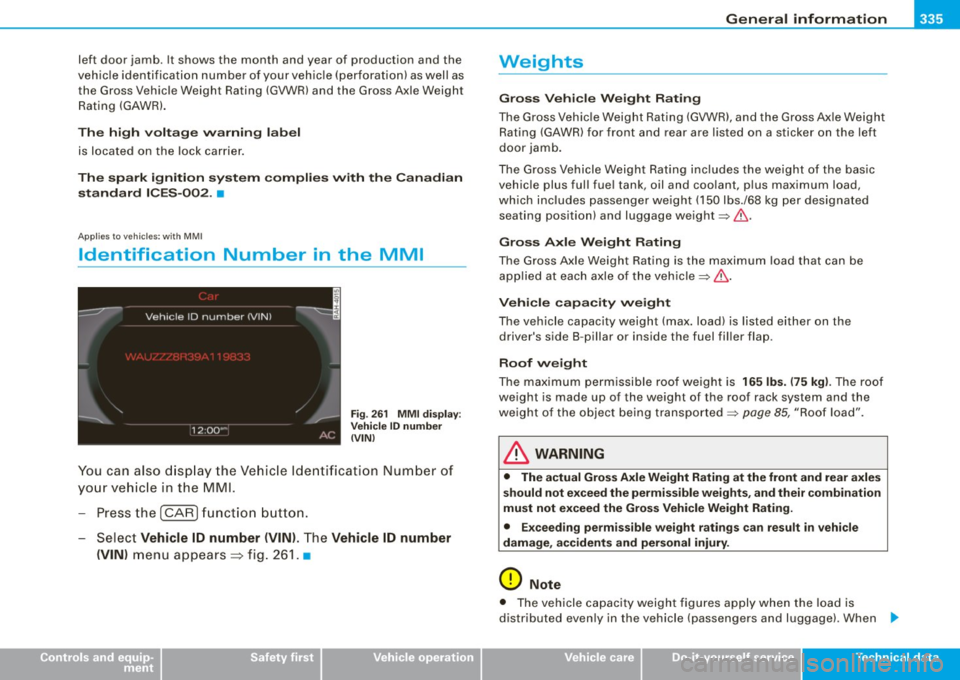
Identification Number in the MMI
Fig. 261 MMI display:
Vehicle ID number
(VIN)
You can also display the Vehicle Identification Number of
your vehicle in the MMI.
- Press the
I CAR) function button.
- Select
Vehicle ID number (VIN). The Vehicle ID number
(VIN)
menu appears =:> fig. 261. •
Controls and equip
ment Safety first Vehicle operation
Weights
Gross Vehicle Weight Rating
The Gross Vehicle
Weight Rating (GVWR), and the Gross Axle Weight
Rating (GAWR) for front and rear are listed on a sticker on the left
door jamb.
The Gross Vehicle Weight Rating includes the weight of the basic
vehicle plus full fuel tank, oil and coolant, plus maximum load,
which includes passenger weight (150 lbs./68 kg per designated
seating position) and luggage weight:::::,&.
Gross Axle Weight Rating
The Gross Axle Weight Rating is the maximum load that can be
applied at each axle of the vehicle:::::,.&,.
Vehicle capacity weight
The vehicle capacity weight (max. load) is listed either on the
driver's side B -pillar or inside the fuel filler flap.
Roof weight
The maximum permissible roof weight is 165 lbs. (75 kg). The roof
weight is made up of the weight of the roof rack system and the
weight of the object being transported:::::,
page 85, "Roof load".
& WARNING
• The actual Gross Axle Weight Rating at the front and rear axles
should not exceed the permissible weights, and their combination
must not exceed the Gross Vehicle Weight Rating.
• Exceeding permissible weight ratings can result in vehicle
damage, accidents and personal injury.
0 Note
• The vehicle capacity weight figures apply when the load is
distributed evenly in the vehicle (passengers and luggage) . When _,,
Vehicle care Do-it-yourself service Tec hn ica l da ta