key AUDI A5 COUPE 2010 Service Manual
[x] Cancel search | Manufacturer: AUDI, Model Year: 2010, Model line: A5 COUPE, Model: AUDI A5 COUPE 2010Pages: 360, PDF Size: 84.39 MB
Page 148 of 360
• ..__A_ u_ d_ i _d _ r_ i_v _e_ s_ e_ le_c_ t _________________________________________________ _
& WARNING
Pay attention to t raffi c when operating Audi dri ve se lect to prevent
potenti al risk of an accid ent.
[ i J Tips
If you remove the igniti on key, AUTO mode is se t the next time you
start the ignition .•
App lies to vehicles: w ith MM I and dr ive select
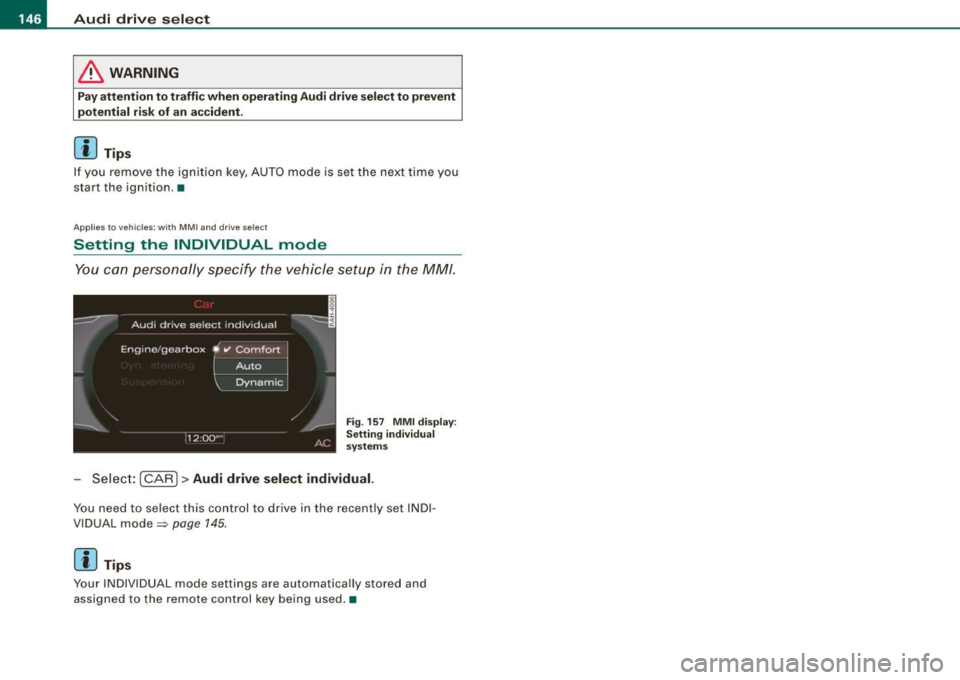
Setting the INDIVIDUAL mode
Y ou can pe rsonally specify the vehicle setup in the M M/.
Fi g. 15 7 MMI di spl ay:
S etting individu al
sy stem s
Sele ct: [CAR]> Audi drive select individual.
Yo u n eed to se le ct this con trol to dr ive in the recently set I NDI
V IDUAL mode=:>
page 145.
[ i J Tips
Your INDIVI DUAL mode settings are automatically stored and
assigned to the remote con trol key being used .•
Page 153 of 360
Tra ns mi ssio n -
----------------
Aut omat ic selec to r l ever lock
The se lector lever is locked in the P and N positions when the igni
tion is turned on. To move the lever from these positions the driver
must depress the brake pedal. As a reminder to the driver, the
follow ing warning appears in the instrument cluster display when
the selector is in
P and N:
W hen sta tio nary app ly footbrake while selecting g ear
A time delay e lement prevents the selector lever from locking when
it is moved through the
N position (going from R to Dl. The locking
e lement will lock the selector lever if the lever is left in N (Neutral)
for more than approximately 1 second, without the brake peda l
being pressed.
At speeds above about 3 mph (5 km/h) the Automatic Shift Lock is
automatically deactivated in the
N position .
Interlock butt on
The lock button on the selector lever prevents the lever from being
accidentally shifted into certain positions. Pressing this button
deactivates the selector lever lock. Depending on the direction of
the shift, the selector lever locks at different positions. The positions
are highlighted in the illustration =>
page 150, fig. 161.
Igniti on key sa fe ty in te rlo ck
The key cannot be removed from the ignition unless the selector
lever is in the
P park position. When the ignition key is removed, the
selector lever wil l be locked in the
P position. •
Applies to vehicles : with automatic transm iss ion
Kick-down
The kick-down feature allows the vehicle to generate
maximum acceleration .
When you press the acce lerator pedal beyond the resistance point
that is reached at ful l throttle, the transmission wi ll select a lower
gear ratio based on vehic le speed and engine RPM. The engine RPM
Controls and equip
ment
wi ll be controlled to produce maximum vehic le acceleration as long
as you continue to press the accelerator pedal beyond this resis
tance point .
& WARNING
Be care ful whe n usi ng the kick -dow n fe atur e on slipp ery ro ads .
R apid acc eleration may cau se th e v ehicle to skid . •
App lies to vehicles : with automat ic transm ission
Dynamic shift program (DSP)
The aut omatic transmission is electronically controlled.
The transmission is se lf adapting and will a ut oma tica lly se lect the
best shift program suited to the driving conditions and driving style.
The transmission will select one of the
eco nom y programs when
you drive at a steady speed or a g radually changing speed without
heavy acceleration. This achieves optimum fuel efficiency, with early
upshifting and delayed downshifting.
The transmission will automatically select the
s p ort y shift programs
when you drive at higher speeds, or with heavy acceleration and
frequent ly changing speeds . Upshifts are delayed to make full use
of engine power . Downshifting takes place at higher engine speeds
than in the economy programs .
The se lect ion of the most su itable shift program is a continuous,
automatic process. The driver can also make the transmission
sw itch to a sporty program by
quick ly pressing down the gas peda l.
This causes the transmission to shift down to a lower gear to
achieve rapid acceleration, e.g. for quickly passing another vehicle .
You do not need to press the gas pedal into the kick-down range.
After the transm ission has upshifted, the original program is
selected accord ing to your driving sty le.
An additiona l shift program allows the automatic transmission to
select the proper gear for uph ill and downhi ll gradients. ..,.
I • •
Page 156 of 360
• ..__T_ ra_ n_s_ m_ i_ s _s_ i_ o _n ___________________________________________________ _
0 Note
If the transmission switches to fail-safe mode, you should take the
vehicle to an authorized Audi dealership as soon as possible to have
the condition corrected .•
A pplies to veh icles : with aut om at ic transmi ssio n
Emergency release of the selector lever
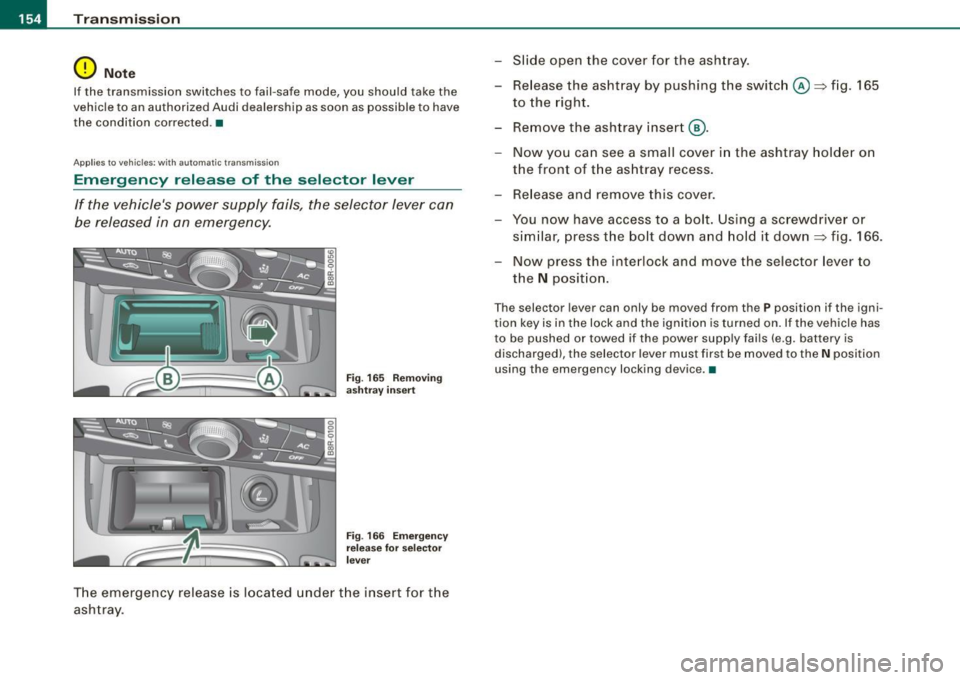
If the vehicle's power supply fails, the selector lever can
be released in an emergency.
Fig. 165 Removing
ashtray insert
Fig. 166 Emergency
release for selector
lever
The emergency release is located under the insert for the
ashtray . -
Slide open the cover for the ashtray.
- Release the ashtray by pushing the switch@~ fig. 165
to the right.
- Remove the ashtray insert @.
- Now you can see a small cover in the ashtray holder on
the front of the ashtray recess.
- Release and remove this cover.
- You now have access to a bolt . Using a screwdriver or
similar, press the bolt down and hold it down ~ fig. 166.
Now press the interlock and move the selector lever to
the
N position.
Th e selector le ve r can only be moved from th e P position if the igni
tion key is in the lock and the ignition is turned on. If the vehicle has
to be pushed or towed if the power supply fails (e.g. battery is
discharged), the selector lever must first be moved to the
N position
using the emergency locking device. •
Page 159 of 360

____________________________________________________ P_a _ r_ k_ a_s_ s_ i_ s _t _ __._
The newly adjusted value is briefly heard from the signal generator.
The settings are automatically stored and assigned to the master
key with remote control. •
Parking system (rear, with
camera)
.
rear view
Applies to vehicles : w ith park in g sys tem (rear, with rear view came ra )
Introduction
Fig . 168 Parking
mode 1: reverse
parking
Fig . 169 Parking
mode 2 : parallel
park ing
Vehicles with the parking system are equipped with a rear view
camera in addition to the acous tic parking system.
Con tro ls and eq uip
ment You can choose between two modes to assist you with parking
. For
example, you can use "parking mode 1" when parking in a parking
space or garage~ fig. 168. When you want to park para llel to the
edge of the street, se lect "parking mode 2"
~ fig. 169.
The rear acoustic park assist system is integrated in the rear of the
vehicle and the rear view camera is integrated in the rear lid
~ page 159.
& WARNING
• The rear view camera has blind spots, in which objects cannot
be detected . Be especially careful to check for small children and
animals before backing up . Small children and animals will not
always be detected by the sensors. •
App lies to veh ic les : wi th p arking system ( rea r, wi th r ear vi ew ca mera)
General Information
Vehicle care I I
®
Fig . 170 Covered area
(D and unco vered a rea
@ of the rear view
cam era .,,_
Technical data
Page 167 of 360
___________________________________________________ H_ o_m _ e_ L_ i_ n _k_ @_R _ __.1111
Applies to vehicles: with Homelin k® un iversal remote contro l
Programming the Homelink ® transmitter
The transmitter is programmed in two phases. For rolling
code transmitters, a third phase is also necessary.
,,,,, r, o: o "'' '''"
Fig . 177 Overhead
console: HomeLink ®
keypad
Fig . 178 Radiator grille
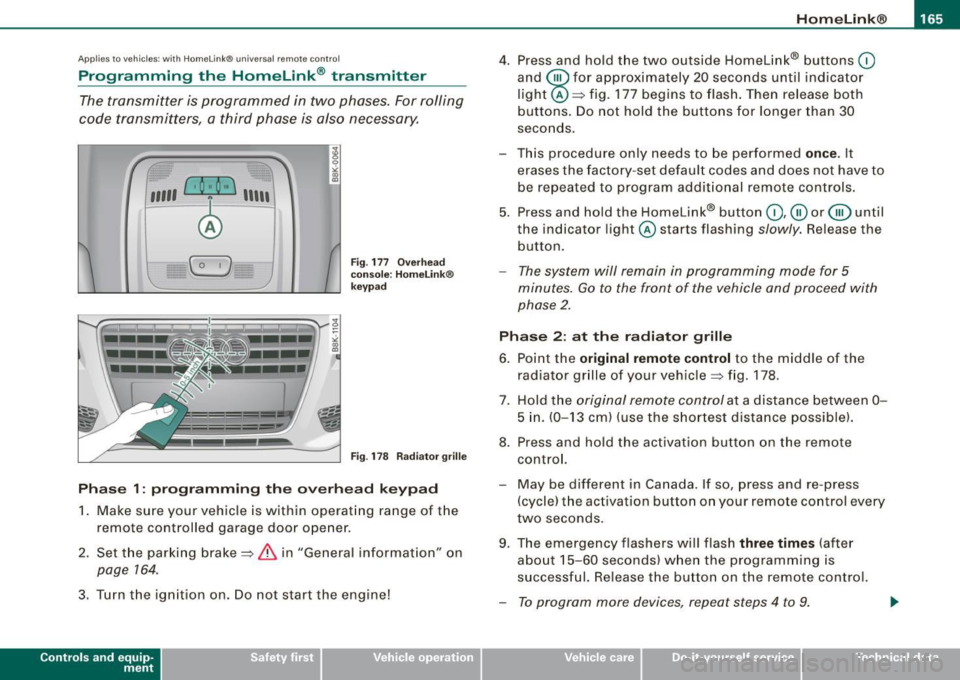
Phase 1: programming the overhead keypad
1. Make sure your vehicle is within operating range of the
remote controlled garage door opener.
2. Set the parking brake==>
& in "General information" on
page 764.
3. Turn the ignition on. Do not start the engine!
Contro ls and eq uip
ment
4. Press and hold the two outside Homelink® buttons 0
and @for approximately 20 seconds until indicator
light@==> fig. 177 begins to flash. Then release both
buttons. Do not hold the buttons for longer than
30
seconds.
- This procedure only needs to be performed
once . It
erases the factory-set default codes and does not have to
be repeated to program additional remote controls.
5. Press and hold the Homelink® button
0,@ or@ until
the indicator light @starts flashing slowly. Release the
button.
- The system will remain in programming mode for 5
minutes.
Go to the front of the vehicle and proceed with
phase 2.
Phase 2: at the radiator grille
6. Point the
original remote control to the middle of the
radiator grille of your vehicle==> fig. 178.
7. Hold the original remote control at a distance between
0-
5 in. (0-13 cm) (use the shortest distance possible).
8. Press and hold the activation button on the remote control.
- May be different in Canada . If so, press and re -press
(cycle) the activation button on your remote control every
two seconds.
9. The emergency flashers will flash
three times (after
about
15 -60 seconds) when the programming is
successful. Release the button on the remote control.
- To program more devices, repeat steps 4 to 9.
Vehicle care I I irechnical data
Page 168 of 360
• ..__H_ o_ m_ e_ L_in _ k_® ____________________________________________________ _
10. Press and ho ld the trained Homelink ® button and
observe t he indicator lig ht @ =>
page 165 , fig. 177 .
- If the indicator light is solid/continuous, programming is
complete and your device shou ld activate when you
press and release the tra ined Homelink ® button .
- If the indicator light b links rapidly for 2 seconds and is
then a solid/cont inuous light, proceed with phase 3 to
program a rolling code device .
Phase 3: rolling code prog rammin g
-A second person on a ladder who can safely reach the
garage door opener motor is recommended.
11 . Locate the "lea rn " button on the garage door opener
motor (refer to the operating instructions for t he opener ,
as the location of this button may vary by manufacturer).
12 . Press and release the lear n button on the garage door
opener motor .
-Not e: once the button is pressed, there are 30 se cond s in
which to in itiate t he next step.
1 3. On the Homeli nk® keypad inside the veh icle, f irmly
press and hold the Homelink ® button previously
programmed in phases 1 and 2 for two seconds and
release. Repeat th is sequence
twice .
-Some vehicles may require the press/hold/re lease
sequence up to three t imes to complete the tra ining
process.
- Homelink ® should now activate your rolling code
equipped device.
I f the 5 mi nute time limit is exceeded, the em erg ency flas hers w ill
fla sh one tim e to indicate that the process has been terminated. In
thi s case, repeat s teps 4 thro ugh 9 .
I f t he emergency flashers do not flash
three times (a fter about 15 -
60 seconds), prog ramming was not successful. In this case , repeat
steps
4 through 9 .
Remote control units for garage door openers in Canada are set to
stop transmi tting rad io frequency signals aft er two seconds . This
time may not be sufficient for the Homelink ® system to learn the
rad io freq uency signal. Perfo rm all o the r steps as described
above. a
Applies to veh icles: wit h Ho meli nk® unive rsal remote co ntro l
Operating the HomeLink ® transmitter
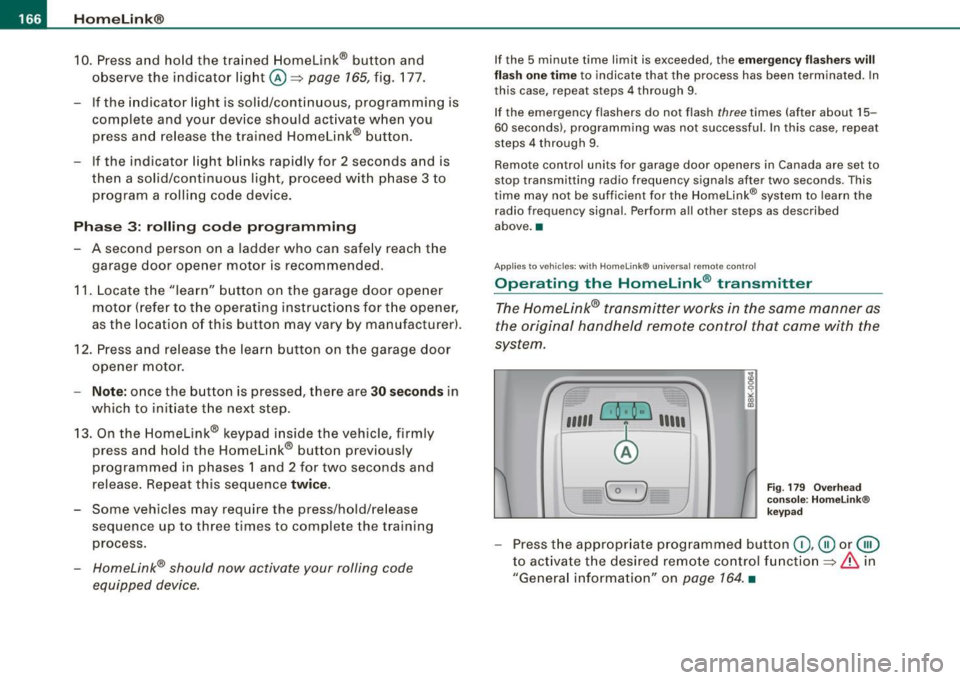
The Homelink® t ransmitter works in the some manner as
the original handheld remote control that came with the
system .
,,,,, r . o ~ o "', 1111 ,
@
B
Fig
. 17 9 Ove rhead
conso le: Hom eli nk®
key pad
- Press t he appropr iate programmed button 0 , ® or @
to activate the desired remo te co ntrol funct io n =>
& in
"General information" on
page 164. •
Page 169 of 360
___________________________________________________ H_ o_m_ e_ L_ i_ n _ k_ @_ R __ !II
Ap plies to vehi cles : w ith Hom elin k® un iversal re mote con tro l
Reprogramming a single button
A Homelink® button can be reprogrammed individually without affecting the other button allocations.
Programming the overhead keypad
Press the appropriate Homelink® button until the indi
cator light begins flashing slowly.
At the radiator grille
1. Point the original remote control to the middle of the
radiator grille of your vehicle~
page 165, fig. 178.
2. Hold the
original remote control at a distance between 0-
5 in. (0-13 cm) (use the shortest distance possible) .
3. Press and hold the activation button on the remote
control.
4. The emergency flashers will flash three times (after
about
15-60 seconds) when the programming is
successful. Now release the button on the remote
control.
- If the device utilizes a rolling code, please follow phase 3
of ~
page 165, "Programming the Homelink® trans
mitter" for rolling code programming.
This procedure will cause the existing programming on the
Homelink ® button to be erased!•
Controls and equip
ment
Ap plies to ve hicles: wit h Hom el ink ® universal re mote co ntro l
Erasing the programming of the Homelink ®
transmitter
When you erase the programming , the programming on
all three of the transmitter channels with be lost!
- Perform steps 1 to 4 as described on~ page 165, "Phase
1: programming the overhead keypad".
When completed, the Homelink ® system will be in the program
ming mode and is then ready to learn the codes for remo te
controlled devices.
[ i ] Tips
• Programmed buttons cannot be erased individual ly .
• For secu rity reasons you are advised to erase the programming
of the HomeLink ® system before you sell your vehicle. •
I • •
Page 185 of 360
& WARNING !continued)
• Never let any person ride with their feet on the instrument
panel or sticking out the window or on the seat.
• Never remove a safety belt while the vehicle is moving. Doing
so will increase your risk of being injured or killed.
• Never wear belts twisted.
• Never wear belts over rigid or breakable objects in or on your
clothing, such as eye glasses, pens, keys, etc. , as these may cause
injury .
• Never allow safety belts to become damaged by being caught
in door or seat hardware.
• Do not wear the shoulder part of the belt under your arm or
otherwise out of position.
• Several layers of heavy clothing may interfere with correct posi
tioning of belts and reduce the overall effectiveness of the system.
• Always keep belt buckles free of anything that may prevent the
buckle from latching securely.
• Never use comfort clips or devices that create slack in the
shoulder belt. However, special clips may be required for the
proper use of some child restraint systems.
• Torn or frayed safety belts can tear , and damaged belt hard
ware can break in an accident . Inspect belts regularly . If webbing,
bindings, buckles, or retractors are damaged, have belts replaced
by an authorized Audi dealer or qualified workshop .
• Safety belts that have been worn and loaded in an accident
must be replaced with the correct replacement safety belt by an
authorized Audi dealer. Replacement may be necessary even if
damage cannot be clearly seen. Anchorages that were loaded
must also be inspected.
• Never remove, modify, disassemble, or try to repair the safety
belts yourself.
Safety first
Safety belts
& WARNING !continued)
• Always keep the belts clean. Dirty belts may not work properly
and can impair the function of the inertia reel
~ page 263, "Safety
belts" .•
Safety belts
Fastening safety belts
Seat first -everybody buckle up!
Fig. 190 Belt buckle
and tongue on the
driver's seat
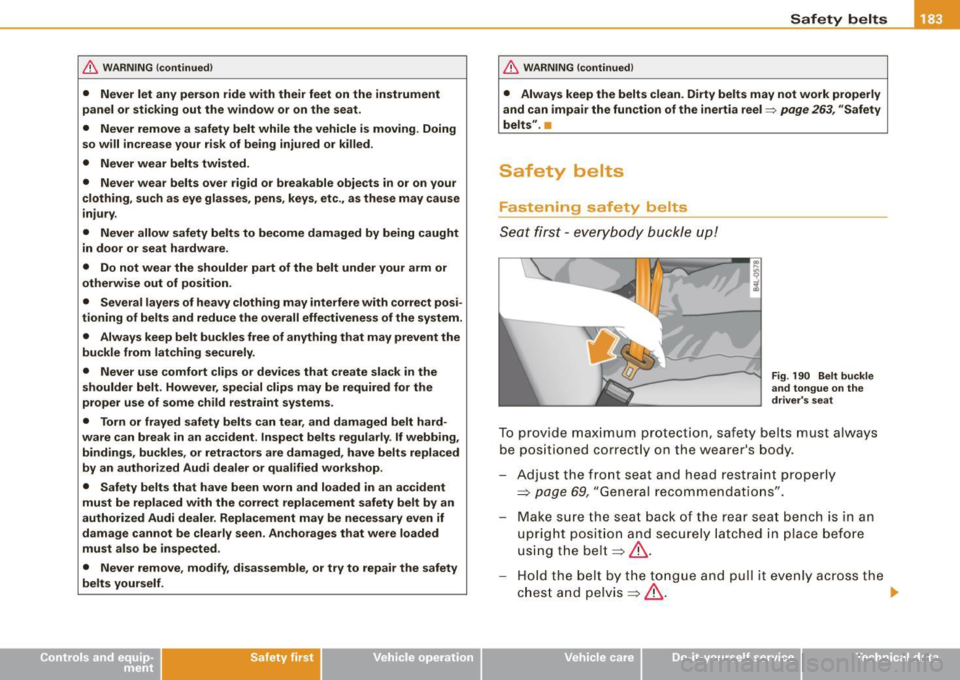
To provide maximum protection, safety belts must always
be positioned correctly on the wearer's body.
Adjust the front seat and head restraint properly
=> page 69, "General recommendations" .
Make sure the seat back of the rear seat bench is in an
upright position and securely latched in place before
using the belt
=> & .
Hold the belt by the tongue and pull it evenly across the
chest and pelvis
=> &. _,.
Vehicle care I I irechnical data
Page 186 of 360
___ S_a_ f_ e_ t-= y_ b_e_ l_ t _s _______________________________________________ _
-Insert t he tongue into the correct b uckle of y our seat
unt il you h ea r it la tc h securely~ fig. 190.
Pull on t he belt to make sure that it is securely latched in
the buckle.
Aut om ati c sa fe ty belt re tra cto rs
Eve ry safety be lt is equipped with an automatic belt retractor on the
shoulder belt. This feature locks the belt when the belt is pulled out
fast, during hard braking and in an accident. The belt may a lso lock
when you drive up or down a steep hill or through a sharp curve .
During normal driving the belt lets you move free ly.
Safety belt prete nsi oners
The safety belts are equipped with a be lt pretensioner that he lps to
tighten the sa fety be lt and remove slack when the pretensioner is
activated. The function of the pretensioner is monitored by a
warning light=>
page 14 .
Swit chable locking fe ature
Every safety belt except the one on the driver sea t is equipped with
a switchab le locking feature that
must be used when the safety belt
is used to a ttach a chi ld safe ty sea t. Be sure to read the important
information about this feature=>
page 223.
& WARNING
Improper ly positioned safet y belts can cause seriou s inj ury in an
accident =>
page 184 , "Safety belt po sitio n".
• Safet y belts offer opt imum protection on ly when the seat back
i s upright and belt s are properly po sition ed on t he bod y.
• Always make sure that the rear seat backrest to whi ch the
c enter r ear sa fet y belt i s atta ched i s sec ure ly lat ched whe nev er
the rear center saf ety belt i s being us ed. If the ba ckrest is not
s ecu rely lat ched, the pas senge r will mo ve fo rward with the back
rest dur ing sudden braking , in a sudden maneu ver and e spec iall y
in a cra sh.
& W AR N ING (continu ed )
• Never attach the safety belt to the buck le for anothe r seat .
Atta ch ing th e be lt to the wrong buckle will reduce safety belt
e ffe ctivenes s and can ca use seriou s per son al injur y.
• A p assenger who i s not prope rly re str ained can be s eriousl y
injured by the saf ety belt it self wh en it m ove s from the stronger
p art s of the body into criti ca l area s like the abd omen .
• Alway s lock the convert ible lo ck ing retractor when you are
s ecu ring a ch ild safety se at in the v ehi cle
=> page 2 25. •
Safety belt position
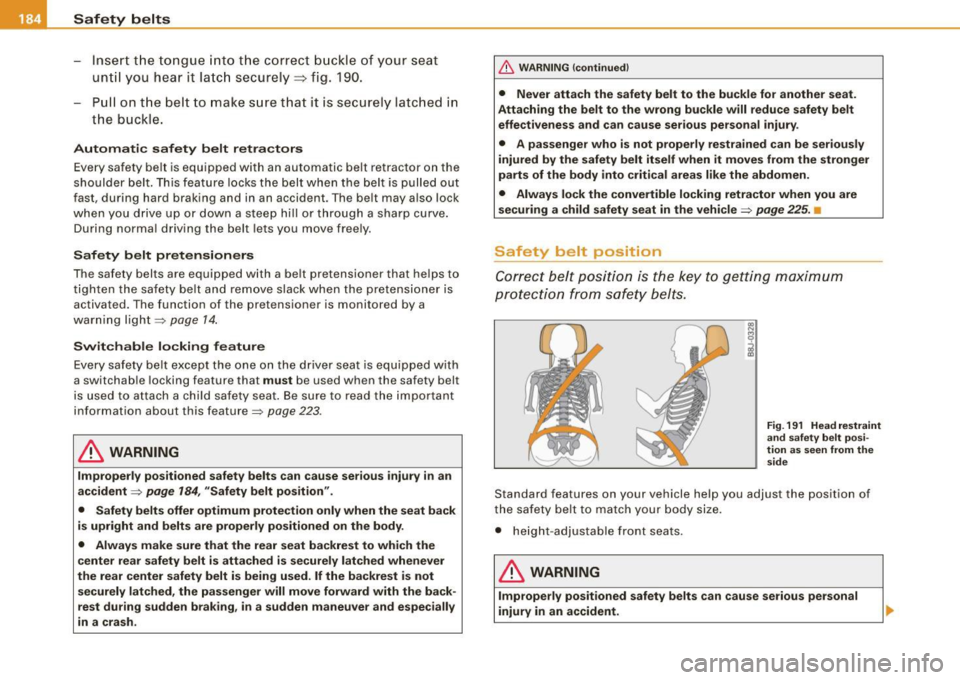
Correct belt posi ti o n is the key to getting maximum
protecti on f rom safety be lts.
Fig . 191 He ad r est ra in t
an d sa fe ty b elt p osi
tion a s seen from th e
sid e
Standard features on your vehicle help you adjust the position of
the safety belt to match your body size .
• height -adjustable front seats.
& WARNING
Improperly posit ioned safety belts can cau se seriou s pe rsonal
injury in an a ccident .
Page 244 of 360

llffl __ ln_ t _e_ ll-'"ig ...,_ e_ n_t _t_ e_ c_ h _ n_o _ l_o _,.g= y,_ __________________________________________ _
Take into consideration that when you unlock your vehicle, some
convenience functions, such as the remote key or power seat
adjustment, may not be available. The convenience functions will be
available again when you turn on the ignition and start the engine.
With the engine turned off
If you listen to the radio, for example, with the engine turned off or
use other MMI functions, the battery is being discharged .
If starting capability is jeopardized due to energy consumption, the
following warning appears in the MMI display :
Please start engine, otherwise system will switch off in
3 minutes.
The warning indicates that the system will be turned off automati
cally after 3 minutes. If you wish to continue using the functions,
you have to start the engine .
With the engine running
Although electrical energy is generated when the vehicle is being
driven, the battery can become discharged. This happens mostly
when little energy is being generated and a great deal consumed and the battery's state of charge is not optimal.
To bring the energy balance back into equilibrium, consumers
which require especially large amounts of energy are temporarily
cut back or switched off. Heating systems in particular require a
great deal of energy. If you notice, for example, that the heated
seats* or the heated rear window are not heating, they have been
temporarily cut back or switched off. These systems will be available
again as soon as the energy balance has been restored.
You will also notice that engine idle speed has been increased
slightly . This is normal and not a cause for concern. By increasing
engine idle speed the additional energy required is generated and
the battery is charged.
Driver not ification in the instrument cluster
d isplay
If battery power drops into the range where it can limit the ability of
the engine to start, this is shown in the instrument cluster display
with the following driver message:
'-' Low battery charge: battery will be charged while driving
This notification reminds you that the starting capability of the
engine may be limited. As soon as you start driving again, the
battery will be recharged and the notification will go out.
Driver notification appears and goes out again
If this driver notification appears after the ignition is turned on or
while driving and it goes out again after a while, the battery has
been adequately recharged.
Driver notification appears and does not go out again
If this driver notification appears after the ignition is turned on or
while driving and does not go out again, the battery's state of
charge is not in the optimal range . Starting ability is restricted . Have
the battery checked as soon as possible by an authorized Audi
dealer or qualified workshop. •