battery AUDI A5 COUPE 2011 User Guide
[x] Cancel search | Manufacturer: AUDI, Model Year: 2011, Model line: A5 COUPE, Model: AUDI A5 COUPE 2011Pages: 362, PDF Size: 84.88 MB
Page 66 of 362

Clear vision
With the door contact switch turned on, the interior lights turn on as
soon as you unlock the vehicle or open the doors. The lighting is also
turned on when the ignition key is removed. The lights go out about
30 seconds after the doors are closed. When the vehicle is locked or
when the ignition is turned on, the interior lights are turned off .
When a door is open, the interior lights are turned off after about 10
minutes to prevent draining of the battery.
The brightness of the lights is controlled automatically by a dimmer
when they are switched on and off. •
Rear interior lights
There are reading lights in the rear for the passengers.
,...
-0
0
"" 0:, a,
Fig. 57 Headliner:
Rear reading lights
The reading lights are switched on and off using the buttons ~~-•
Vision
Sun visors
Using the sun visors makes driving safer.
3
Fig. 58 Sun visor
The sun visors for the driver and passenger can be pulled out of their
brackets in the center of the vehicle and turned towards the the doors
~ fig. 58 (D.
Vanity mirror
The vanity mirrors on the sun visors are covered. When the lid is
opened @, the mirror light in the headliner turns on automatically.
It turns off when the lid is closed and the visor is folded up again. •
Page 94 of 362
Seats and storage
Cigarette lighter/outlet
Cigarette lighter
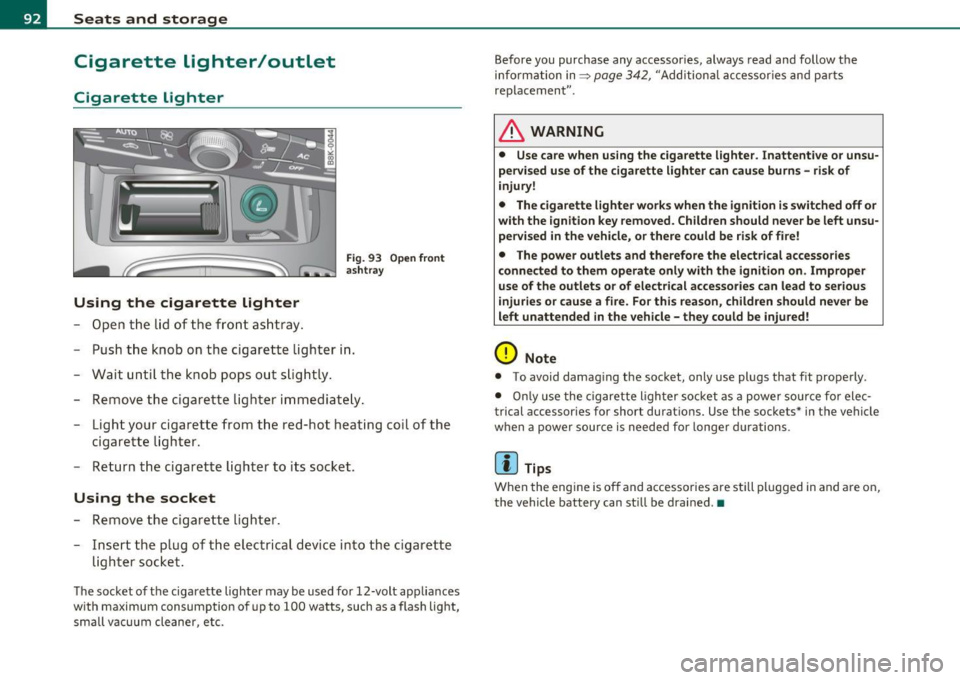
Using the cigarette lighter
-Open the lid of th e front ashtr ay.
Fig . 93 Open front
ash tray
- P ush t he kn ob on the cig are tte lig hter i n.
- Wa it until the knob p ops out s lig htly.
- R emove the ciga rett e lig hter immed iat ely.
- Ligh t yo ur cigaret te fro m t he red- hot heat in g coi l of the
ciga rett e li ghter.
- Return t he cigaret te ligh ter to its socket .
Using the socket
- Remove the cigarette light er.
- In ser t the p lug o f the elect rical d evice i nto the c iga re tt e
li g hter socke t.
The socket o f the cigare tte lighter may be used fo r 12-volt applia nces
with maximum consumption o f up to 100 watts, such as a flash light,
small v acuum cle aner, etc. Before you purchase any accessor
ies, always read and follow the
inf ormat ion in ~
page 342 , "Add it io nal acc esso ries and part s
replac ement" .
& WARNING
• Use care when using the cigarette lighte r. Inattentive or unsu
pervised u se of the cigarette lighter can cause burns - risk of
i njury!
• The cigarette lighter works when the ignition is switched off or
with the ignition key removed . Children should never be left unsu
pervised in the vehicle, or there could be risk of fire!
• The power outlets and therefore the electrical accessories
connected to them operate only with the ignition on. Improper
use of the outlets or of electrical accessories can lead to serious
injuries or cause a fire. For thi s rea son , children should never be
left unattended in the vehicle -they could be injured!
0 Note
• To avoid damag ing the socket, only use plugs that fit properly .
• O nly use the cig are tte ligh ter socket a s a powe r sou rce fo r elec
trical accessories for short durat ions . Use the sockets* in the v ehicle
w hen a powe r sou rce is needed fo r longe r d ur ations.
[ i ] Tips
W hen the eng ine is of f and accessories are sti ll p lu gged in and a re o n,
the vehicle battery can st ill be drai ned .•
Page 97 of 362
Warm and cold
Deluxe automatic climate control
Applies to vehicles : wit h deluxe automat ic climat e cont ro l
Description
The climate control system can be used to set a comfort
able temperature inside the vehicle.
The climate control system is a combination of a heating and ventila
tion system as well a cooling system responsible for dehumidifying
and cooling the air inside the vehicle.
Th e automatic climate control system automatically maintains a
temperature once it has been set. The temperature of the air from
the vents, fan speed (air volume) and air distribution are a lso auto
matically adjusted. The system also takes into account strong
sunlight so that manual adjustment is not necessary . So in almost all
cases,
automatic mode offers the best conditions for the comfort of
the occupants at all times of the year=>
page 97.
Please note the following :
The cooling mode lowers the humid ity level inside the vehicle. This
prevents fogging up of the windows.
In the case of high outside humidity and temperatures,
condensation
can drip from the air conditioning system evaporator and form a pool
under the vehicle . This is normal and not an indication of leaks!
At low outside temperatures, the fan automatically switches to a
higher speed when the coo lant reaches a sufficient temperature
except in the defroster position .
When starting with fu ll thrott le, the compressor of the automatic
climate control system is temporarily switched off to achieve full
eng ine power .
T o ensure engine cooling when the engine is under an extreme load,
the compressor is switched off at high coolant temperatures.
Controls and equip
ment Safety first
Warm and cold
Pollutant filter
The pollutant fi
lter (particle filter) ensures that impurities in the
outs ide air (e.g. dust, pollen) and odors are significantly reduced or
stopped . The air is also filtered in recirculation mode.
T he pollutant filter e lement must be changed at the intervals speci
fied in the service plan so that the performance of the automatic
climate contro l system is not impaired.
If the effectiveness of the filter dec reases prematurely due to opera
tion of the vehicle in areas with significant pollution, the filter
element must be changed between the specified service dates.
Key recognition
Th e cur rent automatic clima te control settings are automatically
stored and assigned to the master key.
Energy management
To prevent the battery from being discharged and to restore the
balance of energy, components which require large amounts of
energy are temporarily cut back or switched off=>
page 243. Heating
systems in particular require a great deal of energy. If you notice , for
example, that the rear window heater is not heating, then it has been
temporarily reduced or switched off by
energy management . These
systems are available again as soon as the energy balance has been
restored.
& WARNING
Traffic safety requires all window s to be clear of ic e, snow, and
condensation. Only then can good visibility be ensured . Famil
iarize yourself with the correct operation of the automatic climate
control system as well as the proper procedure for defog-
ging/defrosting the windows. _,.
Vehicle care Technical data
Page 104 of 362

1111....__w __ a _r_ m __ a_n_ d_ c_ o _ l_d _______________________________________________ _
your Audi Warranty & Maintenance book let . If in doubt, as k yo ur
a u tho rized Au di Serv ice Advisor for adv ice.
Key recognit ion
T he cur rent climate con trol settings are au tom atically s tored and
assigned to the remote key
Energy management
To prevent the battery from being discharged and to restore the
balance of energy, components wh ic h require large amo unts of
energy are temporarily cut back or sw itched off=>
page 243. Heating
systems in part icu lar req uire a g rea t dea l of energy. If you notice, for
example, that the rear window heater is not heating, then it has been
temporar ily c ut back or switched off by
ene rg y management. These
systems are available again as soon as the energy balance has been
restored .
& WARNING
Reduce d vi sibility is danger ous and can cause a ccident s.
• For safe dri ving it is very important that all windows be free of
ic e, snow and condensation .
• Completely fam iliar ize yourself with the prope r use and func
tion of th e heating and v entilation sy stem and esp eciall y how to
defog and defro st the w indows .
• Never use the wind shield wiper /wa sher system in fr eezing
we ather until you h ave warmed the windshield fir st, u sing the
heating and ventila tion syst em . The wa sher solution ma y free ze
on the win d shield and reduce visi bility.
0 Note
• If you suspect that the cl imate contro l system has been damaged,
switch the system off to avoid further damages, and have i t inspected
by a qua lified dealersh ip. •
Repairs to the Audi a ir conditioner require special techn ica l knowl
edge and special tools . Co ntact an a uth orized Audi dealer fo r assis
tance .
(I] Tips
• To avoid adversely affecting heating and cooling performance and
to prevent condensation on the windows, the air intake in front of the
w indshield must be free of ice, snow and leaves.
• Th e air flowing out of the vents and througho ut the veh icle's
entire inter ior is discharged at the rea r of the vehicle . Make su re that
the o utlet s lots are not covered by clothing, etc.
• Climate control works most effective ly if the windows and the
panoramic sliding/tilt ing sunroof * are closed. However, if the interior
of a parked vehicle is extremely hot from the sun, briefly opening the
windows can speed up the cooling process. •
Page 159 of 362
__________________________________________________ T_ ra_ n_s_ m __ is_s_ i_ o_ n _ ___.fflll
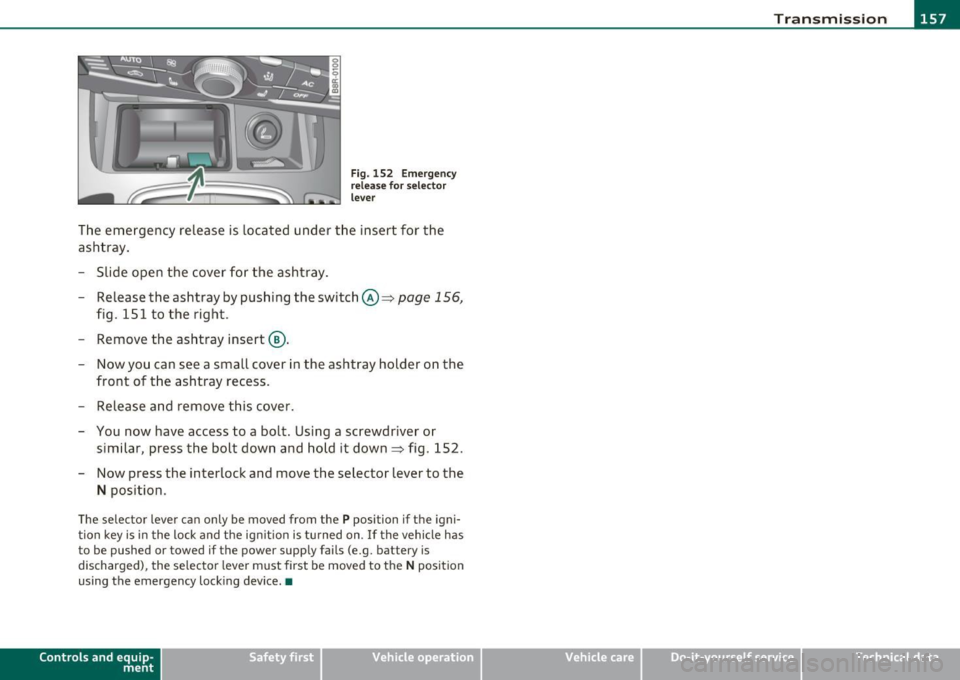
Fig. 152 Emergency
r elease for se lector
lever
The emergency release is located under the insert for the
ashtray .
- Slide open the cover for the ashtray .
- Release the ashtray by pushing the switch©=>
page 156,
fig. 151 to the right.
- Remove the ashtray insert @.
- Now you can see a small cover in the ashtray holder on the
front of the ashtray recess.
- Release and remove this cover.
- You now have access to a bolt. Using a screwdriver or similar, press the bolt down and hold it down=> fig. 152.
- Now press the interlock and move the selector lever to the
N position .
The selector lever can only be moved from the P position if the igni
tion key is in the lock and the ignit io n is tur ned on. If the vehicle has
to be pushed or towed if the power supply fails (e.g. battery is
discharged), the selector lever must first be moved to the
N position
using the emergency locking device .•
Con tro ls a nd e quip
m en t Vehicle
OP-eration Vehicle care Do-it-yourselt service iTechnical data
Page 207 of 362
______________________________________________ ___:.A:::::.:.: ir:....: b~ a~g !....= s:ly '..:s~ t~ e~ m~ ---
& WARNING (co ntinued )
• Always make sure that the side airbag can inflate without
interference:
-Never install se at covers or replacement upholstery over the
front seatbacks that have not been specifically approved by
Audi .
- Never use additional seat cushions that cover the areas
where the side airbags inflate .
- Damage to the original seat covers or to the seam in the area
of the side airbag module must always be repaired immedi
ately by an authorized Audi dealer.
• The airbag sy stem can be activated only once. After an airbag
has inflated, it must be replaced by an authorized Audi dealer or
qualified technician who has the technical information , training
and special equipment necessary.
• The airbag sy st e m can be deployed only onc e. After an airbag
has been deployed, it must be replaced w ith new replacement
parts de signed and approved es pecially for your Audi model
version . Replacement of complete airbag systems or airbag
components must be performed by qualified workshops only.
Make sure that any airbag service action is entered in your Audi
Warranty
& Maintenance booklet under AIRBAG REPLACEMENT
RECORD.
• In accidents when an airbag is deployed, the vehicle battery
separates the alternator and the starter from the vehicle electrical
system for safety reason s with a pyrotechnic circuit interrupter.
- Work on the pyrotechnic circu it interrupter must only be
performed by a qualified dealer -risk of an a ccident!
- If the vehicle or the circu it interrupter is scrapped, all appli
cable safety precautions must be followed .
Controls and equip ment Safety first Vehicle operation
'£' For the sake of the environment
U
ndeployed airbag modules and pretens io ners mig ht be classified as
Perch lorate Material -special handling may app ly, see
www.d ts c. ca.gov/ha za rdouswaste/pe rchlorate . W he n t he vehicle or
parts of the restraint system includi ng a irbag modules safety belts
w ith pretens io ners are s crappe d, all ap plic abl e laws and reg ulat ion s
must be observed. Your author ized Aud i dealer is familiar with these
req uir ements and we recommen d that yo u have yo ur dea le r pe rform
this service for you .•
Other things that can affect Advanced
Airbag performance
Chang ing the ve hicle's suspension system can change the way that
t he Adv anced Airbag System pe rforms in a crash . For example, using
tire-r im combinations not approved by Aud i, lower ing the veh icle,
c hang ing the st iffness o f the suspe nsio n, incl uding the s prings,
s u spension str uts, shoc k absorbe rs etc. can change the forces that
are meas ured by the airb ag sensors and sen t to the ele ctron ic con trol
uni t. Some suspension changes ca n, for examp le, increase the force
levels measu red by t he sensors and ma ke the airbag system dep loy in
crashes in which it wou ld not deploy if the changes had not bee n
made . Other kin ds of changes may re duce the force levels meas ured
by the senso rs and p revent the airbag from dep loyi ng when it should .
The sensors in the safety belt buckle for the d river and front
p assenger se at tell the e le ct ro nic co ntro l mo dule if the sa fe ty belt is
latc hed or not . If the safety be lt is be ing used, the fron t airbag w ill
dep loy at a s ligh tly hig her ra te o f ve hicl e decelerat io n t han if the
safety belt is not be ing used. T he refo re, in a part icular collis io n, it is
poss ible that an a irbag wi ll not deploy at a seating posit ion where the
safety belt is being used but wi ll inflate at the posi tion whe re the
safety belt is not bei ng used. It is important that not hing interfere
w ith the s afe ty be lt bu ckles so t hat th e sensor s can sen d the correct
information about safety belt use to the electronic contro l unit. ..
Vehicle care Do-it-yourself service Technical data
Page 245 of 362
Intelligent technology
--------------------------------------------------' "---.L==--
Repl acing wheel s/tires
Vehicles wi th all wheel drive must a lways have tires of t he same size.
Also avoid tires with different tread depths. For details see page
=> page 303, "New tires and rep lacing tires and wheels".
Off -Road driving?
Your Audi does not have enough ground clearance to be used as an
off-road veh icle . It is therefore best to avo id ro ugh tracks and uneven
terrain as m uch as possible . Also refer to=>
page 247.
& WARNING
Alway s adju st your driving to road and traffi c conditi ons. Do not
let the ex tra safety afforded by all wheel dr ive tempt you into
taking extra risks.
• Although the all wheel dri ve is ve ry effecti ve, always
remember that braking capacity is limited by tire traction. You
should therefore not dri ve at ex cessive speeds on icy or slippery
road surfaces .
• On wet road surfaces , be careful not to drive too fast because
the front wheel s could begin to slide on top of the water (aqua
planing ). If th is should occur, you will have no warning from a
sudden increase in engine speed as with a front-wheel drive
vehicle. Always drive at speeds which are suited to the road cond i
tions -ris k of crash.
n
Controls and equip
ment Safety first Vehicle operation
Energy management
Starting ability is optimized
E
nergy management contr ols th e distributi on of elec
tri cal energy and thus optimizes the availabili ty of elec
tri cal energ y for star ting the engin e.
If a vehicle with a conventiona l energy system is not dr iven for a long
per io d of time, t he battery is di sch arged by idling cur rent consume rs
(e .g. immob il izer) . In certain c ircumstances it can result in there
being insuffic ien t energy av a ilab le to start t he eng ine .
Inte lligent energy management in your ve hicle hand les the d istribu
tion of e lectrical energy . Starting ability is ma rkedly improved and
the l if e of the battery is extended.
Bas ically, energy management consists of
battery d iagnos is, idling
current management
a nd dynamic energy management .
Battery diagnosis
Battery d iagnosis con tinuously dete rmines the st ate o f the batte ry.
Sensors determ ine battery vo ltage, battery current and battery
t empe ra ture. This de termine s the cur rent sta te of cha rge and the
power of the battery.
Idling current management
I d ling current management reduces energy consumption wh ile the
vehicle is s tanding. W ith t he igni tion swi tched off, it con trols the
energy supply to the var io us electrical components. Data from
b att ery diag nosis is considered .
Depend ing on the battery 's state of charge, individual consumers a re
gradually t urned off to p revent excessive discha rge of the battery and
thus main tain start ing capab ility.
Dynamic energy management
Whi le the vehicle is being dr iven , dynamic energy management
dis tributes the energy generated a cco rding to the needs o f th e in di-
Vehicle care Do-it-yourself service Technical data
Page 246 of 362
Intelligent technology
'-------------------------------------------------
vi dual components. It regulates consumption, so that more electrical
energy is not being used than is being generated and ensures an
optimal state of charge for the battery .
[I] Tips
• But even energy management cannot negate the limits of physics.
Consider that the power and life of a battery are limited.
• If starting ability is threatened, you are informed by a warning
~ page 245, "Driver notification in the instrument cluster display" .•
What you should know
The highest priority is given to maintaining starting capa
bility.
Th e battery is severe ly taxed in short-distance driving, in city traffic
and during the cold time of year. Abundant electrical energy is
required, but only a little is generated.
It is also critical if the engine
is not running and electrical components are turned on. In this
instance energy is being consumed but none is being generated.
It is in prec ise ly these sit uations that you will notice energy manage
ment actively regulating the distribution of energy.
Vehicle stands for an extended period
If you do not drive your vehicle over a period of several days or weeks,
electrical components are gradually cut back or sw itched off. This
reduces energy consumption and maintains starting capability over a
longer period.
Take into consideration that when you unlock your vehicle, some
convenience functions, such as the remo te key or power seat adjust
ment, may not be available. The convenience functions will be avail
able again when you turn on the ignition and start the engine.
W ith the engine turned off
If you listen to the radio, for example, with the engine turned off or
use other MMI functions, the battery is being discharged .
If starting capability is jeopardized due to energy consumption, the
following warning appears in the MMI display:
Please start engine, otherwise system will switch off in
3 minutes.
Th e warn ing indicates that the system will be turned off automati
cally after 3 m inutes. If you wish to continue using the functions, you
have to start the engine.
With the engine running
Although electrica l energy is generated when the vehicle is being
driven, the battery can become discharged. This happens most ly
when little energy is being generated and a great deal consumed and
the battery's state of charge is not optimal.
T o br ing the ene rgy balance back into equilibrium, consumers which
require especially large amounts of energy are temporarily cut back
or switched off. Heating systems in particular require a great deal of
energy .
If you notice, for example, that the heated seats* or the
heated rear window are not heating, they have been temporarily cut
back or switched off. These systems will be ava ilable again as soon as
the energy ba lance has been restored.
You will also notice that engine idle speed has been increased
slightly. This is normal and not a cause for concern. By increasing
eng ine id le speed the additional energy required is generated and the
battery is charged. •
Page 247 of 362
Intelligent technology
--------------------------------------------------' '----'----
Driver notification in the instrument
cluster display
If battery power drops into the range where it can limit the ability of
the engine to start, this is shown in the instrument cluster display
with the following driver message:
Lo w b attery charge : batt ery will be charged while driving
Th is notification rem inds you that the starting capability of the
engine may be limited . As soon as you start driving again, the batte ry
w ill be recharged and the notification w ill go out.
Dri ver notification appears and goes out again
If th is dr iver notification appears after the ignition is turned o n or
while driving a nd it goes out again afte r a w hile, the battery has been
adequate ly recharged.
Driver no tification appears and does not go out
again
If th is dr iver notifica tion appears afte r the ignition is turned o n or
while driving and does not go out again, the battery 's state of charge
is not in the optimal range . Starting ability is restricted. Have the
battery checked as soon as poss ible by an au thor ized Aud i dea le r o r
qualified workshop. •
Controls and equip ment Safety first Vehicle operation
Vehicle care Do-it-yourself service Technical data
Page 277 of 362

Checking and filling Ill
-------------~--
Closing the engine hood
- Pull the hood down until the pressure from the struts is
reduced.
- Let the hood
drop down and latch in place. Do not try to
push it shut;
it may fail to engage=:> &.
& WARNING
A hood that is not completely latched could fly up and block your
view while driving.
• When you close the engine hood, check it to make sure the
safety catch has properly engaged. The hood should be flush with
the surrounding vehicle body parts.
• If you notice while driving that the hood is not secured prop
erly, stop at once and close it. •
Working in the engine compartment
Be especially careful whenever you work in the engine
compartment.
Whenever you must perform any work in the engine compartment,
for example checking and filling different fluids, there is a risk of injury, burns and accidents. To prevent personal injury always
observe the following WARNINGS. The engine compartment of any
vehicle is a hazardous area=>& .
& WARNING
To help avoid injury, before you check anything under the hood:
• Turn off the engine.
• Remove the ignition key.
• Apply the parking brake.
Safety first
& WARNING (continued)
• Move selector lever of automatic transmission to "P" (Park);
put manual transmission in Neutral.
• Always let the engine cool down. Hot components will burn
skin on contact.
• To reduce the risk of being burned, never open the hood if you
see or hear steam or coolant escaping from the engine compart
ment. Wait until no steam or coolant can be seen or heard before
carefully opening the hood.
• Keep children away from the engine compartment.
• Never spill fluids on hot engine components. They can cause a
fire.
• Never touch the radiator fan. The auxiliary electric fan is
temperature controlled and can switch on suddenly.
• Never open the coolant reservoir cap when the engine is still
warm. The coolant system is pressurized and hot coolant could
spray out.
• Protect your face, hands and arm from steam or hot engine
coolant by placing a thick rag over the cap when you open the
coolant reservoir.
• If work on the fuel system or the electrical system is necessary:
-Always disconnect the battery.
- Never smoke or work near heaters or open flames. Fluids in
the engine compartment could start a fire.
- Keep an approved fire extinguisher immediately available.
• To avoid electrical shock and personal injury while the engine is
running or being started, never touch:
-Ignition cables
- Other components of the high voltage electronic ignition
system.
• If you must perform a check or repair with the engine running: ..,
Vehicle care Technical data