ABS AUDI A5 COUPE 2012 User Guide
[x] Cancel search | Manufacturer: AUDI, Model Year: 2012, Model line: A5 COUPE, Model: AUDI A5 COUPE 2012Pages: 316, PDF Size: 78.59 MB
Page 157 of 316
Why safety belts?
Frontal collisions and the law of physics
Frontal crashes create very strong forces for
people riding in vehicles .
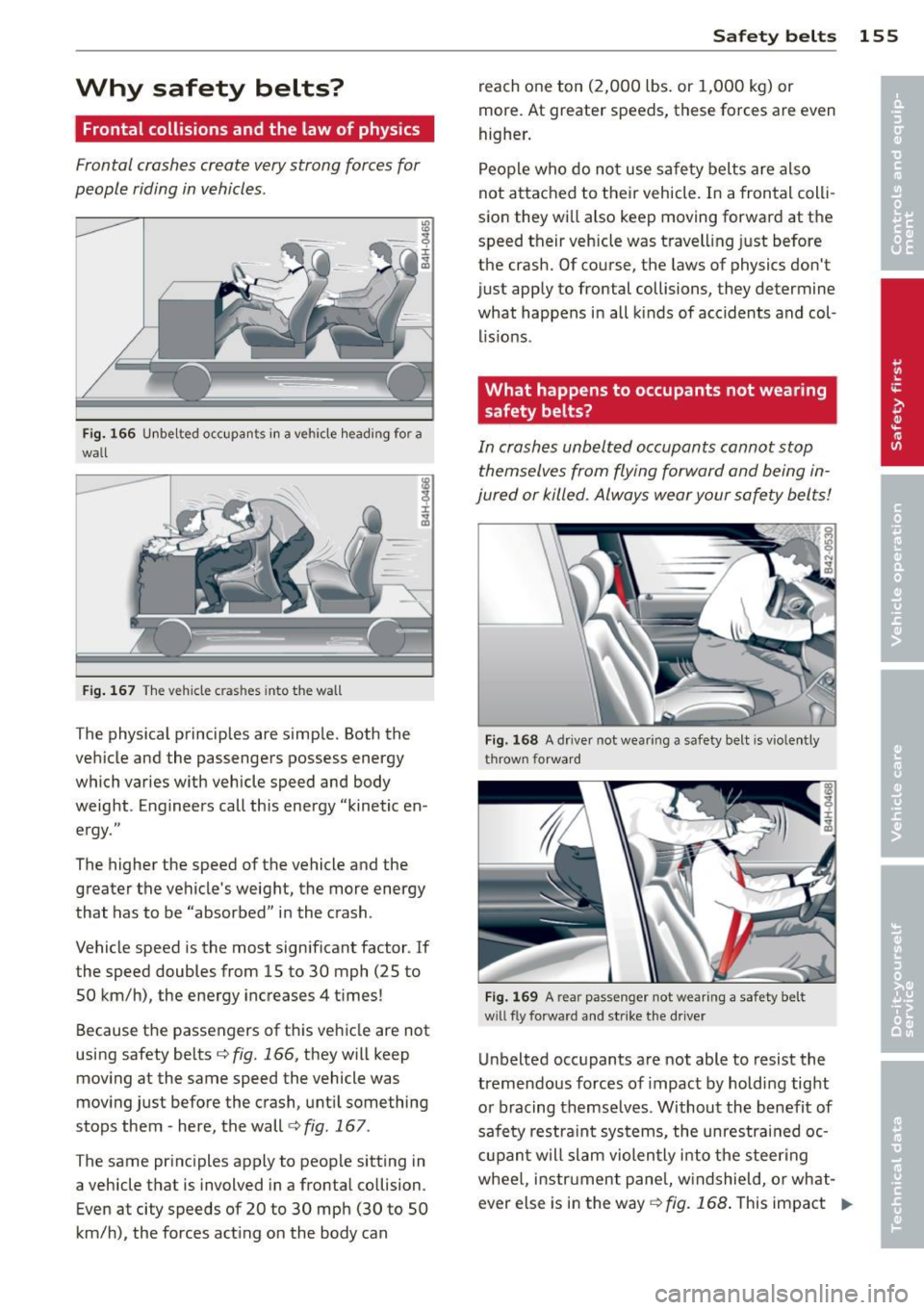
Fig. 166 U nbe lted occupa nts in a ve hicle hea ding for a
wall
F ig. 167 T he ve hicle c ras hes into t he wall
The physical principles are simp le. Both the
ve hicle and the passengers possess energy
which varies w ith vehicle speed and body
weight . Enginee rs call this energy "kinetic en
e rgy ."
The higher the speed of the vehicle and the greater the vehicle 's weight, the more energy
that has to be "absorbed" i n the crash .
Vehicle speed is the most sign ificant factor . If
the speed doubles from 15 to 30 mph (25 to
50 km/h) , the energy inc reases 4 t imes !
Because t he passengers of t his ve hicle are not
using safety belts
r::;, fig . 166, they w ill keep
moving at the same speed the vehicle was
mov ing just before the crash, unt il something
stops them -here, the wall
c:> fig . 167 .
The same pr inc iples apply to peop le sitting in
a vehicle that is involved in a frontal co llision .
Even at city speeds of 20 to 30 mph (30 to 50
km/h), the forces act ing on the body can
Safety belts 155
reach one ton (2,000 lbs . or 1,000 kg) or
more . At greater speeds, these forces are
even
higher .
People who do not use sa fe ty belts are also
not attached to their vehicle. In a frontal coll i
sio n they wi ll also keep moving forward at the
speed their veh icle was t ravell ing just before
the crash. Of co urse, the laws of physics don't
just app ly to frontal collisions, they determine
what happens in all kinds of acc idents and col
lis ions .
What happens to occupants not wearing
safety belts?
In crashes unbelt ed o ccupants cannot stop
themselves from flying forward and being in
jured or killed. Always wear your safety belts!
Fig. 168 A driver not wear ing a safety belt is vi ole ntl y
thrown forwa rd
Fig. 1 69 A rear passeng er not w ear ing a safety be lt
w ill fly forwar d and s trike the d river
Unbelted occ upants a re not able to resist the
tremendous forces of impact by holdi ng tight
or bracing themselves . Without the benefit of
safe ty restra in t systems, the unrestrained oc
cupan t w ill slam violen tly i nto the s teer ing
whee l, instr ument pane l, w indshield, o r what
ever else is in the way ¢ fig. 1 68 . This impact Ill-
Page 158 of 316
156 Safety belts
with the vehicle interior has all the energy
they had just before the crash. Never rely on airbags alone for protection.
Even when they deploy, airbags provide only
additional protection. Airbags are not sup
posed to deploy in all kinds of accidents. Al
though your Audi is equipped with airbags, all
vehicle occupants, including the driver, must
wear safety belts correctly in order to mini mize the risk of severe injury or death in a
crash.
Remember too, that airbags will deploy only
once and that your safety belts are always
there to offer protection in those accidents in
which airbags are not supposed to deploy or when they have already deployed . Unbelted
occupants can also be thrown out of the vehi
cle where even more severe or fatal injuries
can occur.
It is also important for the rear passengers to
wear safety belts correctly. Unbelted passen
gers in the rear seats endanger not only them
selves but also the driver and other passen
gers <=>
fig. 169. In a frontal collision they will
be thrown forward violently, where they can
hit and injure the driver and/or front seat pas
senger.
Safety belts protect
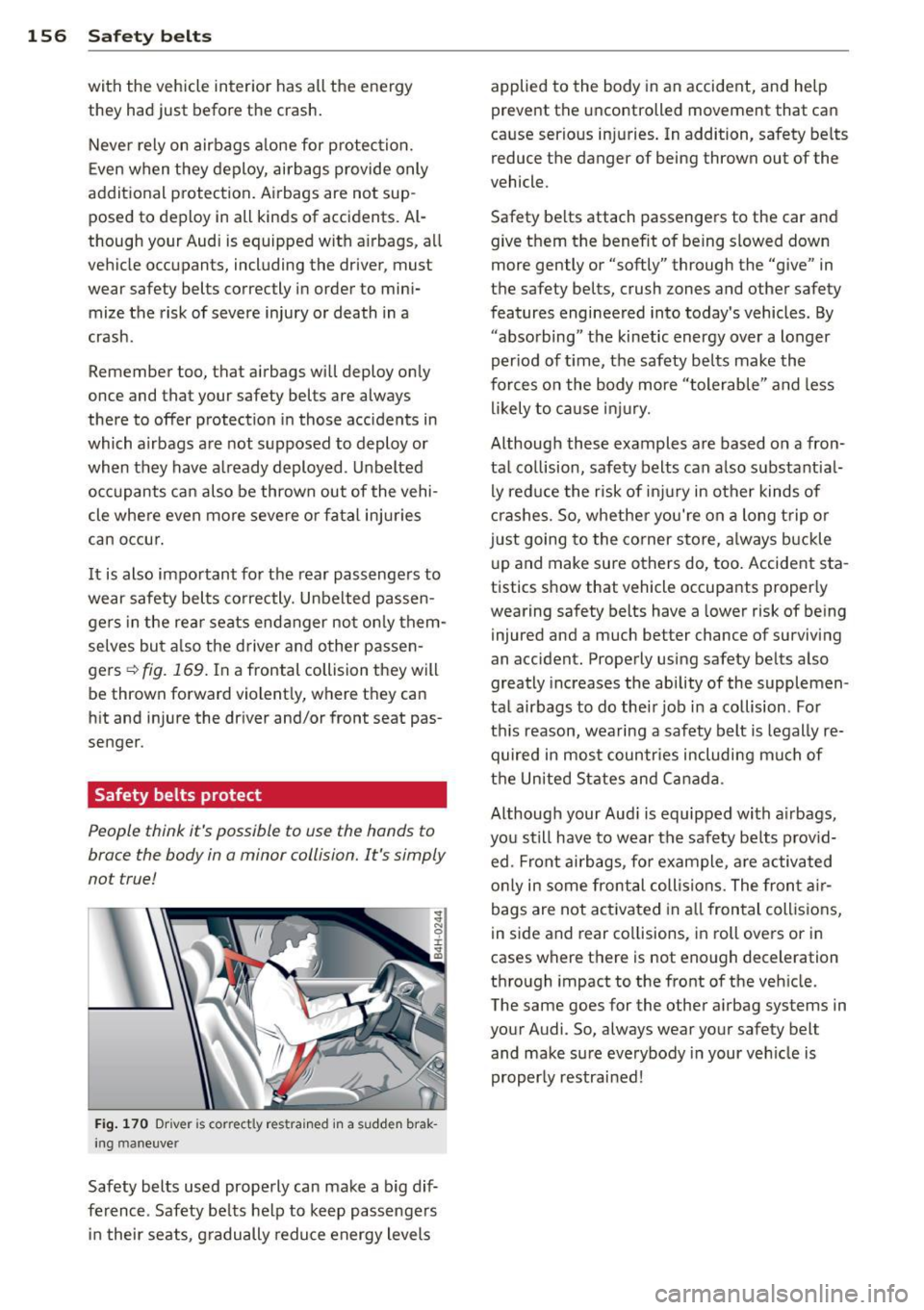
People think it's possible to use the hands to
brace the body in a minor collision. It's simply
not true!
Fig. 170 Drive r is co rrect ly res trained in a sudden brak
ing maneuve r
Safety belts used properly can make a big dif
ference . Safety belts help to keep passengers
in their seats , gradually reduce energy levels applied to
the body in an accident, and help
prevent the uncontrolled movement that can
cause serious injuries. In addition, safety belts
reduce the danger of being thrown out of the
vehicle .
Safety belts attach passengers to the car and give them the benefit of being slowed down
more gently or "softly" through the "give" in
the safety belts, crush zones and other safety
features engineered into today's vehicles. By
"absorbing" the kinetic energy over a longer
period of time, the safety belts make the
forces on the body more "tolerable" and less
likely to cause injury.
Although these examples are based on a fron
tal collision, safety belts can also substantial ly reduce the risk of injury in other kinds of
crashes. So, whether you're on a long trip or
just going to the corner store, always buckle
up and make sure others do, too. Accident sta
tistics show that veh icle occupants properly
wearing safety belts have a lower risk of being
injured and a much better chance of surviving
an accident. Properly using safety belts also
greatly increases the ability of the supplemen
tal airbags to do their job in a collision. For
this reason, wearing a safety belt is legally re
quired in most countries including much of
the United States and Canada .
Although your Audi is equipped with airbags,
you still have to wear the safety belts provid
ed . Front airbags, for example , are activated
only in some frontal collisions. The front air
bags are not activated in all frontal collisions,
in side and rear collisions, in roll overs or in
cases where there is not enough deceleration
through impact to the front of the vehicle.
The same goes for the other airbag systems in
your Audi. So, always wear your safety belt and make sure everybody in your vehicle is
properly restrained!
Page 168 of 316
166 Airbag system
-Never place additiona l items on the seat
that can increase the total weight regis
tered by the weight-sensing mat and can
cause injury in a crash.
Front airbags
Description of front airbags
The airbag system can provide supplemental
protection to properly restrained front seat
occupants.
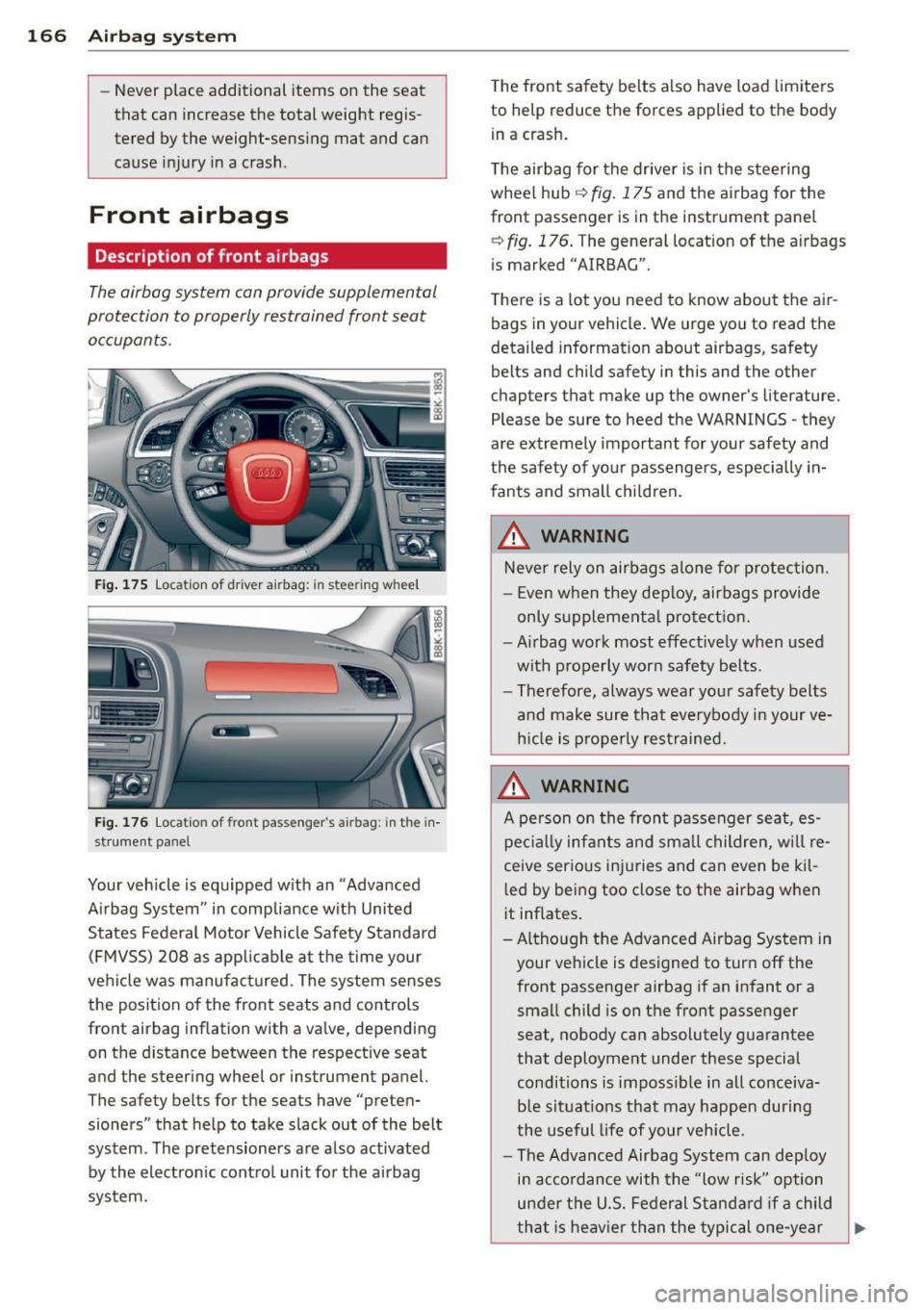
F ig . 175 Location of driver airbag: in steer ing whee l
Fig. 176 Location of front passenger's airbag: in the in
strument panel
Your veh icle is equipped with an "Advanced
A irbag System" in compliance with United
States Federal Motor Vehicle Safety Standard ( FM VSS) 208 as app licab le at the time your
ve hicl e was manufac tured. The system senses
the position of the front seats and controls
front airbag inflation with a valve, depending
on the distance between the respect ive seat
and the steering wheel or instrument panel.
The safety belts for the seats have "preten
sioners" that he lp to take slack out of the belt
system . The pretensioners a re also activated
by the electron ic cont ro l unit for the ai rbag
system. T
he front safety belts also have load limiters
to help reduce the forces applied to the body
i n a crash .
T he airbag for the drive r is in the stee ring
whee l hub¢
fig. 175 and the airbag for the
front passenger is in the instrument panel
~ fig. 176. The general locat ion of the a irbags
is marked "AIRBAG".
T here is a lot you need to know about the ai r
bags in your vehicle. We urge you to read the
detailed information about airbags, safety
belts and child safety in this and the other
chapters that make up th e owner's literature.
P lease be sure to heed the WARNINGS -they
are extremely importa nt for your safety and
the safety of your passengers, especially in
fants and small chi ldren.
_&. WARNING
Neve r rely on airbags alone for p rotection.
- Even w hen they deploy, airbags provide
only s upplement al pro te ctio n.
- Airbag work most effect ive ly when used
with p roperly wor n safety bel ts.
- Therefore, always wea r you r safety belts
a nd make sure tha t eve rybody in your ve
h icle is properly res trained.
_&. WARNING
A pe rson on the front passenger seat, es
pe cial ly infa nts and sm all ch ildren, w ill re
ceive serio us inju ries and can even be kil
l ed by being too close to the airbag when
it inflates .
- Although t he Advanced Airbag System in
your veh icle is designed to tur n off the
front passenger airbag if an infant or a
small child is on the front passe nger
seat, nobody can absolutely guarantee
that deployment under these special
conditions is imposs ible in all conceiva
b le sit uat ions that may happen dur ing
the useful life of your vehicle.
- The Advanced Airbag System can dep loy
i n acco rdance with the "low risk" option
unde r the U.S . Feder al Standa rd if a child
th at is heav ie r than the typical one -year
-
.
Page 170 of 316
168 Airbag sys tem
For exa mple , the ai rb ag ma y depl oy if:
-a small child that is heavier than a typical 1
year-o ld child is on the front passenger seat
(regardless of whe ther the child is in one of
the chi ld safety seats listed
¢ page 188),
-a ch ild who has outg rown child rest raints is
on the front passenger seat.
If the front passenger airbag is turned off, the
PA SSENGER AIR BAG OFF light in the cente r
of the instrument panel w ill come on and stay
on.
The front a irbag on the passenger side may
not deploy (the PAS SENGER AIR BAG OFF
light does not ill uminate and stay lit) if:
- a small adult or teenager is on the front pas
senger seat
- a passenger who is not sitt ing upright wit h
their back against a non-reclined backrest
with their feet on the veh icle floo r in front
of the seat is on the front passenger seat.
If the front passenge r airbag deploys, the
Federal Standard requires the airbag to meet
the "low risk" deployment criteria to help re
d uce the risk of inj ury through interaction
with the airbag. " Low risk" deployment occurs
in those crashes that take place at lower de
celerations as defined in the e lectronic control
un it.
¢ page 173
Alw ays remember : Even though you r vehicle
is equipped with Advanced Airbags, the safest
p lace for children is properly restrained on the
back seat . Please be sure to read the impor
tant information in the sect ions that follow
and be sure to heed a ll of the WARNINGS.
A WARNING
To reduce the risk of injury when an airbag
inf lates, always wear safety belts properly.
- If you are unrestrained, lean ing forward,
sitting sideways or out of position in any
way, your risk of in jury is much higher.
- You w ill also receive serious injuries and
cou ld even be killed if you are up against
the a irbag or too close to it when it in- f
lates - even with an Advanced A irbag
¢page 162.
A WARNING
-A child in a rearward-fac ing ch ild safety
seat installed on the front passenger seat
will be serious ly injured and can be killed if
the front airbag inflates - even with an Ad
vanced A irbag System .
- Although the Advanced Airbag System in your veh icle is designed to turn off the
front airbag when a rearward-facing child restraint has been instal led on the
front passenger seat, nobody can abso
lutely g uarantee that dep loyment is im
possible in all conceivable situations that
may happen during the usefu l life of your
veh icle.
- The inflating airbag will hit the c hild
safety seat or infant carrier with great
force and will smash the child safety seat
and child aga inst the backrest, center
armrest, door, or roof.
-Always install rearward -facing ch ild re
straints in the back seat.
- If you must install a rearward fac ing
child safety seat on the front passenger
seat because of exceptiona l circumstan
ces and the
PASSENGER AIR BAG OFF
light does not come on and stay on, im
mediately insta ll th e rear-fac ing c hild
safety sea t in a rear seating position and
have the airbag system inspected by your
authorized Audi dealer .
A WARNING
If, in exceptional circumstances, you m ust
insta ll a forward -facing child restraint on
the front passenger's seat:
- Always make sure the forward-facing
seat has been designed and certified by
its manufacturer for use on a front seat
with a passenger front and s ide a irbag.
- Never p ut the forward-facing child re
straint up against or very near the instru-
ment panel.
~
Page 179 of 316
dealer is familiar with these requirements
and we recommend that you have your
dealer perform this service for you.
Other things that can affect Advanced
Airbag performance
Changing the vehicle's suspension system can
change the way that the Advanced Airbag Sys
tem performs in a crash. For example, using
tire-r im combinations not approved by Audi,
lowering the vehicle, changing the stiffness of
the suspension, including the springs, suspen
sion struts, shock absorbers etc. can change
the forces that are measured by the airbag sensors and sent to the electronic control
unit. Some suspension changes can, for exam
ple, increase the force levels measured by the
sensors and make the airbag system deploy in
crashes in which it would not deploy if the
changes had not been made . Other kinds of
changes may reduce the force levels meas
ured by the sensors and prevent the airbag
from deploying when it should .
The sensors in the safety belt buckle for the
d river and front passenger seat tell the elec
tronic control module if the safety belt is
latched or not. If the safety belt is being used,
the front airbag will deploy at a slightly high
er rate of vehicle deceleration than if the safe
ty belt is not being used. Therefore, in a par
ticular collision, it is possible that an airbag
will not deploy at a seating position where the safety belt is being used but will inflate at the
position where the safety belt is not being
used. It is important that nothing interfere
with the safety belt buckles so that the sen
sors can send the correct information about
safety belt use to the electronic control unit.
.&_ WARNING
Changing the vehicle 's suspension includ
ing use of unapproved tire-rim combina
tions can change Advanced Airbag per
formance and increase the risk of serious personal injury in a crash.
- Never install suspension components
that do not have the same performance
Airbag system 177
characteristics as the components origi
nally installed on your vehicle .
- Never use tire-rim combinations that
have not been approved by Audi.
.&_ WARNING
= -
Items stored between the safety belt buckle and the center console can cause
the sensors in the buckle to send the
wrong information to the electronic con
trol module and prevent the Advanced Air bag System from working properly.
-Always make sure that nothing can inter-
fere with the safety belt buckles and that
they are not obstructed.
Knee airbags
Description of knee airbags
Applies to vehicles: wit h knee airbags
The knee airbag system can provide supple
mental protection to properly restrained
front seat occupants.
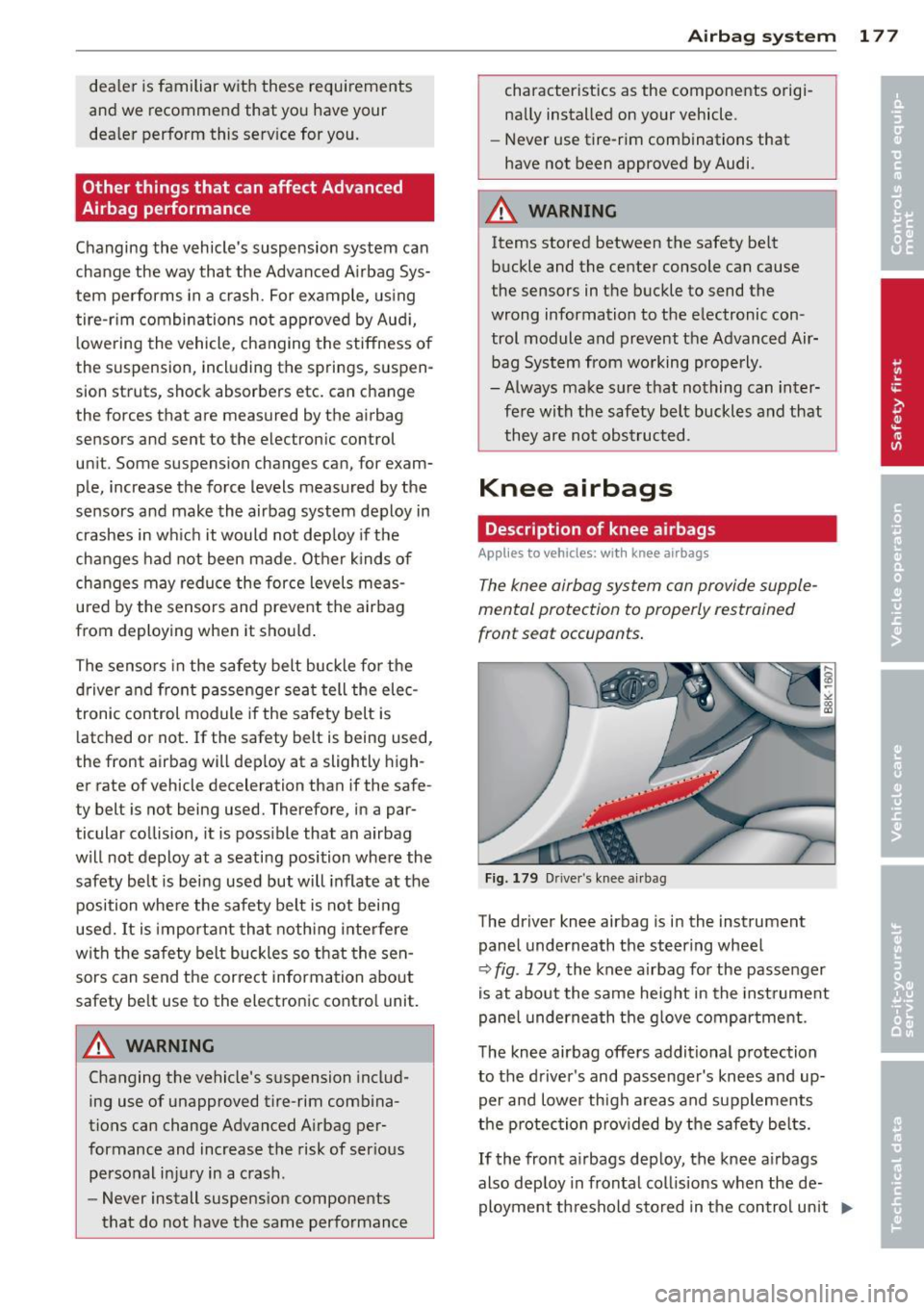
Fig. 179 Driver 's knee airbag
The driver knee airbag is in the instrument
panel underneath the steering wheel
Q fig . 179, the knee airbag for the passenger
is at about the same height in the instrument
panel underneath the glove compartment .
The knee airbag offers additional protection
to the driver's and passenger's knees and up
per and lower thigh areas and supplements
the protection provided by the safety belts.
If the front airbags deploy, the knee airbags
also deploy in frontal collisions when the de ployment threshold stored in the control unit
I),-
Page 206 of 316
204 Intelligent technology
Intelligent technology
Notice about data
recorded by vehicle
control modules
Your veh icle is not equipped with an Event Da
ta Recorder (EDR), installed by some manu
facturers fo r the express purpose of capturing
data for retrieval after an accident or crash
event. EDR's are sometimes called "crash re
corders".
Some state laws restrict the retrieval or down
loading of data stored by EDR's that were in
stalled in a vehicle for the express purpose of retrieving data after an accident or crash
event without the owner's consent.
Although your vehicle is not equipped with an
EDR, it is equipped with a number of electron
ic control modules for various vehicle systems
such as, for example, engine function, emis
sion control, as well as for the airbags and
safety belts .
These electronic control modules also record
vehicle-related data during normal vehicle op
eration for diagnostic and repair purposes .
The recording capacity of the electronic con
trol modules is limited to data (no sound is re
corded) and only a small amount of data is ac
tually recorded over a very limited pe riod of
time and stored when a system fault or other condition is sensed by a control unit. Some of
the data then stored may relate to vehicle
speed, direction, braking as we ll as restraint
system use and performance in the event of a
crash or other condition. Stored data can only be read and downloaded with special equip
ment .
Electronic stabilization
Program (ESP)
General information
The ESP improves the vehicle stability .
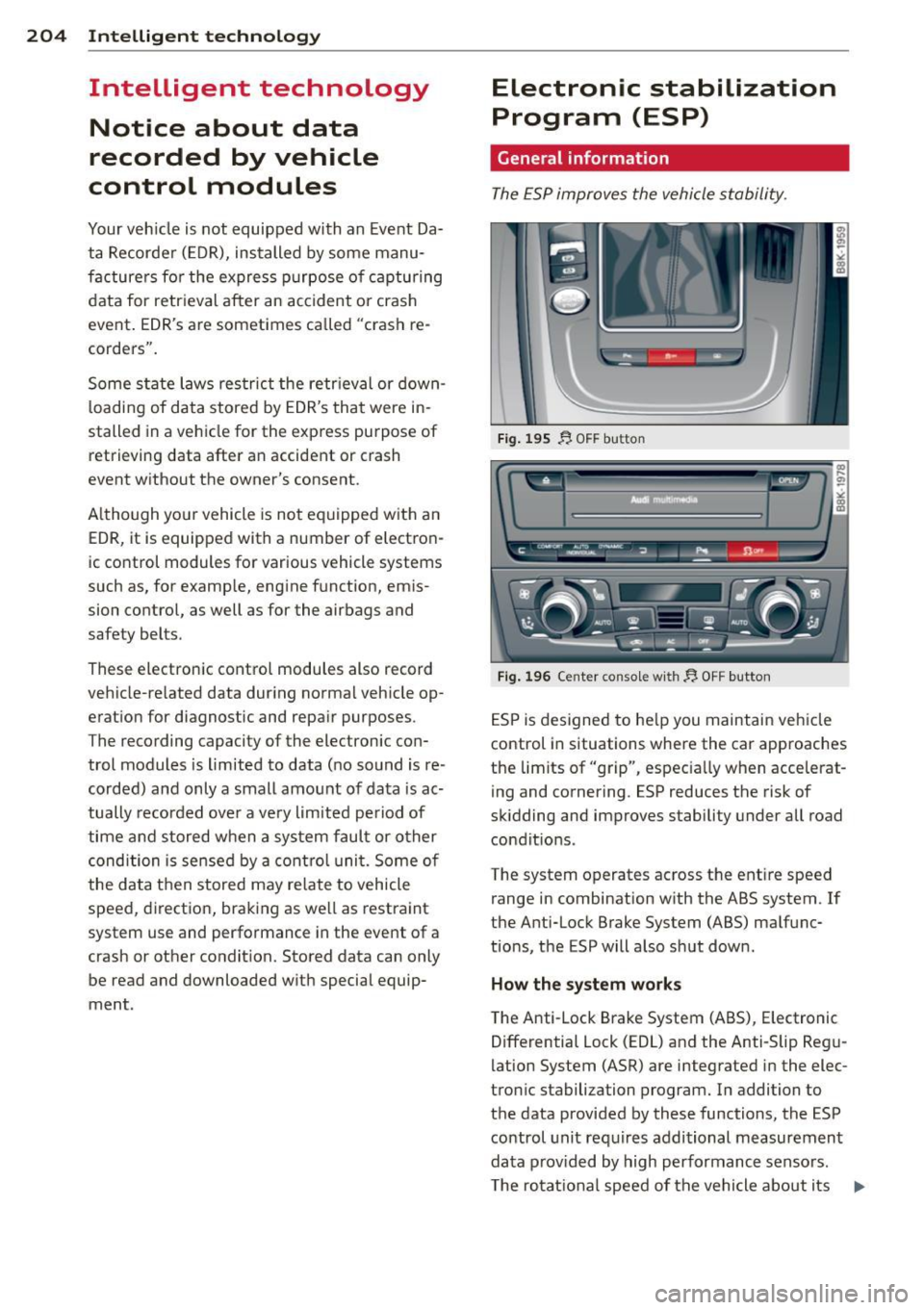
Fig. 195 f;. OFF button
Fig. 196 Center console wit h ~ OFF button
ESP is designed to help you maintain vehicle
control in situations where the car approaches
the limits of "grip", especia lly when accelerat
ing and cornering . ESP reduces the risk of
skidding and improves stability under all road
conditions .
The system operates across the ent ire speed
range in combination with the ABS system . If
the Anti-Lock Brake System (ABS) malfunc
tions, the ESP will also shut down.
How the system works
The Anti -Lock Brake System (ABS), Electronic
Differential Lock (EDL) and the Anti-Slip Regu
lation System (ASR) are integrated in the elec
tronic stabilization program. In addition to
the data provided by these functions, the ESP
control unit requires additional measurement
data provided by high performance sensors.
T he rotational speed of the vehicle about its
II>-
Page 207 of 316
vertical axis, vehicle acceleration in the fore
and-aft and lateral directions , the brake pres
sure, and the steering ang le are all measured .
The direction in which the d river wishes to
travel is determined with the aid of the steer
ing angle and vehicle speed and is continually
compared with the actual behavior of the ve
h icle. If the two do not match, for examp le,
when the vehicle starts hydroplaning on a wet
road, ESP will automatically brake the appro
priate wheel to correct the problem.
The vehicle is then stabili zed by the forces act
ing on the wheel dur ing braking. If the vehicle
is
oversteering (the veh icle turns too sharply
and the rear wheels sl ide toward the outs ide
of a curve), the brakes are main ly applied on
the wheel that is on the outside of the curve.
I n the case of a ve hicle that is
understeering
(the vehicle does not turn sha rply enough and
pushes out of a curve) , the brakes are applied
as needed on the whee l that is on the inside of
the curve o r additiona lly on the other wheels.
An acoust ic signal indicates when ESP brake
application cuts in
q .& .
The system operates across the entire speed
range in combination with the ABS system
q page 208. If the Anti-Lock Brake System
(ABS) malfunctions, the ESP will be out of ac
tion as well.
Acti vating
When you turn on the engine, ESP wi ll auto
matica lly be activated and will perfo rm a se lf
test. As soon as the test is completed, the sys
tem is in normal operating mode .
You can activate a deactivated ESP or deacti
vated ESP/ASR if required by pressing the
qfig. 196 q fig . 195 button. When they are
activated, the message
Stabilisation prog ram
on
appears briefly in the d isplay.
D eacti vating
The ESP sho uld normally be activated all the
time. If necessary, you can deactivate Anti
Slip Regulation (ASR) or the Electron ic Stabili
zation Program (ESP) by pressing the button
<:::;, fig. 196 .
Intellig ent technolog y 205
-Dea cti vating ASR: Tap the b utton. In cer
tain exceptional situations (e.g . driving with
tire chains), the Anti -Slip Regu lation (ASR)
can be deactivated
q page 206. The mes
sage
ASR off Caution ! Limited d riv ing sta
bilit y
appears in the display as we ll.
- Deacti vating ESP /A SR Press the button for
more than 3 seconds. Wi th the ESP/ASR de
activated, the ind icator light comes on, see
c:::;, page 15 . The message War ning! R estrict
ed stability
appea rs in the d isp lay as well.
.8, WARNING -
The Electronic Stabi liz a tion Program is
neverthe less subjec t to the laws o f phys
ics. It is part icu la rly important to pay a t
tention to this fact on wet and slippery roads. It is therefo re important that you
a lways adapt your driving to the condit ion
of the road and traff ic conditions. Do not
allow the increased safety provided by the Elect ronic Stabilization Program system to
lull you into accepting addit iona l safety
r isks.
Electronic differential lock (EDL)
The electronic differential lock monitors the
rotational speed of the drive wheels .
General not es
The electronic d ifferential lock ( E0L) he lps the
car to star t moving, acce lerate and climb a
gradient on surfaces providing poor or almos t
no grip . Without EDL, this would be d iff icult,
if not impossible .
How the sy stem works
The EDL operates automatically. It mon itors
the rotational speed of wheels with the he lp
of the ABS sensors
q page 208 . If a noticea
ble
slip is detected at the wheels (e .g . on s lip
pery ground
on one side), the sp inning wheels
are braked and power is t ransferred to the
othe r whee ls. Thi s is done up to a speed of
abo ut 60 mph (100 km/h) . Noises from the
brake system signa l that wheel spin is be ing
controlled .
Ill>
•
•
Page 208 of 316
206 Intelligent technology
Driving off
When driving off, a lways be sure to keep road
conditions in mind as you accelerate. If one
drive wheel spins because it is on a surface
with less grip, apply
plenty of throttle until
the car starts to
move .
Overheating of brakes
To prevent the disc b rake o f the bra ked wheel
from overheating if subjected to excessive l oads on this whee l, the EDL cuts out tempo
rarily. The vehicle remains operational and be
haves in the same way as a vehicle without
EDL.
As soon as the brake has coo led down, EDL
switches on again automatically .
A WARNING
-When accelerating on slippery surfaces,
such as on ice or snow, always be careful
when depressing the accelerator pedal. Even with the EDL working, the drive
wheels can spin and reduce your ability
to control your car. Risk of crash!
- The increased safety afforded by EDL
does not mean that you can take safety
risks. Always adapt your dr iving style to
the road conditions and traffic situation.
0) Tips
If a fault occurs in the ABS, the EDL is also
not funct ion ing. Thi s is indicated by the
ABS war ning light ¢
page 16.
Anti-Slip Regulation System (ASR)
The Anti-Slip Regulation System prevents the
driven wheels from spinning when the car is
accelerating.
General notes
The Anti -Slip Regulation System (ASR) is inte
grated in the electronic stabilization program
( E SP). When the vehicle starts up and acceler
ates, the wheels are p revented from spinning
by adjusting the engine power to match the amount of grip available
from the road sur
face.
How the system works
ASR performs automat ically, i .e. w ithout the
driver's intervention. With the aid of the ABS
sensors ¢
page 208, ASR monitors the speed
of the driven whee ls. If the whee ls start to
spin, engine torque is reduced automatica lly
until the tires find enough grip to lock onto
the road surface. The system is active across
the entire speed range.
The ASR works in conjunction with the ABS . If
a malfunction should occur in the ABS, the
ASR will also be out of act ion.
Activating
T he ESP is automatica lly activated when the
engine is started and it performs a se lf-test .
You can activate a deactivated ASR if required by pressing the
¢ page 204, fig. 196 button.
When it is act ivated, the message
ESP/ASR
on
appears briefly in the display .
Deactivating
You can deactivate the ASR if required by
pressing the button (for less than 3 seconds)
¢
page 204, fig . 196. With the ASR deactivat
ed, the ESP check light comes on, see
¢
page 15 . The message ASR off appears in
the d isplay as well. The ASR can be deact ivat
ed at any speed.
The ASR s hould normally be activated all the
time . Only in certain exceptional situations
when some slip is desirable does it make
sense to deact ivate the ASR . Examples :
- when driving with tire cha ins
- when driving in deep snow or on loose
ground and
- when rocking the vehicle loose after it has
become stuck.
When the abnormal situation is
over, you
shou ld activate the ASR again .
Page 210 of 316
208 Intellig ent technol ogy
,8. WARNING
- You should perform braking maneuvers
for the purpose of cleaning the brake
system only if road condit ions permit .
Other road users must not be put at r isk -
you may cause an acc iden t!
- Before descending a steep grade, reduce
speed and shift transmiss ion into a lower
gear or lower driving range. Do not ride
the brakes or hold the pedal down too long or too often . This cou ld cause the
brakes to get hot and diminish braking
efficiency.
- Do not "ride the brakes" by resting your
foot on the pedal when you do not intend
to brake . This may cause the brakes to
overheat, premature wear and increased
stopp ing distance.
- Under certain climatic and operating
condit ions such as passing through wa
ter, driving in heavy ra in or after wash ing
the vehicle, the effect iveness of the
brakes can be reduced. In winter, ice can
accumula te on the brake pads, linings,
discs and drums. Carefully apply brakes
for a test. Brakes will dry and ice coat
ings will be cleaned off after a few care
ful brake applications.
- Driv ing fo r an extended period of time on
salt -covered roads w ithout using your
brakes can also affect braking efficiency.
Clean off accumulated salt coating from
brake discs and pads w ith a few careful
brake applicat ions.
- If you damage the front spoiler, or if you
install a different spoiler, be sure the air
flow to the front brakes is not obstruct ed . Otherwise the brake system could
overheat reducing the effectiveness of
the ent ire brake system.
- Failure of one brake c ircuit will impair
the braking capability resulting in an in creased stopp ing distance. Avoid driv ing
the vehicle and have it towed to the near est authorized Audi dealer or qualified
workshop.
Brake booster
The brake booster adds extra braking power .
The brake booster works with vacuum pres
sure which is created only when the engine is
runn ing
c> .&. .
,8. WARNING
-Never let the vehicle roll to a stop with
the engine shut off .
- If the brake booster is not working, for
example when towing your vehicle, or
because the brake booster has somehow
been damaged, the bra ke pedal mus t be
pressed considerably harder to make up
for the lack of booster assistance.
Functioning of Anti-Lock Brake System
(ABS)
ABS prevents the wheels from locking up un der braking .
-
The ABS contributes effect ively to vehicle con
trol since it prevents the whee ls from
locking
when the brakes are applied. This means that
the ve hicle remains steerable and is less likely
to skid .
With AB S you do n ot need to pump the
brake . Ju st hold th e bra ke p edal down.
However, do not expect the ABS to s horten
braking distance under
all c ircumstances.
When driving on gravel or on new ly fallen
snow on top of icy surfaces, braking dis tance
may be even longer, therefore, under these
circumstances, it is especia lly important that
you drive s low ly and with great care.
How the ABS syst em work s
An automat ic check is made when a speed o f
about 12 mph (20 km/h) is reached. When
this happens, a pumping noise can be heard.
If an ind iv idual whee l begi ns to rota te too
s lowly in re lation to vehicle speed and tends
to lock, the ABS automatically reduces brake pressure to prevent that whee l from locking . .,..
Page 211 of 316
This automatic adjustment process will cause
a
slight vib ra tion of the brake pedal and some
noises to alert you that vehicle speed must be
adapted to existing road and traffic condi
tions.
A WARNING
Although the ABS is very effective, always
remember that braking capability is limit
ed by t ire traction . A lways adjust your dr iv
ing speed according to the road and t raff ic
conditions. Do not let the extra sa fety af
forded by the ABS tempt you into taking
extra risks. The ABS cannot overcome the
laws of physics .
(D Tips
-If ABS is not functioning properly, a
warning light will come on . See
~ page 16.
-If a fault occu rs in the ABS, the EDL is al
so not functioning . This is indicated by
the ABS warning light .
Brake assist
Brake assist is designed to achieve the opti
mum broking effect.
Brake assist helps to increase the effective
brak ing power and thus to achieve a shorter
stopping distance. If the driver presses the
brake peda l very quick ly, brake assist auto
mat ica lly boosts the braking force to the max
imum level, up to the point where the anti
lock brake function (ABS) intervenes to stop
the wheels from locking . You should then
keep the brake pedal pressed u ntil the vehicle
has braked to the required speed . Brake ass ist
sw itches itself off as soon as you release the
b rake peda l.
A WARNING
Please remembe r that the accident r is k al
ways increases if yo u drive too fast, espe
cially in corners or on a s lippery road, or if
you fo llow the vehicle ahead of you too
close ly. Increased risk of an accident can-
Int ellig ent technolog y 209
not be compensated for even by brake as
sist, so always maintain a safe speed.
S .
®
ervotron1c
-
advanced power
steering system
The power steering systems uses the power of
the running engine to allow precise steering
with little effort.
T he advanced Servotronic ® power steer ing
system senses the road speed and elect ron i
ca lly adjusts power assistance to provide com
fortab le and safe ste ering response exact ly
matched to the vehicle speed .
Power steering will not work i f the engine is
off. As a result, the stee ring wheel will be hard
to turn .
T he power steering fluid level is checked d ur
ing the schedu led maintenance services .
(D Note
If there is an e lectronic malfunction, ser
votronic
will s till function like a conven
tiona l power steering system, providing a
constant steering support force that is no
l onger proportionate to the vehicle speed.
This is most noticeable when turning the
steering wheel at low speeds (for example
when parking), -more effort w ill be re
q uired than usual.
- Be aware of the different than usual
steering response and adjust your steer
ing force acco rdingly .
- Have the problem checked and set right
by an Audi dealer as soon as possible.
(D Tips
-Whe n the engine is running, never hold
the steering w heel turned all the way to
the rig ht or to the left for longer t han 15
seconds. The powe r steering pump will
overheat the hydraulic fluid if you keep
holding the stee ring wheel turned all the
way. This is likely to damage the power
steering system .
IJI>
•
•