service AUDI A5 COUPE 2012 Owner's Manual
[x] Cancel search | Manufacturer: AUDI, Model Year: 2012, Model line: A5 COUPE, Model: AUDI A5 COUPE 2012Pages: 316, PDF Size: 78.59 MB
Page 235 of 316
-Blend must contain not more than 15%
MTBE.
Seasonally adjusted gasoline
Many gasoline grades are blended to perform
espec ially we ll for winter or summer driving.
During seasonal change-over, we suggest that
you fill up at busy gas stat ions where the sea
sonal adjustment is more likely to be made in
time .
(D Note
-Methanol fuels which do not meet these
requirements may cause corrosion and
damage to plastic and rubber compo
nents in the fuel system .
- Do not use fue ls that fail to meet the
specified criter ia in this chapter.
- If you are unable to determine whether
or not a particular fue l blend meets the
specifications, ask your service station or
its fuel supp lier.
- Do not use fuel for which the contents
cannot be identified.
- Fuel system damage and performance
problems resulting from the use of fuels
different from those specified are not
the responsibility of Audi and are not
covered under the New Vehicle or the Emission Control System Warranties.
- If you experience a loss of fuel economy
or driveability and performance prob l ems due to the use of one of these fuel
blends, we recommend that you switch
to unblended fuel.
Gasoline additives
A major concern among many auto manufac
turers is carbon deposit build- up caused by
the type of gasoline you use.
Although gasoline grades differ from one manufacturer to another , they have certain
things in common. All gasoline grades contain
substances that can cause deposits to collect
on vital engine parts, such as fuel injectors
and intake valves. Although most gasoline brands include additives to keep engine and
Fuel supply and filling your fuel tank 233
fuel systems clean, they are not equally effec
tive .
A udi recommends using TOP TIER Detergent
Gasoline. For more info rmation on TOP TIER
Detergent Gasoline, please go to the official
website (www.toptiergas.com).
After an extended period of using inadeq uate
fuels, built-up carbon deposits can rob yo ur
engine of peak performance.
Q) Note
Damage or malf unct ion due to poor fue l
quality is not covered by the Aud i New Ve
hicle Limited Warranty.
Fuel tank
Fuel filler neck
The fuel filler neck is located on the right rear
side panel behind the fuel fille r flap.
If the power locking system should fail, you
can still open the flap manually -for deta iled
instruct ions see¢
page 235 .
You can find the fuel tank capacity of your ve
hicle in
Technical Data ¢ page 292.
The label on the inside of the fuel fi ller flap
tells you the correct fue l for your vehicle. For
more information about fuel specifications,
see ¢
page 232.
Your vehicle fue l tank has an on -board refue l
li ng vapor recovery system. This feature helps
to prevent fuel vapors from escaping from the
tank and pollut ing the environment while you
refuel your vehicle . In order to fill the tank
properly while protecting the environment,
please fo llow this refueling procedure careful
ly.
_&. WARNING
Under normal operating conditions, never
carry additional fuel containers in your car.
Gas canisters and other containers used to
transport f uel can be dangero us. Such con
tainers, full or empty, may leak and could
cause a fire in a collision. If you must
•
•
Page 245 of 316
@ For the sake of the environment
-Under no circ umstances can the oil come
i n contact w ith the sewage network or
the soil.
- Observe and follow lega l regu lations
when disposing of empty oil containers.
Changing the engine oil
We r ecommend that hove your oil changed by
on authorized Audi dealer or a qualified serv
ice station .
Before you check anything i n the engine com
pa rtment,
alwa ys read and heed all WARN
INGS c:> &. in Working in the engine comport
men t on page 237.
The engine oil must be changed according to
the intervals specified in your Warranty
&
Maintenance book let . T his is very important
because the l ubricating proper ties of oil di
minish gradua lly dur ing no rmal veh icle use.
Under some circ umstances the engine o il
should be changed more frequently . Change
oil more often if yo u drive most ly short dis
tances, operate the vehicle in dusty areas or
under predominantly stop-and -go traff ic con
d itions, or have your ve hicle where tempera
tures remain below free zing fo r extended pe
ri ods.
Detergent addi tives in the o il w ill make fresh
oil look dark after the eng ine has been run
n ing fo r a short time. This is norma l and is not
a reason to change the o il mo re often tha n
recommen ded.
Because of the problem of prope r disposal,
a long w ith the special tools and necessary ex
p e rti se require d, we strong ly recommend tha t
you have you r o il change d by an author ized
Audi dealer or a q ualified service sta tion.
If you choo se to change your oil yourself ,
please note the following importa nt informa
tion :
Checkin g and fillin g 243
A WARNING
To reduce the risk of personal inj ury if you
must change the eng ine oil in your vehicle
yourself:
- Wear eye protect io n.
- To reduce the risk of burns from hot en- gi ne oil, let the engi ne cool down to the
touch.
- When removing the o il dra in p lug with
your fi ngers, stay as far away as possible.
Always keep you r fo rearm parallel to the
grou nd to help p revent hot o il from run
ning down yo ur arm.
- Dra in the oil into a containe r designed
for this purpose, one la rge enough to
hold at least the tota l am ou nt of oi l in
your eng ine .
- E ngine oil is poisonous . Keep it we ll out
of the rea ch of childre n.
- Con tinuous contact wit h used eng ine o il
is harmful to yo ur ski n. A lways p rote ct
your skin by w ashing oil off tho ro ughly
wit h soap and wate r.
@ Note
N eve r mix oil addi tiv es with yo ur engine
oi l. These additives can damage your e n
g ine and adver se ly affec t yo u r A udi L imit
ed New Veh icle Warran ty.
@ For the sake of the environment
- B efore changi ng your oil, first make su re
yo u k now where yo u can prope rly dispose
o f t he used oil.
- Always dispose of used eng ine o il proper
ly. Do not dump it on garden soil, wood
ed are as, into open streams o r down
sewage drains .
- Re cy cl e used engine oil by taking i t to a
used engi ne oil col lect ion facility in your
area, or contact a service station .
•
•
Page 250 of 316
248 Checking and filling
Have the battery checked when you take your
ve hicle in for service. Yo u are well advised to
replace a battery that is older than 5 years .
W ith certa in types o f airbag deployment, the
battery is d isconnected from the vehicle elec
trica l system for safety reasons ¢
& in Re
pair, core and disposal of the airbags on
page 176.
Disconnecting the battery terminals
Some veh icle func tions (power w indow regu
l a tors, for example) are los t if the bat tery ter
minals a re disconnected . These functions have
to be re learned after the battery terminals a re
connected agai n. To prevent this, the battery
should only be disconnected from the vehicle
e lectrical system whe n absolutely necessary
for repairs .
Vehicles not driven for long period s
If you do not drive your vehicle over a period
of several days or weeks, electrical compo n ents are gradually cut back o r switched off.
This reduces energy consumption and main
tains starting capab il ity over a longer period
¢ pag e 211.
Some of the conven ience functions may not
operate, such as the inter ior lights or the
power seat adjustm ent. The conven ience
f u nctions w ill be ava ilable again when you
turn on the igni tion and st art the eng ine.
Winter operation
During the winter months, battery capacity
tends to decrease as tempe rat ures d rop . This
i s becaus e more powe r is also consumed while
start ing , a nd the headligh ts, rea r window de
f o gger, etc., are used more o ften .
Avoid unnec essary power consumption, par
ticular ly in c ity traffic or w hen t rave ling o nly
short d istances. Let you r auth o riz ed Audi
d ea le r che ck t he cap acity of the ve hicl e bat
tery be fore w inte r se ts in
¢ page 250. A we ll
cha rged batte ry w ill not only prevent sta rting
p ro bl ems when the weathe r is cold, but wi ll
a ls o l ast longer.
(D Tips
If your vehicle is left stan ding for seve ral
weeks at e xtremely low temperatures, the
vehicle battery sho uld be removed and
st ored w here it w ill n ot freeze . This will
p revent it from be ing damaged and having
to be replace d.
Working on the battery
Be especially careful when working on or near
the battery.
The battery is located in the luggage compart
ment under the floo r. Befo re you check any
t hi ng in the luggage compartment,
read and
heed all WARNINGS
¢ ,& .
Always heed t he safety warnings , when work
i ng on the veh icle battery or the vehicle e lec
t rical system to prevent injury.
The following WARNINGS are very
important when working on the battery:
Always heed the following WARNING SYMBOLS and safety precautions when working on the battery .
@) Always wear eye protection .
b.. Battery acid contains sulfuric acid . Al
~ ways wear gloves and eye protection .
~ No
\!!51 -sparks
-flames
-smoking.
A. When a battery is charged, it produces
&£:,. hydrogen gas which is explosive and
could cause personal injury.
~ Always keep the battery well out of
V:!JI reach of children.
_& WARNING
Wh eneve r workin g on th e ba ttery o r o n
the elec trical system, there is t he ris k of
in jury, accident and even fi re . Read and
h eed the followin g WAR NINGS:
-
Page 262 of 316
260 Tire s and wheel s
reduced speed to the nearest service sta
t ion to c heck t he tire pressure a nd add
air as required.
Driving without va lve stem caps can cause
damage to the tire va lves. To prevent this,
always make sure that factory installed
valve stem caps on all wheels are secure ly
mounted on the valve .
@I For the sake of the environment
Underinflated tires will also increase the
fue l consumption .
Tires and vehicle load limits
There are limits to the amount of load or
weight that any vehicle and any t ire can carry.
A vehicle that is ove rloaded w ill not ha ndle
well and is more difficult to stop. Over load ing
can no t on ly lead to loss of vehi cle contro l,
but can also damage important pa rts of the
ve hicle and can lead to sudden tire failure, in
cluding a blowout and sudd en deflation that
can cause the veh icle to crash.
Your safety and that of yo ur passenge rs a lso
depends on making s ure that load limits are
not exceeded . Vehicle load includes everybody
and everyth ing in and on the vehicle . These
load limits are techn ically referred to as the
ve hicle's
Gross Veh icle W eight Rat ing
(" GVWR ").
T he "GVWR" incl udes the we ight of the basic
vehicle, all f actory installed accessories, a full
tank of fuel, oil, coolant and other fluids plus maximum load . T he maximum load includes
the number of passengers that the vehicle is in tended to carry ("seating capacity") with a n
assumed weig ht of 150 lbs . (68 kg) for e ach
passenger at a des igna ted seat ing pos ition
and the tota l we ight of any l uggage in the ve
h icle. If you tow a trailer, the weight of the
tra iler hitch and the tong ue weight of the
loaded trailer must be included as part of the
ve hicle load . T
he
Gro ss Axle We ight Rating ("GAWR") is
the maximum load that can be applied at each
of the veh icle's two axles .
T he Gross Vehicle Weigh t Rat ing and the
G ross Ax le Weight Rating are listed on the
safety comp liance sticker label located either
on the dr iver's s ide B-pillar or on the ins ide of
the fuel fi ller flap . Audi has
4 seating pos i
t ions, 2 in the front and 2 in the rear for to tal
seat ing capac ity of 4 . Each seating position
has a seat belt ¢
page 154, Safety belts.
The fact that there is an upper limit to yo ur
vehicle 's Gross Vehicle Weight Rating means
that the total weight of whatever is being car ried in the vehicle ( includ ing t he weight of a
t railer hitch and the tongue weight of the
l oaded tra ile r) is lim ited. The more passen
gers in the vehicle or passengers w ho are
heavier tha n t he standard we ights assumed
mean that less weight can be carried as lug
gage.
T he tire pressure label o n your Aud i also lis ts
the max imum combi ned weight of a ll of the
occupants and luggage or other cargo that
t h e vehicle can carry. Fo r the location of the
label ¢
page 256 , fig. 210.
A WARNING
-Overloading a vehicle can cause loss of ve-
h icle contro l, a crash or other accident, se
rious pe rsonal injury, and even death .
- Carrying more we ight than your veh icle
was des igned to carry will prevent the
veh icle from handling properly and in
crease the risk of the loss of vehicle con
trol.
- The b rakes on a vehicle that has been
overloaded may not be abl e to stop the
veh icle w it hi n a safe distance .
- Tires on a vehicle that has been overload
ed can fail s udden ly, incl uding a blowo ut
a nd sud den defla tion, causing loss of
con trol an d a crash.
- Always make sure that the total load be
i n g tr anspor ted - incl ud ing t he weight o f
a trailer hitch and the tongue we igh t of a
~
Page 264 of 316
262 Tires and wheels
Tire service life
The service life of tires depends on a lot of
different things including proper installation
and balancing, correct tire pressure and driv
ing style.
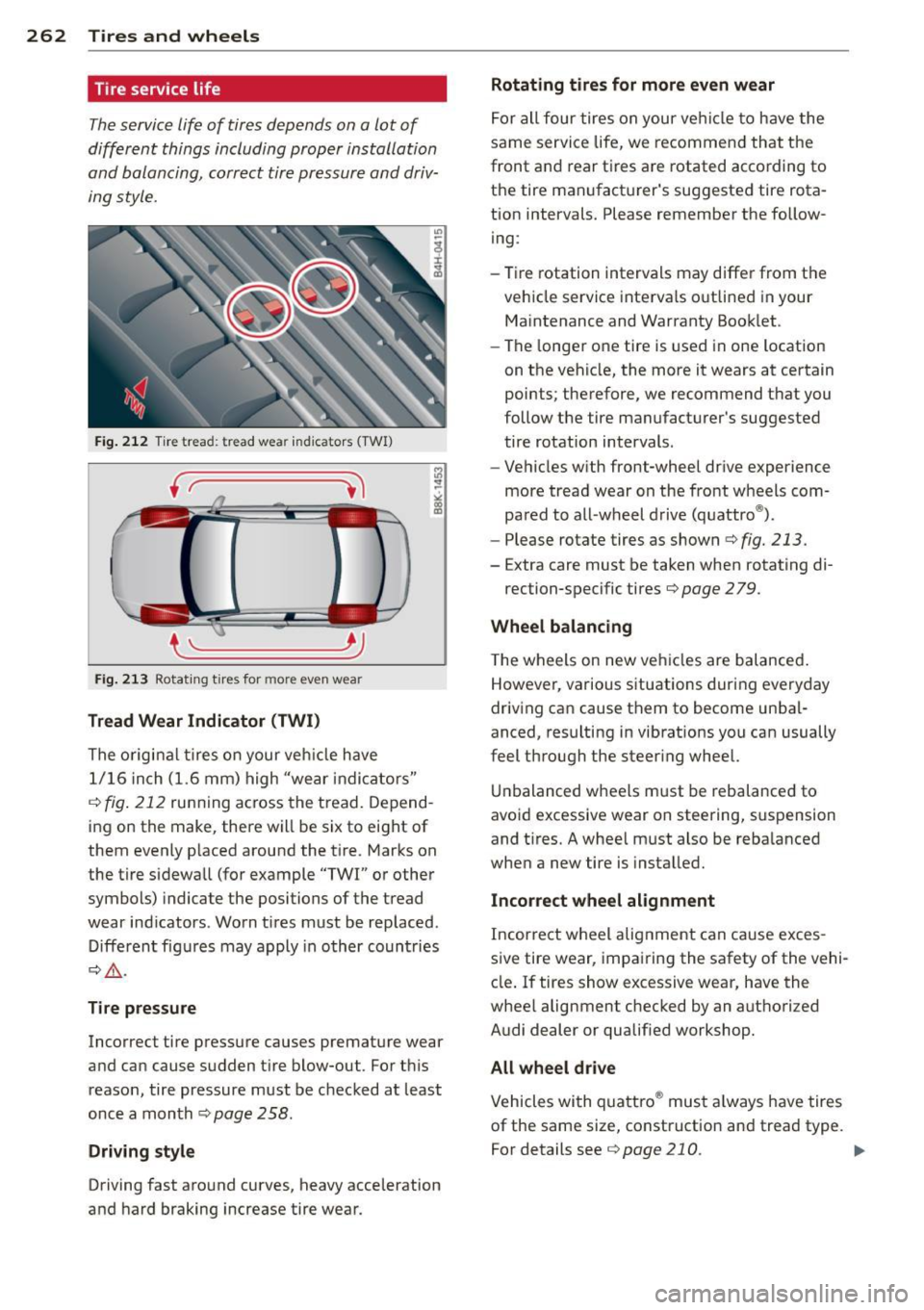
Fig. 212 Tire tread: tread wear ind icators (TWI)
_____ __,.J)
Fig. 213 Rotating t ires for more even wear
Tread Wear Indicator (TWI)
The origina l tires on your veh icle have
1/16 inch (1.6 mm) high "wear indicators"
¢
fig . 212 running across the tread. Depend
ing on the make, there will be six to eight of
them evenly placed around the tire. Marks on
the tire sidewa ll (for example "TWI" or other
symbols) indicate the positions of the tread
wear ind icators . Worn tires must be replaced .
Different figures may apply in other countries
¢ & .
Tire pressure
Incorrect tire pressure causes premature wear
and can cause sudden t ire blow-out. For th is
reason, tire pressure must be checked at least
once a month
¢ page 258.
Driving style
Driving fast around curves, heavy acceleration
and hard braking increase tire wear.
Rotating tires for more even wear
For all four tires on your vehicle to have the
same service life, we recommend that the
front and rear tires are rotated according to
the tire manufacturer's suggested tire rota
tion intervals. Please remember the follow
ing:
- Tire rotation intervals may differ from the
vehicle service interva ls outlined in your
Ma intenance and Warranty Booklet .
- The longer one tire is used in one location
on the vehicle, the more it wears at certain
points; therefore, we recommend that you
follow the tire manufacturer's suggested
tire rotation intervals .
- Vehicles with front-wheel drive experience
more tread wear on the front wheels com
pa red to all-wheel drive (quattro ®).
- Please rotate tires as shown¢
fig. 213.
-Extra care must be taken when rotating di-
rection-specific tires¢
page 279.
Wheel balancing
The wheels on new vehicles are balanced.
However, various situations during everyday
driving can cause them to become unbal
anced, resulting in vibrations you can usually
feel through the steer ing wheel.
Unbalanced wheels must be rebalanced to
avoid excessive wear on steering, suspension
and tires. A wheel must also be rebalanced
when a new tire is installed.
Incorrect wheel alignment
Incorrect wheel alignment can cause exces
sive tire wear, impairing the safety of the vehi
cle. If tires show excessive wear, have the
whee l alignment checked by an authorized
Audi dealer or qualif ied workshop.
All wheel drive
Vehicles with quattro ® must a lways have tires
of the same size, construction and tread type.
For details see
¢page 210. ..,.
Page 287 of 316
@ Tips
-The discharged battery must be properly
connected to the vehicle's electrical sys
tem. When jump start ing or charging the
battery, never connect the negative
ground cable to the battery negative
post because the battery manager sys
tem must be able to detect the battery's
state of cha rge . A lways connect the neg
ative g round cab le to the negative
gro und post o f the battery manage r con
trol uni t.
Use of jumper cables
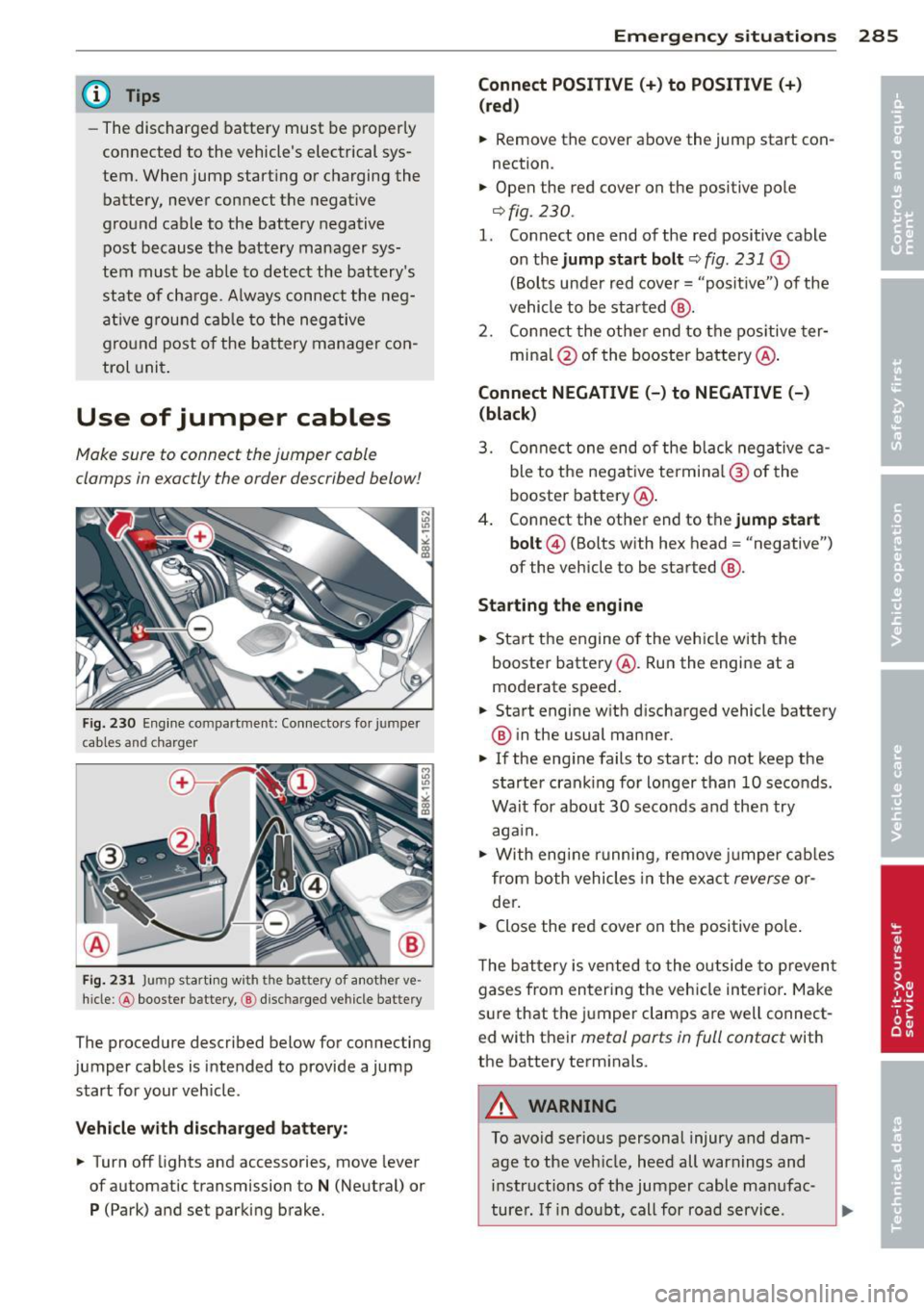
Make sure to connect the jumper cobl e
clomps in exactly the order describ ed b elow!
Fig. 230 Engine co mpartmen t: Con ne ctors fo r jum per
c ables a nd char ger
Fi g. 231 Jump s tart in g w ith t he ba ttery of a not her ve
hi cle :@ booster battery, @ disc harged vehicle bat tery
The procedure described below for connecting
jumper cables is intended to provide a jump
start for your veh icle .
Vehicle with discharged batter y:
.. Turn off lights and accessories , move lever
of automatic transmission to
N (Neutral) or
P (Park) and set parking brake.
Emergenc y situ ation s 285
Connect POSI TIVE(+ ) to POSITIVE (+ )
(red )
.. Remove the cover above the jump start con
nection .
.. Open the red cover on the positive pole
¢fig. 230 .
1. Connect one end of the red positive cable
on the
jump sta rt bolt ¢ fig. 231 (D
(Bolts under red cover= "positive ") of the
vehicle to be star ted @.
2. Connect the othe r end to the pos itive ter -
mina l@ of the booster battery @.
Connect NEGATIVE (-) to NEGATIVE (-)
(black )
3. Connect one end of the b lack negative ca
ble to the nega tive te rmi na l@ of the
booster battery @.
4 . Connect the other end to the
jump start
bolt @
(Bolts with hex head = "negative")
of the vehicle to be started @.
Sta rting the engine
.. Start t he engine of the veh icle w ith the
booster battery @. Run the engine at a
moderate speed .
.. Start engine w ith d ischarged vehicle battery
® in the usual manner .
.. If the eng ine fails to start: do not keep the
starter crank ing for lo nger than 10 seconds .
Wait for about 30 seconds and the n try
aga in .
.,. With engi ne runni ng , remove j umper cab les
from both vehicles in the exact
reverse o r
der .
.. Close the red cover on the positive pole .
T he battery is vented to the o utside to p revent
gases from entering the veh icle in ter ior . Make
s ur e that the j umper clamps a re well connect
e d with their
metal ports in full contact with
the batte ry terminals.
A WARNING
To avoid serious personal injury and dam
age to the vehicle, heed all warnings and
instructions of the jumper cable manufac-
turer . If i n doubt, call for road service .
Ill>
Page 295 of 316
Consumer Information
Warranty coverages
Your Audi is covered by the following war
ranties :
- New Vehicle Limited Warranty
- Limited Warranty Against Corrosion Perfo-
ration
- Emissions Control System Warranty
- Emissions Performance Warranty
- California Emissions Con trol Warranty (USA
vehicles only)
- California Emissions Performance Warranty
(USA vehicles only)
Detailed information regarding your warran
ties can be found in your
Warranty & Mainte
nance booklet .
Operating your vehicle
outside the U.S.A. or
Canada
Government regulations in the United States
and Canada require that automobiles meet
specific emission regulations and safety
standards. Therefore, veh icles built for the
U.S.A. and Canada differ from vehicles sold in
other countries .
If you p lan to take your vehicle outside the
continental limits of the United States or Can
ada, there is the possibility that
- unleaded fuels for vehicles with cata lytic
converter may not be available;
- fuel may have a considerably lower octane
rating . Improper fuel may cause engine
damage ;
- service may be inadequate due to lack of
proper service facilities, tools or testing
equipment ;
- replacement parts may not be readily availa
ble.
- Navigation systems for vehicles built for the
U.S.A. and Canada will not necessari ly work
in Europe, and may not work in other coun
tries outside of North America.
Consumer Information 293
@ Note
Audi cannot be responsible for mechanical
damage that could result from inadequate
fuel, service or parts availab ility.
Audi Service Repair
Manuals and Literature
Audi Offic ial Factory Service Manuals and Lit
erature are published as soon as possible after
model introduction. Service manuals and lit
erat ure are available to order from the Audi
T echnical Literature Ordering Center at:
www.audi.techliterature.com
Maintenance
' General
Your vehicle has been designed to help keep
maintenance requirements to a minimum.
However, a certain amount of regular mainte
nance is still necessary to assure your vehicle's
safety, economy and reliability . For detailed
vehicle maintenance consult your Warranty
&
Maintenance booklet.
Under difficult operating conditions , for ex
ample at extremely low outside temperatures ,
in very dusty regions, when towing a tra iler
very frequently, etc., some serv ice work
shou ld be pe rformed between the intervals
specified. This applies particularly to:
- oil changes, and
- cleaning or replacing the air filter .
® For the sake of the environment
By regularly maintaining your vehicle, you
help make sure that emission standards
are maintained, thus min imizi ng adverse
effects on the environment .
Important considerations for you and
your vehicle
The increasing use of electronics , sophisticat
ed fuel injection and emission contro l sys-
tems, and the genera lly increasing technica l ..,_
•
•
Page 301 of 316
Audi drive select . ... .... ... .. .. .. ... 124
Adaptiv e dampers ..... ... .. .. .. .. . 124
Descr ipt ion ..... ........ ... .. .. .. . 124
Dynamic steering ......... .. .. .. .. . 124
Se tting the driving mode ... .. .. .. .. . 125
Aud i Service Repair Ma nua ls and Litera-
ture . ..... .. .. .... .. .... ... .. .. ... 293
Auto-Check Control . . . . . . . . . . . . . . . . . . 28
Auto Lock . . . . . . . . . . . . . . . . . . . . . . . . . . 40
Automatic belt retrac tor . ... .. .. .. .. . 15 7
Automatic ca r wash
refer to Wash ing ............ .... .. 222
Automatic climate control A/C mode .. ............. .... .. .... 83
Automatic clima te control p lus ... .. .. .. 83
A/C mode . ... ... ..... ... .. .. .. .... 88
also refer to Deluxe automatic climate
contro l plus . . . . . . . . . . . . . . . . . . . . . . . 83
Automatic clima te control sys tem . .. .. .. 79
also refer to D eluxe automatic clima te
control .... ... .. ..... ... .. .. .. .... 79
Automatic driv ing light contro l ... .. .. .. 49
Automatic S hift Lock (ASL) .. .. .. .. .. . 129
Autom atic t ransmission .. ... .. .. .. .. . 126
Automatic S hift Lock (ASL) . . . . . . . . . . 129
Driving .... .. .... .... ... .. .. .. ... 126
Dynamic shift program . . . . . . . . . . . . . 129
Emergency mode . . . . . . . . . . . . . . . . . . 131
Emergency release ........ .. .. .. .. . 132
Kick-dow n ............ ...... .... .. 129
Manual sh ift program . .... .. .. .. .. . 130
Selector leve r ............... ... ... 128
Shift buttons ............ .. .. .. .. . 13 1
S teer ing whee l w ith tiptronic . .. .. .. . 13 1
Automatic wipe/wash system . . . . . . . . . . 55
Auto Safety Hotline ..... ... .. .. .. .. . 152
Average speed . . . . . . . . . . . . . . . . . . . . . . . 2 2
Avoid damaging the vehicle .. .. .. .. .. . 214
B
Battery ..... .. .. .. .. .... ... .. .. ... 247
Battery locat ion inside the luggage com-
partment .. ............. .... .. ... 248
Cha rging . ................ ... ... .. 250
Impo rtant war nings when wo rking on
the battery . . . . . . . . . . . . . . . . . . . . . . . 248
Inde x 299
Jump start ing . ..... . .. .. ..... ... .. 284
Low . ... .. .. .. .... . ... ...... ... .. 211
Rep lacing the battery .. ..... ... .. .. 251
State of charge . .. ................. 211
Winter operation . ................. 247
Working on the battery ............. 248
Battery vo ltage . ...... .. .. ..... ... .. . 35
Befo re d rivi ng . .. .. .... ........... .. 144
B lended gasoline .. .. ........... .... 232
Body cavity sealing ... . .. ..... ... .. .. 226
Boos ter seats ... .. .. . .. .... .... .. .. 194
Brake assist ... .. .. .. .. .. ...... ... .. 209
B rake booste r ... ...... ............. 208
Brake fluid Changi ng the brake fluid ............ 247
Checking the brake fluid level ........ 246
Rese rvoir . .. .. .. .... ........... .. 246
What is the correct b ra ke fluid level? .. 24 6
Wha t shou ld I do i f the brake flui d war n-
ing ligh t comes on? .. ... .... ... .. .. 246
B rake system .. .. .... ... ....... ..... 246
Anti- lock b rake system .. .... ... .. .. . 16
Br ake fluid .. .. .. ................. 246
Br ake fluid specifications fo r refill and re-
placement . ..... ... .. .. ..... ... .. 2 47
Brake light defective . .. ..... ... .. .. . 35
B rake pads .. .... .. . .. .. ..... ... .. 213
E lectromechanica l parking brake ... .. . 96
General information ............... 207
How does moisture or road salt affect the
brakes? ......... .. ............... 207
Malfunction . . . . . . . . . . . . . . . . . . . . . . . 30
Wa rning/ind icator lights ........ .... . 18
Wor n bra ke pads symbo l . . . . . . . . . . . . . 34
Brak ing guard
refer to Aud i brak ing guard ......... . 113
Break -in period . ...... .. .. ..... ... .. 213
Brake pads .. .. .. .. ............... 213
Tires ..... .. .. .. .. .. ........... .. 213
Bu lbs . ... .. .. .. .... .. .. ...... ... .. 283
C
Cali for nia Pr oposition 65 War ning . .. .. 238
B attery spe cific . . . . . . . . . . . . . . . . . . . 249
Capacities .. .. .. .. .. . .. .... .... .. .. 292
•
•
Page 310 of 316

308 Index
Front passenger's seat . . . . . . . . . . . . . . . 62
Front seats ............... ... .... .. 61
Head restraints ................... 147
Manual .. ............... .. .. .... .. 62
Power . .. .... ........... ........ .. 63
Seat back angle manually ...... .. .... 62
Seat height manually . . . . . . . . . . . . . . . . 62
Seat belts
refer to Safety belts . . . . . . . . . . . . . . . . 154
Seat heating
Fr ont seats . . . . . . . . . . . . . . . . . . . . . . . . 91
Seating capacity ............ ... .. .. . 154
Seating position Driver . ...... ........... .. .. .... . 145
Front passenger .......... .. .. .. .. . 146
How to adjust the front seats ... .. ... 146
Incorrect seat position . . . . . . . . . . . . . . 148
Occupants .. ... . ...... ... .. .. .. .. . 145
Rear passengers ............ .. .... . 147
Seat memory . . . . . . . . . . . . . . . . . . . . . . . 65
Seats Number of seats .......... ... .... . 154
Seat symmetry . . . . . . . . . . . . . . . . . . . . . . 66
Selective unlock feature ..... .. .. .. .. . . 41
Selector lever .............. ... .... . 128
Emergency release ................ . 132
Service and disposal Safety belt pretens ioner ... .. .. .. .. . 161
Service interval display ........ .. .. .. .. 21
Service position for windshield wipers ... 56
Servotronic Power steering ......... .. .. .. .. .. . 209
SET button . . . . . . . . . . . . . . . . . . . . . . . . . 11
Shift buttons ............... ... .... . 131
Shift indicator (eff iciency program) .. .. . . 25
Side airbags Description .............. .. .. .. .. . 180
How they work ............. .. .... . 181
Side assist Activating and deactivating .......... 116
Descript ion ............... ... .. .. . 116
Informational and alert stage signals . 118
Messages in instrument cluster display 122
Operation . . . . . . . . . . . . . . . . . . . . . . . . 117
Safety tips . .............. ... .. ... 122
Sensor detection area ......... .. .. .
Settings . .. .. . .......... .. .. .. .. . 117
121 Side curtain airbags .
. . . . . . . . . . . . . . . . 182
Description . ..... ................ . 182
How they work ... ................ . 184
Safety instructions ............. .... 184
S id e marker lights . ............. .... . 49
Ski sack ........ .. .. ... ....... .... .. 72
also refer to Trunk pass-through ...... 73
Snow chains ...... ............. .... 268
Sound system display Driver information display ........ ... . 19
Sources of information about child re-
straints and their use ............. ... 203
Spare tire ... .... .. .. ........... .... 273
Speed control system
refer to Adaptive cruise control ....... 102
Speedometer . . . . . . . . . . . . . . . . . . . . . . . 12
Speed rating letter code ............ .. 264
Speed warning system ........... .. .. . 27
Starting engine Emergency key ... ....... ...... .. .. . 39
Starting from rest . ................. .. 98
Starting off w ith a trailer ......... .. .. . 98
Starting the engine ... .......... .. .. . 92
Steering . . . . . . . . . . . . . . . . . . . . . . . . 14 , 34
Locking the steering ............ ... . 92
Malfunction ... .. ............. .... . 32
Manually adjusting the steering wheel . . 92
Steering wheel column Adjusting manually ................. 92
Steps for determining correct load limit . 261
Stopping the engine ............. .... . 94
Storage
.... .. .. .. .. ........... .... . 76
Glove compartment . . . . . . . . . . . . . . . . . 77
Storage net . . . . . . . . . . . . . . . . . . . . . . . . . 69
Sunroof
refer to Panoramic tilting sunroof .. .. . 48
Sun shade .. .... ................... . 54
Sun visors
Switches 54
Emergency flashers . . . . . . . . . . . . . . . . . 52
Symbols Red ..... ..... .. .. .............. .. 29
Yellow ... ..... .. ............. ..... 33
T
Tachometer . . . . . . . . . . . . . . . . . . . . . . . . . 11
Page 311 of 316
Technical modifications ..... .. .. .. .. . 296
Tether anchors ............... ... ... 201
T ether strap . ............. .... .. .. . 201
The first 1,000 miles (1 ,500 km) a nd after-
wards ..... .. .. .. .. .. .... ... .. .. ... 213
Tie-down r ings ............. ... ... ... 69
T ie-downs . . . . . . . . . . . . . . . . . . . . . 69, 15 1
tiptronic .. .. ............. .. .. .. ... 126
Automatic S hift Lock (ASL) . .. .. .. .. . 129
D riving .... .... .. .... ... .. .. .. ... 126
Dynamic s hift program . ... .. .. .. .. . 129
Emergency mode . ..... ... .. .. .. .. . 13 1
Kick-down . . . . . . . . . . . . . . . . . . . . . . . . 129
Manual sh ift program ..... .. .. .. .. . 130
Selector lever ......... ...... .... .. 128
Tire pressure ... ... ..... ... .. .. .. ... 258
T ire pressure monitor ing system
L oss of air pressure . . . . . . . . . . . . 16, 27 1
M alf unc tion ............. .... .. ... 27 1
Rese tting tire p ressures . ... .. .. .. .. . 272
Tires ...... ... ............. ...... .. 252
Service life . .... .. .... ... .. .... .. . 262
Speed rat ing let ter code ... .. .. .. .. . 264
Tire manufacturing date ... .. .. .. .. . 264
Tire specifica tions ..... ... .. .. .. .. . 264
Tread depth . .... ..... ... .. .. .. ... 262
Uniform t ire quality grading . ... .. .. . 266
W inter t ires ............. .... .. ... 267
T ires/Whee ls
L ow aspect ratio t ires ... ... .. .. .. .. . 269
Tire pressure monitoring system . 16, 270
Tires and vehicle load lim its ... ... . ... . 260
Tires and whee ls
Checking tire pressure ..... .. .. .. .. . 258
Cold tire i nflat ion pressure ..... ... .. 256
D imensions ............... ... ... .. 263
Ge neral notes ............... ... ... 252
Glossa ry of t ire and load ing te rm inolo-
gy .. .. .. .. .. .. ........... .. .. ... 253
N ew tires and wheels ... ... .. .. .. .. . 263
Replacing . ..... ...... ... .. .. .. ... 264
Snow chains . .... ..... ... .. .. .. ... 268
T ires and vehicle load limits .. .. .. .. . 260
Wheel bolts ............. .... .. .. . 269
W inter t ires .. ........... .. .. .. ... 267
Tire se rvice life ... .. .... ... .. .. .. ... 262
Tool kit ... ... ............. ...... .. 273
Inde x 309
To rn o r frayed safety belts ..... ... .. .. 157
Touch-up pa int .. ... ................ 224
Towing Front eye let . . . . . . . . . . . . . . . . . . . . . . 287
Rear eyelet .. .. .. .. . ... ...... ... .. 287
T ow t ruck procedures .......... .... . 286
TPMS Tire pressure monitoring system ... .. 271
T ra ile r tow ing . .. .. .... ........... .. 218
Operating instr uctions .. ..... ... .. .. 218
Technical requirements . . . . . . . . 218, 219
T ips . ... .. .. .... .. . .. .. ..... ... .. 220
T ransmission .. .. .. .. . .............. 1 26
6 -speed manual transmission .... .. .. 126
tiptron ic . ... .. .. .. .. .. ...... ... .. 126
Transmiss ion malfunction ( indicator
li ght) ......... ... .. ............... 131
Transport Canada . . . . . . . . . . . . . . . . . . . 152
T re ad Wea r Ind icator (TW I)
Tr ip computer 262
Fuel consumpt ion . . . . . . . . . . . . . . . . . . 22
Mileage . .. .. .. .. .. . ... ...... ... .. . 22
S ingle-trip memo ry ............ .... . 23
T ota l- t rip memory ............. .. .. . 23
Tr ip odometer ..... .. ................ 12
Tr unk
refer to Luggage compartment 44, 68, 150
T ru nk escape handle ............. .. .. . 4S
Trunk lid
refer to L uggage compartment 44, 68, 150
Trunk pass-through .. . .. ..... ... .. .. . 73
T urn signals . .. .. .. ................. . 52
Wa rning/ind icator lights ........ .. .. . 16
u
Undercoa ting . .. ...... ........... .. 2 26
Unfastening safety belts ......... .. .. 159
U nidirectional tires ... .. ...... ... .. .. 2S2
U niform tire quality grading .......... 266
Un locking
Luggage compartment lid ........... . 44
Power locking switch ............... . 43
Remote cont ro l key .. .. .. .. ... ... .. . 41
U sing the mechanical key ............ 43
U se of jumper cab les .. ... .... ... .. .. 285
•
•