brake light AUDI A5 COUPE 2012 Owner's Guide
[x] Cancel search | Manufacturer: AUDI, Model Year: 2012, Model line: A5 COUPE, Model: AUDI A5 COUPE 2012Pages: 316, PDF Size: 78.59 MB
Page 208 of 316
206 Intelligent technology
Driving off
When driving off, a lways be sure to keep road
conditions in mind as you accelerate. If one
drive wheel spins because it is on a surface
with less grip, apply
plenty of throttle until
the car starts to
move .
Overheating of brakes
To prevent the disc b rake o f the bra ked wheel
from overheating if subjected to excessive l oads on this whee l, the EDL cuts out tempo
rarily. The vehicle remains operational and be
haves in the same way as a vehicle without
EDL.
As soon as the brake has coo led down, EDL
switches on again automatically .
A WARNING
-When accelerating on slippery surfaces,
such as on ice or snow, always be careful
when depressing the accelerator pedal. Even with the EDL working, the drive
wheels can spin and reduce your ability
to control your car. Risk of crash!
- The increased safety afforded by EDL
does not mean that you can take safety
risks. Always adapt your dr iving style to
the road conditions and traffic situation.
0) Tips
If a fault occurs in the ABS, the EDL is also
not funct ion ing. Thi s is indicated by the
ABS war ning light ¢
page 16.
Anti-Slip Regulation System (ASR)
The Anti-Slip Regulation System prevents the
driven wheels from spinning when the car is
accelerating.
General notes
The Anti -Slip Regulation System (ASR) is inte
grated in the electronic stabilization program
( E SP). When the vehicle starts up and acceler
ates, the wheels are p revented from spinning
by adjusting the engine power to match the amount of grip available
from the road sur
face.
How the system works
ASR performs automat ically, i .e. w ithout the
driver's intervention. With the aid of the ABS
sensors ¢
page 208, ASR monitors the speed
of the driven whee ls. If the whee ls start to
spin, engine torque is reduced automatica lly
until the tires find enough grip to lock onto
the road surface. The system is active across
the entire speed range.
The ASR works in conjunction with the ABS . If
a malfunction should occur in the ABS, the
ASR will also be out of act ion.
Activating
T he ESP is automatica lly activated when the
engine is started and it performs a se lf-test .
You can activate a deactivated ASR if required by pressing the
¢ page 204, fig. 196 button.
When it is act ivated, the message
ESP/ASR
on
appears briefly in the display .
Deactivating
You can deactivate the ASR if required by
pressing the button (for less than 3 seconds)
¢
page 204, fig . 196. With the ASR deactivat
ed, the ESP check light comes on, see
¢
page 15 . The message ASR off appears in
the d isplay as well. The ASR can be deact ivat
ed at any speed.
The ASR s hould normally be activated all the
time . Only in certain exceptional situations
when some slip is desirable does it make
sense to deact ivate the ASR . Examples :
- when driving with tire cha ins
- when driving in deep snow or on loose
ground and
- when rocking the vehicle loose after it has
become stuck.
When the abnormal situation is
over, you
shou ld activate the ASR again .
Page 211 of 316
This automatic adjustment process will cause
a
slight vib ra tion of the brake pedal and some
noises to alert you that vehicle speed must be
adapted to existing road and traffic condi
tions.
A WARNING
Although the ABS is very effective, always
remember that braking capability is limit
ed by t ire traction . A lways adjust your dr iv
ing speed according to the road and t raff ic
conditions. Do not let the extra sa fety af
forded by the ABS tempt you into taking
extra risks. The ABS cannot overcome the
laws of physics .
(D Tips
-If ABS is not functioning properly, a
warning light will come on . See
~ page 16.
-If a fault occu rs in the ABS, the EDL is al
so not functioning . This is indicated by
the ABS warning light .
Brake assist
Brake assist is designed to achieve the opti
mum broking effect.
Brake assist helps to increase the effective
brak ing power and thus to achieve a shorter
stopping distance. If the driver presses the
brake peda l very quick ly, brake assist auto
mat ica lly boosts the braking force to the max
imum level, up to the point where the anti
lock brake function (ABS) intervenes to stop
the wheels from locking . You should then
keep the brake pedal pressed u ntil the vehicle
has braked to the required speed . Brake ass ist
sw itches itself off as soon as you release the
b rake peda l.
A WARNING
Please remembe r that the accident r is k al
ways increases if yo u drive too fast, espe
cially in corners or on a s lippery road, or if
you fo llow the vehicle ahead of you too
close ly. Increased risk of an accident can-
Int ellig ent technolog y 209
not be compensated for even by brake as
sist, so always maintain a safe speed.
S .
®
ervotron1c
-
advanced power
steering system
The power steering systems uses the power of
the running engine to allow precise steering
with little effort.
T he advanced Servotronic ® power steer ing
system senses the road speed and elect ron i
ca lly adjusts power assistance to provide com
fortab le and safe ste ering response exact ly
matched to the vehicle speed .
Power steering will not work i f the engine is
off. As a result, the stee ring wheel will be hard
to turn .
T he power steering fluid level is checked d ur
ing the schedu led maintenance services .
(D Note
If there is an e lectronic malfunction, ser
votronic
will s till function like a conven
tiona l power steering system, providing a
constant steering support force that is no
l onger proportionate to the vehicle speed.
This is most noticeable when turning the
steering wheel at low speeds (for example
when parking), -more effort w ill be re
q uired than usual.
- Be aware of the different than usual
steering response and adjust your steer
ing force acco rdingly .
- Have the problem checked and set right
by an Audi dealer as soon as possible.
(D Tips
-Whe n the engine is running, never hold
the steering w heel turned all the way to
the rig ht or to the left for longer t han 15
seconds. The powe r steering pump will
overheat the hydraulic fluid if you keep
holding the stee ring wheel turned all the
way. This is likely to damage the power
steering system .
IJI>
•
•
Page 217 of 316
the exhaust system and this could cause
the catalytic converter to overheat.
- Do not turn off the ignition while the ve
hicle is moving .
- Do not continue to operate yo ur vehicle
under these conditions, as otherwise fuel
can reach the cata lytic converter. This
could result in overheating of the con
verter, requ iring its replacement.
- To assure efficient operation of the Emis
sion Control System:
- Have your veh icle ma inta ined properly
and in acco rdance with the service rec
ommendations in your Warranty
&
Ma intenance booklet.
- Lac k of proper maintenance as well as
improper use of the vehicle will impa ir
t he funct ion of the emission control
system and cou ld lead to damage.
@ For the sake of the environment
Even when the Emission Contro l System is
operating p roperly, the exhaust gas can
have a s ulfu r- like exhaust gas smell under
some operating states. This depends on
the s ulfur content of the fue l being used.
Using a different brand of fuel may help,
or filling the tank w ith lead-free super
grade gasoline .
Operate your vehicle
economically and
minimize pollution
General
Your personal style of driving will determine
the economy of your vehicle, as well as ex
haust and noise levels .
Fuel economy, environmental impact, and
wear on your engine, brakes and t ires largely
depend on three factors :
- your personal driving style
- operating conditions
- technical lim itations
I f you anticipate what you need to do nex t and
d rive economically, you can eas ily cut your
Dri vin g and en vironm ent 215
fuel consumption by 10 -15 percent. Th is sec
tion w ill give you some tips on how you can
help the env ironment and your pocketbook .
(D Tips
The cons umption estimates as published
by ENVIRONME NTAL PROTEC TION AGENCY
(EPA) and Transport Canada may not corre
spond to your actual consumption on the road, which will vary depending upon vehi
cle load and speed, road and weather con
dit ions, trip length, etc.
Drive smoothly and keep a lookout
ahead
Vehicles use the most fuel when they are ac
celerating.
.. Avo id unnecessary accelerating and brak ing .
Vehicles use the most fuel when they are ac
ce lerat ing . If you ant icipate what is going to
happe n next, you will need to brake less and,
t hu s, accele rate less . Let the vehicle coast
whenever possible -for examp le when you see
that the next t raff ic light is red.
Avoid full throttle
Driving at moderate speeds saves fuel and
improves your mileage.
.. Try and keep well below your car's maxi -
mum speed .
Accelerat ing gently reduces fuel consump
tion, eng ine wear, and does not disturb the
environment.
Fuel consumpt ion, exhaust emiss ions and en
gine noise increase disproportionately at high
speeds. If you drive at approximately three
quarte rs of top speed, fuel consumption w ill
be reduced by one half. Never drive faster
t h an the posted speed limit and weathe r con
ditions perm it.
•
•
Page 220 of 316

218 Trailer towing
Trailer towing
Driving with a trailer
General information
Your Audi was designed primarily for passen
ger transportation .
If you plan to tow a trailer, p lease remember
that the additional load will affect durability,
economy and performance .
Trailer towing not on ly places more stress on
the vehicle, it also calls for more concentra
tion from the driver.
For this reason, always fo llow the operating
and driving instructions provided and use
common sense.
Technical requirements
Trailer hitch Use a weight-carrying hitch conforming to the
gross trailer weight. The hitch must be suita
ble for your vehicle and trailer and must be
mounted securely on the veh icle's chassis at a
technically sound location. Use only a trailer
hitch with a removable ball mount. Always
check with the trailer hitch manufacturer to
make sure that you are using the correct
hitch.
Do not use a bumper hitch.
The hitch must be installed in such a way that
it does not interfere with the impact-absorb
ing bumper system . No modifications should
be made to the vehicle exhaust and brake sys
tems . From time to time, check that all hitch
mounting bolts remain securely fastened.
When you are not towing a trailer, remove the
trailer hitch ball mount. This prevents the
hitch from causing damage should your vehi
cle be struck from behind
¢ A.
Trailer brakes
If your trailer is equipped with a braking sys
tem, check to be sure that it conforms to all
regulations . The trailer
hydraulic brake system must not be
direct ly connected to the vehicle's hydraulic
brake system
~ A.
Safety chains
Always use safety chains between your vehicle
and the trai le r.
Trailer lights
T railer lights must meet all regulations. Be
sure to check w ith your authorized Audi dealer
for correct wiring, switches, and relays.
Mirrors
If you are unable to see the traffic behind you
using the regular outside mirrors, then you
must install extended mirrors . It is important
that you
always have clear vis ion to the rear.
,8. WARNING
- If a trailer has electrical brakes please
note that these brakes are not activated
by the factory-fitted control unit -risk of
accident!
- Afte r removing the trailer hitch, do not
store it in your vehicle. In case of sudden
braking, the hitch could fly forward and
injure you or your passengers.
Operating instructions
Maximum trailer weight
-
A trailer for your vehicle is limited to a typical
class 1 or class 2 tra iler.
Trailer load distribution Be sure the load in the trailer is held secure ly
in place to prevent it from shifting forward,
backward or sideways.
Never allow a passenger to ride in a trailer
¢ A in Driving instructions on page 219.
Engine cooling system
T owing a trailer makes the engine work hard
er. It is important that the cooling system's
performance is up to the additional load.
Make sure that the cooling system has enough
fluid . .,..
Page 221 of 316
Tire pressure
When towing a tra ile r, inflate the t ires of your
vehi cle to the co ld tire pressure listed under
"Full load" on the label located either on the
driver's side B-pillar (visible when the doo r is
open) or inside the f uel f iller flap. Inf late
trailer tires to trailer and tire manufact urers'
specifications .
Lights
The headlight settings should be chec ked w ith
the t railer attached before dr iv ing off. Check
to make sure both vehicle and trai ler lights
are working properly.
Safety chains
Be s ure trai le r sa fety chains are p roperly con
nected from the t railer to the hitch on the ve
h icle. Leave enough s lack in the chains to per
mit turn ing corners . When you install safety
chains, make su re they w ill not drag on the
road when you are driving.
T he chains shou ld cross under the trai ler
tongue to prevent it from droppi ng in case of
separat io n from the hitch .
Driving instructions
Driving with a trailer always requires extra
care and consideration.
To obtain the best poss ible handling of vehicle
and trai ler, p lease note the following:
.,. Do no t tow a loa ded tra iler whe n your car i t
self is no t loaded .
.,. Be especia lly careful when passing other ve
hicles.
.,. Observe speed limits.
.,. Do not drive at the maximum permissible
speed.
.,. Always apply brakes early .
.,. Monito r the t em perature gauge.
Weight distribution
Tow ing a loaded trai ler with an empty car re
sults in a highly unstable distribution of
weight . If this ca nnot be avo ided, drive at very
Trailer towin g 219
low speeds on ly to avo id t he ris k of losing
steering cont ro l.
A "b alanced " rig i s ea sier to op erat e and con
tr ol. T his means t hat t he tow vehi cle should
be loaded to the extent possible and permissi
ble, while keep ing the trai ler as light as possi
ble under the c ircu mstances . Whenever poss i
ble, transfer some ca rgo to the luggage com
partment of the tow vehicle while obse rvi ng
tongue load requirements and vehicle load ing
cons idera tions .
Speed
The higher the speed, the more d iff icu lt it be
comes for the driver to contro l the rig. Do not
drive at the maxim um permissib le speed. Re
duce your speed even more if load, weather o r
wind conditions are unfavo rable -pa rticula rly
whe n going downhill .
Red uce ve hicle speed
immediately if the trail
er shows the slig htest s ign of sway ing .
Do not
try to stop the swaying by accelerating .
Observe speed limits. In some areas, speeds
for vehicles tow ing tra ile rs are lowe r than for
regular ve hicles .
A lways apply brakes early. When driving
down hill, shift into a lowe r gear to use the en
gine braking effect to s low the vehicle. Use of
the b rakes alone ca n cause them to overhea t
and fail.
Coo lant temperature
The coo lant temperat ure ga uge ¢ page 10
must be observed carefu lly. If the need le
m oves cl ose to t he upper end of t he scale, re
duce speed immediately and/or turn off t he
a ir condi tioner .
If the coolant temperature warning light .
in the instrument cluster starts flashing, pull
off the road , stop and let the engine
i dle for
abo ut two minutes to prevent heat build-up .
A WARNING
Anyone no t properly restra ined in a mov
in g ve hicle i s at a much gre ater r isk in an
a cci dent . N ever le t anyone rid e in yo ur car
-
•
•
Page 223 of 316
Cleaning and protect ion
General information
Regular core preserves vehicle value.
Any automobile is exposed to industrial
fumes , corrosive road salt, etc. A well cared
for Audi can look like new many years after purchase . Regu lar and correct care w ill con
tr ibute to maintaining the beauty and value of
your Aud i.
F u rth ermor e, good c are may be a conditi on
for subs tantiati ng a w arrant y claim sho uld
c orrosion d amag e or paint d efects oc cur.
Your authorized Audi dealer has a variety of
dedic ated veh icle-car e products and can ad
vise which ones to use for cleaning the exter i
or and interior of your vehicle.
Whether you use products recommended by
Aud i or other commercially available clean ing
agents, please make sure you apply them cor
rectly .
.&, WARNING
-Cleaning agents may be poisonous. Keep
them out of the reach of children.
- Heed all caut ion labels.
- Always read directions on the container
before using any product. Follow the di
rect ions carefu lly.
- Most chemical cleaners are concentrated
and have to be diluted .
- Use spot removing fluids only in well
ventilated areas.
- Do not use gasoline, kerosene, d iesel
fuel, nail polish remover or other volatile
fluids. They may be toxic, flammab le or
haza rdous in other ways. Do not wash,
wax or dry the vehicle with the ign it ion
on or the engine running.
- Do not clean the undersides of chassis,
fenders, wheel covers, e tc. w ithout pro
tecting your hands and arms. You may c u t yourself on sharp -edged metal parts .
Cleaning and protec tion 221
- Moisture and ice on brakes may impair
brak ing effic iency¢
page 207, General
information.
Test the brakes carefully
each time you wash the vehicle.
@) For the sake of the environment
Select on ly environmentally friend ly clean
i ng products . Leftover cleaning products
should not d isposed of in the household
waste.
Care of exterior
Washing
Frequent washing protects the vehicle .
The best protection against environmental i n
fluences is
frequent washing and waxing . How
often t his is required depends on:
- How much the veh icle is used
- Where the veh icle is parked (garage, in the
open under trees, etc.)
- The seasonal and weather conditions
- Environmental infl uences
T he longer b ird droppings, insects, tree resin,
road and indus tria l gr ime, ta r, soot, road salt
and other materials remain on the vehicle body, the more lasting their destructive ef
fects wi ll be . High temperatures caused by ex
posure to intense sun light intens ify the corro
s ive effect, particularly when humid ity is high
as well.
Under certain circumstances,
weekl y washing
may be necessary. Under other cond itions, a
monthly washing and waxing may be ade
quate .
After the winter, the underside of the vehicle
should be thoroughly washed, preferab ly in a
professional car wash .
.&, WARNING ,_
A lways read and heed all WARNINGS and
other information ¢
page 221.
•
•
Page 227 of 316
The best way to remove snow from windows
and mirrors is to use a brush. Use a non-abra
sive
plastic ice scraper -better still, a spray
deicer -to remove
ice from windows and mir
rors.
The windows must not be cleaned with insect
remover or wax sin ce these can interfere with
the function of the windshield wiper blades
(chatter).
Oil, grease, or silicone residue can be removed
with
glass cleaner or silicone remover. How
ever, wax residue require s the use of a special
ly formulated solvent. Please contact your au
thor ized Audi dealer for advice on safe prod
ucts for wax removal.
Windows should also be cleaned on the inside
at regular intervals.
Never dry windows with the same chamois
that you use to dry painted surfaces. Wax resi
due on the chamois can impair vision through
the windows.
A WARNING
-Always read and heed all WARNINGS and
other information
r::.> page 221.
- The windshield must not be treated with
water-repellent materials. They can in
crease glare under poor visibility condi
tions such as wetness, darkness, or when
the sun is low on the horizon. In addi
tion, they can cause the windshield wip
ers to chatter.
- Never use warm or hot water to remove
snow and ice from windows and mirrors.
This could cause the glass to crack.
- To prevent damage to the wires of the
rear defogger, do not place any adhesive
stickers on the inside of the rear window
over the wires.
- To help prevent dirt from scratching the
window, always scrape in a forward di
rection -pushing the scraper away from
you -never back and forth.
Cleaning and protection 225
-Water leaking from the inside of the rear
windows may damage sensitive electrical components located either under the
rear parcel shelf or in the rear trunk area.
Always ensure that water never leaks
through the body section of the vehicle.
You can do this by using waterproof pro tection over the vehicle's electrical com
ponents (e.g. when installing window
tinting) .
- Damage or malfunction of electrical
components due to water damage or any
other outside influence is not covered by
the Audi New Vehicle Limited Warranty.
See your Warranty
& Maintenance book
let for additional details about your war
ranty.
Cast (light) alloy wheels
Cast (light) alloy wheels require special care.
.,. Wash the wheels with a sponge or hose
brush every other
week .
.,. For deep cleaning afterwards, use only a
dedicated
acid-free cast alloy wheel cleaner.
.,. Rub a coat of
liquid wax onto the rims every
three month. Be sure to reach and treat all
parts of the rim.
To preserve the decorative appearance of the
cast alloy wheels, some special care is neces
sary. In addition to road dirt and salt, brake
dust is also corrosive . If left on for too long,
brake dust can cause pitting.
Use only special
acid-free cleaners formulated
for alloy rims. Safe products are available at
your authorized Audi dealer. Never leave the
cleaner on the rims longer than specified on
the label. If not rinsed
off promptly, the acid
contained in some cleaners can attack the
threads on the wheel bolts.
Never use abrasive or metal polishing clean
ing agents. If the protective coating has been
chipped, e.g. by kicked up road dirt, touch it up as soon as possible . .,..
•
•
Page 228 of 316
226 Cleaning and protec tio n
8_ WARNING
- Moisture and ice on brakes may affect
braking efficiency¢
page 207, General
information.
Test the brakes carefully
each time you wash the veh icle .
- Always read and heed all WARNINGS and
-
other information ¢ page 221.
Body cavity sealing
The body cavity sealing does not need to be
checked .
All body cavities wh ich could be affected by
corrosion have been thoroughly protected at
the factory.
This sea ling does not require any inspection or
additional treatment. If any wax should seep
out of the cav ity when the ambient tempera
ture is high, it can be removed w it h a plastic
scraper and a suitable solvent.
8_ WARNING , ~
Solvents can be dangerous .
- Benzine is flammable and toxic . If you
use benzine for removing the wax, keep
spar ks, flame and lighted c igarettes
away. Never dump benzine on t he
ground, into ope n streams or down sew
age drains.
- Be sure to observe all safety and env iro n
me ntal regulations. Follow all instruc
t ions on the con tainer .
- Always read and hee d all WARN INGS and
other information
¢ page 221 .
Chassis
Have the undercoating checked for damage
from time to time.
The lower body shell of your Audi is also thor
ough ly protected against corrosion .
Any damage to the undercoating caused by road hazards shou ld be repa ired promptly .
8_ WARNING
Too much undercoating in the wrong p la
ces can cause a fire.
- Do not app ly additional undercoating or
rustp roofing on or near the exhaust
manifold, exhaust pipes, catalytic con
ver ter or heat shields. While driv ing, the
substance used fo r undercoating could
overheat and cause a fire.
- Always read and heed a ll WARNINGS and
other info rmation ¢
page 221.
Exhaust tail pipes
Road salt and o ther co rrosive materials w ill
damage the material in the e xhaus t tail pipes
i f they a re not cleaned regular ly . Do not clean
the tail pipes with w hee l cleaner, paint polish,
chrome polish or other abras ive cleaners .
Clean the tail pipes with car care products
that are suitable for sta inless steel.
Your a uthorized Audi dea ler can provide clean
ing products that have been tested and ap
proved for your vehicle .
Care of interior
MMI display
Applies to vehicles: with MMI
.,.. Clean the MM I d isplay with a soft clean
cloth and an LC D cleaner .
T he M MI display can be cleaned wit h a profes
s io nally available " LCD cleane r". The cloth
sho uld be slightly dampened with the clean
ing fluid to clean the disp lay.
(J) Note
To avoid sc ratching the M MI disp lay, yo u
shou ld neve r clean it dry.
MMI control console
Appl ies to vehicles: wit h MMI
.,.. First clean the MMI contro l conso le w ith a
brush to remove dust from the housing . .,..
Page 241 of 316
Checking and filling 239
Engine compartment
Engine compartment
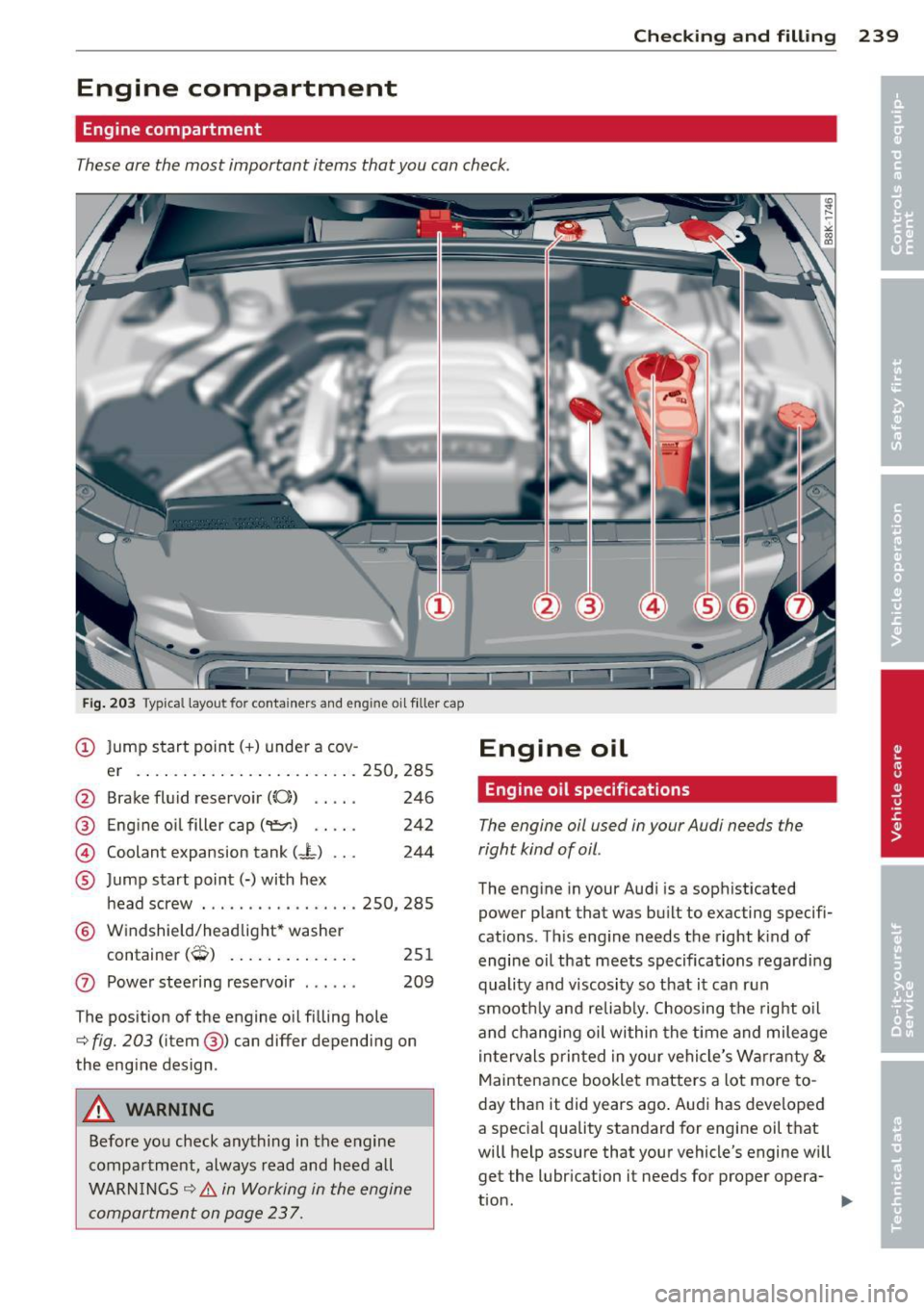
These are the most important items that you can check.
Fig. 203 Typical layout for contain ers and engine oil filler cap
(D Jump start point( +) under a cov -
er .. .. .. .. .............. .. 250, 285
@ Brake fluid reservoir ((0)) . . . . . 246
@ Eng ine oil filler cap ("t=:?1) . . . . . 242
@ Coolant expansion tank (J-) . . . 244
® Jump start point(-) with hex
head screw ..... .......... ..
250, 285
® Windshield/headlight* washer
container
(0) . . . . . . . . . . . . . . 251
(j) Power steering reservoir . . . . . . 209
The position of the engine oil filling hole
¢ fig. 203 (item @) can differ depending on
the eng ine design .
A WARNING
Before you check anything in the engine
compartment, always read and heed all
WARNINGS
¢ .& in Working in the engine
compartment on page 237.
-
Engine oil
Engine oil specifications
The engine oil used in your Audi needs the
right kind of oil .
The engine in your Audi is a sophisticated
power plant that was bu ilt to exacting specifi
cations . This eng ine needs the right k ind of
engine oil that meets specifications regarding
quality and viscosity so that it can run
smooth ly and reliab ly. Choosing the right oil
and changing oil within the time and mileage
intervals printed in your vehicle's Warranty
&
Maintenance booklet matters a lot more to
day than it did years ago . Audi has developed
a specia l quality standard for engi ne oil that
will help assure that your vehicle's engine will
get the lubrication it needs for proper opera-
tion. .,..
Page 248 of 316
246 Checking and filling
sca lding from hot coolant by following
these steps .
- Turn off the engine and allow it to cool
down.
- Protect your face, hands and arms from
escaping flu id and steam by cover ing
the cap with a large, thick rag.
- Turn the cap slowly and very carefully
in a counter-clockwise direction while
applying lig ht, downwa rd pressure on
the top of the cap.
- To avo id being burned, do not spill an
tifreeze or coolant on the exhaust sys
tem or hot engine parts . Under certain
conditions, the ethylene glyco l in en
gine coolant can catch f ire.
- Antifreeze is poisonous . Always store an
tifreeze in its or iginal container and we ll
out of the reach of children.
- If you drain the coolant, it must be
caught and safely stored in a proper con
tainer clear ly marked "poison".
@ Note
- Coolant pollutes the environment and
could cause an engine fire . Excess coo l
ant will be forced out through the pres
sure relief valve in the cap when the en
gine becomes hot.
- If, in an emergency, only water can be
added, the correct ratio between water
and antifreeze
c::> page 244 must be re
stored as soon as possible .
@ For the sake of the environment
Drained coolant should not be reused. Al
ways dispose of used coolant while observ
ing all environmental regulations .
Radiator fan
The radiator fan switches on automatically by
itself
T he radiator fan is driven by the engine via the
V-belt . The viscous clutch regulates the speed
of the fan according to the temperature of the
coolant. An auxiliary electric
radiator fan* switches on
and off depend ing on coolant temperature
and other vehicle operat ing condit ions .
After yo u sw itch the engine off, the auxiliary
f an can continue running for up to 10 minutes
- even with the ignit ion off. It can even switch
on again later by itself
c::> &., if
- the temperature of the engine coolant rises
due to the heat build-up from the engine in
the engine compartment, or
- the engine compa rtment heats up because
the vehicle is parked in i ntense sunlight.
_& WARNING
- To reduce the risk of personal injury nev
er touch the radiator fan.
- The auxiliary electric fan is temperature
controlled and can sw itch on suddenly
even when the engine is not running.
- The auxiliary radiator fan switches on au
tomatically when the engine coo lant
reaches a certain temperature and will
continue to run until the coolant temper
ature drops .
Brake fluid
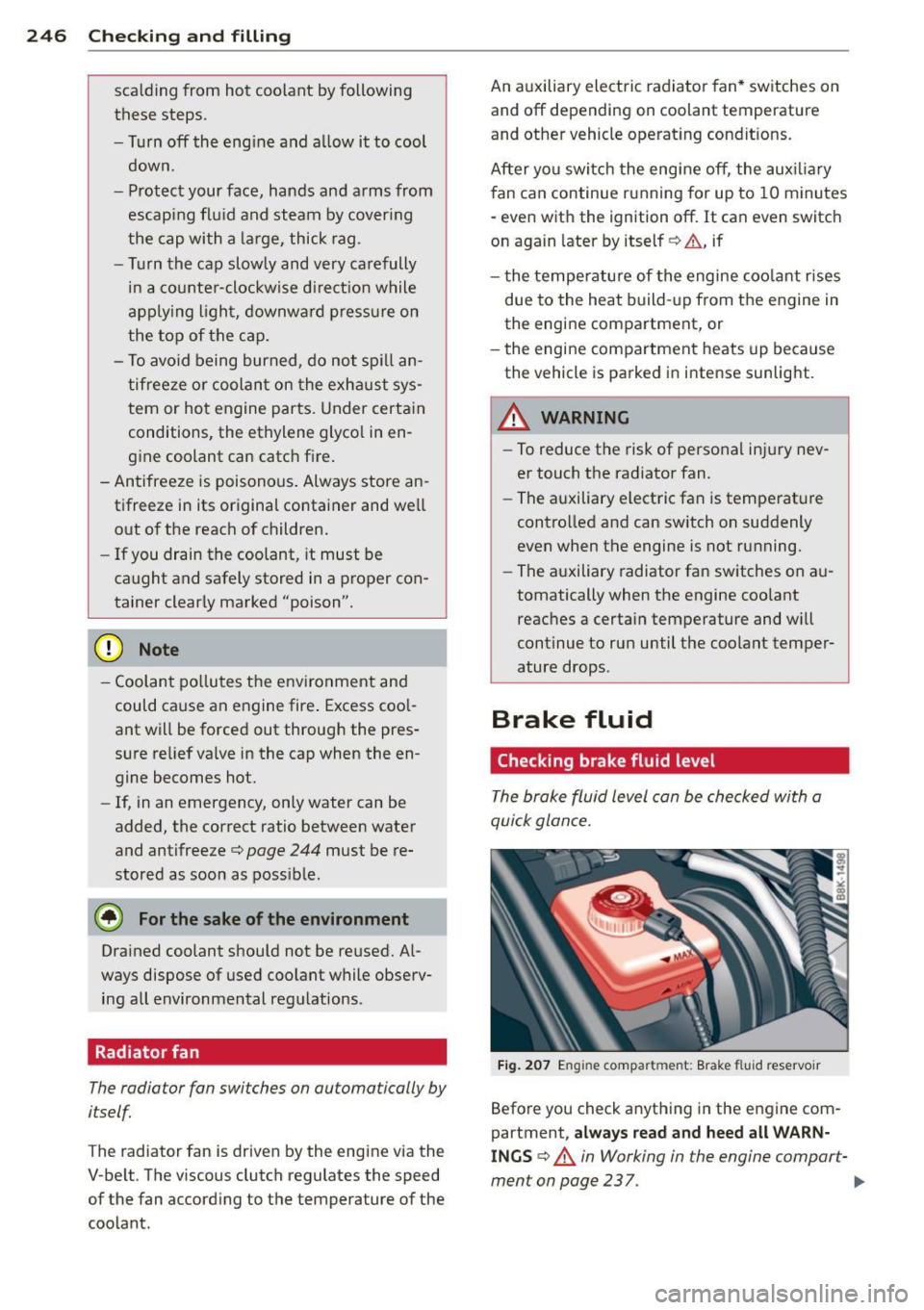
Checking brake fluid level
The brake fluid level can be checked with a
quick glance.
Fig. 207 E ngin e compart men t: B rak e fluid rese rvoir
Before you check anything in the engine com
partment,
always read and heed all WARN
INGS c::> A in Working in the engine compart-
ment on p~e 237.
~