ignition AUDI A5 COUPE 2012 Manual PDF
[x] Cancel search | Manufacturer: AUDI, Model Year: 2012, Model line: A5 COUPE, Model: AUDI A5 COUPE 2012Pages: 316, PDF Size: 78.59 MB
Page 239 of 316

Checking and filling Engine hood
Releasing the engine hood
The engine hood is released from inside the
vehicle .
Fig. 201 Dr iver's s ide footwell: engine hood release
lever
"' Open the driver's door .
"' Pull the release lever on the left under the
instrument panel
i=:> fig. 201 in the d irection
of the arrow.
The hood pops up slight ly under spring pres
sure.
Opening the engine hood
F ig . 202 Re lease lever under the engine hood
Before opening the engine hood, make sure
that the windshie ld wipers are flat against the
windshie ld. Otherwise, they could damage the
paint on the hood.
"' Pull up on the release under the hood
r::!> fig. 202 . This releases the catch.
"' Open the hood all the way
c::> &,.
Checkin g and fillin g 237
A WARNING
Hot engine coolant can burn you.
- To reduce the risk of being burned, never
open the hood if you see or hear steam
or coolant escaping from the eng ine
compartment. Wait unt il no steam or
coolant can be seen or heard before care
fu lly opening the hood.
Closing the engine hood
"' Pull the hood down un til the pressure from
the struts is reduced.
"' Let the hood
drop down and latch in p lace.
Do not try to push it shut; it may fail to en
gage
c;, &, .
A WARNING
--
A hood that is not completely latched
could fly up and b lock your view while dr iv
ing.
- When you close the engine hood, check it
to make sure the safety catch has p roper
ly engaged. The hood should be flush
with the surround ing vehicle body parts.
- If you notice while driv ing that the hood
is not secured prope rly, stop at once and
close it .
Working in the engine compartment
Be especially careful whenever you work in
the engine compartment.
Whene ver y ou must pe rform any wo rk in the
eng ine compartment, for e xample checking
and filling different fluids, th ere is a risk of
injury, burns and accid ent s. To pr event per
s o nal injury always observe the following
WARNINGS . The engine compa rtment of an y
vehicle i s a hazardou s are a
c;, Lh,.
A WARNING ~
To help avoid injury, be fo re yo u check any
thing under the hood:
- Tu rn off the engine.
- Remove the ignition key.
Page 240 of 316
238 Check ing and filling
- Apply the parking brake.
- Move selector lever of automatic trans- mission to "P" (Park); put manual trans
mission in Neutral.
- Always let the engine coo l down . Hot
components will burn skin on contact.
- To reduce the risk o f being burned, never
open the hood if you see or hear steam
or coolant escaping from the engine
compartment. Wait until no steam or
coolant can be seen or heard before care
fully opening the hood.
- Keep children away from the engine com
partment .
- Never spill flu ids on hot engine compo
nents. They can cause a fire.
- Never touch the radiator fan. The auxili
ary electr ic fan is temperature controlled
and can switch on suddenly.
- Never open the coolant reservoir cap when the eng ine is still warm. The cool
ant system is pressur ized and hot coo l
ant could spray out .
-Protect your face, hands and arm from
steam or hot eng ine coolant by placing a
thick rag over the cap when you open the coolant reservoir .
-If work on the fuel system or the electri
cal system is necessary :
- A lways disconnect the battery.
- Never smo ke or work near heaters or
open flames . Fluids in the engine com
partment co uld start a fire.
- Keep an approved fire ext inguisher im
mediately available.
- T o avoid ele ctrical shock and persona l in
jury while the engine is running or being
started, never touch:
- Ignition cables
- Other components of the high voltage
electronic ignition system.
- If you must perform a check or repa ir
with the engine running:
- Fi rst, fully apply the parking bra ke,
move se lec to r l ever o f automat ic trans- mission to
"P" (Park); put manua l
transmission in Neutra l.
- Always use extreme caution to p revent
clothing, jewelry, or long hair from get
ting caught in the radiator fan, V-belts
or other moving parts, or from contact ing hot parts. Tie back hair before
starting, and do not wea r clothing that
will hang o r droop into the engine.
- M inim ize exposure to em iss ion and
chemical hazards
~ &, .
A WARNING
=
Ca lifo rnia Proposition 65 Warning:
- Engine exhaust, some of its const ituents,
and certain vehicle components contain
or emit chemicals known to the State of
California to cause cance r and birt h de
fects and reproductive harm. In addition,
certain fl uids contained in veh icles and
certain products of component wear con
tain or emit chemicals known to the
State of California to cause cancer and
b irth defects or other reproductive harm.
- Battery posts, terminals and related ac
cessories conta in lead and lead com
pounds, chemicals known to the State of
California to cause cancer and reproduc
tive harms. Wash hands after handling.
(D Note
When adding flu ids, always make sure that
they are poured into the proper conta iner
or fil ler opening, otherwise serious dam
age to vehicle systems w ill occur.
@) For the sake of the environment
To detect leaks in time, inspect the vehicle
floor pan from underneath regular ly. If
you see spots from oil or o ther ve hicle flu
i ds, have your vehicle insp ected by a n au
thorized Audi dealer.
Page 244 of 316
242 Checking and filling
Checking the engine oil level
Fig . 204 MMI Display: O il leve l indicator
Read oil level
• Park your vehicle so that it is horizontally
level.
• Shut the engine off when it is at operat ing
temperature.
~ Switch only the ignition back on.
• Wait approx. two minutes.
• Se lect: Function button
,.., IC ,_..,A ,..,R,..., I > Oil level.
• Read the oil leve l in the MMI* Display
¢ fig. 204. Add eng ine oi l if the bar of the
o il level indicator is near "Min" ¢
page 242
Depending on the way the vehicle is driven
and the operating conditions, oil consumption
can be up to a 1/2 quart per 600 mi les (0.5 li
ter per 1,000 km) . Consumption may be high
er within the first 3,000 miles (5,000 km).
@ Tips
The oil level indicator in the MMI* Display
is only an information display. If the oil
level is too low, a min imum oil warning ap
pears in the instrument cluster. Add oil
¢
page 242. If the hood has been opened,
the current oil level is shown in the instru
ment cluster the next time the ignition is
switched on.
~ Adding engine oil
Fig. 205 E ngin e compart ment: O il filler cap locatio n
• Before you check anything in the engine
compartment,
always read and heed all
WARNINGS
¢ &. in Working in the engine
compartment on page
23 7 .
• Unscrew the cap 'l=;r: to the eng ine oi l filling
hole
¢ fig. 205.
• Carefully top off with the appropriate oil in
0.5 liter doses .
• Check the oil level again after two minutes
¢page 242.
• Top off the oil again, if necessary.
• Screw the cap back on the filling hole.
A WARNING ~
-Wh ile topping off, the o il must not come
in contact with hot engine parts -fire
hazard!
- The oil filler cap must be properly se
cured to prevent oil from being sprayed
on the hot engine and exhaust system
when the engine is running -fire hazard!
- If your skin has come in contact with the
engine o il, you must subsequently
cleanse it thoroughly.
(D Note
-Check the oil level using the radio or
MMI*. If the message
Please reduce oil
level
appears, contact your authorized
Audi deale r or other qualified workshop
to have excess oil extrac ted if necessary.
- Audi does not recommend the use of oil
additives. They may damage the engine
and adversely affect your New Vehicle
Warranty.
Page 246 of 316
244 Checking and filling
Engine cooling system
Coolant
The engine coolant performs two functions: it
keeps the engine from overheating and it pro
tects the engine from freezing in the winter .
The cooling system is sealed and generally re
quires little attention .
The cooling system has been filled at the fac tory with a permanent coolant which does not need to be changed. The coolant consists of a
mixture of water and the manufacturer's gly
col-basedcoolant additive G12++ antifreeze
with anticorrosion add itives (SO% for USA
models; 60% for Canadian models). This mix
ture bo th assures the necessary frost protec
tion and protects metal components in the
engine's coo ling system from corrosion and
scaling. It also raises the boiling point of the
coolant.
Do not reduce the concentration of the cool
ant in the summer by adding plain water .
The
proportion of coolant additive must be at
least 50 % but not more than 60%
to main
tain antifree ze protection and cooling efficien
cy. If the coolant frost protection is too low,
the coolant could freeze and damage the vehi
cle heating and engine cooling system .
For year-round driving, antifree ze is added at
the factory for temperatures down to:
- - 31°F (- 35 °C) USA
- -40°F ( - 40°C) Canada.
You can mix the G12 ++ coolant additive with
other additives (G12+ or G12). Always check
with your authorized Audi dealer.
_&. WARNING
Before you check anything in the engine
compartment, always read and heed all
WARNINGS ¢
A in Working in the engine
compartment on page 237.
(D Note
- Before winter sets in, have the coolant
checked to see if the coolant additive in your vehicle is sufficient to meet the cli
mate conditions. This is especia lly impor
tant if you live in a reg ion where the win
ter is extreme ly cold. If necessary, in
crease the proportion of coolant additive
to 60% .
- When adding coolant additive to your
cooling system, remember :
- We recommend using only coolant ad
ditive G12++ (check the label) for your
vehicle . This coolant additive is availa
b le at authorized Audi dealers . Other
types of antifreeze can significant ly re
duce corrosion protection. The result
ing corrosion can cause a loss of cool
ant and serious engine damage.
- Do not add any type of radiator leak seal
ant to your vehicle's engine coolant.
Add ing radiator repair fluid may adverse
ly affect the function and performance of
your cooling system and cou ld resu lt in
damage not covered by your New Vehicle
Limited Warranty.
Checking the engine coolant level
The engine coolant level can be checked with
a quick glance.
Fig. 206 E ngin e compart men t: Coo lant expans ion tank
.,. Before you check anything in the engine
compartment,
always read and heed all
WARNINGS ¢&. in Working in the engine
compartment on page 23
7.
.,. Turn off the ignition .
.,. Read the engine coolant level from the
coo lant expansion tank¢
fig. 206. With a
cold engine, the coolant level should be be-
tween the "MIN" and "MAX" markings . ..,..
Page 251 of 316
-Always wear eye protection. Do not let
battery acid or any lead particles get on
your skin or clothing. Shield your eyes .
Explosive gases can cause blindness or
other injury.
- Battery acid contains sulfuric acid . Sulfu
ric acid can cause blindness and severe
burns.
- Always wear gloves and eye protection.
Do not tilt the battery because acid
could leak out of the ventilation open
ings.
- If you get battery acid in your eyes or
on your skin, immediately rinse with
cold water for several minutes and get
medical attention .
- If you should ingest any battery acid,
seek medical attention immediately.
- Do not expose the battery to an open
flame, electric sparks or an open light.
- Do not smoke.
- Do not interchange the positive and neg-
ative cables .
= When working on the battery, be sure
not to short-circuit the terminals with
tools or other metal objects. This would cause the battery to heat up very quickly,
which could lead to damage or explosion and personal injury.
- When a battery is charged, it produces
hydrogen gas which is explosive and
could cause personal injury .
- Always keep the battery well out of the
reach of children.
- Before work is done on the electrical sys
tem, disconnect the negative ground ca ble .
- Before performing any work on the elec
trical system, switch off the engine and
ignition as well as any electrical equip
ment. The negative cable on the battery
must be disconnected . If you are just go
ing to replace a light bulb, then it is
enough to switch off the lights.
- Before disconnecting the battery, switch
off the anti-theft alarm system! Other
wise you will set off the alarm.
Checking and filling 249
-When disconnecting the battery, first
disconnect the negative cable and then
the positive cable.
- Before reconnecting the battery, make
sure all electrical consumers are switch
ed off. Reconnect the positive cable first
and then the negative cable . Never inter
change the cables -this could start a fire!
- Never charge a frozen or a thawed-out
battery . It could explode! If a battery has
frozen , then it must be replaced . A dis
charged battery can freeze over at 32°F
(QOC),
-Make sure the vent hose is always attach
ed to the opening on the side of the bat
tery .
- Never use batteries which are damaged.
There is the danger of an explosion! Al
ways replace a damaged battery.
&_ WARNING
California Proposition 65 Warning:
- Battery posts, terminals and related ac
cessories contain lead and lead com
pounds, chemicals known to the State of
California to cause cancer and reproduc
tive problems. Wash hands after han dling.
(D Note
- Do not disconnect the vehicle battery
when the ignition is switched on or when the engine is running, otherwise, you will
damage electronic components in the
electrical system.
- If your vehicle is going to stand for a
long period of time without being driven,
protect the battery from "freezing", oth
erwise it will be damaged and will then
have to be replaced.
•
•
Page 252 of 316
250 Checking and filling
Battery charging
Starting the engine requires a well charged
battery.
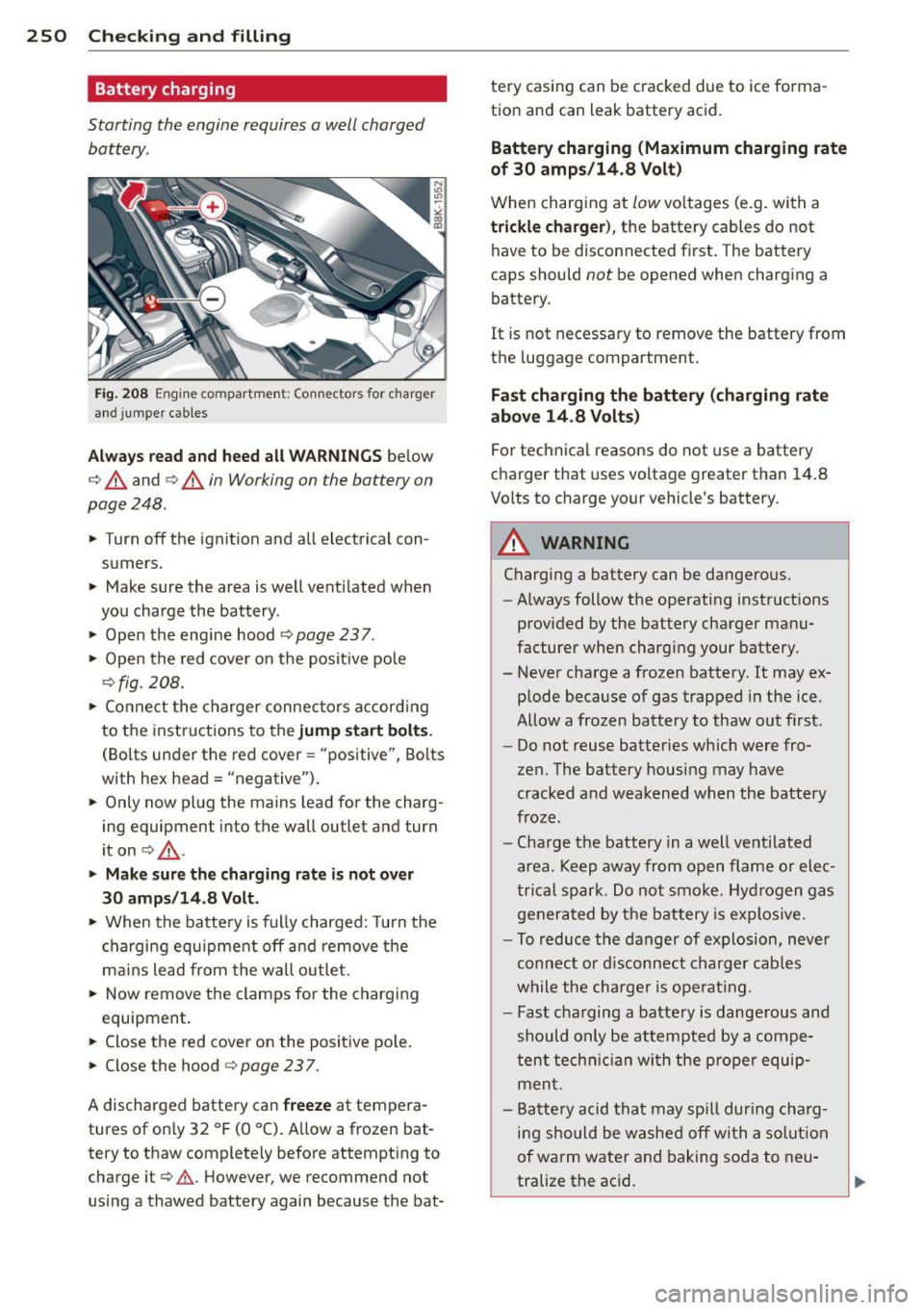
Fig. 208 Engine compartme nt: Connectors for charger
and jumper cables
Always read and heed all WARNINGS below
c:> A and c:> A in Working on the battery on
page 248 .
.,. Turn off the ignition and all electrical con
sumers.
> Make sure the area is well ventilated when
you charge the battery .
> Open the engine hood r:::.> page 237 .
> Open the red cover on the posit ive pole
<::.>fig . 208.
> Connect the charger connectors according
to the instructions to the
jump start bolts.
(Bolts under the red cover= "positive", Bolts
with hex head= "negative") .
> Only now plug the mains lead for the charg
ing equipment into the wall outlet and turn
iton
c:> &_ .
.,. Make sure the charging rate is not over
30 amps/14.8 Volt.
> When the battery is fully charged: Turn the
charging equipm ent off and
remove the
mains lead from the wall outlet.
> Now remove the clamps for the charging
equipment.
.,. Close the red cover on the positive pole.
> Close the hood c:> page 23 7.
A discharged battery can freeze at tempera
tures of on ly 32 °F (0 °C). Allow a frozen bat
tery to thaw completely before attempting to charge it
c:> .&. However, we recommend not
using a thawed battery again because the bat- tery casing can
be cracked due to ice forma
tion and can leak battery acid.
Battery charging (Maximum charging rate
of 30 amps/14.8 Volt)
When charging at low voltages (e.g. with a
trickle charger), the battery cables do not
have to be disconnected first. The battery
caps should
not be opened when charging a
battery.
It i s not necessary to remove the battery from
the luggage compartment.
Fast charging the battery (charging rate
above 14 .8 Volts)
For technical reasons do not use a battery
charger that uses voltage greater than 14.8
Volts to charge your vehicle's battery.
A WARNING
-----=--
Charging a battery can be dangerous.
- Always follow the operating instructions
provided by the battery charger manu
facturer when charging your battery.
- Never charge a frozen battery. It may ex
plode because of gas trapped in the ice.
Allow a frozen battery to thaw out first.
- Do not reuse batteries wh ich were fro
zen. The battery hous ing may have
cracked and weakened when the battery
froze.
- Charge the battery in a well ventilated
area . Keep away from open flame or elec
trica l spark. Do not smoke. Hydrogen gas
generated by the battery is explos ive.
- To reduce the danger of explosion,
never
connect or disconnect charger cables
while the charger is operating.
- Fast charging a battery is dangerous and
should only be attempted by a compe
tent technician with the proper equip
ment.
- Battery acid that may spill during charg
ing should be washed off with a solut ion
of warm water and baking soda to neu-
tralize the acid. ....
L..__ _____________ _J ...
Page 273 of 316

wheels on your vehicle to ensure that the re
p lacement or a lternate tires and wheels allow
the TPMS to continue to function properly .
Tire pressure indicator appears
Appl ies to vehicles: w ith t ire pressure monitoring sys te m
The tire pressure indicator in the instrument
cluster informs you if the tire pressure is too
low or if there is a system malfunction.
Fig . 2 15 Display: underin flati on wa rning
Fig. 216 Disp lay: System malfunction
Using the ABS sensors, the tire pressure moni
tor ing system compares the t ire tread circum
fe rence and vibration characteristics of the in
d iv idual tires.
If t he pressure decreases in one
or mo re tires, th is is indica ted in the instru
men t clus ter with a
[I] warning symbo l and a
message ¢
fig. 215. The driver message in the
disp lay goes out after 5 seconds . The drive r
message can be d isplayed again by pressing
the
! SET ! button. If only one tire is affected,
the display will indicate its pos ition.
The tire press ure monitoring system must be
reset via radio o r MM! * each time the p res
sures are adjusted (e.g . when sw itching be
tween partial and full load pressure) or after
changing or replacing a t ire on your vehicle
<::> page 2 72 . You can find the recommended
Tires and wheels 2 71
tire p ressu res for your vehicle on the label on
drive r's side B-pillar
c!;> page 256 .
Tire tread circumference and vibrat ion charac
teris tics can change and cause a tire pressure
warning if:
- t he t ire p ress ure in one or mo re tires is too
low,
- t he tir e has s tructural damage,
- the t ire pressu re was changed, w heels rotat-
ed or rep laced but the TPMS was not reset
c::>page272 .
Warning symbols
[I] Loss of pressure in at least one tire c::> .&. .
Check the tire or tires and replace or repa ir if
necessary . T he
[I] indicator l ight in the instru
ment cluster also illum inates
<::> page 13.
Check/cor rect the p ress ures of all fou r tir es
and reset TPMS via radio o r M MI*.
11@1@1 (Ti re Pressure Monito ring System) Tire
pre ssure! Sy stem ma lfunction .
Ifll@lf:1 appears after switching the ignition
on or while driving
c::> fig . 216 and the [I] indi
cator light in the instr ument cluster blinks for
approximately one m inute and then stays on,
there is a system malfunction. See your au
thorized Aud i de aler as soon as possible .
& WARNING ~
- If the tire pressure ind icator appears in
the instrument cluster display, one or more of your tires is significant ly unde r
inflated. Reduce your speed immediately
and avoid any hard steering or b raking
maneuvers. Stop as soon as possib le and
check the tires and their pressures . In
flate the tire pressure to the prope r pres
sure as indica ted o n the v ehicl e's tire
p ressu re labe l
c::>page 256. Driving on a
sig nifican tly un der- infla te d tire causes
the t ire to ove rheat and can lead to ti re
fa ilu re . Unde r-inflation also is l ikely to
impair the vehicle's hand ling and stop
ping ability .
Page 274 of 316
272 T ire s and wheel s
- The driver is responsible for maintaining
the correct tire pressures. You must
check the tire pressures regularly.
- Under certain conditions (such as a spor
ty driving style, winter condit ions or un
paved roads), the pressure monitor ind i
cator may be delayed .
- Ask your author ized Audi dealer if run
flat tires may be used on your veh icle.
Your vehicle regist rat ion becomes invalid
if you use these tires when not permit
ted. Damage to your veh icle or acc idents
cou ld also resu lt.
(D Tips
- The tire pressure monitoring system
stops working when there is an ESP/ABS malfunction.
- Using snow chains may result in a system
malfunction.
- To ensure a proper TPMS function use AUDI O riginal Tires wh ich are marked
with "AO" or "RO" on the tire sidewall.
¢page 263.
-The tire pressure monitoring system on
you r A udi was ca lib rated us ing tires w ith
the "AO" or "RO" identification. We rec
ommend using these tires .
Reset tire pressure monitoring system
Applies to vehicles: with tire pressure monito ring system
If the tire pressure is adjusted, wheels are ro
tated or changed, the TPMS must be reset via
radio or MM!*.
• Turn on the ignition.
• Se lect : the
ICARI function bu tton> Tire
pre ssure monitoring
> Store now .
@ Tips
Before resetting the TPMS, the current
pressu res of all four tires must correspond
to the specified values. Adjust the t ire
pressure and reset the pressure in the tire
pressu re monitoring system according to
the load you are carrying
¢ page 256 .
Page 283 of 316

Fuses and bulbs 281
No. Fuse Location, Instrument Panel right
8
Vehicle electrical system control
5
module 1
9 Adaptive Cruise Control
10 Shift gate
11 Heater washer flu id nozzles
12 Climate control
13 Cell phone prep 5
14 Airbag
s
15 Terminal 15 25
16 Terminal 15 engine
40
Fuse panel@ (brown)
1 Automatic dimming
interior s rearview mirror
2 Clutch sensor 5
3 Gasoline fuel pump 25
5 Left seat heating with/without
15/30
seat heating
Fig. 228 Righ t cockpi t: fuse panel wi th pla stic clip
6 Electronic Stabilization Program 10 No. Consumer
7 Horn 25 Fuse panel@ (black)
8
Left door window regulator mo-
30
tor 5
Steering column switch module
5
6 Electronic Stabilization Program 5
9 Wiper motor 30
10 Electronic Stabilization Program
25
7
Terminal 15 diagnostic connec-
5
tor
11 Left doors 15
12 Rain and light sensor 5
8
Gateway (Databus diagnostic in-
5
terface)
Fuse panel © (red)
Fuse panel@ (brown)
3 lumbar support
10
1 C0-/DVD player
5
4 Dynamic steering 35
2 Audi drive select switch module 5
5 Antenna (Avant)
5
3 MMI/Radio
5/20
6
Vehicle electrical system control
35
module
1
7
Vehicle electrical system control
20
module 1 Instrument cluster
5
5 Gateway (instrument cluster
5
control module)
6 Ignition lock 5
8
Vehicle electrical system control
30
module 1
9 sunroof 20
10 Vehicle electrical system control
30
module 1
7 Rotary light switch 5
8 Climate control system blower
40
9 Steering column lock 5
10 Climate control 10
11 sunroof shade (Avant) 20 11 Terminal 30
diagnostic connec-
tor 10
12 Convenience electronics
5
12 Steering column switch module
5
Page 292 of 316
2 90 General information
General information Explanation of
technical data
Some of the technical data listed in this man
ual requires further explanation .
The technical data for your vehicle is listed in
the charts starting on
r:::> page 292. This sec
tion provides general information, notes and restrictions which apply to this data .
Vehicle identification
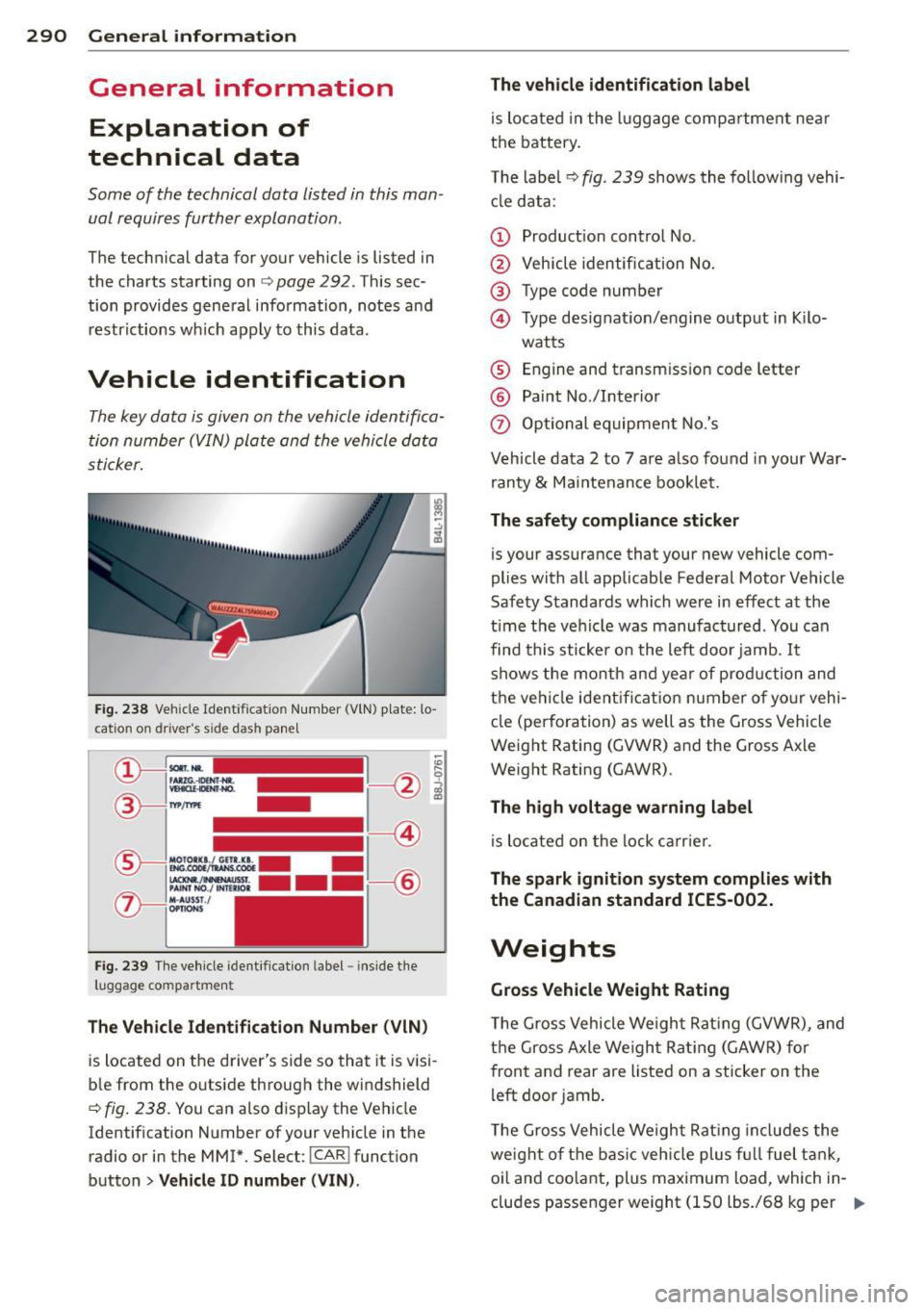
The key data is given on the vehicle identifica
tion number (VIN) plate and the vehicle data
sticker.
Fig. 238 Veh icle Ide ntific atio n Number (VlN) p late: lo
cation on driver 's sid e das h panel
Fig. 239 The vehicle identi fication label -inside the
luggage co mpa rtmen t
The Vehicle Identification Number (VIN)
is located on the driver's side so that it is visi
b le from the outside through the windshield
r:::> fig . 238. You can also display the Vehicle
Identification Number of your vehicle in the
radio or in the MM!*. Select :
!CAR ! function
button> Vehicle ID number (VIN). The
vehicle identification label
is located in the luggage compartment near
the battery .
The label¢
fig. 239 shows the following vehi
cle data :
(D Production control No.
@ Vehicle identification No.
® Type code number
@ Type designation/engine output in Kilo-
watts
® Engine and transmission code letter
@ Paint No./Interior
(f) Optional equipment No.'s
Vehicle data 2 to 7 are also found in your War
ranty
& Maintenance booklet.
The safety compliance sticker
is you r assurance that your new vehicle com
plies with all applicable Federal Motor Vehicle
Safety Standards which were in effect at the
t ime the vehicle was manufactured . You can
find this sticker on the left door jamb.
It
shows the month and year of production and
the ve hicle ident ification number of your vehi
cle (perforation) as well as the Gross Vehicle
Weight Rating (GVWR) and the Gross Axle
Weight Rating (GAWR) .
The high voltage warning label is located on the lock carr ier .
The spark ignition system complies with
the Canadian standard ICES-002.
Weights
Gross Vehicle Weight Rating
The Gross Vehicle Weight Rating (GVWR), and
the Gross Axle Weight Rating (GAWR) for
front and rear are Listed on a sticker on the
left door jamb.
The Gross Vehicle Weight Rating includes the
weight of the basic vehicle plus full fuel tank,
oi l and coolant, plus maximum load , wh ich in
cludes passenger weight (150 lbs./68 kg per
Ill>