lock AUDI A5 COUPE 2012 Manual Online
[x] Cancel search | Manufacturer: AUDI, Model Year: 2012, Model line: A5 COUPE, Model: AUDI A5 COUPE 2012Pages: 316, PDF Size: 78.59 MB
Page 247 of 316

When the engine is warm, the level may be
slightly above the
"MAX" marking.
The location of the coolant expansion tank
can be seen in the engine compartment illus
tration ¢ page 239.
To obtain an accurate reading, the engine must be switched
off.
The expansion tank in your vehicle is equipped
with an electric coolant level sensor.
When the coolant level is too low, the warning
light in the Auto-Check System ¢page
31 will
blink until you add coolant and the level has
been restored to normal. Even though there is
an electric coolant level sensor, we still rec
ommend you check the coolant level from
time to time.
Coolant loss
Coolant loss may indicate a leak in the cooling
system. In the event of coolant loss, the cool
ing system should be inspected immediately
by your authorized Audi dealer.
It is not
enough merely to add coolant.
In a
sealed system, losses can occur only if
the boiling point of the coolant is exceeded as
a result of overheating.
& WARNING
The cooling system is under pressure and
can get very hot. Reduce the risk of scald
ing from hot coolant by following these
steps.
- Turn
off the engine and allow it to cool
down.
- Protect your face, hands and arms from
escaping fluid and steam by covering the
cap with a large, thick rag.
- Turn the cap slowly and very carefully in
a counter-clockwise direction while ap
plying light, downward pressure on the
top of the cap.
- To avoid being burned, do not spill anti freeze or coolant on the exhaust system or hot engine parts. Under certain condi
tions, the ethylene glycol in engine cool
ant can catch fire.
Checking and filling 245
@ Note
Do not add any type of radiator leak seal
ant to your vehicle's engine coolant. Add
ing radiator repair fluid may adversely af
fect the function and performance of your
cooling system and could result in damage not covered by your New Vehicle limited
Warranty.
Adding coolant
Be very careful when adding engine coolant.
Before you check anything in the engine com
partment,
always read and heed all WARN
INGS ¢ & in Working in the engine compart
ment on page 23
7.
.,. Turn off the engine .
.,. let the engine cool down.
.,. Place a thick rag over the coolant expansion
tank ¢ page
244, fig . 206 and carefully turn
the cap counter-clockwise ¢
&_.
.,. Add coolant.
.. Twist the cap on again tightly.
Replacement engine coolant must conform to
exact specifications ¢ page
244, Coolant.
Even in an emergency, if coolant addi-
tive G12++, G12+ or G12 is
not available, do
not use a different additive. Use plain water
instead until you can get the correct additive
and can restore the correct ratio. This should
be done as soon as possible.
If you have lost a considerable amount of
coolant , then you should add cold antifreeze
and cold water only when the engine is cold.
Always use new engine coolant when refilling.
Do not fill coolant above the "MAX" mark. Ex
cess coolant will be forced out through the pressure relief valve in the cap when the en
gine becomes hot.
A WARNING
- The cooling system is under pressure and
can get very hot. Reduce the risk of ...,
•
•
Page 248 of 316
246 Checking and filling
sca lding from hot coolant by following
these steps .
- Turn off the engine and allow it to cool
down.
- Protect your face, hands and arms from
escaping flu id and steam by cover ing
the cap with a large, thick rag.
- Turn the cap slowly and very carefully
in a counter-clockwise direction while
applying lig ht, downwa rd pressure on
the top of the cap.
- To avo id being burned, do not spill an
tifreeze or coolant on the exhaust sys
tem or hot engine parts . Under certain
conditions, the ethylene glyco l in en
gine coolant can catch f ire.
- Antifreeze is poisonous . Always store an
tifreeze in its or iginal container and we ll
out of the reach of children.
- If you drain the coolant, it must be
caught and safely stored in a proper con
tainer clear ly marked "poison".
@ Note
- Coolant pollutes the environment and
could cause an engine fire . Excess coo l
ant will be forced out through the pres
sure relief valve in the cap when the en
gine becomes hot.
- If, in an emergency, only water can be
added, the correct ratio between water
and antifreeze
c::> page 244 must be re
stored as soon as possible .
@ For the sake of the environment
Drained coolant should not be reused. Al
ways dispose of used coolant while observ
ing all environmental regulations .
Radiator fan
The radiator fan switches on automatically by
itself
T he radiator fan is driven by the engine via the
V-belt . The viscous clutch regulates the speed
of the fan according to the temperature of the
coolant. An auxiliary electric
radiator fan* switches on
and off depend ing on coolant temperature
and other vehicle operat ing condit ions .
After yo u sw itch the engine off, the auxiliary
f an can continue running for up to 10 minutes
- even with the ignit ion off. It can even switch
on again later by itself
c::> &., if
- the temperature of the engine coolant rises
due to the heat build-up from the engine in
the engine compartment, or
- the engine compa rtment heats up because
the vehicle is parked in i ntense sunlight.
_& WARNING
- To reduce the risk of personal injury nev
er touch the radiator fan.
- The auxiliary electric fan is temperature
controlled and can sw itch on suddenly
even when the engine is not running.
- The auxiliary radiator fan switches on au
tomatically when the engine coo lant
reaches a certain temperature and will
continue to run until the coolant temper
ature drops .
Brake fluid
Checking brake fluid level
The brake fluid level can be checked with a
quick glance.
Fig. 207 E ngin e compart men t: B rak e fluid rese rvoir
Before you check anything in the engine com
partment,
always read and heed all WARN
INGS c::> A in Working in the engine compart-
ment on p~e 237.
~
Page 249 of 316
~ Read the brake fluid level from the brake
fluid reservoir ¢
fig. 207. The brake fluid
level must be between the "MIN" and
"MAX" markings .
The brake f luid reservoir is located at the rear
partition of the engine compartment on the
l eft side ¢
page 239 .
The fluid level may drop slightly after some
time due to the automatic adjustment of the brake pads . This is not cause for alarm .
If the brake fluid level falls considerably be
l ow the "M IN" mark, the brake wa rning/indi
cator light (U .S . mode ls: . , Canadian
models: . will come on
¢page 18 and
¢
page 30. Do not continue to operate the ve
h icle. The complete brake system shou ld be
thoroughly checked by an authorized Aud i
dealer or qualified workshop and the cause
corrected . If the brake fluid level is too low,
the brake warning/ind icator light will illum i
nate. Contact an autho rized Aud i deale r
im
mediately .
(D Tips
The brake f luid rese rvoir is located unde r
neath the cove r.
Changing brake fluid
Hove the broke fluid changed by an experi
enced technician .
Brake fluid absorbs moistu re from the a ir . If
the water content in the brake fluid is too
hi gh, cor rosion in the b rake system may result
after a per iod of t ime . The bo ili ng po int of the
b rake fluid w ill also decrease considerab ly and
decrease b raking performance.
Therefore, the brake flu id must be changed
e ver y two year s. Always use new b ra ke fluid
which confo rms to Federal Motor Vehicle
S tandard "FMVSS 1 16 DOT 4".
The brake flu id rese rvoi r can be difficult to
reac h, therefo re , we recommend that yo u
h ave the br ake fl uid changed by yo ur autho r
ized
Audi dealer . Your deale r has the co rrect
Checkin g and fillin g 247
tools, the right brake fl uid and t he know -how
to do this for you .
A WARNING
-Brake fl uid is poisonous. It must be stor
ed only in the closed or iginal container
out of the reach of children!
- Brake failure can res ult from o ld or inap
propriate brake f lu id. Observe these pre
cautions:
- Use only b rake fluid th at mee ts SA E
spe cificat ion
J 17 03 and conforms to
Fe dera l Mo to r Ve hicl e Standard 1 16.
Always check with yo ur authorized Au di
dealer to make sure yo u are using the
correct brake fluid. The cor rect type of
brake f luid is also ind icated on t he
brake f luid reservoir .
- The bra ke fl uid must be new. Heavy use
of the brakes ca n cause a vapor lock if
the b rake fluid is left i n the system too
long. This can se riously affect the effi
c iency of the b rakes as well as your
safety , T his could result in an accide nt.
(!) Note
Brake fluid will damage the pai nt of your
vehicle.
@) For the sake of the environment
Because of the prob lem of proper disposal
of brake fluid as well as the spec ial too ls
r equired an d the nec essary expertise, w e
r ecomme nd that yo u have th e brake flu id
c hanged by yo ur aut ho rize d Aud i dea le r.
Battery
General information
U nder normal oper ating cond itions, the bat
tery in your Audi does not need any ma inte
nance . With
high outside temperat ures or
lo ng da ily drives we recommend that you have
t h e e lectrolyte leve l che cked by an autho riz ed
A udi de aler or qu alified workshop. The elec
tro lyte leve l should also be checked e ach time
the battery is charged
¢ page 250 . 1J1>
•
•
Page 261 of 316
Remember that the vehicle manufacturer, not
the tire manufacturer, determines the correct
tire pressure for the t ires on your vehicle .
It is importan t to check the tire pressu re when
the t ires a re cold .
- Read the requ ired ti re p ressure from the tire
pressure label. On USA veh icles, the t ire
pressure label is located on the drive r's side
B-pi llar . On Canada vehicles, the tire pres
s u re label is located either on the driver's
s ide B-pi llar or inside the fue l filler flap . The
t ire press ure label lists the recommended
cold tire inflation pressures for the veh icle
at its max imum capacity weight and the
t ires that were on your vehicle at the time it
was manufactured . Fo r recommended t ire
pressures fo r normal load condit ions, please
see chapter
9page 256.
- T urn the valve stem cap counter-clockwise
to remove it from the tire valve .
- Place the air pressu re ga uge on the valve .
- The tire pressures should only be checked
and adjusted when the tires a re cold . The
s li ghtly raised p ressures of warm tires must
not be reduced.
- Adjust the tire pressure to the load you a re
c a rrying.
- Re install the valve stem cap o n the valve .
When should I check the ti re pres sure ?
The correct tire pressure is espec ially impor
tant at high speeds. The pressure should
therefore be checked at least once a month
and a lways befo re start ing a journey . Do not
forget to check the tire pressure for the spare
wheel.
When should I ad ju st the tire p re ss ures?
Adjust the tire pressure to the load you are
carry ing . After chang ing a wheel
or replacing
wheels you have to adjust the tire pressures
on all wheels. In addition , you must then in it i
alize the new tire pressures in the tire pres
sure mon itor ing system*
9 page 270.
Tire s an d wheel s 259
_& WARNING
Incorrect tire pressures and/or underinfla
tion can lead sudden tire fa ilure, loss of
control, collision, serio us pe rsonal injury
or even death.
- When the
ti] warn ing symbol appears in
the instrument cluster, stop and inspect
the t ires.
- Inco rrect tire pressure and/or underinfla
tion can cause increased tire wea r and
can affect the handling of the vehicle and
s topping ability.
- I nco rrect tire pressures and/or unde rin
f lation can a lso lead to sudden t ire fail
ure, including a blowou t and sudd en de
f lation, ca using loss of veh icle cont ro l.
- T he drive r is responsi ble for the co rrec t
tire pressures for all tires on the veh icle.
The appli cable pressure values a re locat
ed on a sticke r on the dr iver's side B -pil
lar or on the inside of the fuel filler flap.
- On ly when all tires on the vehicle are fil
led to the correct pressure, the t ire pres
sure mon itor ing system * can work cor
rectly.
- The use of incorrect tire pressu re va lues
can lead to acc idents or other damage.
Therefore it is essential that the driver
observe the spec ified t ire pressure values
for the tires and the correct pressures for
the function of th e ti r e p ress ure monito r
ing system*.
- Always inf late tires to the recommended
a nd correct t ire p ress ure before dr iv ing
off.
- Driving with unde rinflated tir es bend
mo re, lett ing t hem get too hot resulting
in tre ad separation, sudden tir e fa ilure
and loss of cont rol.
- Exces sive speed and/overloading can
cause heat b uild- up, s udden tire failure
an d l oss of cont rol.
- If the tire pressure is too low or too high,
the t ires will wear prema turely and the
vehicle wi ll not handle well.
- I f the tire is not fla t and you do not have
to change a wheel immedia tely, drive a t •
•
Page 268 of 316
26 6 T ire s and whee ls
- Never mount used tires on yo ur vehicle if
you are not sure of their "previous histo
ry." Old used tires may have been dam
aged even though the damage cannot be
seen that can lead to sudden tire failure
and loss of vehicle control.
- All four wheels must be fitted with radial
tires of the same type, size (roll ing c ir
cumference) and the same tread pattern.
Driv ing with different ti res reduces veh i
cle handling and can lead to a loss of
control.
- If the spare t ire is not the same as the
t ires that are mounted on the veh icle -
f or example with winte r tires -on ly use
the spare tire for a short period of time
and dr ive with extra care. Refit the nor
ma l road whee l as soon as safely possi
ble.
- Never drive faster than the maximum speed for which the tires on your veh icle
are rated because tires that are driven
faster than their rated speed can fail
suddenly.
- Overloading t ires cause heat build-up,
sudden tire failure, including a blowout
and sudden deflation and loss of control.
- Temperature grades apply to tires that
are properly inflated and not over or un
derinflated .
- For technical reasons it is not always
poss ible to use wheels from other vehi
cles -in some cases not even whee ls
from the same vehicle model.
- If you install wheel tr im discs on the ve
hicle whee ls, make sure that the air flow
to the brakes is not blocked. Reduced air
flow to the brakes can them to overheat, increasing stopping distances and caus
ing a collision.
0 Note
- For technical reasons , it is not general ly
possib le to use the whee l rims from oth
er vehicles . This can ho ld true for wheels
of the same vehicle type.
- If the spare tire is different from the
tires that you have mounted on your ve- hicle (fo
r example winter tires or wide
profi le tires), then use the spare tire for a
short period of time only and drive w ith
extra care. Replace the flat tire with the
tire matching the others on your vehicle
as soon as possib le.
- Never drive without the valve stem cap.
The va lves could get damaged.
@ For the sake of the env ironment
D ispose of o ld tires in accordance with the
l ocal requirements.
Uniform tire quality grading
- Tread wear
- Traction AA A B C
- Temperature ABC
Quality g rades can be found where applicab le
on the tire side wall between tread sho ulder
and maximum section width
~ page 263,
fig . 214.
For exampl e: Tread wear 200, Trac tion AA ,
Tempe rature A.
All passenge r car t ires must conform to Feder
al Safety Requirements in add ition to these
grades .
Tread w ear
The tread wear grade is a comparative rating
based on the wear rate of the t ire when tested
under controlled conditions o n a specified
government test course.
For example, a tire graded 150 would wear
one and one ha lf (1 1/2) times as well on the
gover nment course as a ti re g raded 100 .
The relative performance of tires depends upon the actual conditions of their use, how
ever, and may depart s ignificantly from the
no rm due to va riations i n driving hab its, se rv
ice practices and differences in road charac ter
istics and cl imate.
Traction
The traction grades, from highest to lowest,
are AA, A, Band
C. Those grades represent the ..,.
Page 270 of 316
268 Tire s and wheel s
speed before driving off . Never drive faster
than the speed permitted for your specific
winter t ires. This will cause damage to the
tires leading to an accident and serious
personal injury to you and your passen
gers .
A WARNING
Driv ing faster than the maximum speed
for which the w inter t ires on your vehicle
were designed can cause tire fa ilu re in
cluding a blowout and sudden deflat ion,
loss of control, crashes and serious per
sonal injuries. Have worn or damaged tires
rep laced immed iate ly.
- Winter tires have maximum speed rating
that may be lower than your vehicle's
maximum speed .
- Never drive faster t han the speed for
which the winter or other tires installed
on your vehicle are rated.
A WARNING
Always adjust your driving to the road and
traffic conditions. Never let the good ac
celeration of the winte r tires and all -wheel
drive tempt you into taking extra r is ks. Al
ways remembe r:
- When brak ing, an all -wheel drive vehicle
handles in the same way as a front drive
vehicle .
- Drive carefu lly and reduce your speed on
icy and slippery roads, even winter tires
canno t he lp under black ice condit io ns.
@ For the sake of the environment
Use summer tires when weather cond i
tions permit . They are quieter, do not wea r
as quickly and reduce fue l consumption .
Snow chains
Snow chains may be fitted on ly to the front
wheels, a nd only to certa in tire sizes. Ask yo ur
author ized Audi dealer on wh ich tire sizes
snow chains can be used. The snow chains must have
low -profile links
and must not be thicker than 0 .53 inch
(13.S mm), includ ing the lock.
Remove whee l cen ter cove rs and t rim discs
before putting snow chains on your vehicle
¢ 0 . For safety reasons cover caps m ust then
be fitted over the wheel bolts. These are avail
a ble from authori zed Aud i dealers.
A WARNING
Using the wrong snow chains for your veh i
cle o r instal ling them incorrectly can in
crease the risk of loss of cont rol leading to
serious pe rsonal injury .
- Snow chains are available in different
sizes . Always make sure to follow the in
structions p rov ided by t he snow cha in
manufac turer.
- When driving with snow cha ins never
d rive faster than the speed permitted for
your specifi c snow chains.
- Always observe local regulations.
@ Note
-Remove snow chains before dr iv ing o n
roads not covered with snow to avoid
damaging tires and wea ring the snow
chains down un necessa rily .
- Snow chains, which come into direc t con
tact with the whee l rim, can scratch or
damage i t. Therefo re , make sure tha t the
snow chains are s uitably covered. Check
t he pos ition of t he snow chains after
driving a few yards and correct if neces
sary. Follow the inst ructions from the
snow chain man ufacturer when do ing so.
(I) Tips
Where snow chains are mandatory on cer
tain roads, th is normally a lso applies to ve
hicles w ith all whee l dr ive .
Page 275 of 316
What do I do now?
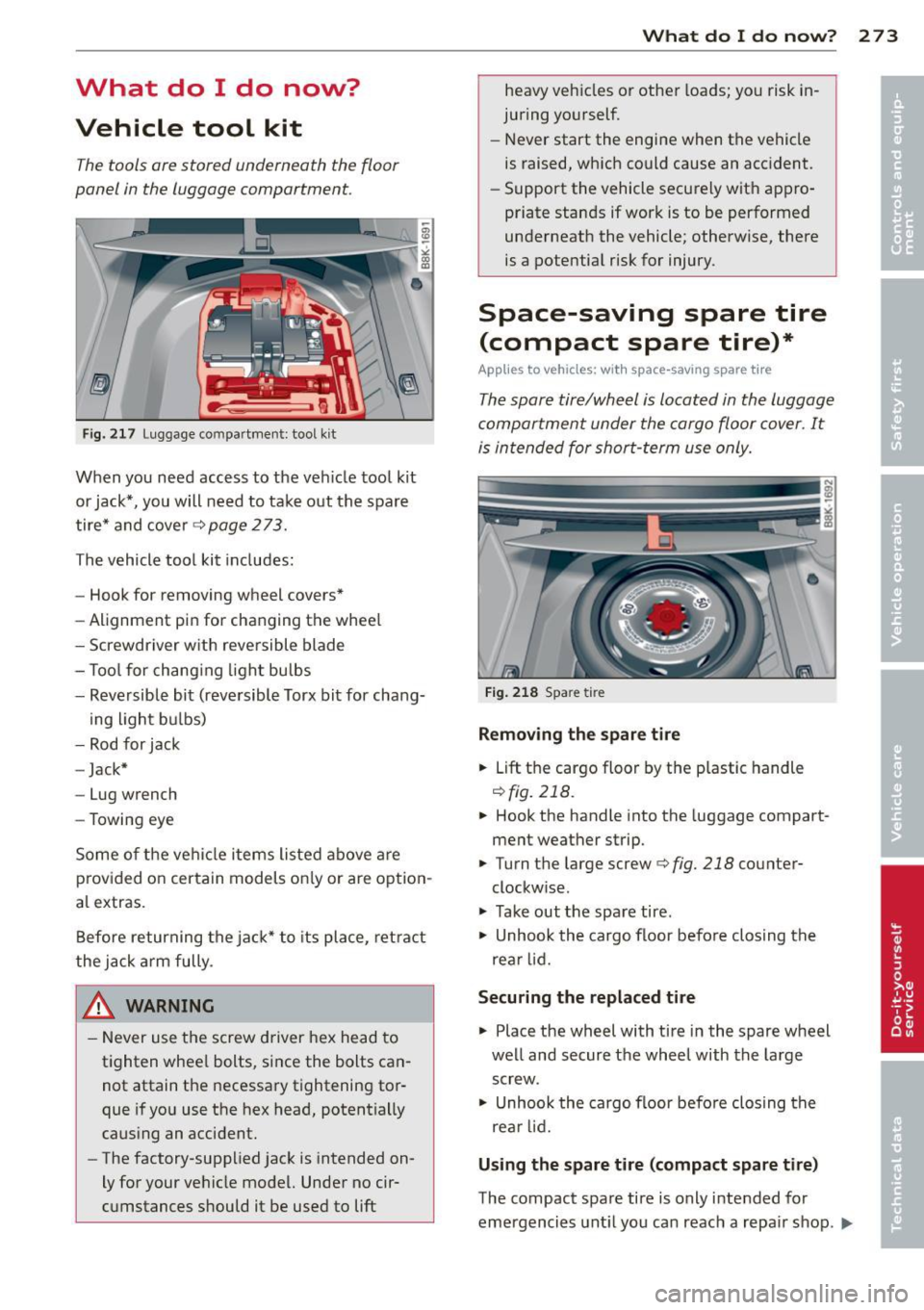
Vehicle tool kit
The tools ore stored underneath the floor
panel in the luggage comportment.
F ig . 2 17 Lug gage compar tment: tool kit
When you need access to the veh icle tool kit
or jack*, you will need to take o ut the spare
tire* and cover¢
page 2 73.
The vehicle tool kit includes:
- Hook for removing wheel covers*
- Alignment pin for changing the whee l
- Screwdriver w ith reversible blade
- T ool for chang ing light bulbs
- Reversible bit (reve rsible Torx bit for chang-
ing light b ulbs)
- Rod for jack
- Jack*
- Lug wrench
- Towing eye
Some o f the ve hicle items listed above are
p rov ided o n certain models on ly or are opt ion
a l extras.
Before returning the ja ck* to its place, ret ract
the jack a rm fully.
& WARNING
- Never use t he screw driver hex head to
tighten whee l bolts, since the bolts can
not attain the necessary tightening tor
que if yo u use the hex head, potentially
caus ing an accident.
- The factory-supplied jack is intended on
ly for your ve hicle model. Unde r no cir
c u mstances should it be used to
lift
What do I d o now ? 273
heavy ve hicles o r other loads; yo u risk in
juring yo urself.
- Never start the engi ne when the vehicle
is raised, which could cause an acc ident.
- Support the vehicle secu re ly wit h app ro
priate stands if wor k is to be performed
underneath the vehicle; otherwise, there
is a pote ntia l risk for injury .
Space-saving spare tire
(compact spare tire)*
App lies to vehicles: wit h space-saving spare tire
The spore tire/wheel is located in the luggage
comportment under the cargo floor cover. It
is in tended for short -term use only.
Fi g. 2 18 Spa re tire
Removing the spare ti re
.. Lift
th e cargo floo r by the p lastic handle
r:!) fig. 218.
.. Hook the handle into the luggage compart
ment weather strip.
.. Turn t he large screw¢
fig. 218 counter
clockw ise .
.. Take out the spare tire .
.. Unhook the cargo floor befo re clos ing the
re ar l id.
Securing the repl aced tire
.. Place the wheel with tire in the spare wheel
we ll and secure the wheel with the large
screw.
.. Unhook the cargo floor befo re closing t he
re ar lid .
Using the spare tire (compact spare tire)
The compact spa re tire is only i ntended for
emergencies unt il you ca n reach a repa ir shop .
l)JI,
Page 277 of 316
A WARNING ,~ -
You or your passengers could be injured
while changing a wheel if you do not fol
low these safety precautions:
- If you have a flat tire, move a safe dis
tance off the road. Turn off the engine,
turn the emergency flashers on and use
other warning devices to alert other mo
torists.
- Make sure that passengers wait in a safe
place away from the vehicle and well
away from the road and traffic.
- To help prevent the vehicle from moving
suddenly and possibly slipping off the
jack, always fully set the parking brake
and block the wheel diagonally opposite
the wheel being changed with the fold
ing chocks or other objects. When one
front wheel is lifted off the ground, plac
ing the Automatic Transmission in "P"
(Park) will
not prevent the vehicle from
moving .
- Before you change a wheel, be sure the
ground is level and firm. If necessary,
use a sturdy board under the jack.
- After installing the inflatable spare tire,
make sure that you replace the flat tire/
wheel in its storage area properly and
tighten the knurled retaining screw se
curely.
0 Note
If you are changing the wheel on a steep
incline, use a rock or similar object to
block the opposite wheel to prevent the
vehicle from moving.
(D Tips
Obey all laws.
Changing a wheel
When you change a wheel, follow these
quence described below step-by-step and in
exactly that order .
1. Remove the decorative wheel cover* or
the
wheel bolt caps* . For more details see
What do I do now? 275
also ~ page 2 76, Decorative wheel cov
ers
or ¢ page 2 76, Wheels with wheel
bolt caps.
2. Loosen the wheel bolts ¢ page 276.
3. Locate the proper mounting point for the
jack and align the jack below that point
¢page 277 .
4.
Lift the car with the jack ¢ page 2 77.
5. Remove the
wheel with the flat tire and
then install the
spare tire ¢page 278.
6. Tighten all wheel bolts lightly.
7.
Lower the vehicle with the jack.
8. Use the wheel bolt wrench and
firmly
tighten all wheel bolts in a crisscross pat
tern ¢
page 2 76.
9. Replace the
decorative wheel cover* or
the
wheel bolt caps* .
A WARNING
Always read and follow all WARNINGS and
information ~.&.
in Raising the vehicle on
page
277 and ¢page 279.
After changing a wheel
A wheel change is not complete without the
doing the following.
"' Store and secure the wheel you replaced in
the spare wheel well.
"' Replace the tools and the jack in their prop
er location.
"' Check the
tire pressure of the spare tire as
soon as possible.
"' As soon as possible, have the
tightening
torques
on all wheel bolts checked with a
torque wrench. The correct tightening tor
que is 90 ft lbs. (120 Nm).
"' Have the flat tire
replaced as soon as possi
ble.
(D Tips
- If you notice that the wheel bolts are
corroded and difficult to turn while
changing a tire, they should be replaced
before you check the tightening torque .
- Drive at reduced speed until you have the
tightening torques checked. •
•
Page 278 of 316
276 What do I do now?
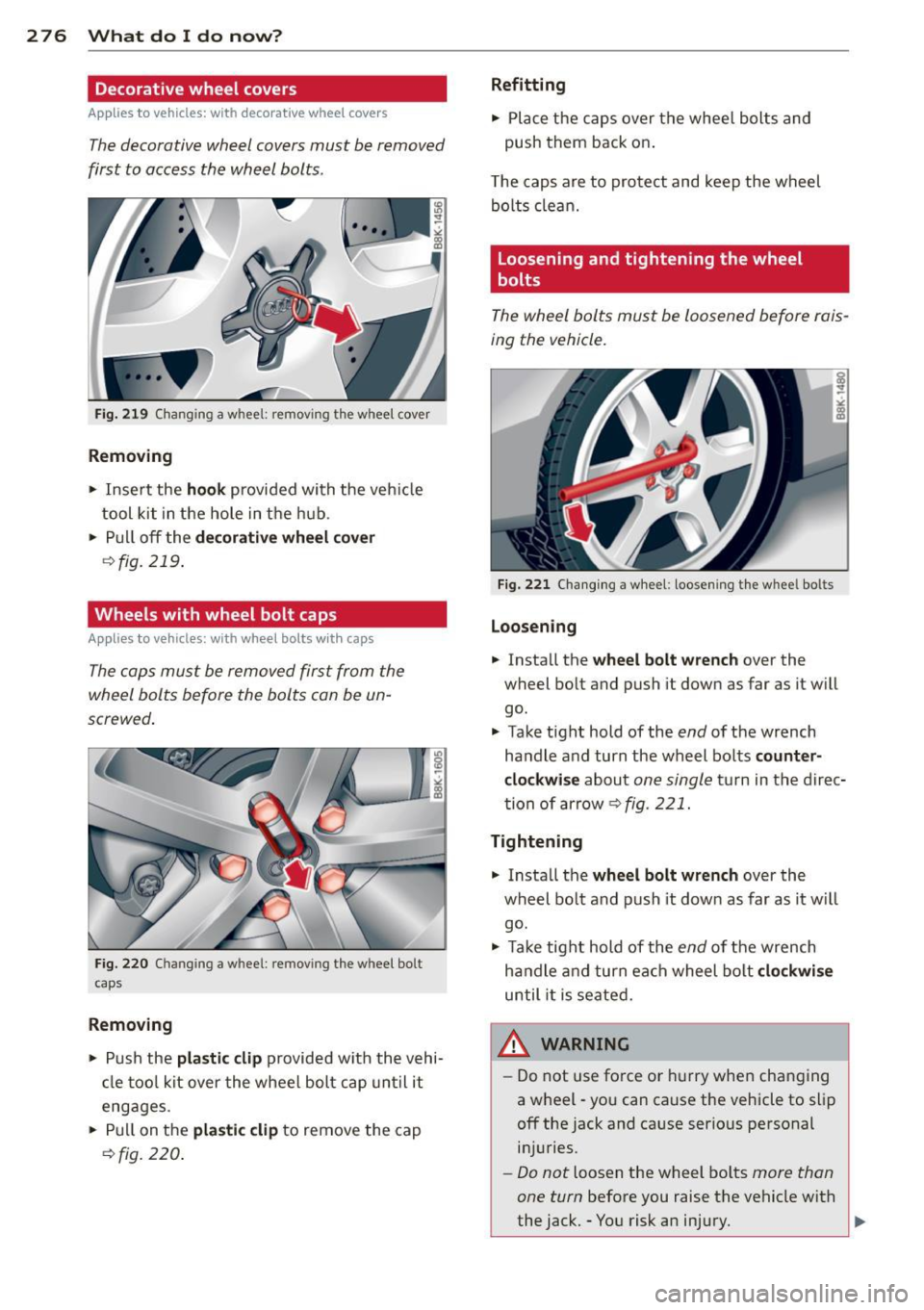
Decorative wheel covers
Applies to vehicles: with decorative wheel covers
The decorative wheel covers must be removed
first to access the wheel bolts .
Fig. 219 Changing a w heel: remov ing the wheel cover
Removing
.. Insert the hook provided with the veh icle
tool kit in the hole in the hub .
.. Pull off the
decorative wheel cover
~fig. 219.
Wheels with wheel bolt caps
Applies to vehicles: with wheel bolts w ith caps
The caps must be removed first from the
wheel bolts before the bolts con be un
screwed .
Fig. 220 Chang ing a w hee l: remov ing the w heel bo lt
c aps
Removing
.. Push the plastic clip provided with the vehi
cl e too l kit over the wheel bolt cap until it
engages.
.. Pull on the
plastic clip to remove the cap
9fig . 220.
Refitting
.. Place the caps over the whee l bolts and
push them back on .
T he caps are to protect and keep the wheel
bolts clean.
Loosening and tightening the wheel
bolts
The wheel bolts must be loosened before rais
ing the vehicle.
Fig. 221 Changing a wheel: loosening the w hee l bo lts
Loosening
.. Insta ll the wheel bolt wrench over the
wheel bolt and push it down as far as it w ill
go.
.. Take tight hold of the
end of the wrench
handle and turn the wheel bolts
counter
clockwise
about one single turn in the direc
tion of arrow
c;, fig. 221.
Tightening
.. Install the wheel bolt wrench over the
wheel bolt and push it dow n as far as it will
go .
.. Take tight hold of the
end of the wrench
handle and turn ea ch wheel bolt
clockwise
until it is seated.
,&_ WARNING
-= -
- Do not use force or hurry when changing
a wheel -you can cause the vehicle to slip
off the jack and cause serious personal
injuries.
- Do not loosen the wheel bolts more than
one turn
before you raise the vehicle with
the jack. -You risk an injury. ..,.
Page 280 of 316

278 What do I do now ?
-Make sure that passengers wait in a
safe p lace away from the vehicle and
well away from the road and t raffic.
- Make sure jack position is correct , ad
just as necessary and then continue to ra ise the jack.
Taking the wheel off/installing the spare
tire
Follow these instructions step-by-step for
changing the wheel.
F ig . 224 Changing a whee l: usi ng the screwdrive r ha n
dle (with th e blade removed} to turn th e bo lts
Fi g. 225 Changing a whee l: a lignm en t pi n insid e t he
top hole
Afte r you have loosened a ll wheel bolts and
r a ised the veh icle off the ground, remove and
r eplace the wheel as follows:
Removing the wheel
" Remove the topmost wheel bo lt completely
with the
hexagonal socket in the screwdr iv
er hand le (vehicle tool kit)
~ fig. 224 and
set it as ide o n a
clean surface.
" Screw t he thre aded end of the
alignment
pin
from the too l ki t hand -tig ht into the
empty bolt hole ~
fig. 225.
" Then remove the other wheel bo lts as de
scribed above. "
Take off the whee l leaving the a lignment
pin in the bolt hole
~CD .
Putting on the inflatable spare tire
" Push the spa re tire over the alignmen t pin.
" Scr ew on t he wheel bolts an d tig hten them
slightly u sing t he hexagona l socket .
" Remove the a lignment pin and insert and
tighten the rema ining wheel bolt slightly
like the rest.
" Turn the jack hand le counter-clockwise to
lower the vehicle until the jack is fully re
leased .
" Use the wheel bo lt wrench to tighten all
wheel bo lts firm ly
~page 276. Tighten
t hem
in a criss cross pattern, from one bolt
to the ( approxim ate ly) opposite one, to keep
t he whee l cen tered .
" Perform the steps required after c hangin g
the whee l~
page 275, After changing a
wheel.
T he hexagonal socket ma kes it easie r to re
move t he whee l bolts from the rim . Care
sho uld be taken when removing the reversible
blade .
(D Note
When removi ng or insta lling the whee l,
the r im cou ld hit the b rake r oto r and dam
age the rotor. Work caref ully and have a
second pe rson to help you.
(@ Tips
- Wh en mount ing tires w ith unidirectional
tread design
make sure the tread pat
tern is po inted the right way
~ page 279.
-The wheel bolts s hou ld be clean and easy
to turn. Check for dirt and corrosion on
the mating surfaces of both the w heel
and the hub. Remove all d irt fro m these
surfaces be fo re remounting th e whee l.
- Do not use the he xagonal socket in the
sc rewd river handl e to loosen or t ight en
t he whee l b olt s.