lock AUDI A5 COUPE 2012 Repair Manual
[x] Cancel search | Manufacturer: AUDI, Model Year: 2012, Model line: A5 COUPE, Model: AUDI A5 COUPE 2012Pages: 316, PDF Size: 78.59 MB
Page 197 of 316
the child's body and the front of the passen
ger compartment, the airbag can inflat e com
p letely and provide supplemental protection
in certa in frontal col lisions .
_&. WARNING
Not using a booster seat, us ing the boos
ter seat improperly, incorrect ly installing a
booster seat or using the vehicle safety
belt improperly increases the risk of seri
ous personal injury and death in a collision
or ot her eme rgency s ituation. To help re
duce t he risk of ser ious persona l injury
and/or death:
- Always make sure to position the should
er port ion of the three -po int bel t over
the middle of chi ld's sho ulder.
- Never let the shoulder port ion of the be lt
rest against or across the neck , face,
chin, or throat of the child .
- Always make sure the lap belt portion o f
the three-po int be lt is worn sn ug and
passes as low as possib le across the
child's pelvis. Never let the belt pass over
the soft abdomen.
- Failure to properly route sa fety belts
over a ch ild's body will cause severe inju
ries in an acc ident or other emergency
situation
¢page 154.
-The rear s ide of the booster seat should
be pos it ioned as close as poss ible to the
backrest on the vehicle seat . Adjust or re
move the rear seat head rest raint if it is
difficult to install the child seat w it h the
head restraint in place¢
page 67. Insta ll
the head res train t again immedia tely
once the child seat is removed . Dr iving
without head rest raints or with head re
straints that are not properly adj usted
increases the risk of ser ious o r fatal neck
injury dramat ically.
- Children on the front seat of any car,
even with Advanced A irbags, can be seri
o usly injured or even killed when an a ir
bag inf lates.
- Never let a child stand or knee l on any
seat.
Child Sa fet y 195
-Never let a chi ld r ide in the cargo area of
your veh icle.
- Always remembe r th at a c hild leaning
forward, sitting sideways or out of posi
tion in any way d uring an accident can be
struck by a dep loying a irbag. This will re
sult in ser ious personal inju ry or death .
- If you must install a booster seat on the
front passenger seat because of excep
tional ci rcumstances the
PASSENGER
AIR BAG OFF
li ght m ust come o n and
s tay on, whenever the ignition is switch
ed on .
- I f the
PASSENGER AIR BAG OFF light
does not come on and stay on, pe rform
the c heck s descr ibed
¢ page 173, Moni
toring the Advanced Airbag System .
- Take the chi ld restraint off the fron t pas
senger sea t and inst all it prope rly at one
of the rear sea t positions if the
PASSEN
GER AIR BAG OFF
li ght does not stay on
whenever the ignit ion is switched on .
-A lways read an d heed a ll WAR NIN GS
wheneve r us ing a chi ld restrained in ave
hicle is being used
¢ page 154, Safety
belts,
¢ page 162, Airbag system and
¢ page 186, Important things to know.
Installing a child safety
seat
Securing a child safety seat using a
safety belt
Safety belts for the rear seats and the front
passenger's sea t con be locked w ith the con
ver tible locking re tractor to properly secure
child safety seats .
The safety belts emergency locking ret ractors
for the rear seats safety bel ts and for the
front passenger's seat safety be lt have a co n
vertib le locking retractor for child rest raints.
T he safety belt must be locked so that be lt
webb ing cannot unreel. The retractor can be
activated to lo ck the safe ty belt and prevent
t h e safety be lt webbing from looseni ng up
during norma l dr iving . A chi ld safety seat can
o nl y be properly installed when the safety belt...,
•
•
Page 198 of 316
196 Child Safety
is locked so that the child and child safety
seat will stay in place.
Always remember: Even though your vehicle is
equipped with an Advanced Airbag system, all
children, especially those 12 years and young
er, should always ride in the back seat proper ly restrained fo r their age and weight.
.&_ WARNING
Improperly installed child safety seats in
crease the risk of serious personal injury
and death in a collision.
- Always make sure that the safety belt re
tractor is locked when installing a child
safety seat . An unlocked safety belt re
tractor cannot hold the child safety seat in place during normal driving or in a
crash .
- Always buckle the child safety seat firmly
in place even if a child is not sitting in it.
A loose child safety seat can fly around
during a sudden stop or in a collision.
- Always make sure that the rear seat
backrest to which the center rear safety
belt is attached is securely latched when
ever the rear center safety belt is being
used to secure a child restraint.
- If the backrest is not securely latched, the child and the child restraint will be
thrown forward together with the back
rest and will strike parts of the vehicle
interior. The child can be seriously in
jured or killed.
- Never install rearward-facing child safety
seats or infant carriers on the front pas
senger seat . A child will be seriously in
jured and can be killed when the passen
ger airbag inflates.
- The inflating airbag will hit the child
safety seat or infant carrier with great
force and will smash the child safety seat
and child against the backrest, center
armrest, door or roof.
- Always install rearward-facing child safe
ty seats or infant carriers on the rear
seat. -
Forward-facing child safety seats or in
fant carriers installed on the front pas
senger 's seat may interfere with the de
ployment of the airbag and cause serious
injury to the child .
- It is safer to install a forward-facing
child safety seat on the rear seat.
- Always read and heed all WARNINGS
whenever using a child restrained in ave
hicle is being used
~ page 186. Special
precautions apply when installing a child
safety seat on the front passenger seat
~ page 163, Child restraints on the front
seat -some important things to know.
.&_ WARNING
-
Always take special precautions if you
must install a forward or rearward-facing
child restraint on the front passenger's
seat in exceptional situations:
- Whenever a forward or rearward-facing
child restraint is installed on the front
passenger seat, the
PASSENGER AIR
BAG OFF light must come on and stay on
whenever the ignition is switched on.
- If the
PASSENGER AIR BAG OFF light
does not come on and stay on, perform
the checks described
~ page 173, Moni
toring the Advanced Airbag System.
- Take the child restraint off the front pas
senger seat and install it properly at one
of the rear seat positions if the
PASSEN
GER AIR BAG OFF
light does not stay on
whenever the ignition is switched on.
- Improper installation of child restraints
can reduce their effectiveness or even
prevent them from providing any protec
tion.
- An improperly installed child restraint
can interfere with the airbag as it de
ploys and seriously injure or even kill the
child.
- Always carefully follow the manufactur
er's instructions provided with the child
safety seat or carrier.
Page 199 of 316
-Never place additional items on the seat
that can increase the total weight regis
tered by the weight-sensing mat and can
cause injury in a crash .
_&. WARNING
Forward-facing child restraints:
- Always make sure the forward-facing
seat has been designed and certified by
its manufacturer for use on a front seat
with a passenger front and side airbag .
- Never put the forward-facing child re
straint up, against or very near the in
strument panel.
-Always move the passenger seat into its
rearmost position in the seat's fore and
aft adjustment range, as far away from
the airbag as possible before installing
the forward-facing child restraint. The
backrest must be adjusted to an upright
position.
- Make sure that the
PASSENGER AIR BAG
OFF
light comes on and stays on all the
time whenever the ignition is switched
on.
_&. WARNING
Rearward-facing child restraints:
- A child in a rearward-facing child safety
seat installed on the front passenger
seat will be seriously injured and can be
killed if the front airbag inflates -even
with an Advanced Airbag System.
- The inflating airbag will hit the child
safety seat or infant carrier with great
force and will smash the child safety seat
and child against the backrest, center
armrest, door or roof.
- Always be especially careful if you must
install a rearward facing child safety seat
on the front passenger seat in exception
al circumstances.
-A tight tether strap on a rearward-facing
child restraint attached to the front pas
senger seat can put too much pressure
on the weight-mat in the seat and regis
ter a heavier weight in the Advanced Air-
Child Safety 197
bag System. The heavier weight regis
tered can make the system work as
though an adult were on the seat and de ploy the Advanced Airbag when it must
be suppressed causing serious or even
fatal injury to the child.
- Make sure that the
PASSENGER AIR BAG
OFF
light comes on and stays on all the
time whenever the ignition is switched
on .
- If the
PASSENGER AIR BAG OFF light
does not come on and stay on, immedi
ately install the rearward-facing child
safety seat in a rear seating position and
have the airbag system inspected by your
authorized Audi dealer.
Activating the convertible locking
retractor
Use the convertible locking retractor to se
cure a child restraint.
Always heed the child safety seat manufactur er 's instructions when installing a child re
straint in your vehicle. To activate the conver
tible locking retractor:
.. Place the child restraint on a seat, prefera
bly on the rear seat.
.. Slowly pull the belt
all the way out.
.. Route it around or through the child re
straint belt path
c:> ,&. .
.. Push the child safety seat down with your
full weight to get the safety belt really tight.
.. Insert the belt tongue into the buckle for
that seating position .
.. Guide the safety belt back into the retractor
until the belt lies flat and snug on the child
safety seat.
.. You should hear a "clicking" noise as the
belt winds back into the inertia reel. Test the
convertible locking retractor by pulling on
the belt. You should no longer be able to
pull the belt out of the retractor. The con
vertible locking retractor is now activated .
.. Make sure that the red release button is fac
ing away from the child restraint so that it
can be unbuckled quickly. .,. •
•
Page 200 of 316
198 Child Saf ety
• Pull on the be lt to make sure the safety belt
is properly tight and fastened so that the
seat cannot move forward or sideways more
than one inch (2.5 cm).
A WARNING t ...cc= -
Using the wrong child restraint or an im-
properly installed child rest raint can cause
ser ious personal in ju ry or death in a crash.
- Always make sure that the safety belt re-
tractor is locked whe n installing a child
safety seat . An unlocked safety belt re
t ra ctor cannot ho ld the child safety seat
in place during norm al driv ing or in a
c rash.
- Always buc kle the child s afety seat firmly
in place even if a child i s not s itting in i t.
A loose ch ild safety seat can fly around
during a sudden stop or in a crash.
- Always make su re the seat bac krest to
which the c hild restraint is installed is in
an upright position and sec urely latched
into p lace and cannot fo ld forward. Oth
erwise, the seatback w ith the child safety
seat attached to it could fly forward in
the event of an acc ident or other emer
gency situation .
- Always read and heed all WARNINGS
whenever using a child rest rained in ave
hicle is being used
c::> page 186. Special
precautions apply when i nstalling a ch ild
safety seat on the front pas senge r seat
c::> page 163, Child restraints on the front
seat -some important things to know.
Deactivating the convertible locking
retractor
The convertible locking retractor for child re
straints will be deactivated automatically
when the belt is wound all the way back into the retractor.
• Press the red button on the safety be lt
buck le . The belt tongue wi ll pop out of the
buck le.
• Gu ide t he safety belt all the way back into
its stowed pos it io n. Always
let the safety be lt ret ract completely
into its stowed position. The safety be lt can
now be used as an ordina ry safety belt w ith
out the convertible locking retracto r for child
restraints.
If the conver tible locking retractor should be
activated inadvertent ly, the safety be lt must
be unfastened and guided complete ly back in
to its stowed posit ion to deactivate this fea
ture. If the convert ible locking retractor is not
deact ivated, the safety belt w ill gradually be
come tig hte r and uncomfortable to wear.
A WARNING
Imp ro perly in stalled ch ild safety seats in
crease the risk of serious pe rsonal injury
and death in a co llision.
- Never u nfasten the safety belt to deacti
v ate the conve rtible locki ng re tra cto r f or
chi ld res traints whi le the vehicle is mov
ing . You would not be restrained and
could be seriously in ju red in an accident .
- Always rea d and heed a ll WAR NIN GS
wheneve r using a child res traine d in ave
hicle is being used c::> page 186. Special
precautions apply when insta lling a child
safety seat on the front passenger seat
c::> page 163, Child restraints on the front
seat -some important things to know .
Page 202 of 316
200 Child Safety
Description
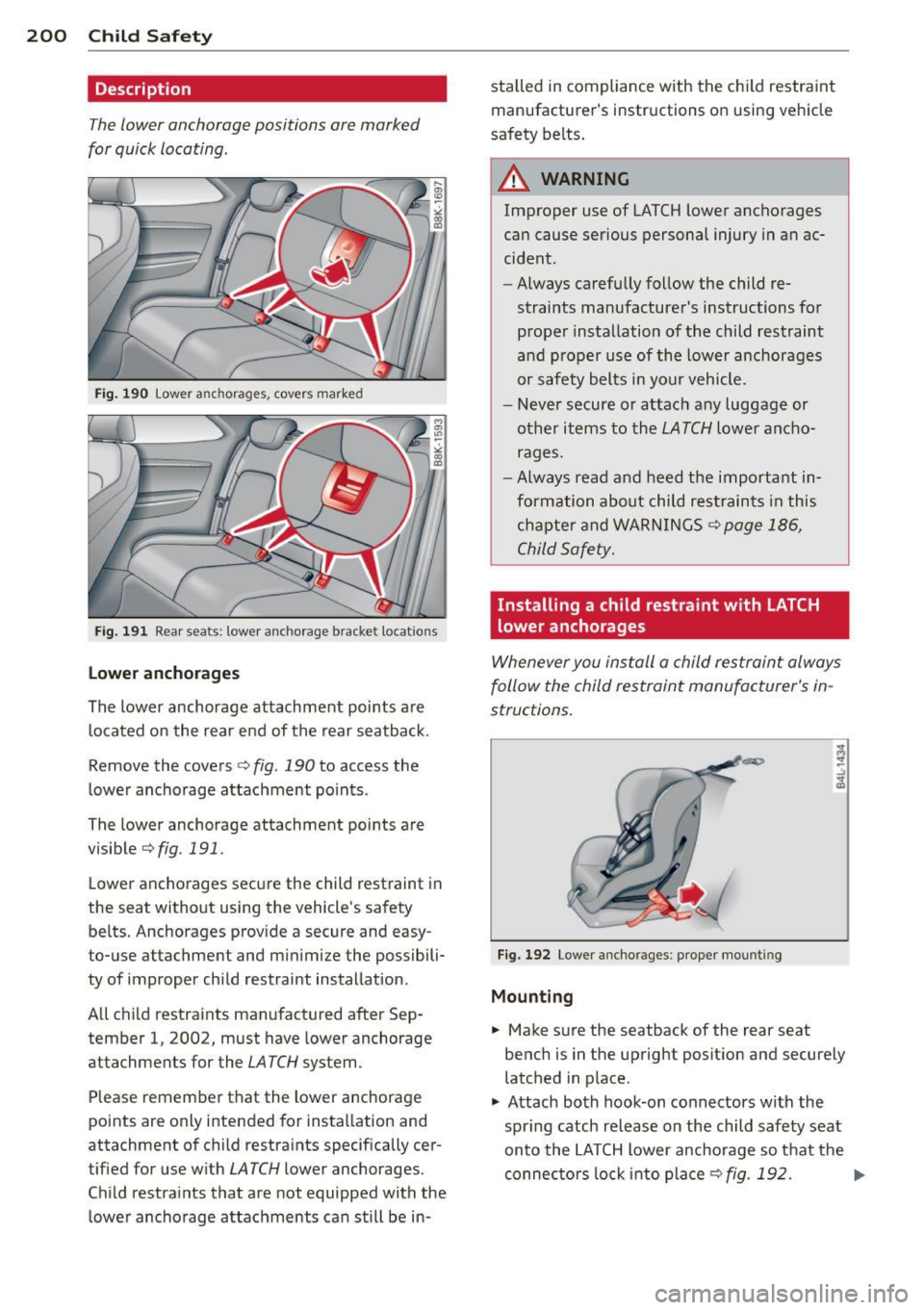
The lower anchorage positions are marked
for quick locating.
Fig. 190 Lower anchorages, covers marked
Fig. 191 Rea r seats: lower anchorage bracket locations
lower anchorages
The lower anchorage attachment points are
l ocated on the rear end of the rear seatback.
Remove the covers
c::> fig . 190 to access the
lower anchorage attachment points .
The lower anchorage attachment points are
visible ¢fig. 191.
Lower anchorages secure the child restraint in
the seat without using the vehicle's safety belts. Anchorages provide a secure and easy
to- use attachment and minimize the possibili
ty of improper child restraint installation.
All child restraints manufactured after Sep
tember 1, 2002, must have lower anchorage
attachments for the LATCH system.
Please remem ber that the lower anchorage
points are only intended for installation and
attachment of child restraints specifically cer
tified for use with LATCH lower anchorages.
Child restra ints that are not equipped with the
lower anchorage attachments can still be in- stalled
in compliance with the child restraint
manufacturer's instructions on using vehicle
safety belts .
A WARNING
-Improper use of LATCH lower anchorages
can cause serious personal injury in an ac
cident.
- Always carefully follow the child re
straints manufacturer's instructions for
proper installation of the child restraint
and proper use of the lower anchorages
or safety belts in your vehicle.
- Never secure or attach any luggage or
other items to the LATCH lower ancho
rages.
- Always read and heed the important in
formation about child restraints in this
chapter and WARNINGS c::>page 186,
Child Safety.
Installing a child restraint with LATCH
lower anchorages
When ever you install a child restraint always
follow the child restraint manufacturer's in
structions.
Fig. 192 Lowe r anc horages : proper mou nting
Mounting
.. Make sure the seatback of the rear seat
bench is in the upright posit ion and securely
latched in place .
"' Attach both hook-on connectors with the
spr ing catch release on the child safety seat
onto the LATCH lower anchorage so that the
connecto rs lock into place ¢fig. 192.
II>
Page 206 of 316
204 Intelligent technology
Intelligent technology
Notice about data
recorded by vehicle
control modules
Your veh icle is not equipped with an Event Da
ta Recorder (EDR), installed by some manu
facturers fo r the express purpose of capturing
data for retrieval after an accident or crash
event. EDR's are sometimes called "crash re
corders".
Some state laws restrict the retrieval or down
loading of data stored by EDR's that were in
stalled in a vehicle for the express purpose of retrieving data after an accident or crash
event without the owner's consent.
Although your vehicle is not equipped with an
EDR, it is equipped with a number of electron
ic control modules for various vehicle systems
such as, for example, engine function, emis
sion control, as well as for the airbags and
safety belts .
These electronic control modules also record
vehicle-related data during normal vehicle op
eration for diagnostic and repair purposes .
The recording capacity of the electronic con
trol modules is limited to data (no sound is re
corded) and only a small amount of data is ac
tually recorded over a very limited pe riod of
time and stored when a system fault or other condition is sensed by a control unit. Some of
the data then stored may relate to vehicle
speed, direction, braking as we ll as restraint
system use and performance in the event of a
crash or other condition. Stored data can only be read and downloaded with special equip
ment .
Electronic stabilization
Program (ESP)
General information
The ESP improves the vehicle stability .
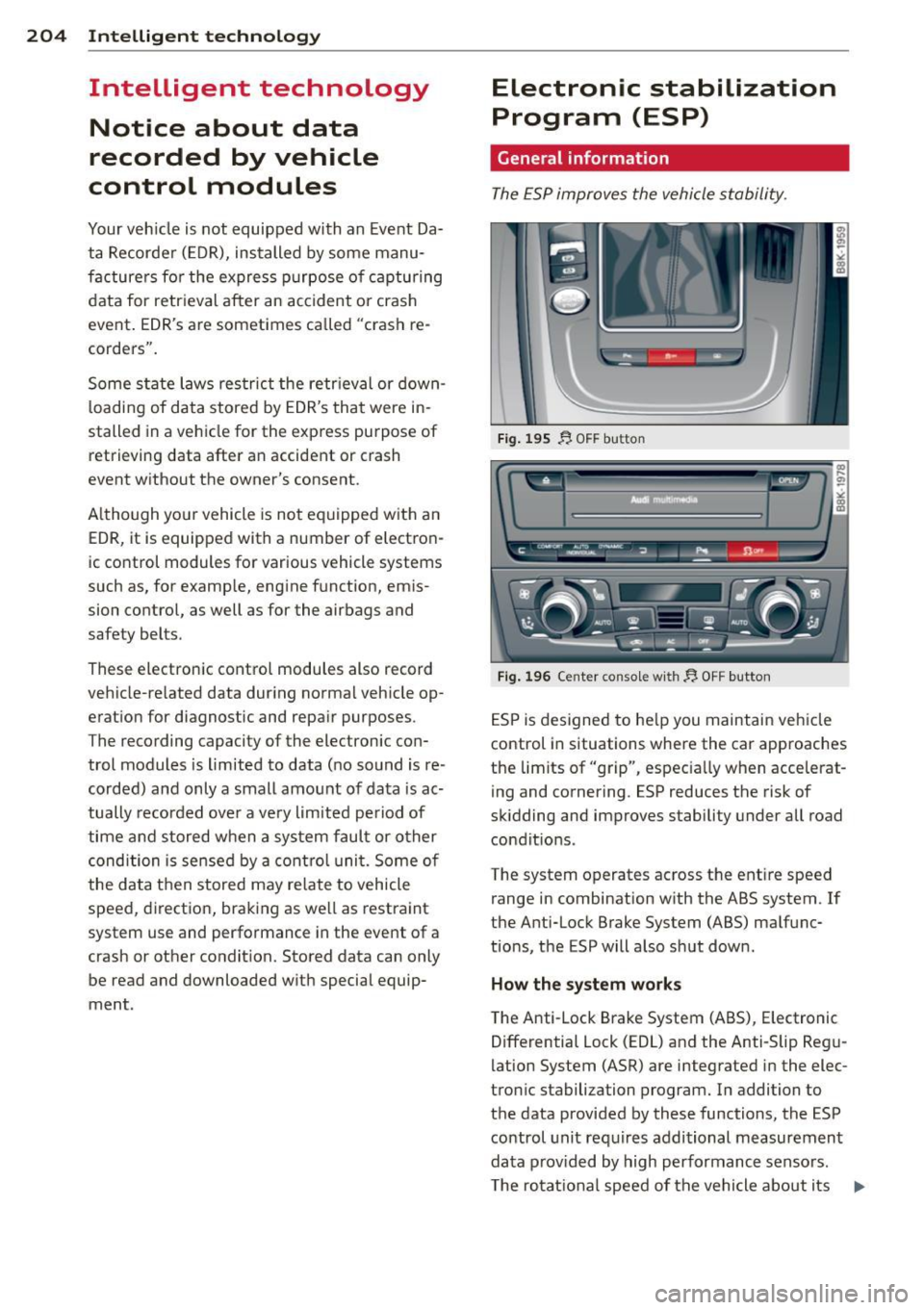
Fig. 195 f;. OFF button
Fig. 196 Center console wit h ~ OFF button
ESP is designed to help you maintain vehicle
control in situations where the car approaches
the limits of "grip", especia lly when accelerat
ing and cornering . ESP reduces the risk of
skidding and improves stability under all road
conditions .
The system operates across the ent ire speed
range in combination with the ABS system . If
the Anti-Lock Brake System (ABS) malfunc
tions, the ESP will also shut down.
How the system works
The Anti -Lock Brake System (ABS), Electronic
Differential Lock (EDL) and the Anti-Slip Regu
lation System (ASR) are integrated in the elec
tronic stabilization program. In addition to
the data provided by these functions, the ESP
control unit requires additional measurement
data provided by high performance sensors.
T he rotational speed of the vehicle about its
II>-
Page 207 of 316
vertical axis, vehicle acceleration in the fore
and-aft and lateral directions , the brake pres
sure, and the steering ang le are all measured .
The direction in which the d river wishes to
travel is determined with the aid of the steer
ing angle and vehicle speed and is continually
compared with the actual behavior of the ve
h icle. If the two do not match, for examp le,
when the vehicle starts hydroplaning on a wet
road, ESP will automatically brake the appro
priate wheel to correct the problem.
The vehicle is then stabili zed by the forces act
ing on the wheel dur ing braking. If the vehicle
is
oversteering (the veh icle turns too sharply
and the rear wheels sl ide toward the outs ide
of a curve), the brakes are main ly applied on
the wheel that is on the outside of the curve.
I n the case of a ve hicle that is
understeering
(the vehicle does not turn sha rply enough and
pushes out of a curve) , the brakes are applied
as needed on the whee l that is on the inside of
the curve o r additiona lly on the other wheels.
An acoust ic signal indicates when ESP brake
application cuts in
q .& .
The system operates across the entire speed
range in combination with the ABS system
q page 208. If the Anti-Lock Brake System
(ABS) malfunctions, the ESP will be out of ac
tion as well.
Acti vating
When you turn on the engine, ESP wi ll auto
matica lly be activated and will perfo rm a se lf
test. As soon as the test is completed, the sys
tem is in normal operating mode .
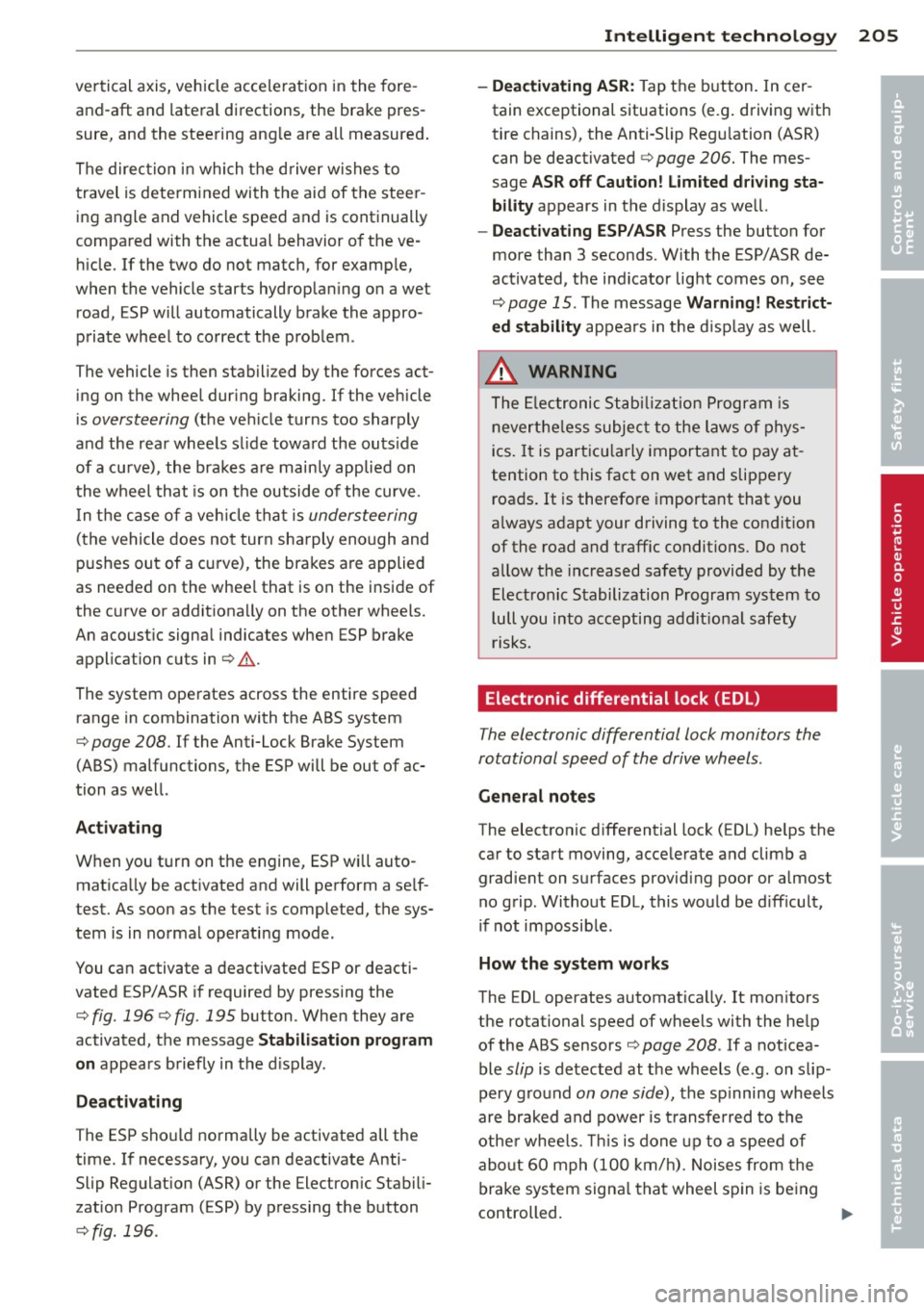
You can activate a deactivated ESP or deacti
vated ESP/ASR if required by pressing the
qfig. 196 q fig . 195 button. When they are
activated, the message
Stabilisation prog ram
on
appears briefly in the d isplay.
D eacti vating
The ESP sho uld normally be activated all the
time. If necessary, you can deactivate Anti
Slip Regulation (ASR) or the Electron ic Stabili
zation Program (ESP) by pressing the button
<:::;, fig. 196 .
Intellig ent technolog y 205
-Dea cti vating ASR: Tap the b utton. In cer
tain exceptional situations (e.g . driving with
tire chains), the Anti -Slip Regu lation (ASR)
can be deactivated
q page 206. The mes
sage
ASR off Caution ! Limited d riv ing sta
bilit y
appears in the display as we ll.
- Deacti vating ESP /A SR Press the button for
more than 3 seconds. Wi th the ESP/ASR de
activated, the ind icator light comes on, see
c:::;, page 15 . The message War ning! R estrict
ed stability
appea rs in the d isp lay as well.
.8, WARNING -
The Electronic Stabi liz a tion Program is
neverthe less subjec t to the laws o f phys
ics. It is part icu la rly important to pay a t
tention to this fact on wet and slippery roads. It is therefo re important that you
a lways adapt your driving to the condit ion
of the road and traff ic conditions. Do not
allow the increased safety provided by the Elect ronic Stabilization Program system to
lull you into accepting addit iona l safety
r isks.
Electronic differential lock (EDL)
The electronic differential lock monitors the
rotational speed of the drive wheels .
General not es
The electronic d ifferential lock ( E0L) he lps the
car to star t moving, acce lerate and climb a
gradient on surfaces providing poor or almos t
no grip . Without EDL, this would be d iff icult,
if not impossible .
How the sy stem works
The EDL operates automatically. It mon itors
the rotational speed of wheels with the he lp
of the ABS sensors
q page 208 . If a noticea
ble
slip is detected at the wheels (e .g . on s lip
pery ground
on one side), the sp inning wheels
are braked and power is t ransferred to the
othe r whee ls. Thi s is done up to a speed of
abo ut 60 mph (100 km/h) . Noises from the
brake system signa l that wheel spin is be ing
controlled .
Ill>
•
•
Page 208 of 316
206 Intelligent technology
Driving off
When driving off, a lways be sure to keep road
conditions in mind as you accelerate. If one
drive wheel spins because it is on a surface
with less grip, apply
plenty of throttle until
the car starts to
move .
Overheating of brakes
To prevent the disc b rake o f the bra ked wheel
from overheating if subjected to excessive l oads on this whee l, the EDL cuts out tempo
rarily. The vehicle remains operational and be
haves in the same way as a vehicle without
EDL.
As soon as the brake has coo led down, EDL
switches on again automatically .
A WARNING
-When accelerating on slippery surfaces,
such as on ice or snow, always be careful
when depressing the accelerator pedal. Even with the EDL working, the drive
wheels can spin and reduce your ability
to control your car. Risk of crash!
- The increased safety afforded by EDL
does not mean that you can take safety
risks. Always adapt your dr iving style to
the road conditions and traffic situation.
0) Tips
If a fault occurs in the ABS, the EDL is also
not funct ion ing. Thi s is indicated by the
ABS war ning light ¢
page 16.
Anti-Slip Regulation System (ASR)
The Anti-Slip Regulation System prevents the
driven wheels from spinning when the car is
accelerating.
General notes
The Anti -Slip Regulation System (ASR) is inte
grated in the electronic stabilization program
( E SP). When the vehicle starts up and acceler
ates, the wheels are p revented from spinning
by adjusting the engine power to match the amount of grip available
from the road sur
face.
How the system works
ASR performs automat ically, i .e. w ithout the
driver's intervention. With the aid of the ABS
sensors ¢
page 208, ASR monitors the speed
of the driven whee ls. If the whee ls start to
spin, engine torque is reduced automatica lly
until the tires find enough grip to lock onto
the road surface. The system is active across
the entire speed range.
The ASR works in conjunction with the ABS . If
a malfunction should occur in the ABS, the
ASR will also be out of act ion.
Activating
T he ESP is automatica lly activated when the
engine is started and it performs a se lf-test .
You can activate a deactivated ASR if required by pressing the
¢ page 204, fig. 196 button.
When it is act ivated, the message
ESP/ASR
on
appears briefly in the display .
Deactivating
You can deactivate the ASR if required by
pressing the button (for less than 3 seconds)
¢
page 204, fig . 196. With the ASR deactivat
ed, the ESP check light comes on, see
¢
page 15 . The message ASR off appears in
the d isplay as well. The ASR can be deact ivat
ed at any speed.
The ASR s hould normally be activated all the
time . Only in certain exceptional situations
when some slip is desirable does it make
sense to deact ivate the ASR . Examples :
- when driving with tire cha ins
- when driving in deep snow or on loose
ground and
- when rocking the vehicle loose after it has
become stuck.
When the abnormal situation is
over, you
shou ld activate the ASR again .
Page 210 of 316
208 Intellig ent technol ogy
,8. WARNING
- You should perform braking maneuvers
for the purpose of cleaning the brake
system only if road condit ions permit .
Other road users must not be put at r isk -
you may cause an acc iden t!
- Before descending a steep grade, reduce
speed and shift transmiss ion into a lower
gear or lower driving range. Do not ride
the brakes or hold the pedal down too long or too often . This cou ld cause the
brakes to get hot and diminish braking
efficiency.
- Do not "ride the brakes" by resting your
foot on the pedal when you do not intend
to brake . This may cause the brakes to
overheat, premature wear and increased
stopp ing distance.
- Under certain climatic and operating
condit ions such as passing through wa
ter, driving in heavy ra in or after wash ing
the vehicle, the effect iveness of the
brakes can be reduced. In winter, ice can
accumula te on the brake pads, linings,
discs and drums. Carefully apply brakes
for a test. Brakes will dry and ice coat
ings will be cleaned off after a few care
ful brake applications.
- Driv ing fo r an extended period of time on
salt -covered roads w ithout using your
brakes can also affect braking efficiency.
Clean off accumulated salt coating from
brake discs and pads w ith a few careful
brake applicat ions.
- If you damage the front spoiler, or if you
install a different spoiler, be sure the air
flow to the front brakes is not obstruct ed . Otherwise the brake system could
overheat reducing the effectiveness of
the ent ire brake system.
- Failure of one brake c ircuit will impair
the braking capability resulting in an in creased stopp ing distance. Avoid driv ing
the vehicle and have it towed to the near est authorized Audi dealer or qualified
workshop.
Brake booster
The brake booster adds extra braking power .
The brake booster works with vacuum pres
sure which is created only when the engine is
runn ing
c> .&. .
,8. WARNING
-Never let the vehicle roll to a stop with
the engine shut off .
- If the brake booster is not working, for
example when towing your vehicle, or
because the brake booster has somehow
been damaged, the bra ke pedal mus t be
pressed considerably harder to make up
for the lack of booster assistance.
Functioning of Anti-Lock Brake System
(ABS)
ABS prevents the wheels from locking up un der braking .
-
The ABS contributes effect ively to vehicle con
trol since it prevents the whee ls from
locking
when the brakes are applied. This means that
the ve hicle remains steerable and is less likely
to skid .
With AB S you do n ot need to pump the
brake . Ju st hold th e bra ke p edal down.
However, do not expect the ABS to s horten
braking distance under
all c ircumstances.
When driving on gravel or on new ly fallen
snow on top of icy surfaces, braking dis tance
may be even longer, therefore, under these
circumstances, it is especia lly important that
you drive s low ly and with great care.
How the ABS syst em work s
An automat ic check is made when a speed o f
about 12 mph (20 km/h) is reached. When
this happens, a pumping noise can be heard.
If an ind iv idual whee l begi ns to rota te too
s lowly in re lation to vehicle speed and tends
to lock, the ABS automatically reduces brake pressure to prevent that whee l from locking . .,..
Page 211 of 316
This automatic adjustment process will cause
a
slight vib ra tion of the brake pedal and some
noises to alert you that vehicle speed must be
adapted to existing road and traffic condi
tions.
A WARNING
Although the ABS is very effective, always
remember that braking capability is limit
ed by t ire traction . A lways adjust your dr iv
ing speed according to the road and t raff ic
conditions. Do not let the extra sa fety af
forded by the ABS tempt you into taking
extra risks. The ABS cannot overcome the
laws of physics .
(D Tips
-If ABS is not functioning properly, a
warning light will come on . See
~ page 16.
-If a fault occu rs in the ABS, the EDL is al
so not functioning . This is indicated by
the ABS warning light .
Brake assist
Brake assist is designed to achieve the opti
mum broking effect.
Brake assist helps to increase the effective
brak ing power and thus to achieve a shorter
stopping distance. If the driver presses the
brake peda l very quick ly, brake assist auto
mat ica lly boosts the braking force to the max
imum level, up to the point where the anti
lock brake function (ABS) intervenes to stop
the wheels from locking . You should then
keep the brake pedal pressed u ntil the vehicle
has braked to the required speed . Brake ass ist
sw itches itself off as soon as you release the
b rake peda l.
A WARNING
Please remembe r that the accident r is k al
ways increases if yo u drive too fast, espe
cially in corners or on a s lippery road, or if
you fo llow the vehicle ahead of you too
close ly. Increased risk of an accident can-
Int ellig ent technolog y 209
not be compensated for even by brake as
sist, so always maintain a safe speed.
S .
®
ervotron1c
-
advanced power
steering system
The power steering systems uses the power of
the running engine to allow precise steering
with little effort.
T he advanced Servotronic ® power steer ing
system senses the road speed and elect ron i
ca lly adjusts power assistance to provide com
fortab le and safe ste ering response exact ly
matched to the vehicle speed .
Power steering will not work i f the engine is
off. As a result, the stee ring wheel will be hard
to turn .
T he power steering fluid level is checked d ur
ing the schedu led maintenance services .
(D Note
If there is an e lectronic malfunction, ser
votronic
will s till function like a conven
tiona l power steering system, providing a
constant steering support force that is no
l onger proportionate to the vehicle speed.
This is most noticeable when turning the
steering wheel at low speeds (for example
when parking), -more effort w ill be re
q uired than usual.
- Be aware of the different than usual
steering response and adjust your steer
ing force acco rdingly .
- Have the problem checked and set right
by an Audi dealer as soon as possible.
(D Tips
-Whe n the engine is running, never hold
the steering w heel turned all the way to
the rig ht or to the left for longer t han 15
seconds. The powe r steering pump will
overheat the hydraulic fluid if you keep
holding the stee ring wheel turned all the
way. This is likely to damage the power
steering system .
IJI>
•
•