lock AUDI A5 COUPE 2012 Workshop Manual
[x] Cancel search | Manufacturer: AUDI, Model Year: 2012, Model line: A5 COUPE, Model: AUDI A5 COUPE 2012Pages: 316, PDF Size: 78.59 MB
Page 131 of 316
Automatic Shift Lock (ASL)
Applies to vehicles: with a utomat ic transm ission
The Automatic Shift Lock safeguards you
against accidentally shi~ing into a forward or
the reverse gear and causing the vehicle to
move unintentionally .
;_ '"''1
·- I , . ,......._
W'.o ,)
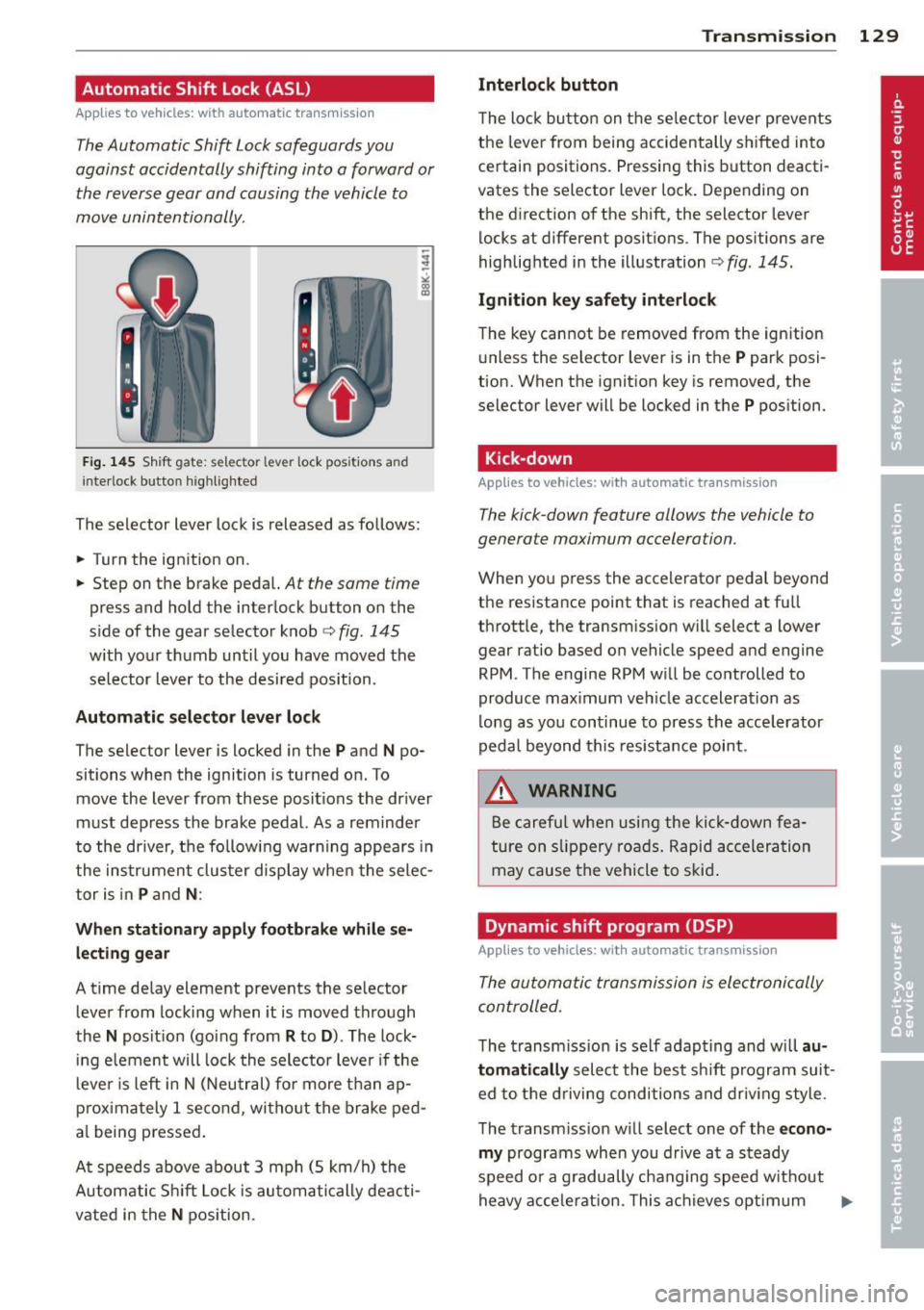
Fig. 145 Shift gate: selector lever lock positions and
in terlock b utto n highlighted
The selector lever lock is released as follows:
.. Turn the ignition on.
.. Step on the brake pedal.
At the same time
press and hold the interlock button on the
s ide of the gear selector knob
c::> fig. 145
with your thumb until you have moved the
selector lever to the desired position.
Automatic selector lever lock
The select or lever is Locked in the P and N po
sitions when the ignition is turned on. To
move the lever from these positions the driver
must depress the brake pedal. As a reminder
to the driver, the following warning appears in
the instrument cluster display when the selec
tor is in
P and N:
When stationary apply footbrake while se
lecting gear
A time delay element prevents the selector
lever from locking when it is moved through
the
N position (going from R to D ). The lock
ing element will lock the selector lever if the
lever is left in N (Neutral) for more than ap
proximately 1 second , without the brake ped
a l being pressed.
At speeds above about 3 mph (5 km/h) the
Automatic Shift Lock is automatically deacti
vated in the
N position.
Transmission 129
Interlock button
The lock button on the selector lever prevents
the lever from being accidentally shifted into
certain positions. Pressing this button deacti
vates the selector lever lock. Depending on
the direction of the shift, the selector lever
locks at different positions. The positions are
highlighted in the illustration
c::> fig . 145.
Ignition key safety interlock
The key cannot be removed from the ignition
unless the selector lever is in the
P park posi
tion. When the ignition key is removed, the
se lec tor Lever will be locked in the
P position.
Kick-down
App lies to vehicles: with automatic transmission
The kick-down feature allows the vehicle to
generate maximum acceleration .
When you press the accelerator pedal beyond
the resistance point that is reached at full
throttle, the transmission will select a lower
gear ratio based on vehicle speed and engine
RPM . The engine RPM will be controlled to
produce maximum vehicle acceleration as
long as you continue to press the accelerator
pedal beyond this resistance point.
.&, WARNING
Be careful when using the kick-down fea
ture on slippery roads. Rapid acceleration
may cause the vehicle to skid .
Dynamic shift program (DSP)
Applies to vehicles: wit h automatic transmission
The automatic transmission is electronically
controlled.
-
The transmission is self adapting and will au
tomatically
select the best sh ift program suit
ed to the driving conditions and driving style .
The transmission will select one of the
econo
my
programs when you drive at a steady
speed or a gradually changing speed w ithout
heavy acceleration. This achieves optimum ..,.
Page 134 of 316
132 Transmi ssion
authorized Audi dealership as soon as pos
sible to have the condition corrected .
Emergency release of the selector lever
Applies to vehicles: wit h automatic transmiss ion
If the vehicle's power supply fails, the selec
tor lever con be released in on emergency.
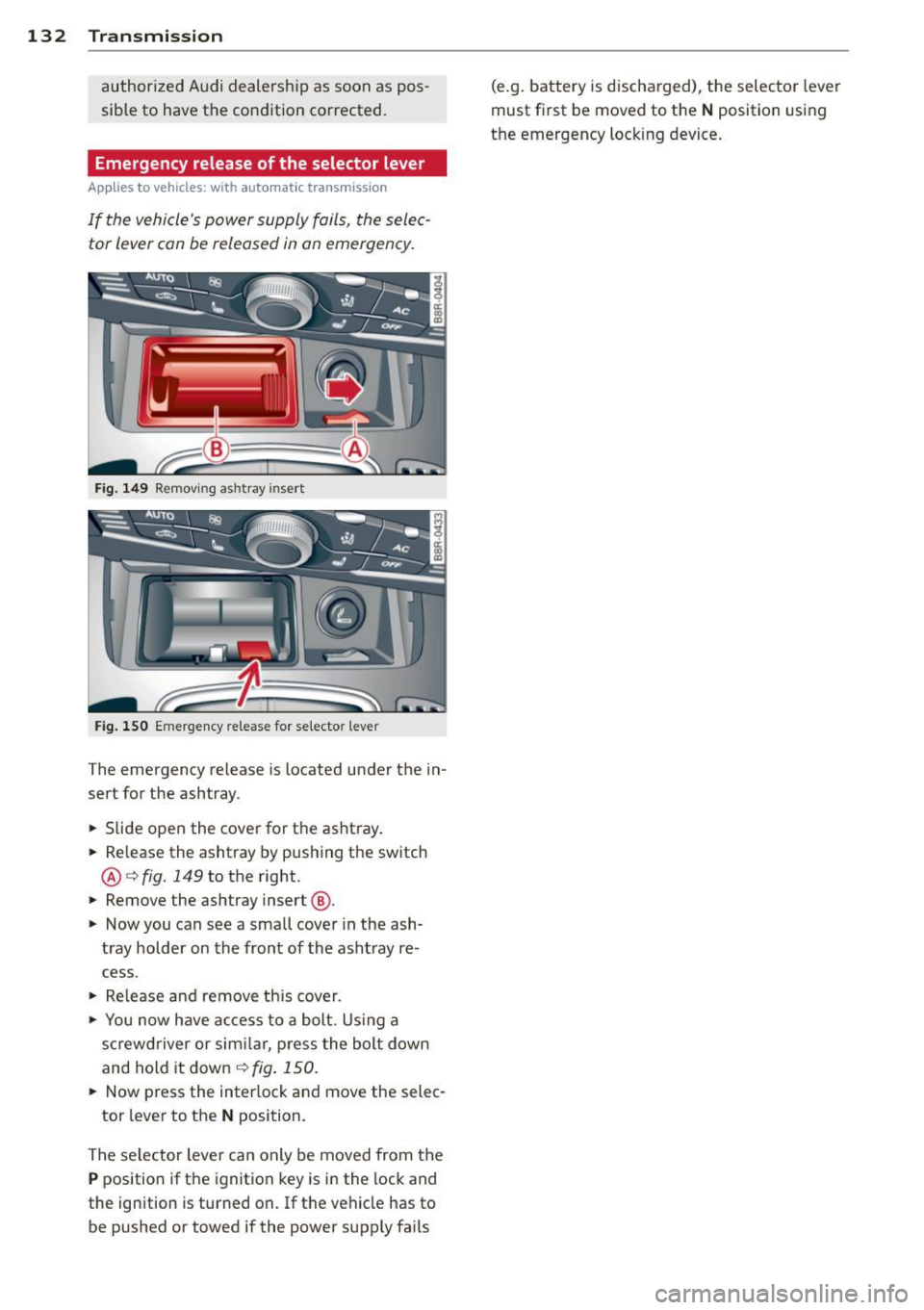
Fig. 14 9 Remo vin g asht ray inse rt
Fig . 150 Eme rge ncy re le ase for se lec to r lever
The emergency release is located under the in
sert for the ashtray.
• Slide open the cover for the ashtray .
• Re lease the ashtray by push ing the sw itch
@ c> fig. 149 to the right.
• Remove the ashtray insert @.
• Now you can see a small cove r in the ash
tray holder on the front of the ashtray re
cess .
• Re lease and remove th is cover .
• You now have ac cess to a bolt. Us ing a
sc rewdriver or sim ilar, press the bolt down
and hold it down ¢
fig. 150.
• Now press the inter lock and move the selec-
tor lever to the
N position.
The selector lever can only be moved from the
P position if the ignition key is in the lock and
the ignition is turned on .
If th e vehicle has to
be pushed o r towed if the power supp ly fa ils (e.g
. battery is discha rged) , the selector lever
must first be moved to the
N pos ition using
the emergency lock ing device.
Page 148 of 316
146 Driving Safely
• Always keep both feet in the footwell so
that you are in control of the vehicle at all
times.
For detailed information on how to adjust the
driver's seat, see
¢ page 63.
A WARNING
Drivers who are unbelted, out of position
or too close to the airbag can be seriously
injured by an airbag as it unfolds. To help
reduce the risk of serious personal injury:
- Always adjust the driver's seat and the
steering wheel so that there are at least
10 inches (25 cm) between your breast
bone and the steering wheel.
- Always hold the steering wheel on the
outside of the steering wheel rim with
your hands at the 9 o'clock and 3 o'clock positions to help reduce the risk of per
sonal injury if the driver's airbag inflates.
- Never hold the steering wheel at the
12 o'clock position or with your hands at
other positions inside the steering wheel
rim or on the steering wheel hub. Hold
ing the steering wheel the wrong way
can cause serious injuries to the hands,
arms and head if the driver's airbag de
ploys.
- Pointing the steering wheel toward your
face decreases the ability of the supple
mental driver 's airbag to protect you in a
collision .
- Always sit in an upright position and nev
er lean against or place any part of your
body too close to the area where the air
bags are located.
- Before driving, always adjust the front
seats and head restraints properly and
make sure that all passengers are prop
erly restrained.
- Never adjust the seats while the vehicle
is moving . Your seat may move unexpect
edly and you could lose control of the ve
hicle.
- Never drive with the backrest reclined or
tilted far back! The farther the backrests
are tilted back, the greater the risk of in- jury due to incorrect positioning of the
safety belt and improper seating posi
tion.
- Children must always ride in child safety
seats ¢
page 186. Special precautions
apply when installing a child safety seat
on the front passenger seat¢
page 162 .
Proper seating position for the front
passenger
The proper front passenger seating position
is important for safe, relaxed driving .
For your own safety and to reduce the risk of
injury in the event of an accident, we recom
mend that you adjust the seat for the front
passenger to the following position :
• Move the front passenger seat back as far
as possible . There must be a minimum of
10 inches (25 cm) between the breastbone
and the instrument panel¢,&. .
• Adjust the angle of the seatback so that it is
in an upright position and your back comes
in full contact with it whenever the vehicle is
moving.
• Applies to vehicles with adjustable head re
straints: Adjust the head restraint so the up
per edge is as even as possible with the top
of your head. If tha t is not possible, try to
adjust the head restraint so that it is as
close to this position as possible.
• Keep both feet flat on the floor in front of
the front passenger seat.
• Fasten and wear safety belts correctly
¢page 157.
For detailed information on how to adjust the
front passenger's seat, see
¢ page 61.
A WARNING
-
Front seat passengers who are unbelted,
out of position or too close to the airbag
can be seriously injured or killed by the air
bag as it unfolds. To help reduce the risk of
serious personal injury:
Page 153 of 316
area because the rear lid cannot be fully
closed.
-If you absolutely must drive with the rear
lid open, observe the following notes to
reduce the risk of poisoning:
- Close all windows,
- Close the panoramic tilting sunroof*,
- Open all air outlets in the instrument
panel,
- Switch off the air recirculation,
- Set the fresh air fan to the highest
speed.
A WARNING
Always make sure that the doors, all win
dows, the panoramic tilting sunroof* and
the rear lid are securely closed and locked
to reduce the risk of injury when the vehi
cle is not being used.
-After closing the rear lid, always make sure that it is properly closed and locked.
- Never leave your vehicle unattended es
pecially with the rear lid left open. A
child could crawl into the vehicle through
the luggage compartment and close the
rear lid becoming trapped and unable to
get out. Being trapped in a vehicle can
lead to serious personal injury.
- Never let children play in or around the
vehicle.
- Never let passengers ride in the luggage
compartment. Vehicle occupants must
always be properly restrained in one of
the vehicle's seating positions.
(D Tips
- Air circulation helps to reduce window
fogging. Stale air escapes to the outside
through vents in the trim panel. Be sure
to keep these slots free and open.
- The tire pressure must correspond to the load. The tire pressure is shown on the
tire pressure label. On USA vehicles, the
tire pressure label is located on the driv
er's side B-pillar. On Canada vehicles, the
tire pressure label is located either on
the driver's side B-pillar or inside the fuel
.
Driving Safely 151
filler flap. The tire pressure label lists
the recommended cold tire inflation
pressures for the vehicle at its maximum
capacity weight and the tires that were
on your vehicle at the time it was manu
factured . For recommended tire pres
sures for normal load conditions, please
see chapter
~page 256.
Tie-downs
The luggage compartment is equipped with
four tie-downs to secure luggage and other
items.
Use the tie -downs to secure your cargo prop
erly ~
page 150, Loading the luggage com
partment .
In a collision, the laws of physics mean that
even smaller items that are loose in the vehi
cle will become heavy missiles that can cause
serious injury. Items in the vehicle possess en
ergy which vary with vehicle speed and the
weight of the item. Vehicle speed is the most
significant factor.
For example, in a frontal collision at a speed
of 30 mph (48 km/h), the forces acting on a
10-lb (4.S kg) object are about 20 times the
normal weight of the item. This means that
the weight of the item would suddenly be
about 200 lbs. (90 kg). You can imagine the
injuries that a 200 lbs. (90 kg) item flying
freely through the passenger compartment
could cause in a collision like this.
A WARNING
Weak, damaged or improper straps used
to secure items to tie-downs can fail dur
ing hard braking or in a collision and cause
serious personal injury.
- Always use suitable mounting straps and
properly secure items to the tie-downs in
the luggage compartment to help pre
vent items from shifting or flying for
ward as dangerous missiles.
- When the rear seat backrest is folded
down, always use suitable mounting
straps and properly secure items to the
•
•
Page 160 of 316
158 S afet y belt s
To provide maximum protection, sa fety belts
must always be positioned correctly on the
wearer 's body .
.,. Adjust the front seat and head restra int
properly ¢
page 61, General recommenda
t ions .
.,. Make sure the seatback of the rear seat
bench is in an upright pos ition and securely
latched in place before using the belt¢ ,&.
.,. Hold the be lt by the tongue and pull it
evenly across the chest and pelvis ¢ ,& .
.,. Inse rt the tongue into the correct buckle of
your seat until you hea r it latc h securely
¢fig. 171.
.,. Pu ll on the be lt to make sure that it is se-
curely latched in the b uckle.
Automatic safety belt retractors
Every safety belt is equipped w ith an automat
i c belt retracto r on the shoulder be lt. This fea
ture locks the be lt whe n the belt is pulled out
fast, during hard braking and i n an accident.
The belt may also lock when you drive up or
down a steep hill or throug h a sharp curve.
During normal driving the belt lets you move
freely.
Safety belt pretensioner s
The safety belts are equipped with a be lt pre
tensioner that helps to tighten the safety belt
and remove s lack when the pretensioner is ac
tivated. The funct ion of the pretensioner is
monitored by a warning lig ht
Q page 15.
Sw itchable locking feature
Every sa fety belt except the one on the dr iver
seat is eq uipped with a switchable locking fea
ture that
must be used when the safety belt is
used to attach a child safe ty seat. Be sure to
read the important information about this
feature ¢
page 195.
A WARNING
Imprope rly positioned safety belts can
cause se rious injury in an accident
¢ page 1 58, Safety bel t position.
- Saf ety belts offe r optimum pro tection
only when the seatba ck is upright and be
lts are properly posit ioned on the
body.
- Always make sure that the rear seat
backrest to wh ich the center rear safety
be lt is attached is securely latched when
ever the rea r center safety belt is being
used. If the backrest is not secure ly
latched, t he passenger w ill move for
ward with the ba ck rest dur ing sudd en
bra king, in a sudden maneuver and espe
ci ally in a crash.
- Neve r attach the safety belt to t he buck
le for ano ther sea t. At taching the belt to
the wrong buckle will redu ce s afety be lt
effec tiveness and can cause serio us per
sonal injury.
- A passenger who is not properly restrain
ed can be seriously injured by the safety
be lt itself w hen it moves from the stro n
ger parts of the body into cr itical areas
like the abdomen .
- Always loc k the convertible locking re
tractor when you are secu ring a child
safety seat in the vehicle ¢
page 19 7.
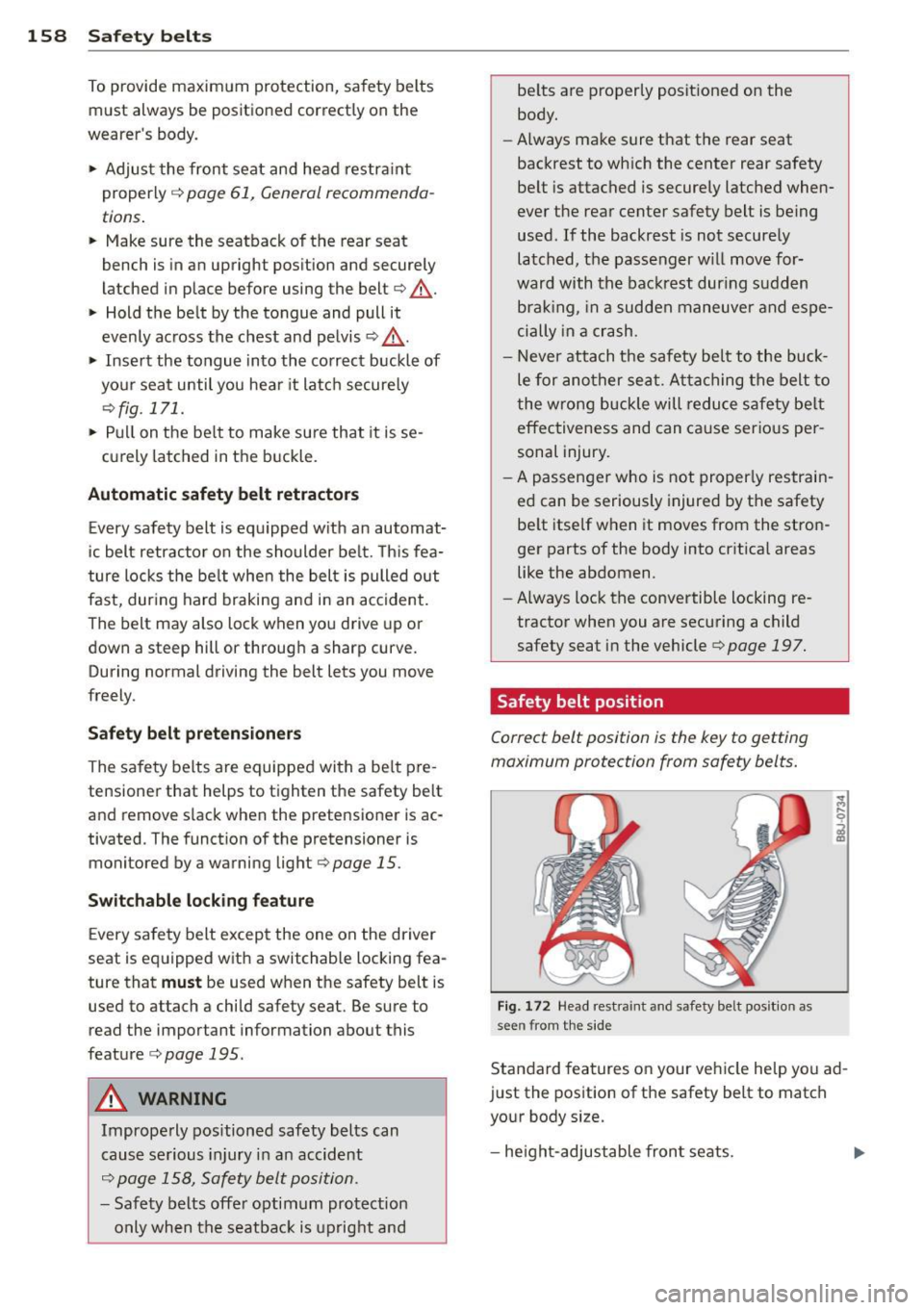
Safety belt position
Correct belt position is the key to getting
maximum protection from safety belts.
Fig . 1 72 Head res tra in t an d safety be lt pos it ion as
see n from t he s ide
Standard features on your vehicle he lp you ad
just the position of the safety be lt to match
yo ur body s ize.
- he ight -adjus table fron t seats.
Page 176 of 316
174 Airbag sys te m
Vehicle Safety Standard 208 with which the
Advanced Airbag System in your vehicle was certified.
I f the front passenger seat is not occupied,
the front airbag will not deploy, and the
PAS
SENGER AIRBAG OFF
light will stay on . Never
install a rearward-facing chi ld restraint on the
front passenger seat, the safest p lace for a
child in any kind of child restraint is at one of
the seating posit ions on the rear seat
c::> page 163, Child restraints on the front seat
- some important things to know
and
c::> page 186, Child Safety .
If the PASSENG ER A IRBAG OFF light com es
on
when one of the conditions l isted above is
met, be sure to check the light regularly to
make certa in that the
PASSENGER AIRBAG
OFF
l igh t stays on cont inuo usly whenever the
ignition is on.
If the PAS SENGER AIRBAG OFF
light does not appear and not stay on all the
time, stop as soon as it is safe to do so and
- react iva te the system by turning the ignition
off and then turning it on again;
- remove and re insta ll the chi ld restraint.
Make su re that the child res traint is properly
insta lled and that the safety be lt for the
front passenger seat has been correct ly
ro uted around the child restraint as descri
bed in the chi ld restraint manufacturer's in
structions;
- make sure that the convertible locking fea
ture on the safety be lt for the front passen
ger seat has been activated and that the
safety belt has been pulled tight. The belt must not be loose or have loops of slack so
t h at the sensor below the safety be lt latch
on the sea t can do its job
c::> page 195.
- make sure that th ings that may increase the
we ight of t he chi ld and child safety seat are
not be ing tra nspo rted on the front passen
ger seat;
- make su re that the safety be lt tension sen
so r is not b locked. Shake t he safety be lt
l atch on the front passenger seat back and
forth;
- If a st rap or te ther is being used to tie the
child safety seat to the front passenger seat, make sure that
it is not so tight that it
causes the weight-sensing mat to measure
more weight than is act ually on the seat.
If the PASSENGER AIRBAG OFF light still
does not come on
and does not stay on con
tin uous ly (when the ignition is switched on),
- t ake the child res train t off the front passen-
ge r seat and ins tall it properly at one of the
rear seat positions. Have the airbag system
inspected by your authorized Audi dea ler
immed iate ly .
- move the child to a rear seat position and
make sure t hat the c hild is properly restra in
ed in a ch ild restra int that is appropriate for
its size and age.
The
PASSENGER AIRBAG OFF light should
NOT come on when the ignit ion is on and an
adult is s itting in a proper seating position on
the front passenger seat. If the
PASSENGER
AIRBAG OFF
lig ht comes on a nd stays on or
flashes fo r about 5 seconds wh ile driving, un
der these c ircumstances, make sure that:
- the adult on the front passenger seat is
properly seated on the center of the seat
cushion with his or her back up aga inst the
backrest and the backrest is not recl ined
c::> page 145, Proper occupant seating posi
tions,
- the adult is not tak ing weight off the seat by
holding on to the passenger assist handle
above the fron t passenger door or s upport
ing their weight on the armres t,
- t he safety belt is be ing properly wo rn and
t hat the re is not a lot o f slack in the safety
be lt webb ing,
- accessory seat covers or cushions or othe r
t hings tha t may cause an incorrec t reading
or impression on the weight-sensing mat
under the upho lstery of the seat have been
removed from the front passenger seat,
- a safety belt extender has not been left in
the safety belt latch for the front passenger
seat.
In add ition to the
PASSENGER AIRBAG OFF
light in the center of the instrument panel,
the message
PASSENGER AIRBAG OFF or
Page 191 of 316
-Model Manufactured on or
after
Graco Snugride September 25, 2007
Peg Perego Primo V i- September 25, 200 7
aggio SIP I MUN00US
Subpart C -Forward-facing and
con vertible child r estra ints
Model Manufactured on or
after
Britax Roundabout September 25, 2007
E9L02xx
Cosco Touriva 02519 December 1, 1999
Cosco Summit Deluxe September 25, 2007
High Back Booster
22-262
Cosco High Back September 25, 2007
Booster 22-209
Evenflo Tribute V September 25, 2007
379xxxx
Evenflo Medallion December 1, 1999
254
Evenflo Generations September 25, 200 7
352xxxx
Graco ComfortSport September 25, 2007
Graco Toddler Safety September 25, 2007
Seat Step 2
Graco Platinum Cargo September 25, 2007
A WARNING
T o reduce the risk of serious injury, make
sure that the
PASSENGER AIR BAG O FF
light comes on and stays on whenever a
child restraint is installed on the front pas
senger seat and the ignition is switched
on.
- Take the child restraint off the fro nt pas
senger seat and install it properly at one of the rea r seat positions if the
PASSEN
GER AIR BAG OFF
light does not stay on.
- Have the airbag system inspected by
your authorized Aud i dealer immediate
ly.
Child Sa fet y 189
(D Tips
The child seats listed in categories A to C
have been statically tested by A udi on ly for
the Advanced A irbag function.
Important safety instructions for using
child safety seats
Correct use of child safety seats substantially
reduces the risk of injury in an accident!
As the dr iver, you are responsible for the safe
ty of everybody in the vehicle, especially ch il
dren:
... Always use the right chi ld safety seat for
each child and always use it properly
¢page 191 .
... Always carefully fo llow the child safety seat
manufacturer's instruct ions on how to route
the safety belt properly through the child
safety seat.
... When usi ng the veh icle safety belt to ins tall
a child safety se at, you m ust first activate
the convertib le locking retractor on the
safety belt to prevent the child safety seat
from moving
¢ page 195.
... Push the ch ild safety seat down with your
full weight to get the safety be lt really tight
so that the seat cannot move forwa rd or
sideways mo re than one inch (2.5 cm) .
... If a strap o r tethe r is be ing used to tie the
child safety seat to the front passenger
s eat, make sure tha t it is not so tight that it
causes the weight-sensing mat to measure
more weight than is act ually on the seat.
A lways remember: Even tho ugh yo ur vehicle is
equippe d wi th an Advanced Airbag system, all
c h ildren, especially those 12 years and young
er, shou ld always ride in the back seat prope r
l y restrained for their age and size.
A WARNING
Not using a child safety seat, using the
wrong child safety seat o r improperly in
stalling a ch ild restraint increases the risk
of ser ious personal inj ury and death.
-
•
•
Page 193 of 316
-Always buck le the child safety seat firmly
in place even if a child is not s itting in it.
A loose ch ild safety seat can fly around
dur ing a sudden stop or in a col lision .
- Always read and heed all WARNINGS
whenever using a child restrained in ave
hicle is being used
<=> page 154, Safety
belts,
<=) page 162, Airbag system and
¢ page 186, Child Safety.
A WARNING
To reduce the risk of serious injury, make
sure that the
PA SSENGER AIR BAG OFF
light comes on and stays on whe never a
child restraint is installed on the front pas
senger seat and the ignition is switched
on.
- Take the child restraint off t he fro nt pas
senger seat and install it proper ly at one
of the rear seat positions if the
PASSEN
G ER AIR BAG OFF
light does not stay on.
- Have the airbag system inspected by
your authorized Aud i dealer immediate
ly.
A WARNING
- A child in a child restraint installed with
the LATCH lowe r anchorages or with the
standard safety belt on the rear seat may
play with unused rear seat safety be lts
and become entang led resu lting in ser i
o us personal injury and even death.
- Always buck le unused rear seat safety
bel ts out of reach of chi ld ren in ch ild
sea ts and p roperly activ ate the converti
ble locking retracto r so that the child
cannot unreel the safety belt from the
retractor .
.
Child S afety 191
Child safety seats
Infant seats
Babies and infants up to about one year old
and 20 lbs. or 9 kg need special rearward -fac
ing child restraints that support the back,
neck and head in a crash .
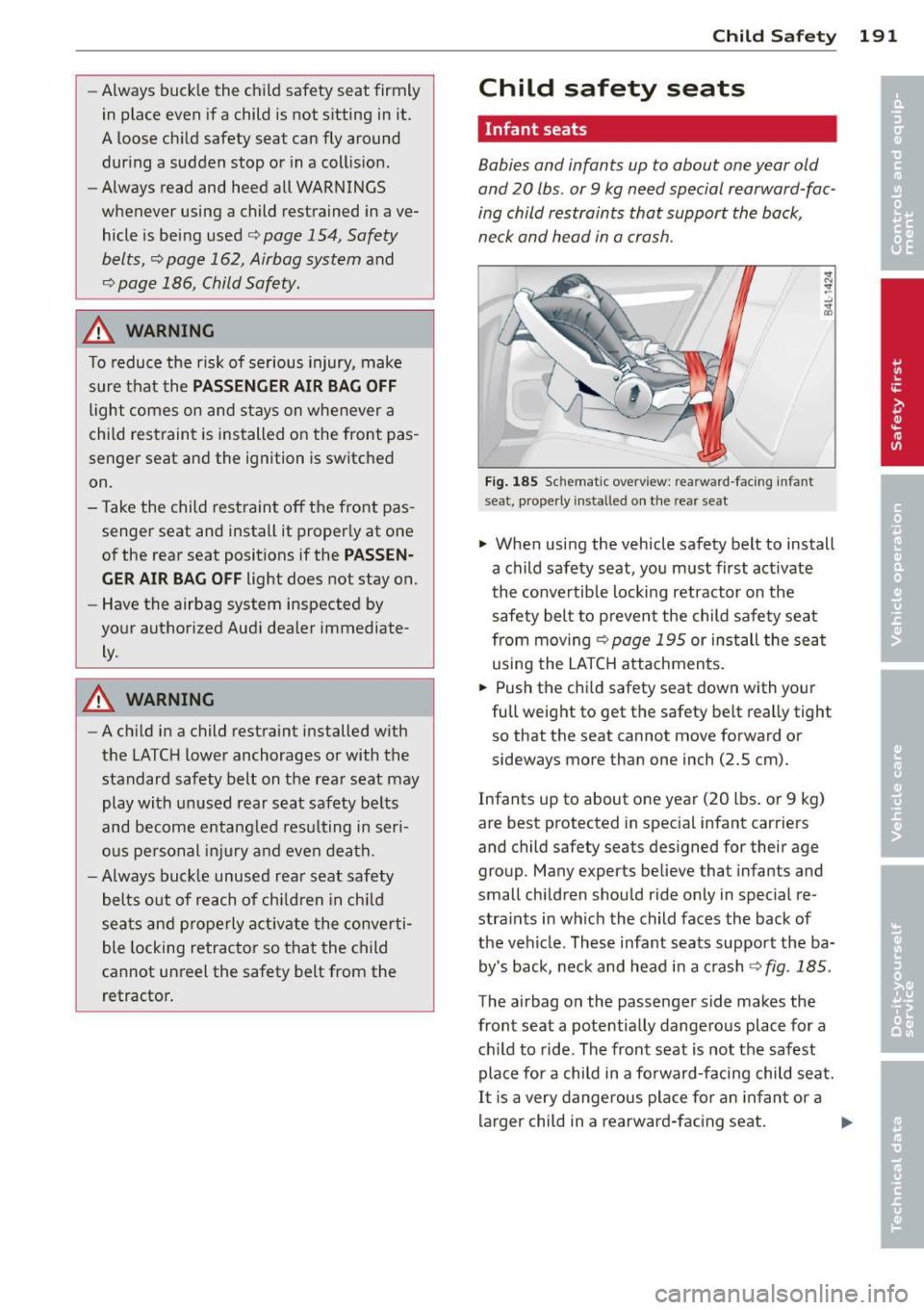
Fig. 185 Schem atic ove rvi ew : re arward-fac ing in fant
se at, p rope rly insta lled on the re ar seat
.. When using the vehicle safety belt to install
a child safety seat, you must first activate
the convertib le locking retractor on the
safety belt to prevent the child safety seat
from mov ing
c> page 195 or install the seat
using the LATCH attachments .
.. Push the chi ld safety seat down w ith your
full weight to get the safety be lt really tight
so that the seat cannot move forward or
sideways more than one inch (2.5 cm).
Infants up to about one year (20 lbs. or 9 kg)
are best protected in special infant carriers
and child safety sea ts designed for their age
group. Many experts believe that infan ts and
small children should r ide only in special re
stra ints in wh ich the child faces the back of
the vehicle. These infant seats support the ba
by 's back, neck and head in a crash ¢
fig. 185.
The airbag on the passenger side makes the
front seat a potentially dangerous place for a
ch ild to ride . The front seat is not the safest
place for a child in a forward-facing child seat.
It is a very dangerous place fo r an in fant or a
larger child in a rearward-facing seat. .._
Page 194 of 316
192 Child Safety
& WARNING
Not using a child safety seat, using the
wrong child safety seat or improperly in
stalling a child restraint increases the risk of serious personal injury and death in a
crash.
- Never install rearward-facing child safety
seats or infant carriers on the front pas
senger seat - even with an Advanced Air
bag System. A child will be seriously in
jured and can be killed when the inflat
ing airbag hits the child safety seat or in
fant carrier with great force and smashes
the child safety seat and child against
the backrest, center armrest, door or
roof
c:> page 163, Child restraints on the
front seat -some important things to
know.
- Always install rearward-facing child safe
ty seats or infant carriers on the rear
seat.
- Never install a rearward-facing child re straint in the forward-facing direction. Such restraints are designed for the spe
cial needs of infants and very small chil
dren and cannot protect them properly if
the seat is forward-facing.
- If you must install a rearward facing
child safety seat on the front passenger
seat because of exceptional circumstan
ces and the
PASSENGER AIR BAG OFF
light does not come on and stay on, im
mediately install the rearward-facing
child safety seat in a rear seating posi
tion and have the airbag system inspect
ed by your authorized Audi dealer.
- Always read and heed all WARNINGS
whenever using a child restrained in ave
hicle is being used
c:>page 154, Safety
belts,
c:> page 162, Airbag system and
c:> page 186, Important things to know.
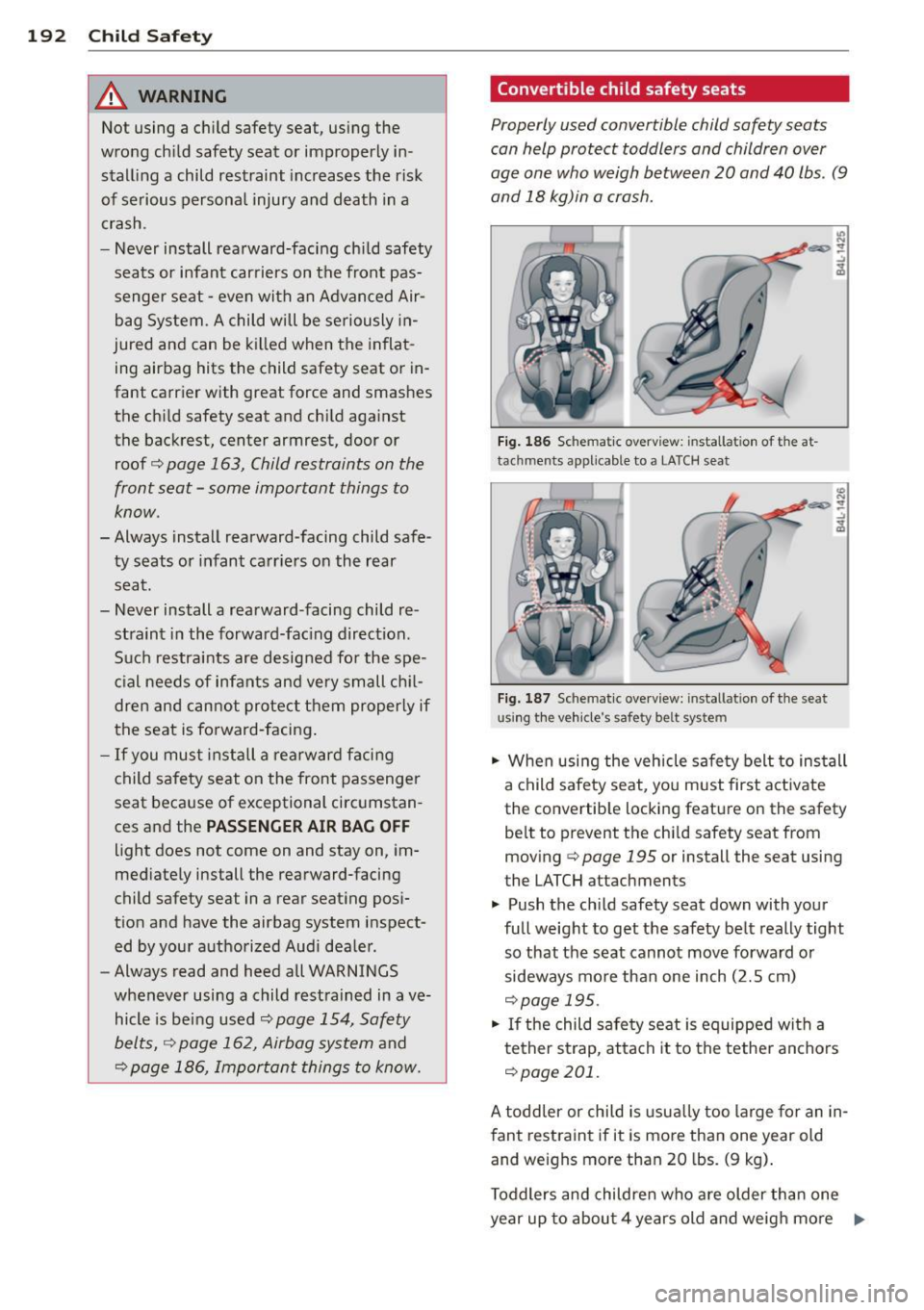
Convertible child safety seats
Properly used convertible child safety seats
can help protect toddlers and children over
age one who weigh between 20 and
40 lbs. (9
and 18 kg)in a crash.
Fig. 186 Schematic overview: installat ion of t he at
tachments appl icable to a LATCH seat
Fig. 187 Schematic overview: installat ion of the seat
using the vehicl e's safety belt system
.,. When using the vehicle safety belt to install
a child safety seat, you must first activate
the convertible locking feature on the safety
belt to prevent the child safety seat from
moving
c:> page 195 or install the seat using
the LATCH attachments
., Push the ch ild safety seat down with your
full weight to get the safety belt really tight
so that the seat cannot move forward or
sideways more than one inch (2.5 cm)
c:> page 195 .
.,. If the child safety seat is equipped with a
t ether strap, attach it to the tether anchors
c:>page 201.
A toddler or child is usually too large for an in
fant r estraint if it is more than one year old
and weighs more than 20 lbs. (9 kg) .
Toddlers and children who are older than one
year up to about 4 years old and weigh more ..,.
Page 196 of 316
194 Child Safety
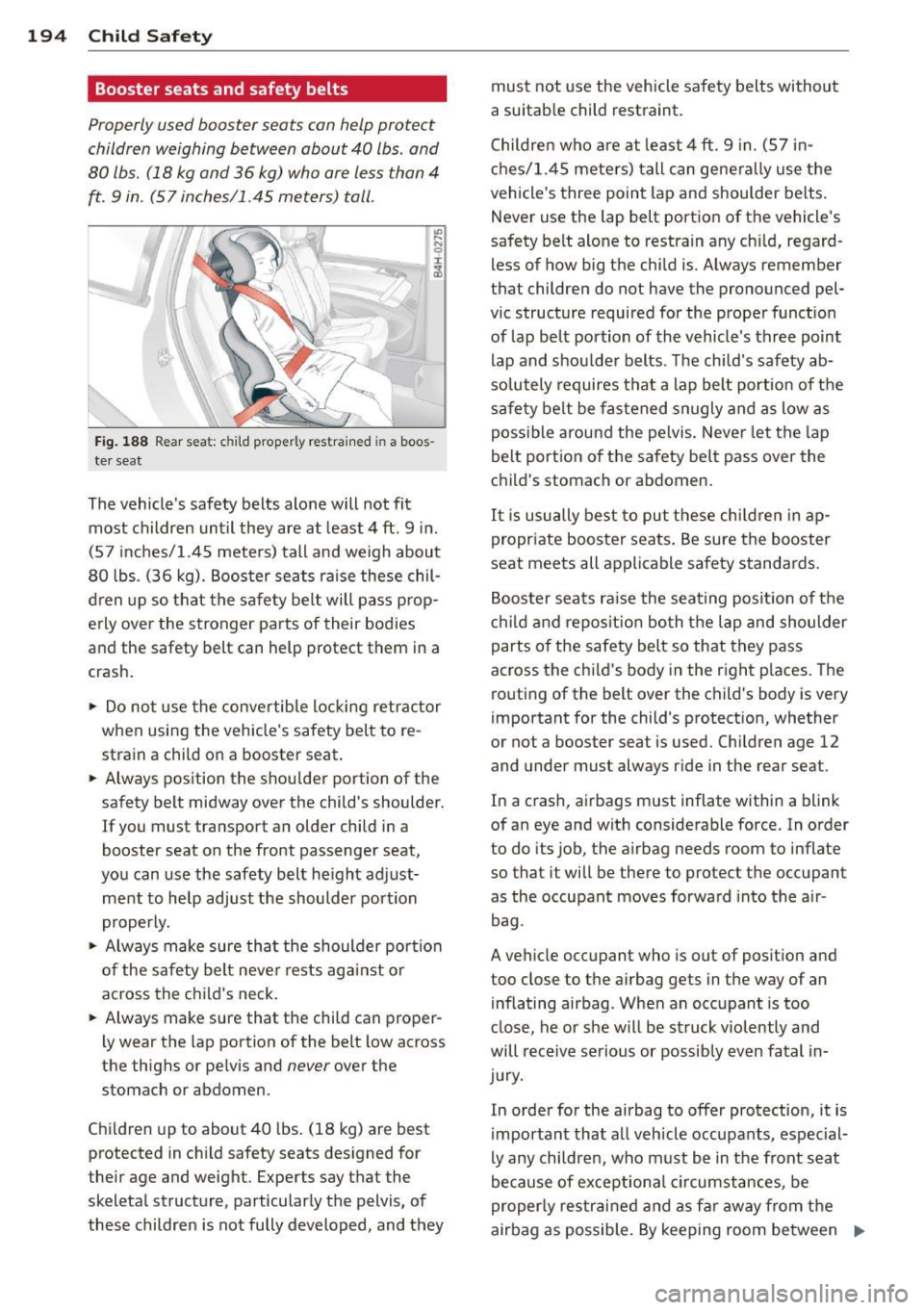
Booster seats and safety belts
Properly used booster seats can help protect
children weighing between about 40 lbs. and
80 lbs. (18 kg and 36 kg) who are less than 4
ft. 9 in. (57 inches/1.45 meters) tall.
Fig. 188 Rear seat: child properly restrained in a boos
ter seat
The vehicle's safety belts alone will not fit
most children until they are at least 4
ft. 9 in.
(57 inches/1.45 meters) tall and weigh about
80 lbs . (36 kg). Booster seats raise these chil
dren up so that the safety belt will pass prop
erly over the stronger pa rts of their bodies
and the safety belt can help protect them in a
crash.
.. Do not use the convertible locking retractor
when using the vehicle's safety belt to re
strain a chi ld on a booster seat .
.. Always position the shou lder portion of the
safety belt midway over the child's shoulder.
If you must transport an older child in a
booster seat on the front passenger seat,
you can use the safety belt he ight adjust
ment to help adjust the shoulder portion
properly .
.. Always make sure that the shoulder portion
of the safety belt never rests against or
across the child's neck .
.. Always make sure that the child can proper
ly wear the lap portion of the belt low across
the thighs or pe lvis and
never over the
stomach or abdomen.
Children up to about 40 lbs. (18 kg) are best
protected in ch ild safety seats designed for
the ir age and weight. Experts say that the
skeletal structure, particularly the pelvis, of
these children is not fully developed, and they must not
use the vehicle safety belts without
a suitab le child restraint.
Children who are at least 4
ft. 9 in. (57 in
ches/1.45 meters) tall can generally use the
vehicle's three point lap and shoulder belts .
Never use the lap belt portio n of the vehicle 's
safety belt alone to restrain any child, regard
less of how big the chi ld is. Always remember
that children do not have the pronounced pel
vic structure required for the proper function
of lap belt portion of the vehicle 's three point
lap and shoulder belts . The child's safety ab
solutely requires that a lap belt port ion of the
safety belt be fastened snugly and as low as
possible around the pelvis. Never let the lap
belt portion of the safety belt pass over the
c hild' s stomach or abdomen.
It is usually best to put these children in ap
propriate booster seats. Be sure the booster
seat meets all applicable safety standards.
Booster seats raise the seating position of the
child and reposition both the lap and shoulder
parts of the safety belt so that they pass
across the child's body in the right p laces. The
routing of the belt over the child's body is very
i mportant for the child's protect ion, whether
or not a booster seat is used. Children age 12
and under must always ride in the rear seat .
In a crash, airbags must inflate within a blink
of an eye and with considerable force. In order
to do its job, the airbag needs room to inflate
so that it will be there to protect the occupant
as the occupant moves forward into the air
bag.
A vehicle occ upant who is out of posit ion and
too close to the airbag gets in the way of an inflating airbag. When an occupant is too
close, he or she will be struck violently and
will receive serious or possibly even fatal in
Jury.
In order for the airbag to offer protection, it is
important that all vehicle occupants, especial-
ly any children, who m ust be in the front s eat
because of exceptiona l circumstances, be
properly restrained and as far away from the
airbag as possible. By keeping room between ..,_