brake AUDI A5 COUPE 2013 Repair Manual
[x] Cancel search | Manufacturer: AUDI, Model Year: 2013, Model line: A5 COUPE, Model: AUDI A5 COUPE 2013Pages: 294, PDF Size: 73.84 MB
Page 239 of 294
-The brakes o n a vehicle t hat has been
overloaded may not be a ble to stop the
vehicle within a safe distance.
- Tires on a vehicle that has been overload
ed can fail suddenly causing loss of con
trol and a crash.
- Always make sure that the tota l load be
ing transported -including the we ight of
a tra ile r hitch and the tongue weight of a
loaded trailer - does not make the veh i
cle heav ier than the veh icle's Gross Vehi
cl e Weight Rating.
A WARNING
- Incorrect tire pressures and/or underin
fla tion can lead to a serious o r fatal acci
dent.
- Incorrect tire pressures and/or underin
fla tion cause increased tire wea r and can
affect the handling of the vehicle .
- Incorrect tire pressures and/or underin
flation can also lea d to sud den tire fa il
ure, incl uding a blowo ut and sudden de
flation, causing loss of vehicle control.
Checking tire pressure
.
The correct tire pressure for the tires original
ly installed on your vehicle is listed on the tire
pressure Lobel located on driver's side 8-pil lor.
The re commended t ire press ures a re o n the
tire pressure label and in the tab le
c=> page 235, Cold tire inflation pressure. This
means that the pressure must be checked and
adj usted when the tire has not been driven for
more than a couple of m iles (kilometers) at
low speeds during the previous three hours .
A ir i n the tires expands when the tire heats up
as a result of inte rnal fr iction as it flexes in
use. The t ire p ress ure is higher w hen the tire
h as wa rmed up th an when it is "cold."
It is the inflat io n pressu re in a "cold" tire that
counts. Therefore, you shou ld never let air out
of a warm t ire to ma tch "Cold tire in flation
p ressu re" recommend ations
c::> page 235. T he
Tire s an d wheel s 237
tires wo uld then be unde rinflated and co uld
fail suddenly.
T he tire pressure label on your Aud i lis ts the
re commended co ld tire inflation pressures at
maximum capacity for the new, orig inal
equipment tires that were on your ve hicle at
the time it was manufactured. For the loca
tion of the labe l
c::> page 235, fig. 176.
Most tires lose air naturally over t ime. They
can a lso lose some air if yo u drive over a pot
ho le or hit a curb while par king. It is usually
not possible to see whether the rad ia l tires
u sed today are underinflated just by looking
at them .
There fore, be sure to check t ire p ress ures at
l east once a month and always before going
on a long tr ip. Make sure to take the n umber
of peop le and the amount of luggage into ac
count when adjust ing tire pressure for a tr ip -
even one that you wou ld not conside r to be
"long." See
c::> page 239, Tires and vehicle
food limits
f or mo re import ant inform ation .
Always use an accurate ti re pressu re gauge
when checking and ad justing inflation pres
s ur es. Check a ll of t he tires and be s ure not to
forge t the spare tire.
If the pressure in any t ire
is too high when the ti re is "cold", let air out
of the ti re s low ly with the edge of the tire
gauge and keep checking the pressure until
you reach the pressure that is correct for the
load (passengers and luggage) and k ind of
driv ing you plan to do.
If the pressure in any ti re is too low, note the
difference between the pressure in the co ld
tire and the pressure you need and add the air
that you need to reach the correct pressure for
the ve hicle load (passengers and luggage) for
the tires on you r veh icle as listed on the on
you r vehicle and in this ma nual and the kind
of d rivi ng you plan to do .
Never exceed th e maximum inflation pr es
sure listed on the tire sidewall for any rea
s on.
•
•
Page 241 of 294
(D Note
Driving without valve stem caps can cause
damage to the t ire va lves. To prevent this,
always make sure that factory installed
valve stem caps on all wheels are securely
mounted on the valve .
@) For the sake of the environment
Underinflated tires will also increase the
fue l consumption .
Tires and vehicle load limits
There are limits to the amount of load or
weight that any vehicle and any t ire can carry .
A vehicle that is overloaded w ill not handle
well and is more difficult to stop. Overload ing
can not on ly lead to loss of vehicle contro l,
but can a lso damage important pa rts of the
ve hicle and can lead to sudden tire failure, in
cluding a blowout and sudd en d eflation that
c a n cause the veh icle to crash.
Your safety and that of yo ur passenge rs a lso
depends on making sure that load limits are
not exce eded . Vehicl e load includes ev erybody
and everyth ing in and on the vehicle. These
load limi ts are techn ically referred to as the
vehicle's
Gross Vehicl e W eight Rat ing
("GVWR ").
The "GVWR" includes the we ight of the basic
vehicle, all fac tory installed accessories, a full
tank of fuel, oil, coolant and other fluids plus
maximum load . The maximum load includes
the number of passengers that the vehicle is
i ntended to ca rry ("seating capacity") with an
assumed weight of 150 lbs . (68 kg) for each
passenger a t a des igna ted seat ing pos ition
and the tota l weight of any l uggage in the ve
h icle. If you tow a trailer, the weig ht of the
trailer hitch and the tongue we ight of the
loaded traile r must be included as part of the
vehicle load .
The
Gro ss Axle Weight Rating ("GAWR") is
the maximum load that can be applied at each
of the vehicle's two axles.
Tire s an d wheel s 239
The Gross Vehicle Weight Rat ing and the
Gross Axle Weight Rating are listed on th e
safety comp liance sticker label located on the
driver's side B-pillar. Audi has 4 seat ing pos i
tions, 2 in the front and 2 in the rear for total
seat ing capac ity of 4. Each seating position
has a seat belt ¢
page 134, Safety belts .
The fact that there is an upper limit to your
vehicle's Gross Vehicle Weight Rating means
that the total weight of whatever is being car ried in the vehicle ( includ ing the weight of a
trailer hitch and the tongue we ight of the
loaded tra ile r) is lim ited. The more passen
gers in the vehicle or passe ngers w ho are
heavier than the standard we ights assumed
mean that less weight can be carried as lug
gage.
T he tire pressure label on your Aud i also lis ts
t h e maximum combined weight of a ll of the
occupants and l uggage or other cargo that
the ve hicle can carry. For the location of the
l abel ¢
page 235, fig. 176.
A WARNING
Overloading a vehicle can cause loss of ve
h icle contro l, a crash or other accident , se
rious personal injury, and even death .
- Carrying more we ight than your veh icle
was des igned to carry will prevent the
ve hicle from handling properly and in
crease the risk of the loss of vehicle con
trol.
- The brakes on a vehicle that has been
overloaded may not be able to stop the
ve hicl e with in a safe distance .
- Tires o n a vehicle that has been overload
ed can fail suddenly, incl uding a blowout
a nd sudden defla tion, causing loss of
control and a crash .
- Always ma ke sure t hat the to tal load be
i n g transpo rted - incl udi ng t he weight of
a trailer hitch and the tongue we igh t of a
loaded trailer -does not make the vehi
cle heavier than the vehicle's Gross Vehi
cle Weight Rating.
•
•
Page 244 of 294
242 Tires and wheels
& WARNING
Sudden tire failure can lead to loss of con
trol, a crash and serious persona l injury!
- Never drive a vehicle when the tread on
any tire is worn down to the wear indica
tors.
- Worn tires are a safety hazard, they do
not grip well on wet roads and increase
your risk of "hydroplaning" and loss of control.
- Always keep chemicals that can cause tire damage, such as grease, oil, gasoline
and brake fluid away from tires.
- Tires age even if they are not be ing used
and can fail suddenly, especially at high
speeds. Tires that are more than 6 years
old can only be used in an emergency
and then with special care and at lower
speeds.
- Never mount used tires on your vehicle if
you are not sure of their "previous histo
ry." Old used tires may have been dam
aged even though the damage cannot be
seen that can lead to sudden tire failure
and loss of vehicle control.
New tires and replacing tires and wheels
New tires and wheels have to be broken in .
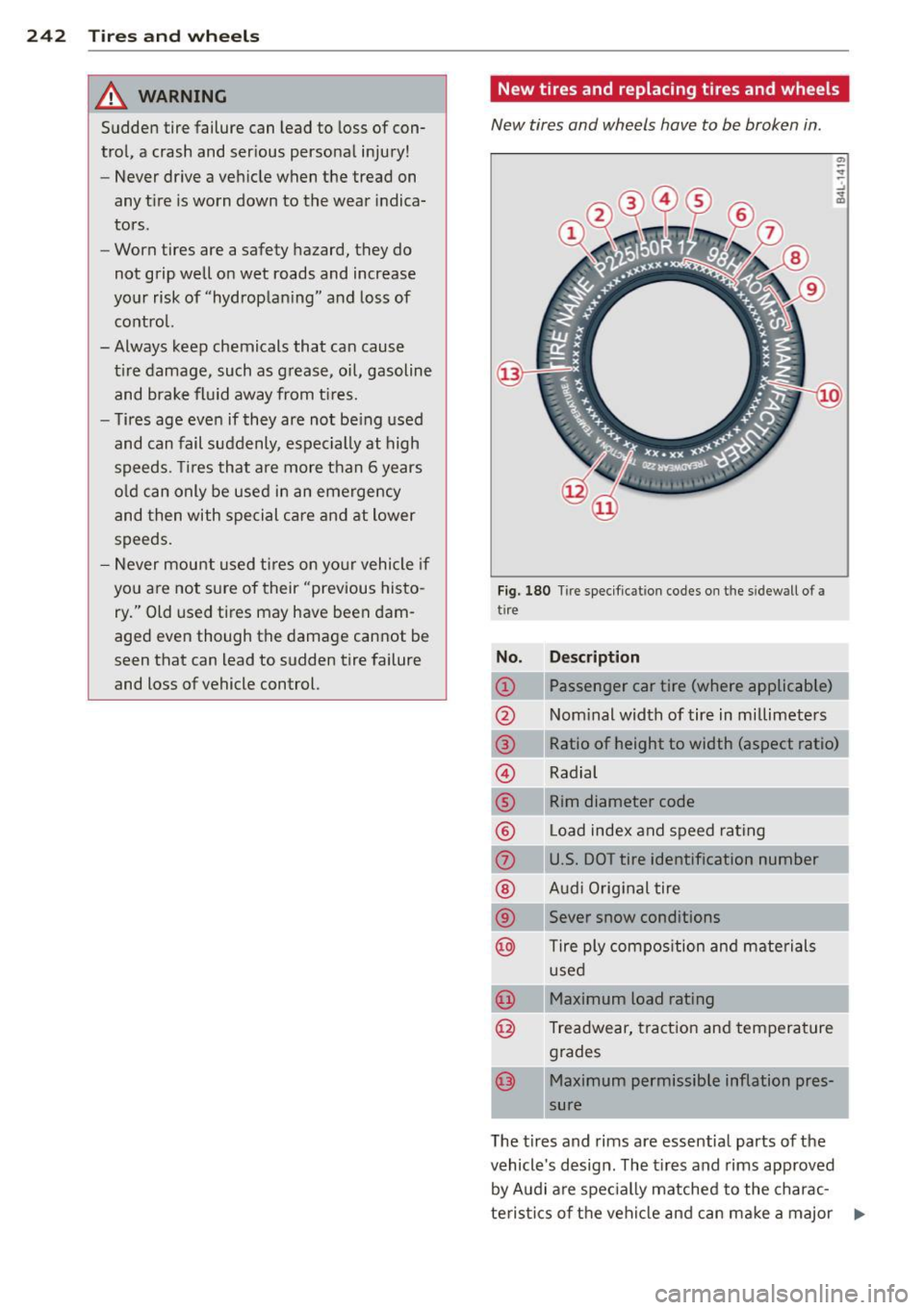
Fig. 180 Tir e specificat ion codes on the s idewall of a
t ire
No. Description
(!) Passenger car tire (where applicable)
@ Nominal width of tire in millimeters
@ Ratio of height to width (aspect ratio)
© Radial
® Rim diameter code
@ Load index and speed rating
(J) U.S. DOT tire identification number
@ Audi Orig inal tire
@ Sever snow conditions
@ Tire ply composition and materials
used
Maximum load rating
Treadwear, traction and temperature
grades
Maximum permissible inflation pres
sure
T he tires and rims are essential parts of the
vehicle 's design . The tires and rims approved
by Audi are spec ially matched to the charac
teristics of the vehicle and can make a major .,..
Page 247 of 294
-All four wheels must be fitted with radial
tires of the same type, size (rolling cir
cumference) and the same tread pattern .
Driving with different tires reduces vehi
cle handling and can lead to a loss of
control.
- If the spare tire is not the same as the
tires that are mounted on the vehicle -
for example with winter tires -only use
the spare tire for a short period of time and drive with extra care. Refit the nor
mal road wheel as soon as safely possi
ble.
- Never drive faster than the maximum
speed for which the tires on your vehicle
are rated because tires that are driven
faster than their rated speed can fail
suddenly.
- Overloading tires cause heat build-up,
sudden tire failure, including a blowout
and sudden deflation and loss of control.
- Temperature grades apply to tires that
are properly inflated and not over or un
derinflated .
- For technical reasons it is not always
possible to use wheels from other
vehicles -in some cases not even wheels
from the same vehicle model.
- If you install wheel trim discs on the ve
hicle wheels, make sure that the air flow
to the brakes is not blocked. Reduced air
flow to the brakes can them to overheat,
increasing stopping distances and caus
ing a collision.
- Run flat tires may only be used on
vehicles that were equipped with them at the factory. The vehicle must have a
chassis designed for run flat tires and a
factory-installed tire pressure monitor ing system* that indicates a loss of tire
pressure. Incorrect use of run flat tires
can lead to vehicle damage or accidents.
Check with an authorized Audi dealer or
tire specialist to see if your vehicle can be
equipped with run flat tires .
If run flat
tires are used, they must be installed on
all four wheels. Mixing tire types is not
permitted.
Tires and wheels 245
@ Note
- For technical reasons, it is not generally
possible to use the wheel rims from oth
er vehicles. This can hold true for wheels
of the same vehicle type.
- If the spare tire is different from the
tires that you have mounted on your ve
hicle (for example winter tires or wide
profile tires), then use the spare tire for a
short period of time only and drive with
extra care. Replace the flat tire with the
tire matching the others on your vehicle
as soon as possible.
- Never drive without the valve stem cap .
The valves could get damaged.
(® For the sake of the environment
Dispose of old tires in accordance with the
local requirements.
Uniform tire quality grading
- Tread wear
- Traction AA A B C
- Temperature ABC
Quality grades can be found where applicable
on the tire side wall between tread shoulder
and maximum section width
c:> page 242,
fig. 180 .
For example: Tread wear 200, Traction AA,
Temperature A.
All passenger car tires must conform to Feder
al Safety Requirements in addition to these
grades.
Tread wear
The tread wear grade is a comparative rating
based on the wear rate of the tire when tested
under controlled conditions on a specified
government test course.
For example, a tire graded 1S0 would wear
one and one half (1 1/2) times as well on the
government course as a tire graded 100.
1JJ>
•
•
Page 250 of 294
248 Tires and wheels
driving a few yards and correct if neces
sary. Follow the instructions from the
snow cha in manufacturer when doing so.
(D Tips
Where snow chains are mandatory oncer
tain roads, this normally also applies to
vehicles with all wheel drive.
Wheel bolts
Wheel bolts must always be tightened to the
correct torque.
The design of whee l bolts is matched to the
factory installed rims. If different rims are fit
ted, the correct wheel bolts with the right length and correctly shaped bolt heads must
be used. This ensures that wheels are fitted
securely and that the brake system functions
correctly .
In certain circumstances, you may not use
wheel bolts from a different vehicle -even if it
is the same model
¢ page 275.
.&_ WARNING
Improperly tightened or maintained wheel
bolts can become loose causing loss of
control, a collision and serious persona l in
Jury.
- Always keep the wheel bolts and the
threads in the wheel hubs clean so the
wheel bolts can turn easily and be prop
erly tightened.
- Never grease or oil the wheel bolts and
the threads in the wheel hubs. They can
become loose while driving if greased or
oiled, even if tightened to the specified
torque.
- Only use wheel bolts that belong to the
rim being installed.
- Never use different wheels bolts on your
vehicle.
- Always maintain the correct tightening
torque for the wheel bolts to reduce the
risk of a wheel loss . If the tightening tor
que of the wheel bolts is too low, they
can loosen and come out when the veh i- cle
is moving.
If the tightening torque is
too high, the wheel bolts and threads
can be damaged and the wheel can be
come loose.
(D Note
The specified torque for the whee l bolts is
90 ft lbs . (120 Nm) with a tolerance of
± 7,4 ft lbs. (± 10 Nm). Torque wheel bolts
diagonally . After changing a wheel, the
torque must be checked as soon as possi
ble with a torque wrench -preferably by an
authorized Audi dealer or qualified work
shop.
Low aspect ratio tires
Your Audi is factory -equipped with low aspect
ratio tires. These tires have been thoroughly
tested and been se lected specifically for your
model for their superb performance, road feel
and handling under a variety of driving condi
t ions . Ask your authorized Audi dealer for
more details .
The low aspect ratio of these tires is indicated
by a numeral of
55 or less in the tire's s ize
designation . The numeral represents the ratio
of the tire's sidewall height in relation to its
tread width expressed in percentage. Conven
tional tires have a height/w idth rat io of 60 or
more.
The performance of low-aspect-ratio tires is
particularly sensitive to improper inflation
pressure. It is therefore important that low
aspect ratio tires are inflated to the specified
pressure and that the inflation pressure is
regularly checked and maintained. Tire pres
sures should be checked at least once a
month and always before a long trip
¢ page 237, Checking tire pressure.
What you can do to avoid tire and rim
damage
Low aspect ratio tires can be damaged more
easily by impact with potholes, curbs, gul lies
or ridges on the road, particularly if the tire is
underinflated . ..,.
Page 255 of 294
has been designed specifically for your type of
vehicle.
It must not be swapped with a com
pact spare t ire from another type of veh icle .
Snow cha ins
F or techn ica l reasons, the use of snow chains
on the compact spare tire is
not p ermitt ed .
If you do have to dr ive with snow cha ins and a
front tire fails, mou nt the spare whee l w it h
tire ins tead of a rea r tir e. Install the snow
chains on the rear t ire and use it to replace
the defective front tire .
A WARNING
-Never use the spare tire if it is damaged
or if it is worn down to the tread wear in
dicators.
- If the spare tire is mo re than 6 years o ld,
use it only in an emergency and w ith ex
treme caution and careful driving.
- The spare tire is intended only for tem
porary and short-term use. It should be
replaced as soon as possib le w ith the
normal wheel and t ire .
- After mounting the compact spare tire,
the tire pressure must be checked as
soon as poss ible. The tire pressure of the
compact spa re tire must be 4.2 bar ; oth
erwise, you risk hav ing an accident.
- Do not drive faster than SO mph (80 km/
h). You risk having an acc ident .
-Avo id full-throttle acce lerat ion, heavy
braking, and fast corner ing . You risk hav
ing an acc ident.
- Never drive us ing more t han one spare
wheel and tire . You risk hav ing an acci
de nt.
- No rma l summer or winte r tires must not
be mounted on the compact spare whee l
rim.
- For technical reasons, the use of ti re
ch ains on the spare tire is no t permitted.
If it is necess ary to dr ive wi th tire ch ain s,
the spare whee l must be moun ted on the
front axle in the event o f a flat in a rear
t ire. The newly ava ilable front w heel
must then be installed in place of the
What do I do now? 253
'
rea r whee l w ith the flat tire. Installing
the t ire cha in be fore mounting the whee l
and tire is recommended.
- Loose items in the passenger compart
ment can cause serious personal injury
during hard brak ing or in a n accident.
Never store the inflatable spa re tire or
jack and tools in the passenge r compart
ment.
Changing a wheel
Before changing a wheel
Observe the following precautions for your
own and your passenger 's safety when chang
ing a wheel .
.,. After you expe rie nce a tir e fail ure, p ull the
car we ll away from mov ing traffic and try to
reac h
level ground before you stop ¢ .&, .
.,. All passengers should
leave the car and
move to a safe location ( for instance, behind
the guardra il) ¢ .&, .
.,. Engage the
park ing brake to prevent your
veh icle from rolling unintentionally¢.&, .
.,. Shift into
1st gear on veh icles with man ual
transm iss ion, or move th e
selector lever to
the P po sition
on vehi cles w ith automa tic
t ra nsm iss io n.
.,. If you are towing a tra iler : u nhi tch the trail
er from your vehicle .
.,. Take the
ja ck r=:> page 252 and the spare tire
r=:> page 252 out of the luggage compart
ment.
A WARNING
You o r you r passengers could be i njured
while changing a w heel if you do not fo l-
low these saf ety p recaut ions :
- If you have a fla t tire, move a safe d is
tance off th e road . T urn off the engine,
tur n the eme rgency flashers on and use
o ther warni ng devi ce s to a le rt other mo
t oris ts.
- Ma ke sure tha t passenge rs wait in a safe
p la ce aw ay from the vehicle and well
-
away from the road and tra ffic. .,. •
•
Page 256 of 294
254 What do I do now?
-To help prevent the vehicle from moving
sudden ly and possibly slipping off the
jack, always fully set the parking brake
and block the wheel diagonally opposite
the wheel being changed with the fold ing chocks or other objects. When one
front whee l is lifted off the gro und, plac
ing the A utomat ic Transm iss io n in "P"
(Park) will
not prevent the vehi cle from
moving .
- Be fore yo u change a wheel, be sure the
ground is leve l and fi rm . If necessa ry,
use a sturdy board under the jack.
- After installing the spare tire, make sure
that you replace the f lat ti re/wheel in its
storage area properly and tighten the
knurled retain ing screw secu rely .
@ Note
If you are chang ing the wheel on a steep
incline, use a rock or similar object to
block the opposite wheel to prevent the
veh icle from mov ing.
(D} Tips
Obey a ll laws .
Changing a wheel
When you change a wheel, follow the se
quence described below step -by -step and in
exactly that order.
1. Remove the decorative wheel c ove r* or
the wheel bolt cap s*. For more de tails see
a lso
¢ page 255, Decorative wheel cov
ers
or ¢ page 255, Wheels with wheel
bolt caps.
2 . Loosen the wheel bolts ¢ page 255.
3. Locate the proper mount ing point for the
jack and align the jack below that point
¢ page 256.
4. Lift the car with the jack¢ page 256 .
S. Remove the wheel with th e flat tire and
then install the spare tire
¢page 257.
6. Tighten all wheel bo lts ligh tly.
7 . lowe r the ve hicle w ith the jack . 8
. Use the wheel bolt w rench and firmly
tighten all wheel bolts in a crisscross pat
te rn
¢ page 255.
9. Replace the decorati ve wheel cover * or
the wheel bolt caps *.
A WARNING
Always read and fo llow all WARNINGS and
in fo rmat ion¢ .&.
in Raising the vehicle on
page 256
and ¢ page 258.
After changing a wheel
A wheel change is not complete without the
doing the following .
.,. Always store the vehicle tool kit, the jack*,
and the replaced tire in the luggage com
partme nt
¢ page 130.
.,. Check the tire pressure of the spare tire as
soon as possible.
.,. As soon as poss ib le, have the tightening
torque s on all whee l bolts chec ked w ith a
to rque wrenc h. The co rrect tighte ning tor
que is
90 ft lbs. (120 Nm) .
.,. Have the flat tire replaced as soon as possi
ble.
@ Tips
- If you notice that the wheel bo lts a re
co rroded and difficult to turn while
chang ing a tire, they shou ld be rep laced
before you check the tightening torque.
- Dr ive at reduced speed until you have the
tightening torques checked.
Page 258 of 294
256 What do I do now?
@ Tips
-Never use the hexagonal socket in the
handle of the screwdriver to loosen or
tighten the wheel bo lts.
- If a whee l bolt is very tight, you may find
it easier to loosen by carefully pushing
down on the end of the wheel bolt
wrench with
one foot only. As you do so,
hold on to the car to keep your balance
and take care not to slip.
Raising the vehicle
The vehicle must be lifted with the jack first
before the wheel can be removed .
*
Fig. 187 Sill panels: mark ings
Fi g. 188 Sill : posit ion ing th e vehicle jack
The location of the jack point is indicated by
an indentat io n on the underside of the vehicle
¢fig . 187.
... Activate the parking brake to prevent the
vehicle from rolling unintentionally.
... Shift into
1st gear on vehicles with manua l
transmission or move the selector lever to
the P position on vehicles with automatic
transmission*.
... Find the
marking (imprint) on the sill that
is nearest the wheel that will be changed
¢fig. 187. Behind the marking, there is a
lifting point on the sill for the vehicle jack.
... Turn the
vehicle jack located under the lift
ing point on the sill to raise the jack unti l
the jaw ¢
fig. 1 BB @covers the notch on
the vehicle ¢
.&,¢(D .
... Align the vehicle jack so the jaw @covers
the notch and the base plate ® is flat on
the floor. The base plate
@ must be vertical
under the lifting point @.
... Insta ll the rod on the vehicle jack: Insert
the rod into the opening on the handwheel.
Turn the rod left or right to secure it.
... Continue raising the jack w ith the rod unti l
the wheel lifts off the ground slightly.
Position the vehicle jack
only under the desig
nated lifting points on the sill ¢
fig . 187.
There is exactly one location for each wheel.
The jack must not be positioned at any other location ¢,&. ¢(}).
Soft ground under the jack can cause the ve
hicle to slip off the jack. Always place the jack
on firm ground. Use a flat, stab le support if
necessary . Use a non-slip surface such as a
rubber mat on a
slippery surface such as tile .
&_ WARNING
--You or your passengers could be injured
while changing a wheel if you do not fol
low these safety precautions:
- Position the vehicle jack only at the
designated lifting points and align the
jack. Otherwise, the vehicle jack could
slip and cause an injury if it does not
have sufficient hold on the vehicle.
- A soft or unstable surface under the
jack may cause the vehicle to slip off
the jack . Always provide a f irm base for
the jack on the ground.
If necessary,
us e a sturdy board under the jack.
- On hard, slippery surface (such as til es)
u se a r ubber mat or similar to prevent
the jack from slipping.
- To help prevent injury to yourself and
your passengers:
Page 261 of 294
Fuses and bulbs
Fuses
Replacing a fuse
Fuses that have blown will have metal strips
that have burned through.
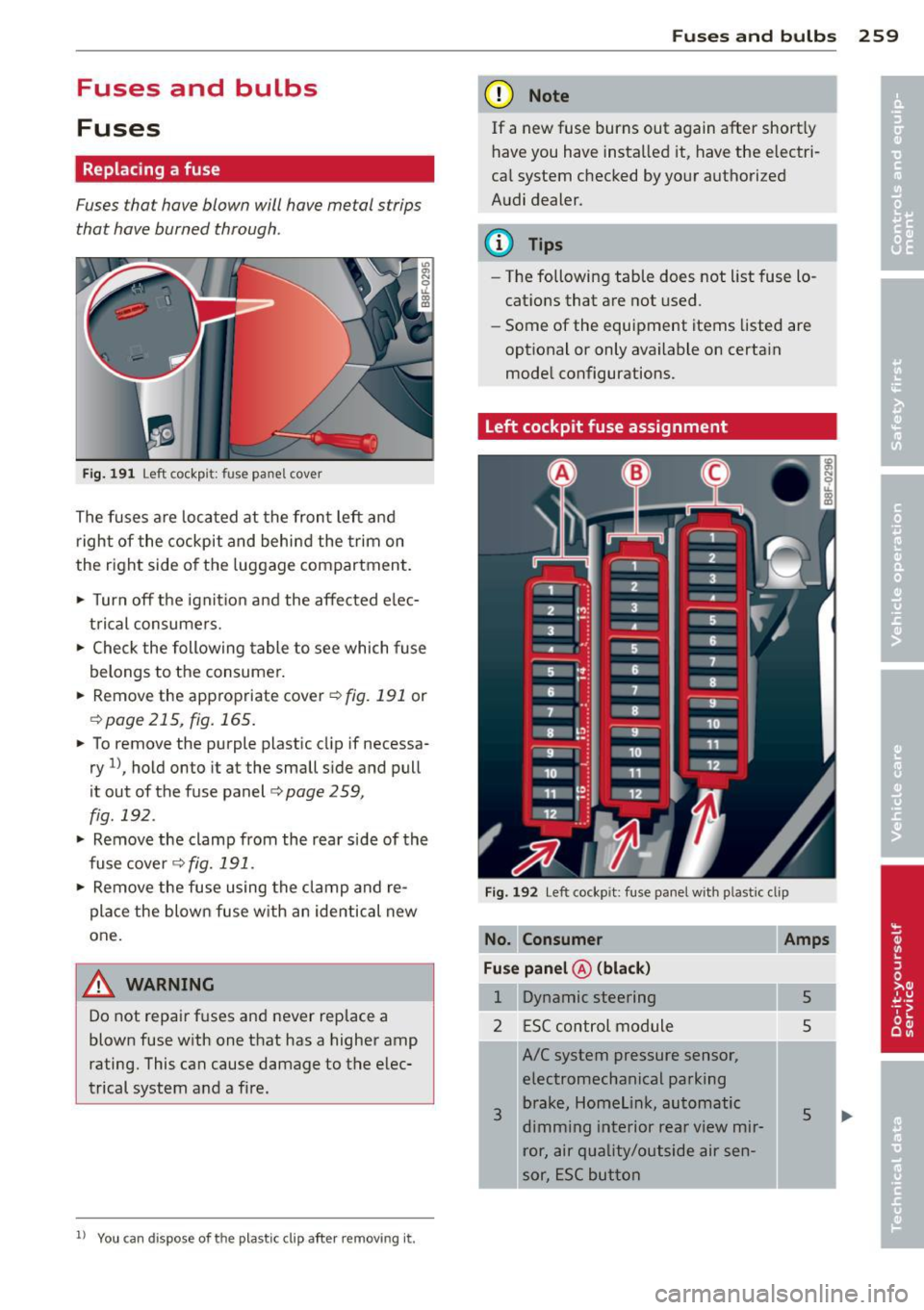
Fig. 191 Left cockp it : fuse panel cover
The fuses are located at the front left and
r igh t of the cockpit and behi nd the trim on
the right side of the luggage compartment .
.. Turn off the ign it ion a nd the affected elec-
t rical consumers .
.. Check the following table to see which fuse
belongs to the consume r .
.. Remove the appropriate cover¢
fig. 191 or
¢page 215, fig. 165 .
.. To remove the purple plastic cl ip if necessa
ry
ll, hold onto it at the small s ide and pull
it out of the fuse panel¢
page 259,
fig. 192 .
.. Remove the clamp from the rear side of the
fuse cover ¢
fig. 191 .
.. Remove the fuse using the clamp and re
pla ce the blown fuse w ith an identical new
one.
& WARNING , -
Do not repair f uses and never replace a
blown fuse w ith one that has a higher amp
rating. This can cause damage to the e lec
trical system and a fire.
11 You can dis pos e of the plastic clip after removing it.
Fu se s and bulb s 259
(D Note
If a new fuse burns out again after short ly
have you have insta lled it, have the electri
ca l system checked by your authorized
A udi dealer .
{!) Tips
-The following table does not list fuse lo
cat ions that are not used .
- Some of the equipment items listed are
opt ional or only available on certa in
mode l configurations.
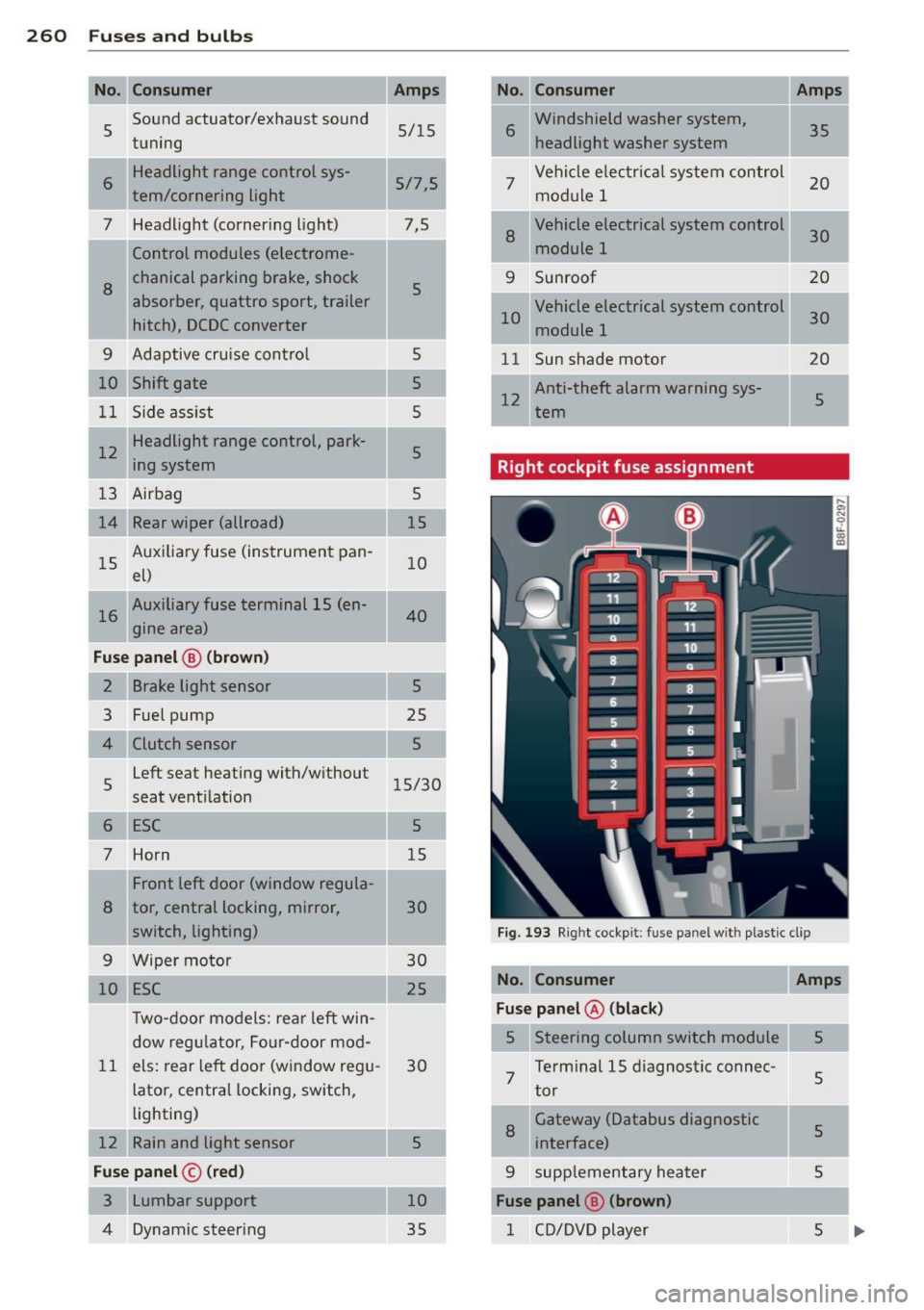
Left cockpit fuse assignment
Fi g. 192 Left cockpit: fuse panel wit h plastic clip
No. Consumer
Fu se panel @(black)
1 Dynamic steering
2 ESC control module
3
A/C system pressure sensor,
electromechanical parking
brake, Homelink, automatic
dimming interior rear view mir
r or, air quality/outside ai r sen
sor, ESC button
Amps
s
s
s
Page 262 of 294
260 Fuses and bulb s
No.
5 Sound actuator/exhaust sound
tuning
6 Headlight range control sys
tem/cornering light
7
8
Headlight (corner ing light)
Control modules (electrome
chanical parking brake, shock
absorber, quattro sport, trailer
hitch), DCDC converter
9 Adaptive cruise contro l
10 Shift gate
1 1 Side ass ist
Headlight range control, park
ing system
13 Airbag
14 Rear wiper (allroad)
15 Auxiliary fuse (instrument pan
el)
1
16
Auxiliary fuse terminal 15 (en
gine area)
Fu se pane l @ (b row n)
2 Brake light sensor
5
6
7
Left seat heating with/w ithout
seat venti lation
ESC Horn
Front left door (window regula-
8 tor, central locking, mirror, switch, lighting)
9 Wiper motor
10 ESC Two-door models: rear left win
dow regulator, Fo ur-door mod-
11 els: rear left door (window regu lator, central locking, switch,
lighting)
12 Rain and light sensor
F u se p anel© (red )
3
4 Dynamic steer ing
Amps
5/15
5/7,5 7,5
5
5
5
5
5
5
15
10
40
5
25
15/30
5
15
30
30
25
30
-No . Consumer Amps
6
Windshield washer system,
35
headlight washer system
7
Vehicle e lectrical system control
20
module 1
8
Vehicle electrical system control
30
module 1
9 Sunroof 20
10 Vehicle electrical system control
30
module
1
11 Sun shade motor 20
-
12 Anti-theft alarm warning sys-
tern 5
Right cockpit fuse assignment
Fig.
193 Right cockpit : fuse panel wit h plastic cl ip
No. Consume r
Fuse pane l@ (black )
..
5 Steering column switch module
7
8
Terminal 15 diagnostic connec
tor
Gateway (Databus diagnostic interface)
9 supp lementary heater
Fuse pan el@ (bro wn)
1 CD/DVD player
Amp s
5
5
5
5
5
•
I