roof AUDI A5 COUPE 2014 Owner's Manual
[x] Cancel search | Manufacturer: AUDI, Model Year: 2014, Model line: A5 COUPE, Model: AUDI A5 COUPE 2014Pages: 286, PDF Size: 70.99 MB
Page 174 of 286
172 Child Safety
-It is safer to install a forward-facing
child safety seat on the rear seat.
- Always read and heed all WARNINGS
whenever using a child restrained in ave
hicle is being used
c::;, page 161. Special
precautions apply when installing a child
safety seat on the front passenger seat
c::;, page 138, Child restraints on the front
seat -some important things to know.
A WARNING
Always take special precautions if you
must install a forward or rearward-facing
child restraint on the front passenger's
seat in exceptional situations:
- Whenever a forward or rearward-facing
child restraint is installed on the front
passenger seat, the
PASSENGER AIR
BAG OFF
light must come on and stay on
whenever the ignition is switched on.
- If the
PASSENGER AIR BAG OFF light
does not come on and stay on, perform
the checks described
c::;, page 147, Moni
toring the Advanced Airbag System.
- Take the child restraint off the front pas
senger seat and install it properly at one
of the rear seat positions if the
PASSEN
GER AIR BAG OFF
light does not stay on
whenever the ignition is switched on .
- Improper installation of child restraints
can reduce their effectiveness or even
prevent them from providing any protec
tion.
- An improperly installed child restraint
can interfere with the airbag as it de
ploys and seriously injure or even kill the
child.
- Always carefully follow the manufactur
er's instructions provided with the child
safety seat or carrier.
- Never place additional items on the seat
that can increase the total weight regis
tered by the weight-sensing mat and can
cause injury in a crash.
A WARNING
Forward-facing child restraints: -
Always make sure the forward-facing
seat has been designed and certified by
its manufacturer for use on a front seat
with a passenger front and side airbag .
- Never put the forward-facing child re
straint up, against or very near the in
strument panel.
- Always move the passenger seat into its
rearmost position in the seat's fore and
aft adjustment range, as far away from
the airbag as possible before installing
the forward-facing child restraint. The
backrest must be adjusted to an upright
position.
- Make sure that the
PASSENGER AIR BAG
OFF
light comes on and stays on all the
time whenever the ignition is switched
on.
A WARNING ~
Rearward-facing child restraints:
- A child in a rearward-facing child safety
seat installed on the front passenger
seat will be seriously injured and can be
killed if the front airbag inflates - even
with an Advanced Airbag System.
- The inflating airbag will hit the child
safety seat or infant carrier with great
force and will smash the child safety seat
and child against the backrest, center
armrest, door or roof.
- Always be especially careful if you must
install a rearward facing child safety seat
on the front passenger seat in exception
al circumstances .
- A tight tether strap on a rearward -facing
child restraint attached to the front pas
senger seat can put too much pressure
on the weight-mat in the seat and regis
ter a heavier weight in the Advanced Air
bag System. The heavier weight regis
tered can make the system work as
though an adult were on the seat and de
ploy the Advanced Airbag when it must
be suppressed causing serious or even
fatal injury to the child.
Page 191 of 286
A WARNING 1= ~
After driving through water, mud, slush, etc., the brakes may be slow to take effect
because of wet brake rotors and pads. Dry
the brakes first by braking carefully to re
store the full brak ing effect.
([) Note
Vehicle components such as the engine,
transmiss ion, suspension or electrical sys
tem can be severely damaged by driving
through wate r.
@ Tips
- Check the depth of the water before dr iv
i ng through it.
- Do not stop the veh icle, dr ive in reverse
or switch the engine off when driving
th rough water.
- Keep in mind that oncoming vehicles
may create waves that raise the water
level and make it too deep for you r vehi
cle to drive th rough safely.
- Avoid dr iving through sa lt water because
i t can ca use corrosion.
Catalytic converter
It is very important that your emission con
trol system (catalytic converter) is function
ing properly to ensure that your vehicle is run
ning in an environmentally sound manner.
11-Always use lead -free gaso line¢ page 201,
Fuel supply .
"'"Never run the tank down all the way to emp
ty.
11-Never put too much motor oil in your engine
¢ page 211, ~ Adding engine oil .
11-Never try to push -or tow -start your veh icle .
The catalytic converter is an efficient "clean up" device built into the exhaust system of
the vehicle . The catalytic converter burns
many of the pollutants in the exhaust gas be
fore they are released into the atmosphere .
Drivin g and en vironm ent 18 9
The exclusive use of unleaded fuel is critically
important for the life of the catalytic convert
er and proper f unct ion ing of the engine.
A WARNING
- The temperature of the exhaust system
is high, both when driving and after stop
ping the eng ine.
- Never touch the exhaust tail pipes once
they have become hot. This could result in burns.
- Do not park or operate the vehicle in
areas where the hot exhaust system may
come in co ntact with dry grass, br ush,
fue l spill or other material wh ich can
cause a fire .
- Do not apply additional undercoating or
ru stp roof ing on or nea r the exhaust
manifold, exhaust pipes, cataly tic con
ve rter or heat shield s. Dur ing driving, the
substance used for undercoating could
overheat and cause a fire.
(D Note
- Be aware that just o ne tank filling with
leaded fuel w ill already ser iously de
grade the performance of the catalytic
converter .
- Do not exceed the cor rect engine oil level
¢ page 211.
-Do not drive until the f ue l t ank becomes
comple tely empty . The engine co uld m is
fire . Unburned fuel could also get into
the exhaust system and this co uld cause
the catalytic converter to overheat.
- Do not turn off the ignition while the ve
hicle is mov ing.
- Do not continue to operate your vehicle
under these conditions, as othe rwise fuel
can reach the catalyt ic converter. Th is
cou ld result in overheating of the con
verter, requir ing its replacement.
- To assure efficient operation of the Emis -
sion Control System: ..,. •
•
Page 198 of 286
196 Vehicle care and cleaning
Vehicle care and
cleaning
General information
Regular, proper care helps to maintain your
ve hicle 's value. It can also be a requirement
when subm itting warranty claims for corro
sion damage and paint defects on the body .
The required cleaning and care prod ucts can
be obtained from your authorized Audi dea ler
or qualified workshop . Read and follow t he in
structions fo r use on the pac kaging .
A WARNING
-Us ing cleaning and care products incor
rect ly can be dange rous to your he alth.
- Always store cleaning and care products
o ut of rea ch of children to redu ce the r is k
of po ison ing.
@) For the sake of the environment
- Preferably use environmentally-friendly
products when buying cleaning agents .
- Do not d ispose of leftover cleaning and
ca re p rod ucts with household trash .
Car washes
-
The longer that depos its suc h as insects, bird
d roppings , tree sap o r road salt rema in on the
ve hicl e, the more the su rface can be dam
aged. High tempe ra tur es such as those
c a used by s unligh t increase the cor rosive ef
fect.
B efore was hing, wet heavy deposits w ith p le n
ty of water.
A lso , wash the underside of your vehicle once
r oad salt stops be ing used fo r th e season .
Pressure wa shers
When washing your veh icles w ith a pressure
washer, always follow the operating instruc
tions provided w ith the pressure washe r. Th is
i s especially important in rega rd to t he pres
sure and spray ing distance . Do not aim the
spray d irectly at seals o n side w indows, doors, the
hood, the rear lid o r the sunroo f* or at
t ir es , rub ber hoses, insu lating mate rial, sen
sors * or camera lenses *. Keep a d istance o f at
l east 16 inches (40 cm).
Do not remove snow and ice wi th a p ressu re
washe r.
Never use rota ry no zzle s or high pressure noz
z les.
T he wate r temperature must not be above
140
° F (60 °() .
Automatic car washes
Spray off the ve hicle before washing.
Make sure that the w indows and roof * are
closed and the winds hield wipers are off . Fo l
l ow instructions from the car wash operator,
especially if there are accessories attached to
your vehicle.
If possible, use car washes that do not have
brushes .
Washing by hand
Clean the ve hicl e starting from the top and
working down using a soft sponge or cleaning
brush . Use solvent-f ree cleaning products.
Washing vehicles with matte finish paint
by hand
To avoid damaging the paint when washing,
first remove dust and la rge particles from
yo ur vehicle. Insects, grease spots and finger
pri nts are best removed with a special cleaner
for matte finish paint .
Apply the p rod uct us ing a microfiber cloth . To
avo id damag ing the pa int surface, do not use
too much pressure.
Rinse the ve hicl e thoro ughly with water . Then
clean usi ng a neutral shampoo and a soft mi
crof iber cloth.
Rinse t he vehi cle thoroughly again and le t it
air dry . Remove any wa ter residue using a
shammy.
Stubborn dep osit s su ch as b ird drop pin gs o r
t ree sap are best remove d with p le nty o f wa -
te r and a microfiber cloth . ..,.
Page 212 of 286
210 Check ing and filling
temperatures stay below freezing point for
long periods.
Detergent addit ives in the o il w il l make fresh
oil look dark after the eng ine has been run
ning for a short time . This is norma l and is not
a reason to change the oi l more often than
recommended.
D am age or m alfunc tions du e to lack of
m ainten ance
It is essential that you change your oil at the
recommended in tervals using only engine o il
that complies with Audi oi l standard
VW 502 00. Your Limited New Vehicle War
ranty does not cover damage or malfunctions
due to fail ure to fo llow recommended mainte
nance and use requ irements as set forth in
the Audi Owner's Manual and Warranty
&
Maintenance book let . Your dealer will have to
deny warranty coverage unless you present to
the dea ler proof in the form of Service or Re
pa ir Orders that all scheduled ma intenance
was performed in a t imely manner.
Eng ine oil consumption
The engine in your vehicle depends on an ade
quate amount of oil to lubricate and cool all
of its moving parts.
In order to provide effective lubrication and
cool ing of internal engine components, a ll in
ternal combustion eng ines consume a certa in
amount of oil. O il consumption varies from
engine to engine and may change significantly
over the life of the engine. Typica lly, engines
with a specif ied break-in period (see
¢
page 188) consume more oil during the
break-in period than they consume after oil
consumption has stabilized.
Under norma l conditions, the rate of oil con
sumption depends on the quality and viscosity
of the oil, the RPM (revolutions per minute) at
which the engine is operated, the ambient
temperature and road condit ions . Further fac
tors are the amount of oil d ilution from water
condensat ion or fuel residue and the ox ida
tion level of the oi l. As any engine is subject to wear as mi
leage builds up, the oil consump
tion may increase over time until replacement
of worn components may become necessary.
With a ll these variab les coming into play, no
standard rate of oil consumption can be es
tablished or specified. There is no alternative
to regu lar and frequent check ing of the o il lev
el, see
Note .
If the yellow engine oil leve l warning symbo l
Ill in the instrument cl uster lights up, you
shou ld check the oil leve l as soon as possib le
¢
page 211. Top off the oil at your earliest
convenience ¢
page 211.
A WARNING '"---
Before you check anythi ng in the engine
compartment, always read and heed all
WARNINGS¢
A in Working in the engine
compartment on page 206.
(D Note
Driving w ith an insufficient o il level is like
ly to cause severe damage to the engine .
(D Tips
-The oil pressu re warn ing display. is
not an indic ator of the oil l evel. Do not
r e ly on it . Instea d, check the oil level in
y our engin e at r egular in ter val s, pref
erably ea ch time y ou r efu el, and alwa ys
befor e go ing on a long trip.
- If you have the impression you r engine
cons umes excessive amoun ts of o il, we
recommend that you consu lt an author
ized Aud i dea le r to have the cause of
your concern properly diagnosed. Keep in m ind that the accurate measu rement of
oil consumption requ ires great care and
may take some time. An authorized Aud i
dea ler has instructions about how to
measu re oil consumption accurately.
-
Page 226 of 286
224 Tires and wheels
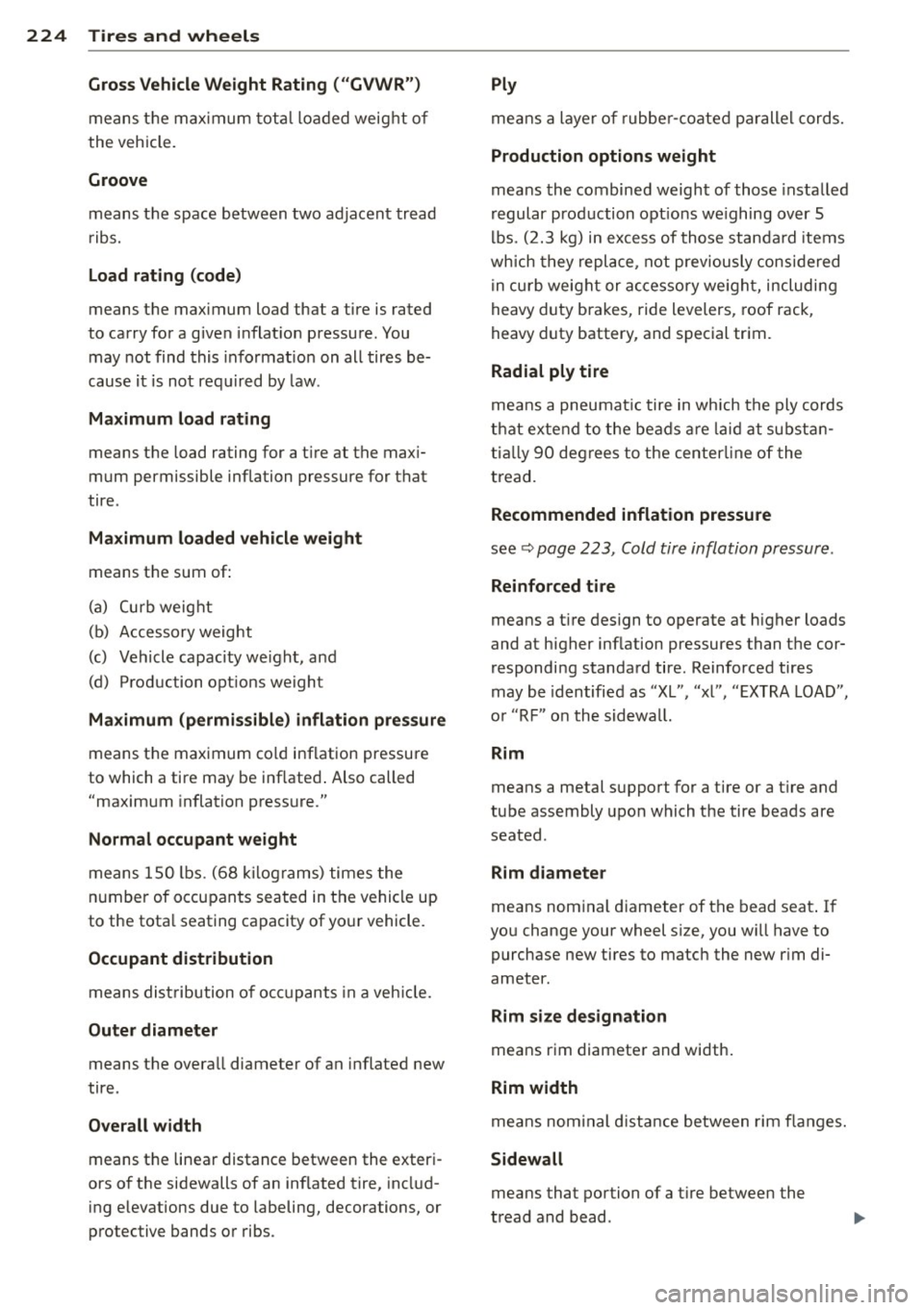
Gross Vehicle Weight Rating ("GVWR" )
means the maximum total loaded weight o f
the vehicle.
Groove
means the space between two adjacent tread
ribs.
Load rating (code)
means the maximum load that a tire is rated
to carry for a given inflat ion pressure. You
may not find this informat ion on all tires be
cause it is not requ ired by law .
Ma ximum load rating
means the load rating for a t ire at the maxi
mum permissible inflation pressure for that
tire .
Maximum loaded vehicle weight
means the sum of:
(a) Curb weight
(b) Accessory weight
(c) Vehicle capacity we ight, and
(d) Production opt ions weight
Maximum (permissible) inflation pressure
means the maximum cold inflation pressure
to which a tire may be inflated . Also called
"maximum inflation pressure."
Normal occupant weight
means 150 lbs. (68 kilog rams) times the
number of occupants seated in the vehicle up
to the tota l seating capacity of your vehicle.
Occupant distribution
means dist ribution of occupants in a veh icle.
Outer diameter
means the overall diameter of an inflated new
tire.
Overall width
means the linear distance between the exteri
ors of the sidewalls of an inflated tire, includ
ing elevations due to labeling, decorations, or
protective bands or ribs .
Ply
means a layer of rubbe r-coated parallel cords.
Production options weight
means the combined weight of those installed
regular production opt ions we ighing over 5
lbs. ( 2.3 kg) in excess of those standa rd items
wh ich they replace, not previously cons idered
in curb weight or accessory weight, including
heavy duty brakes, ride levelers, roof rack,
heavy duty battery, and special tr im.
Radial ply tire
means a pneumat ic tire in which the ply cords
that extend to the beads are laid at substan
tially 90 deg rees to the center line of the
tread.
Recommended inflation pressure
see c:::> page 223, Cold tire inflation pressure .
Reinforced tire
means a tire design to operate at higher loads
and at higher inflation pressures than the cor
responding standard tire. Reinforced tires
may be identified as "XL", "xl", "EXTRA LOAD",
or "RF" on the sidewall.
Rim
means a metal support for a tire or a t ire and
tube assembly upon which the tire beads are
seated .
Rim diameter
means nominal diameter of the bead seat. If
you change your wheel s ize, you w ill have to
purchase new tires to match the new rim di
ameter .
Rim size designation
means rim diameter and width.
Rim width
means nom inal distance between rim flanges.
Sidewall
means that portion of a tire between the
tread and bead .
Page 253 of 286
Fuses and bulb s 251
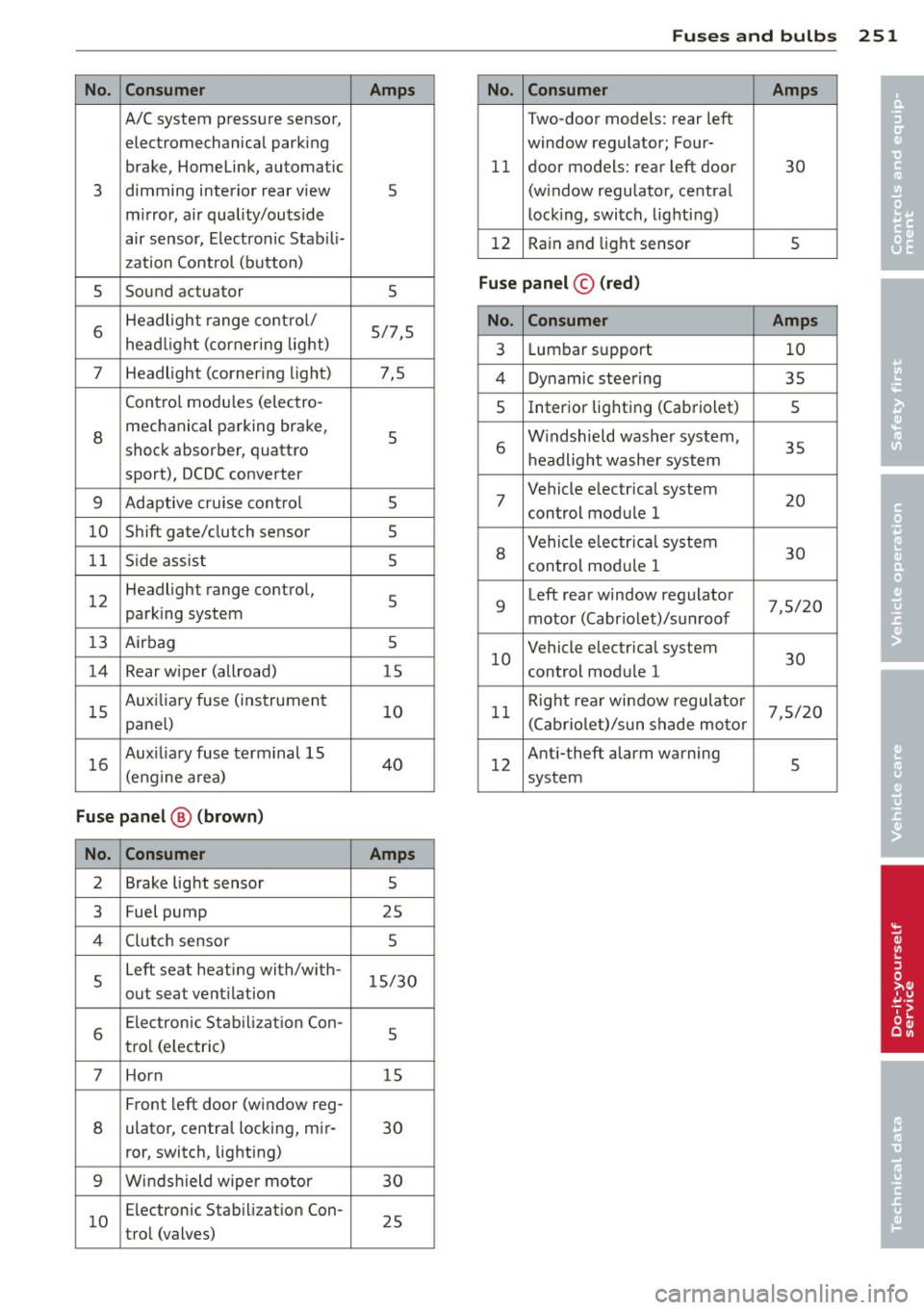
No. Con sumer Amps No. Consumer Amps
•
A/C system pressure sensor, Two-door models: rear left
• electromechanical parking window regulator; Four-
brake, Homelink, automatic 11 door models:
rear left door
30
3 dimming interior rear view
5 (window regulator, central
m irror, air quality/outside locking, switch, lighting)
air sensor, Electronic Stab ili-
12 Rain and light sensor
5
zation Control (button)
5 Sound
actuator
5
Fuse panel© (r e d )
6 Headlight
range cont rol/
5/7,5
head light (cornering light)
No. Consumer Amps
3 Lumbar support 10
7 Headlight (corner
ing light) 7,5
4 Dynamic steering 35
Contro l modu les (e lectro-
s Inter ior lighting (Cabriolet)
5
8 mechanical parking brake,
5
shock absorber, quattro
sport), DCDC converter
9 Adaptive cru ise contro l 5 6
W
indshield washer system,
35
h eadlight washe r system
7 Vehicle electrical
system
20
control module 1
10 Shift gate/clutch
sensor
5
1 1 Side ass ist 5
8
Vehicle electr ica l system
30
control module 1
1 2 Headlight range
control,
5
park ing system 9 Left rear window regulator
7,5/20
motor (Cabriolet)/sunroof
13 Airbag 5
14 Rear wiper (allroad) 15 10 Vehicle e
lectrical system
30
control module 1
1 5 Auxi
liary fuse (instrument
10
pane l) 11 R
ight rea r window regulato r
7,5/20
(Cabriolet)/sun shade motor
16 Aux
iliary fuse terminal 15
40
(engine area) 12 Anti-theft
alarm warning
5
system
Fuse p anel @ (brown )
No. Con sumer Amps
2 Brake light sensor 5
3 Fuel
pump
25
4 Clutc h sensor 5
5 Left
seat heating with/w ith-
15/30
out seat vent ilation
6 Electronic Stab
il iz at ion Con-
5
tro l (e lectric)
7 Horn 15
Front left door (window reg-
8 ulator, centra
l locking, mir-
30
ror, switch, lighting)
9 Winds hield wipe r motor 30
1 0 Electronic
Stabilizat ion Con-
25
trol (valves)
Page 267 of 286
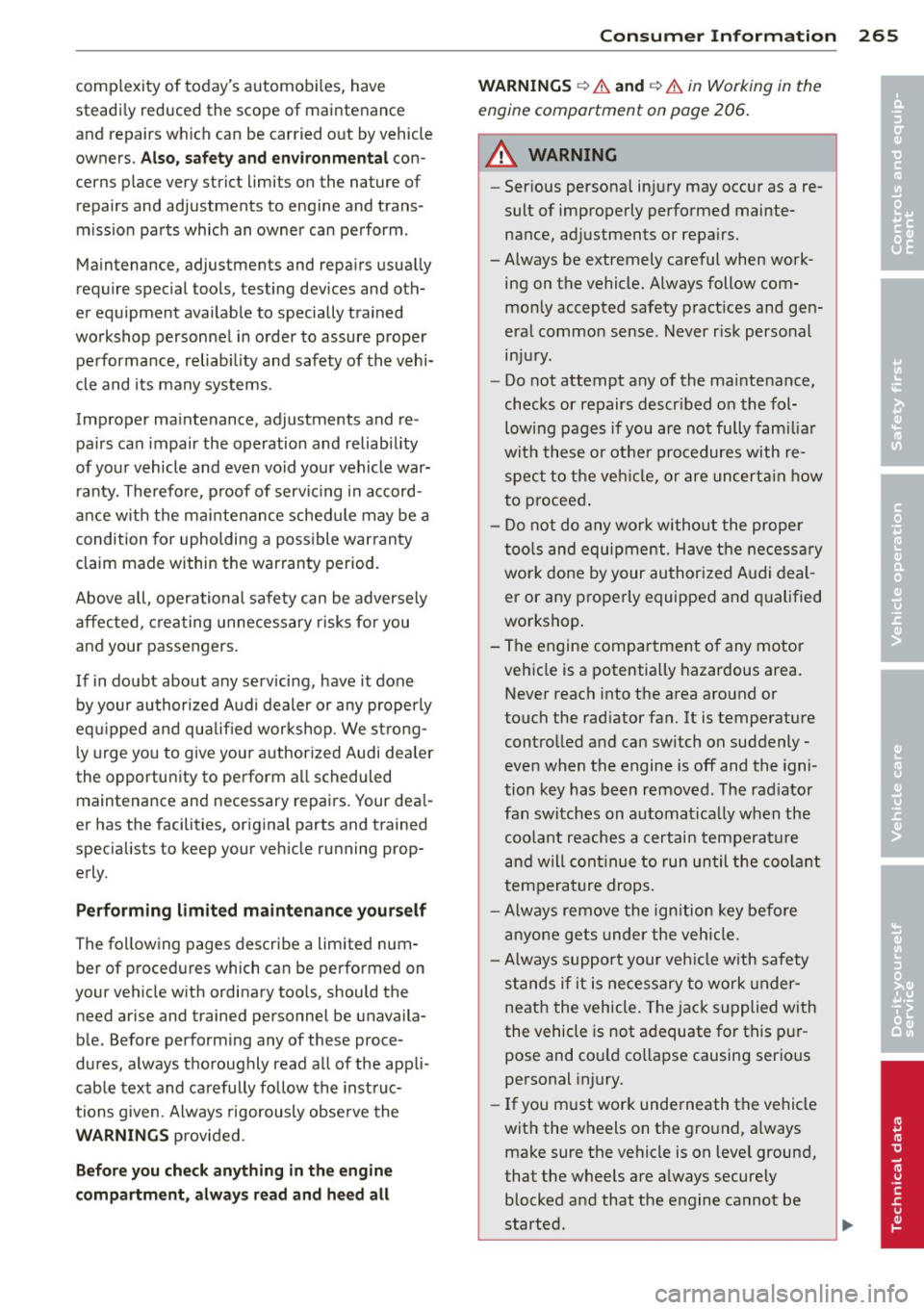
complexity of today's automobi les, have
steadi ly reduced the scope of maintenance
and repairs which can be carried out by vehicle
owners.
Also, safe ty and e nvir onm en tal con
cerns place very strict limits on the nature of
repairs and adjustments to engine and trans
miss io n pa rts which an owner can perform .
Maintenance, adjustments and repairs usua lly
require special tools, testing devices and oth
er equipment avai lab le to specially trained
workshop personnel in order to assure prope r
performance, reliab ility and safety of the vehi
cle and its many systems .
Improper ma intenance, adjustments and re
pa irs can impair the operation and reliability
of your vehicle and even void your vehicle war ranty. The refo re, p roof of servic ing in accord
ance w ith the maintenance sched ule may be a
condition for upholding a poss ible war ranty
claim made within the warranty period.
Above all, operational safety can be adversely
affected, crea ting unnecessary risks for you
and your passengers.
If in doubt about any servicing, have it done
by your authorized Audi dealer or any properly
equ ipped and qua lified workshop. We st rong
l y urge you to g ive your authorized Audi dea ler
the opportunity to perform all scheduled
maintenance and necessary repairs . Your dea l
er has the facilities, original parts and trained
specialists to keep your veh icle running prop
erly.
Performing limit ed m aintenance you rself
The following pages describe a limited num
ber of procedures which can be performed on
your vehicle with ordinary too ls, should the
need arise and trained personnel be unavaila
ble. Before performing any of these proce
dures, always thoroughly read all of the appli
cable text and carefully follow the instruc
tions given. Always rigorously obse rve the
WARNINGS provided.
B efore you check anything in th e engine
compartment, a lways re ad and heed all
Con sumer In formation 265
WARNINGS ¢ & and ¢ & in Working in the
engine comportment on page 206 .
A WARNING
-Ser ious personal injury may occur as a re
sult of improperly performed mainte
nance, adjustments or repa irs.
-Always be extremely careful when work
ing on the vehicle. Always follow com
mon ly accepted safety practices and gen
eral common sense. Never r isk personal
lnJUry.
- Do not attempt any of the ma intenance,
checks or repairs descr ibed on the fol
lowing pages if you are not fully fam iliar
wit h these or othe r pro cedures with re
spect to t he veh icle, or are uncerta in how
to p roceed .
- Do not do any work without the proper
too ls and equipment. Have the necessary
work done by your authorized A udi deal
er or any properly equipped and qualified
wo rkshop.
- The engine compartment o f any motor
veh icle is a potentially hazardous area.
Never reach into the area around or
touch the radiator fan. It is temperature
contro lled and can switch on suddenly -
even when the engine is off and the igni
tion key has been removed. The rad iator
fan switches on automat ica lly when the
coo lant reaches a certai n temperatu re
and will cont inue to run until the coo lan t
tempera ture drops .
- Always remove the ign itio n key befo re
anyone gets under the vehicle.
- Always support your veh icle with safety
s tands i f it is necessary to work under
neath the vehicle. The jack s upplied with
the vehicle is not adequate for this pur
pose and cou ld collapse causing serio us
personal injury.
- If you must work underneath the vehicle
with the wheels on the ground, a lways
make sure the vehicle is on leve l ground,
that the wheels are a lways securely
blocked a nd that the engine cannot be
started.
•
•
Page 273 of 286
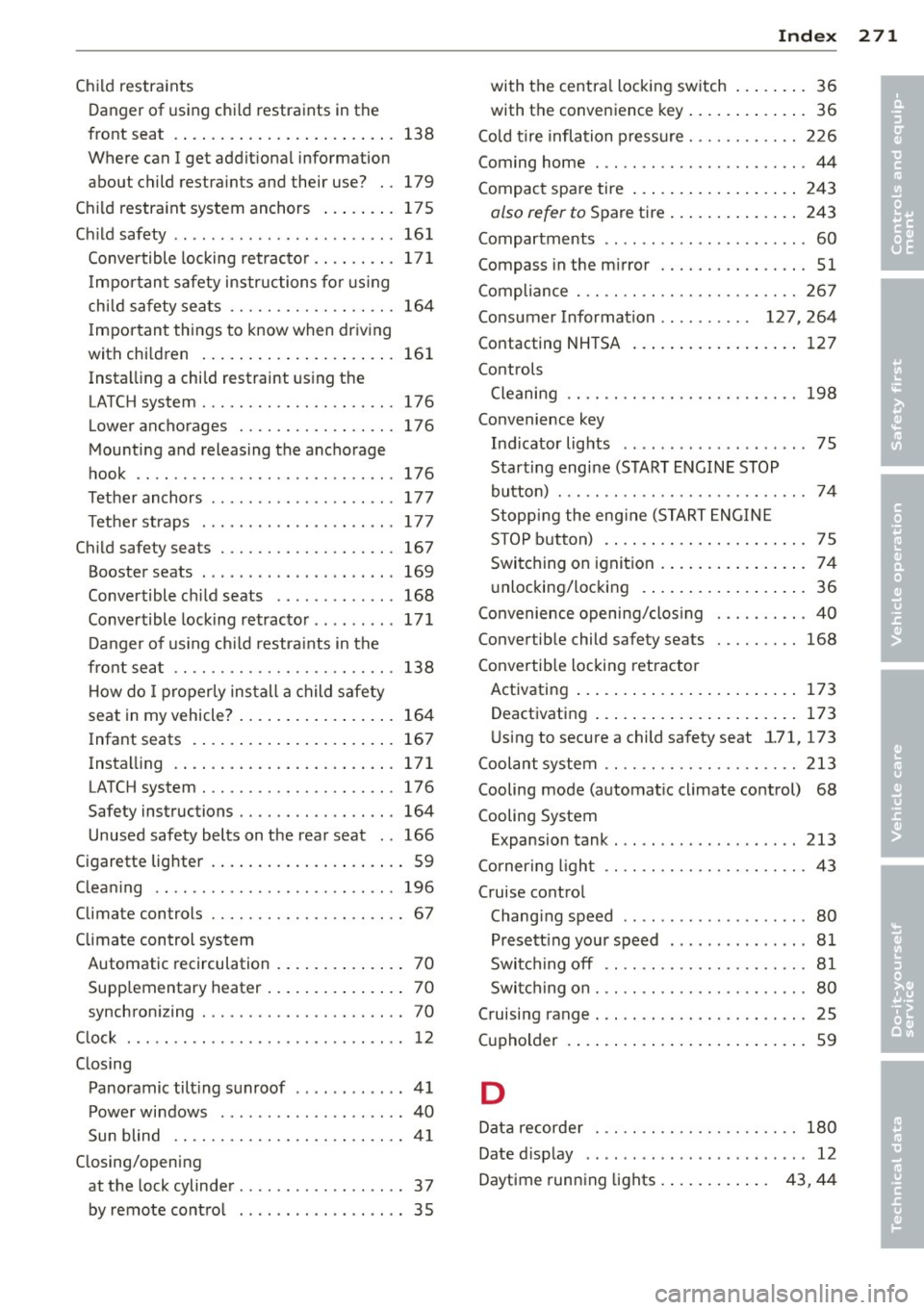
Child restraints
Dang er of using chi ld rest raints in th e
front seat . . . . . . . . . . . . . . . . . . . . . . . . 138
Where can I get addit ional information
about child restra ints and their use? . . 179
Ch ild restra int system anchors ... .. .. . 175
Ch ild safety .. ................ ... ... 161
Convertible locking retracto r . . . . . . . . . 17 1
I mportant safety instr uctions fo r using
ch ild safety seats ......... .. .. .. .. . 164
I mportant things to know when dr iv ing
with chi ld ren .... ..... ... .. .. .. ... 161
Instal ling a chi ld restraint using the
LATCH system ............ .... .. .. . 176
Lower anchorages ........ .. .. .. .. . 176
Mounti ng and releasing the anchorage
hook .. .. ... ............. ...... .. 176
Tether anchors . . . . . . . . . . . . . . . . . . . . 177
Tet her st raps . . . . . . . . . . . . . . . . . . . . . 177
Ch ild safety seats .......... .... .. .. . 167
Booster seats . ... .. ... ... .. .. .. ... 169
Convertible c hild seats .. ..... .... .. 168
Conver tible locking retracto r .. .. ... .. 171
D anger of using c hild restra ints in the
fro nt sea t .. ............. .... .. .. . 138
H ow do I properly ins tall a child s afety
seat in my vehicle? ..... ... .. .. .. .. . 164
Infant seats . .. .. ..... ... .. .. .. ... 167
Install ing .... .. .. .... ... .. .. .... . 17 1
LATCH system . . . . . . . . . . . . . . . . . . . . . 176
Safety instructions ........ .. .. .. .. . 164
Unused safety belts on the rear seat .. 166
Cigarette lig hter . . . . . . . . . . . . . . . . . . . . . 59
Clea ning .. .. .. ........... .. .. .. ... 196
Climate controls . . . . . . . . . . . . . . . . . . . . . 67
Climate con trol sys tem
Automatic recirculation . . . . . . . . . . . . . . 70
Supp lementary heater .. ... .. .. .. .. .. 70
synchron izing . ........... .. .. .. .... 70
C lo ck . .. .. .. .... ............. .. .. .. 12
Closing Panoramic tilt ing s unroof ...... . ... .. 4 1
P owe r windows . .......... ... ... ... 40
Sun blind .. ............. .... .. .... 41
Closing/open ing
at the lock cylinder ............ ... ... 37
by remote cont ro l ........... .. .... . 35
Inde x 271
with t he centra l locking sw itch ... .. .. . 36
with the conve nience key ..... ... .. .. . 36
Cold tire infla tion p ress ure ............ 226
Coming home . .. .. ................. .
44
Compact spa re tire ... . ... .... ... .. .. 24 3
also refer to Spare tire .. ..... ... .. .. 243
Compartments . . . . . . . . . . . . . . . . . . . . . . 60
Compass in the m irror ............... . 51
Compliance . .. .. .. ................. 267
Consumer Informat ion . . . . . . . . . . 127, 264
Co ntacting NHTSA ... . ... .... ... .. .. 127
Cont rols
Cleaning .. .. .. .. .... ........... .. 198
Convenience key Ind icator lig hts .. .. . .. .. .. ... ... .. . 75
Starting engi ne (S TART E NGINE STOP
bu tton) . .. .. .. .. .. . .............. . 74
Stoppi ng the eng ine (STAR T ENG INE
STOP b utton) . ... .. .. .. ...... ... .. . 75
Switching on ignition . .. ..... ... .. .. . 74
u nlocking/loc king . .. ... .... ... .. .. . 36
Convenie nce opening/clos ing
Convertib le child safety seats
Conve rtib le locking retractor 40
168
Activating ... .... .. . .. .. ..... ... .. 173
Deactivating ... .... . ... ...... ... .. 173
Using to secure a child sa fety seat 1.71, 173
Cool ant system .. .. ............... .. 213
Cooling mode (automat ic climate control) 68
Cooling System Expansion tank . .. .. ............... 213
Corner ing l igh t .. ...... ........... .. . 43
Cruise contro l
Changi ng speed .................. .. 80
Presett ing your speed ............. .. 81
Switch ing off .. .. .... ........... .. . 81
Swi tching on . .. .. .. ............... . 80
Cruising range . .. .. ... ... ...... ..... . 2S
( upholder . ... .... .. . .. .. ..... ... .. . 59
D
Dat a recorde r . . . . . . . . . . . . . . . . . . . . . . 180
Date d isp lay ...... .. ..... ........... 12
Daytime running lights. . . . . . . . . . . . 43 , 44
•
•
Page 274 of 286
272 Index
Declaration of compliance
Adaptive cruise control ... ... ... ... . 267
Audi side assist ................... 267
Cell phone package ....... .. .. .... . 267
Convenience key .......... .... .... . 267
Electronic immobilizer ......... .. ... 267
H omelink universal remote control .. . 267
Remote control key ........ ... .. .. . 267
Decorative parts/trim Cleaning . .. ............... ...... . 198
Defective light bulb warning . . . . . . . . . . . 21
Defrosting (w indows) ........ ... .. .. .. 69
Determining correct load limit ... .. ... 231
Digital clock .............. .. .. .... .. 12
Digital compass ............ ... .. .. .. 51
Dimensions .. ................ ..... . 262
Dimming the rearview mirror .. .. .. .. . . 47
Displays Cleaning . ... ............ .. .. .. .. . 198
Doors emergency locking .................. 37
Driver information system
Enhanced shift indicator . .. .. .. .. .. .. 28
Open door or front lid warning . . . . . . . . 24
Outside temperature display ...... .. .. 24
Sound system display . . . . . . . . . . . . . . . 24
Driver seat
refer to Seating pos ition ... .. .. .. .. . 120
Driving safely .. ... .... .... .. .. .... . 119
Driving through water ....... ..... .. . 188
Driving time . . . . . . . . . . . . . . . . . . . . . . . . 25
Dust filter
refer to Pollutant filter (automatic AC
system) .. .. ................ ... .. .. 67
Dynamic steering . . . . . . . . . . . . . . 104, 185
E
E8S ( Fue l) ... ................ ..... . 202
Easy entry function .. ........ ... .. .... 55
Efficiency program .......... ... .... .. 27
Fuel economy messages . . . . . . . . . . . . . 29
Memory levels . . . . . . . . . . . . . . . . . . . . . 25
Other equipment . . . . . . . . . . . . . . . . . . . 28
Shift indicator . . . . . . . . . . . . . . . . . . . . . 28
Electro-mechanical power assist . . . . . . . 185 Electromechanical
parking brake
Emergency braking ................. 78
Indicator light ... ................ .. 76
Parking ... .... .. ............. .... . 77
Releasing and closing .......... .... . 76
Starting assist . . . . . . . . . . . . . . . . . . . . . 77
Start ing from rest ....... ...... .. .. . 77
Starting off w ith a trailer ........... .. 78
Warning/ind icator lights ........ .. .. . 16
Electronic differential lock
Warning/indicator lights ........... .. 18
E lectronic differential lock (EDL) ....... 180
Warning/indicator lights ............. 19
Electronic immob ilizer . . . . . . . . . . . . 12, 38
Electronic power control (EPC) warning/indicator light . . . . . . . . . 20
E lectronic speed
Li miter . . . . . . . . . . . . . . . 31
Electronic stabilization control
Sport mode . .. .. ............. .. .. 182
Electronic Stabilization Control (ESC) . .. 180
Warning/indicator lights . ............ 18
Emergency actuation Doors .... .... .. ............. .... . 37
Ignition
key . .. .. ............. .. .. . 35
Panoramic t ilting sunroof . ...... .... . 42
Sun shade (roof) . ................ .. 42
Emergency braking ................. .. 78
Emergency flasher ................ .. . 45
Warning/ind icator lights ........ .. .. . 23
Emergency key . . . . . . . . . . . . . . . . . . . . . . 33
Starting engine . . . . . . . . . . . . . . . . . . . . 73
Emergency operation Emergency braking function (parking
brake) .... .... .. ............. .... . 78
Emergency starting ................ . 255
Emergency towing ................. . 257
Energy management . . . . . . . . . . . . . . . . 186
Battery power . . . . . . . . . . . . . . . . . . . . . 17
Driver notification . . . . . . . . . . . . . . . . . . 17
Engine Compartment .... ............. .... 208
Coolant . .. .. .. .. ............. .. .. 213
Data ..... .... .. .. ........... .... 263
Hood . .... .... ................... 206
Starting . . . . . . . . . . . . . . . . . . . . . . 71, 74
Starting with jumper cables ... .. .. .. 255
Stopping . . . . . . . . . . . . . . . . . . . . . . 73, 75
Page 275 of 286
Engine compartment
Safety instructions ................ . 206
Working the engine compartment 206
Engine coolant
Indicator light . . . . . . . . . . . . . . . . . . . . . 17
Engine coolant system .......... ... .. 213
Adding coolant .............. ... ... 214
Checking coolant level ..... .. .. .. .. . 213
Checking the engine coolant level . . . . . 213
Radiator fan ............. .. .. .. .. . 215
Engine coolant temperature Temperature gauge .......... .... ... 10
Engine hood Closing .. .. .. ........... .. .. .. ... 206
How to release the hood ... .. .. .. .. . 206
Engine oil ... ................ ... ... 208
Adding .... ................ ... ... 211
Additives . .. .. ........... .. .. .. ... 211
Changing .. ............. .... .. ... 212
Check oil level ........... .... .. ... 211
Consumption ............... ... ... 211
Indicator light . . . . . . . . . . . . . . . . . 17, 21
Oil consumption . ...... ... .. .. .. .. . 210
Oil grades ..................... ... 208
Pressure malfunction ...... .. .. .. .. .. 17
Sensor defective . . . . . . . . . . . . . . . . . . . . 21
Specification and viscosity ... ... .. .. . 208
Engine speed limitation .......... .... . 21
Environment Break-in period ........... .. .. .. ... 188
Catalytic converter ............ ... .. 189
Disposing of your vehicle battery ..... 220
Driving at high speeds .......... .... 190
Driving to minim ize pollution and noise 190
Fu el . .. .. .. .. .. ........... .. .. ... 204
Fu el economy ..................... 190
Leaks under your vehicle ............ 206
Letting the vehicle stand and warm up. 191
Proper disposal of drained brake fluid . 216
Proper disposal of drained engine cool-
ant . .... .. .. ............. .. .. ... 214
Proper disposal of drained engine
oil ...... ... ............. ... 211,212
Recycling used engine oil . .. .. .. .. .. . 211
Roof rack . . . . . . . . . . . . . . . . . . . . . . . . . 62
Unleaded fuel . ........... .. .. .. ... 201
What should I do with an old battery? . 220
Index 273
EPC
refer to Electronic power control . . . . . . 20
Ethyl alcohol (Fuel) . ................. 202
Event Data Recorder (EDR) ........ .... 180
Exhaust tail pipes Cleaning ... ..... .. ............... 197
Expansion tank .. .... ... ....... ..... 213
Exterior lighting . .. ................. . 43
Exterior m irrors
Adjusting ..... .... ................ 46
Dimming ... ..... .. ................ 47
Heating ........................... 46
F
Fan
Radiator
Fastening 215
Booster seats .. ...... ......... .... 169
Convertible child safety seats .... .... 168
Infant seats
Flat tire 167
Changi ng ... .. .. .. .. ........... .. 244
flexible fuel ... .. .... ............... 202
Floor mats ... ..... .. ............... 124
Fog lights/rear fog lig ht(s) . . . . . . . . . . . . . 43
Folding the rear seats ... ............. . 63
Foot pedals . .. .. .. .. ............... 124
For the sake of the environment Gasoline fumes and the environment .. 204
Letting the engine warm up . . . . . . 71, 74
Refueling . .. .. .. ................. 204
Saving fuel by early upsh ifting ... .. .. . 11
Front airbags Description . . . . . . . . . . . . . . . . . . . . . . . 141
How they work ... .. . .. .... ........ 146
Frontal collisions and the laws of physics 130
Front passenger's door emergency locking 37
Front seats Adjusting ....... .. ..... .......... 121
Child restraints in the front seat ...... 138
Fuel Additives .... .. ...... ............. 201
Blended gasoline ... . .. .... ........ 201
Consumption .. ... ............... .. 25
Filler neck . .. .. .... .......... ..... 203
Fuel gauge . . . . . . . . . . . . . . . . . . . . . . . . 12
•
•