ESP AUDI A5 COUPE 2015 Workshop Manual
[x] Cancel search | Manufacturer: AUDI, Model Year: 2015, Model line: A5 COUPE, Model: AUDI A5 COUPE 2015Pages: 264, PDF Size: 66.83 MB
Page 149 of 264
M N
0 loo
rl I.O
"' N
"' rl
How supplemental side airbags work
Side airbags deploy instantly and can help reduce the risk of upper torso injuries for occu
pants who are properly restrained.
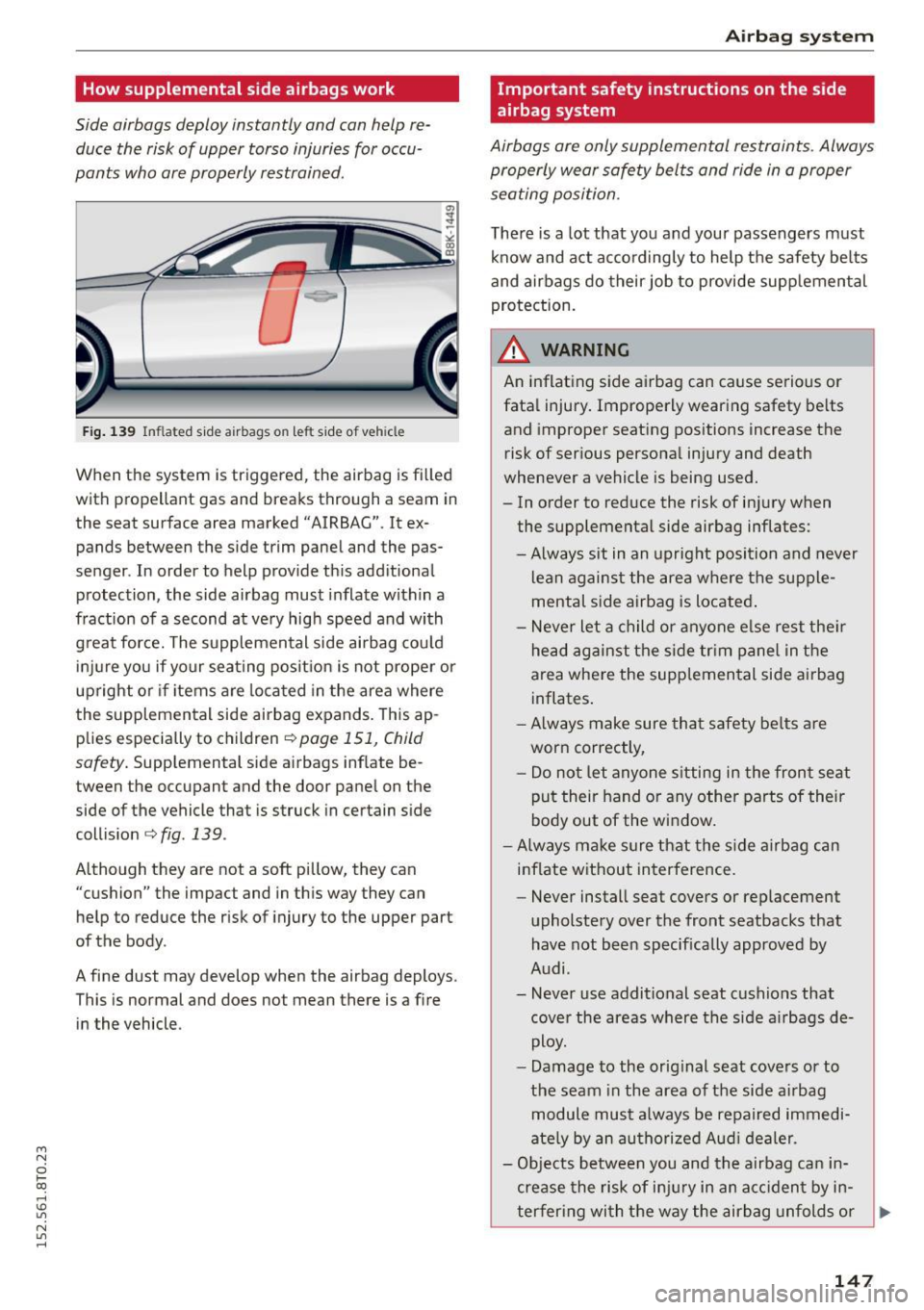
Fig. 139 Inflated side a irbags on left side of veh icle
When the system is triggered, the airbag is filled
with propellant gas and breaks through a seam in
the seat surface area marked "AIRBAG". It ex
pands between the side trim panel and the pas
senger . In order to help provide this additional
protection, the side airbag must inflate within a
fraction of a second at very high speed and with great force. The supplemental side airbag could injure you if your seating position is not proper or
upright or if items are located in the area where
the supplemental side airbag expands. This ap
plies especially to children
¢page 151, Child
safety.
Supplemental side airbags inflate be
tween the occupant and the door panel on the
side of the vehicle that is struck in certain side
collis ion
¢fig. 139.
Although they are not a soft pillow, they can
"cushion" the impact and in this way they can
help to reduce the risk of injury to the upper part
of the body.
A fine dust may develop when the airbag deploys.
This is normal and does not mean there is a fire
in the vehicle .
Airbag system
Important safety instructions on the side
airbag system
Airbags are only supplemental restraints. Always
properly wear safety belts and ride in a proper
seating position .
There is a lot that you and your passengers must
know and act accordingly to help the safety belts
and airbags do their job to provide supplemental
protection.
A WARNING
An inflating side airbag can cause serious or
fatal injury. Improperly wearing safety belts
and improper seating positions increase the
risk of serious personal injury and death
whenever a vehicle is being used.
- In order to reduce the risk of injury when
the supplemental side airbag inflates:
- Always sit in an upright position and never
lean against the area where the supple
mental side airbag is located.
- Never let a child or anyone else rest their
head against the side trim panel in the
area where the supplemental side airbag
inflates.
- Always make sure that safety belts are
worn correctly,
- Do not let anyone sitting in the front seat
put their hand or any other parts of their
body out of the window.
- Always make sure that the side airbag can
inflate without interference.
- Never install seat covers or replacemen t
upholstery over the front seatbacks that
have not been specifically approved by
Audi.
- Never use additional seat cushions that cover the areas where the side airbags deploy.
- Damage to the original seat covers or to
the seam in the area of the side airbag
module must always be repaired immedi
ately by an authorized Audi dealer.
-
- Objects between you and the airbag can in
crease the risk of injury in an accident by in
terfering with the way the airbag unfolds or
~
147
Page 151 of 264
M N
i? co
the circumst ances wi ll vary considerably between
one co llision and another . Important facto rs in
clude, for example, t he nature (hard or soft) of
the impacting object, the angle of impact, vehicle
speed, etc .
¢ page 149, How side curtain air
bags work .
Aside from the ir norma l safety func tion, safety
be lts work to help keep the dr iver or front pas
senger in posit ion in the event of a collision so
that the side curta in a irbags can provide protec
tion .
The airbag system is not a subst itute for your
safety belt. Rather, it is part of the overall occu
pant restraint system in your vehicle . Always re
member that the airbag system can only help to
p rotect you if you are wear ing your safety be lt
and wear ing it prope rly. This is another reason
why you should a lways we ar your safety belts,
not just because the law req uires you to do so
¢ page 121, General information.
It is impor tant to remember that whi le the side
cur tain a irbag sys tem is designed to he lp redu ce
the like lihood o f serious injuries, other injur ies,
for example, swe lling, bruising, and minor abra
sions can a lso be associated with these airbags .
Remember too, these airbags wi ll dep loy only
once and only in certain k inds of accidents -yo ur
safety belts are always there to offer protect ion.
The side curt ain airbag sy stem basically
con sists of :
-The electronic control mod ule and externa l side
impact sensors
- The side curtain airbags above the front and
rear side w indows
- The airbag indicator light in the instrument
panel
The airbag system is monitored elect ronica lly to
make certain it is f unctioning proper ly at a ll
times. Eac h time you turn on the ign ition, the a ir
bag system ind icator light will come on for a few
seconds (self diagnostics).
The side curt ain airbag is not activated:
- if the ignitio n is turned off,
~ - in s ide coll isions when the acce leration meas-.,.,
~ u red by the sensor is too low, ,....,
Airbag syste m
- in rear -end co llisions,
- in rollove rs.
A WARNING
-
- Safety belts and the airbag system will only
p rovi de p rotection when occ upants are in
the proper seating position
¢ page 54,
Seats and storage.
- If the ai rbag indicator light ¢ page 19
comes when the veh icle is being used, have
the system inspected immediately by your
author ized Audi dealer. It is possib le that
the airbag will inflate when it is not sup
posed to, or will not infla te when it s hould.
How side curtain airbags work
Side curtain airbags can work together with side
airbags to help reduce the risk of head and upper
torso injuries for occupants who are properly re
strained .
E
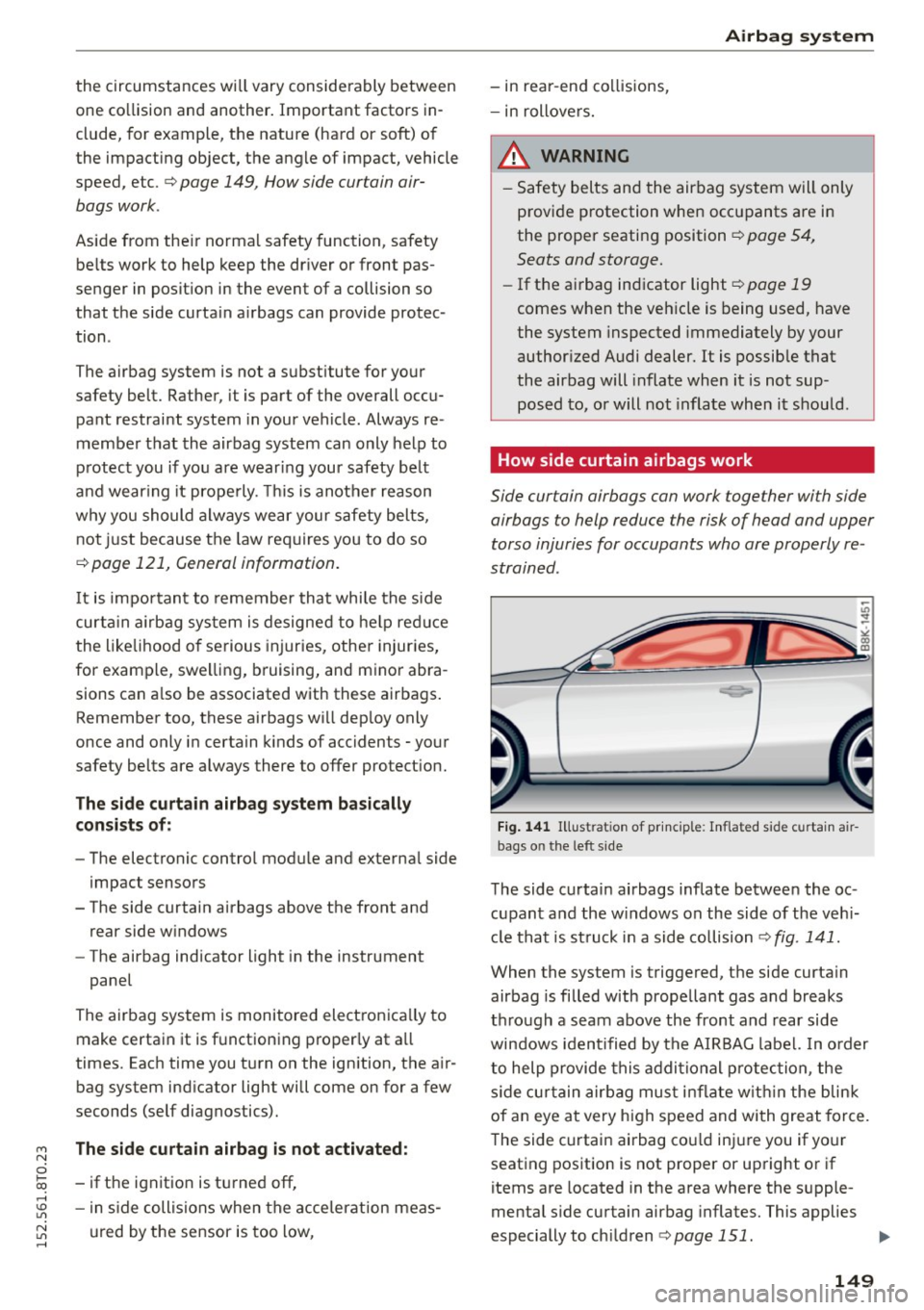
Fig. 14 1 Illus trati on of pr inc ip le : Inf lat ed s ide curtain a ir
bags o n the left s ide
The side curtai n airbags inflate betwee n the oc
cupant a nd the w indows on the side of the ve hi
cl e that is st ruck in a side collision
¢ fig. 141.
When the system is triggered, the side curta in
airbag is filled with prope llant gas and breaks
t hr ough a seam above the front and rear side
windows ident ified by the AIR BAG label. In o rder
to help provide this addi tional p rotec tion , the
s ide cu rtain airbag mus t in flate w it hi n the blin k
of an eye at very high speed and wi th great force.
The side c urtain airbag co uld inj ure you if yo ur
seating position is not proper or upright or if
items are located in the area where the s upple
mental s ide curtain airbag inflates. This applies
especially to ch ildren
¢ page lSl. .,..
149
Page 153 of 264
M N
i? co ,...., \!) 1.1'1
N 1.1'1 ,....,
Child safety
Important information
Introduction
The rear seat is generally the safest place in a
collision .
The physical principles of what happens when
your vehicle is in a crash apply also to children
c:> page 122, What happens to occupants not
wearing safety belts? .
But unlike adults their
muscles and bones are not fully developed. In
many respects children are at greater risk of seri
ous injury in crashes than adults.
Because children's bodies are not fully developed,
they require restraint systems especially de
signed for their size, weight, and body structure.
Many countries and all states of the United
States and provinces of Canada have laws requir
ing the use of approved child restraint systems
for infants and small children.
In a frontal crash at a speed of 20-3S mph
(30-56 km/h) the forces acting on a 13-pound
(6 kg) infant will be more than 20 times the
weight of the child. This means the weight of the
chi ld would suddenly be more than 260 pounds
(120 kg). Under the se cond itions, only an appro
priate child restraint properly used can reduce
the risk of serious injury. Child restraints must be
used properly to be effective. Used improperly,
they can increase the risk of serious injury in an
accident.
Consult the child safety seat manufacturer's in
structions to be sure the seat is right for your
child's size
c:> page 154, Important safety in
structions for using child safety seats.
Please be
sure to read and heed all of the important infor
mation and WARNINGS about child safety, Ad
vanced Airbags, and the installation of child re
straints in this chapter.
There is a lot you need to know about the Ad
vanced Airbags in your vehicle and how they work
when infants and children in child restraints are
on the front passenger seat. Because of the large
amount of important information, we cannot re
peat it all here. We urge you to read the detailed
Child safety
information in this owner's manual about airbags
and the Advanced Airbag System in your vehicle
and the very important information about trans
porting children on the front passenger seat.
Please be sure to heed the WARNINGS -they are
extremely important for your safety and the safe
ty of your passengers, especially infants and
small children .
,&. WARNING
-Accident statistics have shown that children
are generally safer in the rear seat area than
in the front seating position. Always restrain
any child age 12 and under in the rear.
- All vehicle occupants and especially children
must be restrained properly whenever riding
in a vehicle. An unrestrained or improperly
restrained child could be injured by striking
the interior or by being ejected from the ve hicle during a sudden maneuver or impact.
An unrestrained or improperly restrained
child is also at greater risk of injury or death
through contact with an inflating airbag .
-A suitable child restraint properly installed and used at one of the rear seating positions
provides the highest degree of protection
for infants and small children in most acci dent situations.
,&. WARNING
Children on the front seat of any car even with
Advanced Airbags can be seriously injured or
even killed when an airbag inflates. A child in
a rearward-facing child safety seat installed
on the front passenger seat will be seriously
injured and can be killed if the front airbag in
flates.
- The inflating airbag will hit the child safety
seat or infant carrier with great force and
will smash the child safety seat and child
against the backrest, center armrest or
door.
-Always install rearward-facing child safety seats on the rear seat .
- If you must install a rearward facing child
safety seat on the front passenger seat in
151
Page 154 of 264
Child safety
exceptional circumstances and the PASSEN
GER AIR BAG OFF
light does not come on
and stay on, immediately install the rear
ward-facing child safety seat in a rear seat
ing position and have the airbag system in
spected immediately by your authorized
Audi dealer.
_& WARNING
If, in exceptional circumstances, you must in
stall a forward-facing child restraint on the
front passenger's seat:
- Always make sure the forward-facing seat
has been designed and certified by its man
ufacturer for use on a front seat with a pas
senger front and side airbag.
- Always follow the manufacturer's instruc
tions provided with the child safety seat or
carrier.
- Always move the passenger seat into its
rearmost position in the seat's fore and aft
adjustment range, as far away from the air
bag as possible before installing the child
restraint. The backrest must be adjusted to
an upright position.
- Always make sure that the
PASSENGER AIR
BAG OFF
light comes on and stays on all the
time whenever the ignition is switched on.
(D Tips
Always replace child restraints that were in
stalled in a vehicle during a crash. Damage to
a child restraint that is not visible could cause
it to fail in another collision situation.
Advanced front airbag system and children
Your vehicle is equipped with a front "Advanced
Airbag System" in compliance with United States
Federal Motor Vehicle Safety Standard (FMVSS)
208 as applicable at the time your vehicle was
manufactured.
The Advanced Airbag system in your vehicle has
been certified to meet the "low-risk" require
ments for 3- and 6-year old children on the pas
senger side and small adults on the driver side.
The low risk deployment criteria are intended to
152
reduce the risk of injury through interaction with
the airbag that can occur, for example, by being
too close to the steering wheel and instrument panel when the airbag inflates. In addition, the
system has been certified to comply with the
"suppression" requirements of the Safety Stand
ard, to turn off the front airbag for infants up to
12 months who are restrained on the front pas
senger seat in child restraints that are listed in
the Standard.
Even though your vehicle is equipped with an Ad
vanced Airbag system, all children, especially
those 12 years and younger, should always ride in
the back seat properly restrained for their age
and size. The airbag on the passenger side makes
the front seat a potentially dangerous place for a
child to ride. The front seat is not the safest place
for a child in a forward-facing child safety seat. It
can be a very dangerous place for an infant or a
larger child in a rearward-facing seat.
· Advanced Airbags and the weight-sensing
mat in the front seat
The Advanced Airbag System in your vehicle de
tects the presence of an infant or child in a child
restraint on the front passenger seat using the
weight-sensing mat in the seat cushion and the sensor below the safety belt latch on the front
passenger seat that measures the tension on the
safety belt .
The weight-sensing mat measures total weight of
the child and the child safety seat and a child blanket on the front passenger seat. The weight
on the front passenger seat is related to the de
sign of the child restraint and its "footprint", the
size and shape of the bottom of the child re
straint as it sits on the seat . The weight of a child
restraint and its "footprint" vary for different
kinds of child restraints and for the different
models of the same kind of child restraint offered
by child restraint manufacturers.
The weight ranges for the individual types, makes
and models of child restraints that the NHTSA
has specified in the Safety Standard together
with the weight ranges of typical infants and typ-
ical 1 year-old child have been stored in the .,..
Page 156 of 264
Child safety
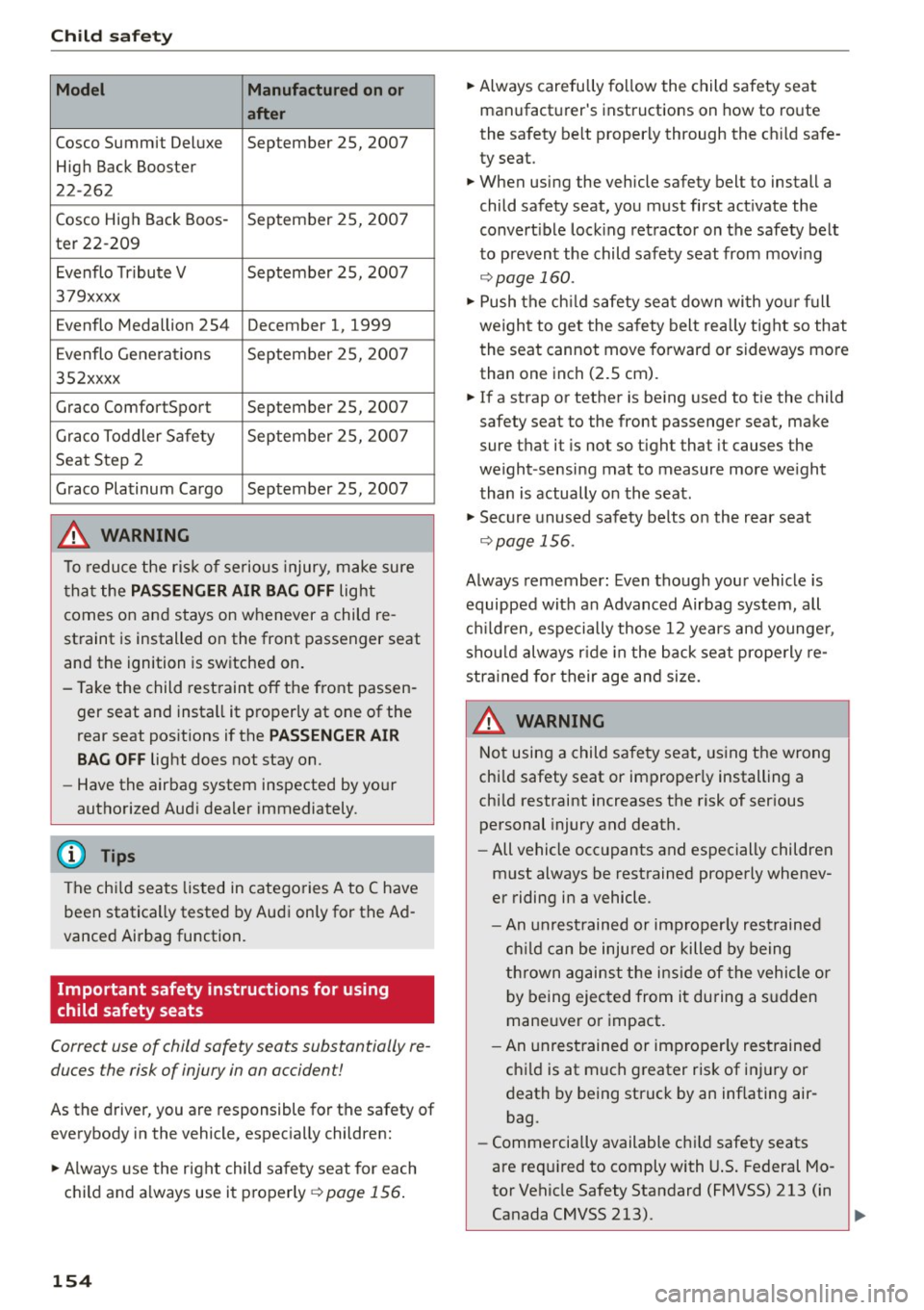
Model Manufactured on or
after
Cosco Summit Deluxe September 25, 2007
High Back Booster
22-262
Cosco High Back Boos -September 25, 200 7
ter 22-209
Evenflo Tr ibute V September 25, 2007
379xxxx
Evenflo Medallion 254 December 1, 1999
E venflo Generations September 25, 2007
352xxxx
Grace ComfortSport September 25, 2007
Grace To ddler Sa fe ty Sep
tember 25, 200 7
Seat Step 2
G race Platinum Cargo September 25, 2007
.&_ WARNING
To reduce the ris k of serious injury, make sure
t ha t the
PASSENGER AIR BAG OFF light
comes on and stays on whenever a child re
st raint is installed on the front passenger seat
and the ignition is switched on.
- Take the child rest raint off the front passen
ger seat and insta ll it properly at one of the
rear seat pos itions if the
PASSENGER AIR
BAG OFF
light does not stay on.
- Have the airbag system inspected by yo ur
autho rized Audi dealer immediately.
(D Tips
The ch ild sea ts listed in catego ries A to C have
been statica lly tested by Audi only for the Ad
vanced Airbag function.
Important safety instructions for using
child safety seats
Correct use of child safety seats substantially re
duces the risk of injury in on occident!
As the driver, you are responsible for the safety of
everybody in the vehicle, espec ially children:
... Always use the right child sa fety seat for each
c h ild and a lways use it properly
¢ page 156.
154 ...
Always carefully fo llow the child safety seat
manufact urer's instructions on how to ro ute
the sa fety belt proper ly through the c hild safe
ty seat.
... When using the vehicle safety belt to install a
child safety seat, you must first act ivate the
convert ible lock ing ret ractor on the safety belt
to prevent the child safety seat from moving
¢ page 160.
... Push the ch ild safety sea t down wi th yo ur fu ll
weigh t to get the safety belt really tight so that
the seat cannot move forward or sideways more
than one inch (2.5 cm).
... If a strap or tether is be ing used to tie the child
safety seat to the front passenger seat, make
sure that it is not so tight that it causes the
weight-sensi ng mat to measure more we ight
than is actually o n the seat .
... Secu re unused safety belts on the r ear seat
¢ page 156.
Always remember : Even tho ugh you r vehicle is
equipped with an Advanced Airbag system, all
c hi ld ren, espe cially those 12 years and younge r,
shou ld always r ide in the back seat prope rly re
stra ine d f or t heir age an d size.
.&_ WARNING
-
N ot using a child safe ty seat, using t he wrong
chi ld safety seat or improper ly installing a
chi ld restraint increases the risk of ser ious
personal injury and death.
- All vehicle occ upants and especially children
m ust always be restrained properly whenev
er riding in a vehicle.
- An un rest rained or imp rope rly res trained
chi ld ca n be inju red or killed by being
t h rown ag ains t the i nsid e of the vehicle or
b y being ejected from it du ring a s udden
mane uver o r impact.
- An unrestrained or im properly res trained
ch ild is at much greater risk of i nju ry or
death by being struck by an inflating air
bag.
- Commercially available ch ild safety seats
are req uired to comply with U.S. Federal Mo
tor Vehicle Safety Standard (FMVSS) 213 (in
Canada CMVSS 213). .,_
Page 158 of 264
Child safety
-Take the child restraint off the front passen
ger seat and install it properly at one of the
rear seat positions if the
PASSENGER AIR
BAG OFF
light does not stay on .
- Have the airbag system inspected by your
authorized Audi dealer immediately .
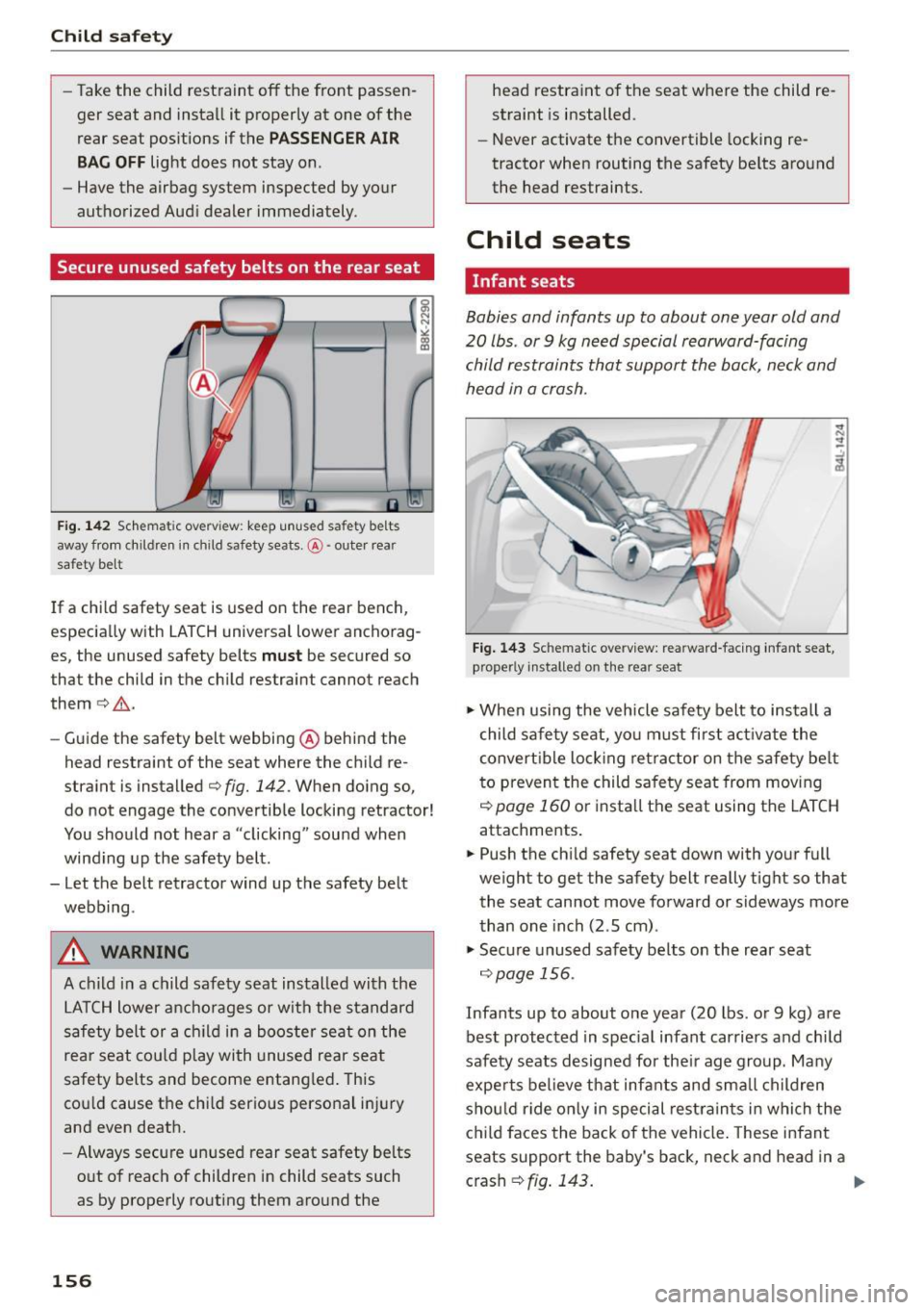
Secure unused safety belts on the rear seat
Fig. 142 Schemat ic overview : keep unus ed sa fety belt s
away from chil dren in chil d safety seats .@ · outer rea r
sa fety belt
If a child safety seat is used on the rear bench,
especially with LATCH universal lower anchorag
es, the unused safety belts
must be secured so
that the child in the child restraint cannot reach
them ¢,& .
- Guide the safety belt webbing @ behind the
head restraint of the seat where the child re
straint is installed
¢fig. 142. When doing so,
do not engage the convertible locking retractor!
You should not hear a "clicking" sound when
winding up the safety belt .
- Let the belt retractor wind up the safety belt webbing .
.,&. WARNING
A child in a child safety seat installed with the
LATCH lower anchorages or with the standard
safety belt or a child in a booster seat on the
rear seat could play with unused rear seat
safety belts and become entangled. This
could cause the child serious personal injury
and even death.
- Always secure unused rear seat safety belts
out of reach of children in child seats such
as by properly routing them around the
156
head restraint of the seat where the child re
straint is installed.
- Never activate the convertible locking re
tractor when routing the safety belts around
the head restraints.
Child seats
Infant seats
Babies and infants up to about one year old and
20 lbs . or
9 kg need special rearward-facing
child restraints that support the back, neck and
head in a crash.
Fig. 143 Sc hem atic ove rview: rearward-facing infant seat,
prope rly installe d on the rea r seat
.,. When using the vehicle safety belt to install a
child safety seat, you must first activate the
convertible locking retractor on the safety belt
to prevent the child safety seat from moving
¢
page 160 or install the seat using the LATCH
attachments.
.,. Push the child safety seat down with your full
weight to get the safety belt really tight so that
the seat cannot move forward or sideways more than one inch (2.5 cm) .
.,. Secure unused safety belts on the rear seat
¢page 156.
Infants up to about one year (20 lbs. or 9 kg) are
best protected in special infant carriers and child
safety seats designed for their age group. Many experts believe that infants and small children
should ride only in special restraints in which the
child faces the back of the vehicle. These infant
seats support the baby's back, neck and head in a
crash
¢ fig. 143. .,.
Page 161 of 264
M N
0 loo
rl I.O
"' N
"' rl
BAG OFF light does not stay on whenever
the ignition is switched on.
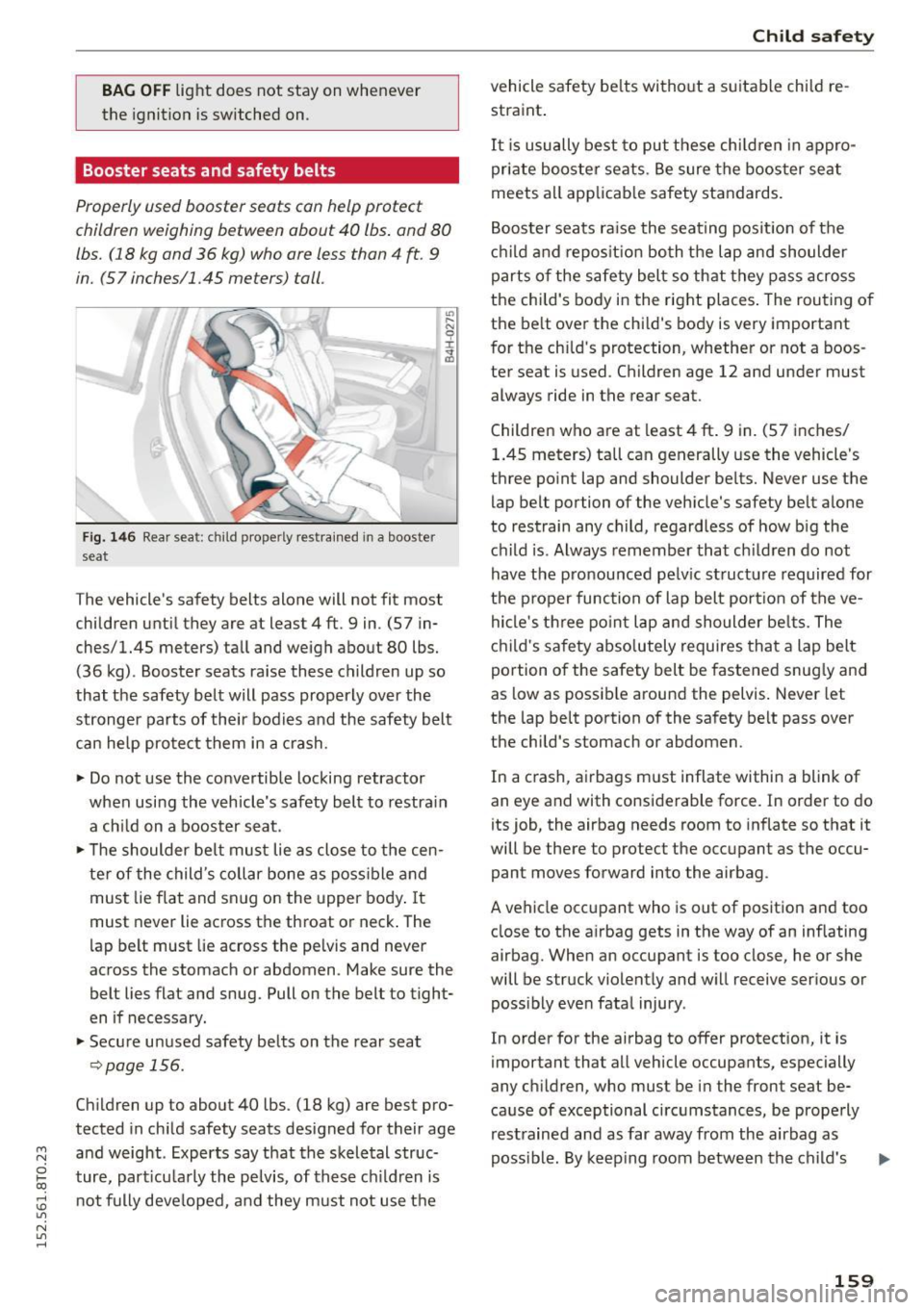
Booster seats and safety belts
Properly used booster seats can help protect
children weighing between about 40 lbs . and 80
lbs. (18 kg and 36 kg) who are less than 4 ft .
9
in. (57 inches/1.45 meters) tall.
Fig. 1 46 Rea r seat : child p roper ly rest ra ined in a booster
seat
The vehicle's safety belts alone will not fit most
children until they are at least4
ft. 9 in . (57 in
ches/1.45 meters) tall and weigh about 80 lbs.
(36 kg). Booster seats raise these children up so
that the safety belt will pass properly over the
stronger parts of their bodies and the safety belt
can he lp protect them in a crash.
.,.. Do not use the convertible locking retractor
when using the vehicle's safety belt to restra in
a ch ild on a booster seat .
.,.. The shoulder be lt must lie as close to the cen
ter of the child's collar bone as poss ible and
must lie flat and snug on the upper body .
It
must never lie across the throat or neck. The
l ap belt must lie across the pe lvis and never
across the stomach or abdomen . Make sure the
belt lies flat and snug. Pull on the belt to tight
en if necessary.
.,.. Secure unused safety belts on the rear seat
<=> page 156.
Children up to about 40 lbs. (18 kg) are best pro
tected in ch ild safety seats des igned for their age
and weight . Experts say that the skeletal struc
ture, part icu larly the pe lvis, of these ch ildren is
n ot fully deve loped, and they m ust not use t he
Chil d sa fe ty
vehicle safety be lts without a suitable chi ld re
straint .
It is usually best to put these chi ldren in appro
priate booster seats. Be sure the booster sea t
meets a ll applicab le safety standards.
Booster seats ra ise the seating posit ion of the
c h ild and re pos it ion bo th the lap and shoulder
parts of the safety belt so that they pass across
the child's body in the right places . The routing of
the be lt over the child 's body is very important
for the ch ild's protection, whether or not a boos
ter seat is used. Children age 12 and under must
always ride in the rear seat.
Children who are at least 4
ft . 9 in. (57 inches/
1.45 meters) tall can generally use the vehicle's
three po int lap and shoulder be lts. Never use the
lap belt portion of the vehicle's safety belt a lone
to restrain any child, regardless of how big the
c hi ld is. Always remember that ch ildren do not
have the pronounced pe lv ic st ructu re required for
the proper func tion of lap belt port io n of the ve
hicle 's th ree po int l ap and shoulder be lts. The
ch ild 's sa fety abso lutely requires that a lap belt
portion of the safety belt be fastened snug ly and
as low as possib le around the pelvis . Never let
the lap belt portion of the safety belt pass over
the child's stomach or abdomen.
In a crash, airbags must inflate within a blink of
an eye and with considerable force. In order to do
its job, the airbag needs room to inflate so that it
will be there to protect the occupant as the occu
pant moves forward into the airbag .
A vehicle occ upant who is out of position and too
close to the a irbag gets in the way of an inflating
airbag. When an occupant is too close, he or she
will be struck violently and w ill receive serious or
poss ibly even fata l injury .
In order for the airbag to offer protection, it is
important that all vehicle occupants, especially
any children, who must be in the front seat be
cause of exceptional circumstances, be properly
rest rained and as far away from the airbag as
poss ible. By keep ing room between th e ch ild's
II>-
159
Page 162 of 264
Child safety
body and the front of the passenger compart
ment, the airbag can inflate completely and pro
vide supplemental protection in certain frontal
collisions .
.,&. WARNING
Not using a booster seat, using the booster
seat improperly, incorrectly installing a boos
ter seat or using the vehicle safety belt im
properly increases the risk of serious personal
injury and death in a collision or other emer
gency situation. To help reduce the risk of se
rious personal injury and/or death:
- The shoulder belt must lie as close to the
center of the child's collar bone as possible
and must lie flat and snug on the upper
body. It must never lie across the throat or
neck. The lap belt must lie across the pelvis
and never across the stomach or abdomen.
Make sure the belt lies flat and snug. Pull on
the belt to tighten if necessary.
- Failure to properly route safety belts over a
child's body will cause severe injuries in an
accident or other emergency situation
c::> page 121 .
-The rear side of the child safety seat should
be positioned as close as possible to the
backrest on the vehicle seat . Adjust or re
move the rear seat head restraint if it is dif
ficult to install the child seat with the head
restraint in place
c::>page 58. Install the
head restraint again immediately once the
child seat is removed. Driving without head
restraints or with head restraints that are
not properly adjusted increases the risk of
serious or fatal neck injury dramatically .
- Children on the front seat of any car, even
with Advanced Airbags, can be seriously in
jured or even killed when an airbag inflates.
- Never let a child stand or kneel on any seat.
- Never let a child ride in the cargo area of
your vehicle.
- Always remember that a child leaning for
ward, sitting sideways or out of position in
any way during an accident can be struck by
a deploying airbag. This will result in serious
personal injury or death .
160
-If you must install a booster seat on the
front passenger seat because of exceptional
circumstances the
PASSENGER AIR BAG
OFF
light must come on and stay on, when
ever the ignition is switched on .
- If the
PASSENGER AIR BAG OFF light does
not come on and stay on, perform the
checks described
c::, page 139, Monitoring
the Advanced Airbag System.
- Take the child restraint off the front passen
ger seat and install it properly at one of the rear seat positions if the
PASSENGER AIR
BAG OFF
light does not stay on whenever
the ignition is switched on.
- Always read and heed all WARNINGS when
ever using a child restrained in a vehicle is
being used
<=> page 121, Safety belts,
<=>page 129, Airbag system
and
c::> page 151, Important information.
Securing child seats
' Securing a child safety seat using a safety
I _!>elt
Safety belts for the rear seats and the front pas
senger's seat con be locked with the convertible
locking retractor to properly secure child safety
seats.
The safety belts emergency locking retractors for
the rear seats safety belts and for the front pas
senger's seat safety belt have a convertible lock
ing retractor for child restraints. The safety belt
must be locked so that belt webbing cannot un
reel. The retractor can be activated to lock the
safety belt and prevent the safety belt webbing
from loosening up during normal driving. A child
safety seat can only be properly installed when
the safety belt is locked so that the child and child safety seat will stay in place.
Always remember: Even though your vehicle is equipped with an Advanced Airbag system, all
children, especially those 12 years and younger,
should always ride in the back seat properly re-
strained for their age and weight . ..,_
Page 164 of 264
Child safet y
adjustment range, as far away from the air
bag as possib le before installing the for
ward-fac ing ch ild restraint. The backrest
must be adjusted to an upright posit ion.
- Make sure that the
PASSENGER AIR BAG
OFF
light comes on and stays on all the t ime
whenever the ignition is switched on.
A WARNING
Rearward-fac ing ch ild restra ints:
- A ch ild in a rearward-facing child safety seat
installed on the front passenger seat will be
seriously injured and can be k illed if the
front a irbag inflates - even with an Ad
vanced Airbag System.
- The inflating a irbag w ill hit the child safety
seat or infant car rier with great force and
will smash the chi ld safety seat and child
against the bac krest, center armrest, door
or roof .
- Always be espe cially caref ul if you must in
sta ll a rearward facing chi ld safety seat on
the front passenger seat in exceptiona l cir
cumstances .
- A tight tether strap on a rearward-facing
child restraint attached to the front passen
ger seat can put too much pressure on the
weight-mat in the seat and register a heavi er we ight in the Advanced Airbag System.
The heav ier weight reg istered can make the
system work as though an adult were on the
seat and deploy the Advanced Airbag when it m ust be s uppressed causing ser ious o r
even fatal injury to the child.
- Make sure that the
PASSENGER AIR BAG
OFF
light comes on and s tays on all the t ime
whenever the ignition is switched on.
- If the PASSENGER AIR BAG OFF light does
not come on and stay on, immed iate ly in
sta ll the rearward-fac ing ch ild safety sea t in
a rear seating posit ion and have the airbag
system inspected by your authorized Audi
dealer .
162
· Activating the convertible locking retractor
Use the convertible locking retractor to secure a
child restraint.
Always heed the child safety seat manufacturer's
i nstruct ions when installing a child restraint in
your vehicle . T o activate the convert ible locking
retractor:
.. Place the child restraint on a seat, preferably on
the rear seat .
.. Slowly pull the belt
all th e wa y out .
.. Route it around or through the child restraint
belt pat h
c::> _&..
.. Push the ch ild safety seat down with your full
weigh t to get the sa fety belt really tight.
.. Insert the belt tongue into the b uckle for that
seating position .
.. Guide the safety be lt back into the retractor un
til the belt lies flat and snug on the ch ild safety
seat.
.. You should hear a "clicking" noise as the belt
w inds back into the inertia reel. Test the con
vert ible lock ing retractor by pu lling on the belt .
You should no longer be able to pull the belt
out of the ret ractor. The conve rtible locking re
tractor is now ac tivated .
.. Make s ure that the red release button is fac ing
away from the child restraint so that it can be
unbuckled quickly .
.. Pull on the belt to make sure the safety be lt is
properly tight and fastened so that the seat
cannot move forward or s ideways more than
one inch (2 .5 cm).
A WARNING
Using the wrong child restraint or an improp
e rly installed child restraint can cause serious
personal injury or death in a crash.
- Always ma ke sure that the safe ty be lt re
tracto r is loc ked when insta lling a child sa fe
ty seat. An unlocked sa fety belt retractor
cannot ho ld the child safety seat in place
during normal driving or in a crash.
- Always buckle the child safety seat firmly in place even if a chi ld is not sitting in it. A
loose child safety seat can fly around d uring
a sudden stop or in a crash.
.
Page 169 of 264
-Never attach a tether strap to a tie-down
hook in the luggage compartment.
- Never use child restraint tether anchorages
to secure safety belts or other kinds of occu
pant restraints.
- Never secure or attach any l uggage or other
items to the LATCH lower anchorages or to
the tether anchors.
- If a tether or other strap is used to attach a
child restraint to the front passenger seat,
make sure that it is not so tight, that it
causes the we ight-sensing mat to measure
more we ight than is actually on the seat .
- The heav ier weight reg istered ca n make the
Advanced Airbag System work as though an
adult were on the seat and deploy the Ad
vanced Airbag whe n it must be supp ressed
ca using se rious or even fatal injur y to the
c h ild.
- If you mu st install a rearwar d faci ng chi ld
sa fety seat on the front passenge r seat be
cause of exceptional c ircums tances and the
PASSENGER AIR BAG OFF light does not
come on and stay on, immediate ly install
the rear-fac ing c hild safety seat in a rear
seating pos ition and have the airbag system
inspected by you r authorized Audi dea ler.
Installing the upper tether strap on the
anchorage
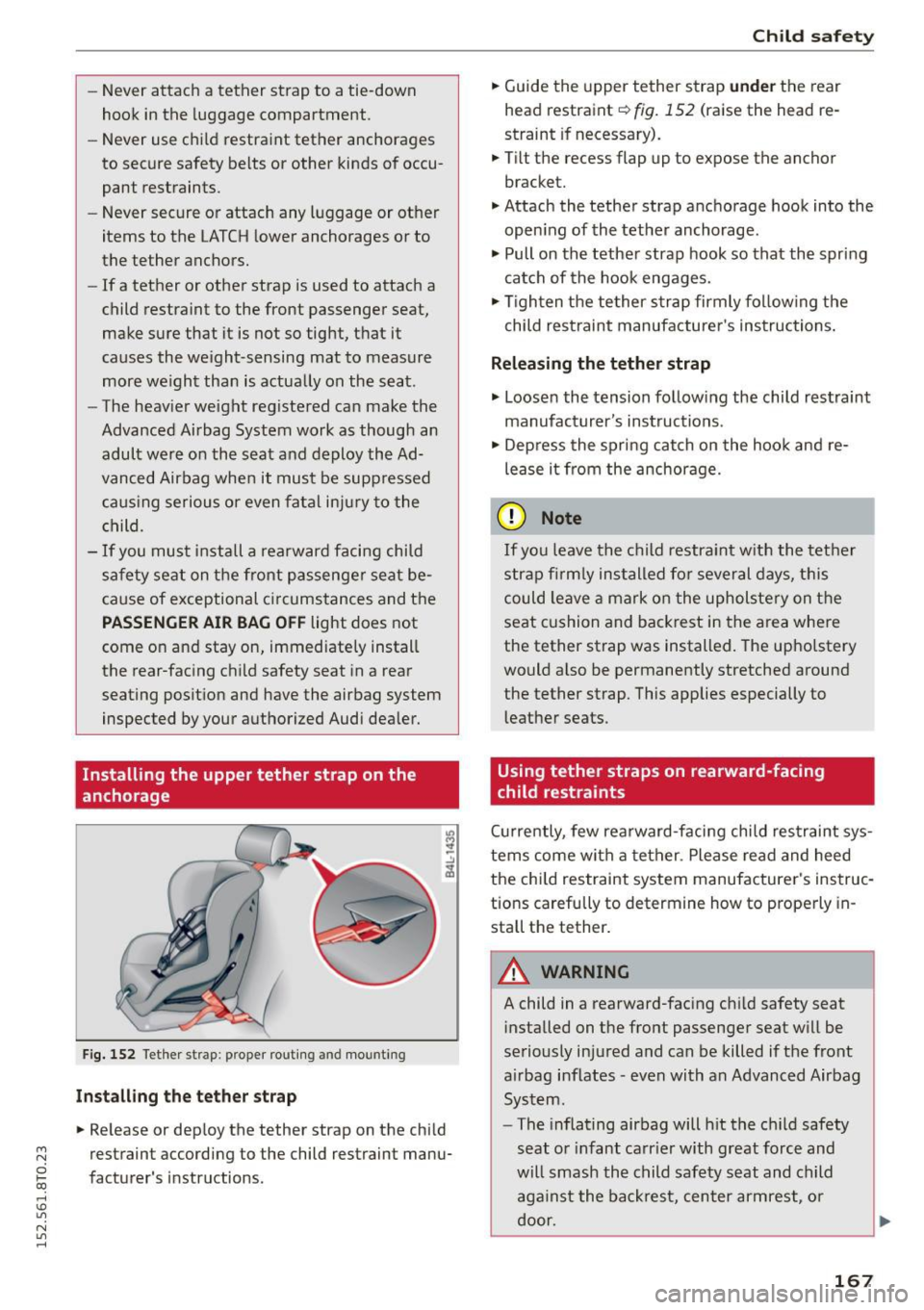
F ig . 1 52 Tether strap : proper ro ut in g a nd mo unting
Installing the tether strap
.,. Re lease or dep loy the tether strap on the chi ld
~ restraint according to the child restraint manu-
o t;o facturer's instructions.
rl I.O
"' N
"' rl
Chil d sa fe ty
.,. Guide the upper tether strap under the rear
head restraint co
fig. 152 (raise the head re
straint if necessary).
.,. Tilt the recess flap up to expose the anchor
bracket.
.,. Attach the tether strap anchorage hook into the
open ing of the tet he r anchorage.
.,. Pull on the tethe r strap hook so that the spri ng
ca tch of the hook engages.
.,. Tigh ten the te ther s trap firmly follow ing the
child res traint manufacture r's instructions .
Releasing the tether strap
.,. Loosen the tension fo llow ing the child restraint
manufac turer's instructions .
.,. Depress the spri ng catch o n the hoo k and re
lease it from the anchor age.
(D Note
If you leave the child restra int w it h the tet her
s trap firm ly ins talled fo r sever al days, t his
could leave a mark o n the upholstery on t he
seat cushion and bac krest in the area whe re
the tether strap was installed. The upho lstery
would a lso be permanently stretched around
the tether strap. This applies especially to
l eather seats .
Using tether straps on rearward-facing
child restraints
Cur rently, few rea rward-faci ng chi ld restraint sys
tems come wit h a teth er. Please read and heed
the ch ild restraint system manufacturer's ins truc
tions carefully to determine how to properly in
stall the tether .
A WARNING
A child in a rearward-facing ch ild safety seat
i nsta lled on the front passenger seat will be
se riously in ju red and can be killed if the front
a irbag inflates -even with an Advanced Airbag
System.
- The inflating airbag will hit the c hild safety
seat o r infant ca rr ier w ith great force and
will smash the c hild safety seat and child
aga inst the ba ck rest, center armrest, or
door .
167