ESP AUDI A5 COUPE 2015 Repair Manual
[x] Cancel search | Manufacturer: AUDI, Model Year: 2015, Model line: A5 COUPE, Model: AUDI A5 COUPE 2015Pages: 264, PDF Size: 66.83 MB
Page 173 of 264
M N
0 loo
rl I.O
"' N
"' rl
In extreme cases, EDL a utomatica lly switches off
to help keep the brake on the braked whee l from
overheating. EDL w ill switch on again automati
cally when conditions have returned to normal.
Steering re commendat ion
The ESC helps to stabilize the ve hicle by chang ing
the steering torque.
I n vehicles with dynamic steeri ng*, ESC also
h e lps to stabilize the steering in critical s itua
tions .
Electronic interaxle differential lock* /
sel ectiv e wheel torque control*
The electron ic in teraxle d iffe ren tial lock (front
wheel drive) or the selective wheel torq ue contro l
(all wheel drive) operates when driving through
curves. The front whee l on the ins ide of the cu rve
or both whee ls on the inside of the curve are
braked selectively as needed. Thi s allows more
precise driving in curves. The applicable system
may not activate when driving in wet or snowy
conditions .
_&, WARNING
- The ESC and its integrated systems cannot
overcome the laws of physics. This is espe
ci al ly impo rtant on slippe ry or wet roads. If
the sys tems begin acting to stabilize your
Switching on/off
Smart Technology
veh icle, you shou ld immediately change
your speed to matc h the road and traffic
conditions. Do not let the increased safety
provided by these systems tempt you to
take risks . Do ing so will increase the risk of a
loss of vehicle control, collision and serious
personal injuries.
- Always adapt your speed to road, traffic and
weather conditions. The risk of losing con
trol of the vehicle inc reases when dr iving
too fast, espec ially through curves and on
slippery or wet roads, and when dr iving too
close to vehicles up ahead . The ESC and its
integrated systems cannot a lways prevent
coll isions -there is sti ll a risk of accidents!
- Always accelerate with special care on even,
smooth su rfaces such as those that are wet
or covered with ice and snow. The drive
wheels can spin even with these assistance
systems that can not always help to reduce
the risk of loss of vehicle cont rol.
{!) Tips
-ABS and ASR only work correct ly when a ll
four wheels are equipped w ith ident ica l
tires. Different tire sizes can lead to a reduc
tion in engine power.
- You may hear noises when the systems de
scribed are working.
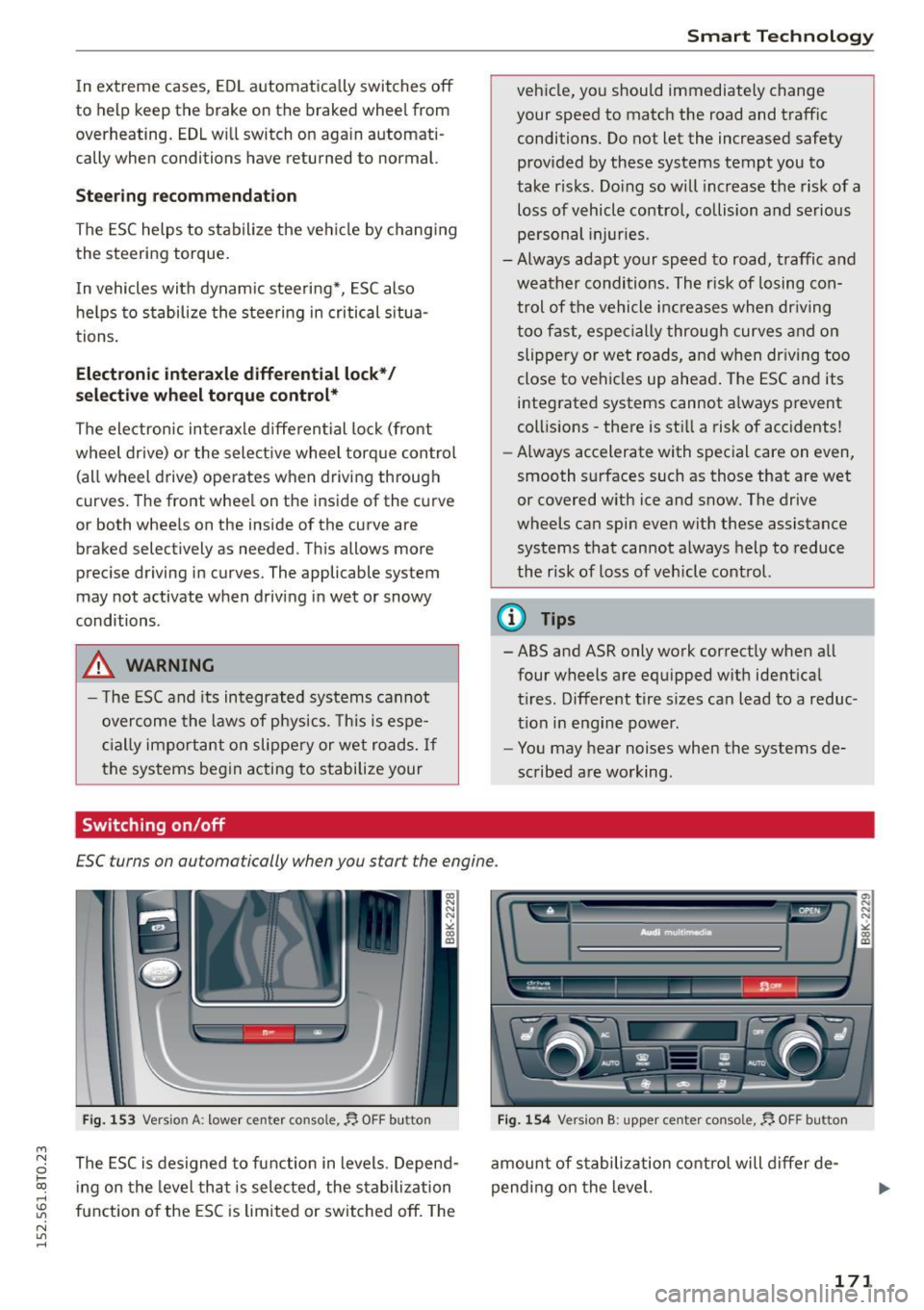
ESC turns on automatically when you start the engine.
Fig. 153 Version A: lowe r ce nter console,~ OFF button
The ESC is designed to function in levels. Depend
i ng on the level that is selected, the stabilization
function o f the ESC is limited or switched off . The
F ig. 154 Versio n B: uppe r ce nter console,~ OFF button
amount of s tabilization control will differ de
pend ing on the level.
a, N N N ,.: CX) m
171
Page 174 of 264
Smart Technology
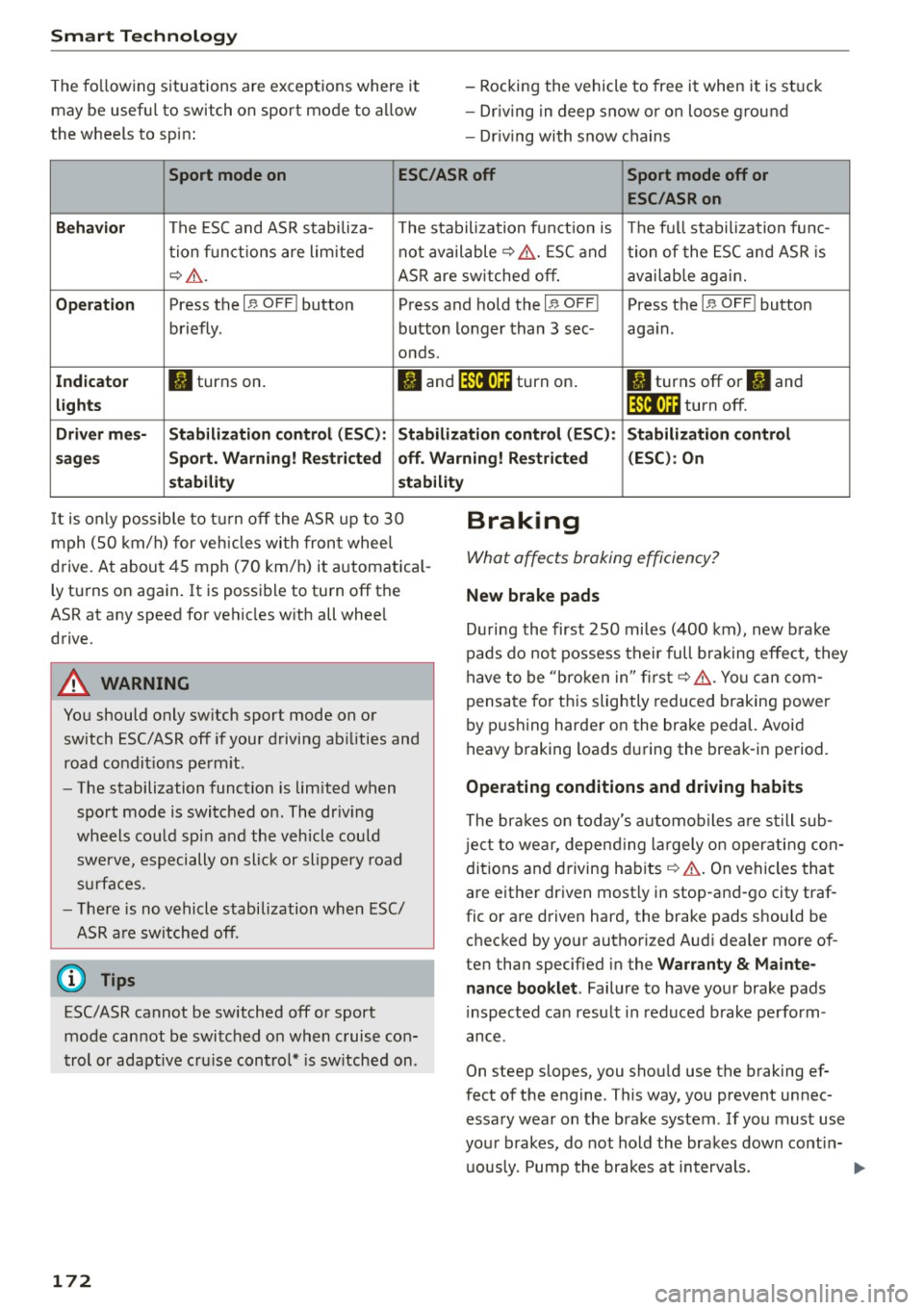
The following situations are exceptions where it
may be usefu l to switch on sport mode to allow
the wheels to spin : -
Rocking the vehicle to free it when it is stuck
- Driv ing in deep snow or on loose ground
- Dr iv ing with snow chains
Sport mode on ESC/ASR off Sport mode off or
ESC /ASRon
Behavior
The ESC and ASR stabiliza- The stabilization funct ion is The full stabilization func-
tion fu nct ions are limited not
available¢ ,&.. ESC and
tion of the ESC and ASR is
¢ ,&. .
ASR are switched
off. available again.
Operation Press the I!> OF F! button Press and hold the I!> OF FI Press the I!> OF F! button
briefly . button longer than 3 sec-again.
onds .
Indicator II turns on. JI and lf'lii•li~ turn on. II turns off or II and
lights lf'lii•l~~ turn off.
Driver mes- Stabilization control (ESC): Stabilization control (ESC): Stabilization control
sages Sport. Warning! Re stricted off. Warning! Restricted (ESC):
On
stability stability
It is only possible to turn off the ASR up to 30
mph (SO km/h) for veh icles wi th front whee l
drive . At about
45 mph (70 km/h) it automatica l
ly turns on again. It is possible to turn
off the
ASR at any speed for vehicles with all whee l
drive.
A WARNING
-
You should only sw itch sport mode on or
switch ESC/ASR
off if your driving ab ilities and
road condit io ns perm it .
- The stabilization function is limited when
sport mode is switched on. The dr iv ing
wheels could spin and the veh icle cou ld
swerve, especially on slick or slippery road
surfaces.
- There is no vehicle stabilization when ESC/
ASR are switched
off.
(D Tips
ESC/ASR cannot be switched off or sport
mode cannot be switched on when cruise con
trol or adaptive cru ise control* is sw itched on .
172
Braking
What affects broking efficiency?
New brake pads
During the first 250 miles (400 km), new brake
pads do not possess their full braking effect, they
have to be "broken in" first¢,&. . You can com
pensate for this slightly reduced braking power
by pushing harder on the brake pedal. Avoid
heavy braking loads during the break-in period.
Operating conditions and driving habits
The brakes on today's automobiles are still sub
ject to wear, depending largely on operating con
ditions and driving habits~,&. . On vehicles that
are either driven most ly in stop-and -go city traf
fic or are driven hard, the brake pads should be
checked by your authorized Audi dealer more of
ten than specified in the
Warranty & Mainte
nance booklet .
Failure to have your brake pads
i nspected can result in reduced brake perform
ance .
On steep slopes, you should use the braking ef
fect of the engine . This way, you prevent unnec
essary wear on the brake system. If you must use
your brakes, do not hold the brakes down contin
uously. Pump the brakes at intervals.
Page 175 of 264
Operating noise
Noises may occur when braking depending on the
speed, braking force and outside conditions such
as temperature and humidity.
Effect of water and road salt
In certain situat ions, for example after driving
through water, in heavy ra in, after overn ight con
densat ion or after washing your car, the braking
effect can be reduced by moisture or ice on the
brake rotors and brake pads. The brakes must be
dried first with a few carefu l brake applications.
At higher speeds and with the w indshie ld w ipers
turned on, the brake pads press against the brake
rotors for a short amount of time. This occurs at
regular intervals without the driver noticing and
provides for better brake response time under
wet conditions.
The effectiveness of the brakes can be reduced
when the vehicle is driven on a salt-covered road
and the brakes are not used. Likewise, you clean
off accumulated salt coating from brake discs
and pads with a few cautious applications of the
brake ¢.& .
Corrosion
There may be a tendency for dirt to build up on
the brake pads and corros ion to form on the discs
if the car is not driven regularly or only for short
tr ips with little use of the brakes.
If the brakes are not used frequently, or if corro
sion has formed on the discs, it is advisab le to
clean off the pads and discs by braking firmly a
few t imes from a moderately high speed¢.&.
Faults in the brake system
If you should notice a sudden increase in brake
pedal trave l, then one of the two brake circuits
may have failed
c:> .& .
Low brake fluid level
Malfunctions can occur in the brake system if the
brake fluid level is too low. The brake fluid leve l is
~ monitored e lectronically.
i? co ,...., \!) ..,.,
N ..,., ,....,
Smart Technology
Brake booster
T he brake booster increases the pressure that you
generate w ith the brake pedal.
It works on ly
when the engine is running
.c:> .&
Brake lining wear status
Brake lining wear may be checked by visual in
spect ion of the condition of the brake pads
through the openings in the wheel. If necessary,
the wheel may be removed for this inspection
c:> page 226, Replacing wheels.
_8 WARNING "'---
-New brake pads don't have the best stop
pin g power and must be "broken-in" during
the initial 250 miles (400 kilometers). You
can compensate for this by press ing the
brake pedal more firmly. This also applies
later when new pads are installed.
-
- You shou ld perform braking maneuvers for
the purpose of cleaning the brake system
only if road conditions permit. Other road
users must not be put at r isk -you may
cause an acciden t!
- Before descending a steep grade, reduce
speed and shift transmission into a lower
gear or lower driving range. Do not ride the
brakes or hold the pedal down too long or
too often . This could cause the brakes to get
hot and diminish braking efficiency.
- Do not "ride the brakes" by resting your foot
on the pedal when you do not intend to
brake. This may cause the brakes to over
heat, premature wear and increased stop
p in g distance.
- Under certain cl imatic and operat ing condi
tions such as passing through water, dr iv ing
in heavy rain or after washing the vehicle,
the effectiveness of the brakes can be re
duced. In winter, ice can accumulate on the
b rak e pads, linings, discs and drums. Care
fully apply brakes for a test. Brakes will dry
and ice coatings will be cleaned off after a
few careful brake applications.
- Driving for an extended period of time on
salt -covered roads wi thout using your
brakes can a lso affect braking efficiency .
173
Page 178 of 264
Smart Technology
according to the needs of the individual compo
nents. It regulates consumption, so that more
electrical energy is not being used than is being
generated and ensures an opt imal state of
charge for the battery.
(D Tips
- But even energy management cannot neg
ate the limits of physics. Consider that the
power and life of a battery are limited.
- If starting ability is threatened, the indica tor light (•) appears ¢
page 16.
What you should know
The highest priority is given to maintaining start
ing capability.
The battery is severely taxed in short-distance
driving, in city traffic and during the cold time of
year. Abundant electrica l energy is requ ired, but
only a little is generated. It is also critical if the
engine is not running and electrical components
are turned on. In th is instance energy is being
consumed but none is being generated.
It is in precisely these situations that you will no
tice energy management actively regulating the
d istr ibut ion of energy.
Vehicle stands for an extended period
If you do not drive your vehicle over a period of
several days or weeks, e lectrical components are
gradually cut back or switched
off. This reduces
energy consumption and maintains starting ca pability over a longer period . Some of the con
ven ience funct ions may not operate, such as the
interior lights or the powe r seat adjustment. The
conven ience functions w ill be available again
when yo u sw itch on the ignition and start the en
gine.
With the engine turned off
I f you listen to the radio, for example, with the
engine turned
off or use other MMI functions,
the battery is being discha rged .
If starting capability is jeopardized due to energy
consumption, a message appears in the MMI dis
p la y. The message indicates that the system will
176
be switched off automatically in a moment . If
you wish to continue using the functions, you have to start the eng ine.
With the engine running
Althoug h elec trical energy is generated when the
vehicle is being driven, the battery can become
discharged . This happens mostly when litt le en
ergy is being generated and a great dea l con
sumed and the battery's state of charge is not
optimal.
To bring the energy ba lance back into equilibri
u m, consumers which require especially large
amounts of energy are temporar ily cut back or
switched
off. Heating systems in part icular re
quire a great deal of energy. If you notice, for ex
ample, that the heated seats* or the heated rear
window a re not heating, they have been tempo
rarily cut back or switched
off. These systems w ill
be ava ilable again as soon as the energy ba lance
has been restored.
You will also notice that engine idle speed has
been increased slightly . Thi s is normal and not a
cause for concern. By incr easing eng ine idle
speed the additional energy required is generated
and the battery is cha rged.
Page 179 of 264
Driving and the
environment
Breaking in
New engine
The engine needs to be run-in during the first
1,000 miles (1,500 km).
For the first 600 miles (1,000 kilometers ):
"' Do not use full throttle .
"' Do not drive at engine speeds that are more
than
2/3 of the max imum permitted RPM .
From 600 to 1,000 miles (1,000 to 1,500
kilometers):
"' Speeds can gradually be increased to the maxi
mum perm issible road or engine speed.
During and after break-in period
"'Do not rev the engine up to high speeds when it
is cold. This applies whether the transmission is
in N (Neutral) or in gear .
After the break-in period
"'Do not exceed maximum engine speed under
any circumstances.
"'U pshift into the next higher gear
before reach
ing the red area at the end of the tachometer
scale
c=> page 10.
During the first few hours of driving, the engine's
internal friction is higher than later when all the
moving parts have been broken in. How well this
break-in process is done depends to a considera
ble extent on the way the vehicle is driven during
the first 1,000 miles (1,500 kilometers).
(D Note
Extremely high engine speeds are automati
cally reduced. However, these rpm limits are
p rog rammed for an engine wel l run- in, not a
new engine.
@) For the sake of the environment
Do not dr ive with unnecessarily high eng ine
speeds -upshifting early saves fuel, reduces
noise and protects the environment.
Driving and the environment
New tires
If your vehicle is running on new tires, drive very
carefully for the fi rst 350 m iles (500 kilometers)
after fitting .
New tires tend to be slippery and must also
be "broken-in". Be sure to remember this dur
ing the first
350 miles (500 kilometers).
Brake gently. Avoid following closely behind
other vehicles or other situations that might
require sudden, hard brak ing .
Avoid damaging the
vehicle
When you are d riving on poor roads, or over
curbs, steep ramps, etc., ma ke certain that low
lying parts such as spoilers and exhaust system
parts do not bottom out and get damaged.
T his is espec ially true for veh icles with low-s lung
chassis (sports chassis)* and fully loaded
vehicles.
Driving through water on
roads
Note the following to avoid vehicle damage when
driving through water, for example on f looded
roads:
- The water must not be any higher than the bot
tom of the vehicle body.
- Do not drive faster than walking speed.
A WARNING
= -
After driving through water, mud, slush, etc.,
the brakes may be s low to take effect because
of wet brake rotors and pads. Dry the brakes
first by braking carefully to restore the full braking effect.
(D Note
Vehicle components such as the engine,
transmission, suspension or electrical system
can be severely damaged by driving through
water . ""
177
Page 181 of 264
M N
i? co ,...., \!) 1.1'1
N 1.1'1 ,....,
on necessary precautions e.g. corrosion preven
tion, maintenance and storage. Pay attention to
addit ional information concern ing the battery.
Refer to
c> page 200.
Economical and environ
mentally-friendly driving
General
Your personal style of driving will determine the
economy of your vehicle, as well as exhaust and
noise levels.
Fu el economy, environmental impact , and wear
on your engine, brakes and tires largely depend
on three factors:
- your persona l dr iving style
- operating conditions
- technical limitations
If you anticipate what you need to do next and
drive economically, you can easily cut your fuel
consumption by 10-15 percen t. This sec tion will
give you some tips on how you can help the envi
ronment and your pocketbook .
(!) Tips
The consumpt ion estimates as published by
ENVIRONMENTAL PROTECTION AGENCY (EPA)
and Transport Canada may not correspond to
your actual consumption on the road, which
w ill vary depending upon vehicle load and
speed, road and weather conditions, trip
length, etc.
Drive smoothly and keep a lookout ahead
Vehicles use the most fuel when they are acceler
ating.
" Avoid unnecessary accelerating and braking.
Vehicles use the most fuel when they are acceler
ating . If you anticipate what is going to happen
next, you will need to brake less and, thus, accel
e rate less. Let the vehicle coast whenever possi
ble - for example when yo u see that the next traf
fic light is red .
Driving and the environment
Avoid full throttle
Driving at moderate speeds saves fuel and im
proves your mileage .
"Try and keep well below your car's maximum
speed.
Acce lerat ing gently reduces fue l consumption,
engine wear, and does not disturb the environ
ment .
Fuel consumption, exhaust emissions and engine
noise increase disproportionately at high speeds.
If you drive at approximate ly three quarters of
top speed, fuel consump tion will be reduced by
one half. Never drive faster than the posted
speed l imit and weather cond itions permit .
Reducing unnecessary idling
Even when your car is jus t idling it burns up fuel.
" Shut the eng ine off when you are not driving
the vehicle.
" Do not warm up the vehicle by lett ing the en-
gine run at idle.
It makes sense to shut off the engine in traffic
jams, when wa iting for tra ins to pass a t railroad
crossings, or at traffic lights that have long waits
on red . Turning the engine
off for just 30-40 sec
onds saves more fue l than is burned starting the
. . engine again.
It takes a long t ime for the engine to warm up
fully when it is running at idle. However, wear
and noxious emissions are especially high when
the engine is warming up. So you should drive
away as soon as you sta rt the engine and avoid
running at high rpms wh ile the engine is st ill
warming up.
(D Note
Do not leave engine idling unatt ended afte r
starting .
If warning lights should come on to
indicate improper operation, they would go
un heeded . Extended idling also produces
heat, which could result in overheating or oth
er damage to the vehicle or other property.
179
Page 184 of 264
Trailer mode
Tire pressure
When tow ing a trailer, inflate the tires of your ve
hicle to the cold tire pressure listed under " Full
load" on the label located on the driver's side B
pillar (visible when the door is open). Inflate
trailer tires to trailer and tire manufacturers'
specifications.
Lights
The headlight settings should be checked with
the trailer attached before driving off . Check to
make sure both vehicle and trailer lights are
working properly.
Safety chains
Be su re trailer safety chains are properly connect
ed from the trailer to the hitch on the vehicle.
Leave enough slack in the chains to permit turn
ing corners. When you install safety chains, make
sure they will not drag on the road when you are
driving.
The chains shou ld cross under the trai ler tongue
to prevent it from dropping in case of separation
from the hitch.
Driving instructions
Driving with a trailer always requires extra care
and consideration.
To obtain the best possible handling of vehicle
and trai ler, please note the following:
.. Do not tow a loaded trailer when your car itself
is not loaded .
.. Be especia lly careful when passing other
vehicles.
.. Observe speed limits.
.. Do not drive at the maximum permissible
speed .
.. Always apply brakes early.
.. Monitor the temperature gauge.
Weight distribution
Towing a loaded trai ler with an empty car results
in a highly unstable distribution of weight. If this
cannot be avoided, drive at very low speeds only
to avoid the risk of losing steering control.
182
A "balanced" rig is easier to operate and contro l.
This means that the tow vehicle shou ld be loaded
to the extent possible and permissib le, wh ile
keep ing the trailer as light as possible under the
c ir cumstances. Whenever poss ible, transfer
some cargo to the luggage compartment of the
tow veh icle while observing tongue load require
ments and vehicle load ing considerat ions .
Speed
The higher the speed, the more difficult it be
comes for the driver to control the rig. Do not
drive at the maximum permissible speed. Reduce
your speed even more if load, weather or w ind
cond it ions are unfavorab le - particularly when
go ing downh ill.
Reduce veh icle speed
immediately if the trailer
shows the slightest sign of swaying.
Do not try
to stop the swaying by accelerating.
Observe speed limits. In some areas, speeds for
vehicles towing tra ilers are lower than for regular
vehicles.
Always apply brakes early. When dr iving down
hill, shift into a lower gear to use the engine
braking effect to slow the vehicle. Use of the
brakes alone can cause them to overheat and fail.
Coolant temperature
The coolant temperature gauge¢ page 10 must
be observed carefully. If the needle moves close
to the upper end of the scale, reduce speed im
med iately and/or turn off the air conditioner .
If the coolant temperature warning light . in
the instrument cluster starts flashing, pull off
the road, stop and let the engine
idle for about
two m inutes to prevent heat build-up .
&_ WARNING
Anyone not properly restrained in a moving
vehicle is at a much greater risk in an acci
dent. Never let anyone ride in your car who is
not properly wearing the restraints provided
by Audi.
-
Page 185 of 264
Trailer mode notes
Important to know
Your vehicle hand les differently when tow ing a
trailer because of the additional weight and dif
ferent weight distribution. Safety, performance
and economy will greatly depend on how careful
ly you load your trailer and operate your rig.
Before you actually tow your trailer, practice
turning, stopping and backing up in an area away
from traffic. Keep practicing until you have be
come completely familiar with the way your vehi
cle-trailer combination behaves and responds.
Backing up is difficult and requires practice. Back
ing up with a trailer generally requires steering
action opposite to that when backing up your ve hicle without a trailer .
Maintain a greater distance between your vehicle
and the one in front of you. You wi ll need more
room to stop. To compensate for the trailer, you
will need a larger than normal turning radius.
When passing, remember that you cannot acce l
erate as fast as you normally would because of
the added load. Make sure you have enough room
to pass. After passing, allow plenty of room for
your trailer before changing lanes again.
Avoid jerky starts, sharp turns or rapid lane
changes.
(D Tips
- Do not tow a trailer during the break-in peri
od of your vehicle.
- If you tow a trailer, your A udi may require
more frequent maintenance due to the ex
tra load
¢ page 244 .
Parking on a slope
Do not park on a slope with a trailer. If it cannot
be avoided, do so only after doing the following:
When parking:
~ .. Apply the foot brake.
~ .. Have someone place chocks under both the ve-
~ hide and the trailer wheels . ..,.,
N ..,., ,....,
Trailer mode
.. With chocks in place, slowly release the brakes
until the wheel chocks absorb the load.
.. Turn the whee ls towards the curb .
.. App ly the parking brake.
.. Place an automatic transmission* in P, respec
tively a manual transmission in first or reverse
gear .
When restarting after parking:
.. App ly the foot brake.
.. Start the engine.
.. Move the selector lever to D/S, respectively a
manual transmission in first gear .
.. Release the parking brake and slowly pull out
and away from the wheel chocks.
.. Stop and have someone retr ieve the wheel
chocks .
(D Tips
If you move the selector lever of the automat
ic transmission* to P before applying the
parking brak e and before blocking the wheels,
you may have to use more force later to move
the lever out of the P position.
183
Page 186 of 264
Care and cleaning
Care and cleaning
General information
Regular, proper care he lps to maintain your vehi
cle's value.
It can also be a requirement when
submitting warranty claims for corrosion damage
and paint defects on the body.
The necessary care products can be obtained
from your authorized Audi dealer . Read and fol
low the instructions for use on the packaging.
A WARNING
-Using cleaning and care products incorrectly
can be dangerous to your health.
- Always store cleaning and care products out of reach of children to reduce the risk of poi
soning .
@ For the sake of the environment
-Preferably use environmentally-friendly
products when buying cleaning agents.
- Do not dispose of leftover cleaning and care
products with household trash .
Car washes
The longer that deposits remain on the vehicle,
the more the surface may be damaged. High
temperatures such as those caused by sunlight
increase the damaging effect.
Before washing, rinse
off heavy deposits with
p lenty of water.
Stubborn deposits such as bird dropp ings or tree
sap are best removed with plenty of water and a
microfiber cloth .
A ls o, wash the underside of your veh icle once
road salt stops be ing used for the season .
Pressure washers
When washing your veh icles with a pressure
washer, always follow the operating instructions
provided with the pressure washer. This is espe
cially important in regard to the p ressure and
spray ing distance. Do not aim the spray directly
at seals on side windows, doors, the hood, the
rear lid or the sunroof* or at tires, rubber hoses,
184 insulating
material, sensors* or camera lenses*.
Keep a distance of at least 16 inches (40 cm).
Do not remove snow and ice with a pressure
washe r.
Never use rotary nozzles or high pressure noz
zles.
The water temperature must not be above 140 °F
(60 °() .
Automatic car washes
Spray off the vehicle before washing.
Make sure that the w indows and roof* are closed
and the windshie ld wipers are off. Follow instruc
tions from the car wash operator, especially if
there are accessories attached to your vehicle.
If possible, use car washes that do not have
brushes.
Washing by hand
Clean the veh icle starting from the top and work
i ng down using a soft sponge or cleaning b rush .
Use solvent-free cleaning p roducts.
Washing vehicles with matte finish paint by
hand
To avoid damaging the paint when washing, first
remove dust and large particles from your vehi
cle. Insects, grease spots and fingerprints are
best removed with a special cleaner for matte
finish paint.
Apply the p roduct using a microfiber cloth. To
avoid damaging the paint surface, do not use too
much pressure.
Rinse the ve hicle thoroughly with water. Then
clean using a neutra l shampoo and a soft micro
fiber cloth .
Rinse the veh icle thoroughly again and let it air
dry. Remove any water residue using a shammy.
A WARNING
-On ly wash the vehicle when the ignition is
off and follow the instructions from the car
wash operator to reduce the risk of acc i
dents.
-
Page 189 of 264
M N
i? co ,...., \!) 1.1'1
N 1.1'1 ,....,
fill up at busy gas stations where the seasonal
adjustment is more likely to be made in time.
(D Note
- Fuels containing a high pe rcentage of etha
no l such as ESQ and E85 may only be used in
vehicles with f lexible fuel engines. Using
high ethanol fuel in veh icles not equ ipped
with flexible fuel engines can cause severe
engine damage.
- Methanol fuels which do not meet these re quirements may cause corrosion and dam
age to plastic and rubber components in the
fuel system.
- Do not use fuels that fail to meet the spec i
fied criter ia in this chapter .
- If you are unable to determine whether or
not a particular fuel blend meets the speci
fications, ask your service station or its fuel
supplier .
- Do not use fuel for wh ich the contents can
not be identified.
- Fuel system damage and performance prob
lems resulting from the use of fuels differ
ent from those spec ified are not the respon
s ibility of Audi and are not covered under
the New Vehicle o r the Emission Cont ro l
System Warranties.
- If you experience a loss of fue l economy o r
driveability and pe rformance problems due
to the use of one of these f uel b lends, we
r ecommend that yo u switch to unb lended
fuel.
Ethanol fuel (Bio-ethanol)
Applies to vehicles: with flexible fuel engine
You can recognize vehicles with a flexible fuel
engine by looking at the label on the inside of the fuel filler flap.
Vehicles w ith f lexible fuel engines may be operat
ed with bio-ethanol fuels such as E85 (85% e tha
nol and 15% gasoline) or with unleaded gasoline
(91 AKI/ROZ 95) . The vehicle may also be operat
ed with a m ixt ure of these fuels.
Fu el and R efu elin g
Your f uel consumption wi ll increase when using
bio-ethano l fue ls due to the lower amount of en
ergy contained per unit vo lume in ethano l.
Warming up the fle xible fuel engine in low
t e mperatu res
Due to the chemical composition of b io-ethanol,
a certain amount of fue l ends up in the engine oil
when driving short distances in
very low temper
atures. This fuel evaporates again when the en
gine is warmed up .
II Please w arm up eng ine .
If the driver message appears in the instrument
cluster disp lay, drive with a warm engine to re
duce the oil leve l.
(D Note
-Never fill with methano l or with a h igher
percentage of b io-ethanol than 85% (E85).
A highe r percentage of bio-ethanol in the
fue l can cause damage to the engine or to
the fuel system.
- If you use on ly E85, it is recommended to
fill the fue l tank complete ly w ith unleaded
premium grade gasoline every 5,000 miles.
- If you experience starting, rough id le or hes
itat ion driveab ility problems, fill the fuel
tank complete ly w ith unleaded premium
grade gasoline and drive it normally unt il
the gaso line is used. See your author ized
Audi dea ler if the problem pe rsists.
- Inform your author ized Audi dealer that you
are operating or have operated the vehicle
w ith E85.
- Read and follow the information and t ips
about gasoli ne
c::> page 186 .
(D Tips
It may take longer to start the engine when
the outs ide temperature is
very cold. If possi
ble, use winte rized fue l if tempe ratu res are
below free zin g.
187