lock AUDI A5 COUPE 2015 Repair Manual
[x] Cancel search | Manufacturer: AUDI, Model Year: 2015, Model line: A5 COUPE, Model: AUDI A5 COUPE 2015Pages: 264, PDF Size: 66.83 MB
Page 190 of 264
Fuel and R efue lin g
Gasoline additives
A major concern among many auto manufactur
ers is carbon deposit build- up ca used by the type
of gasoline you use.
Although gasoline grades differ from one manu
facturer to another, they have certa in things in
common. All gaso line grades contain substances
that can cause deposits to collect on v ita l engine
parts, such as fue l injectors and intake valves. Al
though most gasoline brands include additives to
keep engine and fuel systems clean, they are not
equally effective.
Audi recommends using TOP T IER Detergent Gas
oline. For more information on TOP TIER Deter
gent Gasoline, please go to the officia l website
(www.toptiergas.com).
After an extended period of using inadequate
fue ls, built-up carbon deposits can rob your en
g ine of peak performance .
CD Note
-Damage or ma lf u nction due to poor fuel
quality is not covered by the Aud i New Vehi
cle Limited Warranty .
- Do not add aftermarket f uel addit ive prod
ucts to your fuel tank.
Refueling
Fuel filler neck
The fuel f iller neck is located on the r ight rear
side panel behind the fuel f iller flap .
If the power Locking system should fail, you can
still open the flap manually -for deta iled instruc
tions seer:>
page 190 .
You can find the fue l tank capacity of your vehicle
in
c:>page242 .
The label on the inside of the fuel filler flap tells
you the correct fuel for your vehicle. For more in
formation about fue l specifications, see
c:> page 186 .
Your vehicle fuel tank has an on -board refuelling
vapor recovery system . This feature helps to pre
vent fuel vapors from escaping from the tank and
188
po lluting the environment while you refuel your
vehicle. In order to fi ll the tank properly while
protecting the environment, please follow this
refueling procedure carefu lly.
A WARNING
Under normal operating conditions, never car
ry additional fuel containers in your car. Gas
can isters and other containers used to trans
port fuel can be dangerous. Such containers,
fu ll or empty, may leak and could ca use a fire
in a co llision.
If you must tra nsport f uel to
use for your lawn mower, snow blower, etc.,
be very careful and always observe local and
state laws regarding the use, transportation
and storage of such fue l containers . Make cer
tain the container meets industry standards (ANSI/ASTM F852 -86).
CD Note
Never drive your vehicle until the fue l tank is
complete ly empty. The irregular supply of
f u el can cause misfiring. Gasoline could enter
the exhaust system and damage the catalytic
converter.
Refuelling
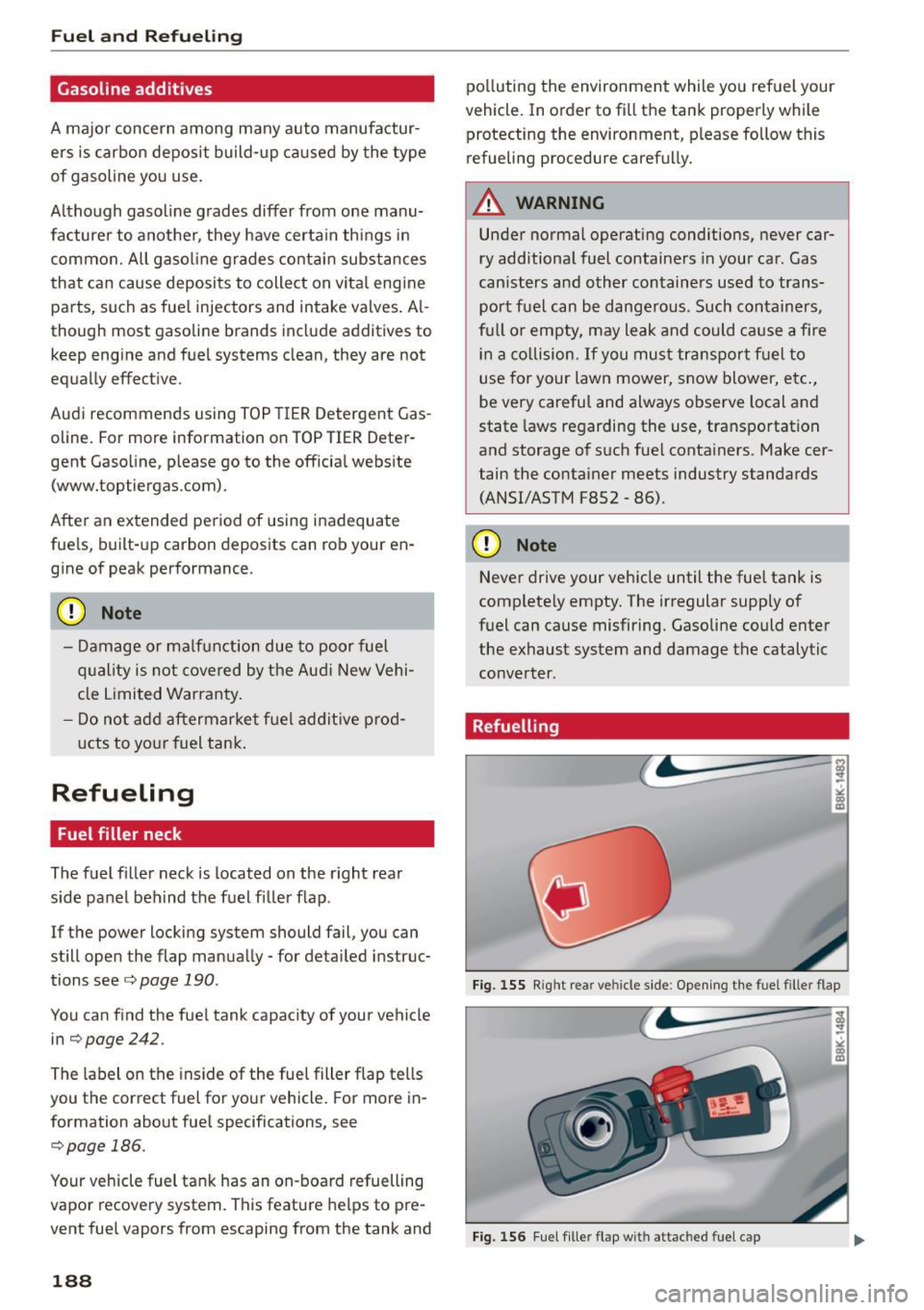
Fig. 155 R ig ht rea r ve hicle side : Open ing t he fue l filler flap
Fig. 156 Fuel fi ller flap w ith attac hed fue l cap
Page 191 of 264
M N
i? co ,...., \!) 1.1'1
N 1.1'1 ,....,
When activating the central locking, the fuel fi ll
er flap is automatically un locked or locked . Re
fue l the vehicle with the ignit ion turned
off.
Tak ing th e fu el cap off
.,. Turn off the ignit ion.
.,. Press the left side o f the fue l filler flap to open
it
r=;, fig . 155 -arrow -.
.,. Unscrew fuel cap counter-clockwise and hang it
on the fue l filler flap
c> fig. 156.
R efuellin g proc edu re
.,. Inse rt the fue l nozz le from the gasol ine p ump
into the fuel filler neck as far as it will go .
.,. Se lect a medium refuelling rate so that the
nozzle switches off automatica lly when the
tank is full.
P utting the fuel cap back on
.,. After fi lling your tank, tw ist the fuel cap clock-
wise as far as it wi ll go.
.,. Close the fuel filler flap .
To avo id f uel spi lling or evaporating from the fue l
tank always close fuel cap properly and com
p letely.
A WARNING
Improper refueling or handling of fue l can
cause fire, exp losion and severe burns.
-
- Fuel is highly flammable and can cause se
vere burns and other injuries.
- Failure to shut the engine off whi le refuel
ing and/or to insert the pump nozzle fu lly
into the fuel filler neck could cause fue l to
spray out of f iller neck or to overflow. Fuel
spray and overflow ing fuel can cause a fire.
- Never use a cellular telephone wh ile refuel
ing. The electromagnetic radiation can
cause sparks that can ignite fuel vapors and
cause a fire.
- Never get back into your vehicle while refu
eling. If in exceptional c ircumstances you
must get back in your vehicle while refuel
ing, make certain that you close the door
and touch meta l to discharge static e lectric
ity before touching the filler nozzle again.
Fu el and R efu elin g
Static electricity can cause sparks that can
ignite fuel vapors released during refue ling.
- Never smoke or have an open f lame any
where in or near your vehicle when refueling or filling a portable fuel conta iner .
- For your safety, we strongly recommend
that you do not travel with a portable f uel
container in your veh icle. The container, full
or empty may leak and cou ld cause a fire,
especially in a crash .
- If, under exceptional c ircumstances, you
must transport a portab le fuel container,
please observe the following:
- Never fill a portable fuel container while it
is anywhere in or on the vehicle (for exam
ple, in the l uggage compartment, or on
the trunk). Static e lectric ity can build up
while filling and can ignite fuel vapors
caus ing a fire .
-Always place a portab le fue l conta iner on
the ground before fill ing .
- Always keep the filler nozzle completely
inside the portable container before and
during f il li ng.
- If filling a portab le container made of
metal, the f iller nozzle must always be in
contact with the container. This will help prevent static electricity from d ischarging
and cause a fi re.
- Never spill fuel inside the vehicle or lug
gage compartment. Fuel vapors are highly
flammable.
- Always observe local and state/provincial
laws regarding the use, storage and trans
po rtation of fue l conta iners.
- Make certain the fuel conta iner meets in
dustry standards (ANSI/ AS TM F852 -86).
(D Note
If any fuel has sp illed onto the car, it should
be removed immediately to prevent damage
to the pa int.
@) For the sake of the environment
As soon as the correct ly operated nozzle
switches off automat ically for the first time,
189
Page 192 of 264
Fuel and Refueling
the tank is full. Do not try to add more fuel
because fuel may spill out. In addition, the
expansion space in the fuel tank will be filled -
causing the fuel to overflow when it becomes
warm and pollute the environment.
(D Tips
- Running your engine while refuelling may
cause vapors to escape or even cause fuel to
spill out of the tank. This would then shut
off the fuel nozzle before the tank is full.
- Do not refuel your vehicle with the ignition
turned on. The fuel gauge may otherwise
not indicate the correct fuel level after refu
elling.
- The fuel filler flap of your vehicle is not
locked when you lock the vehicle from the
inside .
Unlocking the fuel filler flap by hand
You can open the fuel filler flap by hand if the
power locking system should fail.
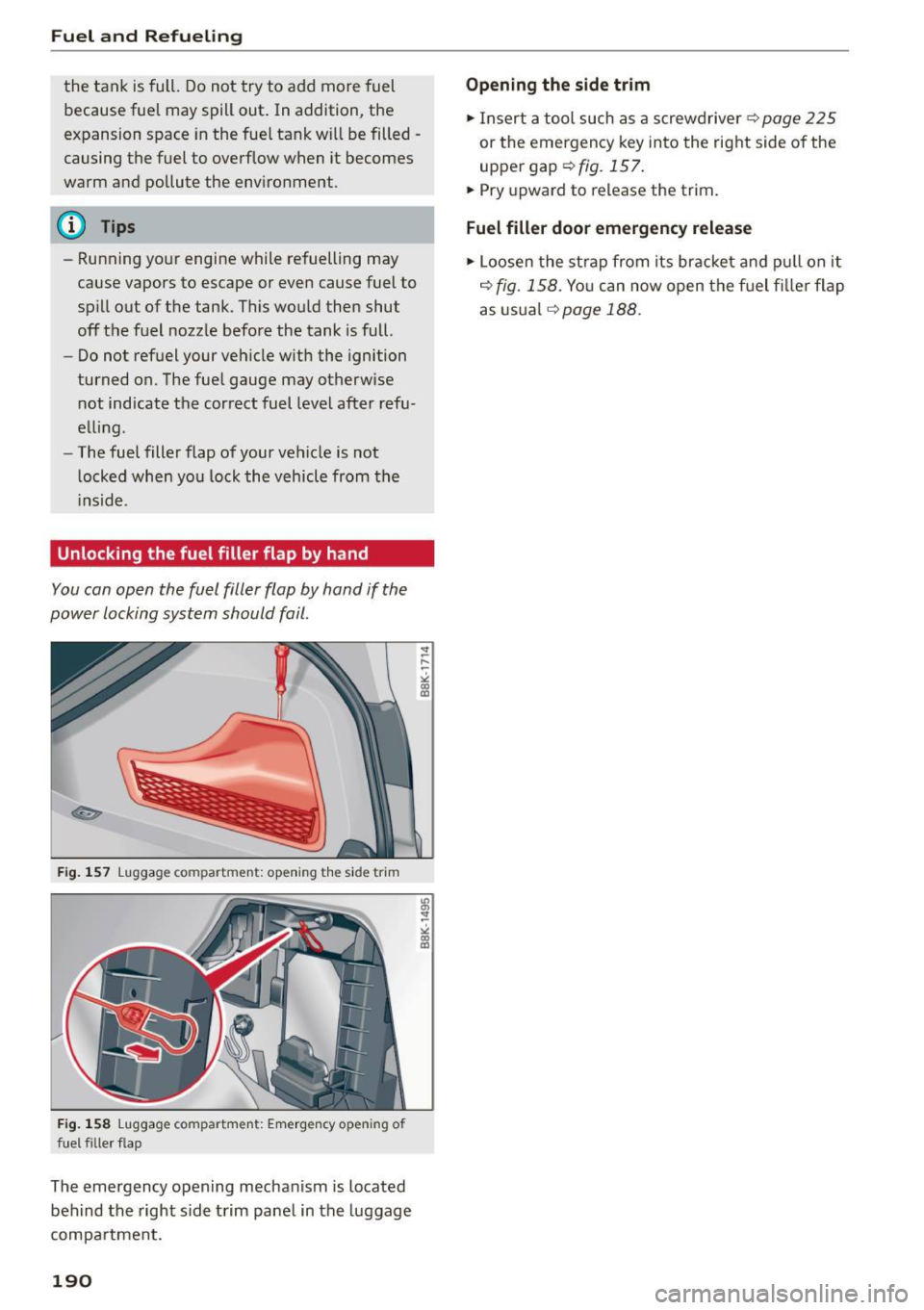
F ig. 157 Luggag e compartment: open ing the sid e trim
Fig. 158 Luggag e compart ment: Emergency open ing of
fuel filler flap
The emergency opening mechanism is located
behind the right side trim panel in the luggage
compartment.
190
"' a, st
-
" co
"'
Opening the side trim
.. Insert a tool such as a screwdrive r c:> page 225
or the emergency key into the right side of the
upper gap
¢fig. 157.
.. Pry upward to release the trim .
Fuel filler door emergency release
.. Loosen the strap from its bracket and pu ll on it
¢ fig. 158. You can now open the fu el filler flap
as usual
¢page 188.
Page 193 of 264
M N
0 loo
rl I.O
"' N
"' rl
Checking and Filling Hood
Releasing and opening the engine hood
The engine hood is released from inside the vehi
cle.
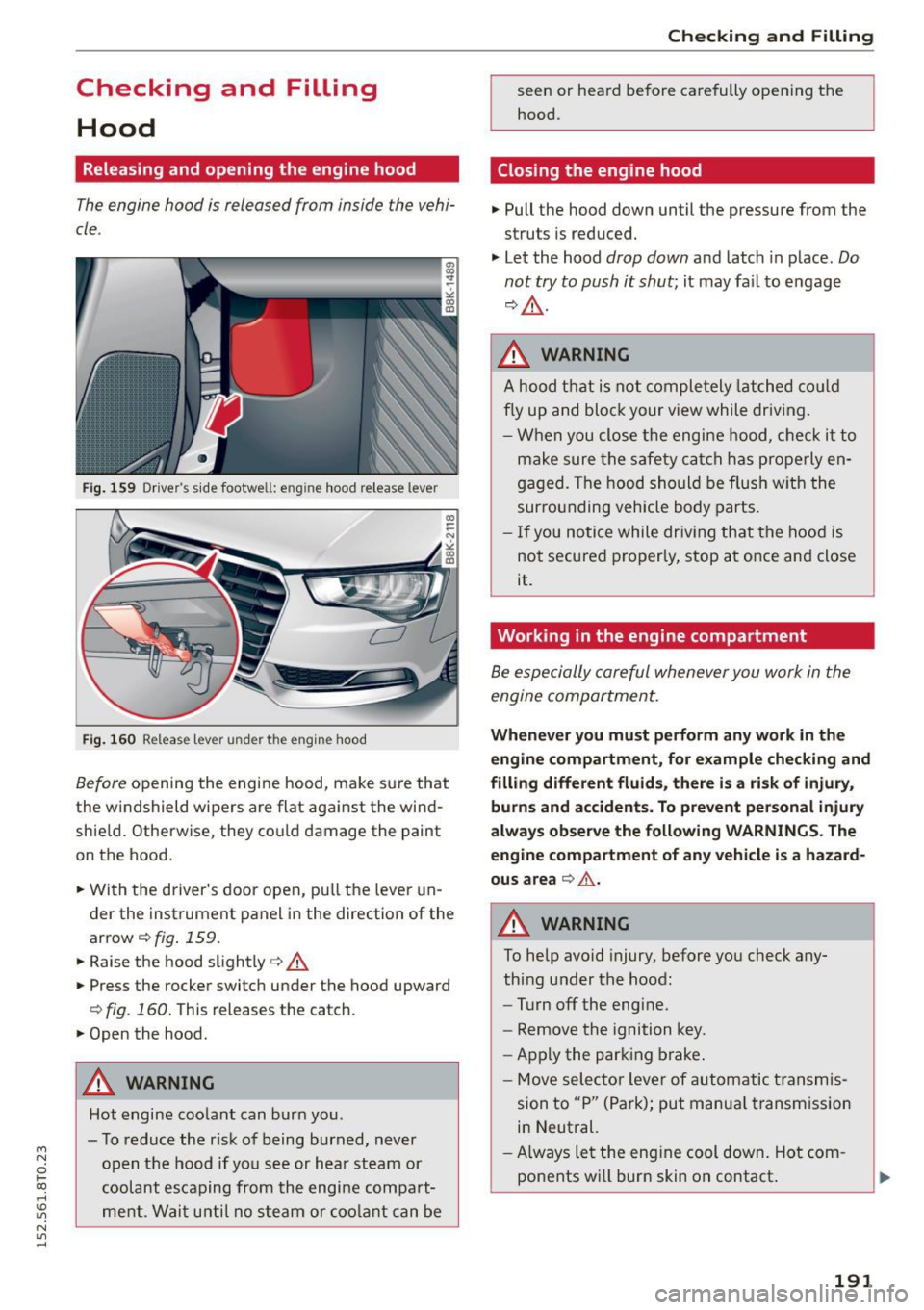
Fig. 159 Driver's side footwell: e ng in e hood release lever
Fig. 160 Releas e lev er un der t he e ngin e hood
Before opening the engine hood, make sure that
the windshield wipers are flat against the wind
shield . Otherwise, they could damage the paint
on the hood.
.. With the driver's door open, pu ll the lever un
der the instrument panel in the direction of the
arrow
c::> fig . 159.
.. Ra ise the hood slightly c::> &.
.. Press the rocker switch under the hood upward
c::> fig . 160. This releases the catch .
.. Open the hood.
A WARNING
Hot engine coolant can burn you.
- To reduce the r isk of being burned, never
open the hood if you see or hear steam or
coolant escaping from the engine compa rt
ment. Wait until no steam or coolant can be
Checking and Filling
seen or heard before carefully opening the
hood .
Closing the engine hood
.. Pull the hood down until the pressure from the
struts is reduced.
"' Let the hood
drop down and latch in place. Do
not try to push it shut;
it may fa il to engage
c::> &. -
A WARNING
A hood that is not comp letely latched could
fly up and block your view while driving.
- When you close the engine hood, check it to
make sure the safety catch has properly en
gaged . The hood should be flush with the
surrounding vehicle body parts.
- If you notice while driv ing that the hood is
not secured properly, stop at once and close
it.
Working in the engine compartment
Be especially careful whenever you work in the
engine compartment.
-
Whenever you must perform any work in the
engine compartment, for example checking and
filling different fluids , there i s a risk of injury ,
burns and accidents. To prevent personal injury
always observe the following WARNINGS . The
engine compartment of any vehicle is a hazard
ous area
c:> .&. .
A WARNING
-
To help avoid injury, before you check any-
thing under the hood:
- Turn off the engine.
- Remove the ignition key .
- Apply the parking brake.
- Move selector lever of automatic transmis-
sion to "P" (Park); put manua l transmission
in Neutral.
-Always let the engine cool down. Hot com
ponents wi ll burn skin on contact .
191
Page 200 of 264
Checking and F ill in g
blink until you add coo lant and the level has been
restored to normal. Even though there is an e lec
tr ic coo lant level sensor, we still recommend you
check the coo lant level from t ime to time.
Coolant los s
Coolant loss may indicate a leak in t he cooling
system. In the event of coolant loss, the cooling
system should be inspected immediately by your
authorized Audi dealer. It is not enough merely
to add coolant.
I n a
s e a led system, losses can occur only if the
boiling point of the coo lant is exceeded as a re
sult of overheating.
A WARNING
The cooling system is under pressure and can
get very hot. Reduce the risk of scalding from
hot coolant by following these steps .
- Turn off the engine and allow it to coo l
down .
- Protect your face, hands and arms from es
caping fluid and steam by covering the cap
with a large, thick rag .
-Turn the cap slowly and very carefully in a
counter-clockw ise d irection while applying
light, downward pressure on the top of the
cap.
- To avoid being burned, do not spill ant i
freeze or coolant on the exhaust system or hot eng ine parts . Under ce rtain conditions,
the ethy lene g lycol in engine coolant can
catch fire.
{il) Note
Do not add any type of rad iator leak sealant
to your veh icle's engine coolant . Adding radia
to r repair f lu id may adverse ly affect the func
tion and performance of your cooling system
and could resu lt in damage not covered by
your New Vehicle Limited Warranty.
Adding coolant
Be very careful when adding engine coolant .
Before you check anything in the engine compart
ment,
alway s re ad an d heed all WARN ING S
198
¢ A in Working in the engine compartment on
page 191.
Req uirement: There must be a res idual amo unt
of coo lant in the expans ion tank
~CD-
.,,. Turn off the engine .
.,,. Let the engine cool down.
.,,. Place a thick rag ove r the coolant expansion
tank
¢ page 197, fig. 164 and car efull y turn
the cap counter-clockwise
~ .&_ .
.,,. Add coo lant mixed in the correct ratio
~ page 196, Coolant up to the MAX marking .
.,,. Make sure that the flu id level remains stab le.
Add more coolant if necessa ry .
.,,. Twist the cap on aga in
tightly .
Replacement engine coo lant must conform to ex
act specifications ¢
page 196, Coolan t.
We recommend using only coo lant additive Gl2 +
+ , Gl3
or in an emergency Gl2+. Do not use a
different additive. In an emergency use plain wa
ter unt il you can get the correct additive and can
restore the correct ratio. This should be done as
soon as possible .
If you have lost a considerab le amount of cool
ant, then you should add cold antifree ze and cold
water only when the engine is cold.
Always use
new engine coo lant when refilling.
Do not fil l coolant above the "MAX " mark. Excess
coolant will be forced out through the pressure
relief valve in the cap when the engine becomes
hot.
A WARNING
- The cooling system is under pressure and
can get very hot. Reduce the risk of scalding
from hot coolant by following these steps.
- Turn off the eng ine and allow it to coo l
down.
- Protect you r face, hands and arms from
escaping fluid and steam by covering the
cap with a large, thick rag .
- Turn the cap s low ly and ve ry carefully in a
counter-clockw ise direction wh ile app ly ing
li ght, downward p ressu re on the top o f
the cap. ..,,.
Page 202 of 264
Checking and F ill in g
The brake fluid reservoir is located at the rear
partition of the engine compartment on t he left
side
c!,> page 193.
The fl uid level may drop slightly after some time
due to the automatic adjustment of the brake
pads. This is not cause for alarm.
If the b ra ke fluid level fal ls considerably below
the "MIN" mark, the brake warn ing/indicator
light (U.S. models:
1111 , Canadian models: . )
will come on
c!,> page 15 . Do not contin ue to oper
ate the vehicle . The complete brake system
should be thoroughly checked by an author iz ed
Aud i dealer or qualified workshop and the cause
corrected . If the brake fluid level is too low, the
brake warning/ind icator light w ill illuminate .
Contact an authorized Audi dealer
i mmed iately .
{D) Tips
The brake fluid reservoir is located under
neath the cove r.
Changing brake fluid
Have the brake fluid changed by an experienced
technician .
Brake fluid absorbs moist ure from the a ir. If the
water content in the brake fluid is too high, cor rosion in the brake system may result after a peri
od of time . The boiling point of the brake flu id
w ill also decrease conside rably and dec rease
b rak ing perfo rmance.
Therefore, the brake flu id must be changed
e ve ry
two year s.
Always use new brake fluid w hich con
forms to Fede ral Motor Vehicle Standard "FMVSS
1 16 DOT 4".
The brake fluid rese rvoir can be difficult to reach,
therefo re , we recommend that you have the
b rake fluid changed by your author ized
Audi
dealer .
Your dealer has the correct too ls , the
right brake fluid and the know-how to do t his for
you.
A WARNING
- B rake fluid is poisonous. It must be stored
on ly in the closed original container out of
the reach of children!
200
- Brake fail ure can resu lt from o ld or inappro
priate brake fluid. Observe these precau
tions:
- Use only b rake fluid that meets SAE spec i
f ica tion
J 170 3 and conform s to Federa l
Motor Vehicle Standard 116. Always check
with yo ur autho rized Audi dea le r to make
su re you are using the correct brake fl uid.
The correct type of brake flu id is also ind i
cated on the brake fluid reservoir.
- The brake fl uid must be new. Heavy use of
the brakes can cause a vapor lock if the
brake f luid is left in the system too long.
This can seriously affect the efficiency of
the brakes as well as your safety. This
could result in an acc ident.
(D Note
Brake fluid will damage the paint of your vehi
cle.
@ For the sake of the env ironment
Because of the prob lem of prope r disposal of
brake fluid as well as the special tools re
qu ired and the necessary expert ise, we rec
omme nd that you have the brake flu id
changed by you r autho rized Aud i dea le r.
Battery
, General information
U nder normal operating conditions, the battery
i n your Audi does not need any maintenance.
Wi th
high outside temperatures or long daily
drives we recommend that you have the e lectro
lyte level checked by an a uth orized Aud i deale r o r
qualified workshop . The electrolyte leve l should
a lso be checked each time the batte ry is c ha rged
c:!,> page 202.
Have the battery checked when yo u take your ve
hicle in for service . You a re well adv ised to re
pla ce a battery that is older tha n 5 years.
With certain types of airbag deployment, the bat
te ry is disconnected from the veh icle elect rical
system for safety reasons
c:!,> & in Repair, care
and disposal of the airbags on page 1 42.
Page 222 of 264
Wheels
A WARNING
Wheel bolts that are tightened or repaired incorrectly can become loose and result in loss
of vehicle control , which increases the risk of
an accident. For the correct tightening specifi
cation, refer to
c:> page 22 7, After changing a
wheel.
- Always keep the wheel bolts and the threads
in the wheel hub clean and free of grease.
- Only use wheel bolts that fit the rim .
- Always have damaged rims repaired by an
authorized Audi dealer or authorized repair
facility. Never repair or disassemble rims
yourself, because this increases the risk of an accident.
Winter tires
Winter tires significantly improve the vehicle's handling when driving in winter conditions . Be
cause of their construction (width, compound,
tread pattern), summer tires provide less traction
on ice and snow.
.., Use winter tires on all four wheels .
.., Only use winter tires that are approved for your
vehicle.
.., Please note that the maximum permitted
speed may be lower with winter tires
c:> .&,.
Your authorized Audi dealer or authorized re
pai r facility can inform you about the maximum
permitted speed for your tires .
.., Check the tire pressure after installing wheels
c:> page 215.
The effectiveness of winter tires is reduced great
ly when the tread is worn down to a depth of
0 .1S7 inch (4 mm). The characteristics of winter
tires also decrease greatly as the tire ages, re
gardless of the remaining tread.
A WARNING
-Never drive faster than the maximum per
mitted speed for your t ires. This could cause
the tires to heat up too much . This increases
the risk of an accident because it can cause
the tire to burst.
220
- Always adapt your driving to the road and
traffic conditions. Drive carefully and reduce
your speed on icy or slippery roads. Even
winter tires can lose traction on black ice.
@ For the sake of the environment
Reinstall summer tires at the appropriate
time, because they provide better handling
when roads are free of snow and ice. Summer
tires cause less road noise, tire wear and fuel
consumpt ion.
(D Tips
You can also use all season tires instead of
winter tires. Please note that in some coun
tries where winter tires are required, only win
ter tires w ith the
& symbol may be permit
ted.
· Snow chains
Snow chains improve traction in the snow .
.., Only install snow chains on the front wheels.
This applies also to vehicles with all wheel drive* .
.., Check and correct the seating of the snow
chains if necessary after driving a few feet. Fol
low the instructions from the manufacturer .
.., Note the maximum permitted speed when driv
ing with snow chains . Do not exceed 30 mph
(SO km/h) .
Snow chains not only improve the
driving in win
ter road conditions, but also the
braking.
Use of snow chains is only permitted with certain
rim/tire combinations due to technical reasons.
Check with an authorized Audi dealer or author
ized repair facility to see if you may use snow
chains .
Use
fine-mesh snow chains. They must not add
more than 0.53 inch (13.S mm) in height, includ
ing the chain lock.
You must remove the chains when driving on
roads that are
free of snow. When roads are free
of snow, snow chains can impair handling and .,.
Page 227 of 264
M N
0 loo
rl I.O
"' N
"' rl
Emergency assistance
Vehicle tool kit
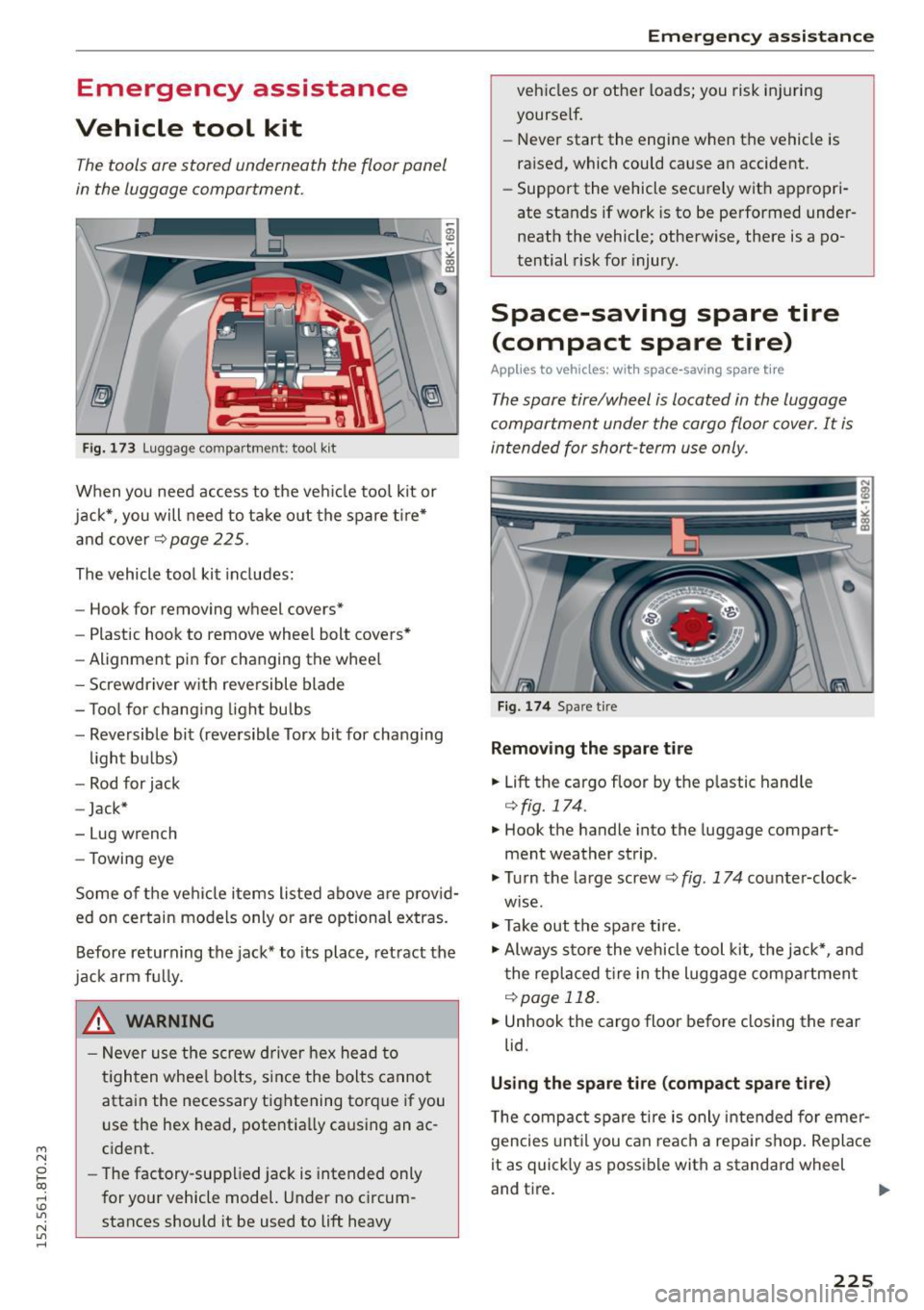
The tools ore stored underneath the floor panel
in the luggage comportment.
Fig. 173 Luggage compartme nt: tool kit
When you need access to the veh icle tool kit or
jack*, you will need to take out the spare t ire*
and cover¢
page 225.
The vehicle tool kit includes:
- Hook for removing wheel covers*
- Plastic hook to remove wheel bolt covers*
- Alignment pin for changing the whee l
- Screwdriver w ith reversible blade
- Tool for chang ing light bulbs
- Reversible bit (reversible Torx bit for changing
light bulbs)
- Rod for jack
- Jack*
- Lug wrench
- Towing eye
Some of the vehicle items listed above are prov id
ed on certain models only or are optional extras.
Before returning the jack* to its place, retract the
jack arm fu lly.
_& WARNING
- Never use the screw driver hex head to
t ighten whee l bolts, since the bolts cannot
attain the necessary tightening torque if you
use the hex head, potentially causing an ac
cident.
- The factory-suppl ied jack is intended only
for your vehicle model. Under no c ircum
stances should it be used to lift heavy
Emergen cy assistance
vehicles or other loads; you risk injuring
yourself.
- Never start the engine when the vehicle is
raised, which could cause an accident.
- Support the vehicle securely with appropri
ate stands if work is to be performed under
neath the vehicle; otherwise, there is a po
tential risk for injury.
Space-saving spare tire
(compact spare tire)
Applies to vehicles: with space-saving spare tire
The spore tire/wheel is located in the luggage
comportment under the cargo floor cover. It is
intended for short-term use only.
Fig. 174 Spare tire
Removing the spare tire
.,. Lift the cargo floor by the p lastic handle
¢fig. 174.
.,. Hook the handle into the luggage compart
ment weather strip.
., Turn the large screw ¢
fig. 174 counter-clock
wise.
., Take out the spare ti re .
., Always store the vehicle tool kit, the jack*, and
the replaced tire in the luggage compartment
¢page 118.
.,. Unhook the cargo floor before closing the rear
lid.
Using the spare tire (compact spare tire)
The compact spare tire is only intended for emer
gencies until you can reach a repa ir shop. Replace
it as quickly as possible with a standard wheel
and tire. ..,
225
Page 228 of 264
Emerg enc y ass is tance
There are some restrictions on the use of the
compact spare tire. The compact spare tire has
been designed specifically for your type of vehi
cle. It must not be swapped w ith a compact
spare tire from another type of vehicle.
Snow chain s
For technical reasons, the use of snow chains on
the compact spare tire is
n ot permitted .
If you do have to drive w ith snow cha ins and a
front tire f ails, mount the spare whee l with tire
instead of a rear tire. Install the snow chains on
the rear tire and use it to replace the defective
front tire .
A WARNING
-Never use the spare tire if it is damaged or if
it is worn down to the tread wear ind icators.
- If the spare t ire is more than 6 years o ld,
use it only in an emergency and w ith ex
treme caut ion and careful driving.
- The spare tire is intended only for tempora
ry and short-term use.
It should be replaced
as soon as possible with the norma l wheel
and t ire.
- After mounti ng the compact spare tire, the
t ire pressure must be checked as soon as
poss ible. The tire pressure of the compact
spare t ire must be 4.2 bar; otherwise, you
risk having an a cc ident.
- Do not drive faster than 50 mph (80 km/h) .
You r isk having an accident.
- Avoid full-throttle acce lerat ion, heavy brak
ing, and fast corneri ng. You r is k having an
a cc ident.
- Never dr ive using more than one spare
wheel and tire. You risk hav ing an accident.
- Norma l summer or winter tires must not be
mounted on the compact spare whee l rim.
- For technical reasons, the use of tire chains
on the spare tire is not permitted. If it is
necessary to drive w ith tire chains, the spare
wheel m ust be mounted on the front axle in
the event of a flat in a rear tire. The new ly
available front wheel must then be installed
in place of the rear wheel with the flat tire .
226
Installing the tire chain before mounting
the wheel and tire is recommended.
- Loose items in the passenger compartment
can cause serious personal injury during
hard braking or in an accident. Never store
the spare t ire or jack and tools in the pas
senger compartment .
Replacing wheels
Before changing a wheel
Observe the following precautions for your own
and your passenger 's safety when changing a
wheel.
~ After you experience a t ire failure, pu ll the ca r
wel l away from mov ing traffic and t ry to reac h
le vel ground before you stop ¢ ,& .
~ All passengers should lea ve the car and move
to a safe location (for instance, behind the
guardrail) ¢,& .
~ Engage the pa rking brake to prevent your vehi
cle from ro lling unintent ionally¢ ,&.
~ Shift into 1st gear on veh icles with manual
transm iss ion, or move the
selector lev er to the
P po sition
on vehicles with automatic transmis
sion .
~ If you are towing a trai le r: unhit ch the trailer
from your ve hicle.
~ Take the jack ¢ page 225 and the spare tire
¢ page 225 out of the luggage compartment .
A WARNING
You or your passengers could be injured wh ile
changing a whee l if you do not follow these
safety precautions:
- If you have a flat tire, move a safe d ista nee
off the road. Turn off the eng ine, turn the
emergency flashers on and use other warn ing dev ices to alert other motor ists.
- Make sure that passengers wait in a safe
place away from the vehicle and well away
from the road and traffic.
- To help preve nt the vehicle from moving
suddenly and possibly slipping off the jack,
always fully set the parking b rake and block
liJ,,
Page 229 of 264
M N
0 I-co
rl I.O
"' N
"' rl
the wheel diagona lly opposite the wheel be
ing changed with the folding chocks or ot h
er objects. When one front wheel is lifted
off the ground, placing the Automatic Trans
mission in "P" (Pa rk) wi ll
not prevent the ve
hicle from moving .
- Before you change a wheel, be sure the
ground is level and fi rm.
If necessary, use a
sturdy board under the jac k.
- Always store the vehicle tool kit, the jack*
and the replaced tire in the luggage com
partment c::>
page 118 .
(D Note
If you are chang ing the wheel o n a steep in
cline, use a rock or sim ila r object to block the
opposite whee l to prevent the vehicle from
moving.
@ Tips
Obey a ll laws.
Changing a wheel
When you change a wheel, follow the sequence
described below step -by -step and in exactly that
order.
1. Remove the decorati ve w heel co ver* or the
w he el bolt caps *. For more details see a lso
c::> page 22 7, Decorative wheel covers or
c::> page 228, Wheels with wheel bolt caps .
2. Loosen the whe el bolt s c::> page 228.
3. Lo cate the proper mo unti ng po int for the
jack and align the jack below tha t point
c::> page229.
4. Lift the car wit h the jack c::> page 229.
5. Remove the wheel with the flat tire and then
install the
spare t ire c::> page 230.
6 . Tighten all wheel bo lts light ly.
7 .
Low er the veh icle w ith the jack.
8 . Use the wheel bolt wrench and
firmly tighten
9.
all whee l bolts in a crissc ross pattern
c::> page 228.
Replace t he de corative wh ee l c over* or the
whe el bolt cap s*.
Em erg en cy ass is tan ce
A WARNING
-Always read and follow all WARNINGS and in-
formation
c::> .&. in Raising the vehicle on
page
229 and c::> page 231.
After changing a wheel
A wheel change is not complete without the do
ing the following.
.. Always store the vehicle tool k it, the jack*, and
the replaced t ire in the luggage compartment
c::>page 118.
.. Check the tir e pr essure of the spare ti re as soon
as poss ible .
.. As soon as possib le, have the
tightening to r
que s
on a ll whee l bolts checked wi th a torque
wrench . Th e cor rect tigh tening torque is 90 ft
lbs .
(120 Nm).
.. Have the flat tire
replaced as soon as possible.
@ Tips
- If you not ice tha t the wheel bo lts are cor
roded and difficult to turn while changing a
tire, they should be replaced before you check the tightening torque.
- Dr ive at reduced speed until you have the
tightening torques checked .
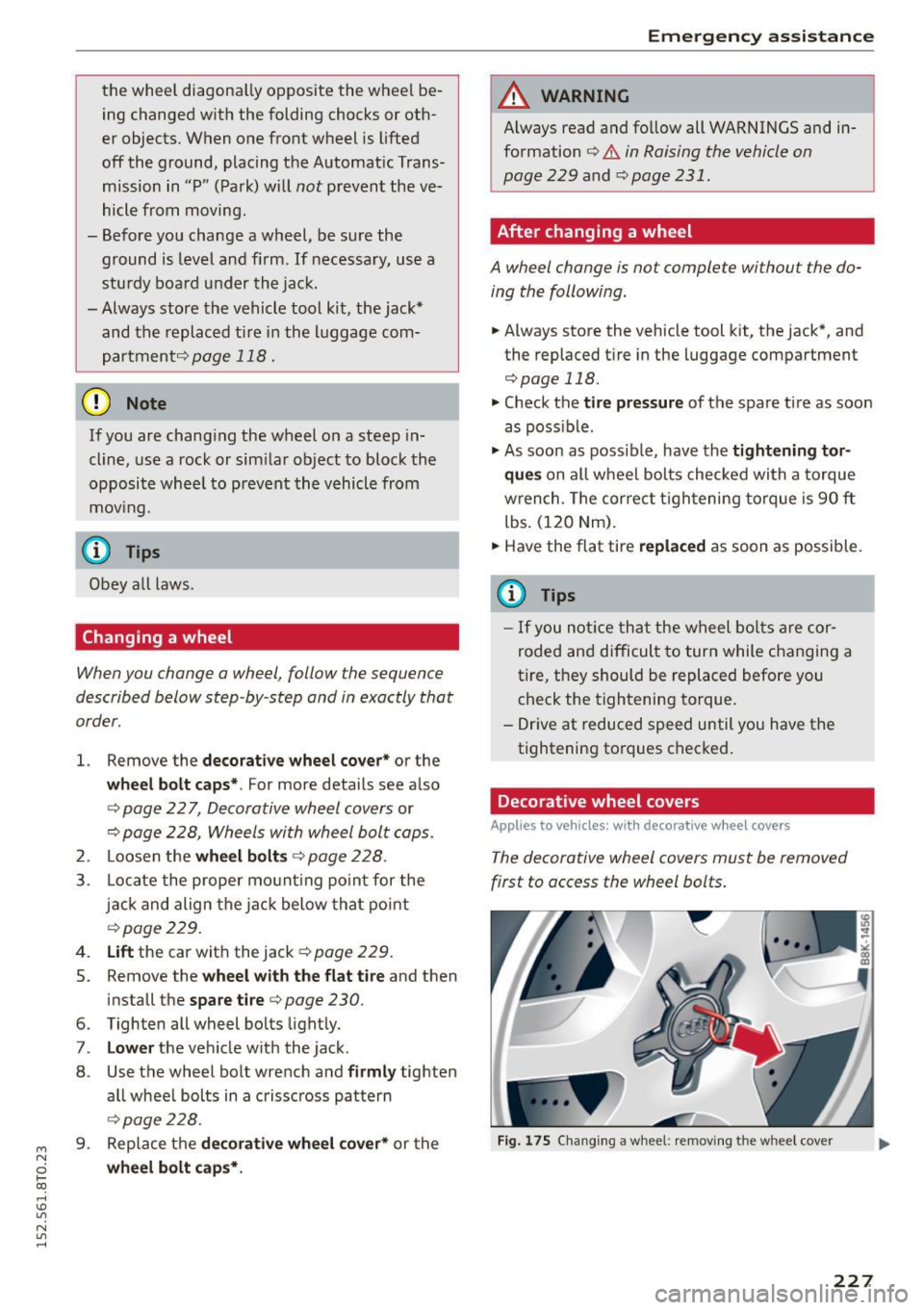
Decorative wheel covers
Applies to vehicles: with decorative w heel covers
The decorative wheel covers must be removed
first to access the wheel bolts .
Fig. 1 75 Chang ing a w heel: re m ovi ng t he w heel cove r
227