ignition AUDI A5 COUPE 2016 Workshop Manual
[x] Cancel search | Manufacturer: AUDI, Model Year: 2016, Model line: A5 COUPE, Model: AUDI A5 COUPE 2016Pages: 264, PDF Size: 66.92 MB
Page 146 of 264
Airbag system
position in a frontal collision so that the airbags
can provide supplemental protection.
The airbag system is not a substitute for your
safety belt. Rather, it is part of the overall occu
pant restraint system in your vehicle. Always re
member that the airbag system can only help to
protect you if you are wearing your safety belt
and wearing it properly . This is why you should
always wear your safety belt, not just because
the law requires you to do soc::>
page 121, Gener
al information.
Remember too, airbags will deploy only once and
only in certain kinds of accidents - your safety
belts are always there to offer protection in those
accidents in which airbags are not supposed to
deploy or when they have already deployed, for
example when your vehicle strikes or is struck by
another after the first collision.
This is just one of the reasons why an airbag is
not a substitute for the safety belt. The airbag
system works most effectively when used with
the safety belts. Therefore, always wear your
safety belts correctly.
It is important to remember that while the sup
plemental knee airbag system is designed to re
duce the likelihood of serious injuries, other inju
ries, for example, swelling, bruising, and minor
abrasions and friction burns can also occur when
an airbag inflates .
The knee airbag system basically consists of:
- The electronic control module
- Two inflatable airbags (airbag and gas genera-
tor), one for the driver and one for the front
passenger
- The airbag indicator light in the instrument
panel
The knee airbag system will not deploy:
- when the ignition is turned off
- in frontal collisions when the deceleration
measured by the control unit is too low
- in side collisions
- in rear-end collisions
- in rollovers
144
- in the event of a system malfunction (warning/
indicator light is on)
c::> page 19.
A WARNING
-Safety belts and the airbag system can only
provide protection when occupants are in
the proper seating position
r::;> page 13 7.
- If the airbag indicator light
c::> page 19
comes when the vehicle is being used, have
the system inspected immediately by your
authorized Audi dealer. It is possible that
the airbag will inflate when it is not sup
posed to, or will not inflate when it should.
How knee airbags work
App lies to vehicles: with knee airbags
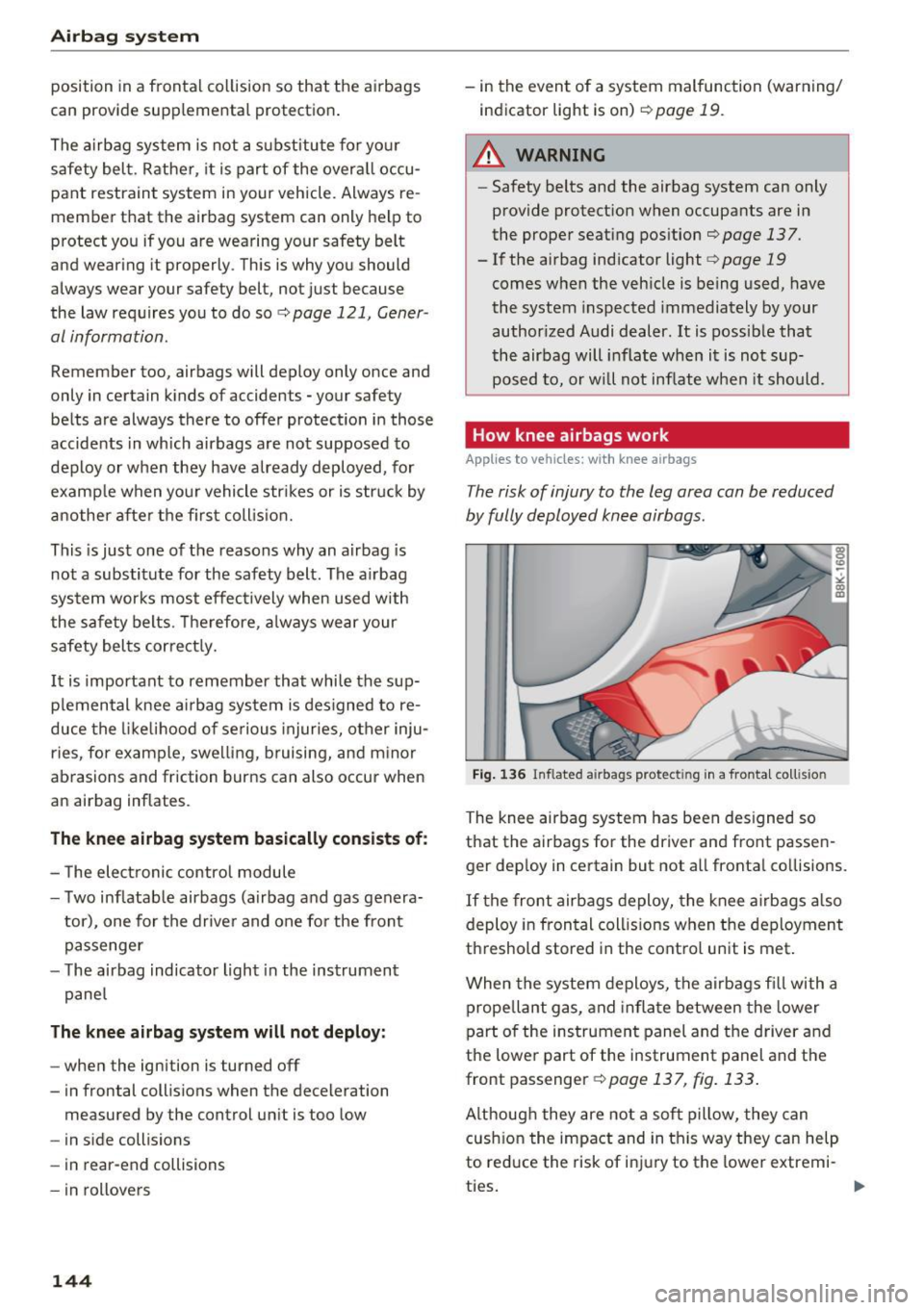
The risk of injury to the leg area can be reduced
by fully deployed knee airbags.
Fig. 136 Inflated a irbags prot ectin g in a frontal coll is io n
The knee airbag system has been designed so
that the airbags for the driver and front passen
ger deploy in certain but not all frontal collisions.
If the front airbags deploy, the knee airbags also
deploy in frontal collisions when the deployment
threshold stored in the control unit is met.
When the system deploys, the airbags fill with a
propellant gas, and inflate between the lower
part of the instrument panel and the driver and
the lower part of the instrument panel and the
front passenger
c::> page 13 7, fig. 133.
Although they are not a soft pillow, they can
cushion the impact and in this way they can help
to reduce the risk of injury to the lower extremi
ties.
..
Page 151 of 264

.... N
0 I-co ....
one co llision and another. Important factors in
clude, for example, the nature (hard or soft) of
the impacting object, the angle of impact, vehicle
speed, etc.
¢ page 149 , How side curtain air
bags work .
Aside from their normal safety function, safety
be lts work to help keep the driver or front pas
senger in posit ion in the event of a collision so
that the side curtain airbags can provide protec
tion .
The airbag system is not a subst itute for your
safety belt. Rather, it is part of the overa ll occu
pant restraint system in your veh icle . Always re
member that the airbag system can only help to
p rotect you if you a re wea ring your safety belt
and wear ing it properly. Th is is anot he r reason
why you should always wea r your s afety be lts ,
not just because the law requires you to do so
¢ page 121, General information.
It is important to remember that wh ile the s ide
curta in a irbag system is des igned to he lp red uce
the likelihood of ser ious injuries, other in juries,
for example, swelling, bruising, and minor abra
sions can a lso be associated with these airbags .
Remember too, these a irbags w ill dep loy only
once and only in certa in kinds of acc idents -your
safety be lts are always there to offer protection.
The side curtain airbag sy stem ba sically
consists of :
-The electronic contro l module and external s ide
impact sensors
- The side curtain airbags above the front and rear s ide windows
- The airbag indicator light in the instrument
panel
The airbag system is monitored e lectronically to
make certain it is f unctioning properly at all
times. Each time you turn on the ignit ion, the air
bag system ind icator light will come on for a few
seconds (self d iagnost ics).
The side curtain a irbag is not activated:
- if t he ignition is turned off,
- in s ide collisions when the acce lerat io n meas -
ur ed by the senso r is too low,
Airb ag sys tem
-in rea r-end col lisions,
- in rollover s.
A WARNING
-- Safety belts and the airbag system will only
provide protection when occupants are in
the proper seating posit ion
¢ page 54,
Seats and storage.
- If the ai rbag in dicator light¢ page 19
comes when the veh icle is being used, have
the system inspected immediately by your
author ized Audi dealer. It is possib le that
the airbag will inflate when it is not sup
posed to, or w ill not inflate w hen it should.
How side curtain airbags work
Side curtain airbags can work together with side
airbags to help reduce the risk of head and upper
torso injuries for occupants who are properly re
strained .
E
Fig. 140 Ill us tratio n of prin cip le: Inflated s ide c urtain a ir
bags o n the left s ide
The side curtain airbags inflate between the oc
cupant a nd the w indows on the side of the ve hi
cl e that is st ruck i n a side collision ¢
fig. 140.
When the system is t riggered, the s ide curta in
airbag is filled w ith propellant gas and breaks
th rough a seam above the front a nd rear side
windows iden tified by the AIR BAG label. In o rder
to help provide this addition al pro te ct ion, the
s ide cu rtain a irb ag m ust infl ate w ith in the blink
of a n eye a t ve ry high spee d and with g reat fo rce.
The side c urtain airbag cou ld injure you if yo ur
seating position is not prope r or upright or if
items are located in the area where the supple
mental s ide curtain a irbag inflates. This applies
especially to ch ildren
¢ page 151. ..,.
149
Page 154 of 264

Child safety
exceptional circumstances and the PASSEN·
GER AIR BAG OFF
light does not come on
and stay on, immediately install the rear
ward-facing child safety seat in a rear seat
ing position and have the airbag system in
spected immediately by your authorized
Audi dealer.
_& WARNING
If, in exceptional circumstances, you must in
stall a forward-facing child restraint on the
front passenger's seat:
- Always make sure the forward-facing seat
has been designed and certified by its man
ufacturer for use on a front seat with a pas
senger front and side airbag.
- Always follow the manufacturer's instruc
tions provided with the child safety seat or
carrier.
- Always move the passenger seat into its
rearmost position in the seat's fore and aft
adjustment range, as far away from the air
bag as possible before installing the child
restraint. The backrest must be adjusted to
an upright position.
- Always make sure that the
PASSENGER AIR
BAG OFF
light comes on and stays on all the
time whenever the ignition is switched on.
(D Tips
Always replace child restraints that were in
stalled in a vehicle during a crash. Damage to
a child restraint that is not visible could cause
it to fail in another collision situation.
Advanced front airbag system and children
Your vehicle is equipped with a front "Advanced
Airbag System" in compliance with United States
Federal Motor Vehicle Safety Standard (FMVSS)
208, as well as Canada Motor Vehicle Safety
Standard (CMVSS) 208 as applicable at the time
your vehicle was manufactured.
The Advanced Airbag system in your vehicle has
been certified to meet the "low-risk" require
ments for 3- and 6-year old children on the pas
senger side and small adults on the driver side.
152 The low risk deployment criteria are intended
to
reduce the risk of injury through interaction with
the airbag that can occur, for example, by being
too close to the steering wheel and instrument
panel when the airbag inflates. In addition, the
system has been certified to comply with the "suppression" requirements of the Safety Stand
ard, to turn off the front airbag for infants up to
12 months who are restrained on the front pas
senger seat in child restraints that are listed in
the Standard.
Even though your vehicle is equipped with an Ad
vanced Airbag system, all children, especially
those 12 years and younger, should always ride
in the back seat properly restrained for their age
and size. The airbag on the passenger side makes
the front seat a potentially dangerous place for a child to ride. The front seat is not the safest place
for a child in a forward-facing child safety seat. It can be a very dangerous place for an infant or a
larger child in a rearward-facing seat.
· Advanced Airbags and the weight -sensing
mat in the front seat
The Advanced Airbag System in your vehicle de
tects the presence of an infant or child in a child
restraint on the front passenger seat using the
weight-sensing mat in the seat cushion and the
sensor below the safety belt latch on the front
passenger seat that measures the tension on the
safety belt .
The weight-sensing mat measures total weight of the child and the child safety seat and a child
blanket on the front passenger seat. The weight
on the front passenger seat is related to the de
sign of the child restraint and its ' 'footprint", the
size and shape of the bottom of the child re- straint as it sits on the seat. The weight of a child
restraint and its "footprint" vary for different
kinds of child restraints and for the different
models of the same kind of child restraint of-
fered by child restraint manufacturers.
The weight ranges for the individual types,
makes and models of child restraints that the
NHTSA has specified in the Safety Standard to
gether with the weight ranges of typical infants .,.
Page 156 of 264
Child safet y
Model Manufactured on or
after
Cosco Summit Deluxe September 25, 2007
High Back Booster
22-262
Cosco High Back Boos -
September 25, 200 7
ter 22-209
Evenflo Tribute V September 25, 2007
379xxxx
Evenflo Medallion 254 December 1, 1999
E venflo Generations September 25, 200 7
352xxxx
Graco ComfortSport September 25, 2007
Graco Toddler Safety Sep tember 25, 200 7
Seat Step 2
Graco P latinum Cargo September 25, 2007
,& WARNING
T o red uce the risk of serio us i njur y, m ake s ure
t ha t the
PASSENGER AIR BAG OFF lig ht
comes o n and stays on wheneve r a child re
straint is installed on the front passenger seat
and the ignition is sw itche d on.
- Take the ch ild rest raint off the front passen
ger seat and insta ll it p roperly at one of the
rear seat positions if the
PASSENGER AIR
BAG OFF
light does not stay on.
- Have the airbag system inspecte d by your
autho rized Aud i dealer immediately.
(D Tips
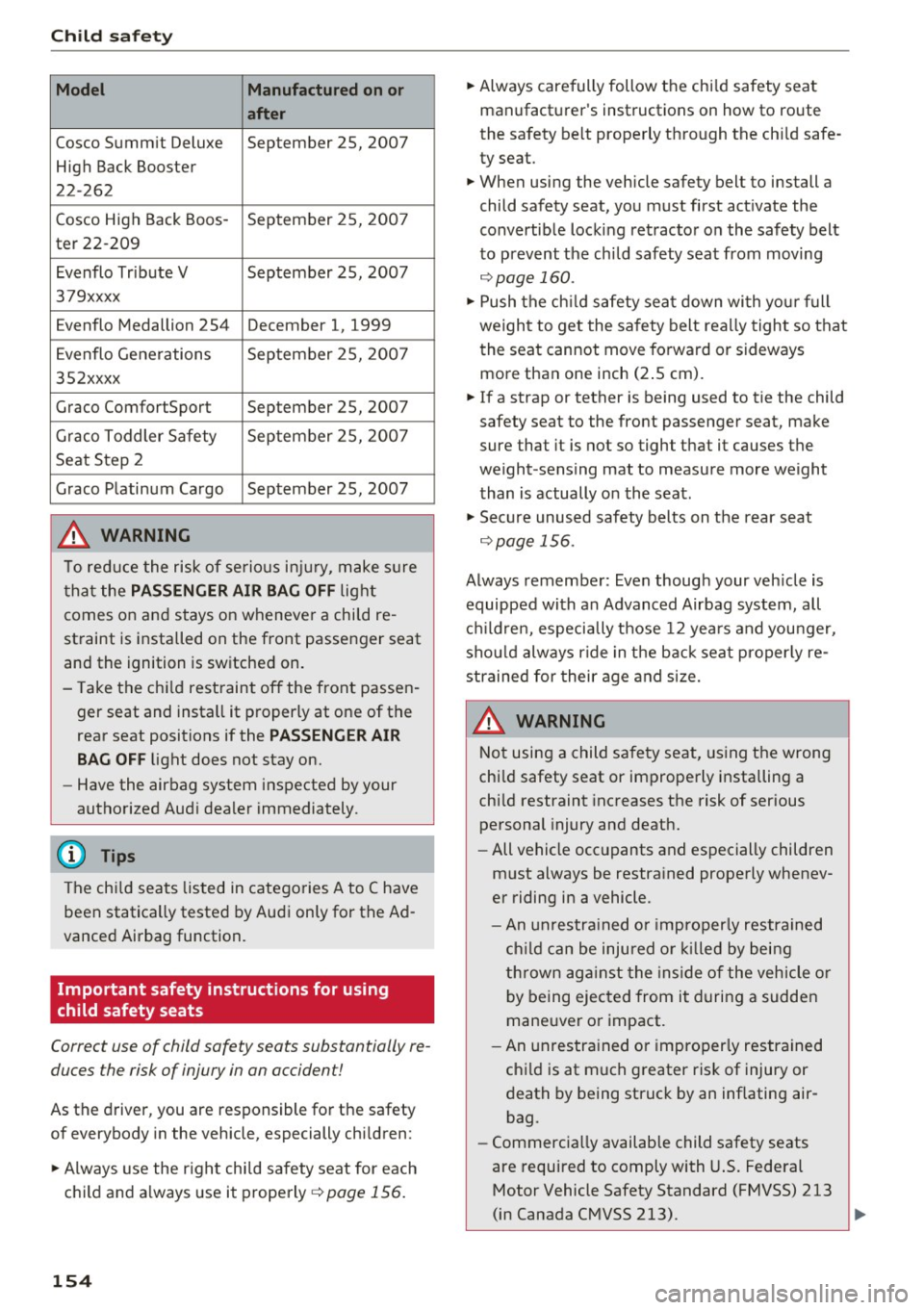
The ch ild seats listed in catego ries A to C have
been statica lly tested by Au di only for the Ad
vanced Airbag function.
Important safety instructions for using
child safety seats
Correct use of child safety seats substantially re
duces the risk of injury in on occident!
As the driver, you are respons ible for the safety
of everybody in the vehicle, especially chi ldren:
... Always use the r ight chi ld safety seat for each
c h ild and a lways use it properly
¢ page 156.
154 ...
Always carefully follow the chi ld safety seat
manufact urer 's instructions on how to route
the sa fety be lt properly thro ugh the ch ild safe
ty seat.
... When using the vehicle safety belt to install a
child safety seat, you must first act ivate the
convertib le lock ing retracto r o n the safety belt
to prevent the chi ld safety seat from moving
¢ page 160.
... Push the ch ild sa fety sea t down wi th yo ur fu ll
weigh t to get the safety belt rea lly tight so tha t
the seat cannot move forward or sideways
more than one inch (2 .5 cm).
... If a strap or tether is being used to tie the child
safety seat to the front passenge r seat, make
sure that it is not so tight t hat it causes the
weight -sensing mat to measure more weight
t han is actually o n the seat .
... Secu re unused safety belts on the rear s eat
¢ page 156.
Always remember : Even though your veh icle is
equipped wi th an Advanced Airbag system, all
c hi ld ren, especially those 12 yea rs and you nger,
s h ould always ride in th e back sea t proper ly re
strained for their age and s ize.
,& WARNING
-
Not usin g a child sa fe ty seat, us ing t he wrong
c h ild safety seat or imprope rly installing a
chi ld restraint inc reases t he risk of serious
personal injury and death.
- All vehicle occupants and es pecially children
m ust always be restra ined properly whenev
er riding in a vehicle.
- An unrestra ined o r imprope rly restrained
c h ild ca n be injured or killed by bei ng
t h rown ag ai nst the inside of the vehicle or
b y being ejected from it durin g a sudden
maneuver o r impact.
- An unrestra ine d or i mprope rly restrained
ch ild is at much g reater risk of injury or
death by being struck by an inflating air
bag .
- Commerc ia lly available child safety seats
are required to comply with U.S. Federal
Motor Vehicle Safety Standard (FMVSS) 213
(in Canada C MVSS 213). ...
Page 160 of 264
Child safety
Toddlers and children who are older than one
year up to about 4 years old and weigh more than 20 lbs. (9 kg) up to 40 lbs. (18 kg) must always
be properly restrained in a child safety seat certi
fied for their size and weight¢
fig. 143 and
¢fig. 144 .
The airbag on the passenger side makes the front
seat a potentially dangerous place for a child to
ride. The front seat is not the safest pl ace for a
child in a forward-facing child safety seat . It is a
very dangerous place for an infant or a larger
child in a rearward-facing seat.
.8, WARNING
Not using a child safety seat, using the wrong
child safety seat or improperly installing a
child restraint increases the risk of serious
personal injury and death in a collision or oth
er emergency situation.
- Children on the front seat of any car, even with Advanced Airbags, can be seriously in
jured or even killed when an airbag inflates. A child in a rearward-facing child safety seat
installed on the front passenger seat will be
seriously injured and can be killed if the
front airbag inflates - even with an Ad
vanced Airbag System .
- The inflating airbag will hit the child safety seat or infant carrier with great force and
will smash the child safety seat and child against the backrest, center armrest, door
or roof.
- Always install rearward-facing child safety
seats on the rear seat .
-If you must install a rearward facing child
safety seat on the front passenger seat be
cause of exceptional circumstances and the
PASSENGER AIR BAG OFF light does not
come on and stay on, immediately install
the rearward-facing child safety seat in a
rear seating position and have the airbag
system inspected by your authorized Audi
dealer.
- The rear side of the child safety seat should be positioned as close as possible to the
backrest on the vehicle seat. Adjust or re
move the rear seat head restraint if it is dif-
158
ficult to install the child seat with the head
restraint in place
¢page 58. Install the
head restraint again immediately once the
child seat is removed . Driving without head
restraints or with head restraints that are
not properly adjusted increases the risk of
serious or fatal neck injury dramatically.
-Always read and heed all WARNINGS when
ever using a child restrained in a vehicle is
being used
¢page 121, Safety belts,
¢page 129, Airbag system
and
¢ page 151, Important information.
.8, WARNING
If exceptional circumstances require the use
of a forward-facing child restraint on the
front passenger's seat, the child's safety and
well-being require that the following special precautions be taken:
- Make sure the forward-facing seat has been
designed and certified by its manufacturer
for use on a front seat with a passenger
front and side airbag .
-Always follow the manufacturer's instruc
tions provided with the child safety seat or
infant carrier.
- Always move the front passenger seat into
the rearmost position of the passenger
seat's fore and aft adjustment range, and as
far away from the airbag as possible before
installing the child restraint .
- Always make sure that nothing prevents the
front passenger's seat from being moved to
the rearmost position in its fore and aft ad
justment range .
- Always make sure the backrest is in an up
right position .
- Make sure that the
PASSENGER AIR BAG
OFF
light comes on and stays on all the time
whenever the ignition is switched on.
- If the light does not stay on, perform the
checks ¢
page 139, Monitoring the Ad
vanced Airbag System.
- Take the child restraint off the front passen
ger seat and install it properly at one of the
rear seat positions if the
PASSENGER AIR
Page 161 of 264
,-1 N
0 1-CX)
,-1 I.Cl U"I
,-1 I.Cl ......
BAG OFF light does not stay on whenever
the ignition is switched on .
Booster seats and safety belts
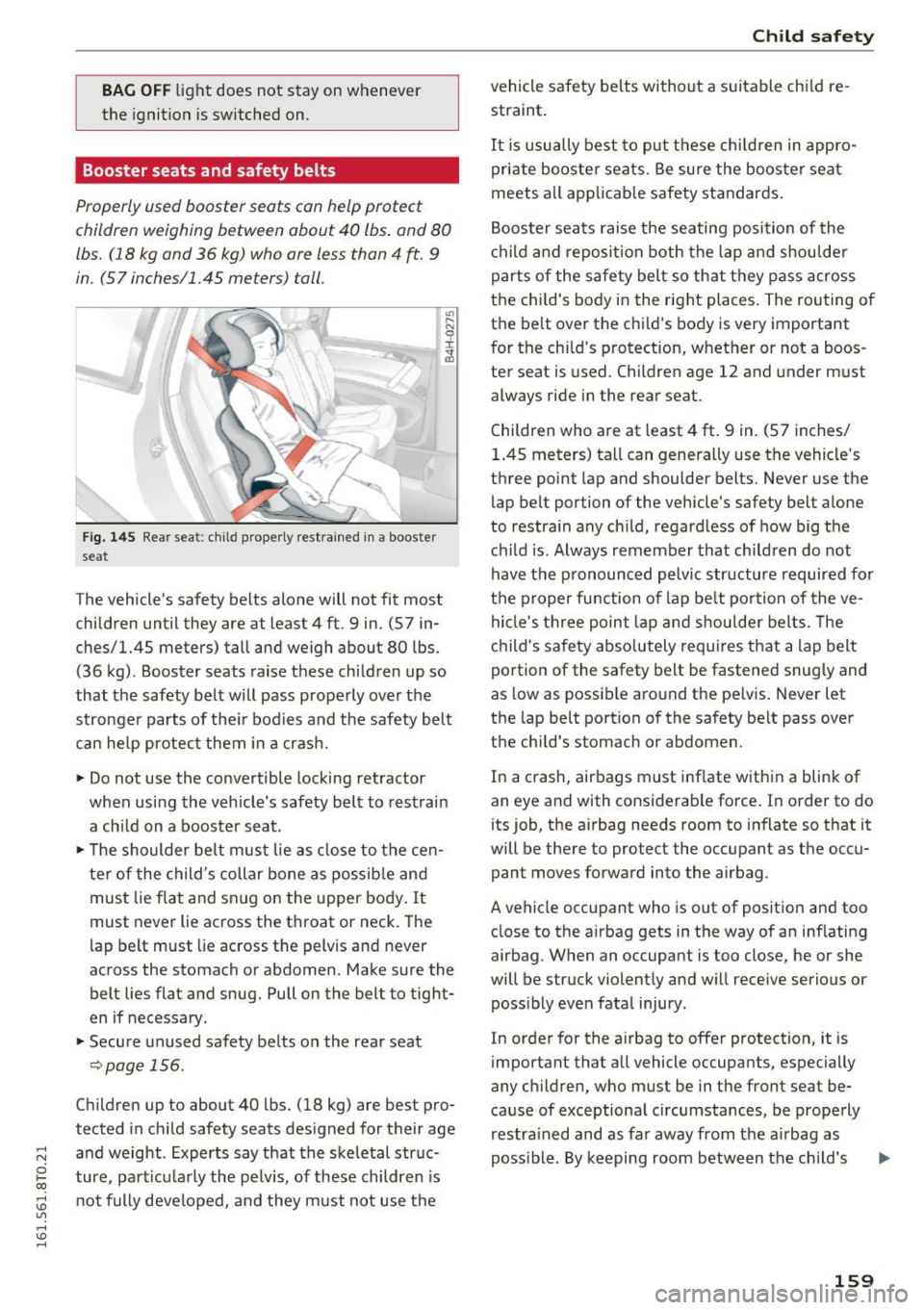
Properly used booster seats can help protect
children weighing between about 40 lbs . and 80
lbs. (18 kg and 36 kg) who are less than 4 ft .
9
in. (57 inches/1.45 meters) tall .
Fig. 145 Rear seat: c hild prope rly rest rai ned in a booste r
sea t
The vehicle's safety belts alone will not fit most
children until they are at least 4
ft. 9 in. (5 7 in
ches/1.45 meters) tall and weigh about 80 lbs.
(36 kg). Booster seats raise these chi ldren up so
that the safety belt will pass properly over the
stronger parts of the ir bodies and the safety belt
can help protec t them in a crash.
.,.. Do not use the convertible locking retractor
when usi ng the vehicle's safety belt to restrain
a ch ild on a booster seat .
.,.. The shoulder belt must lie as close to the cen
ter of the child 's collar bone as possible and
must lie flat and snug on the upper body. It
must never lie across the throat or neck. The
lap belt must lie across the pelvis and never
across the stomach or abdomen. Make sure the
belt lies flat and snug. Pull on the belt to tight
en if necessary .
.,.. Secure unused safety belts on the rear seat
<=>page 156.
Children up to about 40 lbs. (18 kg) are best pro
tected in ch ild safety seats des igned for their age
and weight . Experts say that the skeletal str uc
ture, pa rticular ly the pe lv is , of these children is
no t fully developed, and they must not use the
Child safety
vehicle safety be lts wi thout a suitable child re
straint.
It is usually best to put these childr en in appro
priate booster seats. Be su re the booster seat
meets all applicab le safety standards .
Booster seats raise the seating position of the
child and reposition both the lap and shoulder
parts of the safety belt so that they pass across
the child's body in the right places. The routing o f
the belt over the chi ld's body is very important
for the ch ild's protection, whether or not a boos
ter seat is used. Children age 12 and under must
always ride in the rear seat.
Ch ildren who are at least 4
ft. 9 in. (57 inches/
1.45 meters) tall can generally use the vehicle 's
three point lap and shoulder belts . Never use the
lap belt portion of the vehicle 's safety belt alone
to restrain any ch ild, regard less of how big the
ch ild is. Always remember that childr en do not
have the pronounced pelvic structure required for
the proper function of lap belt portion of the ve
hicle's three point lap and shoulder belts . T he
child's safety absolutely requires that a lap belt
portion of the safety belt be fastened snugly and
as low as possible around the pe lvis. Never let
the lap belt portion of the safety belt pass over
the child 's stomach or abdomen .
In a crash, airbags must inflate within a blink of
an eye and with considerab le force. In order to do
its job, the airbag needs room to inflate so that it
will be there to protect the occupant as the occu pant moves forward into the airbag .
A vehicle occ upant who is out of position and too
close to the a irbag gets in the way of an inflating
airbag. When an occupant is too close , he or she
will be struck violently and w ill receive serious or
possibly even fata l injury .
In order for the airbag to offer protection, it is
important that all vehicle occupants, especially
any children, who must be in the front seat be
cause of exceptiona l circumstances, be properly
restrained and as far away from the airbag as
possible. By keeping room between the child's ..,.
159
Page 162 of 264
Child safety
body and the front of the passenger compart
ment, the airbag can inflate completely and pro
vide supplemental protection in certain frontal
collisions.
.,&. WARNING
Not using a booster seat, using the booster
seat improperly, incorrectly installing a boos
ter seat or using the vehicle safety belt im
properly increases the risk of serious personal
injury and death in a collision or other emer
gency situation. To help reduce the risk of se
rious personal injury and/or death:
- The shoulder belt must lie as close to the
center of the child's collar bone as possible
and must lie flat and snug on the upper
body.
It must never lie across the throat or
neck. The lap belt must lie across the pelvis
and never across the stomach or abdomen .
Make sure the belt lies flat and snug. Pull on
the belt to tighten if necessary .
- Failure to properly route safety belts over a
child's body will cause severe injuries in an
accident or other emergency situation
~ page 121.
-The rear side of the child safety seat should
be positioned as close as possible to the
backrest on the vehicle seat . Adjust or re
move the rear seat head restraint if it is dif
ficult to install the child seat with the head
restraint in place
~page 58. Install the
head restraint again immediately once the
child seat is removed. Driving without head
restraints or with head restraints that are
not properly adjusted increases the risk of
serious or fatal neck injury dramatically.
- Children on the front seat of any car, even
with Advanced Airbags, can be seriously in
jured or even killed when an airbag inflates.
- Never let a child stand or kneel on any seat.
- Never let a child ride in the cargo area of
your vehicle.
- Always remember that a child leaning for
ward, sitting sideways or out of position in
any way during an accident can be struck by
a deploying airbag. This will result in serious
personal injury or death.
160
- If you must install a booster seat on the
front passenger seat because of exceptional
circumstances the
PASSENGER AIR BAG
OFF
light must come on and stay on, when
ever the ignition is switched on .
- If the
PASSENGER AIR BAG OFF light does
not come on and stay on, perform the
checks described~
page 139, Monitoring
the Advanced Airbag System .
-Take the child restraint off the front passen
ger seat and install it properly at one of the rear seat positions if the
PASSENGER AIR
BAG OFF
light does not stay on whenever
the ignition is switched on.
- Always read and heed all WARNINGS when
ever using a child restrained in a vehicle is
being used
~ page 121, Safety belts,
~page 129, Airbag system
and
~ page 151, Important information.
Securing child seats
' Securing a child safety seat using a safety
I _l:>elt
Safety belts for the rear seats and the front pas
senger's seat can be locked with the convertible
locking retractor to properly secure child safety
seats.
The safety belts emergency locking retractors for
the rear seats safety belts and for the front pas senger 's seat safety belt have a convertible lock
ing retractor for child restraints. The safety belt
must be locked so that belt webbing cannot un
reel. The retractor can be activated to lock the
safety belt and prevent the safety belt webbing
from loosening up during normal driving . A child
safety seat can only be properly installed when
the safety belt is locked so that the child and
child safety seat will stay in place.
Always remember : Even though your vehicle is
equipped with an Advanced Airbag system, all
children, especially those 12 years and younger,
should always ride in the back seat properly re-
strained for their age and weight . ..,.
Page 163 of 264
.... N
0 I-co ....
Improperly installed child safety seats in
crease the risk of serious personal injury and
death in a collision.
- Always make sure that the safety belt re
tractor is locked when installing a child
safety seat. An unlocked safety belt retrac
tor cannot hold the child safety seat in place
during no rma l driving or in a crash.
- Always buckle the child safety seat firmly in
place even if a child is not sitting in it. A
loose child safety seat can fly around d uring
a sudden stop or in a collision .
- If the backrest is not securely latched, the
child and the child restrain t will be thrown
forward together with the backrest and will strike parts of the vehicle interior. The ch ild
can be seriously injured or killed.
- Never install rearward -facing child safety
seats or infant carriers on the front passen ger seat. A child will be seriously injured and
can be killed when the passenger airbag in
flates.
- The inflating a irbag will hit the child safety
seat or infant carrier with great force and
will smash the ch ild safety seat and child
against the backrest, center armrest, door or roof .
- Always install rearward-fac ing ch ild safety
seats or infant carriers on the rear seat .
- Forward-fac ing ch ild safety seats or infant
carriers installed on the front passenger's
seat may inte rfere with the deployment of
the a irbag and cause serious injury to the
c hild.
- It is safe r to install a forward-fac ing ch ild
safety seat on the rear seat.
- Always read and heed all WARNINGS when
ever using a child restrained in a veh icle is
being used
¢page 151. Specia l pre caut ions
apply when installing a child safety seat on
the front passenger seat¢
page 130, Child
restraints on the front seat -some impor
tant things to know.
Ch ild safety
A WARNING
Always take special precautions if you must
i nstall a forward or rearward-facing child re
stra int on the front passenger's seat in excep
tional s ituations:
- Whenever a forward or rearward-fac ing
child restraint is installed on the front pas
senger seat, the
PASSENGER AIR BAG OFF
lig ht must come on and stay on w henever
the ignition is switched on.
- If the PASSENGER AIR BAG OFF li ght does
not come on and stay on, perform the
checks desc ribed¢
page 139, Monitoring
the Advanced Airbag System.
- Take the child restr aint off t he front passen
ger seat and install it properly at one of the
rear seat positions if the
PASSENGER AIR
BAG OFF
light does not stay on whenever
the ignition is switched on.
- Improper installation of child restraints can
reduce their effectiveness or even prevent
them from providing any protect ion.
- An imprope rly installed child restraint can
interfere with the airbag as it deploys and
serious ly injure or even kill the chi ld.
- Always care fully follow the manufacturer's
instr uctions provided with the child safety
seat or carr ier.
- Never p lace add itiona l items on the seat
that can increase the total weight registered
by the weight-sensing mat and can cause in
jury in a crash.
A WARNING
-Forward-facing child restra ints:
- Always make sure the forward-facing seat
has been des igned and certified by its man
ufacturer for use on a front seat with a pas
senger front and side airbag .
- Never put the forward-facing child restraint up, against or very nea r the instrument pan
el.
- Always move the passenger seat into its
rearmost posit ion in the seat's fore and aft
-
161
Page 164 of 264
Child safet y
adjustment range, as far away from the air
bag as possib le before insta lling the for
ward-facing child restra int. The backrest
must be adjusted to an upright posit ion.
- Make sure that the
PASSEN GER AIR BAG
OFF
light comes on and stays on all the time
whenever the ignition is switched on .
A WARNING
Rearward-facing child restraints:
- A ch ild in a rearward-facing child safety seat
installed on the front passenger seat will be
seriously injured and can be killed if the
front airbag inflates - even with an Ad
vanced Airbag System.
- The inflating a irbag w ill hit the child safety
seat or infant carrier wi th great force and
will smash the chi ld safety seat a nd child
against the backrest, cen ter armrest, door
or roof.
- Always be especially careful if you must in
sta ll a rearward facing child safety seat on
the front passenger seat in exceptional cir
cumstances .
- A tight tether strap on a rearward-fac ing
child restraint attached to the front passen
ger seat can put too much pressu re on the
weight-mat in the seat and register a heavi er we ight in the Advanced Airbag System.
The heav ier we ight registered can make the
system work as though an adult were on the
seat and deploy the Advanced Airbag when it m ust be s uppressed causi ng serio us or
even fatal injury to the child.
- Make s ure that the
PASSENGER AIR BAG
OFF
light comes on and stays on all the time
whenever the ignition is switched on.
- If the
PASSENGER AIR BAG OFF light does
not come on and stay on , immediately in
sta ll the rearward-facing child safety seat in
a rear seating position and have the a irbag
system inspected by your authorized Audi
dealer .
162
· Activating the convertible locking retractor
Use the convertible locking retractor to secure a
child restraint.
Always heed the ch ild safety seat manufacturer's
i nstruct ions when installing a child restra int in
your vehicle . To activate the convertible locking
retractor:
.. Place the child restraint on a seat, preferably
on the rear seat.
.. Slowly pull the belt
all th e w ay out .
.. Route it around or through the child restra int
be lt path
~ ,&. .
.. Push the ch ild safety sea t down wi th yo ur full
weigh t to get the safety belt really tight.
.. Insert the be lt tong ue into the b uck le for that
seating position .
.. Guide the safety be lt back into the retracto r un
til the belt lies flat and sn ug on the ch ild safety
seat.
.. You should hear a "cl icking" noise as the belt
w inds back into the inertia reel. Test the con
vert ible lock ing retractor by pull ing on the belt.
You shou ld no lo nge r be able to pull the belt
out of the retracto r. T he convertib le locking re
tractor is now activa ted.
.. Make sure that the red release button is facing
away from the chi ld restraint so that it can be
unbuckled quickly .
.. Pull on the belt to make sure the safety belt is
properly t ight and fastened so that the seat
cannot move forward or s ideways more than
one inch (2 .5 cm) .
A WARNING
Using the wrong ch ild restraint or an improp
e rly installed child restra int can ca use serious
personal injury or death in a crash.
- Always make sure that the safety be lt re
tr actor is locked when installing a ch ild
safety seat . An unlocked safety be lt retrac
tor cannot hold the ch ild safety seat in place
during normal driving or in a crash.
- Always buckle the child safety seat firmly in
place even if a chi ld is not sitting in it. A
loose child safety seat can fly around during
a sudden stop or in a crash.
Page 177 of 264

.... N
0 Ico ....
engine power. Your vehicle is exceptionally pow
erful and has excellent driving characterist ics
both under normal dr iving condit ions and on
snow and ice. Always read and fo llow safety pre
cautions <=>
,&.
Winter t ire s
When driving in the winter, your vehicle with a ll
wheel drive has an advantage, even with regular
tires. In winter road conditions it may be adv isa
ble to mount w inter tires (or all-season tires) for
i mproved driveab ility and brak ing : these tires
must be mounted on
all four wheels . See also
<=> page 220, Winter tires.
Tire chains
Where tire chains are mandatory on certain
roads, this normally also applies to vehicles w it h
all -wheel drive <=>
page 220, Snow chains.
Replacing wheels /tires
Vehicles with all-whee l dr ive must always have
tires of the same size. A lso avoid tires with differ
ent tread depths. For details see page
<=>
page 212, New tires or wheels.
Off-Road dri ving ?
Your Aud i does not have enough ground clear
ance to be used as an off-road vehicle.
It is there
fore best to avoid rough tracks and uneven ter rain as much as possible . Also refer to
<=> page 177 .
A WARNING
Always adjust your driving to road and t raff ic
conditions. Do not let the extra safety affo rd
ed by all-wheel drive temp t yo u into ta king
extra risks.
- Although the all-whee l drive is very effec
t ive, a lways remember th at br akin g capac ity
is limited by tire traction. Yo u should t here
f ore not drive at excess ive speeds on icy or
slippery road surfaces.
- On wet road surfaces, be caref ul no t to drive
too fast because the front wheels co uld be
gin to slide on top of the water (aq uaplan
ing). If this shou ld occur, you wi ll have no
Intellig ent Technology
warn ing from a s udden increase in engine
speed as w ith a front-wheel drive vehicle.
Always drive at speeds which are suited to the road conditions - risk of crash .
Energy management
Starting ability is optimized
Energy management controls the distribution of
elec trical energy and thus optimizes the availa
bility of ele ctrical energy for star ting the engine.
If a vehicle with a conventiona l energy system is
not dr iven fo r a long pe riod of time, the batte ry is
discharged by id ling curre nt cons umers (e.g. im
mobili ze r). In cer tain circumstances i t can res ult
in the re being insuffi cien t energy ava ilable to
start the engine .
Intellige nt energy manageme nt in yo ur vehicle
hand les the distri bu tion of elec trical energy.
Start ing ability is markedly improved and the life
of the battery is extended .
B as ic all y, energy managemen t cons ists of
bat
tery diagn osis , idling current man agement
a nd
d ynamic energy man agement.
Battery diagnosis
Battery d iagnosis con tinuously dete rmines the
state of the bat tery. Sensors de termine battery
vo ltage, b attery curren t and batte ry tempera
tu re. This de termines t he current state of charge
and the power of the battery .
Idling current management
Idling cur rent management reduces ene rgy con
s u mption wh ile the vehicle is standi ng. With the
ignition swi tched off , it co ntrols the energy sup
ply to the vario us elec trical components . Data
from battery diagnosis is considered .
Depend ing on the ba tte ry's s ta te of charge, indi
v idual consumers are g radually turned off to pre
ven t excess ive d ischarge of the battery and thus
maintain starting capab il ity.
Dynamic energy management
While the vehicle is being driven, dynam ic ene rgy
manageme nt dis trib utes the energy generated ""'
175