service AUDI A6 2011 Owners Manual
[x] Cancel search | Manufacturer: AUDI, Model Year: 2011, Model line: A6, Model: AUDI A6 2011Pages: 370, PDF Size: 87.15 MB
Page 321 of 370

What do I do now? -______________________________ ____::..:..:..:..::..::....::..::.....::.....:::...::,_ __ __,J
& WARNING (continued)
• Never start or run the engine while the vehicle is supported by
the jack.
• If you must work under the vehicle, always use safety stands
specifically designed for this purpose.
• Never use the hexagonal socket in the handle of the screw
driver to loosen or tighten the wheel bolts.
• Always make sure the spare tire and even a flat tire are secured
in place and not loose, otherwise they could fly forward, causing
personal injury to passengers in the vehicle in an accident or
sudden maneuver. •
Tools
The vehicle tools are stored in the luggage compartment
behind the right-side trim panel.
-
The onboard tool kit includes:
• Hook for removing wheel covers*
• Wheel bolt wrench
• Alignment pin for changing wheels
• Screwdrive r with reve rsible blade
Fig. 225 Luggage
compartment: vehicle
tool kit
Vehicle OP-eration
• Towing eye
[ i] Tips
Some of the onboard items listed above are provided on certain
models only or are optional extras. •
Spare wheel
The spare wheel is stored in the wheel well underneath
the floor panel in the luggage compartment.
Fig. 226 Luggage
compartment spare
wheel
Your vehicle is equipped with a regular spare wheel. It is held
in place by plastic retaining knurled screw .
Taking out the spare wheel
- Raise the floor panel at the plastic handle.
- Securely engage the handle in the luggage compartment
seal as illustrated to keep the floor panel up.
Unscrew the knurled retainer bolt in the wheel center
=> fig. 226. Turn it counter-clockwise.
- Take out the spare wheel.
Vehicle care Do-it-yourself service iTechnical data
Page 323 of 370

What do I do now? Ill
----------------
& WARNING (con tinued)
Trans missio n in "P " (Pa rk) w ill not pre ve nt the vehicle from
mo ving .
• Befo re you ch an ge a wheel , be s ure the ground i s le ve l an d
firm . If ne cess ary, us e a sturdy b oard und er the jack.
• Aft er in st a llin g the sp are wheel , make sure that you repl ace
the flat tire /wheel in it s storage area prop erly and tight en the
knurled ret ain ing s crew se cu rel y.•
Changing a wheel
When you change a wheel, follow the sequence described
below step-by-step and in exactly that order .
1. Activate the vehicle jack mode (only vehicles with Adaptive
Air Suspension) =>
page 170.
2. Remove the decorative wheel cover *. For more details see
also =>
page 322, "Decorative wheel covers" .
3 . Loosen the
wheel bolts => page 322.
4. Locate the proper mo unti ng point for the jack and align
the jack below that point=>
page 323.
5. Lift the car with the jack=> page 323.
6. Remove the wheel with the flat tire and then install the
spare =>
page 324.
7. Tighten all wheel bolts lightly.
8 .
Lower the vehicle with the jack.
9. Use the wheel bolt wrench and
firmly t ighten all wheel
bolts =>
page 322.
10. Replace the decorative wheel cover *.
Safety first
1 1. Deactivate the vehicle jack mode (only vehicles with
Adaptive Air Suspens ion) =>
page 170 .
& WARNING
Alwa ys re ad and f ollow all WARNINGS and information ~ & in
" Ra ising the vehicl e" on pag e
32 3 and ~ pag e 325. •
After changing a wheel
A wheel change is not complete without the doing the
following .
-Store and secure the wheel you replaced in the spare
wheel well .
- Replace the tools and the jack in the ir proper location.
- Check the tir e pr essur e on the spare wheel immediately
after mounting it .
- As soon as possib le, have the
tighten ing torques on a ll
wheel bolts checked with a torque wrench . The correct
tightening torque is 90 ft lb (120 Nm) .
- Have the flat tire
replaced as soon as possible.
[ i ] Tips
• If you not ic e that the wheel bolts are corroded and difficu lt to turn
wh ile chang ing a tire, they should be replaced before you check the
tightening torque .
• Drive at reduced speed until you have the tighten ing torques
checked. •
Vehicle care Do-it-yourself service Technical data
Page 325 of 370
What do I do now? -_______________ __.PfWII
& WARNING (continued)
• Do not loosen the wheel bolts more than one turn before you
raise the vehicle with the jack. -You risk an injury.
(I) Tips
• Never use the hexagonal socket in the handle of the screwdriver to
loosen o r tighten the wheel bolts .
• If a wheel bolt is very tight, you may find it easier to loosen by
carefully pushing down on the end of th e wheel bolt wrench with
one
foot only .
As you do so, hold on to the car to keep your balance and
take ca re not to slip .•
Raising the vehicle
The vehicle must be li~ed with the jack first before the
wheel can be removed.
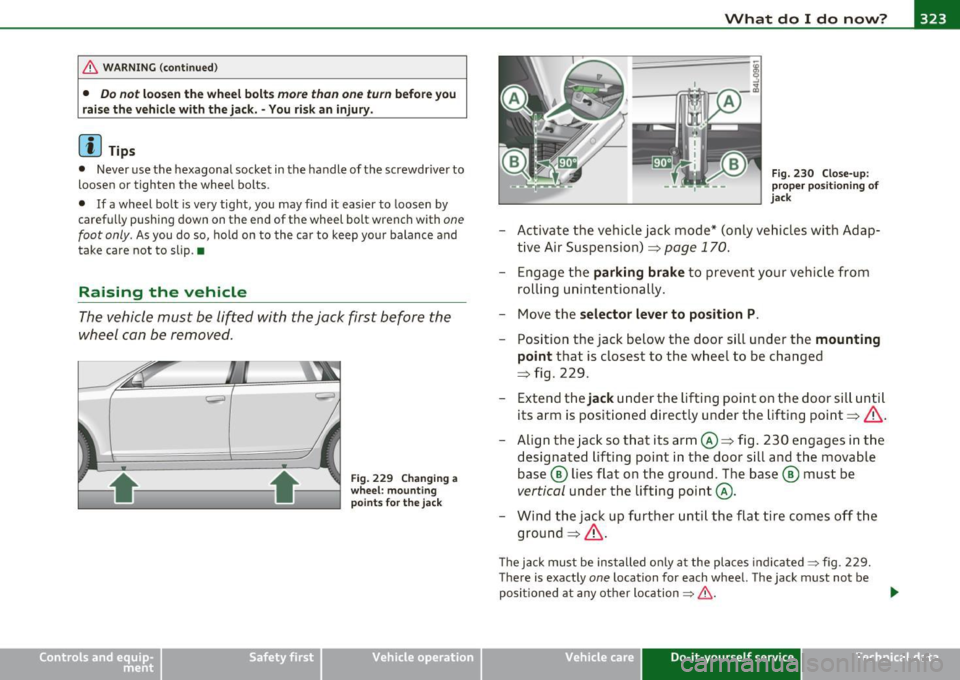
Fig. 229 Changing a
wheel: mounting
points for the jack
Vehicle OP-eration
Fig. 230 Close-up:
proper positioning of
jack
- Activate the vehicle jack mode* (only vehicles with Adap
tive Air Suspension)=>
page 170.
-Engage the parking brake to prevent your vehicle from
rolling unintentionally.
- Move the
selector lever to position P.
-Position the jack below the door sill under the mounting
point
that is closest to the wheel to be changed
=> fig . 229.
- Extend the
jack under the lifting point on the door sill until
its arm is positioned directly under the lifting point=>& .
- Align the jack so that its arm©=> fig. 230 engages in the
designated lifting point in the door sill and the movable
base ® lies flat on the ground. The base® must be
vertical under the lifting point@.
- Wind the jack up further until the flat tire comes off the
ground =>& .
The jack must be installed only at the places indicated=> fig . 229.
There is exactly
one location for each wheel. The jack must not be
positioned at any other location
~ & .
Vehicle care Do-it-yourself service iTechnical data
Page 327 of 370

What do I do now? -________________ Vf'.'11
- Screw the threaded end of the alignment pin from the
tool kit hand-tight into the empty bo lt hole~
page 324,
fig. 232.
- Then re m ove the o ther wheel bolts as described above.
- Take off t he w heel leaving the alignment pin i n the bolt
hole.
Putting on the spare wheel
- Lift the spare wheel and carefully slide it over the alig n
ment pi n to guide it in p lace .
- Use the hexagona l socket in the screwdriver handle to
screw in and tighte n all w heel bolts
slightly.
- Remove the alig nment pi n and inse rt an d tighten the
remaining wheel bolt slig htly like the rest.
- Turn the jac k han dle counter-c lockwise to lower the
ve hicle u ntil the jack is fully released.
- Use the wheel bolt wrench to t ighten all whee l bolts firmly
~ page 322. Ti ghten them crosswise, from one bolt to
the (approximately) opposite one, to keep the w heel
centered.
[I] Tips
Never use the hexagonal socket i n the handle of the screwdriver to
loosen or tighten the wheel bolts.
• Pull the reve rsible blade from the screwdriver before yo u use the
hexagonal socket in the handle to t urn the whee l bolts.
• When mounting tires with
unidirectional tread design make sure
t he tread pa ttern is po inted the right way~
page 325.
Safety first
• The wheel bolts should be clea n and easy to turn. Check for dirt
and cor rosion on the mat ing surfa ces o f bo th the whee l and the hub.
Remove all d irt from these surfaces before remounting the wheel. •
Tires with unidirectional tread design
Tires with unidirectional tread design must be mounted
with their trea d pattern pointed in the right direction .
Using a spare tire with a tread pattern intended for
use in a specific direction
When using a spare tire w ith a tread pattern intended for use in a
specific direction, p lease note the fo llow ing:
• T he direct ion of rotation is marked by an ar row on the s ide of the
tire.
• If the spare tire has to be installed in the incor rect d irect ion, use
the spare tire only tempo rari ly since the tire wi ll not be ab le to
achieve its optimum pe rforma nce charact erist ics with rega rd to
aquaplaning, noise and wear.
• We recommend that you pay particular attention to this fact
during wet weather and that you adjust your speed to match road
condit ions.
• Replace the flat t ire with a new one and have it installed on your
vehicle as soon as possible to restore the handling advantages of a
unidirect iona l tire .•
Notes on wheel changing
Please read the information~ page 307, "New tires and replacing
t ires and wheels" if yo u are go ing to use a spa re t ire wh ich is d iffe rent
from the tires on yo ur vehicle .
After you c hange a ti re:
• Check the tire pressure on the spa re immediately after installa-
tion. ..,
Vehicle care Do-it-yourself service Technical data
Page 328 of 370
llffl.___W __ h_a_ t_ d_ o_ I_ d_o_ n_ o_w _ ? _____________________________________________ _
• Have the wheel bolt tightening torque checked with a torque
wrench as soon as possible by your authorized Audi dealer or a qual ified service station.
• With steel and alloy wheel rims, the wheel bolts are correctly
tightened at a torque of 90
ft lb (120 Nm).
• If you notice that the wheel bolts are corroded and difficult to
turn while changing a tire, they should be replaced before you check
the tightening torque.
• Replace the flat tire with a new one and have it installed on your
vehicle as soon as possible. Remount the wheel cover.
Until then, drive with extra care and at reduced speeds.
& WARNING
• If you are going to equip your vehicle with tires or rims which
differ from those which were factory installed, then be sure to
read the information =>
page 307, "New tires and replacing tires
and wheels".
• Always make sure the damaged wheel or even a flat tire and
the jack and tool kit are properly secured in the luggage compart
ment and are not loose in the passenger compartment.
• In an accident or sudden maneuver they could fly forward,
injuring anyone in the vehicle.
• Always store damaged wheel, jack and tools securely in the
luggage compartment. Otherwise, in an accident or sudden
maneuver they could fly forward, causing injury to passengers in
the vehicle. •
Page 329 of 370

______________________________________________ F _u_s _e_ s_ a_ n_ d _ b _u_l_b _ s _ ___.9I
Fuses and bulbs
Electrical fuses
Replacing fuses
Fuses that have blown will have metal strips that have
burned through .
Fig. 233 Left cockpi t:
f use panel cover
The fuses are located at the front left and right of the cockpit
and behind the trim on the right side of the luggage compart
ment .
- Turn off the ignition and the affected electr ical
consumers.
- Check the following table to see which fuse belongs to the
consumer.
- Remove the appropriate cover.
- To remove the purple plastic clip if necessary
4
), hold onto
it at the small side and pull it out of the fuse panel.
4J You can dispose of the p last ic cli p after remov ing it .
Vehicle OP-eration
- Remove the clamp from the rear side of the fuse cover
=> fig. 233.
-Remove the fuse using the clamp and replace the blown
fuse with an identical new one.
& WARNING
Do not repair fuses and never replace a blown fuse with one that
has a higher amp rating. This can cause damage to the electrical
system and a fire.
0 Note
If a new fuse burns out again after shortly have you have installed it,
have the electrical system checked by your authorized Aud i dea ler.
[I) Tips
• The follow ing tab le does not list fuse locations that are not used .
• Th e crank in the cover is used for emergency operation of the
power roof*.•
Vehicle care Do-it-yourself service iTechnical data
Page 331 of 370

______________________________________________ F _u_s _e_ s_ a_ n_ d _ b _u_l_b _ s_---J _
Fuse assignment, cockpit passenger's side
No . Consumer
Fu se pa nel (bl ack )
1 Control module Convenience key
2 Cigarette lighter front
3 Tire pressure monitoring system
4 Electrical outlet front (center console)
5 Intelligent power module passenger
(glove box lock)
6 Door control module right-s ide
7 Sunroof
8 A/C cont rols
9 Heated seats, front
10 MMI
11 Seat adjustment (passenger)
12 Communication
Fu se pan el (brown )
1 Electr ic fuel pump
Fig . 235 Cockp it
passenger 's side : fuse
pa nel layo ut
Amps
15
20
5
20
15
15
-
20 1 0
30
7 ,5
10
5
20/30
Vehicle OP-eration
No. Consume r .,
2 Adaptive Air Suspension
3 Lane assist
4 Audi side assist
S Adaptive Air Suspens ion
6 Shift gate automatic transmission/clutch switch Parking System
9
10 Control module Gateway
Automatic headlight range control (a
uxiliary
driving lights) , headl ight electronics, right -side
Airbag
11 Heated rear seats
12 Telephone
Amps
15
10
5
5
5
5
5
5
5
5
5
Fuse assignment , luggage compartment
right
F ig. 236 R ight
luggage compartment:
fuse pane l layo ut
Re ad nu mber s of the fuses in the l ug ga ge comp art men t sta rti ng
from below ~ fig . 236.
•
Vehicle care Do-it-yourself service Technical data
Page 333 of 370

Fuses and bulbs -________________ Ef"I
& WARNING (co ntinued )
• Only an authorized Audi dealer o r other qualified workshop
should change the bulb s in gas dis charge lamps .
& WARNING
There are parts with sharp edges on the openings and on the bulb
holders that can cause serious cuts .
• If you are uncertain about what to do , have the work
performed by an auth orized Audi dealer or other qualified work
shop. Serious personal injury may result from imp roperly
performed work.
[ i ] Tips
• If you m ust rep lace the lig ht bulbs yo ursel f, a lways remember
tha t the eng ine compartment of any vehicle is a hazardous area to
work in . Always rea d and hee d all WAR NINGS ~
page 271, "Engine
compartment"~ &.
• It is bes t to ask yo ur au thorize d Audi dea ler wheneve r you need to
change a bulb .•
Safety first Vehicle care Do-it-yourself service Technical data
Page 335 of 370

_____________________________________________ E_ m___;, e_r-=g ~ e_ n_c,_:!y:.__: s_i:..:t ..:..u :..:a;;,. t.:.; i...: o :..: n...:..:. s _ __,J_
& WA RNING (co ntinued )
• Before you che ck anything in the engine compartment , always
read and heed all WARNINGS~
page 271, "Engine compart
ment ".
0 Note
• App lying a higher vo ltage booster battery will cause expensive
damage to sens itive e lec tron ic component s, such as contro l units,
re lays, rad io, etc.
• Th ere must be no electrical contac t between the vehicles as othe r
wise current could a lready start to flow as soon as the posit ive(+)
t erm inals are con nected.
[I] Tips
• Th e discharged ba tte ry mus t be properly co nnecte d to the
vehicle's electrical system . When jump starting or charging the
bat tery, never connec t the negat ive ground cable to the batte ry nega
tive post because the battery manager system must be able to detect
t he battery's state of charge . Always connect the negative ground
cable to the negative ground post of the battery manage r contro l
unit. •
Vehicle OP-eration
Use of jumper cables
Make sure to conne ct the jumper c able clamps in e xactly
the order described bel ow!
Fig. 237 Engine
c omp artment : C on nec
t o rs for jum per cable s
a nd ch arger
F ig . 238 J ump
sta rting wit h the
battery of anot her
v ehi cle: A -disch arged
v eh icle battery , B -
boo ster battery
Th e pro ce dur e descr ibed b elow f or con necting j ump er cabl es
is int en de d to provide a jum p star t for yo ur vehi cle.
Vehicle with discharged battery:
-Turn off lig hts a nd accessories, move lever o f au tomat ic
t ransmission to
N (N eutral) o r P (P ark) and se t parking
b rake.
~
Vehicle care Do-it-yourself service iTechnical data
Page 336 of 370
lffll.___E_ m_ e_r -=g =- e_ n_c -=y ;..._ s_i_t _u _a _ t_ i_ o _ n_ s ____________________________________________ _
Connect POSITIVE(+) to POSITIVE(+) (red)
- Open the red cover o n the posi tive po le => page 333,
fig . 237 .
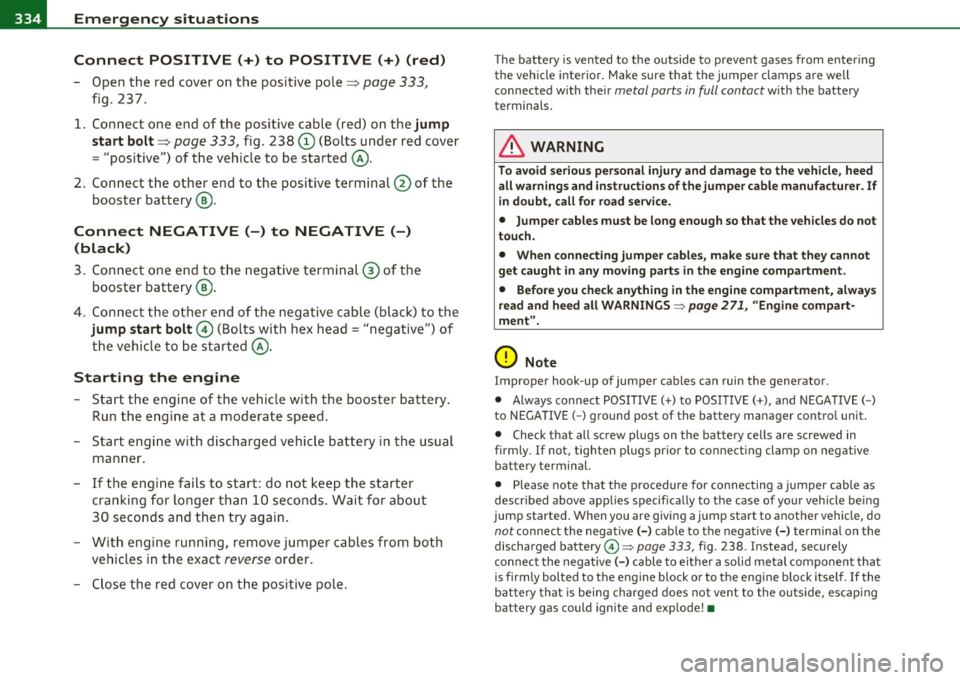
1. Connect one end of t he positive cable (red) on the
jump
start bolt=>
page 333, fig. 238 (D (B olts under red cove r
= "positive") of t he vehicle to be star ted @.
2. Con nect t he ot her end to t he positive terminal @ of t he
booster battery @.
Connect NEGATIVE(-) to NEGATIVE(-)
(black)
3 . Co nnect one end to th e n egative t ermin al@ of t he
b oost er batter y@ .
4. Con nect the o ther e nd of th e nega tiv e cabl e (b la ck) to the
jump start bolt© (Bolts wi th hex hea d= "n ega tiv e") of
the v ehic le t o b e sta rted
@ .
Starting the engine
- S ta rt the e ngi ne of t he ve hic le with the booster battery.
R un the e ngi ne at a moderate speed.
- Star t engi ne wi th discha rged vehi cle battery in the usual
ma nner.
- If the engine fails to start: do not keep t he star ter
c ran kin g f or l onge r tha n 1 0 seco nds . W ait f or a bo ut
3 0 seco nds an d the n try aga in .
- Wi th eng ine ru nn ing , rem ove jum per cables from bot h
v ehic les i n the exact
re ve rs e orde r.
- C lose the red cover on the posi tive po le.
The battery is vented to the outside to prevent gases from enter ing
th e ve hicl e int erior. Ma ke sure th at th e jum per cl amp s are well
connected w ith t he ir
metal parts in full contact w ith the batte ry
terminals .
& WARNING
To avoid serious personal injury and damage to the vehicle, heed
all warnings and instructions of the jumper cable manufacturer. If
in doubt, call for road service.
• Jumper cables must be long enough so that the vehicles do not
touch.
• When connecting jumper cables , make sure that they cannot
get caught in any moving parts in the engine compartment .
• Before you check anything in the engine compartment, always
read and heed all WARNINGS~
page 271, "Engine compart
ment ".
0 Note
Improper hook-up of jumpe r cables can ruin the generator.
• Always connect POSI TIVE(+) to POSI TIV E(+ ), and NEGA TIVE( -)
to NEGATIVE( -) ground post of the batte ry manage r contro l unit.
• Check t hat all sc rew p lugs on the battery cells are screwed in
firmly . If not, tighten plugs prior to co nnecting clam p on negative
battery terminal.
• P lease note th at the p roce dure for connec ting a jumper cab le as
described
a bove ap pli es specifically to the case o f yo ur vehicle be ing
jump starte d. When you are giving a j ump sta rt to anot her vehicle, do
not con nect the negative (-) cab le to t he negat ive (-) termina l on the
discharged battery ©~
page 333, fig. 238. Instea d, secure ly
c o nnec t the neg ative (- ) cable to ei ther a soli d met al c o m ponen t that
is firm ly bolted to the eng ine b lock or to the eng ine b lock itself .
If the
b att ery th at is being ch arged does not
ven t to th e ou tside, es caping
battery gas could ignite and exp lode! •