ECU AUDI A6 2011 User Guide
[x] Cancel search | Manufacturer: AUDI, Model Year: 2011, Model line: A6, Model: AUDI A6 2011Pages: 370, PDF Size: 87.15 MB
Page 91 of 370

The maxim um permiss ible roof we ight is 220 lb (100 kg). T he roof
we ight is mad e up of the wei ght of th e ro of ra ck sy stem and the
we ight of the ob ject b eing trans ported .
Wh en usin g a roof rack system whic h has a lower load carry ing
capac it y, you mus t not use up the t otal ma ximum permi ssible load
carrying ca pac ity spe cified above. Instead, you s hould lo ad t he roof
r ack s yst em o nly to t he ma ximum c apacity speci fied by the man ufa c
turer of the roof rack system.
& WARNING
Weak, damaged or improper straps used to secure items to the
roof rack can fail during hard braking or in a collision and cause
serious personal injury.
• Make
sure the roof rack is installed exactly as specified above
=> page 88.
• Always use suitable mounting straps for securing items to the
roof rack to help prevent items from shifting or flying forward.
• Items on the roof rack must always be securely mounted.
• The use of a roof rack can negatively affect the way a vehicle
handles . Cargo that is large, heavy, bulky , long or flat will have a
greater negative influence on the vehicle's aerodynamics , center
of gravity and overall handling. Always drive slowly, avoid sudden
braking and maneuvers when transporting cargo on the roof of
your vehicle.
• Never exceed the maximum permissible load carrying capacity
of the roof of your vehicle, the permissible axle weights and the
permissible total weight of your vehicle=>
page 341, "Weights ".
• Always drive slowly, avoid sudden braking and maneuvers
when transporting cargo on the roof of your vehicle.
'£> For the sake of the environment
Some times i t may be eas ie r t o le ave a roof ra ck in sta lled even though
you a re not using i t. Due to th e increased air resistanc e your veh icle
Con trol s and equ ip
m ent Vehicle
OP-eration
Seats and storage
will unnecessa rily use more f ue l. Remove t he roo f rack if you a re not
g oing to use it. •
Cupholder
Cupholder in center console
The c up hold er is located un der a co ve r.
.. .. . .
' .
' '
' .
. . . . ' '
'
' . '
'
'
' . ' '
' '
.. . ' . ' ' . ..
'• N ' • Lil : : ~ : : tL : : ~ ' • a,
.. . .
' . "' '. 0 : : ~ : : tL '' ... : : G:l
' ' . '
'
. . ' ..
Fig. 82 Center
co nso le: (upholder
Fig . 83 Cente r
c on sole: Adap ter for
c upholder
- To open the c upholde r, p re ss the fo rward e dge of th e
cove r.
- Ins ert or re mov e the ada pter in to th e cu phold er, a s ne ces-
s ar y. .,
Vehicle care Do-it-yourselt service iTechnical data
Page 92 of 370
Seats and storage
You can use the c upholder ada pter to s ecur ely ho ld narrow dr ink
contain ers.
& WARNING
Spilled hot liquid can cause an accident and personal injury.
• Never carry any beverage containers with hot liquids, such as
hot coffee or hot tea, in the vehicle while it is moving. In case of
an accident, sudden braking or other vehicle movement, hot liquid
could spill, causing scalding burns . Spilled hot liquid can also
cause an accident and personal injury.
• Use only soft cups in the cupholder . Hard cups and glasses can
cause injury in an accident.
• Never use the cupholder or adapter as an ashtray -risk of fire .
0 Note
Only drink conta in ers wi th lids should be c arrie d in t he cup hold er.
L iq uid could spill out and damage your vehicle 's e lectro nic equipme nt
o r st ain t he up holstery, e tc. •
Cupholder in the rear center armrest
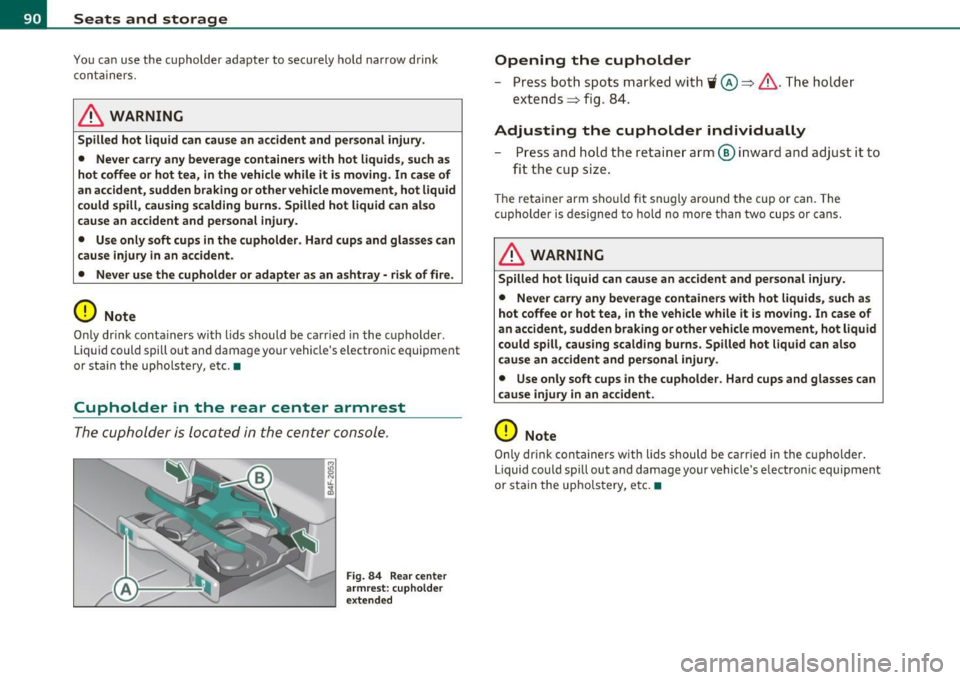
The c uphold er is located in the cente r console .
Fig. 84 Rear cente r
armrest : cupholder
exten ded
Opening the cupholder
- Press both spo ts mark ed w ith ii @ ~& . Th e hol der
ext end s ~ fig . 84 .
Adjusting the cupholder individually
Press and hol d th e reta in er arm ® inw ard and adjust it to
fit t he cup s ize .
Th e retainer arm s ho uld fit snugly a ro und t he cup or can . The
cupholder is des igned to hold no mo re than two cups o r cans.
& WARNING
Spilled hot liquid can cause an accident and personal injury.
• Never carry any beverage containers with hot liquids , such as
hot coffee or hot tea,
i n the vehicle while it is moving. In case of
an accident, sudden braking or other vehicle movement, hot liquid could spill, causing scalding burns. Spilled hot liquid can also
cause an accident and personal injury .
• Use only soft cups in the cupholder . Hard cups and glasses can
c ause injury in an accident.
0 Note
O nly dr ink cont ainers w ith lids should be car rie d in t he cup holder.
Liquid c ould sp ill out and damage y our vehicle's e lectro nic equipment
or stain the up ho ls tery, e tc.•
Page 96 of 370
Seats and storage
& WARNING (continued )
braking or in an accident· especially if the airbag is deployed -
the se object s could injure any passengers inside the vehicle. •
Glove compartment
The media p layer is in the glove compartment.
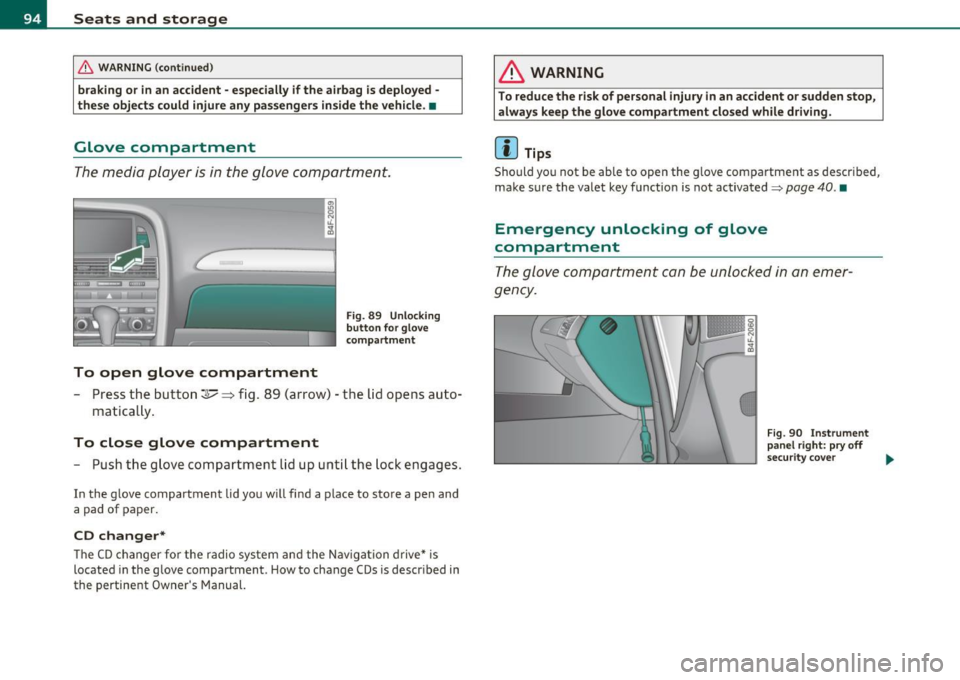
To open glove compartment
Fig. 89 Un lo cking
button fo r g love
c om partm ent
- Press the button~~ fig. 89 ( arrow) - the lid opens auto-
matica lly .
To close glove compartment
- Push the glove comp art ment lid up unt il th e lo ck en gag es.
In the g love compartment lid yo u w ill find a plac e to sto re a pen and
a pad of paper.
CD changer*
Th e C D ch an ger f or the radio sy stem and t he Nav igation drive* is
located in the g love compartment . How to change CDs is descr ibed in
the pertinent Owner's Manual.
& WARNING
To reduce the risk of personal injury in an accident or sudden stop,
always keep the glove compartment clo sed while driving.
[I) Tips
Sho uld you not be ab le to open the g love compa rtme nt as descr ibed,
make s ure the valet key f unction is not activated~
page 40. •
Emergency unlocking of glove
compartment
T h e glov e co mp artm ent can be unl ocke d in a n em er
g ency.
Fig . 90 In strument
panel right: pry off
s ecu rit y cove r
~
Page 114 of 370
-On the road .,,, ___________________ _
in. WARNING
• Never turn off th e engine until the vehicle has come to a
c omplete stop .
• The b rake booste r and servotronic only work when the eng ine
is running . With the ignition turned off, you have to apply more
force when stee ring or braking . Since you cannot steer and stop
normally , thi s can lead to accident s and serious in juries.
• For s afety reasons , you should always park your vehicle with
the selector lever in P. Otherwi se, the vehicle could inadvertently
roll away.
• After the engine has been switched off , the radiator fan can
continue to run for up to 10 minutes - even with the ignition
s witched off. It can also switch on again after some time if the
c oolant temper ature rises as the r esult of a heat buildup or if the
engine is hot and the engine compartment is additionally heated
by the sun's rays .
0 Note
If the eng ine has been under heavy load for a n extended per iod, heat
builds up in the engine compartment after the engine is switched
off
- there is a r is k of damaging t he eng ine. Allow the e ngine to run at id le
for about 2 min utes before switc hing it
off. •
Appli es to ve hicles : w it h Conve nience key
Driver messages in the instrument cluster
display
If a function is not present, a driver mess age appea rs .
No key identified
Th is message appears when the ! START ] button is p ressed if there is
no mast er key ins ide the veh icle o r if t he sys tem does not recogn ize
it. For examp le, the master key cannot be recognized if it is covered
by an o bject (e.g . al uminum br ie f c ase) w hich
screens the r adio signal. .Electronic dev
ices such as cell phones can also interfere with
t he radio signal.
Press brake pedal to start engine
Thi s message appea rs if yo u press the !STAR T] butto n to start the
eng ine and do not depress the brake pedal. The engine can on ly be
s t ar ted i f the brake ped al is dep ressed .
Engage N or P to start engine
This message appea rs w he n th e engi ne is started if the sele cto r lever
for the automa tic transmission is not in the P o r N position. The
eng ine can only be s tarted w ith the se lec tor in these pos itions.
? Key not in vehicle
Thi s message appea rs alo ng with the symbol if the master key is
removed from the vehicle with t he engine runn ing. It is intended to
remind you (e.g. w hen c hanging dr ive rs) not to con tinue t he journey
w ithout the master key.
If t he master key is no longe r in the ve hicle, yo u cannot switch of f the
ig nitio n after stopping the engine and you a lso cannot start the
engine again. Moreover, you cannot lock the vehicle from the outside
w ith the key.
Shift to P otherwise vehicle can roll away. Doors do not lock if you
are not in P .
This message appea rs for safety reasons along with a warning buzzer
if the se lector lever for the automatic transmission is not in the P
position when t he ig nition is sw itched
off with t he !STOP] button and
t he d river's door is opened. Move t he selector lever to the P posit io n ,
otherwise the vehicle is not secured against rolling away. You also
c anno t lock the vehicle usi ng the lo cking but ton o n the door hand le
or using the remote key.
To engage steer ing lock, press and hold STOP button
Thi s message appears for safety reasons if the engine and the ignit ion
h ave bee n sw itche d off by p ress ing the
!S T O P) bu tton once, and t hen .,,_
Page 149 of 370

______________________________________________ A_ u_ t_ o _ m_ a_ t_ ic_ t_r_a _ n_ s_m_ i_ s _s_ i_ o _ n __ l!'II
The selector lever must be in Nor P. If one of the dr iv ing positions is
eng aged a safety swi tch will p reven t th e e ng ine from be ing s tarte d.
See also=>
page 109.
Before you move t he se lector lever from t he P position, yo u must
always ap ply the b rake peda l befo re and while de press ing the bu tton
in the handle of the selector lever.
_& WARNING
• Unintended vehicle movement can cau se serious injury.
- When the selector lever is in a driving position, the vehicle may creep, even at idle speed. Therefore do not release the
parking brake or foot brake until you are ready to move,
because power is transm itted to the wheels as soon as a driv ing
po sition i s engaged.
- Do not accelerate while selecting a driv ing position . At this
time the engine must be at idle speed so that undue stress i s
not placed on the clutches in the transm iss ion.
- Remember : • even when stopped briefly with the automatic
transmission in "D", "S" or "R" , engine power is being trans
mitted to the wheels . Your vehicle could "creep " forward or
backward. When stopped, keep the brake pedal fully
depre ssed and use the parking brake if neces sary to keep the
vehicle from rolling .
• If the selector lever is unintentionally moved into N while you
are driving, take your foot off the accelerator pedal and wait for
the engine to return to idle speed before selecting a driving posi
tion.
• Never shift into "R " or "P " when the vehicle is in motion .
• Never get out of the d river's seat when the engine is running.
• If you must get out of the vehicle , move the selector lever
securely into the P position and apply the parking brake firmly .
• If the engine must remain running, never have any driving
position engaged when checking under the hood.
Make sure the
selector lever has securely engaged and is locked in "P " with the
Controls and equip
ment Safety first
& WARNING (
co ntinued )
parking brake firmly set=> page 271, "Engine compartment ".
Otherwi se, any increase in engine speed may set the v ehicle in
motion , even with the par king brake applied. •
Applies to vehicles : w ith 6-s peed automatic tran smission
Selector lever positions
T his s ection describ es the selector lever positions and
driving ranges.
Fig . 139 Di splay in
the in strum ent cluster :
se lector le ver In po si
tio n P
Th e selector lever posi tion engaged appe ars next to the se lec tor lever
as well as in the instrument cluster display .
P -Park
In this selector lever position the transmission is mechan ica lly
lo cked. Engage P only when the vehi cle is
comple tely stop ped=> &
in "Driving the automatic transmissio n" on page 146.
T o sh ift in or o ut of position P, yo u must first press an d hold the brake
peda l
and then press t he release button in the se lecto r lever hand le
wh ile moving the selector lever to or from P. Yo u can s hift out of this
posit ion on ly with the ignit ion on . .,,
Vehicle care Technical data
Page 156 of 370
IIJIL___!A~u~t~o~m~a~t~i~c ~t~ra~n~s~m~i~s~s~i~o~n~ -------------------------------------------
& WARNING (conti nu ed )
-When the selector le ver is in a driving position, the vehicle
may creep, even at idle speed. Therefore do not relea se the
parking brake or foot brake until you are ready to mov e,
becau se power is transmitted to the wheel s as soon a s a driving
po sition i s engaged .
- Do not a ccelerate while selecting a driving position . At this
time th e engine must be at idle sp eed so that undue stres s is
not placed on the clutche s in the tran smis sion .
- Remember: -even when stopped b riefly with the automatic
tran smi ssion in "D ", "S " or "R ", engine power is being tran s
mitted to the wheels . Your vehicle could "creep " forward or
ba ckward. When stopped , keep the brake pedal fully
depre ssed and use the parking brake if necessary to keep the
vehicle from roll ing.
- If the selector lever is unintentionally moved into N while
you are driving, take your foot off the accelerator pedal and
wait for the engine to return to idle speed before s electing a
driving pos ition .
- Never shift into "R " or "P " when the vehicle i s in motion .
- Never get out of the driver 's seat when the engine i s running.
- If you must get out of the vehicle , move the selector leve r
s ecurely into the P position and apply the parking brake firmly .
-If the engine must remain running , never have any driving
po sition engaged when checking und er the hood . Make sure
the selector leve r has securely engaged and is locked in "P"
with the parking brake firmly set=>
page 271, "Engine
compartment ". Otherwise , any increase in engine speed may
set the vehicle in motion, even with the parking brake
applied. a
Applies to vehicles: with mu lt itron ic® Continu ous ly Vari able Transmission (CVT)
Selector Lever positions
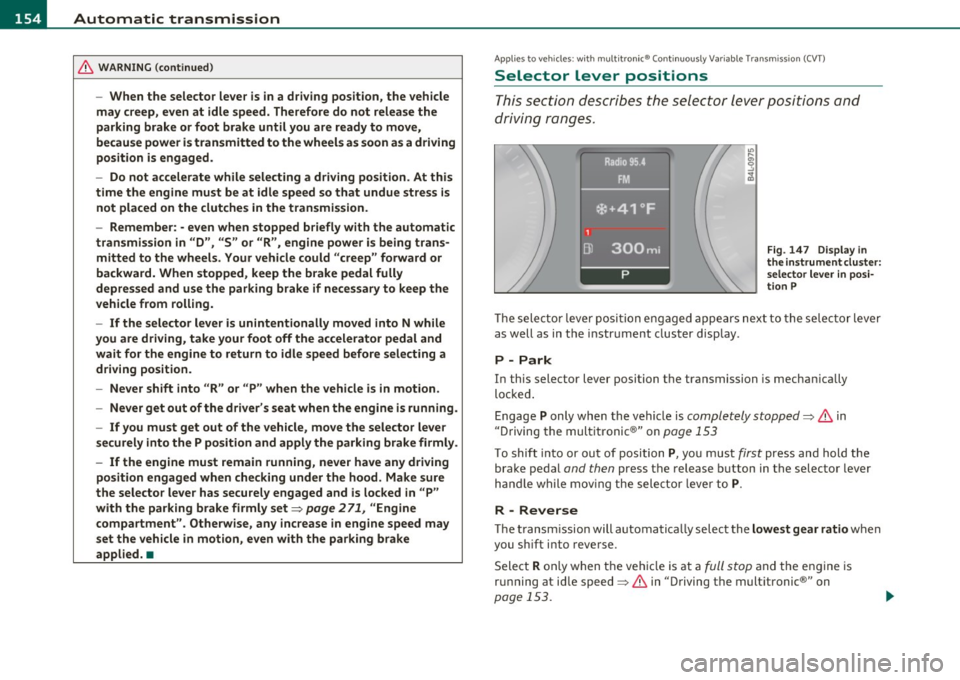
This section descri bes the selector lever positions and
driving r ang es .
Fig . 14 7 Displ ay in
the in strume nt clu ster :
selecto r leve r in posi
ti on P
Th e sele cto r lever posi tio n engaged appears nex t to the se lec tor lever
as well as in the i nstr ument clus ter disp lay .
P - Park
In this selector lever position t he transmission is mechan ically
lo ck ed.
Engage P only wh en the vehicle is completely stopped=>
& in
" Dr iving the mult itronic ®" on page 153
T o shift into or out of position P, yo u mus t first press an d hold the
brake pedal and then press the release b utton in the selector lever
h andl e wh ile mov ing the sele cto r leve r to P.
R - Reverse
Th e tran smi ssion will a utoma tica lly selec t the lowest gear ratio when
you sh ift into reve rse.
Select R only when t he veh icle is at a full stop and the eng ine is
running at idle speed=>
& in "Driving the multitronic®" on
page 153.
~
Page 170 of 370

lffll.___A_ d_ a_,_ p_t _i_ v _e _ A_i_ r_ S_ u_ s ... p,_ e_n_ s_ io_ n __________________________________________ _
Adaptive Air Suspension
Adaptive Air Suspension and
Damping
Ap plies to veh icles: w ith Ad aptive Ai r Suspens ion
Description
Adaptive Air Suspension and damping can be regula ted
and they adapt automatically to a request from the
driver and the driving situation at the time .
Adaptive Air Suspension is an e lectron ically controlled springing and
damping system . This chass is system makes it eas ie r on the driver by
adapting to the particular situation th rough impe rceptible contro l
processes .
The
Adaptive Air Suspension component regu lates ground clearance
depending on ve hicl e speed, load cond ition and driver input.
W hen the system is in a utomatic mode, accelerat ing to a speed above
a predete rm ined limit will make the vehicle lower itsel f. On t he othe r
hand, driv ing more slowly res ults in the vehicle ra is ing again at
specific speeds.
Th e
damping component provides individua l control of the damping
forces. For example, with damp ing characterist ics set to provide
greater com fort, damp ing is se t somewhat harder for a br ief period
only as required, for example, whe n going around a curve or over
rough road sur faces as we ll as when braking .
Settings
Adaptive Air Suspension prov ides the drive r wi th t he opportu nity to
set the chass is characterist ics also to their individual preference.
W ith the driving modes
Comfort, Automatic an d Dynamic the dr ive r
has three chassis sett ings available, ranging from comfort to sporty.
In addit ion,
Lift p rovides a fourth mode which can be selecting fo r
dr iving over poor stretches of road =>
page 169, "Chass is controls" . The modes are set
in MM I =>
page 169.
& WARNING
The height of the parked vehicle can change due to temperature
fluctuation s or changes in load .
0 Note
• Whenever you park yo ur vehicle, always make sure there is
adeq uate clearance above and below the ve hicle . T he heig ht of the
parked vehicle can change as the res ult of temperature fluctuations,
chang es in load condition and changes in the dr iv ing mode (ground
clearance).
• If the veh icle is be ing transported (e .g. by tow truck, train, ship,
etc.) , mount the tie-down cha ins/cables over the r unning s urface
(c ircumfere nce) of the tir es. Never sec ure the ve hicle by the ax le, the
suspension struts or the front or rea r tow line eye. For technical
reaso ns, the p ressure in t he suspension st ru ts m ay change dur ing the
transport, w hic h could result in the vehicle no longer being secured
pro perly.
• To prevent damage to the vehicle underbody, remember that your
veh icle is no t an off-roa d veh icle, even in the "lift" mo de. Th e ground
clearance is insufficient for this type of operation.
• If you are go ing to tow a trai ler, you mus t activate the trai ler ope r
ation mode =>
page 170.
[ i ] Tips
Before you raising your vehicle us ing the veh icle jack (for example,
w hen c hanging a flat tire) you must acti va te the j ack ing mode
::::>page170 .•
Page 176 of 370

1111....__H_ o_ m __ e_L_ i_n _k_ ®_ • _________________________________________________ _
-Press th e ap pro priate programmed button G) , @ or@
to activate the desired remote control function ::::>
& in
"Genera l informat io n" on
page 171. •
Applies to ve hicles : w ith Hom eli nk® univer sa l rem ote c ont rol
Reprogramming a single button
A Homelink ® button can be reprogrammed individually
without affecting the other button allocations.
Programming the ov erh ead keypad
- Press the appropriate Homelink ® button until the indi-
cator light begins flashing slowly .
Programming the bumper mounted transmit
ter
1. Hold the original remote control at a distance between 0 -
5 in . (0-13 cm) from the bumper below the appropriate
headlight for your vehicle (use the shortest distance
possible).
2. Aim the remote control just below the
pas senger side
headlight .
3 . Press and hold the ac tivation button on the remote
control.
4 . The emergency flashers will flash
three times (after about
15 -60 seconds) when the programm ing is successful.
N ow release the b utton on the remote control.
- If the device utilizes a rolling code , please follow phase 3
of =>
page 172 , "Programming the Homelink ® trans
mitter" for rolling code programming.
This pr ocedur e will caus e th e ex is ting pr ogramming on th e
Homelink ® button to be era sed !•
Ap plies to veh icles: w ith Ho meli nk® un ive rsa l rem ote c ont rol
Erasing the programming of the
Homelink ® tr ansmitter
When you erase the programming, the programming on
all three of the transmitter channels with be lost!
- Perform steps 1 to 4 as described on::::> page 172, "Phase
1 : programming the overhead keypad".
When completed , the Homel ink ® system will be in the programm ing
mode and is then ready to learn the codes for remote controlled
devices .
[I) Tips
• Programmed buttons cannot be erased individually.
• For security reasons you are advised to erase the programming of
the Homelink ® system before you sell your veh icle .•
Page 179 of 370

Driving Safely ---------------------"~'----
Important things to do before driving
Safety is everybody's job! Vehicle and occupant safety
always depends on the informed and careful driver.
For your safety and the safety of your passengers, before
driving always:
- Make sure that all lights and signals are operating
correctly.
- Make sure that the tire pressure is correct.
- Make sure that all windows are clean and afford good visi-
bility to the outside.
- Secure all luggage and other items carefully::::>
page 93.
-Make sure that nothing can interfere with the pedals.
- Adjust front seat, head restraint and mirrors correctly for your height .
- Instruct passengers to adjust the head restraints according to their height.
- Make sure to use the right child restraint correctly to
protect children ::::,
page 219, "Child Safety".
- Sit properly in your seat and make sure that your passen gers do the same::::,
page 75, "General recommenda
tions".
- Fasten your safety belt and wear it properly. Also instruct
your passengers to fasten their safety belts properly
=:> page 187. •
Controls and equip
ment Safety first Vehicle operation
What impairs driving safety?
Safe driving is directly related to the condition of the
vehicle, the driver as well as the driver's ability to concen
trate on the road without being distracted .
The driver is responsible for the safety of the vehicle and all
of its occupants. If your ability to drive is impaired, safety
risks for everybody in the vehicle increase and you also
become a hazard to everyone else on the road::::,,& . There
fore:
Do not let yourself be distracted by passengers or by using
a cellular telephone.
NEVER drive when your driving ability is impaired (by
medications, alcohol, drugs, etc.).
- Observe all traffic laws, rules of the road and speed limits
and plain common sense .
- ALWAYS adjust your speed to road, traffic and weather
conditions.
- Take frequent breaks on long trips. Do not drive for more than two hours at a stretch.
- Do NOT drive when you are tired, under pressure or when
you are stressed .
& WARNING
Impaired driving safety increases the risk of serious personal
injury and death whenever a vehicle is being used.•
Vehicle care Do-it-yourself service Technical data
Page 182 of 370
-Driving Safely 1---- ---:!....::..-=....:...'=.::,!.._ _______________________ _
& WARNING (continued)
• Always make sure that there are at least 10 inches (25 cm)
between the front passenger's breastbone and the instrument
panel.
• Each passenger must always sit on a seat of their own and
properly fasten and wear the safety belt belonging to that seat.
• Before driving, always adjust the front passenger seat and
head restraint properly.
• Always keep your feet on the floor
in front of the seat. Never
rest them on the seat, instrument panel, out of the window, etc.
The airbag system and safety belt will not be able to protect you properly and can even increase the risk of injury in a crash.
• Never drive with the backrest reclined or tilted far back! The
farther the backrests are tilted back, the greater the risk of injury
due to incorrect positioning of the safety belt and improper
seating position.
• Children must always ride in child safety seats=>
page 219.
Special precautions apply when installing a child safety seat on
the front passenger seat=>
page 197. •
Proper seating positions for passengers in
rear seats
Rear seat passengers must sit upright with both feet on
the floor consistent with their physical size and be prop
erly restrained whenever the vehicle is in use.
To reduce the risk of injury caused by an incorrect seating
position in the event of a sudden braking maneuver or an
accident , your passengers on the rear bench seat must
always observe the following :
- Make sure that the seatback is securely latched in the
upright position ~
page 83.
-The rear head restraints must be raised fully upward when
passengers ride in the rear seats~
page 181.
- Keep both feet flat in the footwell in front of the rear seat.
- Fasten and wear safety belts properly~
page 191.
-Make sure that children are always properly restrained in a
child restraint that is appropriate for their size and age
~ page 219.
& WARNING
Passengers who are improperly seated on the rear seat can be seri
ously injured in a crash.
• Each passenger must always sit on a seat of their own and
properly fasten and wear the safety belt belonging to that seat.
• Safety belts only offer maximum protection when the seatback
is securely latched in the upright position and the safety belts are
properly positioned on the body. By not sitting upright, a rear seat
passenger increases the risk of personal injury from improperly
positioned safety belts!
• Always adjust the head restraint properly so that it can give
maximum protection. •