ECU AUDI A6 2011 Owner's Guide
[x] Cancel search | Manufacturer: AUDI, Model Year: 2011, Model line: A6, Model: AUDI A6 2011Pages: 370, PDF Size: 87.15 MB
Page 234 of 370
-Child Safety P:fM..,____ ______________ _
& WARNING (conti nued)
• Always bu ckle the child safety seat firmly in place even if a
child i s not sitting in it . A loo se child safety seat can fly around
during a sudden stop or in a crash.
• Always make sure the seat backre st to which the child restraint
is installed is in an up right position and securely latched into place
and cannot fold forward . Otherwise, the seat back with the child
safety seat attached to it could fly forward in the event of an acci
dent or other emergency situation.
• Alway s read and heed all WARNINGS wheneve r using a child
restrained in a vehicle is being used=>
page 219. Special precau
tions apply when installing a ch ild safety seat on the front
passenger seat =>
page 199, "Child restraints on the front seat -
some important things to know ".•
Deactivating the convertible Locking
retractor
The convertible l ocking retrac tor for child restraints will
be d eactivated automatically when the belt is wound all
the way back into the retractor.
- P ress the red butto n on t he safety be lt buckle . T he belt
to ngue will pop out o f the buckle.
- G uid e the s afety belt all the way back in to its stowed posi-
t ion .
Always le t the safety be lt retract comple tely i nto i ts s towed position.
T he safety bel t can now be used as an ord inary safety belt without the
convertib le locking ret ractor for ch ild rest raints.
If th e convertible locking r etractor should be activated inadve rtently,
the safety be lt must be unfastened and guided comp letely back into
i t s s towe d position to de activa te th is fe ature. If th e convert ible locking retractor is
not deact ivated, the safety belt w ill gradua lly
become tigh ter and uncomfo rtable to we ar.
& WARNING
Improperly in stalled child safety seats increase the risk of serious
personal injury and death in a collision.
• Never unfasten the safety belt to deactivate the convertible
lo cking retractor for child restraints while the vehicle is moving.
You would not be restrained and could be seriou sly injured in an
a ccident .
• Always read and heed all WARNINGS whenever u sing a child
restrained in a vehicle is being used
=> page 219. Special precau
tions apply when in stalling a child safety seat on the front
passenger seat =>
page 199, "Child restraints on the front seat -
s ome important things to know ".•
LATCH Lower anchorages and
tethers for children
Child Restraint System anchors and how
are they related to child safety
T o prov ide a simp le r a nd more practic able way to a ttach the child
restraint on the vehicle seat, Federal regulat ions require special
lowe r anch orages in ve hicl es and devi ces on new ch ild re st rain ts to
attac h to the veh icle anchorages.
Th e combination of the tether anchorages and the lower anchorages
is now gene rally called the
LATCH sys tem fo r "Lowe r Anch orages and
T ethers for Children ."
Forw ard -fa cing child res train ts manuf actured aft e r September 1,
1999, are required by U.S. federa l regu lat ions to comp ly with new
c hild head moveme nt performan ce requirements. These new per for -
~
Page 235 of 370

mance requirements make a tether necessary on most new ch ild
seats.
Installing a child restra int that requires a top tether w ithout one can
seriously impair the performance of the chi ld restrai nt and its ability
to prote ct the child in a collision. Insta lling a child restraint tha t
requires a top tether without the top tether may be a violation of
state law.
Child restraint manufacturers offer LATCH lower anchorages on the ir
child seats with hook -on or push-on connectors attached to adjust
able straps .
In addition to the LATCH lower anchorages, these child restraint
systems usually require the use of tet he r straps to he lp keep the child
restra int firm ly in place.
& WARNING
Improper installation of child restraints will increase the risk of
injury and death in a crash.
• Always follow the instructions provided by the manufacturer
of the child restraint you intend to install in your vehicle.
• Never install a child restraint without a properly attached top
tether strap if the child restraint manufacturer 's instructions
require the top tether strap to be used.
• Improper use of child restraint LATCH lower anchorage points
can lead to injury in a collision . The LATCH lower anchorage points
are designed to withstand only those loads imposed by correctly
fitted child restraints .
• Never mount two child restraint systems on one LATCH lower
anchorage point .
• Never secure or attach any luggage or other item to the LATCH
lower anchorages .
Safety first Vehicle OP-eration
Child Safety
(I) Tips
• In Canada, the terms "top tether" with "lower universal anchor
ages" (or " lower universal anchorage bars") are used to describe the
system.
• In other countries the term "ISOFIX" is used to describe the lower
anchorages. •
Location
Fig. 193 Schematic
overview: LATCH
a nchorage point loca-
tions
Th e illustrat io n shows the seat ing locat ions in your vehicle whic h are
equipped with the lower anchorages system. •
Vehicle care Do-it-yourselt service iTechnical data
Page 236 of 370
Ill Child Safety __ .,.___ ____________ _
Description
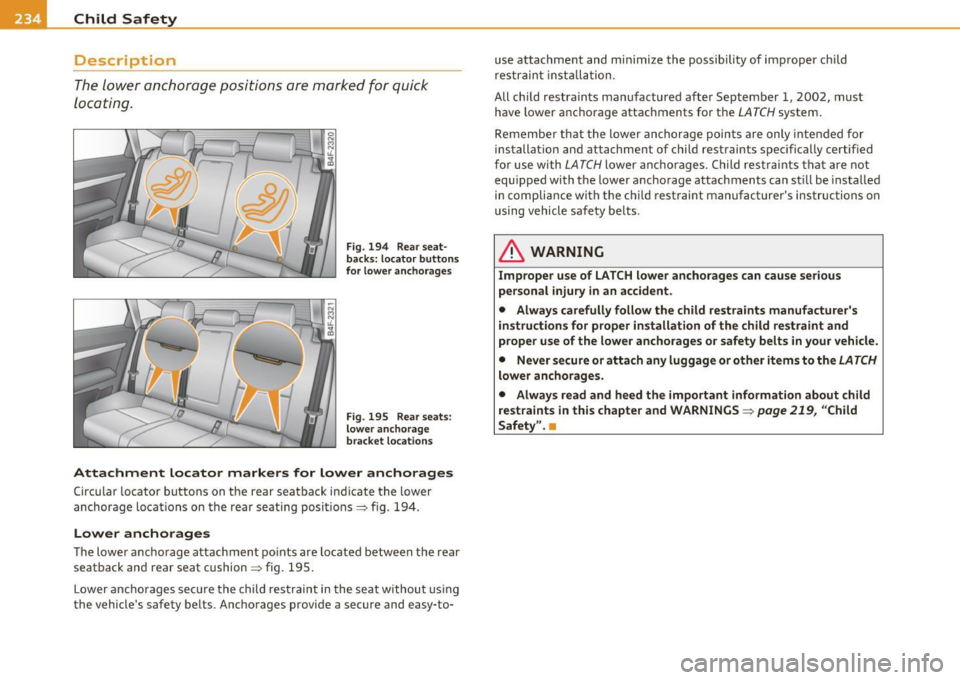
The lower anchorage positions are marked for quick
locating.
Fig. 194 Rear seat
backs: locator buttons
fo r lower anchorages
Fig . 195 Rear seats:
lower anchorage
bracket locations
Attachment locator markers for lower anchorages
Circu lar locator buttons on the rear seatback indicate the lower
anchorage locations on the rear seating positions:::;, fig. 194 .
Lower anchorages
The lower anchorage attachment points are located between the rear
seatback and rear seat cushion:::;, fig . 195.
Lower anchorages secure the child restraint in the seat without using
the vehicle's safety belts. Anchorages prov ide a secure and easy-to- use attachme
nt and minimize the possibility of improper child
restrain t installat ion.
All ch ild restraints manufactured after September 1, 2002, must
have lower anchorage attachments for the
LATCH system.
Remember that the lower anchorage points are only intended for
installat ion and attachment of ch ild restraints specifically certif ied
for use with
LATCH lower anchorages . Child restraints that are not
equ ipped with the lower anchorage attachments can st ill be installed
in compliance with the ch ild restraint manufact urer's instructions on
using vehicle safety belts .
& WARNING
Improper use of LATCH lower anchorages can cause serious
per sonal injury in an accident.
• Always carefully follow the child restraints manufacturer 's
instructions for proper installation of the child restraint and
proper use of the lower anchorages or safety belts in your vehicle.
• Never secure or attach any luggage or other items to the
LATCH
lower anchorages.
• Always read and heed the important information about child
restraints in this chapter and WARNINGS :::;,
page 219, "Child
Safety". •
Page 238 of 370
lffll.___C_ h_ il_d _ S_a _ f_ e _ t--= y '------------------------------------------------
& WA RNING (conti nued)
• Never u se the LATCH or tether anchorages to attach safety
belt s or other kinds of occupant re straints .
• Child restraint tether attachments and lower attachment s are
only designed to se cure a child restraint that has been equipped to
u se the se anchorages.
• Tether anchorages and lower anchorages are designed to with ·
stand only tho se loads imposed by correctly fitted child re straints.
Under no circumstances can they be used safely for adult or child
s afety belts or harnesses .
• Never mount more than one child restraint to a s ingle tether or
to a lower anchorage point. Attaching two child restraint s to a
single anchorage point can cause the anchorage to fail and cause
seriou s personal injury in a crash.
0 Note
• Remove the g uidance fixtures before folding the rear seatback to
preven t damaging the seat cushion .
• If you leave t he gui dance fix tures ins talled for severa l days, they
co uld leave a mark o n th e upholste ry on t he seat c ushi on and bac krest
in th e area t hat the guidance fixt ures w ere install ed. The upholstery
wou ld also be permane ntly stretc hed a round the gu idance fixtures .
Th is applies especially to leathe r seats. •
Installing a child restraint with LATCH
lower anchorages
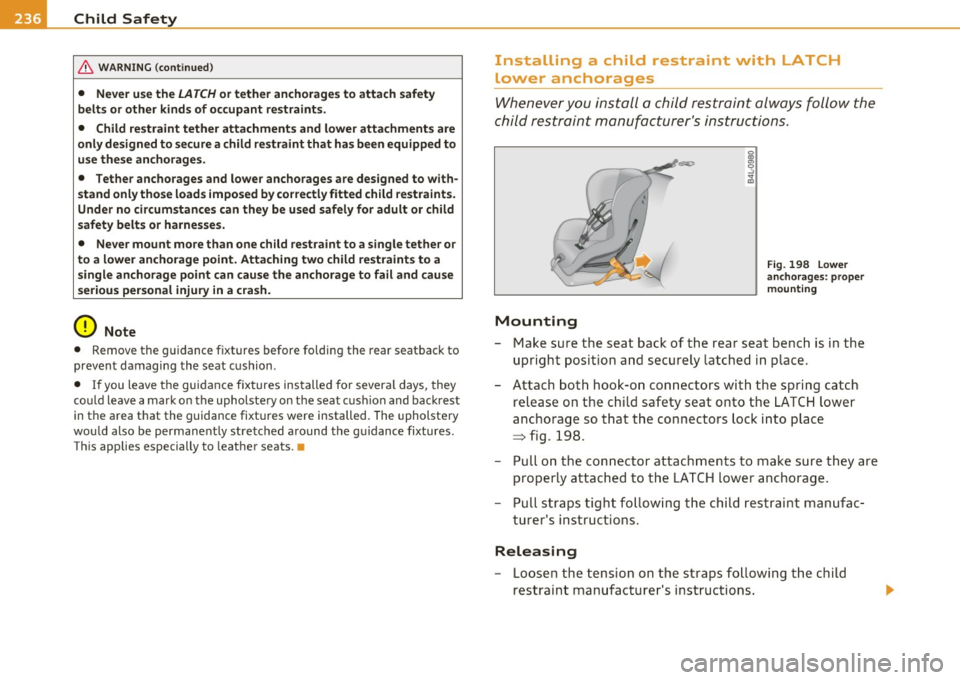
Whenev er you install a child restraint always f ollo w the
child restraint manufacturer's instructions.
Mounting
Fig. 19 8 Lower
anch ora ges : pr op er
mounting
- M ake sure the seat back of the re ar seat bench is in the
u prigh t position a nd securely latche d in p lace .
- Att ach both hook-o n con nectors wi th th e spring catc h
release on t he ch ild sa fety se at o nto the LATC H lower
anchorage so t hat th e connectors lock i nto place
~ fi g. 198 .
-Pull o n the con nec tor attac hmen ts to ma ke s ure they are
properly attac hed to t he LAT CH lower anchorage.
- Pull st ra ps t ig ht fo llow ing t he child r est raint manufa c
t u re r's instr uct io ns.
Releasing
- Loose n the tens ion on t he straps fo llowing t he child
restrain t man ufacture r's i nst ructions.
Page 239 of 370

-Depress the spring catches to release the anchorage hooks
from the lower anchorages.
Remember: Use tether straps to help keep the child restraint firmly
in place.
& WARNING
Improper use of the LATCH system can increase the risk of serious
personal injury and death in an accident.
• These anchors were developed only for child safety seats using
the "LATCH " system.
• Never attach other child safety seats, belts or other objects to
these anchors.
• Always make sure that you hear a click when latching the seat
in place. If you do not hear a click the seat is not secure and could
fly forward and hit the interior of the vehicle, or be ejected from
the vehicle.
& WARNING
Improper installation of child restraints will increase the risk of
injury in an accident.
• Always follow the child restraint system manufacturer's
instructions for proper installation of the child restraint system
and proper use of tether straps as well as the lower anchorages or
safety belts in your vehicle.
• Always read and heed the important information and WARN·
INGS about child safety and the installation of child restraint
systems~ page
219, "Child Safety".•
Safety first Vehicle OP-eration
Child Safety
Tether anchors and tether straps
Fig. 199 Tether
an chors : recess flaps
behind the rear seat·
backs
The tether anchors for the rear seating positions are located in recesses in the rear window shelf~ fig . 199.
A tether is a straight or V-shaped strap that attaches the top part of
a child restraint to special anchorage points in the vehicle.
Th e pu rpose of the tether is to reduce the forward movement of the
child restraint in a crash, in order to help reduce the risk of head injury
that could be caused by striking the veh icle inter ior.
Forward fac ing ch ild restraints manufact ured after September 1,
1999, are required by U.S. federa l regulations to comply with new
child head movement performance requirements. These new perfor·
mance requirements make a tether necessary on most new child
safety seats.
& WARNING
Improper installation of child restraints will increase the risk of
injury and death in a crash.
• Always follow the instructions provided by the manufacturer
of the child restraint you intend to install in your Audi.
• Improper use of child restraint anchors (including tether
anchors) can lead to injury in a collision . The anchors are designed •
Vehicle care Do-it-yourselt service iTechnical data
Page 240 of 370
___ C_h _i_ld _ S_ a_ f_ e_ t_,, y'-----------------------------------------------
& WARNING (cont inued )
to withstand only those loads imposed by correctly fitted child
restraints.
• Never mount two child restraint systems on one LATCH lower
anchor point .
• Never attach two child restraint system s to one tether strap or
tether anchorage.
• Never attach a tether strap to a tie-down hook in the luggage
compartment.
• Never u se child restraint tether anchorages to secure safety
belts or other kinds of occupant restraints .
• Never se cure or attach any luggage or other items to the LATCH
lower anchorages or to the tether anchors.
• If a tether or other strap i s used to attach a child restraint to
the front passenger seat, make sure that it is not so tight, that it
c auses the weight -sensing mat to mea sure more weight than is
actually on the seat .
• The heavier weight regi stered can make the Advan ced Airbag
System work as though an adult were on the seat and deploy the
Advanced Airbag when it must be suppre ssed causing serious or
e ven fatal injury to the child.
• If you must install a rearward facing child safety seat on the
front passenger seat because of e xceptional circumstances and
the PASSENGER AIR BAG OFF light does not come on and stay on,
immediately install the rear-facing child safety seat in a rear
seating position and have the airbag system inspected by your
Audi dealer. •
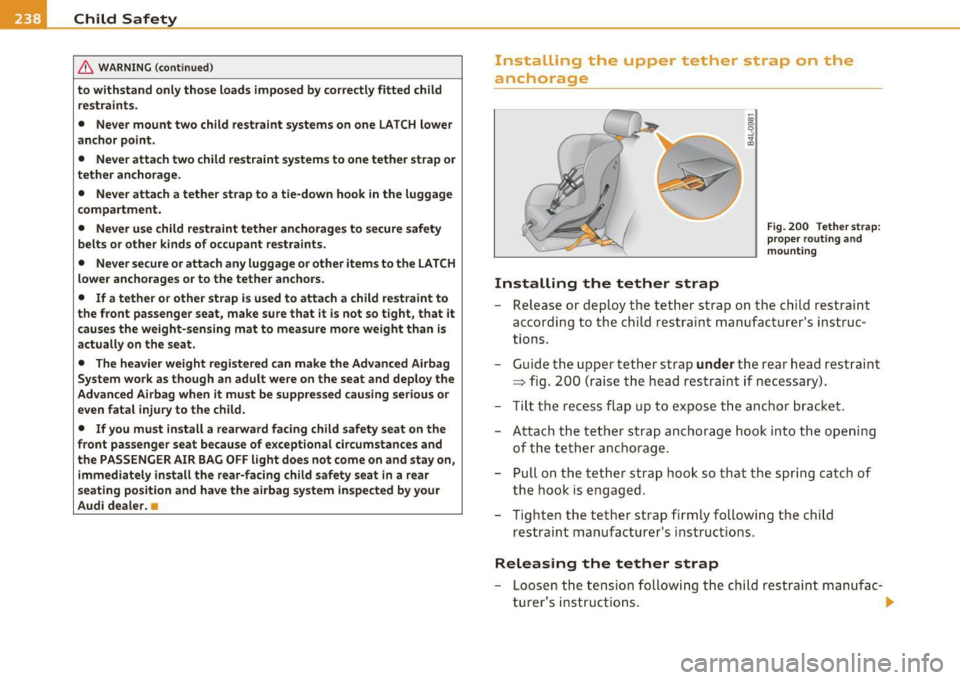
Installing the upper tether strap on the
anchorage
Installing the tether strap
Fig. 2 00 Tet her s tra p :
prop er rou ting and
mounting
- Release or deploy the tet her strap on the ch ild restrai nt
according to the c hild restrain t manufac ture r's instruc
tions .
- Guide t he u pper tet her strap
under th e rear head rest raint
=> fi g. 20 0 (raise t he head restraint if necessary).
- T ilt the recess fla p up to ex pose t he anc hor brac ke t.
- Attach the teth er st ra p anchora ge hoo k in to the openi ng
of t he t eth er anchora ge.
- Pu ll on the tet her s trap hoo k so that the s pri ng catch of
th e h ook is e ngag ed .
- Tighte n the te ther s trap firm ly followi ng the chi ld
res traint manufactu re r's i nstruc tio ns.
Releasing the tether strap
- Loos en the ten sion follow ing th e ch ild restr aint man ufac -
t u re r's instru ctio ns.
~
Page 258 of 370
Trailer towing
"---------------------------------------------------
Trailer towing
Driving with a trailer
General information
Your Audi was designed primarily for passenger transpor
tation .
If you p lan to tow a t railer, p lease remember that the additional load
w ill affect durability, economy and performance.
Tr ailer towing not on ly p laces mo re s tress on the vehicle, it also calls
for more concentration from the driver.
For this reason, a lways follow the operating and dr iv ing inst ructions
prov ided and use common sense .
0 Note
If you are going to tow a trailer, you must activate the tra iler ope ra
tion mode =>
page 170, "Towing a tra iler". •
Technical requirements
Trailer hitch
Use a we igh t-car rying h itch co nform ing to the gross tra iler we ig ht.
The h itch must be suitab le for your vehicle and trailer and must be
mou nted securely o n th e vehi cle's ch assi s at a
techni cally sound loc a
tion . Use only a trailer hitch with a removab le ball mount. Always
check wit h the t railer h itch manufactu rer to make sure that yo u are
using the correct h itch .
Do not use a bumper hitch.
The h itch mus t be installed in such a way t hat it does not in terfe re
w ith t he impact-absorb ing bumper system. No modifications shou ld be made to t
he veh icle exha ust and bra ke systems. From t ime to
time, check that a ll hitch mounting bo lts rema in securely fastened.
W hen you are no t tow in g a tra ile r, remove the t railer hit ch ball
mount. This prevents the hitc h from caus ing damage should your
vehicle be str uck from behind=>& .
Trailer brakes
If your trail er is e quipped w ith a b raking system, che ck to be s ure t hat
it conforms to all regulations.
T he tra ile r hydrau lic brake system m ust not be directly connected to
t he vehicle's hyd raulic b rake sys tem .
Safety chains
Always use safety chains between your veh icle and t he tra ile r.
Trailer lights
Trailer lights must meet all regulations. Be sure to check w ith your
Audi de aler fo r corr ec t wir ing , sw itches and re lays.
Mirrors
If you are unab le to see t he t raff ic be hind you using t he regular
outs ide mirrors, then you
must install extended mi rrors. It is impor
t an t th at yo u
always ha ve clear vi sion to the re ar.
& WARNING
After removing the trailer hitch, do not store it in your vehicle. In
case of sudden braking , the hitch could fly forward and inju re you
or your passengers. •
Page 259 of 370

Operating instructions
Max imum tr aile r weight
A trai ler for your vehicle is lim ited to a typical class 1 or class 2 trailer.
Trail er lo ad di stribut ion
Be sure the load in the t ra iler is held secu rely in place to prevent it
from shift ing forward, backward or sideways.
N ev er a llow a pa ssenge r to ride in a traile r=>
& in "Driving instr uc
tions".
Eng ine c ooling s ystem
Towing a trailer makes the eng ine work harder. It is important that
the cooling system 's performance is up to the addi tional load. Make
sure that the cooling system has enough fluid.
Tire pre ssur e
When towing a tra iler, inflate the tires of your veh icle to the co ld tire
pressu re listed under "Full load" on the label located on the d river's
side 8 -pillar (visible when the door is open) . Inflate traile r tires to
t rai ler and tire manufacture rs' specificat io n s.
Light s
The headl ight sett ings shou ld be checked with the tr ailer attached
before driving off. Check to make sure both vehicle and trailer lights
are working properly .
Safety chain s
Be sure traile r safety cha ins are p roperly connected from the trai ler
to the hitch on the vehicle. Leave enough slack in the chains to perm it
tu rning corners. When you install sa fe ty cha ins, make s ure they will
not drag on the road when you are driving.
T he chains should cross under the trai ler tongue to prevent it from
dropping in case of separation from the h itch .
Controls and equip ment Safety first Vehicle operation
0 Note
If you are going to tow a t
railer, you must activate the tra iler opera
tion mode =>
page 170, "T owing a trai ler" .
Driving instructions
Driving with a trailer always requires e xtra care and
consideration .
To obtain the best possible handling of vehic le and trailer,
please note the following:
- Do not tow a loaded trailer when your car itself is not
loaded.
- Be especially careful when passing other veh icles .
- Observe speed limits .
- Do not dr ive at the maximum permissible speed.
- Always apply brakes early .
- Monitor the temperature gauge .
Weight distribut ion
T owing a loaded tra iler w ith an empty car results in a highly unstable
distribution of we ight . If this cannot be avoided, d rive at very low
speeds only to avoid the risk of losing steering control.
A "balanced" r ig is easier to operate and control. This means that the
t ow ve hicle sho uld be loaded to the exte nt poss ible and permissib le,
wh ile keeping the tra iler as light as poss ible under the circumstances.
Whenever poss ible, tra nsfer some cargo to the l uggage compart
ment of the tow vehicle while observing tongue load requirements
and vehicle load ing considerations .
Vehicle care Do-it-yourself service Technical data
Page 281 of 370

___________________________________________ C..:...._ h:....:e :....:c:..:. k.::..: i..:.. n .:..:g:!:....:: a....:. n..:.. d~ f:....:. i.:..ll :.:.i:....:n :.:g !....- __
Closing the engine hood
- Pull the hood down until the pressure from the struts is
reduced.
- Let the hood
drop down and latch in place. Do not try to
push it shut;
it may fail to engage=:> &.
& WARNING
A hood that is not completely latched could fly up and block your
view while driving.
• When you close the engine hood, check it to make sure the
safety catch has properly engaged. The hood should be flush with
the surrounding vehicle body parts.
• If you notice while driving that the hood is not secured prop
erly, stop at once and close it. •
Working in the engine compartment
Be especially careful whenever you work in the engine
compartment.
Whenever you must perform any work in the engine compartment,
for example checking and filling different fluids, there is a risk of injury, burns and accidents. To prevent personal injury always
observe the following WARNINGS. The engine compartment of any
vehicle is a hazardous area=>& .
& WARNING
To help avoid injury, before you check anything under the hood:
• Turn off the engine.
• Remove the ignition key.
• Apply the parking brake.
Safety first
& WARNING (continued)
• Move selector lever to "P" (Park).
• Always let the engine cool down. Hot components will burn
skin on contact.
• To reduce the risk of being burned, never open the hood if you
see or hear steam or coolant escaping from the engine compart
ment. Wait until no steam or coolant can be seen or heard before
carefully opening the hood.
• Keep children away from the engine compartment.
• Never spill fluids on hot engine components. They can cause a
fire. • Never touch the radiator fan. The auxiliary electric fan is
temperature controlled and can switch on suddenly.
• Never open the coolant reservoir cap when the engine is still
warm. The coolant system is pressurized and hot coolant could
spray out.
• Protect your face, hands and arm from steam or hot engine
coolant by placing a thick rag over the cap when you open the
coolant reservoir.
• If work on the fuel system or the electrical system is necessary:
- Always disconnect the battery.
- Never smoke or work near heaters or open flames. Fluids in
the engine compartment could start a fire.
- Keep an approved fire extinguisher immediately available.
• To avoid electrical shock and personal injury while the engine is
running or being started, never touch:
-Ignition cables
- Other components of the high voltage electronic ignition
system.
• If you must perform a check or repair with the engine running:
- First, fully apply the parking brake, move selector lever to
"P" (Park). .,
Vehicle care Technical data
Page 286 of 370
lffll __ C_h_ e_c_ k_i_n -=g :a,__ a_n_ d_ f_ i_ l _li _n _,g;._ __________________________________________ _
Oil level within range
©
- You must add oil. Afterwards, the oil level should be
within range@.
The oil level needs to be checked at regular intervals . The best times
to do this are whenever you refuel and prior to long trips.
Depending on the way the vehicle is driven and the operating condi
tions, oil consumption can be up to 1 quart per 1.200 miles
(l liter
per 2,000 km). Consumption may be higher within the first 3 ,000
miles (5,000 km) .•
Adding engine oil 9=::11
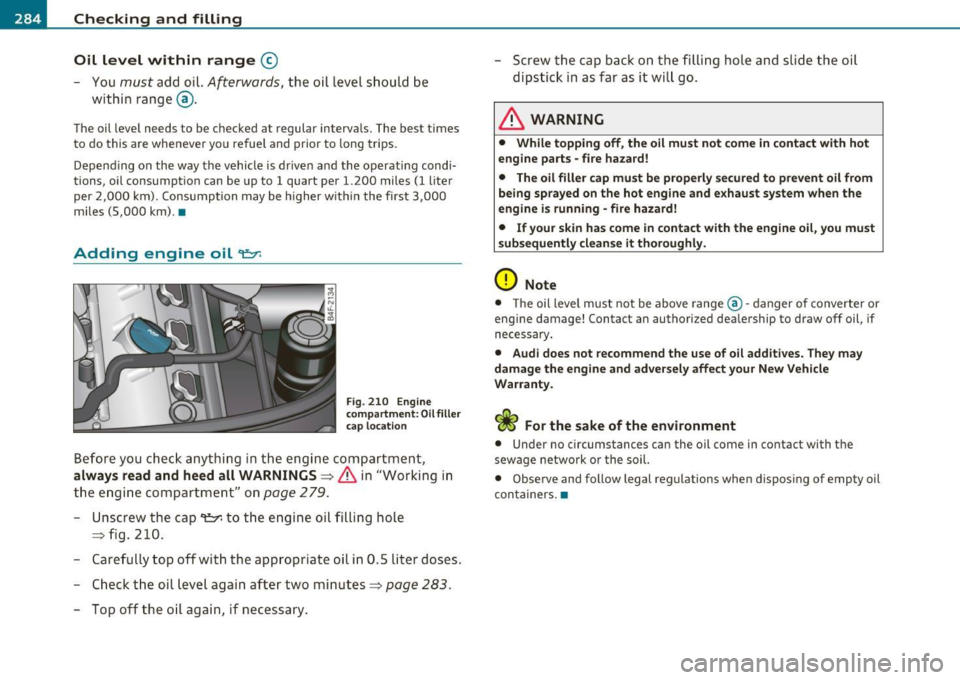
Fig . 210 Engine
compa rtment: Oil filler
cap locatio n
Before you check anything in the engine compartment,
always read and heed all WARNINGS =>
& in "Working in
the engine compartment" on
page 279.
-Unscrew the cap
- Carefully top off with the appropriate oil in 0.5 liter doses.
- Check the oil level again after two minutes=>
page 283.
-Top off the oil again, if necessary . -
Screw the cap back on the filling hole and slide the oil
dipstick in as far as it will go.
& WARNING
• While topping off, the oil must not come in contact with hot
engine parts -fire hazard!
• The oil filler cap must be properly secured to prevent oil from
being sprayed on the hot engine and ex haust system when the
engine is running -fire hazard!
• If your skin has come in contact with the engine oil, you must
subsequently cleanse it thoroughly.
0 Note
• The oil level must not be above range@- danger of converter or
engine damage! Contact an authorized dealership to draw off oil, if
necessary .
• Audi does not recommend the use of oil additives. They may
damage the engine and adversely affect your New Vehicle
Warranty.
sewage network o r the soil.
• Observe and follow legal regulations when disposing of empty oil
containers. •