warning AUDI A6 2011 Owners Manual
[x] Cancel search | Manufacturer: AUDI, Model Year: 2011, Model line: A6, Model: AUDI A6 2011Pages: 370, PDF Size: 87.15 MB
Page 305 of 370

________________________________________________ T_i_re _ s_ a _ n_d_ w_ h_ e_ e_l_s __ _
• Adjust the tire press ure to the load you are ca rry ing .
• Reins tall the valve s te m ca p on the v alve .
When should I check the tire pressure?
The cor rect tire p ress ure is especially importa nt a t hi gh s peeds . The
pressu re s ho ul d therefore be c hecked at least once a month and
always befor e sta rt ing a jou rney . Do not fo rget to ch eck the tire pr es
sure for the spare wheel=>
page 319.
When should I adjust the tire pressures?
Adjust t he tire pressure to the loa d you are ca rry ing . After chan ging a
w hee l or replac ing w heels yo u hav e to adjust the t ire press ures on all
w heels. I n add it io n, you m ust then store th e new t ire pressures in the
t ire press ure moni toring system *=>
page 31 6.
& WARNING
Incorrect tire pressures and /or underinflation can lead sudden tire
failure , loss of control , collision , serious personal injury or even
death .
• When the warning symbol appears in the instrument
cluster, stop and inspect the tires. • Incorrect tire pressure and/or underinflation can cause
increased tire
wear and can affect the handling of the vehicle and
stopping ability.
• Incorrect tire pressures and /or underinflation can also lead to
sudden tire failure , including a blowout and sudden deflation ,
causing loss of vehicle control.
• The driver is responsible for the correct tire pressures for all
tires on the vehicle. The applicable pressure values are located on
a sticker on the driver 's side 8-pillar.
• Only when all tires on the vehicle are filled to the correct pres
sure, the tire pressure monitoring system* can work correctly .
• The use of incorrect tire pressure values can lead to accidents or
other damage . Therefore it is e ssential that the driver observe the
Safety first
& WARNING (co ntinued )
specified tire pressure values for the tires and the correct pres
sures for the function of the tire pres sure monitoring system*.
• Always inflate tires to the recommended and correct tire pres
sure before driving off.
• Driving with underinflated tires bend more , letting them get
too hot re sulting in tread separation, sudden tire failure and loss
of control.
• Excessive speed and /overloading can cause heat build-up,
sudden tire failure and loss of control.
• If the tire pressure is too low or too high, the tires will wear
prematurely and the vehicle will not handle well.
• If the tire is not flat and you do not have to change a wheel
immediately, drive at reduced speed to the nearest service station
to check the tire pressure and add air as required .
0 Note
Driv ing witho ut valve stem caps can cause damage to the t ir e valves.
T o preven t this, a lways make sure th at fa ct o ry insta lled va lve stem
caps on all wheels are s ecure ly m ou nted on t he v alve .
<£> For the sake of the environment
Under infla ted ti res will also increase t he fue l cons umption .•
Tires and vehicle load limits
Th ere a re limits to the amo unt of load or weight that a ny vehicle and
any tire can ca rry . A veh icle t hat is overloaded w ill not handle well and
is mo re diffic ult to s top . Ove rloading can no t only lead to loss of
vehicle contro l, but can also damage important parts o f the ve hicle
a nd can le ad t o sud de n tir e fa ilure, incl uding a blowout and su dden
deflation t hat can cause the vehicle to crash . .,_
Vehicle care Technical data
Page 306 of 370
lffllL-_T.:..:..: ir:....:e~ s=---= a~ n:..:..: d:......: w..:....:.. h:....:e~ e= ls=--------------------------------------------------
Yo ur sa fety and that of your passengers also depends o n mak ing s ure
t h at loa d limits are no t ex ceede d. Vehicle lo ad incl udes eve rybody
and everyth ing in and on the vehicle. These load limits are tech nica lly
referred to as the ve hicle 's
Gross Vehicle Weight Rating ("G VW R").
T he "G VWR" includes the we igh t of the b asic ve hicl e, all fa ctory
installe d accesso ries, a fu ll tank of fue l, o il, coo lant and other fluids
p lu s m aximu m lo ad. Th e maxi mum lo ad include s th e num ber of
passengers that the vehicle is intended to carry ("seating capacity")
w ith a n assu med we ight of 150 l bs (6 8 kg) for e ach p assenger at a
designated seating position and the tota l weight of any luggage in
t he vehicle . If you tow a trai le r, t he weight o f the t railer hitch and t he
tongue we ig ht of the loaded trailer must be included as pa rt of the
veh icle load .
T he
Gross Axle Weight Rating ("GAWR") is the m aximum load tha t
can be applied at each of the vehicle's two ax les.
Th e Gross Vehi cle We ight Ratin g a nd the Gross Axle Weigh t Ra ting
are listed o n the safety compliance sticker label located on the
dr ive r's side B-pillar. You r A udi has 5 sea ting positions, 2 in the fron t
and 3 in the rear fo r tota l seati ng ca pac ity of 5 . Eac h seat ing position
has a safety belt ~
page 18 7, "Safety belts".
T he fa ct t hat t here is an upper lim it to your ve hicle's G ross Veh icle
We ight Rating means that t he total weight of whatever is being
c arried in t he ve hicle (includi ng the wei ght of a tra ile r hit ch an d the
tongue weig ht of the loaded tra iler) is limited. The more passengers
i n th e ve hicl e or p assenge rs who are heavier th an the stan dard
we igh ts assumed mean that less we igh t can be ca rried as luggage.
The tire pressure label on yo ur A udi a lso lists the max imum combined
w eight of all of th e occ upants and luggag e or o ther cargo that th e
vehicle ca n car ry. Fo r the location o f the labe l~
page 299, fig . 216.
& WARNING
Overloading a vehicle can cause loss of vehicle control , a crash or
other accident, serious personal injury, and even death.
& WARNING (co ntinued )
• Carrying more weight than your vehicle was de signed to carry
will prevent the vehicle from handling properly and increase the risk of the loss of vehicle control.
• The brakes on a vehicle that has been overloaded may not be
able to stop the vehicle within a safe di stance.
• Tires on a vehicle that has been overloaded can fail suddenly,
including a blowout and sudden deflation, causing loss of control
and a crash .
• Always make sure that the total load being transported -
including the weight of a trailer hitch and the tongue weight of a
loaded trailer -does not make the vehicle heavier than the
vehicle's Gros s Vehicle Weight Rating. •
Determining correct load limit
Use the example below to calculate the
total weight of the passengers and luggage or other things that you plan to transport so
that you can make sure that your vehicle
will not be overloaded. .-.
Page 309 of 370
________________________________________________ T_ i_ re _ s_ a_ n_d_ w_ h_ e_ e_l _s _ ....... JIII
Incorrect wheel alignment
In correct whee l al ignme nt can ca use excessive tir e wea r, impairing
th e sa fety o f the vehicl e. If t ires show excessive w ear, hav e the w heel
alignment checked by a n authorized A udi dea ler or qualifie d work
shop.
All Wheel Drive
Vehicles wi th quattro® must always have tires of the same size ,
con st ruct ion an d tread type . For details see~
page 248.
& WARNING
Sudden tire failure can lead to los s of control, a cra sh and serious
personal injury!
• Never drive a vehicle when the tread on any tire is worn down
to the wear indicators.
• Worn tires are a safety hazard, they do not grip well on wet
roads and increase your risk of "hydroplaning" and loss of control.
• Always keep chemicals that can cause t ire damage, such as
grease , oil, gasoline and brake fluid away from tires.
• Tires age even if they are not being used and can fail suddenly,
especially at high speeds. Tires that are more than 6 years old can
only be used in an emergency and then with special care and at
lower speeds.
• Never mount used tires on your vehicle if you are not sure of
their "previous history. " Old used tires may have been damaged
even though the damage cannot be seen that can lead to sudden
tire failu re and loss of vehicle control. •
Vehicle OP-eration
New tires and replacing tires and whee ls
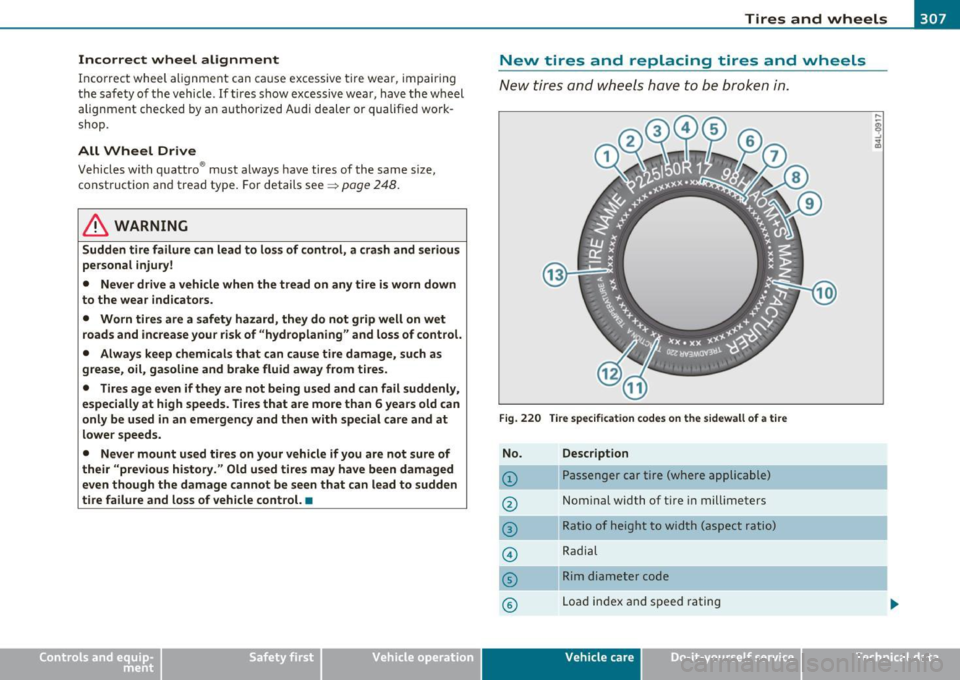
N ew t ires an d w hee ls have to be brok en in .
Fig. 220 Tire specificat ion codes on th e sidewall of a tire
No.
©
®
®
©
©
©
Description
Passenger car tire (where applicable)
Nom inal wid th of ti re in mil limeters
Ratio of hei9ht to width (aspect ratio)
Radial
jj Rim diameter code
L oa d index and speed rating
Vehicle care Do-it-yourselt service iTechnical data
Page 311 of 370

________________________________________________ T_i_re _ s_ a _ n_d_ w_ h_ e_ e_l_s __ _
Tire manufacturing date
The manufacturing date is also indicated on the tire sidewall
(possibly on ly on the
inner s ide of the wheel):
"DOT ... 2210 ... " means, for example, that the tire was produced in
the 22nd week of 2010.
Speed rating (letter code)
The speed rat ing letter code on the wheels ind icates the maximum
permissible road speeds =>
& in "Winter tires" on page 311.
P up to 93 mph (150 km/h)
Q up to 99 mph (158 km/h)
R up to 106 mph (170 km/h)
S up to 110 mph (180 km/h)
T up to 1 18 mp h (190 km/h)
U up to 124 mph (200 km/h)
H up to 130 mph (210 km/h)
V up to 149 mph (240 km/h)3>
Z over 149 mph (240 km/h)3>
W up to 168 mph (270 km/h)3>
Y up to 186 mph (298 km/h)3>
Your vehicle is normally factory equipped with t ires, which possess
excellent driving characterist ics and give you r A udi optimum driv ing
comfort. An electronic speed limiter=>
page 23 will normally prevent
your vehicle from going faster than the tire speed rating =>
&-
U.S. DOT Tire Identification Number (TIN) and tire
manufacture date
This is the tire's "serial number". It begins with the letters "DOT" and
indicates that the tire mee ts all federal standa rds. The next two
numbers or letters indicate the plant where it was manufactured, and
the last four numbers represent the week and year of manufacture .
For example, the numbers 2210 mean that the tire was produced in
3
l For tires w ith a maxim um speed capabi lity ove r 149 mph (240 km/h), tire
manufacture rs sometimes use the letters "ZR."
Safety first
the 22nd week of 2010 . The other numbers are marketing codes that
may or may not be used by the tire manufacturer . This i nformation is
used to contact consumers if a tire defect requires a recall.
Audi Original tire
Tires with the identification "AO" or "RO" have been specially
matched w ith your Audi. We recommend using only these tires
because they meet the highest standards regard ing safety and
driv ing characteristics when used correct ly. Your authorized Audi
dealer will gladly provide you with more information .
Tire ply composition and materials used
The number of plies indicates the number of layers of rubber-coated
fabric in the tire. In general, the greater the number of plies, the
more weight a tire can support . Tire manufacturers also must indi
cate the materials in the tire, which include steel, nylon, polyester,
and others .
Maximum Load Rating
This number indicates the maximum load in kilograms and pounds
that can be carried by the tire.
Tire quality grading for treadwear, traction, and
temperature resistance
Tread wear, traction and temperature grades=> page 310.
Maximum Permissible Inflation Pressure
Th is number is the greatest amount of air pressure that should ever
be put in the tire under normal driving conditions.
& WARNING
• Using incorrect or unmatched tires and/ or wheels or improper
tire and wheel combinations can lead to loss of control, collision
and serious personal injury. _,.
Vehicle care Technical data
Page 312 of 370
-~_T_ i_ re _ s_ a_n _ d_ w_ h _e_ e_ ls _________________________________________________ _
& WARNING (conti nu ed )
• Alway s use tire s, rim s and wheel bolts that meet the specifica
tions of original factory-installed tires or other combinat ions that
have been specifically approved by the vehicle manufacturer .
• Tires age even if they are not being used and can fail suddenly,
especially at high speed s. Tires that are more than 6 years old can
only be used in an emergency and then with special care and at
lower speeds.
• Never mount used tir es on your vehicle if you are not sure of
their "previous history. " Old used t ires m ay have been damaged
even though the damage cannot be seen that can lead to sudden
tire failure and loss of vehicle control.
• All four wheels must be fitted with radial tires of the same
type , size (rolling circumference) and the same tread pattern .
Driving with different tire s reduces vehicle handling and can lead
to a loss of control.
• If the spare tire is not the same as the tires that are mounted
on the vehicle - for example w ith winter tires - only use the spare
tire for a short period of time and drive with extra care. Refit the
normal road wheel as soon as safely possible.
• Never drive fa ster than the maximum speed for which the tires
on your vehicle are rated because ti re s that are driven faster than
their rated speed can fail suddenly.
• Overloading tire s cause heat build-up, sudden tire failure,
including a blowout and sudden deflation and loss of control.
• Temperature grades apply to tires that are properl y inflated
and not over or underinflated.
• For technical reasons it is not always possible to u se wheels
from other veh icles- in some cases not even wheels from the same
vehicle model.
• If you install wheel tr im discs on the vehicle wheels , make sure
that the air flow to the brakes i s not blocked . Reduced airflow to
the brakes can them to overheat, increasing stopping distances
and cau sing a collision.
& W ARNING (continued )
• Run flat ti res may only be used on vehicles that were equipped
with them at the factory. The vehicle must have a chassi s designed
fo r run flat tires. Inco rrect use of run flat tires can lead to vehicle
damage or accidents. Che ck with an author ized Audi dealer or tire
specialist to see if your vehicle can be equipped with run flat tires .
If run flat tire s are u sed, they must be installed on all four wheels.
M ixing t ire types is not permitted.
0 Note
• For tech nica l reasons, it is not generally poss ible to use the wheel
r ims from o ther veh icles . T his ca n hold t rue for w heels of the same
veh icle type.
• If the sp are tire is different fr om the tires t hat yo u have mo unted
on your vehicle (for example w inter t ires or wide profile tires), then
use the s pare tire for a shor t perio d of tim e on ly and drive wi th ext ra
care. Replace t he flat tire w ith the tire matching the others on your
vehicle as soon as possible.
• Never dr ive witho ut the valve stem cap . The valves could get
damage d.
~ For the sake of the environment
Dispose of old t ires in accor dance with the loca l req uiremen ts .•
Uniform tire quality grading
• Tr ead we ar
• Tract ion AA A B C
• T emperat ure A B C
Quality g rades can be fo und where applicable on the tire s ide wall
between t re ad sho ulder and m aximum se ct io n w idth =>
page 30 7,
fig.220 . ~
Page 313 of 370

Tires and wheels Ill
----------------
For example: Tread wear 200, Traction AA, Temperature A.
All passenger car tires must conform to Federal Safety Requirements
in addition to these grades.
Tread wear
The tread wear grade is a comparative rating based on the wear rate
of the tire when tested under controlled conditions on a specified
government test course .
For example, a tire graded 150 would wear one and one half (1 1/2)
times as well on the government course as a tire graded 100.
The relative performance of tires depends upon the actual conditions
of their use, however, and may depart significantly from the norm
due to variations in driving habits, service practices and differences in
road characteristics and climate.
Traction
The traction grades, from highest to lowest, are AA, A, Band C. Those
grades represent the tire's ability to stop on wet pavement as
measured under controlled conditions on specified government test
surfaces of asphalt and concrete . A tire marked C may have poor trac
tion performance ~& .
Temperature
The temperature grades are A (the highest), B, and C, representing
the tire's resistance to the generation of heat and its ability to dissi
pate heat when tested under controlled conditions on a specified
indoor laboratory test wheel.
Sustained high temperature can cause the material of the tire to
degenerate and reduce tire life, and excessive temperature can lead
to sudden tire failure~&.
The grade C corresponds to a level of performance which all
passenger car tires must meet under the Federal Motor Vehicle
Safety Standard No. 109 . Grades Band A represent higher levels of
performance on the laboratory test wheel than the minimum
required by law .
Safety first
& WARNING
The traction grade assigned to this tire is based on straight-ahead
braking traction tests, and does not include acceleration,
cornering, hydroplaning or peak traction characteristics.
& WARNING
The temperature grade for this tire is established for a tire that is
properly inflated and not overloaded. Excessive speed, underinfla
tion, or excessive loading, either separately or in combination, can
cause heat buildup and possible tire failure. •
Winter tires
Winter tires can improve vehicle handling on snow and
ice . At temperatures below 45 °F (7 °C) we recommend
changing to winter tires.
In some heavy snow areas, local governments may require true
winter or "snow" tires, those with very deeply cut tread. These tires
should only be used in pairs and be installed on all four wheels. Make
sure you purchase snow tires that are the same size and construction
type as the other tires on your vehicle.
If your vehicle is equipped with all-wheel drive*, this will improve
traction during winter driving,
even with the standard tires. However,
we strongly recommend that you always equip all four wheels on your
vehicle with correctly fitted winter tires or all-season tires, when
winter road conditions are expected. This also improves the vehicle's
braking performance and reduces stopping distances.
Summer tires provide less grip on ice and snow .
Winter tires (snow tires) must always be fitted on all four wheels .
Ask your authorized Audi dealer or qualified workshop for permitted
winter tire sizes. Use only radial winter tires. ..,_
Vehicle care Technical data
Page 314 of 370
Ill Tires and wheels
-------------------
Winter tires lose their effectiveness when the tread is worn down to
a d epth o f 0. 157 inch ( 4 mm).
Only drive w it h w inte r tir es under w inte r co nd it io ns. S u mmer t ires
hand le better w hen there is no s now or ice on t he roads a nd the
t em pe ra ture i s above 4 5
°F (7 ° ( ).
If you have a flat tire, see notes on spare wheel~ page 307.
Please always remember that winter tires may have a lower speed
rating than t he t ires originally installed on yo ur ve hicle at the time it
was ma nufact ured . Please see~
page 309, "Speed rat ing ( letter
c ode)" fo r a listing of the speed rating le tte r codes a nd t he maximu m
speed at which the tires can be dr ive n.
Th e spee d rat ing le tt er code( ~
page 298 ) is on the side w all of the
t ire~
page 307 .
& WARNING
Winter tires have ma ximum speed limits that may be lower than
your vehicle's maximum speed. Always know the maximum speed
before driving off. Never drive faster than the speed perm itted fo r
your specific winter tires . This will cause damage to the tire s
leading to an accident and serious personal injury to you and your
passengers.
& WARNING
Driving faster than the maximum speed for which the winter tires
on your vehicle were des igned can cause ti re failure includ ing a
blowout and sudden deflation, lo ss of control, crashes and serious
personal injuries . Have worn or damaged tires replaced immedi
ately.
• Winter t ires have maximum speed rat ing that may be lower
than your vehicle's maximum speed .
• Never drive faster than the speed for which the winter or other
tires installed on your vehicle are rated.
& WARNING
Always adjust your driving to the road and traffic conditions.
Never let the good acceleration of the winter tires and all-wheel
drive tempt you into taking extra risks. Always remember :
• When braking , an all-wheel drive vehicle handles in the same
way as a front drive vehicle .
• Drive carefully and reduce your speed on icy and slippery roads,
even winter tires cannot help under black ice conditions.
do not wear as quickly and reduce fuel consum ption .•
Snow chains
Snow chains may be fit te d on ly to the fr ont w heels, and only to
certain t ire sizes . Ask yo ur aut horized Audi dealer on which tire sizes
snow chains can be used .
If you are go ing to use snow c ha ins, then you must insta ll th em on t he
front wheels at least .
Th e sn ow chain s mus t have low-pr ofile li nks and m ust no t be th icker
than 0 .53 inc h (13.5 mm), including the lock.
R emove wheel cente r covers an d trim discs before putti ng snow
chains on your vehicle~
0. For safety reaso ns cove r caps m ust the n
be fitted over the whee l bo lts. These are availab le from a utho rized
Audi dealers.
& WARNING
Using the wrong snow chains for your veh icle or installing them
incorrectly can incre ase the risk of loss of control leading to
serious personal injury .
~
Page 315 of 370

Tires and wheels -________________ Effll
& WARNING (co ntinued )
• Snow chain s are available in different sizes. Always make sure
to follow the instructions provi ded by the snow chain manufac
turer.
• Wh en driving with snow cha in s never drive fa ster than the
speed permitted for your specific snow chains .
• Always observe local regulations.
0 Note
• Remove snow chains before d riving on roads not cove red w it h
snow to avoid damaging t ires and wearing t he snow chains down
unnecessar ily.
• Snow chains, which come into direct contact wi th the wheel rim,
can scratch or damage it. The refore, make s ure that the snow chai ns
are sui tably covered. Chec k the pos it ion o f the snow cha ins afte r
driving a few yards and correct if necessary . Follow the instructions
from t he snow chain man ufacturer when doing so .
• If the Adaptive A ir Suspension* sho uld ma lfunct ion, do no t mount
or use snow cha ins because t he ve hicle will be ex tremely low . If you
do drive w ith snow chains o n while the veh icle is at t his level, the
snow c hains m ight severe ly damage the whee lhouse and other parts
o f the ve hicl e.
[I) Tips
W he re snow c ha ins a re mandato ry on certain ro ads, this no rm ally
also applies to ve hicles with A ll W hee l Dr ive. •
Safety first
Wheel bolts
Wheel bol ts mus t alwa ys be tigh tened to the co rrect
torque .
The design of wheel bolts is matched to the factory installed rims. If
differe nt rims a re fitte d, the correc t wheel bolt s wi th the r ig ht length
and co rrectly s haped bolt heads must be used. Th is ensures that
w heels are fitte d se cu rely and that the br ake system fun ctions
correctly .
In certain circumstances, yo u may not use wheel bolts from a
different veh icle -even if it is the same model~
page 348.
& WARNING
Improperly tightened or ma intained wheel bolts can become
loose causing los s of control, a collision and seriou s per sonal
injury .
• Always keep the wheel bolts and the thread s in the wheel hub s
clean so the wheel bolts can turn easily and be properly tightened .
• Never grease or oil the wheel bolts and the threads in the wheel
hubs. They can become loose while driving if greased or oiled , even
if tightened to the specified torque.
• Only use wheel bolts that belong to the rim being installed.
• Never use different wheels bolts on your vehicle .
• Always maintain the correct tightening torque for the wheel
bolts to reduce the risk of a wheel loss . If the tightening torque of
the wheel bolts is too low , they can loosen and come out when the
vehicle is moving . If the tightening torque i s too h igh, the wheel
bolts and threads can be damaged and the wheel can become
loose .
0 Note
The specified tor que fo r th e wheel bolt s i s 90 ft lb (120 Nm) wi th a
tolerance of ± 7,4 ft lb( ± 10 Nm). Torque wheel bo lts diagonally. .,_
Vehicle care Technical data
Page 317 of 370

Tires and wheels Ill _______________ _____.
than the size indicated on the vehicle placard or tire inflation pressure
label , you sho uld determine the proper tire infla tion pressure fo r
those tires.)
As an added safety feature, your vehicle has been equipped with a tire pressu re monitoring sys tem (TPMS) that illuminates a low tire pres
sure telltale when one o r more of your t ires is s ignificantly under
inflated. Accord ingly, when the low tire pressure tellta le illumi nates,
you should stop and check your tires as soon as possib le, and inflate
them to the proper p ress ure. D riving on a sign ificantly under-inflated
tire causes the tire to overheat and can lead to tire fa ilure . Under
inflation also reduces f uel efficiency and tire tread life, and may
affect the vehicle's handling and stopping ability .
Please note that the TPMS is not a substitute for proper tire mainte
nance, and it is the d river's responsibility to mainta in correct tire
pressure, even if under-inflation has not reached the level to trigger
ill umination of the TPMS low tire press ure te lltale.
Your vehicle has also been equipped w ith a TPMS malfunction indi
cato r to indica te when the system is not operating properly . The
TP MS ma lf u nction indicator is combined with the low tire p ress ure
telltale. When the system detects a malfunct ion, the telltale will
fl ash for approximate ly one minute and then rema in continuously
illuminated. This sequence will continue upon subsequent vehicle
sta rt-ups as long as the malfunction exists.
When the ma lfunction indicator is illum inated, the system may not
be able to de tect or signa l low ti re pressure as intended . TPMS
ma lfunctions may occur fo r a var iety of reaso ns, includ ing the instal
lation of replacement o r alternate tires or wheels on the vehi cle that
prevent the T PMS from functioning properly . Always check the TPMS
ma lfunction tellta le after replacing one or more tires or whee ls on
yo ur vehicle to ensure that the replacement o r alte rnate t ires and
wheels allow the TPMS to continue to funct ion proper ly .•
Vehicle OP-eration
App lies to vehicles : wi th t ire p ressu re mon it ori ng system
Tire pressure indicator appears
The tire pressure indicator in the instrument cluster
informs you if the tire pressure is too low or if there is a
system malfunction.
Fi g. 221 D is pl ay:
un der infl ation
wa rning
Fi g. 2 22 Display :
Sys tem malfun ction
Us ing the ABS sensors, the tire pressure monitor ing system compares
the t ire tread c ircumference and vibration characteristics of the ind i
vidual tires .
If the pressure decreases in one or more tires, this is indi -
cated in the instrument cl uster with a warning symbol and a
message ~ fig. 221. The d river message in the display goes o ut after
5 seconds . The driver message can be displayed again by p ressing the
!C HECK ] button. If on ly one t ire is affected, the display will ind icate
its position. ._
Vehicle care Do-it-yourselt service iTechnical data
Page 318 of 370
IIIIL_T.:...:..: i r~ e:.: s~ a:::. n:..:..:: d:.....: w..:...:. h::e:.: e::.:: ls::::._ ______________________________________________ _
The tire pressure monitoring must be reset via MMI each t ime the
pressures are adjus ted (e.g. w hen swi tching between p art ial an d full
load pressure) or after chang ing o r replacing a tire o n your veh icle
~ page 31 6. Yo u can fi nd the recommended tire press ures for yo ur
veh icle on the label on the driver 's door pillar~ page
299 .
Tire tread circ umference and vibrat ion characteristics can change and
c a u se a tir e pressure war ning if:
• the t ire pressure in one o r more tires is too low,
• t he tire ha s structur al dam age,
• the tire press ure was changed, wheels rotated or rep laced but the
TPM S was no t reset~ page
316.
Warning symbols
1..1' Loss of press ure in at least one tire~ &. Check the tire or tires
and replace or repair if necessary. The indicator light (• in the instru
me nt clust er also illuminates~ page
12. Check/correct th e p res
sures o f all four tires and reset TPMS via MMI.
rr :; (T ire Pressu re M on itor ing System) Tire pres sure! System
malfunction.
If T ,.;> appears a fter switching the ignition on or w hile
dr iv ing ~ page
315, fig . 2 22 a nd t he indica to r lig ht 'in th e instr u
me nt clus ter b links for approx ima tely one m inute and the n stays on,
there is a system ma lf u nct io n. See your authorized Audi dealer as
soon as poss ible.
& WARNING
• If the tir e pres sure indicator appears in the instrument cluster
display, one or more of your tires i s significantly under-inflated.
Reduce your speed immediately and avoid any hard steering or
braking maneuvers. Stop as soon a s possible and check the tires
and their pressures . Inflate the tire pressure to the proper pres
sure as indicated on the vehicle 's tire pressure label~
page 299.
Driving on a significantly under -inflated tire causes the tire to
overheat and can lead to tire failure. Under -inflation also is likely
to impair the vehicle's handling and stopping ability.
& WARNING (co ntinued )
• The driver is re sponsible for maintaining the correct tire pres
sures . You must check the tire pres sures regularly .
• Under certain conditions (such as a sporty driving style , winter
conditions or unpaved roads) , the pressure monitor indicator may
be delayed.
• Ask your authorized Audi dealer if run-flat tires may be used on
your vehicle . Your vehicle registration becomes invalid if you u se
the se tires when not permitted. Damage to your vehicle or acci
dents could also result.
[ i ] Tips
• T he tire pressure monito ring system stops wor king when there is
an ES P/ABS malf u nctio n.
• Using snow cha ins may res ult in a system ma lf u n ct ion .
• The tire pressure mon itor ing system on your Au di was calibrated
using t ires with the "AO" or "RO " id ent ificat ion . We re comme nd
using these tires. •
Applies to vehicles: with tire p ressure monito ring system
Reset tire pressure monitoring system
I f the tire pressure is adjus ted, wheels are rotated or
changed, th e TPfvf S must b e re set via
fv1fv1 I.
-Turn on the ign it ion .
- Sele ct : Fu nct ion butt on
[C AR ]> Systems* > Tire pressure
monitoring
> Store now.
[ i ] Tips
Before resett ing the TPMS, the current pressures of all four t ires
mus t co rrespo nd to the specifie d val ues. A djust the tire pre ssure and
~