warning AUDI A6 2011 Owners Manual
[x] Cancel search | Manufacturer: AUDI, Model Year: 2011, Model line: A6, Model: AUDI A6 2011Pages: 370, PDF Size: 87.15 MB
Page 291 of 370

___________________________________________ C_ h _ e_c _k _ i_n -=g .._ a_n _ d_ f_i _ll _i _ n -=g '-- ........
Brake fluid
Checking brake fluid level
The b rake f lu id l eve l can be checke d wit h a qui ck g lanc e.
Fig . 212 E ngine
compartment : Br ake
fluid re se rv o ir
Before you c heck a nythi ng in the eng ine compartment ,
always read and heed all WARNINGS~ & in "Working in
the e ngi ne comp art ment" on
page 279.
- Read t he bra ke flu id level from the bra ke fluid reservoir
~ page 289, fig . 212. The brake flu id level must be
between the " MIN" and " MAX" mar kings.
The brake fluid reservoir is locate d at the rear pa rtition of the engine
compartmen t on the left s ide=>
page 280 .
The f luid leve l may drop slightly after some time d ue to the auto
m atic a dju stment of t he b rake pads. This is not c ause for ala rm.
If the brake flu id level falls
considerably be low the "M IN" mark, the
brake warni ng/ind icator light (U .S. models :
BRAKE, Canadia n mo dels:
(0) ) will come on=> page 18 and=> page 26. Do not continue to
operate t he vehicle. The complete brake system sho uld be thoroug hly
chec ked by an au thor ized A ud i d eale r or othe r qualified fac ility and
the cause corrected.
If the brake fluid level is too low, the brake
Vehicle OP-eration
warning/ind icator light will illum inate . Contact an au thoriz ed Aud i
de aler
immediately .•
Changing brake fluid
H av e the b rake fluid chang ed by an expe rie nc ed t echni
CJ an.
B ra ke flui d abso rb s moi stur e from the air. If the wa te r c on ten t in t he
brake fl uid is too high, corros ion in the b rake system may res ult after
a pe riod of time. The boili ng po int of the brak e flu id will also decrea se
co nsiderab ly and decrease brak ing perfo rmance.
Th erefore, the brake f lui d m ust be c hanged
every two years . Always
use new brake fluid w hich conforms to Fede ral Motor Veh icle Stan
dard "F MVSS 1 16 DOT 4" .
Th e br ake f luid reserv oir can be diffi cult to rea ch, there fore, we
recommend that you have the brake fluid changed by your authori zed
Audi dealer . Your deal er h as th e correc t tools, the rig ht bra ke flui d
and the know-how to do th is for you.
& WARNING
• Brake fluid is poisonous. It must be stored only in the closed
original container out of the rea ch of children!
• Brake
failure can result from old or inappropriate brake fluid .
Observe these precaution s:
- Use only b rake fluid that meets SAE specification
J 1703 and
conforms to Federa l Motor Vehicle Standard 116. Alway s check
with you r authorized Audi dealer to make sure you are using
the correct brake fluid. The corre ct type of brake fluid is also
indicated on the brake fluid rese rvoir.
- The brake fluid must be new . Heavy use of the brakes can
c ause a vapor lo ck if the brake fluid is left in the system too
long . Thi s can seriously affect the efficiency of the brakes as
well as your safety. This could result in an accident .
~
Vehicle care Do-it-yourselt service Technical data
Page 293 of 370

_____________________________________________ C_h _ e_ c_ k_in --= g'-- a_n _d_ f_i _ll _i_n -=g ::;__ ____..
Working on the battery
Be es peciall y careful when wor kin g on or near the
ba ttery .
Fig. 213 Luggage
compartment : Battery
T he b atte ry is loc ated in th e lugg age co mpartmen t under the
flo or. Before you check an ything i n the lu~ga ge compart
m ent , read and heed all WARNINGS~
&-
- Li ft the fl oor by the plastic handle .
- Hook the ha nd le i nto the lugga ge com partm ent weat her
s tri p.
Always heed the safety warnings, when working on the veh icle
b att ery o r the vehi cle elec trical sys te m t o pr even t injury .
The following WARNINGS are very important when
working on the battery:
Always heed the following WARNING SYMBOLS and safety pre cautions when working on the battery.
®
Always wear eye protection.
Battery acid contains sulfuric acid. Always wear
gloves and eye protection. I
Vehicle OP-eration
No
- sparks
- flames
- smoking .
When a battery is charged, it produces hydrogen
gas which is explosive and could cause personal
injury.
Always keep the battery well out of reach of chil
dren.
& WARNING
Whenever working on the battery or on the electrical system,
there is the risk of injury, accident and even fire . Read and heed
the following WARNINGS:
• Always wear eye protection. Do not let battery acid or any lead
particle s get on your skin or clothing. Shield your eyes. Explosive
gases can cause blindness or other injury.
• Battery acid contains sulfuric acid . Sulfuric acid can cause
blindness and severe burns .
- Always wear gloves and eye protection. Do not tilt the battery because acid could leak out of the ventilation open
ings.
- If you get battery acid in your eyes or on your skin, immedi
ately rinse with cold water for several minutes and get medical
attent ion.
- If you should ingest any battery acid, seek medical attention
immediately.
• Do not expose the battery to an open flame, electric sparks or
an open light. • Do not smoke.
• Do not interchange the positive and negative cable s.
Vehicle care Do-it-yourselt service iTechnical data
Page 294 of 370
--~C:!h ~e~ c~ k~ i~ n ~g~ a~n~ d~ f~il ~l~in ~ g ~ ----------------------------------------
& WARN ING (con tinu ed)
• When working on the batter y, be su re not to short-ci rcuit the
terminal s with tools or other metal object s. This would cau se the
battery to heat up very quickly , which could lead to damage or
e xplo sion and per sonal injury .
• When a battery is charged , it produces hydrogen gas which i s
explo sive and could cau se p ersonal injury .
• Alway s keep the battery well out of the reach of children .
• Before work is done on the electric al system, di sconnect the
negative ground cable.
• Before perfo rming any work on the electrical system , switch
off the engine and ignition a s well as any electrical equipment .
The negative cable on the battery mu st be disconnected. If you are
just g oing to replace a light bulb, then it is enough to switch off
the l ights.
• Before dis conne cting the battery, swit ch off the anti -theft
ala rm system! Otherwise you w ill set off the alarm .
• When d is connecting the battery, first di sconnect the negative
cable and then the positive cable .
• Before reconnecting the battery, make sure all electrical
consumers are switched off. Reconnect the positive cable first and
then the negative cabl e. Never interchange th e cables· this could
start a fire!
• Never charge a frozen or a thawed-out battery . It could
e xplode! If a battery has frozen , then it must be replaced. A
dis charged battery can freeze over at 32 °F (0 °C ).
• Make sure the vent ho se is always atta ched to the opening on
the side of the battery .
• Never use batteries which are damaged. There is the danger of
an e xplosion! Always replace a damaged battery.
& WARNING
California Proposition 65 Warning:
• Battery posts , terminal s and r elated ac cessorie s cont ain lead
and lead compounds, chemi cals known to the State of Cal ifornia
to cause cancer and reproductive problem s. Wash hands after
handling.
0 Note
• Do not disco nnect the vehicle battery when the ign ition is
switched on or whe n the engine is runni ng, otherwise, you wi ll
damage electronic compone nts in the electr ical system .
• If you r ve hicl e is go ing to s ta nd for a long pe riod of time wit ho ut
being driven, protect the battery from "freezi ng", ot herwise it w ill be
damaged and will then have to be replaced .•
Battery charging
Starting the engine requires a well charged battery.
Fi g. 2 14 Engin e
c omp artm ent : Connec
to rs for charger an d
jumper cables
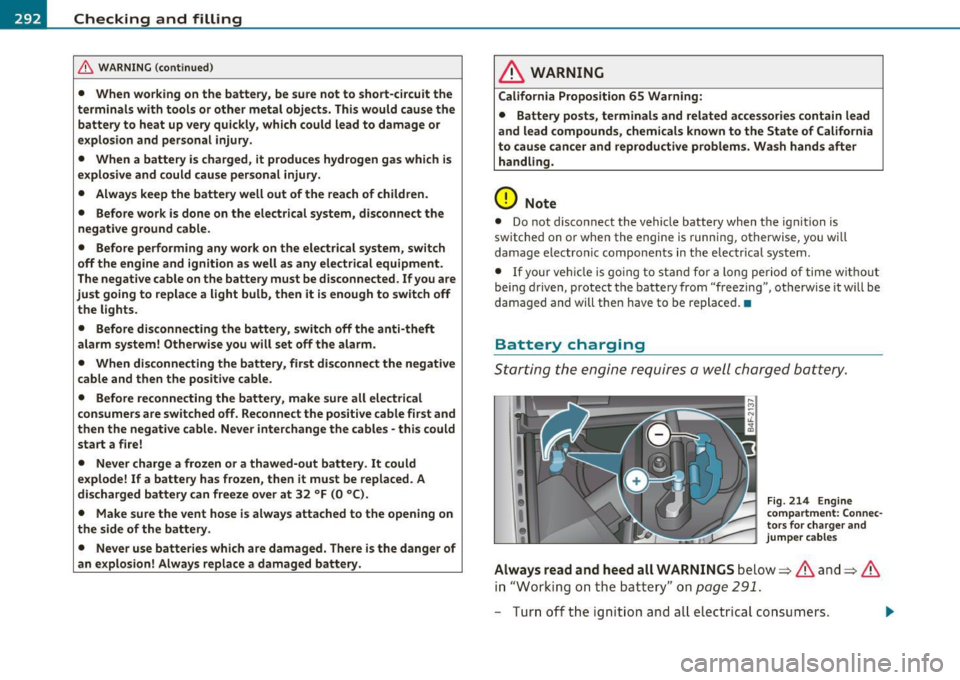
Always read and heed all WARNINGS be lo w => & and => &
in "Work ing o n the bat tery" on pag e 291.
- Turn o ff the ign it ion and all electrical consumers. ~
Page 295 of 370

___________________________________________ C_ h_e _c _k_ i_n ~g_ a_n_ d_ f_ i_ll _i_n _g __ _
- Mak e su re the a rea is w ell ventilated when you charge the
battery .
- Open the hood~
page 2 78.
- Open the red cover on the positive pole~ fig. 214.
- Connect the charger connectors according to the instruc- tions to the
jump start bolts . (Bolts under the red cover =
"positive", Bolts wit h hex head = "negative").
- Only now p lug the ma ins lead for the charging equipment
into the wall outlet and turn it on
~ &,. .
- Make sure the charging rate is not over 30 amps /14.8
Volt.
- When the batte ry is fully charged : Turn the charging
equipment off and remov e the ma ins lead from the wall
ou tlet.
- Now remove the clamps for the charging equipment .
- Close the red cover on the posit ive pole .
- Clos e the hood ~
page 279.
A discharged battery can freeze at tempe rat ures of only O 0C. Allow a
frozen battery to thaw completely before attemp ting to charge it
~ ,&. . However, we recommend not using a thawed battery again
because the battery casing can be cracked due to ice formation and
can leak battery acid.
B atter y charging (Ma ximum charging rate of 30
amps /14.8 Volt )
When charging at low voltages (e.g. w ith a trickle charger ), the
ba ttery cab les do not have to be disconnec ted first. The battery caps
should
not be opened when charging a battery .
It is not necessary to remove the battery from the luggage compart
ment.
Safety first
Fa st charging the b atter y (charging rat e above 14 .8
Volts)
For technical reasons do not use a batte ry c ha rger that uses voltage
greater t han 14.8 Volts to charge your veh icle's battery .
& WARNING
Charging a batter y can be dange rou s.
• Always follow the ope rating instruct ions p ro vi ded by the
batt ery c harger manufa cturer when charging your battery .
• Never cha rge a frozen battery. It ma y explode be cause of gas
trapped in the i ce. Allow a frozen battery to thaw out first.
• Do not reu se batter ies which were frozen. The battery housing
may have cracked and weakened when the batt ery froze.
• Charge the battery in a well ventilated are a. Keep a way from
open flame or el ectr ica l spark. Do not sm oke. Hydrogen gas gener
ated by the battery i s ex plosive.
• To r educ e th e danger of e xplosion , nev er conn ect or dis conne ct
c harger cable s while the charger i s operating.
• Batt ery acid that may spill during charging should b e washed
off with a solution of warm water and bakin g soda to neutralize
the acid .
0 Note
Never use a fast charger as a booster to start the engine . This will seri
ous ly damage sensitive electronic components , such as control units,
re lays, rad io, etc., as well as the battery charger. •
Vehicle care Technical data
Page 296 of 370
___ C_h_ e_c _k _i_n -=g :a,__ a_n_ d_ f_ i_ l _li _n _,g;._ __________________________________________ _
Battery replacement
The new battery must have the same specifications and
dimensions as the original equipment battery.
Inte lligent energy management in your veh icle is responsible for
dis trib uti ng the elect ric al ene rgy throughout yo ur vehi cle
::} page 249. The intelligent energy management system will keep
t he e ngine battery charged be tter then vehicles withou t this system.
To make sure the additional e lectrical energy is available once again
after you have changed the ba tte ry, we recom mend that you in sta ll
batter ies of the same type and manufacture only (the same as those
installed at the t ime your vehicle was delivered). Specifications are
listed on the battery hous ing. You r authorized dealer must code the
battery in t he energy ma nageme nt system to enab le yo u to use the
energy management functions corre ct ly aft er replac ing the battery.
If it is not poss ible to use a battery of this type, the new battery must
have the same capacity, vo ltage ( 12 volts), ampe rage, co nstr uction
and plug sea ling.
When install ing the battery, make sure the ign it ion and a ll electrica l
c ons umers are tur ned off.
0 Note
Make s ure the ventilation hose on the sid e of the battery is
connected, otherwise fumes or battery acid ca n leak o ut.
<£> For the sake of the environment
Beca use of the problem of proper disposal of a battery, we recom
me nd your authorized Audi de aler change the ba ttery for you.
Batte ries contain sulfuric acid and lead and must always be d isposed
o f prope rly in com pliance wi th all environmen tal regula tions.
Disposing of vehicle batteries imprope rly is very dangerous to the
envi ro n ment .•
Windshield/headlight washer
container
Fig. 215 En gine
compartm ent: Wind
s hie ld and head lig ht *
w as her flu id co ntainer
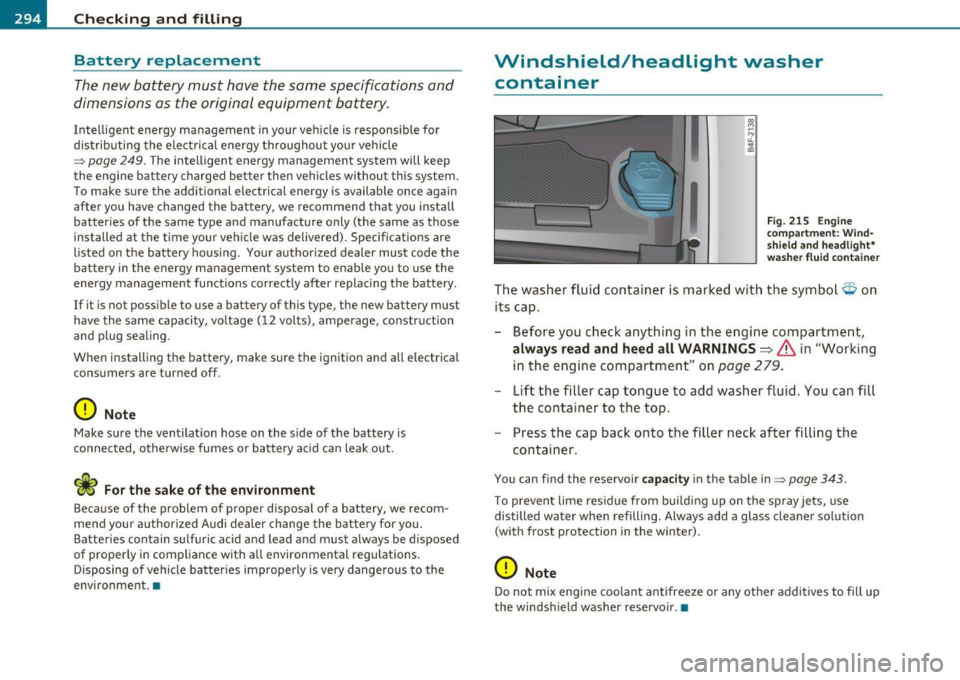
Th e washe r fluid contain er is mark ed with the symb ol O on
its cap .
- Bef ore you check anything i n th e engin e compartm ent,
always read and heed all WARNINGS~ & in "Working
in th e e ngine com partme nt" on
page 279 .
-Lift t he filler cap tongue to add washe r fluid. You can fill
the conta iner to the top.
- Press the cap bac k onto the f iller neck af ter filling the
container .
You can find the reservoir capacity in the table in::} page 343.
To preven t lime res idue from bui ldi ng up on t he spray jets, use
distilled water when refilling. Always add a glass cleane r so lution
(with frost protection in t he winter).
0 Note
Do not mix engine coo lant antifreeze or any othe r additives to fi ll up
the windsh ield washe r rese rvo ir .•
Page 297 of 370

________________________________________________ T_i_re _ s_ a _ n_d_ w_ h_ e_ e_l_s __ _
Tires and wheels
Tires
General notes
Tires may be the least appreciated and most abused
parts of a motor vehicle.
T ir es may be the least appreciated and most abused pa rts of a motor
vehicle . Tires are, however, one of the most important parts of a
vehicle , pa rticul arly conside ring the comparat ive ly small patch of
rubber on eac h tire that assures that all-important contact between
you, your veh icle and the road.
Maintai ning t he cor rect tire pressu re, mak ing su re that your veh icle
and i ts tires do not have to carry more weight t han they can safely
hand le, avoid ing damage from road ha za rds and regularly inspecting
tires for damage includ ing cuts, s lashes irregular wea r and ove rall
condi tion a re the mos t important th ings that you can do to help avoid
sudden t ire failure including tread separation and blowouts.
Avoiding damage
If you have to d rive ove r a cur b or sim ilar obstacle, d rive very slowly
and as close as possible at a rig ht angle to the curb .
Always keep chemicals incl ud ing grease, oil, gaso line and brake f luid
o ff t he t ires .
Ins pect the ti res regularly for damage (cu ts, cracks o r blisters, e tc.) .
Remove any foreign bodies embe dded in the treads.
Storing tires
M ark tires w hen yo u remove t hem to indica te t he d ire ct io n of rota
tion . This ensures you to be ab le to mount them correctly when you
re insta ll them.
Whe n removed, t he wheels or tires should be sto red in a cool, dry and
preferably da rk p lace.
Safety first
Store tires in a v ertica l pos it io n if they a re not mount ed on rims, in a
hor izonta l posit ion if they are mounted on r ims.
New tires
N ew tires have to be broken in~ & .
Th e tre ad d epth of new ti res may v ary, accor ding t o th e type an d
make of t ire and the tread pattern .
Hidden damage
Damage to tires and rims is often not readi ly visible. If yo u notice
unu sual vib ra ti on o r the ve hicle pulls to one side, t his may in dica te
that one of the t ires has been damaged. The tires must be checked
im media tely by an auth oriz ed A ud i d eale r or qual ifie d wor ks hop.
Unidirectional tires
A un id irectional tire can be identified by arrows o n th e sidewall , th at
point in the direct ion the t ire is designed to rotate. You must fo llow
t he s peci fied dire ction o f ro tat io n . This is neces sary so t hat t hese
tires can deve lop their optimum cha racte ristics regard ing g rip, road
noise, we ar an d hy dropl aning res ist an ce. F o r more informat ion
~page 325 .
& WARNING
New tires or tires that are old , worn or damaged cannot provide
maximum control and braking ability.
• New tires tend to be slippery and must be broken in. To reduce
the risk of losing control, a collision and serious personal injuries, dri ve with special care for the first 350 miles (560 km).
• Driving with worn or damaged tires can lead to loss of control,
sudden tire failure , including a blowout and sudden deflation ,
crashes and serious personal injuries . Have worn or damaged tires
replaced immediately. _..
Vehicle care Technical data
Page 298 of 370
-~_T_ ir_e_ s_ a_ n_ d_ w_ h_e_ e_ ls _______________________________________________ _
& WARNING (conti nu ed )
• Tire s age even if they are not being used and can fail suddenly ,
especially at high speeds . Tires that are more than 6 year s old can
only be used in an emergency and then with special care and at low
s peed .
Glossary of tire and loading terminology
Accessory weight
means the combined we ight (in excess of those sta nda rd items which
may be rep lace d) of automatic transmission, power steering, power
bra kes, powe r w indows , power seats, radio, and heater, to the extent
that these items are avai lab le as factory- installed equipment
(w het he r i nsta lled or no t).
Aspect ratio
me ans the ratio of t he he ight to t he w id th of the tir e in percent .
Numbe rs of 55 o r lower indicate a low sidewa ll for improved steer ing
respo nse an d be tter overa ll handling on dry p avemen t.
Bead
means the part o f the tire that is made of stee l w ires , wrap ped o r
re in forced by ply cords and that is shaped to fit the rim.
Bead separation
means a brea kdown of the bon d between components in the bead .
Cord
means the st rands forming the plies in the tire.
& W ARNING (continued )
• Never mount used tire s on your vehicle if you are not sure of
their "previous hi story ." Old used tires may have been damaged
eventhoughthedamagecannotbeseenthatcanleadtosudden
tire failure and lo ss of vehicle control.
• If you notice unu sual vibration or if the vehicle pull s to one side
when driving, alway s stop as soon as it is safe to do so and check
the wheels and tires for damage. •
Cold tire inflation pressure
means the tire pressure recommended by the vehicle ma nufa cturer
for a tire of a des ignated size t hat has not been driven for more than
a couple of m iles ( kilomete rs) a t low speeds in the t hree ho ur period
before the tire pressure is measured or ad justed.
Curb weight
mea ns the weig ht of a motor vehicle wit h standard equ ipment
including the max imum cap aci ty of f ue l, oil, and coo lan t, air condi
tioning and additiona l weight of optional equipment.
Extra load tire
means a t ire designe d to operate at higher loads and at higher infla
t ion p ressures than the co rrespo nd ing standard t ire. Ext ra load tires
my be identified as "XL", "xl", "EXTRA LOAD", or "RF" on the sidewall.
Gross Axle Weight Rating ( "GAWR ")
means the load -ca rry ing capacity of a s ingle ax le system, measured at
t he t ire-grou nd inte rfaces .
Gross Vehicle Weight Rating ("GVWR")
means the max imum total loaded we ight of the vehicle .
Page 300 of 370
-~_T_ ir_e_ s_ a_ n_ d_ w_ h_e_ e_ ls _______________________________________________ _
Sidewall
means that portion of a tire between the tread and bead.
Speed rating (letter code)
means the speed at which a tire is designed to be driven for extended
periods of time. The ratings range from 93 mph (150 km/h) to 186
mph (298 km/h) =>
page 309. You may not find this information on
all tires because it is not required by law.
The speed rating letter code, where applicable, is mo lded on the tire
sidewall and indicates the maximum permissible road speeds=>
& in
"Winter tires" on
page 311.
Tire pressure monitoring system*
means a system that detects when one or more of a vehicle's tires are
unde rinflated and illuminates a low tire pressure warning te lltale.
Tread
means that portion of a tire that comes into contact with the road.
Tread separation
means pulling away of the tread from the tire carcass.
Treadwear indicators (TWI)
means the projections within the princ ipal grooves designed to give a
visual ind ication of the degrees of wear of the tread. See=>
page 306,
"Tread Wear Indicator (TWI)" for more information on measuring
tire wear.
Uniform Tire Quality Grading
is a tire informat ion system developed by the United States National
H ighway Traff ic Safety Adm inistration (NHTSA) that is designed to
help buye rs make relative comparisons among tires. The UTQG is not
a safety rating and not a guarantee that a tire will last for a prescribed
number of miles or perform in a certain way. It simply gives tire
buyers additional information to comb ine with other considerations,
such as price, brand loyalty and dealer recommendations. Under
UTQG, tires are graded by the tire manufacturers in three areas: treadwear
, traction and temperature resistance. The UTQG informa
tion on the tires, molded into the sidewa lls.
U.S. DOT Tire Identification Number (TIN)
This is the tire's "ser ial number" It begins with the letters "DOT" and
indicates that the tire meets all federal standards. The next two
numbers or letters ind icate the plant where it was manufactu red, and
the last four numbers represent the week and year of manufacture.
For examp le,
DOT ... 2210 ...
means that the tire was produced in the 22nd week of 2010. The
o ther numbers are marketing codes that may or may not be used by
the t ire manufacturer. Th is informat ion is used to contact consumers
if a tire defect requires a recall.
Vehicle capacity weight
means the rated cargo and l uggage load plus 150 lbs. (68 kilograms)
times the vehicle 's total seating capacity as listed on the label located
on the driver's side B-pillar.
Vehicle maximum load on the tire
means that load on an individual tire that is determined by dist rib
uting to each axle its share of the maximum loaded vehicle weight
and divid ing by two.
Vehicle normal load on the tire
means that load on an individua l tire that is determined by distrib
uting to each axle its share of the curb weight, accessory weight, and
normal occupant weight (distributed in accordance with table below
=>
page 299) and dividing by two. .,_
Page 303 of 370

__________________________________________________ T_i_ r _e _s_ a_ n_ d_ w_ h_e_ e _ l_s __ _
Engine Tire designation Tire pressure front II Tire pressure rear
(displace- normal load normal load
ment
in
liter) condition (up full load condition (up full load
to 3 occu-condition to 3 occu- condition
pants) pants)
PSI II kPA PSI II kPA II PSI ll kPA PSI II kPA
a-cylinder 245/45 Rl 7 99H X L All Season 36 250 39 270 33 230 39 270
4
.2
245/40 R18 97H XL All Season 39 270 42 29 0 35 2 40 42 290
245 /40 R18 97Y XL High Performance 36 250
39 270
33 230
39 270
255
/35 R19 96Y XL High Performance 39 4 4 300 33 230 45 310
XL = reinf orced or extr a load t ire. It m ay a lso ap pear a s xl, EXTRA LOAD , or RF on the tire sidewa ll.
The correct tir e press ure for th e
spare wh eel is l ocat ed on a labe l on
the driver 's s ide B-pillar.
B eca u se technical c hanges may be ma de to vehicle e quipment dur ing
the model year, always compare the tire s ize des ignation on the tire
pressu re la b el on yo ur vehicle with the t ires on your veh icle. Make
sure that the tire size in forma tion on the vehicle labe l is the same as
the s ize of the t ires on the vehicle. This is especially important i f the
vehicle belongs to someone else or you bought the vehicle with
different r ims/tires or you bought the vehicle as a previously owned
vehicle. that the vehicle can carry.
For the loc atio n of t he ti re p ressure label
~ page 299, fig. 216 .
_& WARNING
Overloading a vehicle can cause loss of vehicle control , a cra sh or
other accident, serious personal injury, and even death .
• Carrying more weight than your vehicle wa s de signed to carr y
will prevent the veh icle from handling properly and increase the
risk of a los s of vehicle control.
• The brakes on a vehicle that has been overloaded may not be
able to stop the vehicle within a safe di stan ce.
• Tires on a vehicle that has been overloaded can fail suddenly
c ausing lo ss of control and a crash .
• Always make sure that the total load being transported -
including the weight of a trailer hitch and the tongue weight of a
loaded trailer -does not make the vehicle heavier than the
I
I
Remember, your safety and that of your passengers also depends on
m aki ng sure th at lo ad lim its are no t ex ceeded. Vehicle lo ad includes
everybody and everything in and on the veh icle. These load limits are
t echnically re fer red to as t he ve hicle's G ross Vehicle Weig ht Ra ting
("GVWR") . The Gross Axle Weight Rat ing ("GA WR") is the max imum
load that can be applied at each of the veh icle's two ax les. The Gross
Vehicle Weight Rat ing and the G ross Ax le We ight Ra ting are listed on
the safety comp liance sticke r label located on the driver's side B
pillar. The tire p re ssur e label on your Audi lists the maxim um
combined weight of a ll of th e occ upants and luggage or other cargo
vehicle 's Gros s Vehicle Weight Rating. ._
Safety first Vehicle care Technical data
Page 304 of 370
-~_T_ i_ re _ s_ a_n _ d_ w_ h _e_ e_ls _________________________________________________ _
in. WARNING
• Incorrect tire pressures and /or underinflation can lead to a
s eriou s or fatal a ccident .
• Incor rect tire p ressu res and /or underinflation cause increased
tire wear and can affect the handling of the vehicle .
• Incorrect tire pressu res and /or underinflation can also lead to
s udden tire failur e, including a blowout and sudden deflation,
caus ing loss of vehicle cont rol. •
Checking tire pressure
The correct tire pressure for the tires ori ginally installed
on your vehicle is listed on the tire pressure la bel located
on driv er's side 8-pillar.
Th e recommended tire pressures a re on the tire press ure labe l and in
t he table~ page 299, "Cold tire infla tion pressure" . This means that
the pressure m ust be checked an d adju sted when the tire has not
bee n dr iven for more than a co uple of miles (kilometers) at low
speeds dur ing the previous three hours. Air in the tires expands w hen
the tire heats up as a resul t of inte rna l fr iction as it flexes in use. The
tire press ure is higher when the t ire has warmed up than when it is
"cold."
It is the inflation press ure i n a "cold" t ire that counts . Therefore, you
should never let air out of a warm tire to match "Co ld tire inflat ion
pressure" recommendat ions~
page 299 . The t ires would t hen be
underinflated and co uld fail sudden ly .
T he tire p ress ure label on your Audi lists the recommended co ld tire
inflation pressures for the new, or iginal equipment t ires that were on
your vehicle at t he time i t was man ufa cture d. For the location of t he
label~
page 299 , fig. 216.
Most tires lose a ir nat urally over time. They can a lso lose some a ir if
you d rive over a pot hole or hi t a curb while pa rking .
It is usua lly not possible to see whether the rad
ia l tires used today are underinflated
jus t by loo king at th em.
T herefore, be sure to check t ire pressures a t least once a month and
always before go ing on a long trip. Make sure to take the number of
peop le and the amoun t of lugg age i nto a ccount whe n ad justi ng tire
pressure for a trip -even one that you would not consider to be
" lo ng." See ~
page 303, "Ti res and vehicle lo ad lim its" fo r mo re
important informat ion.
Always use an accurate t ire pressure ga uge when check ing and
ad justing i nflat io n pressures . Check all of the tires and be sure not to
forget the s pare tire . If the press ure in any ti re is too hig h when the
t ire is "co ld," let ai r out of t he tire slowly with t he edge of the ti re
gauge and keep checki ng the press ure unt il yo u reach the press ure
that is co rrect for the load (p assenge rs a nd luggage) a nd kind of
driving yo u plan to do.
If the press ure in any t ire is too low , no te the difference between t he
pressure in the cold tire and the pressure you need and add the a ir
t ha t you need to reac h the co rrect pressure fo r the vehi cle load
(passengers a nd luggage) fo r the tires o n yo ur vehicle as listed on the
on your vehicle and in this man ual and the k ind of driving yo u plan to
do .
Never exceed the ma ximum inflation pressure listed on the tire
s idewall for any reason .
Remember that the vehicle manufacturer, not the t ire manufacturer,
determines the cor rec t tire p ress ure for the tires on your ve hicle.
It is important to chec k the tire pressu re whe n the t ires a re co ld.
• Read the required t ire pressure from the t ire pressure label. The
ti re press ure la bel is located on t he dr iver's s ide 8 -pilla r.
• Turn t he va lve stem cap counte r-clockw ise to remove it from th e
t ire v alve .
• Place the air press ure gauge on the valve.
• Th e tire press ures s houl d only be ch ecked and adjus ted whe n the
tires are cold. The slightly raised pressures of warm ti res must not be
re du ced.
~