battery AUDI A6 2011 Owner's Guide
[x] Cancel search | Manufacturer: AUDI, Model Year: 2011, Model line: A6, Model: AUDI A6 2011Pages: 370, PDF Size: 87.15 MB
Page 299 of 370

________________________________________________ T_i_re _ s_ a _ n_d_ w_ h_ e_ e_l_s __ l!'II
Groove
means the spa ce between two ad jacen t tread ribs .
Load rating (code)
mea ns the max imu m load th at a tir e is ra te d to c arry fo r a give n infla
tion pressure. You may not find this information on all t ires beca use
i t is no t required by law .
Maximum load rat ing
me ans the load r ati ng for a t ire at th e maxi mum p ermis sib le in flation
pressure for that tire.
Maximum loaded vehicle weight
means the sum of:
(a) Curb weight
(b) Accessory weig ht
(c) Vehicle ca pacity we ight, and
(d) Pro duct ion op tions weigh t
Maximum (permissible) inflation pressure
means the m aximu m cold infla tio n pr essur e to whi ch a t ire may be
inflated . Also called "maximum inflat ion press ure."
Normal occupant weight
means 150 lbs. (68 k ilog rams) times t he num ber of occupants seate d
in t he vehi cle up to the total sea ting cap aci ty of yo ur vehicl e.
Occupant distribution
means d is tribut ion of occ upan ts i n a vehicle.
Outer diameter
means the ove rall d iameter of an inflated new tire.
Overall width
means the linear distance betwee n the exter iors of the s idewalls of
a n in flated tire, in cludi ng eleva tions due to la beling, dec ora tions, o r
protective bands or ribs.
Safety first
Ply
means a layer o f rubbe r-coate d para llel co rds.
Production options we ight
me ans the co m bine d we ight of tho se in stalled regu lar pr oduction
options weighi ng over 5 lbs. (2.3 kg) in excess of t hose standard
i t ems w hic h they replace, not previously considere d in c urb we igh t o r
accessory weight, includ ing heavy duty brakes , ride levelers, roof
rack, heavy duty battery, and s pecial tr im.
Radial ply tire
me ans a pneuma tic tir e in wh ich the pl y cords that extend to t he
beads are laid at substantially 90 degrees to the centerline of the
t rea d.
Recommended inflation pressure
see => page 296, "C old tire in fla tion pr essu re".
Reinforced tire
mea ns a t ire designe d to ope rate at hig her loads an d at higher infla
tion pressures than the co rresponding standard ti re. Reinforced t ires
my be i de ntified as "X L" , "xi", "EX TRA LOA D", o r "RF " on the sidewall.
Rim
mea ns a metal suppo rt fo r a tire or a tire and tube assemb ly up on
wh ic h the t ire beads are seated.
Rim diameter
means nom inal d iameter of the bead seat . If you change yo ur whee l
si ze, yo u w ill have to purchase new tires to ma tc h the new r im diam
eter .
Rim size designation
means r im diamete r and width.
Rim width
mea ns nom inal dis tance be twee n rim flanges.
Vehicle care Technical data
Page 332 of 370
lffl!I.___F_ u_ s_e _s_ a_n_ d_ b_u _ l_ b_ s _______________________________________________ _
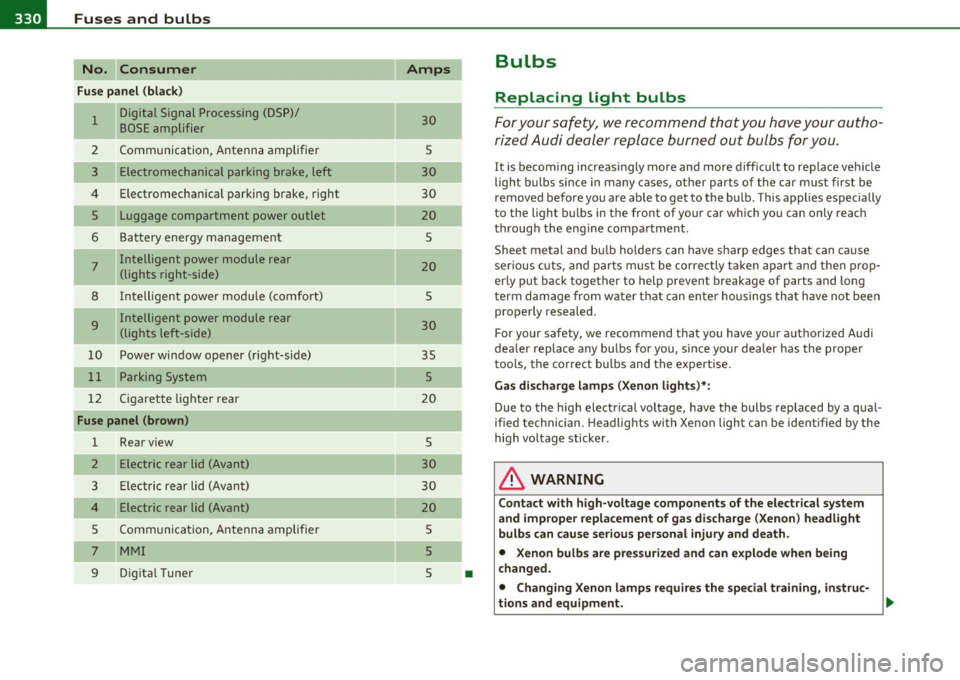
No. Consumer
Fuse panel (black)
-
1 Digital Signal Processing (DSP)/
BOSE amplifier
2 Communication , Antenna amplifier
3 Electromechanical parking brake, left
4 Electromechanical parking brake, right
5 Luggage compartment power outlet
6 Battery energy management
7 Intelligent power module rear
(lights right-side)
8 Intelligent power module (comfort)
9 Intelligent power module rear
(lights left-side)
10 Power window opener (right-side)
11 Parking System
12 Cigarette lighter rear
Fuse panel (brown)
1 Rear view
2 Electric rear lid (Avant)
3 Electric rear lid (Avant)
Electric rear lid (Avant)
5 Communication , Antenna amplifier
7 MMI
9 Digital Tuner
Amps
-
30
5
30
30
20 5
20
-
5
30
-
35
5
20
5
30
30
20
5
5
5
•
Bulbs
Replacing light bulbs
For your safety, we recommend that you have your autho
rized Audi dealer replace burned out bulbs for you.
It is becoming increasingly more and more difficult to replace vehicle
light bulbs since in many cases, other parts of the car must first be
removed before you are able to get to the bulb . This applies especially
to the light bulbs in the front of your car which you can only reach
through the engine compartment .
Sheet metal and bulb holde rs can have sharp edges that can cause
serious cuts, and parts must be correctly taken apart and then prop
erly put back together to help p revent breakage of parts and long
term damage from water that can enter housings that have not been
properly resealed .
For your safety, we recommend that you have your authorized Audi
dealer replace any bulbs for you , since your dealer has the proper
tools, the correct bulbs and the expertise.
Gas discharge lamps (Xenon lights)*:
Due to the high electrical voltage, have the bulbs replaced by a qual
ified technician. Headlights with Xenon light can be identified by the
high voltage sticker .
& WARNING
Contact with high-voltage components of the electrical system
and improper replacement of gas discharge (Xenon) headlight
bulbs can cause serious personal injury and death.
• Xenon bulbs are pressurized and can explode when being
changed.
• Changing Xenon lamps requires the special training, instruc-
tions and equipment. .,_
Page 334 of 370
-Emergency situations Pf":11..--=---=;..._-------------
Emergency situations
General
This chapter is intended for t rained emergency crew s and working
pe rsonnel who have the necessary tool s and equipment to perform
the se operation s. •
Starting by pushing or towing
0 Note
Yo ur vehicle is equipped with an automatic t ransmission . Conse
quently, the engine ca nnot be started by push ing or tow ing .•
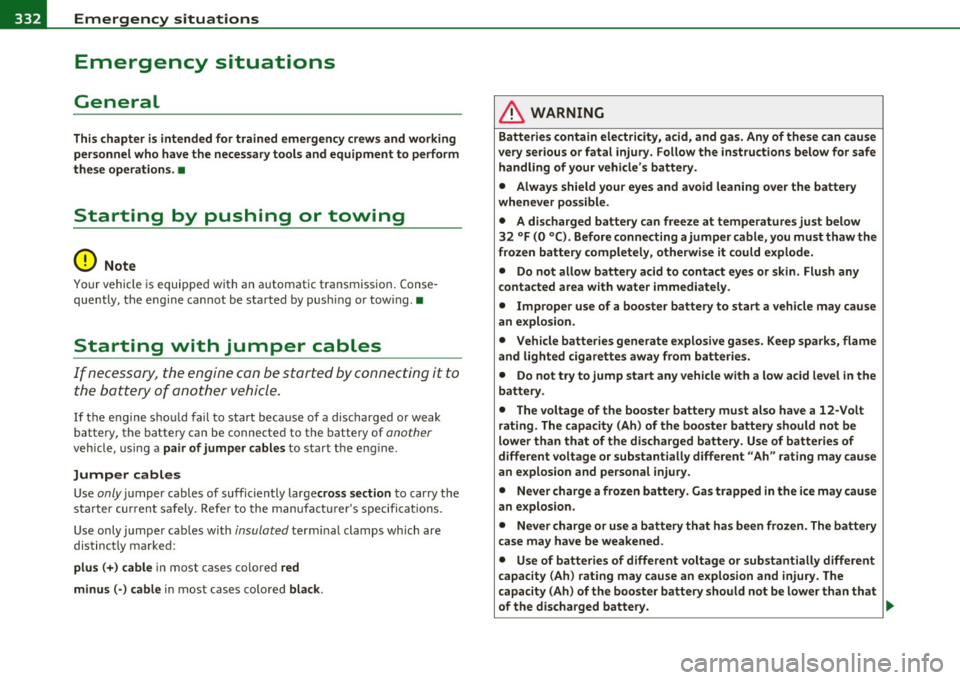
Starting with jumper cables
I f necessary, the engine can be started by connectin g it to
the bat tery of another vehicle.
If the eng ine shou ld fa il to start because of a discharged or weak
battery, the battery can be connected to t he battery of
another
veh icle, us ing a pair of jumper cables to start the engine .
Jumper cables
Use only jumper cables of suffic iently large cross section to carry the
sta rter cur rent s afely . Refer to the m an ufa ct ur er's specificat ions.
Use only j umpe r cab les with
insulated te rm inal clamps wh ich are
distinct ly marked :
plu s(+) cable i n most cases colored red
minus (-) cable i n most cases colored black .
& WARNING
Batterie s contain el ectricity, acid, and gas . Any of the se can cause
very serious or fatal injury. Follow the inst ructions below for safe
handling of your vehicle 's battery.
• Always shield your eyes and avoid leaning over the battery
whenev er po ssible .
• A discharged battery can freeze at temperatures just below
32 °F (0 °C ). Before connecting a jumper cable, you must thaw the
frozen battery completely, otherwise it could explode.
• Do not allow battery acid to contact eyes or sk in . Flush any
contacted area with water immedi ately .
• Improper use of a booste r battery to start a vehicle may cause
an explosion .
• Vehicle batteries generate e xplosive gases. Keep sparks, flame
and lighted cigarettes away from batterie s.
• Do not try to jump start any vehicle with a low acid level in the
battery.
• The voltage of the booster battery must also have a 12-Volt
rating. The capacity (Ah) of the booster battery should not be
lower than that of the discharged battery . Use of batteries of
different voltage or substantially different "Ah " rating may cau se
an e xplosion and personal injury.
• Never charge a frozen battery . Gas trapped in the ice may cause
an explosion.
• Never charge or use a battery that has been frozen. The battery
case may have be weakened .
• Use of batteries of different voltage or substantially different
capacity (Ah) rating may cause an explosion and injury . The
capacity (Ah) of the booster battery should not be lower than that
of the discharged battery. .,_
Page 335 of 370

_____________________________________________ E_ m___;, e_r-=g ~ e_ n_c,_:!y:.__: s_i:..:t ..:..u :..:a;;,. t.:.; i...: o :..: n...:..:. s _ __,J_
& WA RNING (co ntinued )
• Before you che ck anything in the engine compartment , always
read and heed all WARNINGS~
page 271, "Engine compart
ment ".
0 Note
• App lying a higher vo ltage booster battery will cause expensive
damage to sens itive e lec tron ic component s, such as contro l units,
re lays, rad io, etc.
• Th ere must be no electrical contac t between the vehicles as othe r
wise current could a lready start to flow as soon as the posit ive(+)
t erm inals are con nected.
[I] Tips
• Th e discharged ba tte ry mus t be properly co nnecte d to the
vehicle's electrical system . When jump starting or charging the
bat tery, never connec t the negat ive ground cable to the batte ry nega
tive post because the battery manager system must be able to detect
t he battery's state of charge . Always connect the negative ground
cable to the negative ground post of the battery manage r contro l
unit. •
Vehicle OP-eration
Use of jumper cables
Make sure to conne ct the jumper c able clamps in e xactly
the order described bel ow!
Fig. 237 Engine
c omp artment : C on nec
t o rs for jum per cable s
a nd ch arger
F ig . 238 J ump
sta rting wit h the
battery of anot her
v ehi cle: A -disch arged
v eh icle battery , B -
boo ster battery
Th e pro ce dur e descr ibed b elow f or con necting j ump er cabl es
is int en de d to provide a jum p star t for yo ur vehi cle.
Vehicle with discharged battery:
-Turn off lig hts a nd accessories, move lever o f au tomat ic
t ransmission to
N (N eutral) o r P (P ark) and se t parking
b rake.
~
Vehicle care Do-it-yourself service iTechnical data
Page 336 of 370
lffll.___E_ m_ e_r -=g =- e_ n_c -=y ;..._ s_i_t _u _a _ t_ i_ o _ n_ s ____________________________________________ _
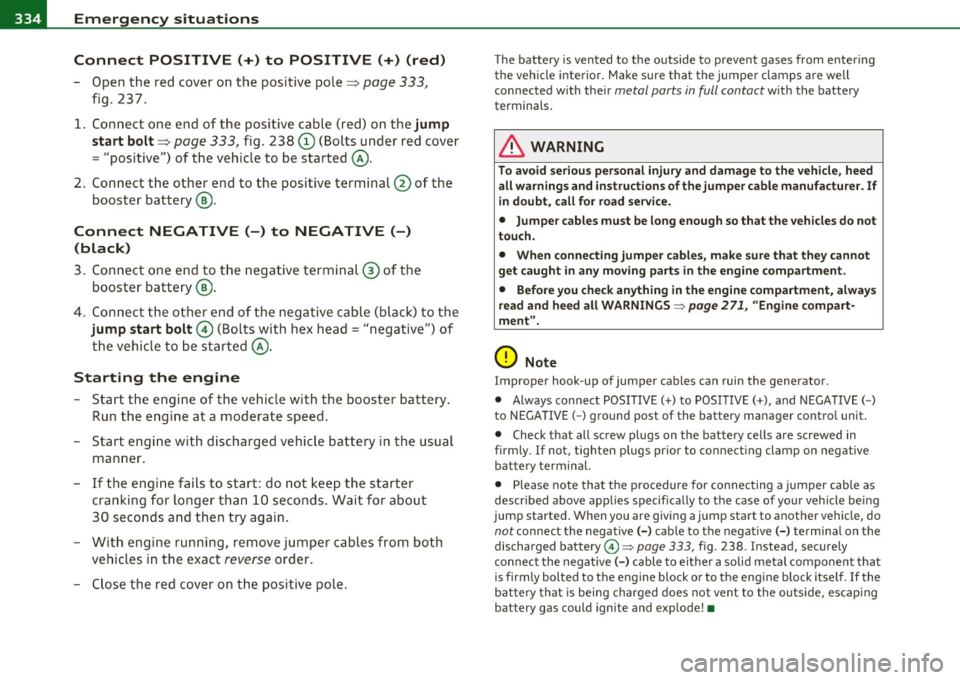
Connect POSITIVE(+) to POSITIVE(+) (red)
- Open the red cover o n the posi tive po le => page 333,
fig . 237 .
1. Connect one end of t he positive cable (red) on the
jump
start bolt=>
page 333, fig. 238 (D (B olts under red cove r
= "positive") of t he vehicle to be star ted @.
2. Con nect t he ot her end to t he positive terminal @ of t he
booster battery @.
Connect NEGATIVE(-) to NEGATIVE(-)
(black)
3 . Co nnect one end to th e n egative t ermin al@ of t he
b oost er batter y@ .
4. Con nect the o ther e nd of th e nega tiv e cabl e (b la ck) to the
jump start bolt© (Bolts wi th hex hea d= "n ega tiv e") of
the v ehic le t o b e sta rted
@ .
Starting the engine
- S ta rt the e ngi ne of t he ve hic le with the booster battery.
R un the e ngi ne at a moderate speed.
- Star t engi ne wi th discha rged vehi cle battery in the usual
ma nner.
- If the engine fails to start: do not keep t he star ter
c ran kin g f or l onge r tha n 1 0 seco nds . W ait f or a bo ut
3 0 seco nds an d the n try aga in .
- Wi th eng ine ru nn ing , rem ove jum per cables from bot h
v ehic les i n the exact
re ve rs e orde r.
- C lose the red cover on the posi tive po le.
The battery is vented to the outside to prevent gases from enter ing
th e ve hicl e int erior. Ma ke sure th at th e jum per cl amp s are well
connected w ith t he ir
metal parts in full contact w ith the batte ry
terminals .
& WARNING
To avoid serious personal injury and damage to the vehicle, heed
all warnings and instructions of the jumper cable manufacturer. If
in doubt, call for road service.
• Jumper cables must be long enough so that the vehicles do not
touch.
• When connecting jumper cables , make sure that they cannot
get caught in any moving parts in the engine compartment .
• Before you check anything in the engine compartment, always
read and heed all WARNINGS~
page 271, "Engine compart
ment ".
0 Note
Improper hook-up of jumpe r cables can ruin the generator.
• Always connect POSI TIVE(+) to POSI TIV E(+ ), and NEGA TIVE( -)
to NEGATIVE( -) ground post of the batte ry manage r contro l unit.
• Check t hat all sc rew p lugs on the battery cells are screwed in
firmly . If not, tighten plugs prior to co nnecting clam p on negative
battery terminal.
• P lease note th at the p roce dure for connec ting a jumper cab le as
described
a bove ap pli es specifically to the case o f yo ur vehicle be ing
jump starte d. When you are giving a j ump sta rt to anot her vehicle, do
not con nect the negative (-) cab le to t he negat ive (-) termina l on the
discharged battery ©~
page 333, fig. 238. Instea d, secure ly
c o nnec t the neg ative (- ) cable to ei ther a soli d met al c o m ponen t that
is firm ly bolted to the eng ine b lock or to the eng ine b lock itself .
If the
b att ery th at is being ch arged does not
ven t to th e ou tside, es caping
battery gas could ignite and exp lode! •
Page 342 of 370

___ G_ e_n_ e_r _a _ l_ in_ f_o _r_ m_ a_ t_io _ n _______________________________________________ _
General information
Explanation of technical data
Some of the technical data listed in this manual requires
further explanation.
The technical data for your vehicle is listed in the charts starting on
~ page 343. This sect ion prov ides genera l information, notes and
restrictions which app ly to this data .•
Veh icle identification
The key data is given on the vehicle identification number
(VIN) plate and the vehicle data sticker.
F ig. 2 45 Vehi cle I den
t ifi ca tion Nu mbe r
(V IN ) plate: locat io n
o n d river's s id e d ash
p an el Fi
g. 2 46 Th e vehicle
i d enti fication l abel -
in side the l ugga ge
co mpa rtme nt
The Vehicle Id ent ifi cat ion Number (VlN )
is located on the driver's s ide so that it is visible from the outside
through the windshield~ fig. 245 . You can also d isp lay the Vehicle
Identification Number of your vehicle in the MMI. Se lect funct ion
button [CAR]>
S yst em s*> Vehicle ID number (VIN ).
The vehicle identifica tion lab el
is located in the luggage compartment near the battery .
The label~ fig. 246 shows the following vehicle data:
© Production control No.
@ Vehicle identification No.
® Type code n umber
@ Type designat io n/eng ine output in Kilow atts
© Engine and transmission code letter
© Paint No./Interior
(j) Optional equipment No.'s
Vehicle data 2 to 7 are also found in your Warranty
& Maintenance
booklet . .,,
Page 355 of 370

Alphabetical index -________________ fWI
Anti-Slip Regulation System (ASR)
How the system works ....... .. .. . 244
Anti-theft systems Anti-theft alarm system ....... ... .. 49
Electronic immobilizer ............. 40
Ashtray Front .............. ...... .. .. .. .. 91
Rea r ........ .... .. .. ... ......... 91
ASR How the Anti-Slip Regulation System works . ...... .. ... .. .. ......... 244
Asterisk What does it mean when something is
marked with an asterisk? ........... S
Audi Service Repair Manuals and Literature
346
AUTO mode AC climate controls ...... .... .. .. .. 99
Auto Safety Hotline .... .. .. .. ....... 185
Auto-Check Control .. ........ .... ... .. 24
Automatic belt retractor ............. 191
Automatic car wash
See Washing ....... .. .... .. .. .. . 261
Automatic Shift Lock (ASL) ..... .. 148, 155
Automatic transmission 6-speed automatic transmission ... . 146
Automatic Shift Lock (ASL) .... 148, 155 Driving ............ .. .. .. .. .... . 146
Dynamic shift program ... .. .. .. .. . 149
Emergency release for selector lever . 152
Emergency release for selector lever
(mu ltitron ic®) .............. .... 159
Fail-safe mode .............. 151, 158
Controls and equip
ment Safety first
Ignition key safety lock
.... ... .. .. . 109
Kick -down . .. .. .... .. .. .. ....... 149
Manual shift program .. ... ... .... . 150
multitronic ® ....... ... ... .. .. ... 152
Selector lever .... .. .. .. .. .. . 147, 154
Shift buttons . ........... ... 151, 158
Steering wheel with tiptron ic® . 151, 158
Average speed .. ... .... .. .. .. .... .... 34
Avoid damaging the vehicle ........... 252
B
Battery ... ..... .................... 290
Battery location ins.ide the luggage
compartment . ........ ......... 291
Charging ................ .... .. .. 292
Important warnings when wo rk ing on the
battery . .. .. ..... ....... ... .. .. 291
Jump starting ..... ...... ..... .. .. 332
Low ..... .. ... ..... .. ....... .... 249
Replacing the battery .. .. ... ...... 294
State of charge .... ... ........... 249
Voltage ................. .. .. .. .. . 31
Winter operation ...... .. .. .. ..... 290
Working on the battery .... ... .. .. . 291
Before driving .. ... ... .. ... .. .. .. .. . 177
Blended gasoline ................... 273
Body cavity seal ing . ...... .. ......... 266
Booster seats . .. .. ........ ......... 227
Brake assistant ...... ............... 247
Brake booster . ........ ... ... .. .. ... 246 Brake fluid
Changing the brake fluid ....... .... 289
Checking the brake fluid level ....... 289
Reservoir . .... .. .. ... .... ... ... . 289
What is the correct brake fluid level? . 289
What should I do if the brake fluid warning
light comes on? . ................ 289
Brake light Defective ... .. ................... 21
Brake system . .. .. .. .. .. ... ..... .. .. 289
Anti-lock brake system ............. 17
Brake fluid ........ ............. . 289
Brake fluid spec ificat ions for refil l and
replacement . .... ....... ... ... . 289
Brake pads .. .. .. .. ...... .. .. .. .. 252
Electromechanical parking brake ... . 113
General informat ion ..... ...... .. . 245
How does moisture or road salt affect the
brakes? ... .................. .. 245
Malfunction ...................... 26
Warning/indicator lights ... .. .. .. .. 18
Worn brake pads symbol ........... 31
Break -in period ... .. .. .............. 251
Brake pads . ... ................ .. 252
Tires ... .... .................... 251
Bulbs .................. .. .. .. .. ... 330
Bumper cover Caution when parking near a parking barri-er or curb . ................... .. 114
C
California Proposition 65 Warning ..... 280
Battery specific .... .............. 292
Vehicle operation Vehicle care Do-it-yourself service Technical data
Page 358 of 370

ffl Alphabetical index ------',.__ ___________________________________ _
Driv ing messages ...... ...... .. .. .. .. 24
Dr iv ing safely ..... .. .. .. .. ...... ... 176
Dr iving through water ... ... ... .. .. .. 252
Dr iv ing time .. ............ .......... 34
Duplica te key . .... .... .. .. .. ........ 3 7
Dust fi lter
Climate controls .. .. .. .... .. .. . ...
96
DVD player for navigation system . .. . .. . 86
Dynam ic shift program ............ .. 1 56
E
Easy entry feature . .. .. .. .. .... ..... 1 08
Electric seat adjustment
See Power seat ................... 76
Electromechanical parking brake
Emergency braking . ... .. .. .... .. .
11 5
Ma lf u nct ion . . . . . . . . . . . . . . . . . . . . . 115
Operation . . . . . . . . . . . . . . . . . . . . . . 113
Park ing .................... .. .. 114
Releasing and app ly ing ... .. ... .. .. 113
Starting off w ith a t railer ......... . 115
Warning/ind icator lights . .......... 17
Electronic differential lock (EDL)
How the system works ... .........
243
Warning/ind icator lights . .......... 17
Electroni c immobili ze r ... .... .. .. .. .. . 4 0
Electronic powe r control
(EPC) war ning/ indicato r light .. .. ... .
14
Electronic speed limiter ........ .... .. . 23
Ele ctro nic s tabiliza tion p rogram ( ESP)
How t he system wor ks ... .........
2 4 2
W arning/ind icator lights . .......... 14
Emergency braking ..... .. .. .. .. .. .. 115
Emergency closing
Power su nroof ... ... .. .. . ... ...
55, 56
Eme rgency flasher ................ ... 61
Wa rning/ind icator l ights . .. .. .. .. .. 15
Emergency locking of doors . .. .. .. .. .. 45
E mergency sta rt ing .... ..... ... .. .. . 332
Emergency towing .................. 335
Energy management ................ 249
Battery power .. .. .. .. .. .... ..... 250
Dr iver not ification ............... . 250
Engine
Compartment . ... .. .. .. .. .. .. ...
280
Coolant .. ... .. .. .. .. .... .. .. .. . 286
Hood . ... .. .. .. .... ... .. .. .. .. . 278
Starting ....... .. .. ........ . 108, 109
Starting with jumpe r cab les . .. .... . 332
Stopping ...... .............. ...
110
Engine compa rtment
Sa fety instructions . .... ... .. .. .. .
2 79
Working the eng ine compartment .. 2 79
En gine coolant system ........ .. .. .. . 286
Add ing coolant ................. . 287
Checking coo la nt level . ..... .. .. .. 286
Checking the engine coo lant level . .. 286
Ma lfu nction ... .. ..... ..... .... .. . 27
Radiator fan ....... .. ... . .. .. ... 288
E ngine coo lant tempe rature
T emperat ure gauge ............. .. . 8
Engine data ....... ...... .... .. .....
343
Engine hood
Closing .... ..... ..... .... .. .. .. .
2 79
How to re lease the hood ..... .. ... . 278
Engine oil .. ... .... ... .. . ... ... .. .. 281
Add ing .............. .... ... .. .. 284
Add itives .................. .... . 284
Changing .. ..... .......... .. .. .. 285
Checking the engine oil leve l ..... .. 2 83
Indi cat io ns and conditions requiring extr a
check ing . .. .. .. .. .............
283
Oil consumption .... ............. 282
Oil grades . .. .. .... ..... ....... . 281
Recommended oil check intervals ... 283
Specification and viscosity ..... .. .. 28 1
Engine oil leve l .... .. .. ............. . 31
Engine oil p ress ure
Mal fu nct ion .. .. .. .. .... ..........
28
Engine oil sensor defect ive . ...... ... .. 31
Engine speed limitation ....... ... .. .. . 32
Environmen t
Bre ak-in per iod ...... ...... .. .. ..
2 51
Ca taly tic converte r .. .... ......... 2 52
Disposing o f you r vehi cle bat tery .... 29 4
Driving at hig h speeds ..... ... . ... 254
Driving to minimize poll ution and noise . .
253
Fuel .. .. .... ....... ...... .... .. 27 5
Fue l economy .. .. .. ....... .. .. .. 2 53
Leaks unde r yo ur vehicle ... .. .. .. . 2 79
Lett ing the vehicle stand and warm up .. .
254
Proper disposa l of dra ined brake fluid 289
Prope r disposal of dra ined engine coo la nt
287
Proper disposal of drained engine oil 284,
285
Recy cling used e ng ine o il .......... 2 8 4
Page 359 of 370
___________________________________________ A_ l::.. p _h _a_ b_ e_t _ic _a_ l_ in_ d _ e_x __ ffllll
Unleaded fuel .... .... ... .. .. . .. . 273
What should I do with an old battery? ...
294
EPC
See E lectronic power control ........ 14
ESP
See Electronic stabilizat ion program (ESP)
14
Event Data Recorder (EDR) ............ 242
Exhaust tail pipes
Cleaning ................ .... .... 266
Expansion tank ..................... 286
Ex terior lighting in the mirror housing ... 61
Eyeglass es compa rtment .............. 9S
F
Fan
Radiator ............... .. .. .. .. . 288
Fastening Booster seats .................... 227
Convertible child safety seats .. ..... 225
Infant seats .............. .... .. . 224
Fastening eyelets .................... 84
Flat tire Changing . .. ........... ...... .. . 320
Floor mats ......................... 182
Fog lights ................. ........ . 60
Folding master key with remote control .. 3 7
Foot pedals .. .. ... ........ .. .. .. .. . 182
For the sake of the environment
Gasoline fumes and the environment 27S
Letting your engine warm up ...... . 109
Controls and equip
ment Safety first
Reducing engine noise
by early upshifting
8
Refueling . .. ..... .. .. .. ......... 2 7 5
Saving fuel by early upshifting ........ 8
Using the rear window defogger ..... 101
Front airbags Descript ion . ...... .. .. .. .. ....... 201
How they work ................. .. 206
Front ashtray ........................ 91
Front fog lights .. ................. .. . 60
Front seats ... .. ..... ...... ...... .. . 75
Adjusting .. .. .. ........ ......... 179
Chi ld restraints in the front seat . ... 199
Fro nta l collisions and the laws of physics 188
Fuel Additives .... .. .... .. .. ......... 273
Blended gasoline ................. 273
Consumption ............ .... .. .. . 34
Filler neck ....................... 274
Fuel gauge ...... ............. .... 10
Gasoline ..................... ... 273
Gasoline additives ................ 274
Low fuel leve l . . . . . . . . . . . . . . . . . 10, 30
Octane rating . .. ................. 273
Recommendation . ......... .... .. 273
Refuelling ....... .... .. .. ....... 275
Reserve .................. ... .. .. . 10
T ank capacity .................... 343
Unlocking the fuel filler flap by hand . 277
Fuses Replacing ....................... 327
G
Garage door opener (Homelink ®) ...... 171
Gas discharge lamps ................. 330
Gauges Engine coolant temperature .......... 8
Fuel gauge .. .... .. .. .. ........... 10
Speedometer ............ ... ... ... 10
T achometer ... .................... 9
T rip odometer .................. .. 10
General illust ration
Instruments and controls ... .. . ... .. . 7
Glossary of tire and loading terminology 296
Glove compartment ... ... ... ..... .... 94
cd changer .... .. .. ............... 94
emergency unlocking ........... ... 94
Valet key function .. .... ........... 40
Gross Veh icle We ight Rating (GVWR) ... 341
H
Head restraints .................. .. . 181
Adjusting ............... ... ... .. 181
Front seats ... .................... 81
Rear seats ....... ................ 81
Headlight washer reservoir . .......... 294
Headlights .................. .. .. .. .. 58
Adaptive Light ...... ...... .. .. .. .. 61
Defective . .. .. .... ............... 21
Front fog lights ....... ..... .... ... 60
Headlight range control defect ive .... 31
Switching off .............. ....... 58
Switching on ................... .. 58
Vehicle operation Vehicle care Do-it-yourself service Technical data
Page 360 of 370

___ A_ l_. p_ h _ a_b_ e_ t_ic _a_ l_ in_ d_e _ x ____________________________________________ _
Washer system ... .. .. ... ... .. .... 67
Xeno n headlights . .. .......... .... 58
Heated outside mirrors .... .... .. .. ... 71
Heated seats Front . ................. ...... .. 103
Rear .. .. .. .. .. ........ ......... 103
Heated steering wheel ............... 104
Heated washer jets Wiper and washer system .. ... . ... . 66
Heat ing
Climate con trols .. ............. ... 96
Heavy clothing and safety belts ..... ... 190
H igh beam ....... .. ... .. .... .. .. 58, 62
Wa rning/indicator lights ... .. ... ... 16
H igh vo ltage wa rni ng labe l .. .. .. .. ... 340
Homelink ® un iversal remote control . .. 171
Hood Opening ... .. ...... .. .. .. ... . ... 278
Release lever ... .. .. ...... .. .. . .. 278
Ho rn ....... .... .... .. .. .. .. .. .. .. .. 7
How are child restraint system anchors related to ch ild safety . .. .. .. .. ......... 23 2
How many a irbags does my vehicle have? .. ..
20 4
How often should I check my t ire pressures? .
303 I
gnition lock ... ........ ... . ... .. .. . 108
Ma lfunction ................... 29, 32
Ignition lock positions ... .. .. ... .. .. . 108
Importa nt things to do before driving .. 177
Improperly worn safety belts .. .. .... . 195
Indicato r ligh ts . .. ........... .... .. .. 12
Airbag system ... ..... .... .. . 2 08, 2 09
PASSENGER A IR BAG OF F .... .. ... . 209
Infant seats .......... .. .. ......... 224
Ins ide rear view mirror ........ .. .. . 69, 70
Inst alling child s afe ty se ats
Sa fety belts .. ... ... .. .. . ... .. .. . 229
Insta lling the upper tether strap on the
anchorage ... .. ..... ..... ... .. . 238
Inst rument cluster illuminatio n .. .. .. .. 11
Instruments and controls .............. 8 General illustration . . . . . . . . . . . . . . . . . 7
Interior lights . ... ..... ..... ... .. .. .. 63
Rear ... .. .. .. ..... ....... .. .. 63, 64
Interm itte nt w ip ing
Rai n sensor ... ........... .... .. .. 66
J
Jack ............... .... .. .. .. ..... 318
Jumper cables .. .. .................. 333
How safety be lt prete nsione rs work .. . . 1
95 J ump -sta rting . ... ...... .. .. ... .... . 332
Hydroplaning . .. .................. . 307
K
I
Key .... .... . .. .... .. .. .... .. .. .. .. 37
Ignition key ... .. ................. .. 108 Battery
replacement ....... .. .. .... 39
Coded settings .. ... .. .. .. .. .... .. 96 Convenience open
ing and clos ing of
w indows . .. ...... .............. 52
E mergency key . . . . . . . . . . . . . . . . . . . 3 7
Key replacement . ... ...... .. .. ... . 37
Master key . . . . . . . . . . . . . . . . . . . . . . . 3 7
Valet key ............. .... .. .. .. . 37
Key code d se tti ngs
C limate controls . . . . . . . . . . . . . . . . . . 96
Keyless entry remote contro l .......... 38
Kick-down mu ltitronic ® ... .. .. .. .. ... ..... . 156
tiptron ic ® 149
L
Lane assist
Act ivat ing and deact ivat ing 134
Description ..................... 134
Instrument cluster ind icator light ... 134
M MI settings ....... .. . .. .. .. .. .. 135
N otes on inst rument cluster d isp lay . 134
LATCH ............ .... .. .. .. .. . ... 232
Description .. ...... ............. 234
Guidance fixtures fo r lower anchorages . .
2 35
Insta lling a child rest raint .. ... .. .. 236
Location ... .. ... ..... .. ... .... .. 233
Mounting and re leasi ng the anchorage
hook ............... .... .... .. 236
Leather ..................... .... .. 268
Cleaning ........... ...... .... .. 269
Level ad justment
See Adap tive A ir Suspens ion .. .. ... 168
L if t ing jack .......... .. .. .. .. .. .. .. 323