wheel AUDI A6 2011 Workshop Manual
[x] Cancel search | Manufacturer: AUDI, Model Year: 2011, Model line: A6, Model: AUDI A6 2011Pages: 370, PDF Size: 87.15 MB
Page 261 of 370

-With chocks in place, slowly release the brakes until the
wheel chocks absorb the load.
- Turn the whee ls towards the curb .
- Apply the parking brake.
- Move the selector lever to
P.
When restarting after parking:
- Apply the foot brake.
- Start the eng ine .
- M ove the selector lever to
D.
-Release the parking brake and slowly pu ll out and away
from the wheel chocks .
- Stop and have someone retrieve the wheel chocks .
[ i ) Tips
If you move the se lector lever of the automat ic t ransm ission to P
before applying the parking brake and before blocking the whee ls,
yo u may have to use mo re force later to move the leve r out of t he
P
position. •
Controls and equip
ment Safety first Vehicle operation
Vehicle care Do-it-yourself service Technical data
Page 262 of 370

-~_C_ le_ a_n_ i_ n_ g=- a_ n_d___. p_ ro_ t_e _c_ t_ i_o _n ___________________________________________ _
Cleaning and protection
General information
Regular care preserves vehicl e val ue.
Any automobile is exposed to industria l fumes, co rrosive road salt,
e tc. A well ca red for Audi c an look lik e new many ye ars after pur cha se.
Regu lar and correct care w ill contribute to mai nta in ing t he bea uty
a nd valu e of your Au di.
Furthermore, good care may be a condition for substantiating a
warranty claim should corrosion damage or paint defects occur.
Yo ur au thori zed Audi d eale r h as a var iety of dedicated vehicle-care
products
and can advise w hich ones to use for clea ning the exterior
a n d inter io r of your ve hicle.
W het her you use products recommended by Aud i or other comme r
cia lly availab le cleaning agents , please make sure yo u appl y them
co rrectly .
& WARNING
• Cleaning agents may be poisonous . Keep them out of the reach
of children.
• Heed all caution labels .
• Always read directions on the container before using any
product. Follow the directions carefully.
• Most chemical cleaners are concentrated and have to be
diluted .
• Use spot removing fluids only in well ventilated areas.
• Do not use gasoline, kero sene , diesel fuel , nail polish remover
or other volatile fluids . They may be toxic, flammable or
hazardous in other ways. Do not wash, wax or dry the vehicle with
the ign ition on or the engine running .
& WARNING (continued )
• Do not clean the under sides of chassi s, fenders , wheel covers,
etc. without protecting your hands and arms. You may cut your
self on sharp-edged metal parts.
• Moisture and ice on brakes may impair braking efficiency
~ page 245, "General information ". Test the brakes carefully
each time you wash the vehicle .
'£> For the sake of the environment
Select only envir onmenta lly fr iendly clea ning produc ts . Leftover
cleaning pro ducts sho uld not dis posed of i n the household waste .•
Care of exterior
Washing
F re quent w ashin g protec ts th e vehicle.
T he best protection aga inst env ironmental influences is frequent
w ashi ng and w ax ing. How oft en thi s is requ ired depen ds on :
• How m uch the vehicle is used
• Whe re the ve hicle is parke d (gar age, in the o pen un der tr ees, etc.)
• The seasona l and weather conditions
• Environ mental influences
T he longer bird droppings , insects , tree resin, road and industria l
gr ime, t ar, soo t, road sa lt and o ther ma ter ia ls remain on t he veh icle
body, the more lasti ng their destructive effects w ill be. H igh temper
atu res cause d by ex pos ure to intense s unlight int ensify the co rrosive
effect, part icu larly when humid ity is high as we ll.
~
Page 263 of 370

____________________________________________ C_l_e _a_ n_ i n--= g=--- a_n_ d----' p,__ r_o _t_ e_ c_ t_ i _o_ n __ _
Under certain circumstances, weekly washing may be necessary .
Under other conditions, a monthly washing and waxing may be
adequate.
After the winter, the underside of the vehicle shou ld be thoroughly
washed, p referably in a profess ional car wash.
& WARNING
Always read and heed all WARNINGS and other information
~page 260. •
Automatic car wash
The vehicle can be washed in almost any modern auto
matic car wash.
Th e vehicle paint is so durable that the vehicle can normally be
washed without problems in an automatic car wash . However, the
effect on the paint depends to a lar ge exten t on the design of the
facility, the filtering of the wash water, the type of wash and care material, etc. If the paint has a dull appearance after going through
the car wash or is scratched, bring this to the attention of the oper
ator immediately . If necessary, use a different car wash.
Before going thro ugh a car wash, be sure to take the usual precau
tions such as closing the windows and power roof. Factory installed
antennas must not be removed.
If you have installed additional accessories on the vehicle -such as
spoilers, roof rack, etc. - it is best to ask the car wash operator if these
should be removed.
& WARNING
Always read and heed all WARNINGS and other information
~page 260. •
Safety first
Washing the vehicle by hand
A lot of water is needed when washing a vehicle by hand.
-Before you star t washing, make sure you have read and
understood the WARNINGS~
& in "General informa
tion" on
page 260.
- First soak all dried dirt until it is soft, then rinse it off .
- As you clean your vehicle, start with the roof and work your
way down to the bottom, using a sponge, a sponge glove
or a clean brush.
- Rinse the sponge or the sponge glove often, flush ing it
clean each time .
- Use special car shampoo only for very persistent dirt.
- Rinse the car thoroughly with water.
- Use a chamois leather to gently wipe the exterior dry.
Use a separate sponge for cleaning the wheels, door sills and other
regions exposed to road dirt. In this way, you will not scratch the
paint with coa rse particles imbedded in the sponge the next time you
wash the car.
& WARNING
• Do not clean the underside of the chassis, fenders, wheel
covers, or other hard to reach parts without protecting your hands
and arms. You may cut yourself on sharp-edged metal parts.
• Always read and heed all WARNINGS and other information
~page 260. _..
Vehicle care Technical data
Page 267 of 370

_________________________________________ ___.:C=..:..: le~a::..:... n:.:i.:...;n :.:g L:: a:.:n..:. d=...! pt:.:.. r.::o :..:t :.::e :.:c:.: t:.: i.::o :..:n..:_ __
The best way to remove snow from w indows and mirrors is to use a
br ush . Use a non- abra sive
plastic ice scraper -better st ill, a spray
deicer -to remove
ice from w indows and mirro rs .
T he windows must not be cleaned with insect remover o r wax since
t hese ca n interfere w it h the func tion of the w indshie ld wipe r blades
(chatte r).
O il, g re ase o r silicone resi due c an be remove d with
glass cleaner or
silicone remover. However, wax residue requires the use of a specially
formulated solvent . Please contact your A udi dea ler for advice on safe
prod ucts for wax removal.
Wi ndows s hou ld also be cleaned on the inside at regu lar intervals .
N ever dry wi ndow s w ith t he same ch amo is tha t you use to dry pain ted
surfaces. Wax res idue o n the c hamois ca n impa ir vis ion t hrough t he
w indows.
& WARNING
• The windshield must not be treated with water-repellent
materials. They can increase glare under poor vis ibility conditions
such as wetness, darkness, or when the sun is low on the horizon .
In addit ion, they can cause the windshield wipe rs to chatter.
• Always read and heed all WARNINGS and other information
~page 260.
0 Note
• N ever use warm or hot water to remove snow and ice from
w indows and mir rors . This cou ld c au se the glass to c rac k.
• To prevent damage to the wires of the rear defogger, do not place
a ny adhesive stick ers on the inside of the re ar window ove r the wires .
• T o help prevent dirt from scratching the window, a lways scra pe in
a fo rwa rd direction -pu shing t he s crape r away fro m you -neve r back
and fort h.•
Safety first
Weatherstrips
C om pl ete c ar c are inc ludes the weat her strips as well .
- Ap ply a sui tab le ru bb er co nditio ner to t he we athers tri ps
from time to time .
To be able sea l pro pe rly, the weat hers tr ips arou nd the hood, doo rs,
rear lid, etc. m ust remain pliable. Spray the weathe rst rips with sili
con e or coat them wit h talcu m p owder or glyce rine t o reta in the flex
ibility of the rubber and to protect them against freezing in t he
wi nter.
& WARNING
Always read and heed all WARNINGS and other information
~ page 260.
[I) Tips
Keep silicone sprays off the winds hie ld to avoid wiper smear in ra in. •
Cast (light) alloy wheels
Cast (light) all oy wheels requir e sp ecial c are.
- Wash the whe els wi th a spo nge or h ose bru sh ev er y othe r
w ee k.
- Fo r deep cleaning afterwar ds, use on ly a dedi cated
acid
free cas t all oy whe el cleaner.
- R ub a coat of
liquid wax onto the r ims eve ry three month .
B e su re to reac h an d trea t all parts o f the rim.
To preserve the dec orative appearance of the cast alloy whee ls , some
s pecial care is necessa ry . In add ition to road dirt and s alt , bra ke du st
is a lso corrosive . If left on for too long, brake dust can cause pitt ing . ..,_
Vehicle care Technical data
Page 274 of 370
-Cleaning and protection pn, _____________________ _
in. WARNING
Be aware: The engine compartment of any motor vehicle is a
potentially hazardous area.
• Before working in the engine compartment, be sure to read the information =>
page 271.
• Before reaching into the front plenum panel, always remove
the ignition key . Otherwise, the windshield wiper system could
unintentionally be switched on, possibly causing personal injury
from the moving wiper linkage.
• Never reach into the area around or touch the radiator fan. The
auxiliary fan is temperature controlled and can switch on suddenly
- even when the ignition is off.
• Do not wash, wax or dry the engine with the engine running.
Moving or hot parts could injure you.
• Do not clean the underside of the chassis, fenders, wheel
covers, or other hard to reach parts without protecting your hands
and arms. You may cut yourself on sharp-edged metal parts.
• Always read and heed all WARNINGS and other information
=:> page 260. •
Page 297 of 370

________________________________________________ T_i_re _ s_ a _ n_d_ w_ h_ e_ e_l_s __ _
Tires and wheels
Tires
General notes
Tires may be the least appreciated and most abused
parts of a motor vehicle.
T ir es may be the least appreciated and most abused pa rts of a motor
vehicle . Tires are, however, one of the most important parts of a
vehicle , pa rticul arly conside ring the comparat ive ly small patch of
rubber on eac h tire that assures that all-important contact between
you, your veh icle and the road.
Maintai ning t he cor rect tire pressu re, mak ing su re that your veh icle
and i ts tires do not have to carry more weight t han they can safely
hand le, avoid ing damage from road ha za rds and regularly inspecting
tires for damage includ ing cuts, s lashes irregular wea r and ove rall
condi tion a re the mos t important th ings that you can do to help avoid
sudden t ire failure including tread separation and blowouts.
Avoiding damage
If you have to d rive ove r a cur b or sim ilar obstacle, d rive very slowly
and as close as possible at a rig ht angle to the curb .
Always keep chemicals incl ud ing grease, oil, gaso line and brake f luid
o ff t he t ires .
Ins pect the ti res regularly for damage (cu ts, cracks o r blisters, e tc.) .
Remove any foreign bodies embe dded in the treads.
Storing tires
M ark tires w hen yo u remove t hem to indica te t he d ire ct io n of rota
tion . This ensures you to be ab le to mount them correctly when you
re insta ll them.
Whe n removed, t he wheels or tires should be sto red in a cool, dry and
preferably da rk p lace.
Safety first
Store tires in a v ertica l pos it io n if they a re not mount ed on rims, in a
hor izonta l posit ion if they are mounted on r ims.
New tires
N ew tires have to be broken in~ & .
Th e tre ad d epth of new ti res may v ary, accor ding t o th e type an d
make of t ire and the tread pattern .
Hidden damage
Damage to tires and rims is often not readi ly visible. If yo u notice
unu sual vib ra ti on o r the ve hicle pulls to one side, t his may in dica te
that one of the t ires has been damaged. The tires must be checked
im media tely by an auth oriz ed A ud i d eale r or qual ifie d wor ks hop.
Unidirectional tires
A un id irectional tire can be identified by arrows o n th e sidewall , th at
point in the direct ion the t ire is designed to rotate. You must fo llow
t he s peci fied dire ction o f ro tat io n . This is neces sary so t hat t hese
tires can deve lop their optimum cha racte ristics regard ing g rip, road
noise, we ar an d hy dropl aning res ist an ce. F o r more informat ion
~page 325 .
& WARNING
New tires or tires that are old , worn or damaged cannot provide
maximum control and braking ability.
• New tires tend to be slippery and must be broken in. To reduce
the risk of losing control, a collision and serious personal injuries, dri ve with special care for the first 350 miles (560 km).
• Driving with worn or damaged tires can lead to loss of control,
sudden tire failure , including a blowout and sudden deflation ,
crashes and serious personal injuries . Have worn or damaged tires
replaced immediately. _..
Vehicle care Technical data
Page 298 of 370
-~_T_ ir_e_ s_ a_ n_ d_ w_ h_e_ e_ ls _______________________________________________ _
& WARNING (conti nu ed )
• Tire s age even if they are not being used and can fail suddenly ,
especially at high speeds . Tires that are more than 6 year s old can
only be used in an emergency and then with special care and at low
s peed .
Glossary of tire and loading terminology
Accessory weight
means the combined we ight (in excess of those sta nda rd items which
may be rep lace d) of automatic transmission, power steering, power
bra kes, powe r w indows , power seats, radio, and heater, to the extent
that these items are avai lab le as factory- installed equipment
(w het he r i nsta lled or no t).
Aspect ratio
me ans the ratio of t he he ight to t he w id th of the tir e in percent .
Numbe rs of 55 o r lower indicate a low sidewa ll for improved steer ing
respo nse an d be tter overa ll handling on dry p avemen t.
Bead
means the part o f the tire that is made of stee l w ires , wrap ped o r
re in forced by ply cords and that is shaped to fit the rim.
Bead separation
means a brea kdown of the bon d between components in the bead .
Cord
means the st rands forming the plies in the tire.
& W ARNING (continued )
• Never mount used tire s on your vehicle if you are not sure of
their "previous hi story ." Old used tires may have been damaged
eventhoughthedamagecannotbeseenthatcanleadtosudden
tire failure and lo ss of vehicle control.
• If you notice unu sual vibration or if the vehicle pull s to one side
when driving, alway s stop as soon as it is safe to do so and check
the wheels and tires for damage. •
Cold tire inflation pressure
means the tire pressure recommended by the vehicle ma nufa cturer
for a tire of a des ignated size t hat has not been driven for more than
a couple of m iles ( kilomete rs) a t low speeds in the t hree ho ur period
before the tire pressure is measured or ad justed.
Curb weight
mea ns the weig ht of a motor vehicle wit h standard equ ipment
including the max imum cap aci ty of f ue l, oil, and coo lan t, air condi
tioning and additiona l weight of optional equipment.
Extra load tire
means a t ire designe d to operate at higher loads and at higher infla
t ion p ressures than the co rrespo nd ing standard t ire. Ext ra load tires
my be identified as "XL", "xl", "EXTRA LOAD", or "RF" on the sidewall.
Gross Axle Weight Rating ( "GAWR ")
means the load -ca rry ing capacity of a s ingle ax le system, measured at
t he t ire-grou nd inte rfaces .
Gross Vehicle Weight Rating ("GVWR")
means the max imum total loaded we ight of the vehicle .
Page 305 of 370

________________________________________________ T_i_re _ s_ a _ n_d_ w_ h_ e_ e_l_s __ _
• Adjust the tire press ure to the load you are ca rry ing .
• Reins tall the valve s te m ca p on the v alve .
When should I check the tire pressure?
The cor rect tire p ress ure is especially importa nt a t hi gh s peeds . The
pressu re s ho ul d therefore be c hecked at least once a month and
always befor e sta rt ing a jou rney . Do not fo rget to ch eck the tire pr es
sure for the spare wheel=>
page 319.
When should I adjust the tire pressures?
Adjust t he tire pressure to the loa d you are ca rry ing . After chan ging a
w hee l or replac ing w heels yo u hav e to adjust the t ire press ures on all
w heels. I n add it io n, you m ust then store th e new t ire pressures in the
t ire press ure moni toring system *=>
page 31 6.
& WARNING
Incorrect tire pressures and /or underinflation can lead sudden tire
failure , loss of control , collision , serious personal injury or even
death .
• When the warning symbol appears in the instrument
cluster, stop and inspect the tires. • Incorrect tire pressure and/or underinflation can cause
increased tire
wear and can affect the handling of the vehicle and
stopping ability.
• Incorrect tire pressures and /or underinflation can also lead to
sudden tire failure , including a blowout and sudden deflation ,
causing loss of vehicle control.
• The driver is responsible for the correct tire pressures for all
tires on the vehicle. The applicable pressure values are located on
a sticker on the driver 's side 8-pillar.
• Only when all tires on the vehicle are filled to the correct pres
sure, the tire pressure monitoring system* can work correctly .
• The use of incorrect tire pressure values can lead to accidents or
other damage . Therefore it is e ssential that the driver observe the
Safety first
& WARNING (co ntinued )
specified tire pressure values for the tires and the correct pres
sures for the function of the tire pres sure monitoring system*.
• Always inflate tires to the recommended and correct tire pres
sure before driving off.
• Driving with underinflated tires bend more , letting them get
too hot re sulting in tread separation, sudden tire failure and loss
of control.
• Excessive speed and /overloading can cause heat build-up,
sudden tire failure and loss of control.
• If the tire pressure is too low or too high, the tires will wear
prematurely and the vehicle will not handle well.
• If the tire is not flat and you do not have to change a wheel
immediately, drive at reduced speed to the nearest service station
to check the tire pressure and add air as required .
0 Note
Driv ing witho ut valve stem caps can cause damage to the t ir e valves.
T o preven t this, a lways make sure th at fa ct o ry insta lled va lve stem
caps on all wheels are s ecure ly m ou nted on t he v alve .
<£> For the sake of the environment
Under infla ted ti res will also increase t he fue l cons umption .•
Tires and vehicle load limits
Th ere a re limits to the amo unt of load or weight that a ny vehicle and
any tire can ca rry . A veh icle t hat is overloaded w ill not handle well and
is mo re diffic ult to s top . Ove rloading can no t only lead to loss of
vehicle contro l, but can also damage important parts o f the ve hicle
a nd can le ad t o sud de n tir e fa ilure, incl uding a blowout and su dden
deflation t hat can cause the vehicle to crash . .,_
Vehicle care Technical data
Page 307 of 370

Steps for Determining Correct Load Limit
1.Locate the statement "THE COMBINED WEIGHT OF OCCUPANTS AND CARGO
SHOULD NEVER EXCEED XXX KG OR XXX LBS"on your vehicle's placard (tire infla
tion pressure label) =>
page 299,
fig. 216.
2. Determine the combined weight of the driver and passengers that will be riding in your vehicle.
3. Subtract the combined weight of the driver and passengers from
"XXX" kilo
grams or
"XXX" pounds shown on the
sticker =>
page 299, fig. 216.
4. The resulting figure equals the available amount of cargo and luggage load
capacity. For example, if the
"XXX"
amount equals 1400 lbs. and there will be five 150 lbs . passengers in your
vehicle, the amount of available cargo
and luggage load capacity is 650 lbs.
(1400-750 (5
X 150) = 650 lbs.)
Safety first
Tires and wheels -
5. Determine the combined weight of
luggage and cargo being loaded on the
vehicle. That weight may not safely exceed the available cargo and luggage
load capacity calculated in Step 4.
6. If your vehicle will be towing a trailer ,
load from your trailer will be transferred
to your vehicle. Consult this manual to
determine how this reduces the available cargo and luggage load capacity of your
vehicle.
- Check the tire sidewall(=>
page 307,
fig. 220) to determine the designated load rating for a specific tire . •
Vehicle care Technical data
Page 308 of 370
___ T_ i_ r _e _s_ a_n_ d_ w_ h_ e_e_ l_ s _______________________________________________ _
Tire service Life
The servi ce life of tires depends on a lot of different
things including proper installation and balancing,
correct tir e pressure and driving style.
l 1.. ______ Jj
Tread Wear Indicator (TWI)
Fig. 2 18 Tire tread:
t rea d w ear in di cato rs
(TW I)
Fig . 21 9 R otati ng
tires f or m ore e ven
w ea r
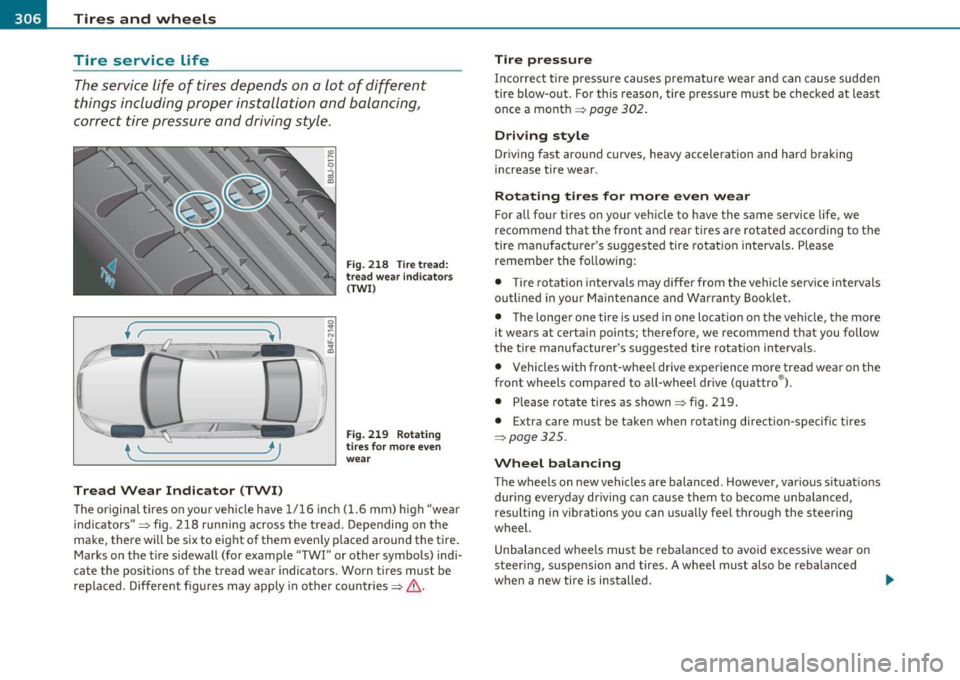
The original t ires o n your veh icle have 1/16 inch ( 1.6 mm) h igh "wear
ind icators"~ fig. 218 running across the tread . Depending on the
ma ke, there w ill be six to eight of them even Ly placed around the ti re.
Marks on the t ire sidewall (for examp le "TWI " or other symbols) indi
cate the positions of the tread wea r indicators . Worn t ires must be
replaced. Differe nt figu res may apply in other countries ~ & .
Tire pressure
Incorrect tire pressure causes premature wea r and can cause sudden
tire blow-o ut. Fo r th is reason, tire pressu re must be checked at least
once a mont h
~ page 302.
Driving style
Driving fast aro und curves, heavy acceleration and hard b raking
increase tire wear .
Rotating tires for more even wear
For all four tires o n your ve hicle to have the same se rvice life, we
recommend that the fron t and rear t ires are rot ated according to the
tire manufact urer's suggested tire rotat ion intervals . Please
remember the fo llow ing :
• Tir e ro tat ion inte rvals may d iffe r from the vehicle serv ice intervals
out lined in your Maintenance and Warranty Booklet .
• The longer one tire is used in one locat ion on the vehicle, the more
it wears at certain points; therefore, we recommend that you follow
the t ire manufacture r's sugges ted tire rotation interva ls .
• Vehicles with front-whee l drive experience more tread wea r on the
front wheels compa red to a ll-wheel dr ive (quattro ®).
• Please ro ta te tires as shown~ fig. 219 .
• Extra care must be taken when rotating direction -specific t ires
~ page 325 .
Wheel balancing
The wheels on new vehicles are balanced. However, var ious si tuatio ns
dur ing everyday driving can cause them to become unbalanced,
resu lting in v ibr ations yo u can us ua lly fee l throug h the stee rin g
w heel.
Unbalanced whee ls mus t be rebalanced to avoid excessive wea r on
steeri ng, suspension and tires . A wheel must also be rebalanced
when a new tire is installed.
~