instrument panel AUDI A6 2017 User Guide
[x] Cancel search | Manufacturer: AUDI, Model Year: 2017, Model line: A6, Model: AUDI A6 2017Pages: 280, PDF Size: 70.24 MB
Page 164 of 280
Airbag system
-If, in exceptional circumstances, you must
install a forward-facing child restraint on
the front passenger seat, always move the
seat into its rearmost position in the seat 's
fore and aft adjustment range , as far away
from the airbag as possible . The backrest
must be adjusted to an upright position.
- Make sure that the
PASSENGER AIR BAG
OFF
light comes on and stays on all the time
whenever the ignition is switched on.
_& WARNING
-If the PASSENGER AIR BAG OFF light does
not go out when an adult is sitting on the
front passenger seat after taking the steps
described above, make sure the adult is
properly seated and restrained at one of the
rear seating positions .
- Have the airbag system inspected by your
Audi dealer before transporting anyone on
the front passenger seat .
@ Tips
If the capacitive passenger detection system
determines that the front passenger seat is
empty, the frontal airbag on the passenger
side will be turned
off, and the PASSENGER
AIR BAG OFF
light will stay on.
Repair , care and disposal of the airbags
Parts of the airbag system are installed at many
different places on your Audi. Installing , remov
ing, servicing or repairing a part in an area of the
vehicle can damage a part of an airbag system
and prevent that system from working properly
in a collision .
There are some important things you have to
know to make sure that the effectiveness of the
system will not be impaired and that discarded
components do not cause injury or pollute the
environment.
A WARNING
Improper care, servicing and repair proce
dures can increase the risk of personal injury
and death by preventing an airbag from de-
162
ploying when needed or deploying an airbag
unexpectedly :
- Never cover, obstruct, or change the steer
ing wheel horn pad or airbag cover or the in
strument panel or modify them in any way .
- Never attach any objects such as cup holders
or telephone mountings to the surfaces cov
ering the airbag units .
- For cleaning the horn pad or instrument
panel, use only a soft, dry cloth or one mois
tened with plain water. Solvents or cleaners could damage the airbag cover or change
the stiffness or strength of the material so
that the airbag cannot deploy and protect properly.
- Never repair , adjust, or change any parts of
the airbag system.
-All work on the steering wheel, instrument
panel, front seats or electrical system (in
cluding the installation of audio equipment,
cellular telephones and CB radios, etc.) must be performed by a qualified technician
who has the training and special equipment
necessary.
- For any work on the airbag system, we
strongly recommend that you see your au
thorized Audi dealer or qualified workshop.
- Never modify the front bumper or parts of the vehicle body.
- Always make sure that the side airbag can inflate without interference:
- Never install seat covers or replacement
upholstery over the front seatbacks that
have not been specifically approved by
Audi .
- Never use additional seat cushions that
cover the areas where the side airbags in
flate.
- Damage to the original seat covers or to
the seam in the area of the side airbag
module must always be repaired immedi
ately by an authorized Audi dealer .
- The airbag system can deploy only once. Af
ter an airbag has been deployed, it must be
replaced with new replacement parts de
signed and approved especially for your
Audi model version. Replacement of com
plete airbag systems or airbag components
Page 165 of 280
co
co
.... N
" N .... 0 0 <.,;) 'SI"
must be performe d by qualified workshops
only. Make sure that any airbag service ac
tion is entered in your Audi Warranty
&
Maintenance booklet under AIRBAG RE
PLACEMENT RECORD.
- For safety reasons in severe accidents, the
alternator and starter are separated from
the vehicle battery with a pyrotechn ic circuit
interrupter.
- Work on the pyrotechnic circ uit interrupt
er must only be performed by a qualified
technicians who have the experience, in
formation and special tools necessary to
perform the work safely.
- If the veh icle or the c ircuit interrupter is
scrapped, all app licable safety precautions
must be followed .
@) For the sake of the environment
Undeployed airbag modu les and pretension
ers might be classified as Perch lorate Materi
al - special handling may apply, see
www.dtsc .ca.gov/hazardouswaste/perchlo
rate. When the veh icle or parts of the re
strai nt system including airbag modules and
safety bel ts wit h pretensione rs are scrapped,
all a ppli cable laws and regulations mus t be
observed. Your a uthorized Audi dealer is fa
m iliar with these requirements and we recom
mend that you have your dealer perform this
service for you.
Other things that can affect Advanced
Airbag performance
Changing the vehicle's suspension system can
change the way that t he Advanced Airbag System
pe rforms in a crash. For examp le, using tire-r im
comb inat ions no t approved by Audi, lowering the
ve hicle, changing the s tiffness of the suspens ion,
includ ing the springs, suspension struts, shock
absorbers etc . can change the forces that are
measured by the airbag sensors and sent to the
e lectronic contro l unit . Some suspens ion changes
can, for example, increase the force levels meas
ured by the sensors and make the airbag system
deploy in crashes in wh ich it would not dep loy if
the changes had no t been made. Other kinds of
Airb ag sys tem
changes may red uce the force levels measured by
the sensors and prevent the airbag from deploy
i ng when it sho uld.
A WARNING
=
Changing the vehicle's suspension including
use of unapproved tire-rim combinations can
change Advanced Airbag performance a nd in
crease the risk of serious personal injury in a
crash.
- Never install suspension components that do not have the same performance charac
ter istics as the components origina lly instal
led on you r vehi cle.
- Never use tire-rim combinations that have
not been approved by Audi.
Knee airbags
Description of knee airbags
Applies to: vehicles wi th knee airbags
The knee airbag system can provide supplemen
tal protection to properly restrained front seat
occupants .
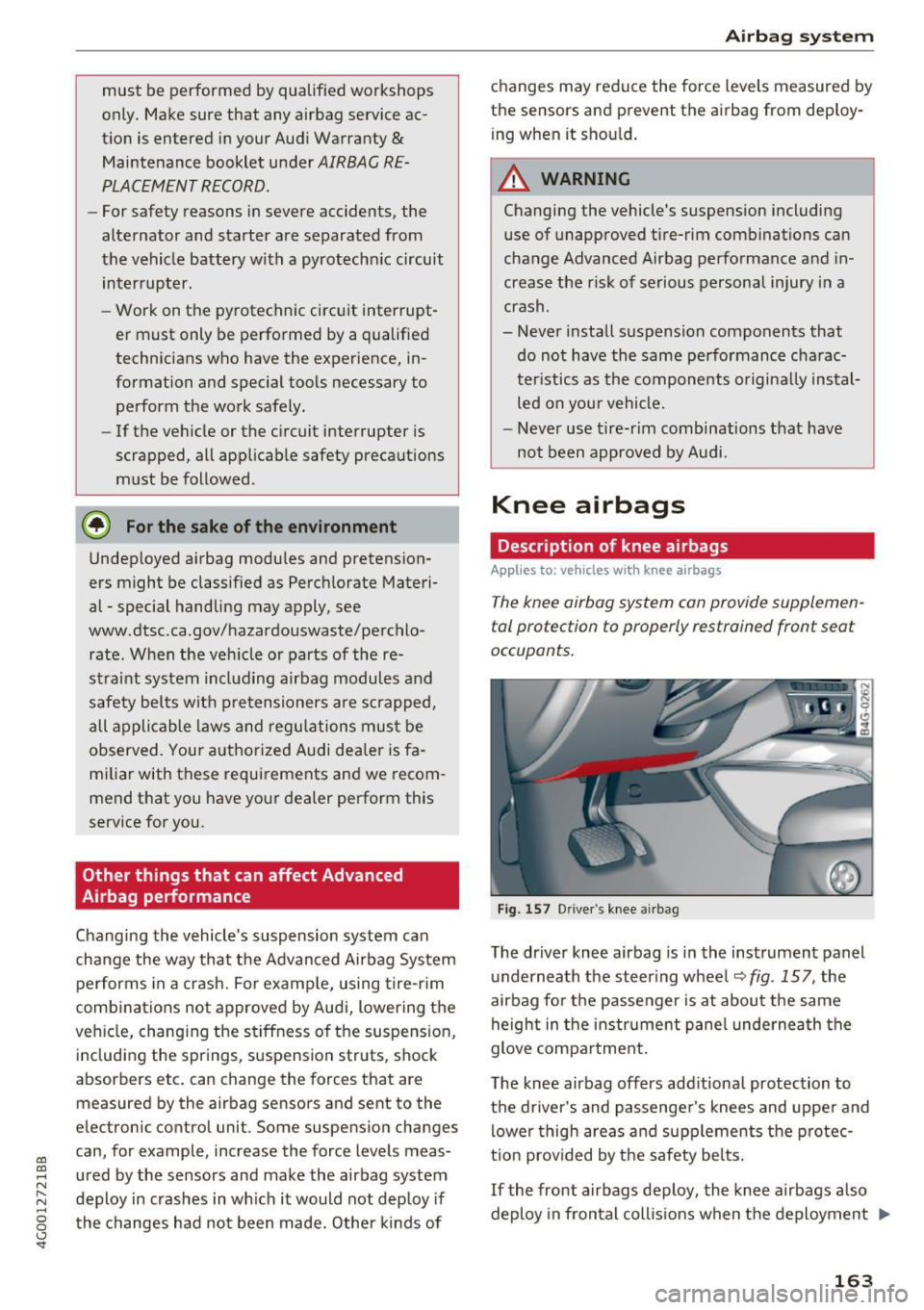
Fig. 1 57 Dr iver 's k nee a irbag
The driver knee airbag is in the instrument panel
underneath the s teer ing whee l~
fig . 157, the
airbag fo r the passenger is at abou t the same
heig ht in the i nstr ume nt p ane l underneath the
glove compa rtment.
The knee airbag offers add itiona l protection to
t h e d river's and passenge r's knees and uppe r and
l ower thigh areas a nd supplements the p rotec
t ion prov ided by the safety bel ts .
If the front airbags deploy, the knee a irbags also
deploy in frontal coll is ions when the deploymen t
Iii--
163
Page 166 of 280
Airbag system
thresho ld stored in the control unit is met
c::>
page 157 , More important things to know
about front airbags .
In addition to their normal safety function, safe
ty belts help keep the driver or front passenger in
position in a frontal collision so that the airbags
can prov ide supplemental protect ion .
The airbag system is not a substitute for your
safety belt. Rather, it is part of the overall occu
pant restraint system in your vehicle . Always re
member that the airbag system can only help to
protect you if you are wearing your safety belt
and wearing it properly . This is why you should
always wear your safety belt, not just because
the law requires you to do soc::>
page 139, Gener
al information .
Remember too, airbags will deploy only once and
only in certain kinds of accidents -your safety
belts are always there to offer protect ion in those
accidents in which airbags are not supposed to
deploy or when they have already deployed, for
example when your vehicle strikes or is struck by
another after the first collis ion .
This is just one of the reasons why an airbag is
not a substitute for the safety belt. The airbag
system works most effectively when used with
the safety belts. Therefore, always wear your
safety belts correct ly.
It is important to remember that whi le the sup
p lemental knee airbag system is designed to re
duce the likelihood of serious injuries, other inju
ries, for example, swelling, bruising and minor
abras ions and friction burns can also occur when
an airbag inflates .
The knee airbag system basically consists of:
-The electronic control module
- Two inflatab le airbags (airbag and gas genera-
tor), one for the driver and one for the front
passenger
- The airbag indicator light in the instrument
panel
The knee airbag system will not deploy:
- when the ignition is switched off
164 - in frontal
collisions when the deceleration
measured by the contro l unit is too low
- in side collisions
- in rear-end collisions
- in rollovers
- in the event of a system malfunction (warning/
ind icator light is on)
<=:>page 17.
.&_ WARNING
-Safety belts and the airbag system can only
provide protection when occupants are in
th e proper seating position
c::> page 157 .
-If the airbag indicator light c::> page 17
comes when the vehicle is being used, have
the system inspected immediately by your
authorized Audi dealer.
It is possible that
the airbag will inflate when it is not sup
posed to, or will not inf late when it should.
How knee airbags work
Applies to: vehicles with knee airbags
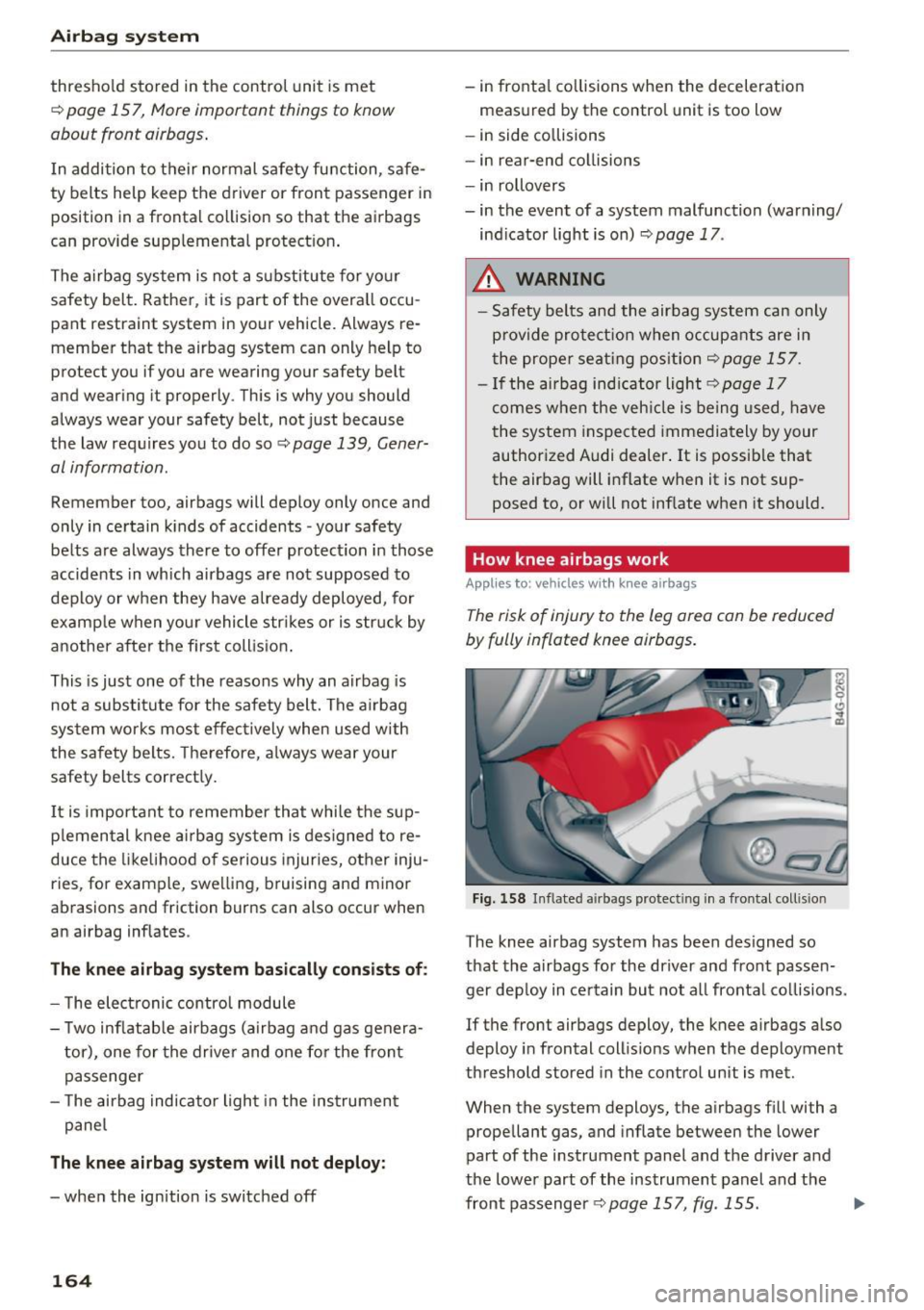
The risk of injury to the leg area can be reduced
by fully inflated knee airbags.
Fig. 158 Inflated a irbags protect ing in a frontal coll is io n
The knee airbag system has been designed so
that the airbags for the driver and front passen
ger dep loy in certain bu t not all fronta l co llisions.
If the front airbags deploy, the knee airbags also
deploy in frontal coll isions when the deployment
threshold stored in the control unit is met.
When the system deploys, the airbags f ill with a
prope llant gas, and inflate between the lower
part of the instrument panel and the driver and
the lower part of the instrument panel and the
front passenger
<=:> page 157, fig . 155. .,..
Page 167 of 280
co
co
.... N
" N .... 0 0 <..:l 'SI"
Although they are not a soft pillow, they can
"cushion" the impact and in this way they can
help to reduce the risk of injury to the lower ex
tremities .
All of this takes place in the blink of an eye, so
fast that many people don't even realize that the
airbags have deployed . The airbags also inflate
wi th a great deal of force and it is important for
occupant safety that nothing should be in their
way when they deploy .
Fully inflated airbags in comb ination with proper
ly worn safety belts slow down and limit the o c
cupant 's forward movement and help to reduce
the r isk of injury .
Important safety instructions on the knee
airbag system
Applies to: veh icles wit h knee airbags
Airbags are only supplemental restraints . Always
wear safety belts correctly and ride in a proper
seating position.
There is a lot that you and your passengers must
know and do to help the safety belts and airbags
to p rovide supplemental protection .
& WARNING
An inflating knee airbag can cause ser ious in
jury. Wearing safety bel ts incorrec tly and im
proper sea ting positions increase the r isk o f
serious personal injury and death whenever a
vehicle is being used.
- The knee airbag system cannot protect you
properly if you are seated too close to any of
the airbag locat ions. When ad justing their
seat positions, it is important that both the
driver and the front passenger keep their
upper bod ies a nd knees at the following
min imum safe distances :
- at least 10 inches (25 cm) between the
chest and the steering wheel/instrument
panel.
- at least 4 inc hes (10 cm) between the
knees and the lower part of the instru
ment panel.
- The risk of persona l injury inc reases if you
lean forward or to the side, or if the seat is
-
Airb ag sys tem
improperly positioned and you are not wear
ing your safety belt. The risk increases even
more should the airbag deploy.
- Always make sure that the knee a irbag can
inflate w ithout interference . Objects be
tween you and the airbag can increase the risk of injury in an acc ident by interfering
with the way the airbag deploys or by being
pushed into yo u as the a irbag deploys.
- Never let anybody, especia lly children or
anima ls ride in the footwell in front of the
passenger seat. If the airbag deploys, this
can result in serious or fatal inj uries.
- Never carry objects of any kind in the foot
well area in front of the driver's or pas
senger's seat. Bulky objects (shopp ing
bags, fo r example) can interfere with or
prevent proper dep loyment of the airbag .
Small objects ca n be thrown th rough the
vehicle if the airbag deploys and injure you
o r your passengers .
- M ake sure the re are no c rac ks, deep scratch
es or othe r damage in the area of the inst ru
men t panel where the knee airbags are lo
cated.
- If children are incorrec tly se ated, their risk
of injury inc reases in a coll is io n
~ page 171, Child safety.
Side airbags
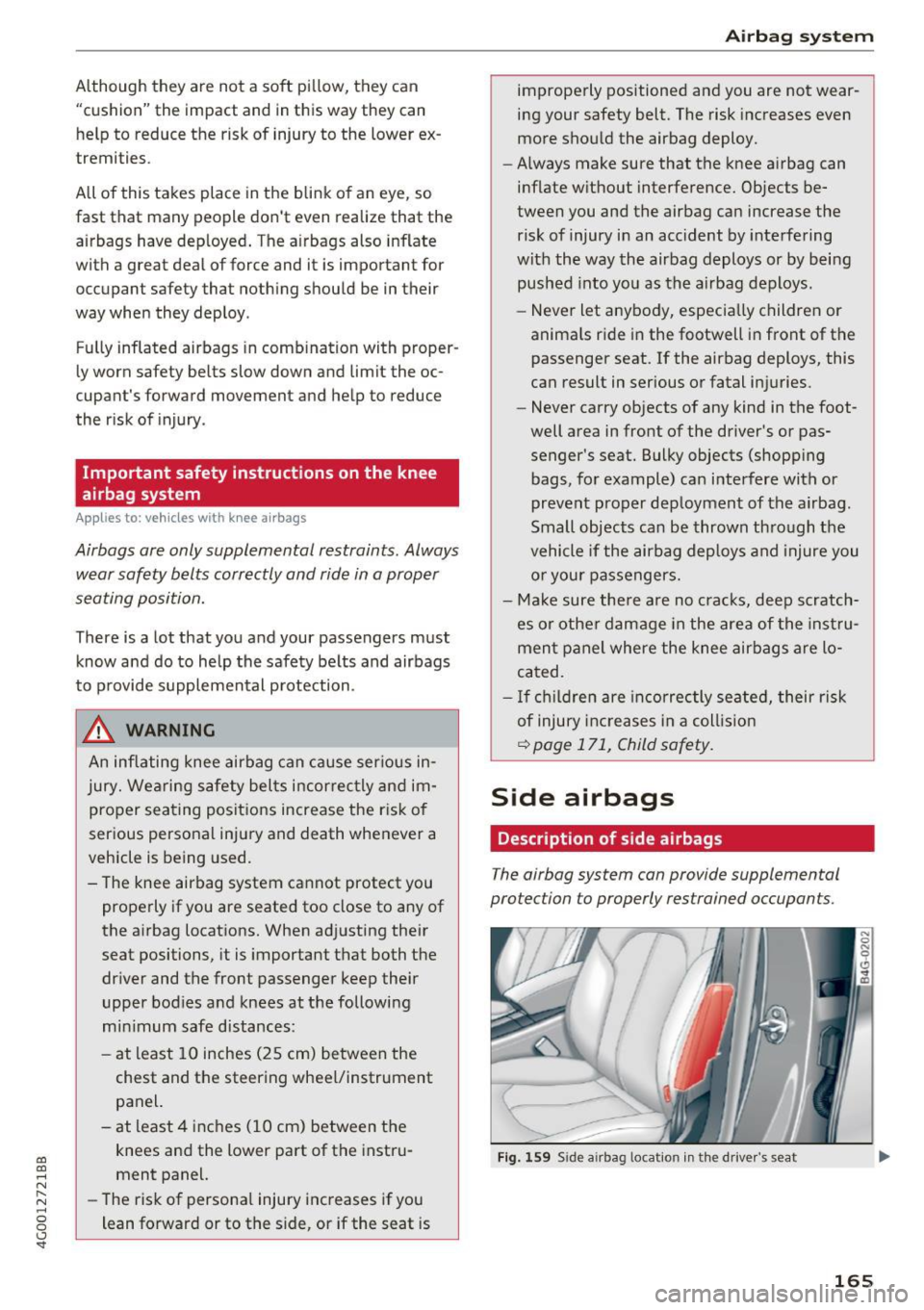
Description of side airbags
The airbag system can provide supplemental
pro tec tion to properly restrained occupan ts .
Fig . 1 59 Side a irbag locatio n in t he drive r's seat
165
Page 171 of 280
The side curtain airbag system supplements the
safety belts and can help to reduce the risk of in
jury for occupants' heads and upper torso. The
side curtain airbag inflates in side impacts and
only when the vehicle acce leration registered by
the control unit is high enough . If this rate is be
l ow the reference value programmed into the
control unit, the side curtain airbag will not be
tr iggered, even thoug h the car may be bad ly
damaged as a resul t of the collision.
It is not pos
sib le to define an airbag triggering range that
will cover every possible angle o f impact, since
the circumstances wi ll vary considerably between
one co llision and another. Important factors in
clude, for example, the nature (hard or soft) of
the impacting object, the angle of impact, vehicle speed, etc.
c> page 169, How side curtain air
bags work.
Aside from their normal safety function, safety
be lts work to help keep the driver or front pas
senger in posit ion in the event of a collision so
that t he side curta in airbags can provide protec
tion .
The airbag system is not a substitute for your
safety belt . Rather, it is part of the overall occu
pant restraint system in your veh icle . Always re
member that the airbag system can only help to
protect you if you are wearing your safety belt
and wear ing it properly . T his is another reason
why you should always wear your safety belts,
not just because the law requires you to do so
¢ page 139, General information.
It is important to remember that while the side
curta in airbag system is designed to help reduce
the likelihood of serious injuries, other injuries,
for example, swelling, bruising, friction burns
and minor abrasions can also be associated with
these airbags upon deployment . Remember too,
these airbags will deploy only once and only in
certa in kinds of accidents -your safety belts are
always there to offer protection .
The side curtain airbag system basically
consists of:
co ~ - The electronic control module and external s ide
N ~ impact sensors
.... 0 0 <.,;) 'SI"
Airbag system
- The side curta in airbags above the front and
rear side windows with ejection mitigation fea
tures
- The airbag indicator light in the instrument
panel
T he airbag system is mon itored electron ically to
make certain it is functioning properly at all
times. Each time you switch on the ignition, the
airbag system ind icator light wi ll come on for a
few seconds (self diagnostics) .
The side curtain airbag is not activated:
-if the ignition is switched off,
- in side collisions when the acceleration meas-
ured by the sensor is too low,
- in rear-end col lisions.
_& WARNING
- Safety belts and the airbag system will only
provide protection when occupants are in
the proper seating position
¢ page 50,
Seats and storage.
- If the airbag indicator light¢ page 17
comes when the vehicle is being used, have
the system inspected immediately
by your
author ized Audi dealer. It is possible that
the airbag will inflate when it is not sup
posed to, or w ill not inflate when it should.
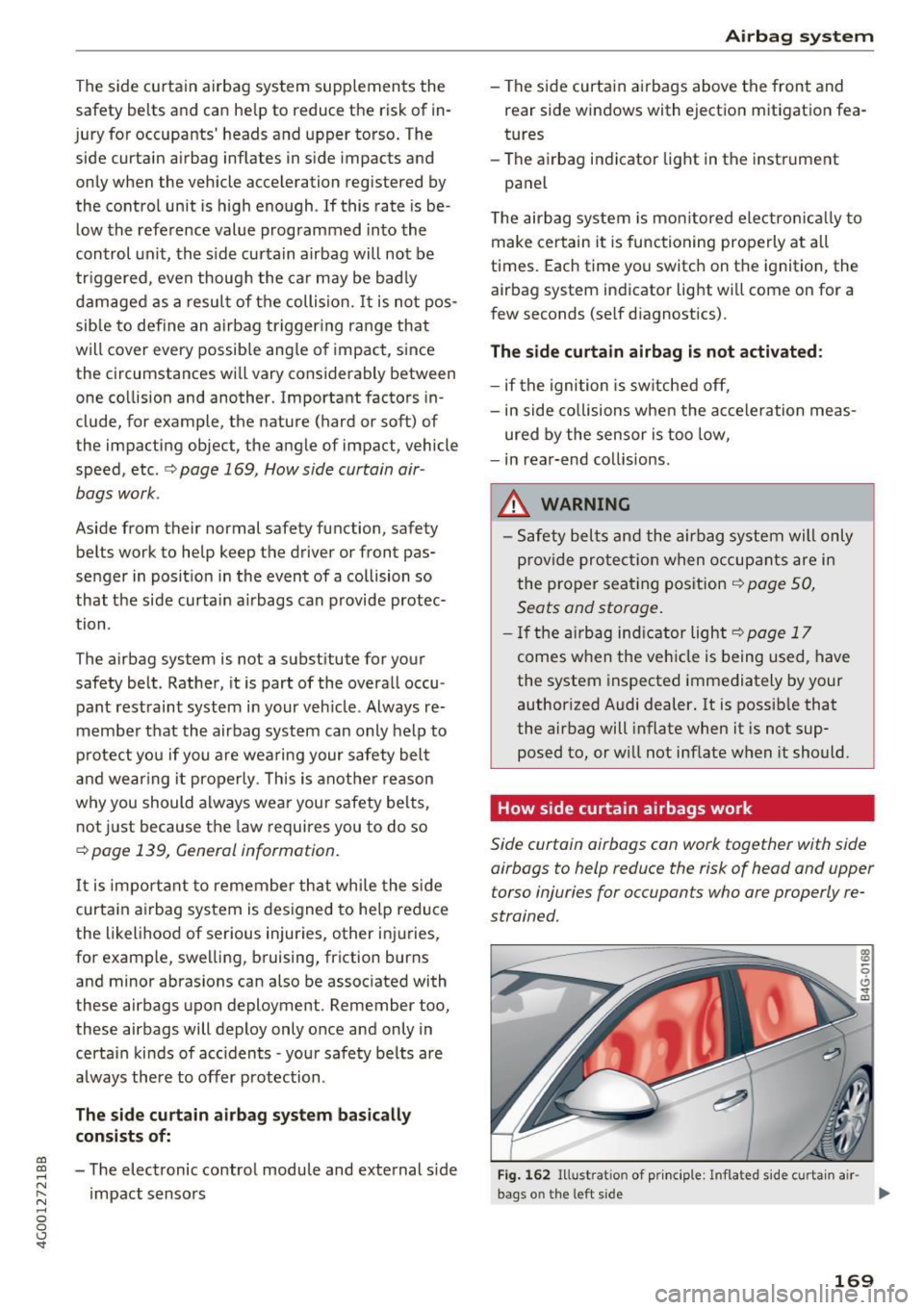
How side curtain airbags work
Side curtain airbags can work together with side
airbags to help reduce the risk of head and upper
torso injuries for occupants who are properly re
strained.
Fig. 162 Illustration of principle: Inflated s ide cu rta in air·
bags on the left s ide
Ill>
169
Page 175 of 280
co
co
.... N
" N .... 0 0 <..:l '
switched on.
- If the
PASSENGER AIR BAG OFF light
does not come on and stay on, immediate
ly install the forward-facing child seat in a
rear seating position and have the airbag
system inspected by your authorized Aud i
dealer.
- Always buckle the chi ld seat firmly in
p lace even if a ch ild is not sitt ing in it. A
loose child seat can fly around during a
sudden stop o r in a collision.
-Always read and heed all WARNINGS wheneve r using a child restraint in a vehi
cle <=>
page 139, Safety belts, <=> page 147,
Airbag system
and¢ page 171, Impor
tant information .
@ Tips
Always replace ch ild restraints that were in
stalled in a vehicle dur ing a crash. Damage to
a child restraint that is not visib le co uld cause
it to fail in anothe r collision situation .
Advanced front airbag system and children
Your vehicle is equipped with a front "Advanced
Airbag System" in compliance with United States
Federal Motor Vehicle Safety Standard (FMVSS)
208, as well as Canada Motor Vehicle Safety
Standard (CMVSS) 208 as applicable at the time
your veh icle was manufactured.
The Advanced Airbag system in your vehicle has
been certified to meet the "low-risk" require
ments for 3-and 6-year old children on the pas
senger side and small adults on the driver side .
The low risk deployment crite ria are intended to
reduce the risk of injury through inte raction with
the airbag that can occur, for examp le, by being
too close to the steering whee l and instrument
panel when the airbag inflates . In addition, the
system has been certified to comply with the
"suppression" req uirements of the Safety Stand
ard, to turn off the front airbag for infants up to
12 months who are restra ined on the front pas
senger seat in child restraints that are listed in
the Standard .
Child safety
Even though your vehicle is equipped with an Ad
vanced Airbag system, all chi ldren, especially
those 12 years and younger, should always ride
in the back seat properly restrained for their age
and size. The airbag on the passenger side makes
the front seat a potentia lly dangerous place for a
child to ride . The front seat is not the safest place
for a ch ild in a forward-fac ing ch ild safety seat .
It
can be a very dangerous place fo r an infant o r a
la rger ch ild i n a rea rwa rd-facing seat .
T he veh icle 's Advanced Airbag System has a ca
pacit ive passenger detection system in the front
passenge r seat cushion that can de tect the p res
ence of a baby or a ch ild in a child restra int sys
tem on this seat .
The capacitive passenger detection system reg is
te rs the changes that result in an electrical field
when a child, a ch ild restraint, and a baby b lan ket
are on the front passenger seat. The change in
the measured capacitance due to the presence of
a chi ld, a child restraint, and a baby blanket on
the front passenger seat is related to the child
restra int system resting on the seat. The meas
ured capacitance of a child restraint system var
ies depend ing on the type of system and specific
make and model.
The electrical capac itance of the various types,
makes, and models of child restraints specif ied
by the U .S.National Highway Traff ic Safety Ad
min istrat ion (NHTSA) in the relevant safety
standard are stored in the Advanced Airbag Sys
tem contro l unit together with the capacitances
typ ica l of infants and a 1-year old child. When a
child restraint is used on the front passenger
seat with a typical 1 year-old infant, the Ad
vanced Airbag System compares the capacitance
measured by the capacitive passenger detection
system with the data stored in the electronic con
trol unit .
Child restraints and Advanced front airbag
system
Regardless of the ch ild restrain t that yo u use,
make sure that it has been cer tified to meet Safe
ty Standards and has been cert ified by its manu-
facturer for use with an airbag. Always be sure ..,.
173
Page 202 of 280
Checking and Filling
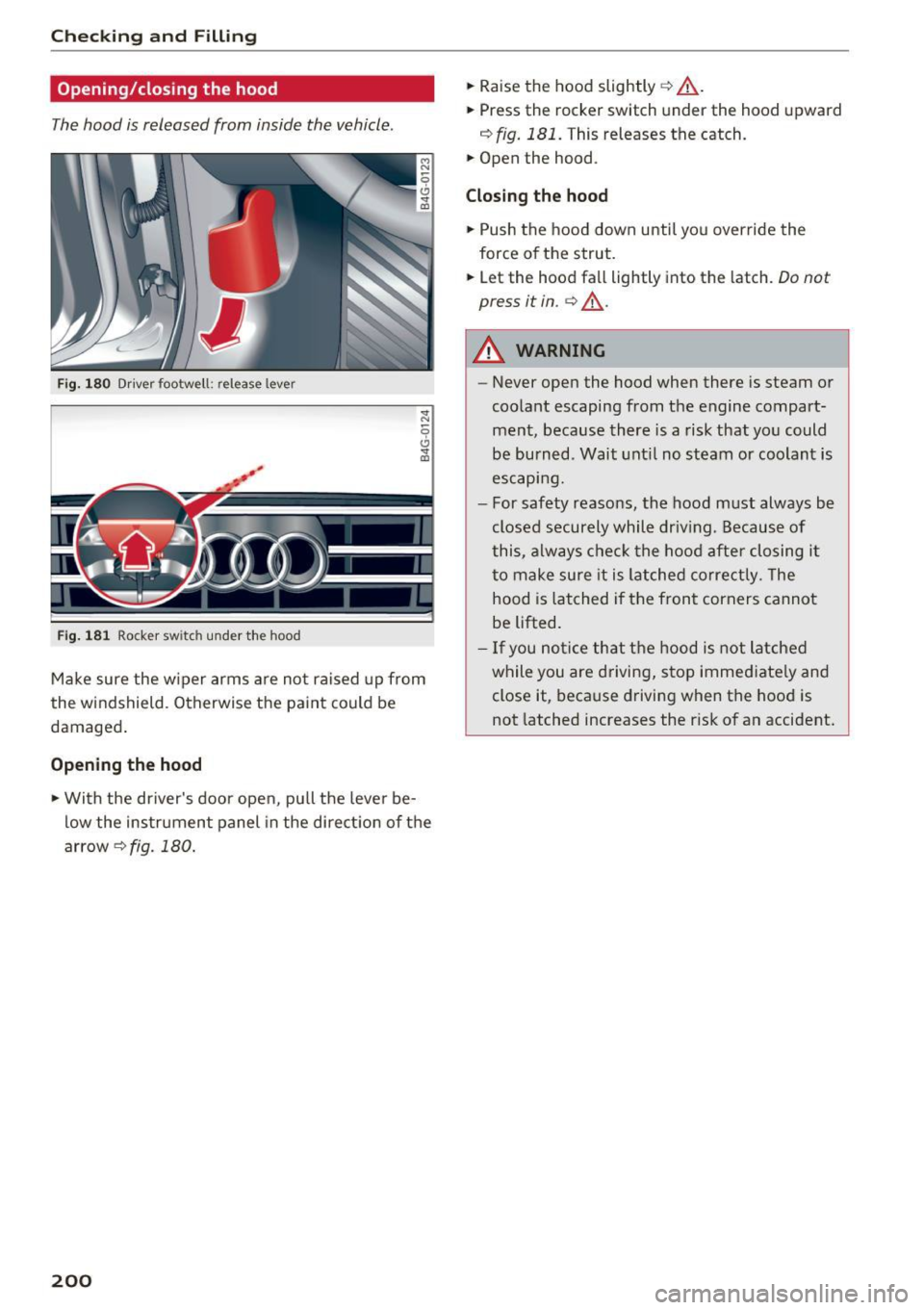
Opening/closing the hood
The hood is released from inside the vehicle .
Fig. 180 Driver footwell: release lever
Fig . 181 Rocker switch under the hood
Make sure the wiper arms are not raised up from
the windshield. Otherwise the paint could be
damaged .
Opening th e hood
• With the driver's door open, pu ll the lever be
low the instrument panel in the direction of the
arrow
c!;> fig. 180 .
200
• Raise the hood slightly c!;> &_ .
• Press the rocker switch under the hood upward
i=> fig. 181. This releases the catch.
• Open the hood .
Clos ing the hood
• Push the hood down until you override the
force of the s trut.
• Let the hood fall lightly into the latch .
Do not
press it in .
c> &_.
A WARNING
-Never open the hood when there is steam or
coolant escaping from the engine compart
ment, because there is a risk that you could
be burned. Wait unt il no steam or coolant is
escaping.
- For safety reasons, the hood m ust always be
closed securely while driv ing. Because of
this, always check the hood after closing it
to make sure it is latched correctly . The
hood is latched if the front corners cannot
be lifted.
- If you no tice that t he hood is not latched
while you are driving, stop immediate ly and
close it, because driving when the hood is
not latched increases the r isk of an accident.
Page 248 of 280
Fuses
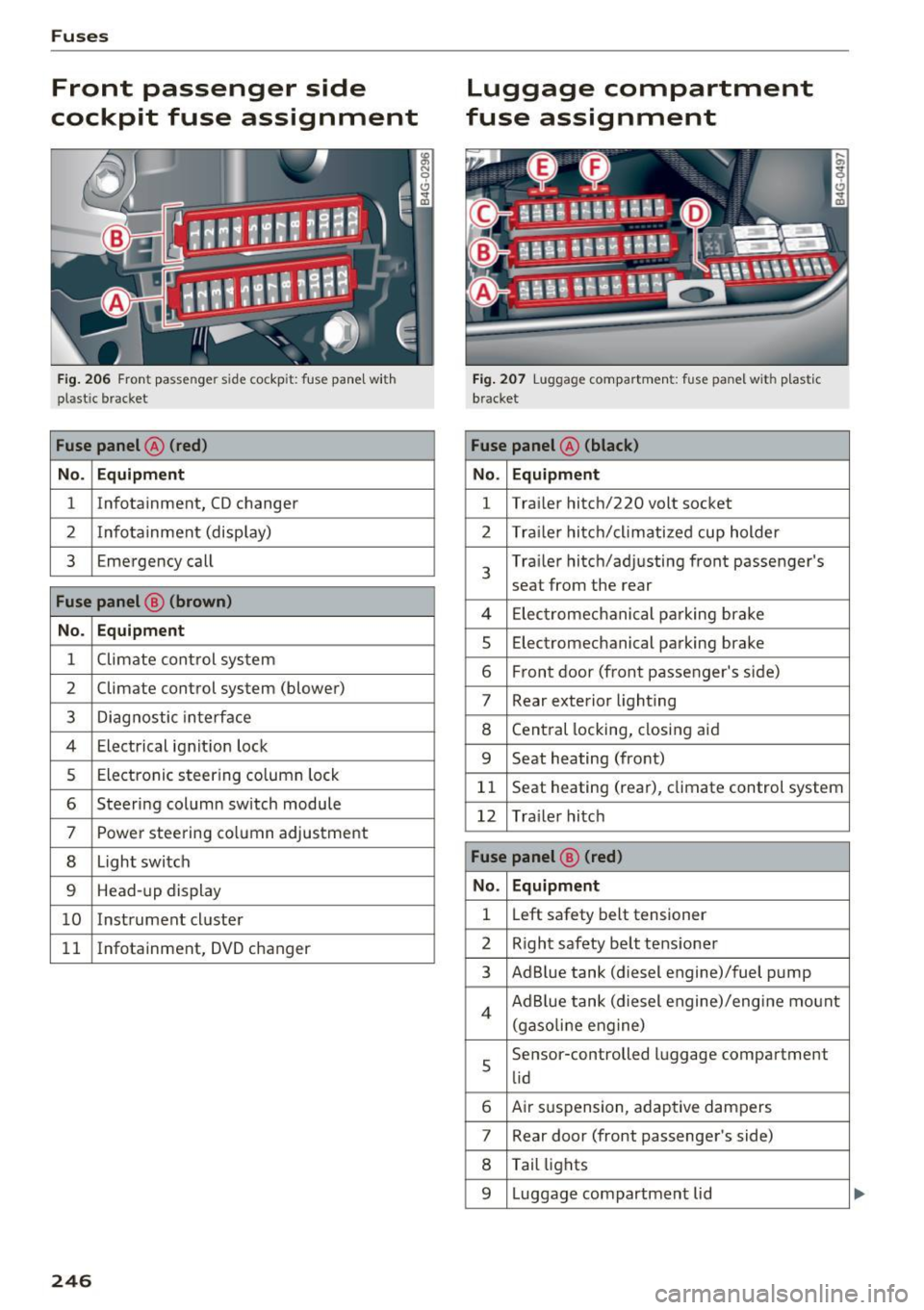
Front passenger side
cockpit fuse assignment
Fig. 206 Front passenger side cockpit: fuse panel wit h
plastic bracket
Fuse panel @ (red)
No. Equipm ent
1 Infotainment, CD changer
2 Inf
ota inment (display)
3 Emergency call
Fuse panel @ (brown)
No. Equipment
1 Climate control system
2 Climate control
system (blower)
3 Diagnostic interface
4 Electrical ignit ion lock
5 Electronic steering column lock
6 Steering column switch module
7 Power steering column adjustment
8 Light switch
9 Head-up display
10 Instrument cl uster
11 Infotainment, DVD
changer
246
Luggage compartment
fuse assignment
Fig. 207 Luggage compa rtme nt: fuse panel with plast ic
bracket
Fuse panel @ (black)
No . Equipment
1 Tra
iler hitch/220 volt socket
2 Trailer hitch/climatized cup holder
3
Trailer hitch/adjusting front passenger's
seat from the rear
4 El ec trom echan ical parking brake
5 Electromechanical parking brake
6 Front door (front passenger's side)
7 Rear exterior lighting
8 Central locking, closing aid
9 Seat heating (fro nt)
11 Seat heating
(rear), climate control system
12 Trailer hitch
Fuse panel @ (red)
No. Equipment
1 L
eft safety belt tensioner
2 Right safety belt tensioner
3 Ad Blue tank (diesel engine)/fuel pump
4 Ad Blue tank (diesel engine)/engi ne mount
(gaso lin e eng ine)
5
Se nsor-controlled luggage compartment
lid
6 Air suspension, adaptive dampers
7 Rear door (front passenger's side)
8 Tail lights
9 Luggage compartment lid