recommend AUDI A6 2017 Owner's Guide
[x] Cancel search | Manufacturer: AUDI, Model Year: 2017, Model line: A6, Model: AUDI A6 2017Pages: 280, PDF Size: 70.24 MB
Page 216 of 280
Wheel s
Maximum (permissible)
inflation pressure
means the max imum cold infla
tion pressure to which a t ire may
be inflated . Also called "maxi
mum inflation pressure."
Normal occupant weight
means 150 lbs. (68 k ilograms)
times the number of occupants seated in the vehicle up to the to
tal seating capacity of your vehi
cle .
Occupant distribution
means distribution of occupants
in a vehicle.
Outer d iameter
means the overall diamete r of an
inflated new tire.
Overall width
means the linear distance be
tween the exteriors of the side
walls of an inflated tire , including
elevations due to labeling, deco rations, or protective bands or
ribs .
Ply
means a layer of rubber-coated
para llel cords.
2 14
Production options we ight
means the combined weight of
those installed regular product ion
options weighing over 5 lbs . (2 .3
kg) in excess of those standard
items which they replace, not pre
viously considered in curb weight or accessory weight , including
heavy duty brakes, ride levelers,
roof rack, heavy duty battery, and
special trim.
Radial ply ti re
means a pneumatic tire in which
the ply cords that extend to the beads are la id at substantially 90
degrees to the centerline of the
tread.
Recommended inflation
pressure
see ¢ page 213 , Cold tire infla
tion pressure.
Reinforced tire
means a tire designed to operate
at higher loads and at higher in
flation pressures than the corre
sponding standard tire . Rein
forced tires may be identified as "XL", "xl", "EXTRA LOAD", or "RF"
on the sidewall. ...
Page 218 of 280
Wheels
comparisons among tires. The
UTQG is not a safety rating and not a guarantee that a tire will
last for a prescribed number of
miles (kilometers) or perform in a
certain way. It simply gives tire
buyers additional information to
combine with other considera
tions, such as price, brand loyalty
and dealer recommendations. Un
der UTQG, tires are graded by the
tire manufacturers in three areas:
treadwear, traction, and tempera
ture resistance. The UTQG i nfor
mation on the tires, molded into
the sidewalls .
U.S. DOT Tire Identification
Number (TIN)
This is the tire's "serial number".
It begins with the letters "DOT"
and indicates that the tire meets
all federal standards. The nex t
two numbers or letters indicate
the plant where it was manufac
tured, and the last four numbers represent the week and year of
manufacture. For example,
DOT ... 2216 ...
means that the tire was produced
in the 22nd wee k of 2016. The
other numbers are marketing co
des that may or may not be used
2 16
by the t ire manufacturer . This in
formation is used to contact con
sumers if a tire defect requ ires a
recall.
Vehicle capacity weight
means the rated cargo and lug
gage load pl us 150 lbs. (68 k ilo
grams) times the vehicle's desig na ted seating capacity .
Vehicle maximum load on the
tire
means that load on an individual
tire that is determined by distrib
uting to each axle its sha re of the
maximum loaded vehic le we ight
and dividing
by two.
Vehicle normal load on the tire
means that load on an individual
tire that is determined by d istrib
ut ing to each axle its share of the
curb weight, accessory weight,
and normal occupan t weight (dis
tr ibuted in accordance with ¢
ta
ble on page 222) and dividing by
two.
Occupant loading and distri bution for vehicle normal load
for various designated seating capacities
Refer to the tire inflation p res -
sure label¢
page 220, fig. 191 .,.
Page 219 of 280

a,
a,
..... N ,.__ N ..... 0
s ..
for the number of seating posi
tions. Refer to the table ¢
table
on page 222
for the number of
people that correspond to the ve
hicle normal load.
New tires or wheels
Audi recommends having all work on tires or wheels performed by
an author ized Audi dealer or au
thorized Audi Service Facility.
These facilities have the proper
knowledge and are equipped with
the required tools and replace
ment parts.
.,.New tires do not yet have the
optimum gripping properties. Drive carefully and at moderate
speeds for the first 350 miles
(500 km) with new tires.
.,.Use tires of the same construc
tion, size (rolling circumference)
and as close to the same tread
pattern as possible on all four
wheels.
.,.Do not replace tires individually .
At least replace both tires on the
same axle at the same time.
.,.Audi recommends that you use
Audi Original Tires. If you would
like to use different tires, please
note that the tires may perform
Wheels
differently even if they are the
same size¢.&,. .
.,. If you would like to equip your
vehicle with a tire/rim combina
tion that is different from what
was installed at the factory, con
sult with an authorized Audi
dealer or authorized Audi Service
Facility before making a pur
chase¢ .&,..
The spare tire* is different from
the regular tires installed on the
vehicle -for example, if winter
tires or wide tires are installed -
so only use the spare tire* tempo
rarily in case of emergency and
drive carefully while it is in use . It
should be replaced with a regular
tire as soon as possible.
Applies to: vehicles with all whee l dr ive
All four wheels must be equipped
with tires that are the same brand
and have the same construction
and tread pattern so that the drive system is not damaged by
different tire speeds. For this rea
son, in case of emergency, only
use a spare tire* that is the same
circumference as the regular
tires. ,..
217
Page 223 of 280
-The tire must flex more if the
tire pressure is too low or if
the vehicle speed or load are
too high. This heats the tire up
too much . This increases the
risk of an accident because it
can cause the tire to burst and result in loss of vehicle con
trol.
-Incorrect tire pressure in
creases tire wear and has a
negative effect on driving and
braking behavior, which in
creases the risk of an accident .
(D Note
Replace lost valve caps to re
duce the risk of damage to the
tire valves.
Tire pressure table
Please note that the information
contained in the following table
was correct at the time of print ing, and the information is sub
ject to change. If there are differ
ences between this information
and the tire pressures specified
on the label on the driver's side B
pillar, always follow the specifica
tion on the B -pillar label
! ¢ page 220, fig. 190. N r-. N ..... 0
s ..
Wheels
'® For the sake of the environment
Tire pressure that is too low in
creases fuel consumption .
Audi recommends using the
tire pressure specified for a normal load
¢ table on
page 222
or for a full load
when the vehicle is partially loaded.
Make sure that the tire designa
tion on your tire matches the des ignation on the tire pressure label
and the tire pressure table.
The following table lists recom mended tire pressures in cold
tires according to the load and
the size of the tires installed . ..
221
Page 229 of 280
co
co
.... N
" N .... 0
In o rder to minimize the oc currence of impact
damage to the tires of your vehicle, we recom mend that you observe the fo llow ing
precautions:
- Always maintain recommended inflation pres
sures. Check your tire pressure every 2,000
miles (3,000 km) and add a ir if necessary .
- Drive carefully on roads with potho les, deep
gullies or ridges. The impact from driving
through or over such obstacles can damage
your tires . Impact w ith a curb may also cause
damage to your tires.
- After any impact, immediately inspect your
tires or have them inspected by the nearest au
thorized Aud i dealer . Replace a damaged tire as
soon as poss ible .
- Inspect your t ires every 2 ,000 miles (3,000 km)
for damage and wear . Damage is not always
easy to see . Damage can lead to loss of a ir and
underinflation , which cou ld eventually cause
t ir e failure. If you be lieve tha t a tire may have
been damaged, replace the t ire as soon as pos
s ible.
= T hese tires may wear more q uick ly than othe rs.
- Please a lso remember that, while these tires
deliver responsive hand ling, they may r ide less
comfortab ly and ma ke more no ise th an other
cho ices .
Reduced performance in winter /cold season
condit ions
All t ires are desig ned fo r ce rtain pur poses. The
l ow aspect ratio, ul tra high performance t ires
originally insta lled on you r vehicle a re intended
for maximum dry and wet road performance and handling. They are not s uitable for cold, snowy or
icy weather cond it ions. If you dr ive under those
circumstances, you shou ld equ ip your ve hicle
with a ll-season or winter tires, wh ic h offer better
traction under those condit ions . We suggest you
use the recommended snow or all-season tires
specified fo r you r vehicle , or the ir equivalent.
Refer to¢
page 225 for more detailed informa
tion rega rding winter tires .
Uniform tire quality grading
8 -Tread wea r '
-Traction AA ABC
- Tempe ra tu re ABC
Quali ty g rades can be found where applicable o n
the tire side wall be tween tread shoulder and
max imum sec tion width
¢ page 210, fig . 188.
For example: Tread wear 200 , Traction AA, Tem
perature
A .
All passenger car ti res must conform to Federal
Safety Requiremen ts in addit io n to these grades .
Tread wear
The tread wear grade is a comparative rating
based on the wea r rate of the tire when tested
u nder controlled cond it ions on a specif ied gov
ernment test course.
F or example , a tire graded 1 50 wou ld wear one
and one half (1 1/2) times as we ll on the govern
ment course as a t ire graded 100 .
T he re lative performance of tires depends upon
t h e actual conditions of thei r use, however, and
may depa rt sig nificantly from the norm due to
variations in driv ing habits , service practices and
differences in road character istics and cli mate.
Traction
The traction grades, from highest to lowest, a re
AA , A, Band
C. Those grades represent t he tire 's
ability to stop o n we t pavement as measured un
der controlled cond itions on specified govern
ment test surfaces of asphalt and concrete. A tire
marked C may have poor traction performance
¢ ,&. .
Temperature
The temperature grades are A (the highest), B,
and C, representing the tire's resistance to the
generat ion of heat and its abi lity to dissipate
heat when tested u nder cont rolled conditions on
a specified indoor laboratory test wheel.
Sustained h igh temperatu re can cause the mate
rial of the tire to degenerate and reduce tire life,
and excessive tempe rature can lead to s udden
t ire failure ¢,&. . .,.
227
Page 230 of 280
Wheels
The grade C corresponds to a level of perform
ance which all passenger car tires must meet un
der the Federal Motor Vehicle Safety Standard No.
109. Grades B and A represent higher levels
of performance on the laboratory test wheel than
the minimum required by law.
A WARNING
The traction grade assigned to this tire is
based on straight-ahead braking traction
tests, and does not include acceleration, cor
nering, hydroplaning or peak traction charac
teristics.
A WARNING
The temperature grade for this tire is estab
lished for a tire that is properly inflated and
not overloaded. Excessive speed, underinfla
tion, or excessive loading, either separately or
in combination, can cause heat buildup and
possible tire failure.
A WARNING
Temperature grades apply to tires that are properly inflated and not over or underinflat
ed.
Tire pressure monitoring system
CD General notes
Each tire, including the spare (if provided),
should be checked monthly when cold and inflat
ed to the inflation pressure recommended by the
vehicle manufacturer on the vehicle placard or
tire inflation pressure label. (If your vehicle has
tires of a different size than the size indicated on
the vehicle placard or tire inflation pressure la
bel, you should determine the proper tire infla
tion pressure for those tires).
As an added safety feature, your vehicle has been
equipped with a tire pressure monitoring system
(TPMS) that illuminates a low tire pressure tell
tale when one or more of your tires is significant ly under-inflated. Accordingly, when the low tire
pressure telltale illuminates, you should stop and
228
check your tires as soon as possible, and inflate
them to the proper pressure . Driving on a signifi
cantly under-inflated tire causes the tire to over
heat and can lead to tire failure. Under-inflation
also reduces fuel efficiency and tire tread life,
and may affect the vehicle's handling and stop ping ability.
Please note that the TPMS is not a substitute for
proper tire maintenance, and it is the driver's re
sponsibility to maintain correct tire pressure, even if under-inflation has not reached the level
to trigger illumination of the TPMS low tire pres
sure tel ltale.
Your vehicle has also been equipped with a TPMS
malfunction indicator to indicate when the sys
tem is not operating properly. The TPMS mal
function indicator is combined with the low t ire
pressure telltale. When the system detects a
malfunction, the telltale will flash for approxi
mately one minute and then remain continuously
illuminated. This sequence will continue upon
subsequent vehicle start-ups as long as the mal
function exists.
When the malfunction indicator is illuminated,
the system may not be able to detect or signal
low tire pressure as intended. TPMS malfunctions
may occur for a variety of reasons, including the
installation of replacement or alternate tires or
wheels on the veh icle that prevent the TPMS
from functioning properly. Always check the
TPMS malfunction telltale after replacing one or more tires or wheels on your vehicle to ensure
that the replacement or alternate tires and
wheels allow the TPMS to continue to function
properly.
Page 231 of 280
Tire pressure monitoring system
Applies to: vehicles with Tire Pressure Monitoring System in
dicator
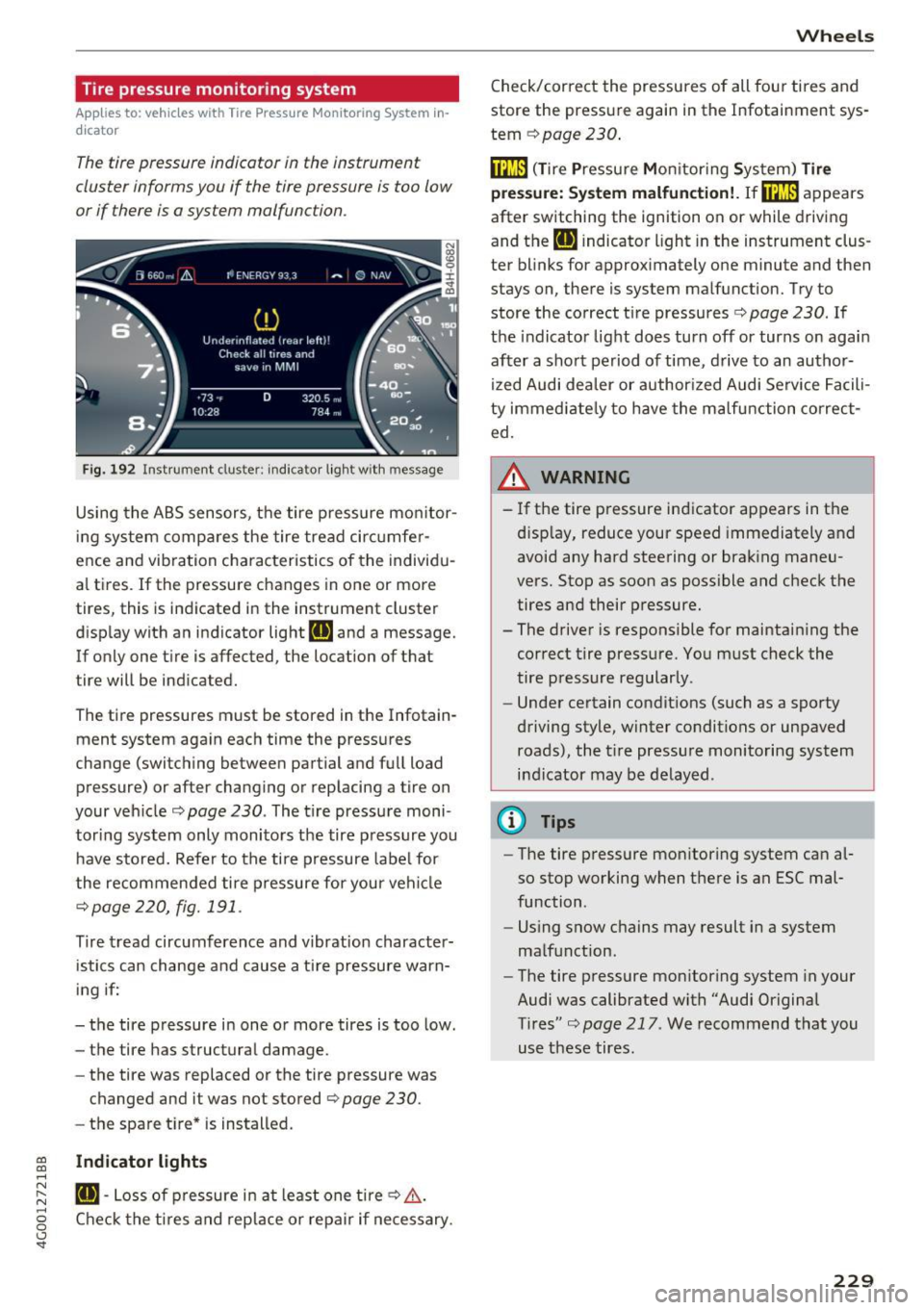
The tire pressure indicator in the instrument
cluster informs you if the tire pressure is too low
or if there is a system malfunction .
Fig. 192 Instrument clus ter : indicator ligh t w ith message
Using the ABS sensors, the tire pressure monitor
ing system compares the tire tread circumfer
ence and vib ration characteristics of the individu
al tires.
If the pressure changes in one or more
tires, this is indicated in the instrument cluster
display with an indicator light
RE and a message.
If only one tire is affected, the location of that
tire will be indicated.
The tire pressures must be stored in the Infotain
ment system again each time the pressures
change (switching between partial and full load pressure) or after changing or replacing a tire on
your vehicle ¢
page 230 . The tire pressure moni
toring system only monitors the tire pressure you have stored. Refer to the tire pressure label for
the recommended tire pressure for your vehicle
¢page 220, fig.191 .
Tire tread circumference and v ibration character
istics can change and cause a tire pressure warn
ing if:
- the tire pressure in one or more tires is too low.
- the tire has structural damage.
- the tire was replaced or the tire pressure was
changed and it was not stored
¢ page 230.
- the spare tire* is installed.
~ Indicator lights ....
~ RE-Loss of pressure in at least one tire¢,&,. . ....
g Check the tires and replace or repair if necessary.
<.,;) 'SI"
Wheels
Check/correct the pressures of all four tires and
store the pressure again in the Infotainment sys
tem
¢ page 230 .
fflm (T ire Pressure Monitoring System) Tire
press ure: System malfunction!.
Ifffi:m appears
after switching the ignition on or while driving
and the
RE indicator light in the instrument clus
ter blinks for approximately one minute and then
stays on, there is system malfunction. Try to
store the correct tire pressures¢
page 230. If
the indicator light does turn off or turns on again
after a short period of time , drive to an author
ized Audi dealer or author ized Audi Service Facili
ty immediately to have the malfunction correct
ed.
_& WARNING ,..___
- If the tire pressure indicator appears in the
d isplay, reduce your speed immediately and
avoid any hard steering or braking maneu
vers. Stop as soon as possible and check the
tires and their pressure.
- The driver is responsible for maintaining the
correct tire pressure. You must check the
tire pressure regularly.
- Under certain conditions (such as a sporty
driving style, winter conditions or unpaved roads), the tire pressure monitoring system
indicator may be delayed .
@ Tips
-The tire pressure monitoring system can al
so stop working when there is an ESC mal
function .
- Using snow chains may result in a system
malfunction.
- The tire pressure monitoring system in your
Audi was calibrated with "Audi Original
Tires"¢
page 217 . We recommend that you
use these tires.
229
Page 244 of 280
Emergency assistance
-If the spare tire has to be installed in the incor
rect direction, use the spare tire only tempora
rily since the tire w ill not be able to achieve its
optimum performance characteristics with re
gard to aquaplaning, noise and wear.
- We recommend that you pay particular atten
tion to this fact during wet weather and that
you adjust your speed to match road condi
tions.
- Replace the flat tire with a new one and have it
installed on your vehicle as soon as possible to
restore the handling advantages of a unidirec
tional tire .
Notes on wheel changing
Please read the informat ion ~ page 217, New
tires or wheels
if you are going to use a spare tire
which is different from the tires on your vehicle.
After you change a tire:
-Check the tire pressure on the spare tire im
mediately after installation.
- Have the wheel bolt tightening torque
checked with a torque wrench as soon as pos
sible by your authorized Audi dealer or a
qualified service station .
- With steel and alloy wheel rims, the wheel
bolts are correctly tightened at a torque of 90
ft lb
(120 Nm) .
- If you notice that the wheel bolts are corroded
and difficult to turn while changing a tire,
they should be replaced before you check the
tightening torque.
- Replace the flat tire with a new one and have
it installed on your vehicle as soon as possi
ble. Remount the wheel cover.
Until then, drive with extra care and at reduced
speeds.
_& WARNING
- If you are going to equ ip your vehicle with
tires or rims which differ from those which
were factory installed, then be sure to read
the information
~ page 217, New tires or
wheels .
242
-Always make sure the damaged wheel or
even a flat tire and the jack and tool kit are
proper ly secured in the luggage compart
ment and are not loose in the passenger
compartment.
- In an accident or sudden maneuver they
could fly forward, injuring anyone in the
ve
hicle.
- Always store damaged w heel, jack and tools
securely in the luggage compartment. Oth
erwise, in an accident or sudden maneuver
they could fly forward, causing in jury to pas
sengers in the vehicle.
Spare tire
Space-saving spare tire
App lies to : vehicles wit h spare tire
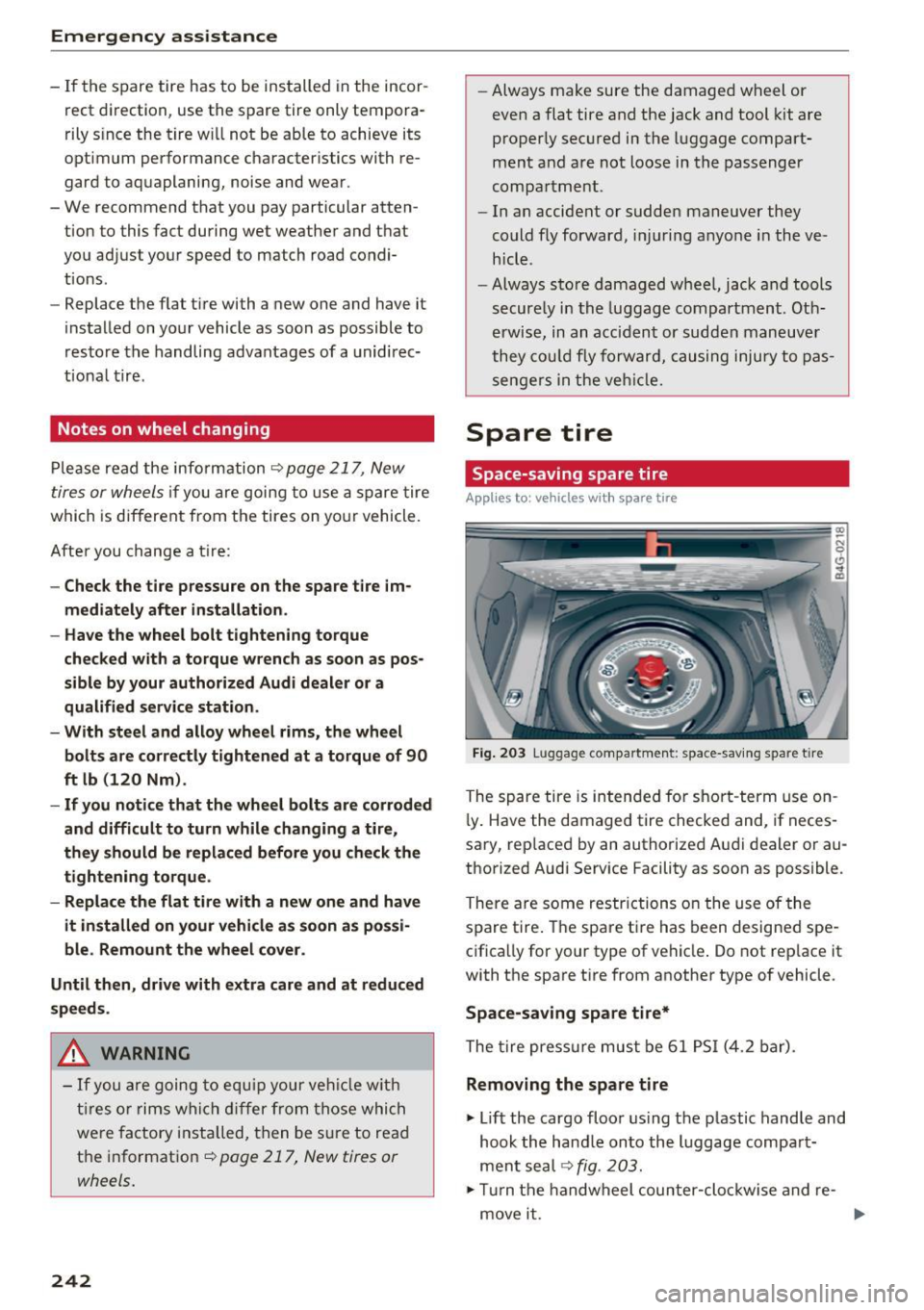
Fig. 203 Luggage com partment: space-sav ing spare t ire
The spare tire is intended for short -term use on
l y . Have the damaged tire checked and, if neces
sary, replaced by an authorized Audi dealer or au
thorized Audi
Serv ice Facility as soon as possible .
There are some restr ictions on the use of the
spare tire. The spare tire has been designed spe
cifica lly for your type of vehicle . Do not replace it
with the spare tire from another type of vehicle .
Space-saving spare tire*
The tire pressure must be 61 PSI (4.2 bar).
Removing the spare tire
"' Lift the cargo floor using the plastic handle and
hook the hand le onto the luggage compa rt
ment seal
~fig . 203.
"'Tur n the handwheel counter-clockwise and re
move it.
Page 250 of 280
Bulbs
Bulbs
Replacing light bulbs
For your safety, we recommend that you have
your authori zed Audi dealer replace burned out
bulbs for you.
It
is becoming increasingly more and more diffi
cult to replace vehicle light bulbs since in many
cases, other parts
of the car must first be re
moved before you are able to get to the bulb.
This applies especially to the light bulbs in the
front of your car which you can only reach
through the eng ine compartment.
Sheet metal and bulb holders can have sharp
edges that can cause serious cuts, and parts must be correctly taken apart and then properly
put back together to help prevent breakage of
parts and long term damage from water that can
enter housings that have not been properly re
sealed.
For your safety, we recommend that you have
your author ized Audi dealer replace any bulbs for
you, since your dealer has the proper tools, the
correct bulbs and the expertise .
Gas discharge lamps (Xenon lights):
Due to the high electrical voltage, have the bulbs
replaced by a qualified technic ian . Headlights
with Xenon light can be identified by the high
voltage sticker.
LED headlights*
LED headlights require no maintenance. Please
contact your authorized Audi dealer if a bulb needs to be replaced.
A WARNING
Contact w ith high-voltage components of the
electrical system and improper replacement
of gas d ischarge (Xenon) headlight bulbs can
cause se rious personal injury and death.
- Xenon bulbs are pressurized and can ex
plode when be ing changed .
- Chang ing Xenon lamps requires the spec ial
training, instructions and equipment .
248
-Only an authorized Audi dealer or other
qualified workshop should change the bu lbs
in gas discharge lamps.
A WARNING
There are parts with sharp edges on the open
ings and on the bulb holders that can cause
serious cuts .
- If you are uncertain about what to do, have
the work performed by an authorized Audi
dealer or other qualified workshop . Ser ious
personal injury may result from improperly
performed work.
(D Tips
- If you still prefer to replace the light bulbs
yourself, be aware that the engine compart
ment is a hazardous area to work in
~page 198~.&.
- It
is best to ask your authorized Audi dealer
whenever you need to change a bulb.
Page 263 of 280
co
co
.... N
" N .... 0 0 <..:l '
-Changing the engine settings will adversely
affect emission levels. This is detrimental to
the environment and increases fuel con
sumption.
-Always observe environmental regulations when disposing of old engine oil, used brake
fluid, dirty engine coolant, spent batteries
or worn out tires.
- Undeployed airbag modules and pretension
ers might be classified as Perchlorate Mate
rial -special handling may apply, see
www .dtsc.ca.gov/hazardouswaste/perchlo
rate. When the vehicle or parts of the re
straint system including airbag modules
safety belts with pretensioners are scrap
ped, all applicable laws and regulations
must be observed. Your authorized Audi
dealer is familiar with these requirements
and we recommend that you have your deal er perform this service for you.
Accessories and
technical changes
Additional accessories and parts replacement
Always consult on authorized Audi dealer before
purchasing accessories.
Your vehicle incorporates the latest safety design
features ensuring a high standard of active and passive safety.
This safety could be compromised by non-ap proved changes to the vehicle. For this reason, if
parts have to be replaced, please observe the fol
lowing points when installing additional accesso
ries:
Approved Audi accessories and genuine Audi parts are available from authorized Audi dealers.
These dealers also have the necessary facilities, tools and trained specialists to install the parts
and accessories properly .
Consumer information
A WARNING
Using the wrong spare parts or using non-ap
proved accessories can cause damage to the
vehicle and serious personal injury.
- Use only accessories expressly approved by
Audi and genuine Audi spare parts
- These parts and accessories have been spe
cially designed to be used on your vehicle.
- Do not use license plate brackets in the
front area that are different from the one
installed at the factory, or add additional li
cense plate brackets.
- Never install accessories such as telephone
cradles or beverage holders on airbag covers
or within the airbag deployment zones. Do
ing so will increase the risk of injury if air
bags are triggered in an accident!
- Before you check anything in the engine
compartment, always read and heed all
WARNINGS Qpoge 198.
(D Note
-If items other than genuine Audi spare
parts, add-on equipment and accessory
items are used or if repair work is not per
formed according to specified methods, this
can result in severe damage to your vehi
cle's engine and body (such as corrosion)
and adversely affect your vehicle's warranty.
- If emergency repairs must be performed
elsewhere, have the vehicle examined by an
authorized Audi dealer as soon as possible.
- The manufacturer cannot be held liable for
damage which occurs due to failure to com
ply with these stipulations.
Technical Modifications
Our guidelines must be complied with when tech
nical modifications ore mode.
Always consult an authorized Audi dealer
before
starting work on any modifications.
This will help ensure that vehicle function, per
formance and safety are not impaired
Q ,&.
261