recommend AUDI A6 2017 Owner's Manual
[x] Cancel search | Manufacturer: AUDI, Model Year: 2017, Model line: A6, Model: AUDI A6 2017Pages: 280, PDF Size: 70.24 MB
Page 148 of 280
Safety belts
(D Tips
The pyrotechnic safety be lt pretensioners can
only deploy once.
- The safety belt pretensioners do not deploy
in minor frontal, side and rear-end co lli
sions.
- A fine dust is released when the pyrotechnic
safety be lt pretensioners deploy. This is nor
mal and is not caused by a fire in the vehi
cle.
- The relevant safety requirements must be
observed when the vehicle or components
of the system are scrapped. A qualified
dealership is familiar with these regulations
and will be pleased to pass on the informa
tion to you.
- Be sure to observe all safety, environmental
and other regulations if the veh icle or indi
v idual parts of the system, pa rticula rly the
safety be lt o r airbag, are to be disposed . We
recommend you have your authorized Audi
dealer perform this service for you.
Service and disposal of safety belt preten
sioner
The safety belt pretensioners are parts of the
safety belts on your Audi. Installing, removing,
servicing or repairing of belt pretensioners can
damage the safety belt system and prevent it
from working correctly in a collision.
There are some important things you have to
know to make sure that the effectiveness of the
system w ill not be impaired and that discarded
components do not cause injury or pollute the
environment.
_& WARNING
Improper care, servicing and repair proce
dures can increase the risk of personal injury
and death by preventing a safety belt preten
sioner from activating when needed or acti
vating it unexpectedly :
- The belt pretensioner system can be activat
ed only once.
If belt pretensioners have
been act ivated, the system must be re
placed .
146
-Never repair, adjust, or change any parts of
the safety belt system .
- Safety belt systems including safety belt
pretensioners cannot be repaired . Spec ial
procedures are required for removal, instal
lation and disposal of this system.
- For any work on the safety belt system, we
strongly recommend that you see your au
thorized Audi dealer or qualified technician
who has an Audi approved repa ir manual,
tra ining and special equipment necessary .
@) For the sake of the environment
Undeployed airbag modules and pretension
ers might be classified as Perchlorate Materi
al -special handling may apply, see
www .dtsc.ca .gov/hazardouswaste/perchlo
rate. When the vehicle or parts of the re
straint system including airbag modules safe
ty belts with pretensioners are scrapped, all
applicable laws and regulations must be ob
served. Your authorized Audi dealer is familiar
with these requirements and we recommend
that you have your dealer perform this service
for you.
Page 152 of 280
Airbag syste m
Always remember, a child seat or infant carrier
installed on the front seat may be struck and
knocked out of position by the rapidly inflating
passenger's airbag in a frontal collision. The air
bag could greatly reduce the effectiveness of the
child restraint and even seriously injure the child
during inflation.
For this reason, and because the back seat is the
safest place for children -when properly restrain
ed according to their age and size -we strongly
recommend that children always sit in the back
seat
¢ page 171, Child safety.
.8, WARNING
A child in a rearward-facing chi ld seat insta l
led on the front passenger seat will be ser i
ously injured and can be killed if the front air
bag inflates -even with an Advanced Airbag
System.
- The inflating airbag will hit the child seat or
infant carrier with great force and will
smash the chi ld seat and child against the
backrest, center armrest, door or roof.
- Always install rear-facing child seats on the
rear seat.
- If you must install a rearward facing chi ld
seat on the front passenger seat because of
exceptional c ircumstances and the
PASS EN
G ER AIR BA G OFF
light does not come on
and stay on, immediately install the rear
facing child seat in a rear seating position
and have the airbag system inspected by
yo ur Audi dealer.
- Forward-facing ch ild seats insta lled on the
front passenger's seat may interfe re with
the deployment of the airbag and cause se
rious persona l injury to the child.
.8, WARNING
If, in except ional circumstances, you must in
stall a forward-facing chi ld restraint on the
front passenger's seat:
- Always make sure the forward-facing se at
has been designed and certified by its man
ufacturer for use on a front seat with a pas
senger front and side airbag .
150
-
-Never put the fo rward-facing child restraint
up against or very near the instrument pan
el.
- Always move the front passenger seat to
the highest posit ion in the up and down ad
justment range and move it back to the
rearmost posit ion in the seat's fore and aft
ad justment range, as far away from the a ir
bag as poss ible, before install ing the for
ward-facing chi ld restrain t.
- Always make sure that the safety be lt upper
anchorage is behind the ch ild rest raint and
not next to o r in fron t of the child rest raint
so that the safety be lt will be properly posi
tioned.
- Ma ke sure that the
PASSENGER AIR BAG
OFF
light comes on and stays on a ll the time
wheneve r the ignit ion is switched on .
.8, WARNING
-
To reduce the risk of serious injury, make sure
that the
PASSENGER AIR BAG OFF light will
be d isp layed whenever a ch ild restraint is in
stalled on the front passenge r seat and the
ignit ion is switched on.
- If the
PASSENGER AIR BA G OFF light does
not stay on, perform the checks described
¢ page 159, Monitoring the Advanced Air
bag System .
-Take the child restraint off the front passen
ger seat and install it properly at one of the
rear seat positions if the
PASSENGER AIR
BAG OFF
light does not stay on.
- Have the airbag system inspected by your
Aud i dea le r i mmediately.
- Always carefully follow instructions from child restraint manufacture rs when instal
ling child restra ints .
.8, WARNING
If, i n exceptional ci rcumstances, you must in
stall a forward or rearward-fac ing child re
stra int on the front passenger's seat:
- Improper installat ion of child restraints can
reduce the ir effectiveness or even preven t
them from provi ding any pro tect ion .
Page 164 of 280
Airbag system
-If, in exceptional circumstances, you must
install a forward-facing child restraint on
the front passenger seat, always move the
seat into its rearmost position in the seat 's
fore and aft adjustment range , as far away
from the airbag as possible . The backrest
must be adjusted to an upright position.
- Make sure that the
PASSENGER AIR BAG
OFF
light comes on and stays on all the time
whenever the ignition is switched on.
_& WARNING
-If the PASSENGER AIR BAG OFF light does
not go out when an adult is sitting on the
front passenger seat after taking the steps
described above, make sure the adult is
properly seated and restrained at one of the
rear seating positions .
- Have the airbag system inspected by your
Audi dealer before transporting anyone on
the front passenger seat .
@ Tips
If the capacitive passenger detection system
determines that the front passenger seat is
empty, the frontal airbag on the passenger
side will be turned
off, and the PASSENGER
AIR BAG OFF
light will stay on.
Repair , care and disposal of the airbags
Parts of the airbag system are installed at many
different places on your Audi. Installing , remov
ing, servicing or repairing a part in an area of the
vehicle can damage a part of an airbag system
and prevent that system from working properly
in a collision .
There are some important things you have to
know to make sure that the effectiveness of the
system will not be impaired and that discarded
components do not cause injury or pollute the
environment.
A WARNING
Improper care, servicing and repair proce
dures can increase the risk of personal injury
and death by preventing an airbag from de-
162
ploying when needed or deploying an airbag
unexpectedly :
- Never cover, obstruct, or change the steer
ing wheel horn pad or airbag cover or the in
strument panel or modify them in any way .
- Never attach any objects such as cup holders
or telephone mountings to the surfaces cov
ering the airbag units .
- For cleaning the horn pad or instrument
panel, use only a soft, dry cloth or one mois
tened with plain water. Solvents or cleaners could damage the airbag cover or change
the stiffness or strength of the material so
that the airbag cannot deploy and protect properly.
- Never repair , adjust, or change any parts of
the airbag system.
-All work on the steering wheel, instrument
panel, front seats or electrical system (in
cluding the installation of audio equipment,
cellular telephones and CB radios, etc.) must be performed by a qualified technician
who has the training and special equipment
necessary.
- For any work on the airbag system, we
strongly recommend that you see your au
thorized Audi dealer or qualified workshop.
- Never modify the front bumper or parts of the vehicle body.
- Always make sure that the side airbag can inflate without interference:
- Never install seat covers or replacement
upholstery over the front seatbacks that
have not been specifically approved by
Audi .
- Never use additional seat cushions that
cover the areas where the side airbags in
flate.
- Damage to the original seat covers or to
the seam in the area of the side airbag
module must always be repaired immedi
ately by an authorized Audi dealer .
- The airbag system can deploy only once. Af
ter an airbag has been deployed, it must be
replaced with new replacement parts de
signed and approved especially for your
Audi model version. Replacement of com
plete airbag systems or airbag components
Page 192 of 280
Check ing and F illing
Checking and Filling
Gasoline
Fuel supply
Applies to: vehicles with gaso line engine
Using the right fuel helps keep the environment
clean and prevents engine damage.
F u el r eco mmend ati on
The fuel recommended for your vehicle is unle ad
e d pr em ium
grade gasoline . Audi recommends
using TOP TIER Detergent Gasoline with a mini
mum octane rating of 91 AKI (95 RON). For more
information on TOP TIER Detergent Gasoline,
p lease go to the offic ial website
(www.toptiergas .com).
The recommended gasoline octane rating for
your engine can also be found on a label located on the ins ide of the fuel filler flap . This rating
may be specified as AK I or RON .
Your veh icle may also be operated using unlead
ed regular gasoline with a minimum octane rat
ing of 87 AKl/91 RON. However, using 87 AKI/91
RON octane fuel w il l slightly reduce engine pe r
forma nce.
Us e un leade d gaso lin e onl y. Unleaded gasoline
is availab le throughout the USA , Canada, and in
most European countries . We recommend that
you do not ta ke your vehicle to areas or co unt ries
where un leaded gaso line may not be availab le.
For more information on refueling your vehicle,
see
¢page 192.
Octan e rating
Octane rating indicates a gasoline's ability to re
sist engine damaging "knock" caused by prema
ture ignit ion and detonation . Therefore, buy ing
the correct grade of gasoline is very important to
he lp prevent poss ible engine damage and a loss
of eng ine performance.
Gasoline most commonly used in the Un ited
States and Canada has the following octane rat
i n gs that ca n usually be found on the filler pump:
- Premium Grade: 91 - 96 AKI
190
- Regu la r Grade: 87 - 90 AK I
Explanation of the abbreviations:
AKI = Anti Knock Index = (R +M)/2 = (RON +MON)/
2
RON = Research Octane Number
MON = Motor Octane Number.
{[) Note
-Do not use a ny fue l w ith o ctane ratings low
er than 87 AKI or 91 RON othe rw ise expen
sive engine damage wi ll occur .
- Do
not use leaded gasoline. The use of lead
ed gasoline will severely damage your vehi
cle's catalyt ic converter and its ability to
control exhaust emissions .
Blended gasoline
Applies to: vehicles with gasoline engine
Use of gaso lin e conta ining alcoho l or MTBE
(meth yl tertia ry butyl ether )
You may use unleaded gasoline blended with al
cohol or MTB E (commonly referred to as oxygen
ates) if the blended m ixture meets the follow ing
criteria:
Blend of g asoline methanol (wood alcohol o r
m eth yl alcoho l)
-Anti -knock index must be 87 AKI or h igher.
- Blend must contain no more than 3% metha-
nol.
- Blend must contain more than 2% co -solvents.
Blend of ga soline and ethanol (grain alcohol or
ethyl alc ohol )
- Anti-knock index must be 87 AKI or h igher .
- Blend must not conta in more than 15% etha-
nol.
Blend of gas oline and M TBE
- Anti-knock index must be 87 AK I or h igher .
- Blend must contain not mo re than 1S% MTB E.
S easonall y adjusted gasoline
Many gasoline grades are blended to perform es
pecially well for winter or summer dr iv ing . Dur-
i ng seasonal change-over, we suggest that you .,..
Page 193 of 280
co
co
.... N
" N .... 0 0 <..:l '
adjustment is more likely to be made in time .
(D Note
-Methanol f uels which do not mee t these re
quirements may ca use corrosion and dam
age to plastic and rubber components in the
fuel system.
- Do not use fuels that fai l to meet the speci
fied criteria in this chapter.
- If you are unable to determine whether or not a particular fuel blend meets the speci
fications, ask your service station or its fuel
supplier.
- Do not use fuel for which the contents can
not be identif ied.
- Fuel system damage and performance prob
lems resulting from the use of fue ls differ
ent from those specified are not the respon
s ibility of Audi and are not covered under
the New Veh icle or the Emiss ion Control
System Wa rrant ies.
- If you experience a loss of fue l economy or
driveability and performance problems due
to the use of one of these fuel b lends, we
recommend that you switch to unblended
fuel.
Gasoline additives
A ma jo r concern among many auto manufactur
e rs is carbon deposit build-up caused by the type
of gasoline you use.
A lthough gasoline grades d iffer from one manu
facturer to ano ther, they have certain things in
common . All gasoline grades contain substances
that can cause deposits to collect on v ita l eng ine
parts, such as fuel injectors and intake valves. Al
though most gasoline brands include additives to
keep engine and fuel systems clean, they are not
equally effective.
Audi recommends using TOP TIER Detergent Gas
oline. For more informat ion on TOP TIER Deter
gent Gasoline, please go to the official website (www .toptiergas .com) .
Check ing and Filling
After an extended period of using inadeq uate
fuels, carbon deposit bui ld-ups can rob your en
gine of peak performance.
(D Note
Damage or ma lf u nction due to poor fuel qual
ity is not covered by the A udi New Vehicle
Limited Warranty .
Diesel fuel
Applies to: vehicles with diesel engine
Always use ULSD (Ultra Low Sulfur Diesel) No. 2 .
The ULSD No . 2 meets the ASTM 0975.
Diesel fuel w it h concentrations of b iod iesel h igh
er than 5 % such as Bl 1, B20 or BlOO are strict ly
prohibited .
Se rvice station fuel p umps are labe led with the
correct f uel info rmation for e asy recog nition by
the user.
If the d iesel fue l pump is not labeled
ask the station operator what fuel is being dis
pensed before fil ling up your vehicle .
UL SD No . 2 m ay not be available ou tside the USA
and Canada . Be sure to check befo re t raveling to
other countries .
UL SD No . 2 can become thic ke r i n ve ry cold tem
peratures, and th is can imp air the engine's s tart
ing and running. Depend ing on the sea son, gas
stations provide ULSD No . 2 that flows better in
cold temperatures so that you can continue oper
at ing your vehicle as usual.
@ Note
- Your vehicle's diese l engine was designed
soley for use with ULSD No . 2 . Therefore,
neve r use gasoline, heating oil, other fuels
or flow improvers. These contain substances
that will severely damage the fuel system
and the engine . Such damage will not be
cove red by your New Vehicle Limited War
r a nty.
- If you put a ny amo unt of incorrect fuel in
the fuel tank, do not sta rt the eng ine under
any circumstances. Imme diately contact the
nea res t a uthor ized Audi dealer or author
ized Aud i Serv ice Facility fo r ass istance .
191
Page 195 of 280
co
co
.... N
" N .... 0 0 <..:l '
the
Tech nical D ata s e ction ¢ page 257.
To avoid fuel spill ing or evaporating from the f uel
tank always close fuel cap p roperly and com
p letely. An improperly closed fue l filler cap may
also cause the MIL lamp
r:!> pag e 25 to come on.
A WARNING
Not paying attention when fueling or han
dling fuel incorrectly can lead to fires, exp lo
sions or serious in juries.
- Fuel ignites easily and can cause serious burns and other injuries .
- If you do not switch the eng ine off when fu
eling and/or do not insert the fuel no zzle
completely into the tank opening, fue l can
leak out or run over . Leaked fuel can ignite
and start a fire .
- Do no t use the telephone while fueling. The
electromagnet ic rays can cause sparks,
wh ich can ignite fuel vapors and start a fire .
- Do not s it in your vehicle while fueling . If
you must make an except ion and enter your
vehicle again wh ile fue ling , close the door
and touch meta l to discha rge static electric
ity befo re touching the fue l nozzle . Static
electricity can create spar ks, wh ich can ig
ni te vapors when fue ling.
- Do not smoke or have an open flame i n the
area when fueling your vehicle or filling a
fuel container because this increases the
risk of a n explosion .
- For your safety , carrying fuel containers in
your vehicle is not recommended . Whether
full or empty, the container can leak and cause a fire in the event of an accident.
- If you must make an exception and trans
port a fuel container, note the following:
- Never fill the fuel containe r with fuel
while it is in or on the vehicle. Stat ic elec
tr icity is d ischa rged when filling wh ich can
cause the f uel vapors to ignite and in
creases the risk of an explos ion .
- Always p lace a fuel containe r on the
g round before fi lling .
- Always ho ld the fuel no zzle comp letely in
the fuel container when filling.
Ch eck ing and Filling
-If the fuel container is made of metal, the
fuel nozzle must always be in contact with
the container when filling it with fuel. This prevents stat ic electricity from discharg
ing .
- Never spill fue l in the vehicle or the lug
gage compartment. Evaporated fuel is ex
plosive and increases the risk of serious in
ju ry or death .
- Follow legal req uirements when using,
stor ing and transporti ng fuel containers.
- Make sure the fuel container conforms to
industry standards (ANSI/ASTM F852-86).
CD Note
- Remove spilled fuel from vehicle pa int im
mediately , because it can damage paint.
- Never drive unt il the fuel tank is complete ly
empty. The irregular supply of fue l that re
sults from that can cause eng ine misfires .
Uncombusted fuel will enter t he exhaust
system and increase the risk of damage to
the catalyti c converter .
CD Note
Applies to: vehicles with diesel engines
If the f uel tank ru ns completely empty, the
i gni tion must remain sw itched on for a t least
30 seco nds after refueling before sta rting the
engine . It may take longer than usua l for the
engine to start, even up to a minute. This is
because the air must first bleed out of the
fuel system when start ing the engine .
@ For the sake of the environment
Do not overfill the fuel tank, otherwise fuel
can leak out when the veh icle is warming up.
(D Tips
The fuel filler door on your vehicle does not l ock if you lock the ve hicle from the ins ide.
(D Tips
Applies to: vehicles with diesel e ngin es
Diesel veh icles are equipped w ith a misfueling
guard
l )_ It a llows the vehicle to be fueled on-
l y w ith a diesel fuel p ump nozzle .
IJJ,,
193
Page 203 of 280

co
co
.... N
" N .... 0 0 <..:l 'SI'
Checking and Filling
Engine compartment overview
The most important check points .
Fig. 182 Typ ical locatio n of t he rese rvoi r and the engine o il filler opening
(D Jump start po int(-) with hex head screw
¢ page 207, ¢ page 249
@ J ump start point(+) under a cover
¢ page 20 7, ¢ page 249
® Eng ine oi l label* w ith VW standard
¢page201
© B rake fluid reservoi r (0)) ¢ page 2 06
® Eng ine oil filling opening ('t::r.) ¢ page 203
@ Coolant reservo ir (- L) ¢ page 205
0 Washer fluid rese rvoir (0) ¢ page 208
The engine oil fill ing opening (item@) may be
l oca ted in a different area depend ing on the en
g ine version.
A WARNING 1 =
Read an d follow the WAR NINGS befo re
checking anything in the engine compartment
¢ A in Working in the engine compartment
on page 198.
Engine oil
Engine oil specifications
The engine oil used mus t conform to exact speci
fications.
T he serv ice interv al d isplay in the instrument
cl uster of yo ur vehicle will inform you when it is
t ime for an oi l change. We recommend that you
have yo ur oil changed by an authorized Audi Serv
ice Adv isor.
If you mu st add oil betwee n oil c hanges, use an
o il that matches the Audi oil qua lity standard
li sted on the sticker. The sticker is located at the
front of the eng ine compartment ¢
page 201,
fig. 182.
Audi recommends
~Castrol / /gfj;;j;f!K[g Frtfl7?-:<:"£Jl.JAi.
Audi recommends Longlife high performance
eng ine oil from Aud i Genuine Parts
II>
201
Page 204 of 280
Check ing and F illing
Using the proper engine oil is impo rtant for the
functionality and service life of the engine. Your
engine was facto ry-filled with a h igh-quality oi l
which can usually be used throughout the entire
year.
@) Note
Your Limited New Vehicle War ranty does not
cover damage or malfunctions due to failure
to follow recommended maintenance and use
requirements as set forth in the Audi Owner's
Manual and Warran ty
& Maintenance booklet.
- Use only a high quality eng ine oil t hat ex-
p ressly complies with the Audi oil qua lity
standard specified for your vehicle's engine.
Using a ny o ther oil can cause serious engine
d am age.
- D o not mix any lubricants o r other addit ives
i nto the engine oil. Doing so ca n cause en
g ine damage.
(D Tips
I f you need to add oil and there is none availa
ble t hat meets the Audi o il quality standard
your eng ine requi res, you m ay ad d a tot al of
no more than 0.5 q t (0.5
l) of a h igh-quali ty
"synthe tic"oil that meets t he following speci
fications.
- Applies to: gasoline engine: ACEA A3 or
API SM with a viscosity g rade of SAE 0W-30,
SAE SW -30 or SAE SW-40.
- Applies to: diesel engine: ACEA C3 or API C F
with a viscosity grade of SAE 0W-30 or
SAE SW-30.
- Fo r more information about engine o il that
has been approve d for your ve hicle, please
contact either you r authorized Audi dea ler
or Audi C ustome r Relat ions at
1 (800) 822-2834 or visit our web site at
www.audiusa.com or www .aud icanada .ca.
Engine oil consumption
The engine in your vehicle depends on an ade
quate amount of oil to lubricate and cool all of
its moving parts .
In order to provide effective lubr ication and cool
ing of internal engine components, a ll inter nal
202
combust ion engines consume a certa in amo unt
of oil. Oil consumption varies from engine to en
gine and may change signi ficantly over the life of
the engine. Typically, engines w ith a specified
break-in period (see
c:::;, page 66) consume more
o il dur ing the break-in per iod than they consume
af ter o il consumption has stab ilized .
Under normal cond itions, the rate of oil con
sumption depends on the quality and viscos ity of
the oil, the RPM (revo lutions per m inute) at
wh ich the engine is operated, the amb ient tem
perature and road condit ions. Furt her facto rs a re
the amo unt of o il di lution from wate r condensa
t ion or fue l resid ue an d the oxidation level of the
o il. As any engine is sub je ct to wear as mileage
builds up, the oi l cons umption may increase ove r
time unt il replacement of worn components may
become necessary.
With a ll these va riab les coming into p lay, no
standard rate of oil consumption can be estab
li shed or spec ified. The re is no alte rnative to reg
ul ar and freq uent checking of the oi l level, see
Note .
If the yellow engine oi l level warning symbo l in
the instr ument cluster
El lights up, yo u should
check the o il level as soon as possible
c:::;, page 203. Top off the o il at your ea rliest con
venience
c:::;, page 203.
A WARNING
Before you check a nyth ing in the e ng ine com
par tment, always read and heed all WARN
IN GS
c:::;, .&. in Working in the engin e compart
ment on page 198.
(D Note
Drivi ng w it h an insuff ic ient oil level is likely to
cause severe damage to the eng ine.
(D Tips
- The oil pressure warn ing d isplay. is not
an indicator of the oil level. Do not rely on
it. Instead, check the oil level in your en
gine at regular intervals, preferably each
time you refuel, and alway s before going
on a long trip .
Page 206 of 280
Checking and Filling
system the next time the ignition is
switched on.
- The engine oil consumption may be up to
0.5 quart/600 miles (0.5 liter/1 ,000 km),
depending on driving style and operating
conditions . Consumption may be higher
during the first 3,000 miles (5,000 km). Be
cause of this, the engine oil level must be
checked regularly .
It would be best to check
each time you refuel your vehicle and before
long drives .
Changing the engine oil
We recommend that have your oil changed by an
authorized Audi dealer or a qualified service sta
tion.
Before you check anything in the engine compart
ment ,
always read and heed all WARNINGS q .&.
in Working in the engine compartment on
page 198.
The engine oil must be changed according to the
intervals specified in your Warranty
& Mainte
nance booklet. This is very important because the
lubricating properties of oil diminish gradually
during normal vehicle use.
Under some circumstances the engine oil should
be changed more frequently . Change oil more of
ten if you drive mostly short distances , operate
the vehicle in dusty areas or under predominantly
stop-and-go traffic conditions, or have your vehi
cle where temperatures remain below freezing
for extended periods.
Detergent additives in the oil will make fresh oil
look dark after the engine has been running for a
short time. This is normal and is not a reason to
chang e the oil more often than recommended.
Because of the problem of proper disposal, along
with the special tools and necessary expertise re
quired, we strongly recommend that you have
your oil changed by an authorized
Audi dealer or
a qualified service station .
If you choose to change your oil yourself, please
note the following important information:
204
A WARNING
-
To reduce the risk of personal injury if you
must change the engine oil in your vehicle
yourself:
- Wear eye protection.
- To reduce the risk of burns from hot engine
-
oil, let the engine cool down to the touch .
- When removing the oil drain plug with your
fingers, stay as far away as possible. Always keep your forearm parallel to the ground to
help prevent hot oil from running down your
arm .
- Drain the oil into a container designed for
this purpose, one large enough to hold at
least the total amount of oil in your engine.
- Engine oil is poisonous . Keep it well out of
the reach of children.
- Continuous contact with used engine oil is
harmful to your skin . Always protect your
skin by washing oil off thoroughly with soap
and water.
(D Note
Never mix oil additives with your engine oil.
These additives can damage your engine and
adversely affect your Audi Limited New Vehi
cle Warranty.
@ For the sake of the environment
- Before changing your oil, first make sure you know where you can properly dispose of
the used oil.
- Always dispose of used engine oil properly .
Do not dump it on garden soil, wooded
areas, into open streams or down sewage
drains.
- Recycle used engine oil by taking it to a used
engine oil collection facility in your area, or
contact a service station .
Cooling system
Coolant
The engine cooling system is filled with a mixture
of purified water and coolant additive at the fac-
tory. This coolant must not be not changed. ..,.
Page 207 of 280
co
co
.... N
" N .... 0 0 <..:l 'SI'
The coolant leve l is monitored through the. in
dicator light
c::> poge 14. However, we do recom
mend occasionally check ing the coo lant level
manually.
If you m ust add coolant, use a m ixture o f water
and coolant additive . M ixing the coolant additive
w ith d istilled water is recommended.
Coolant additive
The coolan t addi tive is made of ant i-freez ing and
corrosion protection agents. Only use the fo llow
i n g coo lant additives . These additives may be
mixed wit h each other .
Coolant additive Specification
Gl3 TL774J
Gl2++ TL 774 G
The amount of coo lant add itive that needs to be
mixed with water depends on the climate where
the veh icle will be ope rated. If the coolant addi
tive percentage is too low, the cool ant can freeze
and damage the engine.
Coolant Freeze protec-
additive tion
Warm regions min . 40% m
in. -13 ° F
max. 45% (-25 °C)
Cold regions min . 50% max . -40 °F
max . 55% (-40 °C)
(D Note
-
Befo re the start of winter, have your author
i zed Audi dealer or author ized Audi Se rvice
Facility check if the coolant additive in yo ur
vehicle ma tches the percen tage approp riate
fo r th e climate. This is especially import ant
whe n driving in co lder climates .
-If the approp ria te coolant addi tive is no t
available in an emergency, do no t ad d any
other additive. You co uld damage the en
gine. If this happens, only use wate r and re
store the correct mixture ratio with the
spec ified coolant additive as soon as possi
ble.
- Only refill with new coo lant .
- Radiator sealant must not be mixed with
the coo lant .
Checking and Filling
Adding coolant
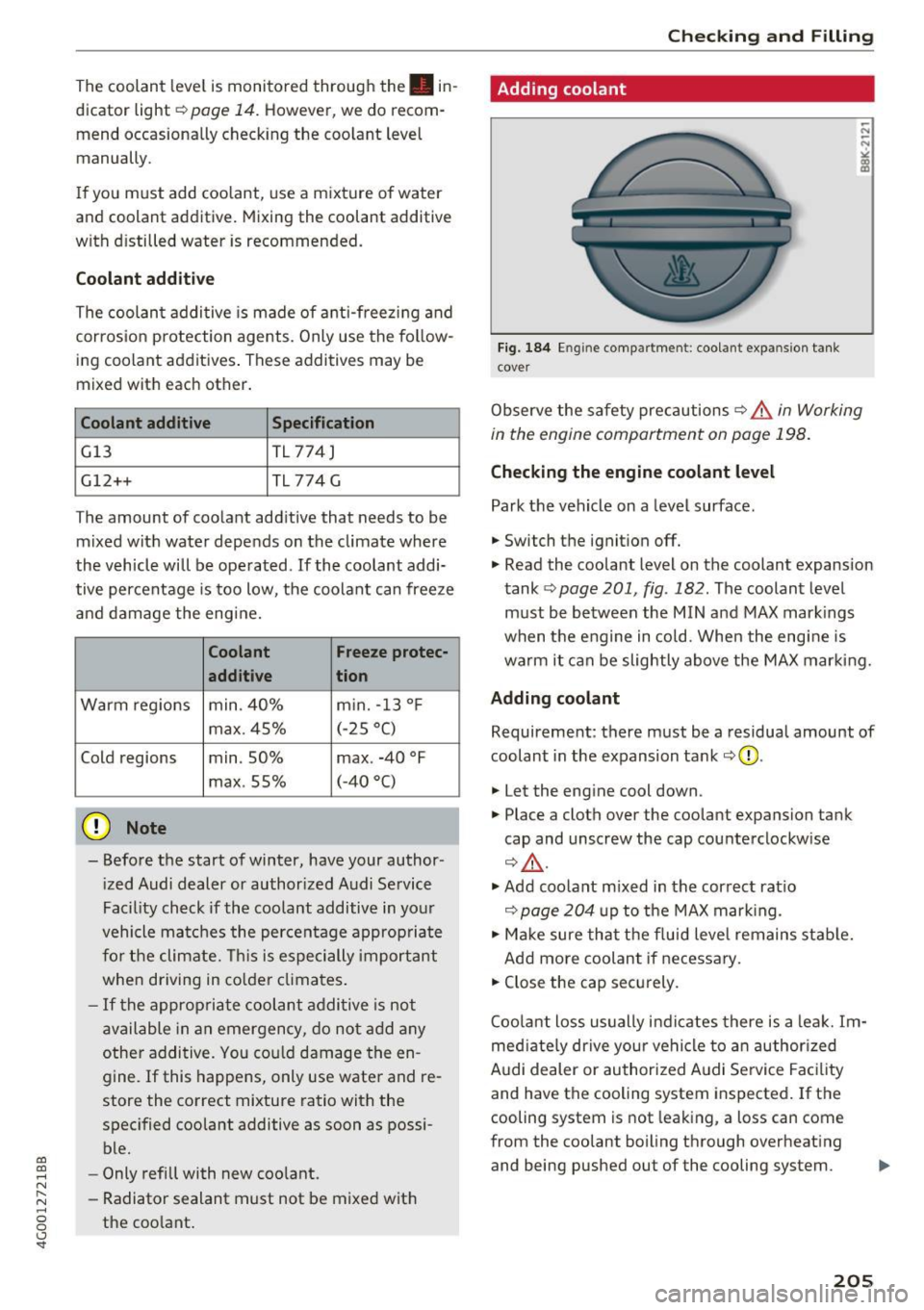
Fig. 184 En g in e compa rtment : coo lant expa nsion ta nk
cove r
Observe the safety prec autions c::> A in Working
in the engine comportmen t on page 198.
Checking the engine coolant level
Park the vehicle on a level surface.
.,. Switch t he ignit ion off.
.,. Read the coolant level on the coolant expansion
tank
c::> page 201, fig . 182. The coolant level
must be between the MIN and MAX mark ings
when the engine in cold. When the eng ine is
warm it can be slightly above the MAX marki ng.
Adding coolant
Requirement: there must be a residua l amount of
coolant in the expansion tank
c::> (D .
.,. Let the eng ine cool down .
.,. Place a cloth over the coolant expansion tank
cap and unscrew the cap counterclockw ise
c::> .&_ .
.,. Add coo lant m ixed in the cor rect rat io
c::> page 204 u p to the MAX mark ing.
.,. Ma ke sure that the f luid level remains stab le.
Add mo re coolant if necessary.
.,. Close the cap sec urely.
Coo la nt loss usually i ndicates there is a lea k. Im
med iate ly drive you r ve hicle to a n author ized
Audi dealer or authorized A udi Se rvice Faci lity
and have the cooling system inspected. If the
cooling system is not leak ing, a loss can come
from the coolant boiling through overheat ing
and being pushed out of the cooling system.
205