vent AUDI A7 2012 Workshop Manual
[x] Cancel search | Manufacturer: AUDI, Model Year: 2012, Model line: A7, Model: AUDI A7 2012Pages: 294, PDF Size: 73.33 MB
Page 126 of 294
124 Driving Safel y
Floor mats used in your vehicle m ust be at
tached to these fasteners. Proper ly securing
the floor mats will prevent them from s liding
into pos itions that could interfere with the
pedals or impair safe operation of your vehicle
in other ways .
A WARNING
Pedals that cannot move freely can result
in a loss of veh icle contro l and increase the
r isk of serious personal injury .
- Always make sure that floor mats are
properly secured.
- Never place or insta ll floor mats or other
floor coverings in the vehicle that cannot be properly secured in place to prevent
them from slipping and interfering w ith
the pedals or the ability to control the
vehicle.
- Never place o r insta ll floor ma ts or other
floor coverings on top of a lready insta l
led floor mats. Additional floor mats and
other coverings w ill reduce the size of
the pedal area and interfere with the
pedals.
- Always properly reinstall and sec ure floor
mats that have been taken out for clean
ing.
- Always make sure that objects cannot fall into the driver footwe ll wh ile the ve
hicle is moving. Objects can become
trapped under the b rake pedal and accel
erator peda l causing a loss of veh icle
c o ntrol.
Stowing luggage
Loading the luggage compartment
All luggage and other objec ts must be prop
erly stowed and secured in the luggage com
partment.
L oose items in the luggage comp art ment can
shift suddenly, changing veh icle hand ling
characteristics. Loose items can also increase
the risk of serious personal injury in a sudde n
vehicle maneuver or in a collision . ..
Distribute the load even ly in the luggage
compartment .
.. Always place and proper ly secure heavy
items in the luggage compartment as far
forward as possible .
.. Secure luggage using the tie -downs prov id
ed
¢ page 59, Luggage compartment.
.. Make s ure that the rear seatback is securely
la tc hed in place.
A WARNING
Imp roperly store d luggage or other items
can fly thro ugh the vehi cle causing ser ious
personal injury in the event of hard brak
i ng or an accident. To help reduce t he risk
of ser ious personal in jury:
- Always put objects, fo r example, luggage
or other heavy items in the luggage com pa rtment.
- Always secure objects in the luggage
compartment using the t ie-down hoo ks
and suitable straps.
A WARNING
=
Heavy loads w ill influence the way yo ur ve-
hi cle handles . To help reduce the risk of a
l oss of contro l leading to serious pe rsonal
i njury :
-Always keep in mind when transporting
heavy objects, that a change i n the cen
ter of gravity can also cause changes in
veh icle ha ndling:
- Always distribute the load as evenly as
poss ible.
- Place heavy objects as far forward in
the luggage compartment as possible .
- Never exceed the Gross Axle Weight Rat
ing or the Gross Vehicle We ight Rating
specified on the safety compliance stick
er on the left door jamb. Exceed ing per
miss ible weight standards can cause the
veh icle to slide and handle differently .
- Please observe information on safe dr iv
ing
¢page 118.
Page 127 of 294
A WARNING ,~
To help prevent poisonous exhaust gas
from being drawn into the vehicle, always
keep the rear lid closed while driving .
- Never transport objects larger than
those fitting completely into the luggage
area because the rear lid cannot be fully
closed.
- If you absolutely must drive with the rear
lid open, observe the following notes to
reduce the risk of poisoning:
- Close all windows,
- Close the power roof*,
- Open all air outlets in the instrument
panel,
- Switch off the air recirculation,
- Set the fresh air fan to the highest
speed.
A WARNING
Always make sure that the doors, all win dows, the power roof* and the rear lid are
securely closed and locked to reduce the
risk of injury when the vehicle is not being
used.
- After closing the rear lid, always make
sure that it is properly closed and locked.
- Never leave your vehicle unattended es
pecially with the rear lid left open. A
child could crawl into the vehicle through
the luggage compartment and close the
rear lid becoming trapped and unable to
get out. Being trapped in a vehicle can
lead to serious personal injury.
- Never let children play in or around the
vehicle .
- Never let passengers ride in the luggage
compartment. Vehicle occupants must
always be properly restrained in one of
the vehicle's seating positions.
Gj) Tips
-Air circulation helps to reduce window fogging. Stale air escapes to the outside
through vents in the trim panel. Be sure
to keep these slots free and open .
-
Driving Safely 125
-The tire pressure must correspond to the
load. The tire pressure is shown on the
tire pressure label. The tire pressure la
bel is located on the driver's side B-pillar.
The tire pressure label lists the recom
mended cold tire inflation pressures for
the vehicle at its maximum capacity
weight and the tires that were on your
vehicle at the time it was manufactured. For recommended tire pressures for nor
mal load conditions, please see chapter
r:!)page235.
Tie-downs
The luggage compartment is equipped with
four tie-downs to secure luggage and other
items.
Use the tie-downs to secure your cargo prop
erly<>
page 124, Loading the luggage com
partment.
In a collision, the laws of physics mean that
even smaller items that are loose in the vehi
cle will become heavy missiles that can cause
serious injury. Items in the vehicle possess en
ergy which vary with vehicle speed and the
weight of the item. Vehicle speed is the most
significant factor.
For example , in a frontal collision at a speed
of 30 mph (48 km/h), the forces acting on a 10-lb (4.5 kg) object are about 20 times the
normal weight of the item. This means that
the weight of the item would suddenly be about 200 lbs. (90 kg) . You can imagine the
injuries that a 200 lbs . (90 kg) item flying
freely through the passenger compartment
could cause in a collision like this.
A WARNING
Weak, damaged or improper straps used
to secure items to tie-downs can fail dur
ing hard braking or in a collision and cause
serious personal injury.
-Always use suitable mounting straps and properly secure items to the tie-downs in
'
•
•
Page 128 of 294
126 Driving Safely
the luggage compartment to help pre-To contact NHTSA, you may call
vent items from shifting or flying
the Vehicle Safety Hotline toll-forward as dangerous missiles.
- When the rear seat backrest is folded
free at:
down, always use suitable mounting
Tel.: 1-888-327-4236 (TTY: straps and properly secure items to the
tie-downs in the luggage compartment
to help prevent items from flying for-
1-800-424-9153)
ward as dangerous missiles into the pas-or write to:
senger compartment.
- Never attach a child safety seat tether
Administrator
strap to a tie-down.
NHTSA
Reporting Safety 1200 New Jersey Avenue, SE
Defects Washington, D.C. 20590
Applicable to U.S.A. You can also obtain other infor-
If you believe that your vehicle mation about motor vehicle
has a defect which could cause safety from:
a crash or could cause injury or http://www.safercar.gov
death, you should immediately
Applicable to Canada
inform the National Highway Canadian customers who wish
Traffic Safety Administration
to report a safety-related de-
(NHTSA) in addition to notify-
feet to Transport Canada, De-
ing Audi of America, Inc.
If NHTSA receives similar com- feet Investigations and Recalls,
may telephone the toll free hot-
plaints, it may open an investi- line:
gation, and if it finds that a
safety defects exists in a group Tel.: 1-800-333-0371 or
Tel.: 1-613-998-8616 if you are
of vehicles, it may order a recall
in the Ottawa area
and remedy campaign. Howev-
TTY for hearing impaired:
er, NHTSA cannot become in-
volved in individual problems 1-888-67 5-6863
between you, your dealer, or email comments/questions to:
Audi of America, Inc. [email protected]
or contact Transport Canada by mail at:
....
Page 132 of 294

130 Safety belts
occupant will slam violently into the steering
wheel, instrument panel, windshield, or what
ever else is in the way
c::> fig. 133. This imp act
with the vehicle interior has all the energy
t hey had just before the crash.
Never rely on a irbags alone for protection.
Even when they deploy, airbags provide only
additional protection. Airbags are not sup
posed to deploy in all kinds of accidents. Al
though your Audi is equipped with airbags, all
vehicle occupants, including the driver , must
wear safety belts correctly in order to mini
mize the risk of severe injury or death in a
crash.
Remember too, that airbags will deploy only
once and that your safety belts are always
there to offer protection in those accidents in
which airbags are not supposed to deploy or
when they have already deployed . Unbelted
occupants can also be thrown out of the vehi
cle where even more severe or fatal injuries
can occur.
It is also important for the rear passengers to
wear safety belts correctly. Unbelted passen
gers in the rear seats endanger not only them
selves but also the driver and othe r passen
gers ~
fig. 134. In a frontal collision they will
be thrown forward violently, where they can
hit and injure the driver and/or front seat pas
senger .
Safety belts protect
People think it's possible to use the hands to
brace the body in a minor collision . It's simply
not true !
Fig. 135 Driver is co rr ect ly re strain ed in a sudd en brak
ing maneuve r
Safety belts used properly can make a big dif
ference. Safety belts help to keep passengers
in their seats, gradually reduce energy levels
applied to the body in an accident, and help
prevent the uncontrolled movement tha t can
cause serious injuries . In addition, safety belts
reduce the danger of being thrown out of the
vehicle .
Safety belts attach passengers to the car and
give them the benefit of being slowed down
more gently or "softly" through the "give" in
the safety belts, crush zones and other safety
features engineered into today's vehicles. By
"absorbing " the kinetic energy over a longer
period of ti me, the safety belts make the
forces on the body more "tolerable" and less
likely to cause injury.
Although these examples are based on a fron
tal collision, safety belts can also substantial
ly reduce the r isk of injury in other kinds of
crashes. So, whether you're on a long trip or
just going to the corner store, always buckle up and make sure others do, too. Accident sta
tistics show that vehicle occupants properly
wearing safety belts have a lower risk of being
injured and a much better chance of surviving
an accident. Properly using safety belts also
greatly increases the ability of the supplemen
tal airbags to do their job in a collision . For
this reason, wearing a safety belt is legally re
quired in most countries including much of
the United States and Canada.
Although your Audi is equipped with airbags,
you still have to wear the safety belts provid
ed. Front airbags , for example, are activated
only in some frontal collisions. The front air
bags are not activated in all frontal collisions,
in side and rear collisions, in roll overs or in
cases where there is no t enough decelera tion
through impact to the front of the vehicle .
The same goes for the other airbag systems in
your Audi . So, always wear your safety belt
and make sure everybody in your vehicle is
properly restrained!
Page 133 of 294
Important safety instructions about
safety belts
Safety belts must always be correctly posi
tioned across the strongest bones of your
body.
~ Always wear safety belts as illustrated and
described in this chapter.
~ Make sure that your safety belts are always
ready for use and are not damaged.
A WARNING
Not wearing safety belts or wearing them
improperly increases the risk of serious
personal injury and death. Safety belts can
work only when used correctly.
- Always fasten your safety be lts correctly
before driving off and make sure all pas
sengers are correctly restrained.
- For maximum protection, safety belts must always be positioned properly on
the body .
- Never strap more than one person, in
cluding small children, into any belt.
- Never place a safety belt over a child sit ting on your lap.
- Always keep feet in the footwell in front
of the seat while the vehicle is being d riv
en .
- Never let any person ride with their feet
on the instrument panel or sticking out
the window or on the seat.
- Never remove a safety belt while the ve
hicle is moving. Doing so will increase
your risk of be ing injured or killed.
- Never wear belts twisted.
- Never wear belts over rigid or breakable
objects in or on your clothing, such as
eye glasses, pens, keys, etc., as these may cause injury.
- Never allow safety belts to become dam
aged by being caught in door or seat
hardware .
- Do not wear the shoulder part of the belt
under your arm or otherwise out of posi
tion . Safety belts
131
- Several layers of heavy clothing may in
terfere with correct positioning of belts and reduce the overall effectiveness of
the system .
- Always keep belt buckles free of anything
that may prevent the buckle from latch
ing securely .
- Never use comfort clips or devices that
create slack in the shoulder belt . Howev
er, special clips may be requ ired for the
proper use of some child restraint sys
tems .
- Torn or frayed safety belts can tear, and
damaged belt hardware can break in an
accident. Inspect belts regularly.
If web
bing , bindings, buckles, or retractors are
damaged, have belts replaced by an au
thorized Audi dealer or qualified work
shop.
- Safety belts that have been worn and
loaded in an accident must be replaced
with the correct replacement safety belt
by an authorized Audi dealer. Replace
ment may be necessary even if damage
cannot be clearly seen . Anchorages that
were loaded must also be inspected.
- Never remove, modify, disassemble, or
try to repair the safety belts yourself.
- Always keep the belts clean. Dirty belts
may not work properly and can impair
the function of the inertia reel
c::> page 209, Safety belts .
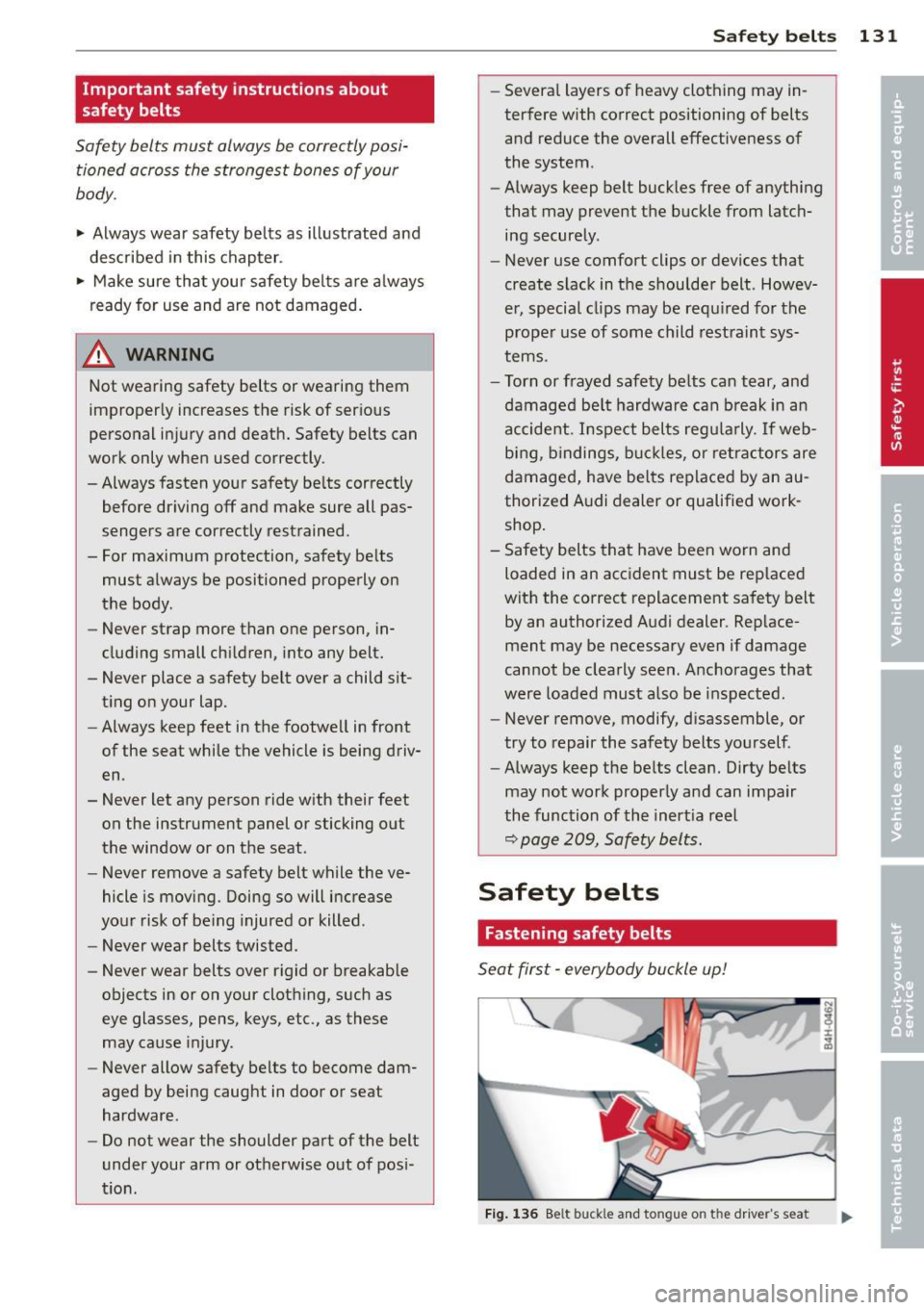
Safety belts
Fastening safety belts
Seat first -everybody buckle up!
Fig. 136 Bel t bu ckle and to ngue on the drive r's seat
Page 137 of 294
Safety belt preten
sioners
How safety belt pretensioners work
In fron t, side and rear-end collisions above a
parti cular severi ty and in a rollover, safety
belts are tensioned automatically .
Reversible safety belt tensioners
The safety belts on the front seats are equip
ped wit h power reve rsible tensioners. The fo l
l ow ing f un ct ions are available w hen the dr iv
e r' s/fron t passenger 's sa fety bel ts are fas
tened :
- Automatic tensioners: at the start of a d rive,
the safety be lts automatically adjust to the
passenge r aft er a certai n time period o r ve
hicle speed. To switch the automa tic ten
s ioners off, select the fo llow ing in the M MI:
I CAR I funct ion button > Car sy stems > Vehi
cle settings
> Seats > Dr ive r's seat or Pas
senger's seat
> Automatic belt tensione r >
Off.
-In certa in driving situations, the safety belts
may t ighten with a reversib le tensioning
function
¢ page 182.
-The safety belts may also tighten w ith this
r evers ible tension ing funct ion in mino r colli
s ions .
Pyrotechnic safety belt pretensioners
The safety be lts are equipped with safety be lt
pretensioners. The system is activated by sen
s o rs in front, side and rear-end collisions of
great severity and in a rollover. Th is tightens
the bel t and takes up be lt slack ¢&.
in Service
and disposal of safety belt pre tensioner on
page 136.
T aking up the s lack helps to redu ce
forward occup ant movemen t during a colli
sion.
A WARNING
- It is possib le for the pre tensioners to de
ploy i ncor rect ly .
- T he pyrotechnic sys tem can only provide
protection for one co llision. If the pyro -
Safety belts 13 5
technic pretensioners deploy, the preten
sioning system must be replaced.
(D Tips
T he pyro technic safety be lt pretensioners
ca n only deploy once .
- T he safety bel t pretensioners do not de
ploy in minor frontal and s ide collisions,
in rear-end co llisions, i n rollovers and in
co llisions involving very little impact
f o rce.
- A fine dust is released w hen the py ro
technic safety be lt pretensioners dep loy.
Th is is normal and is not caused by a fire
in the vehicle.
- The re levant safety requi rements must
be observed when the vehicle or compo
nents of the system are scrapped . A
qualified dealership is fam iliar with
these regulations and will be please d to
pa ss o n the information to yo u.
- Be sure to observe all safety, env iron
ment al and ot her regu la tio ns if t he ve hi
cle or ind ividu al p ar ts of t he system, par
t ic ular ly the s afe ty belt or airbag, are to
be disposed. We recommend you have
your authorized A udi dealer perform this
service fo r you .
Service and disposal of safety belt
pretensioner
The safety belt pretens ione rs are parts of the
saf ety be lts on your Aud i. Insta lling, remov
i ng, se rv ici ng o r repair ing of be lt pre tension
ers can dam age the safe ty belt sy stem and
prevent it from working correctly in a co lli
sio n.
T he re a re some impo rtan t thi ngs you have to
kn ow to m ake su re th at the effectiveness o f
t h e sys tem w ill not be impaired and tha t dis
ca rded components do not cause injury o r pol -
lu te the environment . ..,_ •
•
Page 138 of 294
136 Safety belts
,8. WARNING
Improper care, servicing and repair proce
dures can increase the risk of personal in
jury and death by preventing a safety belt
pretens ioner from act ivat ing when needed
or act ivat ing it unexpectedly:
- The belt pretensioner system can be acti
vated only once. If belt pretens ioners
have been act ivated, the system must be
replaced.
- Never repair, adjust, or change any parts
of the safety belt system.
- Safety belt systems includ ing safety be lt
pretensione rs cannot be repaired. Spe
ci al procedures are required for removal,
installation and disposal of this system.
- For any work on the safety belt system,
we strongly recommend that you see
your authorized Audi dealer or qualified
technician who has an Audi approved re
pair manual, training and specia l equip
ment necessary.
@ For the sake of the environment
Undep loyed airbag modu les and preten
sioners might be classified as Perchlorate
Material -specia l hand ling may apply, see
www.dtsc.ca.gov/haza rdou swaste/per
chlorate. When the vehicle or parts of the
restraint system including airbag modules
safety belts w ith pretens ioners are scrap
ped, all applicable laws and regulations
must be observed. Your authorized Aud i
deale r is familiar with these requ irements
and we recommend that you have your
dea ler perform this service for you.
Page 139 of 294

Airbag system Important things to know
Importance of wearing safety belts and
sitting properly
Airbags are only supplemental restraints. For
airbags to do their job , occupants must al
ways properly wear their safety belts and be
in a proper seating position.
For your safety and the safety of your passen
gers, before driving off, always:
"" Adjust the driver's seat and steering wheel
properly ¢
page 119,
"" Adjust the front passenger's seat properly
¢page 51,
"" Wear safety be lts properly ¢ page 131,
"" Always properly use the proper child re-
straint to protect chi ldren ¢
page 163.
In a collision, airbags must inflate within the
blink of an eye and with considerable force.
The supplemental airbags can cause injuries if
the driver or the front seat passenger is not
seated properly . Th erefore in order to help the
a ir bag to do its job, it is important, both as a
driver and as a passenger to s it properly at all
times.
By keeping room between your body and the
steer ing wheel and the front of the passenger
compartment, the airbag can inflate fully and
comp letely and provide supplemental protec
tion in certain frontal collisions ¢
page 119,
Proper occupant seating positions.
F or details
on the operation of the seat adjustment con
trols
¢ page 51.
It's especially important that children a re
properly restrained ¢
page 163.
There is a lot that the driver and the passen
gers can and must do to help the individual
safety features installed in your Aud i work to
gether as a system.
Proper seating pos ition is important so that
the front airbag on the driver side can do its
job. If yo u have a physical impa irment or con-
Airbag system 137
dition that prevents you from sitting properly
on the driver seat with the safety belt properly
fastened and reach ing the peda ls, or if you
have concerns with regard to the function or
operation of the Advanced Airbag System,
please contact your author ized Audi dealer or
qualified workshop, or call Audi Customer
CARE at 1-800-822-2834 for possible modifi
cations to your vehicle .
When the airbag system dep loys, a gas gener
ator will fill the a irbags, break open the pad
ded covers, and inflate between the steer ing
whee l and the driver and between the instru
ment pane l and the front passenger. The air
bags will deflate immediately after deploy
ment so that the front occupants can see
through the windshield again without inter ruption .
All of th is takes place in the blink of an eye, so
fast that many people don't even realize that
the airbags have deployed. The airbags a lso
inflate with a great dea l of force and nothing
should be in their way when they deploy.
Front airbags in combination with properly
worn safety belts slow down and lim it the oc
cupant's forward movement . T ogether they
help to prevent the driver and front seat pas
senger from hitting parts of the inside of the
vehicle while reducing the forces acting on the
occupant during the crash . In this way they
help to reduce the risk of injury to the head
and upper body in the crash. Airbags do not
protect the arms or the lower parts of the
body.
Both front airbags will not inflate in all fronta l
collisions . The triggering of the airbag system
depends on the vehicle dece leration rate
caused by the collision and registered by the
electron ic control unit. If th is rate is below
the reference value programmed into the con
trol unit, the airbags will not be trigge red,
even though the car may be bad ly damaged as
a result of the collision . Ve hicl e damage, re
pair costs or even the lack of veh icle damage
is not necessarily an indication of whether an
airbag should inflate or not . .,. •
•
Page 140 of 294
138 Airbag sys te m
Since the cir cumstances will vary considerab ly
between one collision and anot her, it is not
possib le to def ine a range of vehicle speeds
that will cover every possible k ind and angle
of impact t hat will always trigger the airbags.
Important factors include, for example, the
nature (hard or soft) of the object which the
car h its, the ang le of impact, vehicle speed,
etc. The front airbags will also not inflate in
side or rea r collisions, or in ro ll-overs .
Always rememb er: Airbags will deploy only
once, and only in certa in k inds of co llisions.
Your safety belts are always there to offer pro
tection in those s ituations in which airbags
a re not supposed to deploy, or when they have
a lready deployed; for example, when your ve
hicle strikes or is struck by another vehicle af
ter the first co llision.
This is just one of the reasons why an airbag is
a supplementary restraint and is not a substi
tute for a safety belt . The airbag system
works most effect ively when used with the
safety belts. Therefore, always properly wear
your safety belts¢
page 128.
A WARNING
Sitting too close to the steer ing wheel or
instrument panel will dec rease the effec
t iveness of the airbags and will increase
the risk of personal injury in a collision .
- Never sit closer than 10 inches (2S cm)
to the stee ring wheel or instrument pan
el.
- If you cannot sit more than 10 inches
( 2 5 cm) from the s teer ing whee l, investi
gate whethe r adaptive equipmen t may
be available to help you reach the pedals
and increase your seating distance from
the steering wheel.
- If you are unrestrained, lean ing fo rward,
sitting sideways or out of position in any
way, your risk of in jury is much higher.
- You will also receive serio us injuries and
cou ld even be killed if you are up against
the airbag or too close to it when it in
flates - even with an Advanced Airbag. -
To reduce the risk of injury when an a ir
bag inflates, always wear safety be lts
properly ¢
page 131, Safety belts.
-Always make certain that ch ildren age 12
or younger always ride in the rear seat. If
children are not properly restrained, they
may be severely injured or killed when an
airbag inflates.
- Never let children ride unrestrained or
improperly restrained in the vehicle. Ad
just the front seats prope rly .
- Never ride with the back rest reclined.
- Always sit as far as possible from the
steer ing whee l or the instrument pane l
¢page 119.
-Always sit upright with your back against
the backrest of your seat .
- Never p lace your feet on the instrument
panel or on the seat. Always keep both
feet on the floor in front of the seat to
help prevent serio us in ju ries to the legs
and h ips if the airbag inflates.
- Never recline the front passenger 's seat
to transport objects , Items can a lso
move into the a rea of the s ide airbag or
the front a irbag du ring bra king or in a
sudden maneuve r. Objects nea r the air
bags can become projectiles and cause
in jur y when an airbag inflates.
A WARNING ~
Airbags that have deployed in a crash must
be replaced.
- Use on ly orig inal equipment airbags ap
proved by Aud i and installed by a trained
technician who has the necessary too ls
and d iagnost ic equipment to properly re
p lace any airbag in your vehicle and as
sure system effectiveness in a crash .
- Never permit salvaged or recycled air
bags to be installed in your vehicle.
Page 143 of 294

-Always carefully follow instru ctions from
c hild restraint manufacturers when in
sta lling child restraints.
A WARNING
If, in exceptional circumstances, you must
install a forward or rearward-facing child
restraint on the front passenger's seat:
- Improper installation of child restraints
can reduce their effectiveness or even
prevent them from providing any protec
tion.
- An improperly installed child restraint
can interfere with the airbag as it de
ploys and seriously injure or even kill the
child - even with an Advanced Airbag
System.
- Always carefully follow the manufactur
er's instructions provided with the child
seat or carrier .
- Always make sure that there is nothing
on the front passenger seat that will
cause the capacitive passenger detection
system in the seat to signal to the Airbag
System that the seat is occupied by a
person when it is not, or to signal that it
is occupied by someone who is heavier
than the person actually sitting on the
seat. The presence of additional objects
could cause the passenger front airbag
to be turned on when it should be off, or
could cause the airbag to work in a way
that is different from the way it would
have worked without the object on the
seat .
Airbag system 141
Front airbags
Description of front airbags
The airbag system can provide supplemental
protection to properly restrained front seat occupants.
Fig. 141 Loc ation of driver airbag: in steering w heel
Fig. 142 Loc ation of front passenger's a irbag: in the in·
strument panel
Your vehicle is equipped with an "Advanced
Airbag System" in compliance with United
States Federal Motor Vehicle Safety Standard
(FMVSS) 208 as applicable at the time your
vehicle was manufactured. The system senses
the position of the front seats and controls
front airbag inflation with a valve, depending
on the distance between the respective seat
and the steering wheel or instrument panel.
The safety belts for the seats have "preten
sioners" that help to take slack out of the belt
system. The pretens ioners are also activated
by the electronic control unit for the airbag
system .
The front safety belts also have load limiters
to help reduce the forces applied to the body
in a crash.
The airbag for the driver is in the steering
wheel hub
q fig. 141 and the airbag for the
front passenger is in the instrument panel