vent AUDI A7 2012 Manual PDF
[x] Cancel search | Manufacturer: AUDI, Model Year: 2012, Model line: A7, Model: AUDI A7 2012Pages: 294, PDF Size: 73.33 MB
Page 170 of 294

168 Child Saf ety
- Never install rear-facing chi ld safety
seats or infant carriers on the front pas
senger seat. A chi ld will be ser iously in
jured and can be k illed when the passen
ger airbag inflates -even with an Ad
vanced Airbag System .
- The inflating a irbag will hit the child
safety seat or infant carrier w ith great
force and w ill smash the ch ild safety seat
and child against the backrest, center
armrest, door or roof.
- Always install rear-facing child safety
seats or infant car riers on the rear seat.
- Forward-fac ing ch ild safety seats instal
led on the front passenger's seat can in
terfere wi th the ai rbag when it inflates
and cause serious injury to the child. Al
ways install forwa rd-facing child safety
seats on the rear seat .
- If exceptiona l circumstances require the
use of a forward-facing chi ld restraint on
the front passenger 's seat, the chi ld's
safety and well-being requ ire that the
following special precaut ions be taken:
- Make sure the fo rward-facing seat has
been designed and certified by its man
ufacturer for use on a front seat with a
passenger front and side airbag.
- Always carefu lly follow the manufac
turer 's instructions p rov ided with the
child safety seat or carrier.
- Always move the front passenger seat
into the rearmost position o f the pas
senger seat 's fore and aft adjustment
range, and as far away from the airbag
as possible before installing the child restra int.
- Always make sure that nothing pre vents the front passenger 's seat from
be ing moved to the rearmost position
in its fore and aft adjustment range.
- Always make sure that the backrest is
in the upr ight position .
- Never p lace or use any electrical dev ice
(such as a laptop, CD player, electronic
games device or power inverter) on the
front passenger seat if the device is connected to the
12-volt socket or the
c igarette lighter socket.
- If a seat heate r has been retrofitted or
otherwise added to the front passen
ger seat, never install any child re
stra int system on this seat.
- Make sure that there are no wet objects (such as a wet towel) and no water or
other liquids on the front passenger
seat cushion .
- Never place objects on the seat (such
as a laptop, CD player, e lectronic
games device or powe r inverte r) . These
may influence the electr ica l capaci
tance measured by the capacitive pas
senger detection system and can also
fly a round in an accident and cause se
rious personal injury.
- Always buckle the child safe ty seat firmly
in place even if a ch ild is not sitt ing in it.
A loose child safety seat can fly around
during a s udden stop or in a collision.
- Always read and heed all WARNINGS whenever using a child restrained in ave
h icle is being used
¢ page 128, Safety
belts,
¢ page 13 7, Airbag system and
¢ page 163, Child Safety .
A WARNING ,-
To reduce the risk of serious injury , make
sure that the
PASSENGER AIR BAG OFF
light comes on and stays on whenever a
chi ld restraint is installed on the front pas
senger sea t and the ignit ion is switched
on.
- Ta ke t he chi ld restraint off the front pas
senger seat and install it prope rly at one
of the rear seat positions i f the
PASSEN
GER AIR BAG OFF
light does not stay on.
- Have the airbag system inspected by
your author ized Audi dealer immed iate
ly.
A WARNING
A child in a chi ld restraint installed with
the LATCH lower anchorages or with the
Page 171 of 294
standard safety belt on the rear seat may
play with unused rear seat safety belts and
become entangled resulting in serious per
sonal injury and even death .
- Always buck le unused rear seat safety
belts out of reach of chi ldren in ch ild
seats a nd properly act ivate the converti
ble locking retractor so that the child
cannot unreel the safety belt from the
retra cto r.
Child safety seats
Infant seats
Babies and infants up to about one year old
and 20 lbs . or 9 kg need special rearward-fac
ing child restraints that support the back ,
neck and head in a crash.
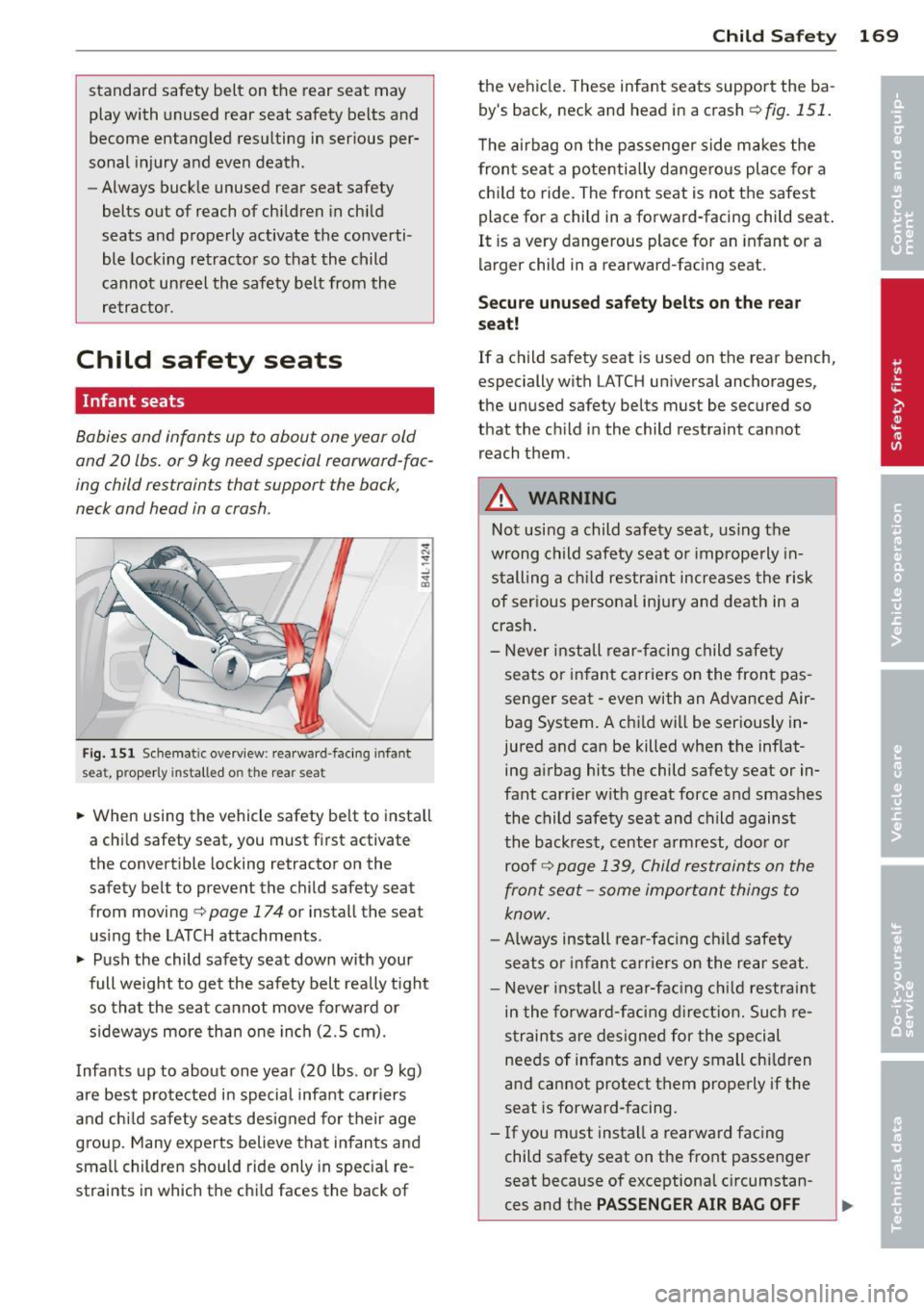
F ig. 151 Schemat ic overv iew : rea rwa rd -fa cing infa nt
s ea t, p rope rly in stalled o n the re ar sea t
... <'< ...
-.:, ... m
.,. When using the vehicle safety be lt to insta ll
a ch ild safety seat, you must first activate
the convertible locking retractor on the
safety belt to prevent the c hild safety seat
from moving
c:> page 174 or install the sea t
us ing the LATCH attachments .
.,. Push the child safety seat down with your
full weight to get the safety belt rea lly t ight
so tha t the sea t ca nnot move forward or
s ideways more than one inch (2.5 cm).
I nfants up to about one year (20 lbs . or 9 kg)
a re best pro tected i n specia l infa nt carriers
and chi ld safety seats des igned for their age
g roup . Many experts believe that infants and
sma ll children should ride only in spec ial re
straints in which the chi ld faces the back of
Child S afety 169
the vehicle . These infant seats support the ba
by's back, neck and head i n a c rash
c:> fig. 151 .
The airbag on the p assenger side makes the
fron t seat a potentia lly dangero us place for a
ch ild to ride. The front seat is not the safest
place for a child in a forward -facing child seat.
It is a very dangerous place for an in fant or a
larger child in a rearward-fac ing seat.
Secure unused saf ety belts on the rear
s eat!
If a child safety seat is used on the rear bench,
especially with LATCH universal anchorages,
the unu sed safety belt s must be secured so
that the c hild in the child restra int cannot
reach them .
A WARNING
--
Not using a child safety seat, us ing the
wrong c hild safety seat o r imprope rly in
stalling a ch ild restraint increases the risk
of ser ious persona l injury and death in a
crash .
- Never install rear- fa cing child safety
seats or in fant ca rrie rs on the front pas
senger seat - even with an Advanced Air bag System. A chi ld will be seriously in
jured and can be killed when the inflat ing airbag hits the child safety seat or in
fant carrier wit h great force and smashes
the child safety seat and child against
the backrest, center armrest, doo r o r
roof
c:> page 139, Child restraints o n the
front seat -
some important thing s to
know.
- Always install rear-fac ing ch ild safety
se ats or inf ant c arrie rs on the rear sea t.
- Never install a rea r-fac ing chi ld restrai nt
in the forward-fac ing direct io n. Su ch re
s traints a re designe d for the special
needs of infants and very small chi ld ren
a nd cannot protect them properly if the
seat is forward- facing.
- If you must install a rearward facing
child safety seat on the front passenger
seat because of exceptiona l circumstan
ces and the
PASSENGER AIR BAG OFF
Page 172 of 294

1 70 Child Safety
light does not come on and stay on, im
mediately install the rear-facing child
safety seat in a rear seating position and have the airbag system inspected by your
Audi dealer.
- Never place or use any electrical device
(such as a laptop, CD player, electronic
games device or power inverter) on the
front passenger seat if the device is con
nected to the 12-volt socket or the ciga
rette lighter socket.
- If a seat heater has been retrofitted or
otherwise added to the front passenger
seat, never install any child restraint sys
tem on this seat.
- Make sure that there are no wet objects
(such as a wet towel) and no water or
other liquids on the front passenger seat
cushion.
- Never place objects on the seat (such as
a laptop , CD player, electronic games de
vice or power inverter). These may influ
ence the electrical capacitance measured by the capacitive passenger detection
system and can also fly around in an acci
dent and cause serious personal injury.
- Always read and heed all WARNINGS
whenever using a child restrained in
ave
hicle is being used c:::> page 128, Safety
belts,
c:::> page 13 7, Airbag system and
c:::> page 163, Important things to know.
A WARNING
A child in a child restraint installed with
the LATCH lower universal anchorages or
with the standard safety belt on the rear
seat may play with unused rear seat safety
belts and become entangled resulting in
serious personal injury and
even death.
- Always secure unused rear seat safety
belts out of reach of children in child
seats such as by properly routing them around the head restraint for the seating
position where the child restraint is in
stalled.
-
- Never activate the switchable locking re
tractor when routing the safety belts
around the head restraints.
- Never let anyone sit at the center rear
seating position if the center rear safety
belt has been routed around a rear head
restraint.
- A child restrained in the child safety seat
on the rear bench can be fatally injured
when playing with unused lockable safe
ty belts.
- Always secure unused lockable safety belts on the rear bench.
Convertible child safety seats
Properly used convertible child safety seats
can help protect toddlers and children over
age one who weigh between 20 and 40 lbs . (9
and
18 kg) in a crash .
Fig. 152 Schematic overview: installat ion of the at
tachments applicable to a LATCH seat
Fig. 153 Schematic overview : installat ion of the seat
u sing the vehicte ·s safety belt system
.. When using the vehicle safety belt to install
a child safety seat, you must first activate
th e convertible locking feature on the safety
belt to prevent the child safety seat from
moving
¢ page 174 or install the seat using
the LATCH attachments.
II>
Page 173 of 294
~ Push the child safety seat down with your
full weight to get the safety belt rea lly tight
so that the seat cannot move forward or
s ideways more than one inch (2 .5 cm)
<=> page 174.
~ If the c hild safety seat is equ ipped with a
tether strap, attach it to the tether a nchors
<=> page 180.
A toddler or child is usually too large for an in
fant restra int if it is more than one year old
and weighs more than 20 lbs . (9 kg) .
Todd lers and c hildren who are older than one
year up to about 4 years o ld and weigh more
than 20 lbs (9 kg) up to 40 lbs. (18 kg) must
a lways be properly restra ined in a ch ild safety
seat ce rtified fo r the ir size and weight
<=> fig. 152 and <=>fig . 153.
The airbag on the passenger side makes the
fro nt seat a potentially dangerous place for a
ch ild to r ide . T he fro nt seat is not the safest
p lace for a child in a forwa rd -fac ing child safe
ty seat. It is a very dangero us place for an in
fant or a larger child in a rearward -fac ing seat .
Secure unused safety belts on the rear
seat!
If a child s afety sea t is used o n the rear ben ch ,
espec ia lly w ith LA TCH universal anchorages,
the unused safety belts must be secured so
that the child in the chi ld restraint cannot
reach them.
A WARNING
Not using a ch ild safety seat, using the
w rong chi ld safety seat or improper ly in
stalling a child restraint increases the risk
of serious personal injury and death in a
c o llision or othe r eme rgency s ituation.
- Children on the front seat of any car,
even with Advanced A irbags, can be seri
o usly injured or eve n killed when an a ir
b ag in flates. A child in a rearward-facing
child safety seat installed on the front
passenger seat w ill be seriously injured
and can be killed if the front ai rbag in
flates - even with an Advanced Airbag
System.
Child Sa fet y 1 71
-The inflating airbag will h it the ch ild
safety seat or infant carrier with great
force and will smash the child safety seat and child against the back rest, center
arm res t, door or roof.
- Always install rear-fac ing ch ild safety
seats on the rear seat.
- If you must install a rearward fac ing
child safety seat on the front passenger
seat because of exceptional c ircumstan
c e s and t he
PASSENGER AIR BAG OFF
light does not come o n and stay on, im
medi ately ins ta ll t he rear-fa cing ch ild
safety sea t in a re ar se ating position and
have the airbag system inspected by your
Aud i dea ler.
- Always rea d an d heed al l WAR NIN GS
wheneve r using a child restraine d in ave
hicle is being used¢
page 128, Safety
belts, ¢ page 137, Airbag system
and
¢ page 163, Important things to know.
A WARNING
If exceptional circ umstances require the
use of a forward-facing child restraint on
the front passenge r's seat, the child's safe
ty and we ll- being req uire that the follow
ing spec ial precautions be ta ken:
- Ma ke sure the forward-facing seat has
been designed a nd c ert ified by its man u
facturer fo r use on a fro nt seat wi th a
passe nger front and side airbag.
- Always follow the manufacturer's in
st ructions p rov ided with the ch ild safety
se at o r infa nt c arr ier .
- Always move the front passenger seat in
to the rearmos t position of the p assen
ger seat's fo re and aft adjustment range,
an d as far away from the airbag as possi
ble before installing the ch ild restraint.
- Always ma ke s ure that nothing prevents
the front passenger 's seat from being
moved to the rea rmost position in its
fore and aft ad justment range .
- Always make sure the backrest is in an
upright pos ition. •
•
-
Page 176 of 294
174 Child Saf ety
the head restraint again immediately
once the child seat is removed. Dr iving
without head restraints or with head re
straints that are not properly adjusted
increases the risk of ser ious or fatal neck
injury dramat ica lly .
- Children on the front seat of any car, even w ith Advanced A irbags, can be seri
ously injured or even killed when an a ir
bag inflates.
- Never let a child stand or knee l on any
seat, for example the front seat.
- Never let a child ride in the cargo area of
your vehicle.
-Always remember that a ch ild lean ing
forward, sitt ing s ideways or out of posi
t ion in any way during an acc ident can be
struck by a deploying airbag. This will re
sult in serious personal injury or death.
- If you must install a booster seat on the
front passenger seat because of excep
tional circumstances the
PASSENGER
AIR BAG OFF
light must come on and
stay on, whenever the ignition is switch
ed on.
- If the
PASSENGER AIR BAG OFF light
does not come on and stay on, perform
the checks described
<=> page 149, Moni
toring the Advanced Airbag System.
- Take the child restraint off the front pas
senger seat and install it properly at one
of the rear seat positions if the
PASSEN
GER AIR BAG OFF
light does not stay on
whenever the ignition is switched on .
- Always read and heed all WARNINGS
whenever using a child restrained in ave
hicle is being used
<=> page 128, Safety
belts, <=> page 137, Airbag system
and
<=> page 163, Important things to know.
_&, WARNING
A child in a booster seat installed with the
standard safety belt on the rear seat may
play with unused rear seat safety belts and
become entangled resulting in serious per
sonal injury and even death. -
Always secure unused rear seat safety
be lts out of reach of children in child
seats such as by properly rout ing them
around the head restraint for the seat ing
position where the child restraint is in
stalled.
- Never activate the switchable lock ing re
tractor when routing the safety belts
around the head restraints.
Installing a child safety
seat
Securing a child safety seat using a
safety belt
Safety belts for the rear seats and the front
passenger can be locked with the convertible locking retractor to properly secure child
safety seats.
The safety belts emergency locking retractors
for the rear seats safety belts and for the
front passenger's seat safety belt have a con
vertib le locking ret ractor for child restraints.
T he safety belt m ust be locked so that be lt
webbing cannot unreel. The retractor can be
activated to lock the safety belt and prevent
the safety belt webbing from loosening up
during normal driving . A chi ld safety seat can
only be properly installed when the safety belt
is locked so that the child and child safety
seat w ill stay in place .
Always remember: Even though your vehicle is
equipped with an Advanced Airbag system, all
children, especially those 12 years and young
er, should always r ide in the back seat proper
ly restrained for the ir age and size .
_&, WARNING
Improperly installed ch ild safety seats in
crease the risk of serious personal injury
and death in a collision.
- Always make sure that the safety belt re
tractor is lo cked when insta lling a child
safety seat . An un locked safety belt re -
tractor cannot hold the child safety seat ..,.
Page 179 of 294
into place and canno t fold forward. Oth
erwise, the seatback w ith the ch ild safety
seat attached to it could fly forward in
the event of an acc ident or other emer
gency situation .
- Always read and heed all WARNINGS
whenever using a child rest rained in ave
hicle is being used
<=:> page 163 . Special
precautions apply when installing a ch ild
safety sea t on the front passenge r seat
<=:> page 139, Child restraints on the front
seat -some important things to know.
Deactivating the convertible locking
retractor
The convertible locking retractor for child re
straints will be deactivated automatically when the belt is wound all the way back into the retractor.
~ Press the red button on the safety be lt
buck le . The belt tongue will pop out of the
buck le.
ii-G ui de the safety belt all the way back into
its stowed posit ion.
Always let the safety belt retract comp lete ly
i nto its stowed posit ion. The safety belt can
now be used as an ordinary safety belt with
out the convert ib le lock ing retractor for ch ild
restra ints .
If the c onvertible locking retractor shou ld be
activated inadvertently, the safety belt must be unfastened and guided completely back in
to its stowed position to deactivate th is fea
ture .
If the convertib le locking retractor is not
dea ctivated, the safety belt will g radua lly be
come tighter a nd uncomfo rt a b le to wear .
_& WARNING
Improperly installed chil d sa fe ty se ats in
crease the risk of ser ious personal inju ry
and death in a collision.
- Never unfasten the sa fe ty belt to deac ti
vate the convert ible lock ing retractor for
child restraints while the veh icle is mov-
Child Sa fet y 177
ing. You would not be restrained and
could be serious ly injured in an accident.
- Always rea d and heed all WAR NIN GS
whenever us ing a child restrained in ave
hicle is being used ¢
page 163. Special
precautions apply when insta lling a child
safety seat o n the fron t passenger seat
<=:> page 139, Child restraints on the front
seat -some important things to know.
LATCH Lower
anchorages and tethers
for children
Child Restraint System anchors and how
are they related to child safety
T o provi de a simp ler and more practicable way
to attach the c hild restra int on the vehicle
seat, Federal regulat ions req uire spec ial lower
anchorages in vehicles and devices on new
c h ild restra ints to attach to the veh icle ancho
r ages .
The combinat ion of the tether anchorages and
the lower anchorages is now generally called
the
LATCH system for " Lower Anchorages and
T ethers for Chil d ren."
Fo rward-facing chi ld restraints manufactured
after September 1, 1999, are requ ired by U.S.
federa l regu lations to comply with new child
head movement performa nce re quirements .
T hese new pe rfo rmance requ ir e ments ma ke a
tethe r ne cessary on most new c hild sea ts.
Installing a ch ild restra int that requires a top
tethe r without one can seriously impa ir the
p erfo rman ce of the c hild restra int and its abil
ity to p rotect the child in a coll is io n. Insta lli ng
a ch ild res tra in t that re quires a top tethe r
withou t the to p tether may be a violat ion o f
state law.
Child res train t manufacturers offer LA T CH
l ower anchor ages on t heir child seats w ith
hook -on or push -on connectors a ttached to
adjustable straps.
In add ition to the LA TCH lower anchorages,
th ese chi ld res tra int systems usu ally require .,. •
•
Page 184 of 294

182 Audi pre sense
Audi pre sense
Preventative passenger
protection
Applies to vehicles: with Audi pre sense
Audi pre sense can initiate steps to help pro
tect vehicle occupants in certain situations.
The functions described depend on equ ipment
installed in your vehicle:
Audi pre sense basic*
The following functions can be triggered in
certain driving situations:
- Tightening of the safety belts (for example,
during heavy braking): the front safety belts
have reversible belt pretensioners. If a colli
sion does not occur, the safety belts loosen
slightly and are ready to be tightened again.
- Closing the windows and the sunroof* : the
windows and the sunroof* close leaving a
small open gap .
Audi pre sense basic functions can be trig
gered at speeds above 20 mph (30 km/h).
Vehicles with Aud i drive select*: the deploy
ment time is adapted in dynamic mode.
Audi pre sense front (vehicles with
adaptive cruise control*)
Audi pre sense front includes the functions in
Audi pre sense basic. In addition, within the limits of the system, the likelihood of a colli
sion with the vehicle immediately ahead is al
so calculated . If the system senses an immi
nent collision the follow ing functions can be
tr iggered:
- Audi braking guard
c::> page 85
- Tightening the safety be lts
- Closing the windows and the sunroof* (leav-
ing a small open gap)
Audi pre sense rear (vehicles with Audi
side assist*)
Audi pre sense rear includes the functions in
Audi pre sense basic. In addition, the likeli
hood of a rear-end collision with the vehicle
coming from behind is also calcu lated. If the risk
of a co llision is detected, the following
functions can be triggered:
- Tig htening the safety belts
- Closing the windows and the sunroof* (leav-
ing a small open gap)
Audi pre sense plus*
Audi pre sense plus includes the functions in
Audi pre sense front and Audi pre sense rear .
Error message
Audi pre sense: not available
Preventative passenger protection is not avail
able. See your authorized Audi dealer immedi
ately to have the malfunction corrected.
_& WARNING
-=
Audi pre sense cannot overcome the laws
of physics. It cannot prevent a collision. Do
not let the increased safety provided
tempt you to take risks . This will increase
the risk of a coll is ion and serious personal
in juries .
- The sensors cannot always detect all ob jects. This increases the risk of a colli
sion.
-Aud i pre sense does not detect people or
an im als or objects that are crossing the
veh icle's path
c::> page 79.
-The radar sensor's vis ion can be reduced
by heavy rain, ice, snow, heavy road sp ray
and reflections from gua rd rails, tunnel
entrances, etc. These and similar condi
tions can prevent vehicles from being ac
curately detected and in some cases they
may not be detected at all.
(D Note
The sensors can be displaced by impacts or
damage to the bumper, wheel housing and
underbody. This can affect the function of
the Audi pre sense system. Have your au
thorized Audi dealer check to make sure
that the system is working properly.
Page 186 of 294
184 Intelligent technology
Intelligent technology
Notice about data
recorded by vehicle
control modules
Your veh icle is not equipped with an Event Da
ta Recorde r (EDR), ins talled by some manu
facture rs fo r the express p urpose of capturing
data for retrieval after an accident or cras h
event . EDR's are sometimes ca lled "crash re
corders".
Some state laws restr ict the retr ieval or down
loading of data stored by EDR's that were in
stalled in a vehicle for the express purpose of retrieving data after an accident or crash
event without the owner's consent.
A ltho ugh yo ur vehicle is not equ ipped wit h an
EDR, it is equipped with a number of electron
ic control modules for various vehicle systems
such as, for examp le, eng ine f unction, em is
sion control, as well as for the airbags and
safety belts.
These electronic contro l modules also record
vehicle-re lated data during norma l vehicle op
erat ion for diagnostic and repa ir purposes.
The recording capacity of the electronic con
trol modules is limited to data (no sound is re
corded) and only a small amount of data is ac
tually recorded ove r a ve ry limited pe riod of
time and stored when a sys tem faul t or o ther
cond ition is sensed by a cont ro l u nit. Some of
the data then stored may re late to vehicle
speed, direction, braking as we ll as restraint
system use and performance in the event of a
crash or other condit ion. Stored data can only
be read and downloaded w ith special equip
ment.
Electronic stabilization
program (ESP)
Description
ESP helps to improve road holding and vehicle
dynamics to help reduce the probability of
skidd ing and loss of veh icle control. It works
only when the eng ine is running. ESP detects certain difficult driving situat
ions, including
when the vehicle is beginning to spin (yaw) o ut of control and helps you to get the veh icle
back under contro l by se lectively braking the
whee ls, and/or reducing engine power and
providing steer ing ass istance to he lp hold the
vehicle o n the dr ive r's intended cou rse. The in
dicato r light
G] in the instrument cluste r
blinks when ESP is taking action to help you
control the veh icle.
ESP has l imitations.
It is importa nt to remem
ber that ESP cannot overcome the laws of
physics. It will not always be able to help out
under a ll cond it ions you may come up aga inst.
F or example, ESP may not always be able to
help you master situations where there is a
s u dden change in the coefficient of friction of
the road surface. When there is a section of dry road that is sudden ly covered w ith water,
s lush or snow, ESP cannot perform the same
way it wou ld on the dry surface . If the ve hicle
hydroplanes (rides on a cushion of water in
stead of the road surface), ESP will not be
able to help you steer the vehicle be cause con
tact with the pavement has been interrupted
and the vehicle cannot be braked or steered .
D uring fast cornering, particularly on winding
roads, ESP cannot a lways deal as effectively
with difficult driv ing situations than at lower
speeds. When towing a trailer, ESP is not able
to help you regain control as it would if you
were not tow ing a trailer.
Always adjust your speed and driving style to road, traffic; and weather condit ions. ESP can
not override the vehicle's physical limits, in
crease the availab le tract ion, or keep a ve hicle
on the road if road departu re is a result of
drive r inattent io n. Instead, ESP improves the
poss ibil ity of keeping the vehi cle under con
trol and on the road during extreme maneu
vers by using the d river's steering inputs to
help keep the vehicle going in the intended di
rection . If you are traveling at a speed that
ca uses you to run off the road before ESP can
provide any assistance, you may not experi
ence the benefits of ESP .
Page 187 of 294

ESP includes and/or works together with the
anti-lock brake system (ABS) , brake assist sys
tem, anti -slip regulation (ASR) , e lectronic dif
ferential lock ( EDL) and e lectronic interax le
d ifferential lock* . ESP is swi tched on all the
time. In certain situat ions when you need less
traction , you can switch off ASR by pressing
the button
[ru <::;> page 186, fig . 161 . Be sure
to switch ASR on again when you no longer
n eed less t raction.
Anti-lock br aking s ystem (ABS)
ABS prevents the wheels from locking up
when braking . The veh icle can still be steered
even during hard braking . Apply steady pres
sure to the brake pedal. Do not pump the ped
a l. A puls ing in the bra ke peda l indicates that
the system is he lping you to brake the vehicle.
Brake assist system
The brake assist system can decrease brak ing
d istance.
It increases braking power when the
d river p resses the brake pedal quic kly in emer
gency situations. You must press and ho ld the
b rake peda l until the situation is over. In vehi
cles with adaptive cruise control*, the brake
assist system is more sensitive if the distance
detected to the vehicle ahead is too small.
Anti -slip regulati on (ASR )
ASR reduces engine power when the drive
wheels begin to spin and adapts the force to
the road conditions. This makes it easier to
start, accelerate and drive up hills .
Electronic differential lock (EDL )
The ED L brakes wheels that are spinn ing and
transfers the drive power to the other drive
wheel or whee ls if the vehicle is equipped with
all-whee l drive* . This function is available up
to about 75 mph (120 km/h).
I n extreme cases, ED L automat ica lly switches
off to help keep the brake on the braked whee l
from overheating . EDL will switch on again au
tomatically when conditions have returned to
normal.
Int ellig ent technolog y 185
Electronic intera xle differ ential l ock */
s el ecti ve w heel torque cont rol *
The electronic interaxle differential lock (front
whee l drive) or the se lective whee l torque
control (all-wheel dr ive) operates when dr iv
ing through curves . The front wheel on the in
s ide of the curve or both wheels on the inside
of the curve are braked selectively as needed .
T his min imizes sliding in the front wheels and
allows for more p recise d riving through
curves . T he applicable system may no t acti
vate when driv ing in wet or snowy conditions.
A WARNING
-
- ESP , ABS, ASR, EDL and the e lectronic in
teraxle diffe rential lock function* cannot
overcome the laws of physics. This is es
pecially important on slippery or wet
roads . If the systems begin acting to sta
bilize your veh icle, you shou ld immedi
ately change you r speed to match the
road and traffic cond itions. Do not let
the increased safety provided by these
systems tempt you to take risks. Do ing
so will increase the risk o f a loss of vehi
cle control, collision and serious persona l
inju ries.
-A lways adapt your speed to road, traffic
and weather conditions . The risk of los
ing control of the vehicle increases when
driving too fast, espec ially through
curves and on slippery or wet roads, and
when dr iv ing too close to vehicles up
ahead . ESP, ABS, the brake ass ist system,
EDL, ASR and the e lectronic interax le dif
fe rential lock fu nction* cannot prevent
coll is ions .
- Always accelerate with spec ial care on
even, smooth su rfaces such as those that
are wet or covered with ice and snow.
The drive wheels can spin even with these assistance systems that cannot al
ways he lp to red uce the risk of loss of ve -
hicle control. .,.
•
•
Page 189 of 294
Manual mode
-Manua l dep loyment: Tapping b riefly on the
switch
¢ fig. 162 dep loys the rear spoiler.
- Manua l retraction: A t speeds up to abo ut
10 mph (20 km/h), ret ract the rear spoiler
by pressing and holding the switch
¢ fig. 162 . At speeds between 10 mph (20
km/h) and 80 mph (130 km/h), retract the
rear spoiler by tapping on the switch
¢ fig. 162.
Ind icat or light s
1,1 /. Rea r spo ile r: sys tem malfunct ion!
The rear spoiler may not have extended due to
a ma lf u nction. This could change the vehicle 's
driving characteristics at high speeds . Do not
exceed 85 mph (140 km/h). Drive to your au
thorized Audi dealer immed iate ly to have the
malfunction corrected. The co lor of the indica
tor light depends on the ve hicle speed.
A WARNING
Dr iv ing at higher speeds w ithout the rear
spoiler dep loyed can impair handling char
acteristics, making the veh icle harde r to
cont ro l.
- Always make sure that the spoiler is de
ployed when driving at speeds over
85 mph (1 40 km/h). If the rear spoiler
warning/ind icator light in the i nstr u
ment cluster comes on, the rear spoiler
may not have dep loyed .
- Never drive at speeds higher than
85 mph (140 km/h) if the spoiler is not
deployed. Have the spoi ler inspected as
soon as possib le by an authorized A udi
dealer or qualif ied workshop.
- Always obey speed limits and other traf
fic laws.
A WARNING
Improper operation of the rear spoiler can
cause crushing injuries.
- Always make sure that nobody, espec ially
children, is in the way when the rear
spoiler is deployed or retracted.
Int ellig ent technolog y 187
@ Note
-Never push the vehicle or apply force to
the rear spoiler -it could be damaged.
- Only operate the rear spoiler manua lly
w hen the rear lid is closed . Otherwise,
damage cou ld occur.
(D Tips
C lean the spoiler compa rtment every 2 to
3 months. The spoiler compartment must
a lways be free of ice, snow, leaves or other
debris.
Braking
General information
What affects braking efficiency?
Ope rating condition s and dri ving h abit s
The brakes on today's automobiles are still
subject to wear, depending largely on operat
ing condit ions and driving habits ¢.&, . On ve
hicles that are either dr iven mostly in stop
and-go c ity traff ic or are dr iven hard, the
brake pads should be checked by your author
ized Audi dea ler more often th an specified in
the
Warran ty & Maintenan ce boo klet. Failure
to have yo ur brake pads inspected can result
in reduced brake performance .
On steep slopes, you sho uld use the braking
effect o f the engine . This way, you prevent un
necessary wear on the b rake system. If you
must use your brakes, do not hold the brakes
down cont inuous ly. Pump the brakes at inter
vals.
Mo istur e or road salt
U nder certain conditions, for example, when
driving through water or very heavy rain, or
even after washing your vehicle, the braking
effect can be reduced due to moisture (or in
freez ing cond itions ice) on the brake pads. A
few carefu l brake applications should dry off
the brake pads or remove any ice coatings.
The effectiveness of the brakes can be reduced
when the vehicle is driven on a salt-covered
Ill-
•
•