ESP AUDI A7 2016 Service Manual
[x] Cancel search | Manufacturer: AUDI, Model Year: 2016, Model line: A7, Model: AUDI A7 2016Pages: 294, PDF Size: 73.82 MB
Page 135 of 294
M N <( (.J
'SI: ,...., \!) 1.1"1
N \!) ,....,
-Never leave your vehicle unattended espe
cially w ith the rear lid left open. A chi ld
could crawl into the vehicle through the lug
gage compartment and close the rear lid be
coming trapped and unable to get out . Be
ing trapped in a vehicle can lead to serious
persona l inju ry.
- Never let children play in or around the vehi
cle.
- Never let passengers r ide in the luggage
compartment . Veh icle occupants m ust al
ways be properly restrained in one of the ve
hicle's seat ing pos itions.
-Air c irculation helps to reduce window fog
ging . Stale air escapes to the outside
th rough vents in the trim pane l. Be su re to
k eep the se slots free and open.
- The t ire pressure must correspond to the
l oad. The t ire pressure is shown o n the tire
pres sure label. T he tire pressure l abe l is lo
cated on the d river 's side B-pi llar . The t ire
pressure label lists the recommended cold
tire inflation pressures for the vehicle at its max imum capacity weight and the t ires that
were on your vehicle at the time it was man
ufactured. For recommended tire pressures
for normal load cond it ions, please see chap
te r
c:> page 244.
Tie-downs
The luggage compartment is equipped with four
tie-downs to secure luggage and other items.
Use the tie-downs to secure your cargo properly
c:> page 132, Loading the luggage compartment.
I n a collision, the laws of physics mean that even
sma ller items that are loose in the vehicle wi ll
become heavy miss iles that can cause serious in
jury . Items in the vehicle possess energy which
vary with vehicle speed and the weight of the
item . Vehicle speed is the most s ignificant factor .
For example, in a frontal collis ion at a speed of
30 mph (48 km/h), the forces acting on a 10-lb
(4 .5 kg) object are about 20 times the normal
weight of the item. This means that the we ight
Dr ivin g s afet y
of the item would sudden ly be about
200 lbs. (90 kg) . You can imagine the injuries
that a 200 lbs. (90 kg) item flying freely through
the passenger compartment co uld cause in a col
li sion like this.
A WARNING
=
Weak, damaged or imprope r straps used to
secure items to tie-downs can fail during ha rd
b raking o r in a coll is ion and cause serious per
sona l injury.
- Always use su itable mount ing straps and
p roperly secu re items to the tie-downs in
the l uggage compa rtment to he lp prevent
items from sh ifting or flying forw ard as dan
ge ro us m issi les.
- W hen the rea r seat backrest is folded down,
always use s uitable mo unt ing straps and
properly secu re items to the tie -downs in
the l uggage compa rtment to he lp prevent
items from f ly ing forward as dangerous mis
siles into the passenger compartment.
- Never attach a chi ld safety seat tether strap
to a tie-down.
-
Reporting Safety Defects
Applicable to U.S.A.
If you belie ve that your vehicle
has a def ect which could cause a
c rash or could cau se injur y or
de ath, you should imm ediately in
form the National High way Traffic
S afet y Adm ini stration (NHTSA) in
a ddition to notif yin g Audi of
America, In c.
If NHT SA re ceive s similar com
pl aint s, it may open an inv estig a
tion , and if it finds that a safety
defe cts exists in a group of
ve hicles, it may ord er a recall and .,
133
Page 137 of 294
M N <( (.J
'SI: ,...., \!) 1.1"1
N \!) ,....,
Safety belts
General information
Always wear safety belts!
Wearing safety belts correctly saves lives!
This chapter exp lains why safety be lts are neces
sary, how they work and how to adjust and wear
them cor rectly.
~ Read a ll the information that fo llows and heed
all of the instructions and WARNINGS .
A WARNING
Not wearing safety belts or wearing them im
properly increases the risk of serious personal
injury and death.
- Safety belts are the sing le most effective
means availab le to reduce the risk of serious
injury and death in automobile accidents.
For yo ur protection and that of your passen
gers, always correct ly wear safety belts
when the veh icle is moving.
- Preg nant women, injured, or physically im
paired pe rsons must also use safety belts.
Lik e all ve hicle occupants, t hey are more
likely to be seriously injured if they do not
wea r safety belts . The best way to protect a
fetus is to protect the mother -througho ut
the entire pregnancy.
Number of seats
Your Audi has a total of four seating positions:
two in the front and two in the rear. In some
ve hicles, there are five seat ing positions: two in
the front and th ree in the rear . Each seat ing pos i
tion has a safety belt.
A WARNING
N ot wea ring safety bel ts or wearing them im
prope rly i ncrea ses the r is k of se rious person al
injury and death.
- Never st rap more than o ne pe rson, in cl ud
ing small c hildren, in to any bel t. It is espe
c ially dangerous to place a sa fety belt over a
child sitting on your lap.
Sa fety bel ts
- Never let more people ride in the vehicle
than there are safety belts available.
- Be s ure everyone riding in the vehicle is
properly restrained with a separate safety
belt or child restraint.
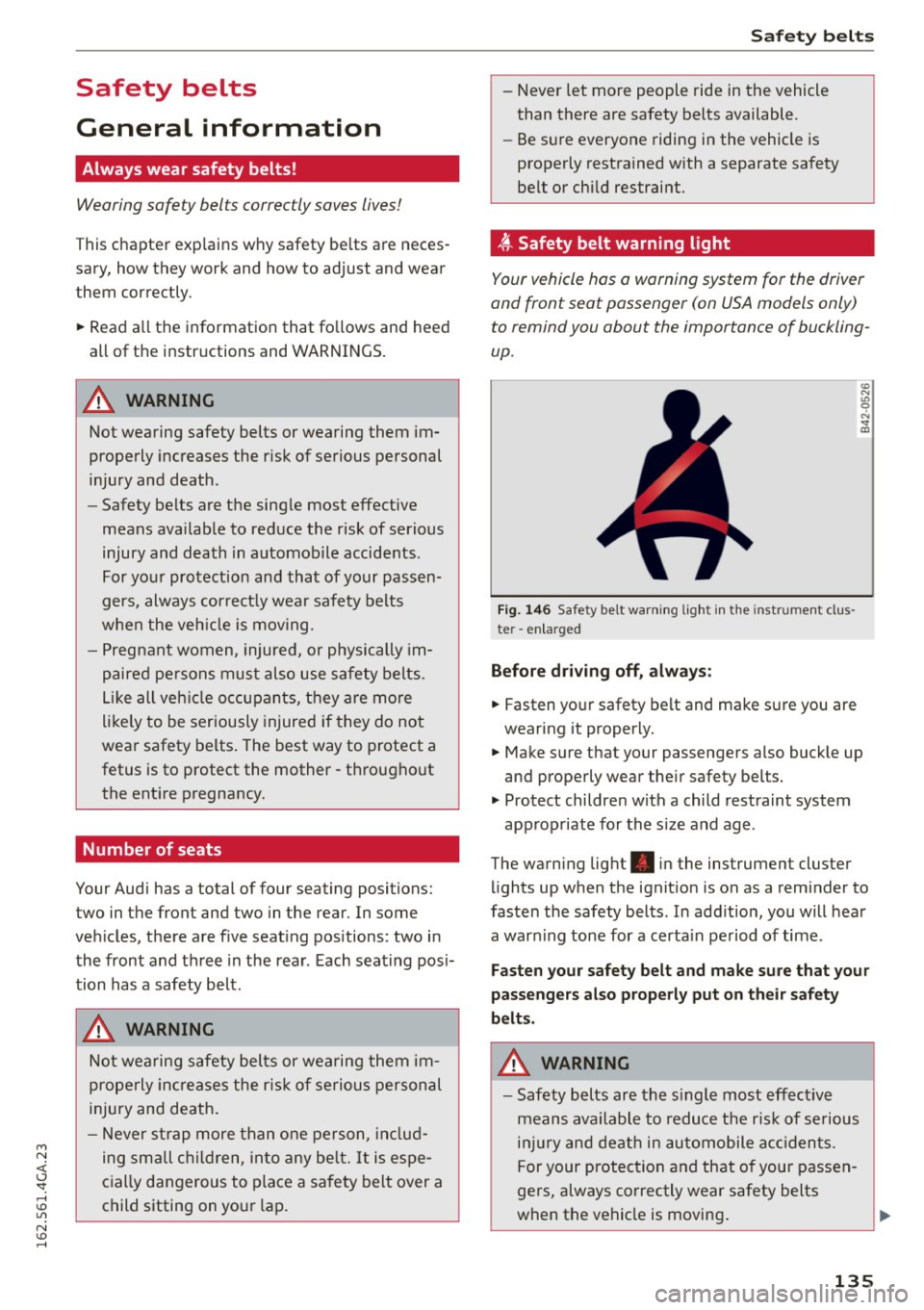
~ Safety belt warning light
Your vehicle has a warning system for the driver
and front seat passenger (on USA models only)
to remind you about the importance of buckling
up.
Fi g. 146 Safety belt warni ng light in the instr ument clus
te r -en larged
Befor e dr iv ing off , always :
~ Fasten yo ur safety belt and make su re you are
wearing it properly.
U) N
"' 0 ..:, .. m
~ Make sure that your passengers also buck le up
and properly wear their safety belts.
~ Protect childre n w ith a child restraint system
app rop riate for the s ize and age .
The warning lig ht . in the instrument cluster
li ghts up when the ignit ion is on as a reminder to
fasten the safety belts . In add ition, you will hear
a warn ing tone for a certa in pe riod of time .
Fasten your safety belt and make sure that your
passengers al so properly put on their safety
belts .
A WARNING
-
-Safety belts are the s ingle most effective
means ava ilable to reduce t he risk of se rious
inj ury and death in au tomobile acc iden ts.
F or your protec tion and that of your passen
ge rs, always correctly wear safety belts
when the vehicle is moving .
13 5
Page 141 of 294
M N <( I.J "". rl I.O
"' N I.O rl
Automatic safety belt retractors
Every safe ty belt is eq uipped w ith an automatic
be lt re tractor on the shou lder belt. This fea ture
l ocks the belt when the be lt is pulled o ut fast ,
d uring hard braking and in an accident . The belt
may a lso lock when you drive up or down a steep
h ill or through a sharp curve. During normal driv
ing the belt lets you move free ly.
Safety belt preten sioner s
The safety belts are equipped w ith a be lt p reten
sioner that helps to tighten the safety belt and
remove s lack when the pretensioner is activated
c::> page 141. The funct ion of the pretensioner is
monitored by a warni ng light
c::> page 18.
Convert ible locking ret ra ctor
Every safety belt except the one on the driver
seat is equipped with a convertib le locking retrac
tor that
m ust be used when the safety belt is
used to attach a child seat. Be sure to read the
important information about this feature
c::> page 177 .
A WARNING
Improperly positioned safety belts can ca use
ser ious injury in an a cci dent
c::> page 139,
Safety belt position .
-Safety belts offe r optimum protection only
when the seatback is upright and belts are
properly positioned on the body.
- Always make sure that t he rear seat back
re st to which the cente r rear safety belt* is
attached is securely latched whenever the
rear center safety belt is being used . If the
backrest is not securely latched, the passen
ger will move forward with the backrest dur
ing sudden braking, i n a sudden maneuver
and especially in a crash.
- Never attac h the sa fety belt to the buck le
for another seat. Attaching the belt to the
wrong buckle will reduce safety be lt effec
t iveness and can cause serious personal in
jury.
- A passenger who is not p roperly rest rained
can be seriously in ju red by the safety belt it
self when it moves from t he stronger parts
Safety belts
of the body into critical areas like the abdo
men .
- Always lock the convertible locking retractor
when yo u are secur ing a chi ld seat in the ve
hicle
c::> page 179.
@ Tips
For information on safety belt pretensione rs,
r efer to
c::> page 141.
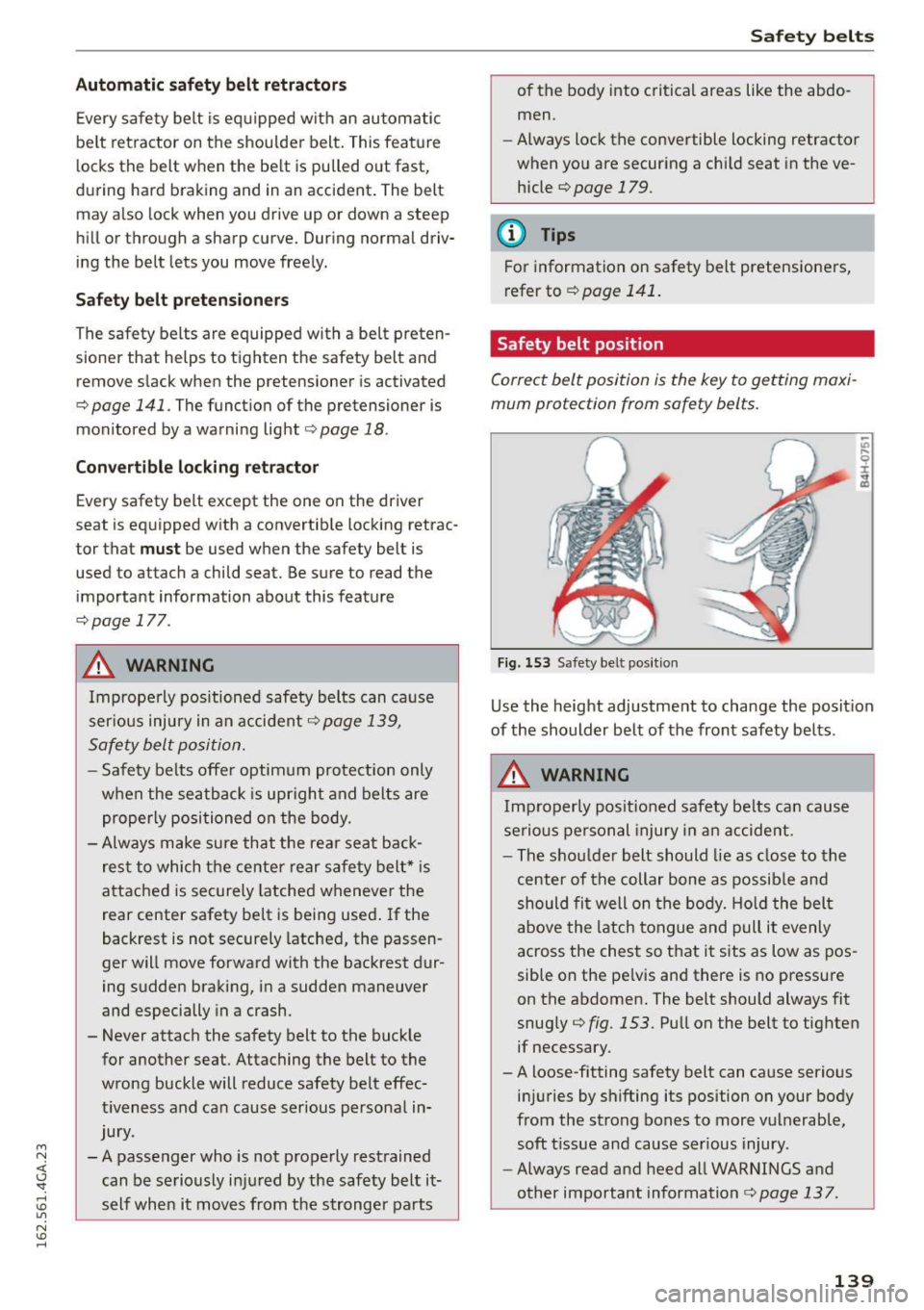
Safety belt position
Correct belt position is the key to getting ma xi
mum protection from safety belts.
Fig . 1 53 Safety belt posit ion
Use the height adjustme nt to change the posit ion
of the shoulder belt of the front safety belts .
A WARNING ~
Imp roperly posit ioned safety be lts can cause
se riou s pe rsonal injury in an accident.
- The s hou lder belt should lie as close to the
ce nter of the collar bone as possib le and
should fi t well on the body. Hold the bel t
above the latch tongue and pull it evenly
across the ches t so t hat it sits as low as pos
sib le on the pe lvis and there is no pressure
on the abdomen. The belt should always fit
snug ly
c::> fig. 153. Pu ll on the belt to tighten
if necessary.
- A loose-fitting safety belt can ca use serio us
in juries by shifting its position on your body
from the strong bones to more vulnerable, soft t issue and cause serious injury .
- Always read and heed all WARNINGS and
other important information<=:>
page 137.
139
Page 143 of 294
M N <( (.J
'SI: ,...., \!) ..,.,
N \!) ,....,
~ Push the loop-aro und fittings up ¢ fig. 156 @,
or
~ squeeze together the (D button, and push the
loop-around fittings
do wn@ .
~ Pull the belt to make sure that the upper at
tachment is properly engaged.
A WARNING
Always read and heed all WARNINGS and oth
er important information
¢ page 137.
With the front seats, the height adjustment
of the seat can also be used to adjust the po
sition of the safety belts.
Improperly worn safety belts
Incorrectly positioned safety belts can cause se
vere injuries .
Wearing safety be lts improperly can cause seri
ous injury or death. Safety belts can on ly work
when they are correct ly posit ioned on the body .
Imp roper seat ing posit ions reduce the effective
n ess of safety belts and will even inc rease the risk
of inju ry and death by moving the sa fety be lt to
cr it ica l areas of the body. Improper seat ing posi
tions also increase the risk of ser ious injury and
deat h when an airbag deploys and stri kes an oc
cupant who is not in t he cor rect seating posit ion .
A driver is responsible for the safety of all veh icle
occupants and espec ially for children. Therefore :
~ Never permit anyone to ass ume an inco rrect sit-
t ing position in the vehicle while trave ling
¢ ,& .
A WARNING
Imprope rly worn safety belts increase the risk
of serious personal injury and death whe never
a vehicle is be ing used.
- Always make sure that al l vehicle occupants
are co rrectly restrained and stay in a cor rect
sea ting pos it ion whenever the veh icle is be
ing used.
- Always read and heed all WARNI NGS and
ot her important i nfo rmat ion
¢page 137 .
Safety bel ts
Belt tensioners
How safety belt pretensioners work
In front, side and rear-end collisions above a
particular severity and in a rollover, safety belts
are tensioned automatically.
Reversible safety belt tensioners
The safety belts on the front seats are eq uipped
with power reversib le tensioners. The fo llow ing
funct ions are availab le when the driver's/front
passenge r's safety belts are fastened:
- Automatic tens ioners : at the start of a drive,
the safety belts automat ica lly adjust to the
passenger after a certain time per iod or vehicle
speed. To sw itch the automat ic tensioners off,
s e lect the following in the MMI:
!CA RI fu nction
button
> (Car )* systems > Vehicle s etting s >
Seats > Driver's seat or Pass enger' s seat > Au
tomatic belt ten sioner
> Off .
- In ce rtai n dr iv ing s ituations, the safety belts
may tighten w ith a revers ible tens ion ing f unc
t ion
¢ page 185.
-The s afety be lt s may also t igh ten wi th th is re-
versible tens ion ing funct ion in m inor collisions.
Pyrotechnic safety belt pretensioners
The safety belts are equ ipped with safe ty belt
pretensioners . The system is act ivated by se nsors
i n front, side and rea r-e nd coll is ions of great se
ver ity and in a ro llover. This tig htens the belt and
ta kes up belt slack¢ .&.
in Service and disposal of
safety belt pre tensioner on page 14 2.
Taking up
t h e slack he lps to reduce forward occupa nt
movement during a collision.
A WARNING
- It is poss ible for the pretens ioners to deploy
incorrectly.
- The pyrotechnic system can only provide protection for one coll is ion. If the pyrotech
n ic pretensioners deploy, the pretens ion ing
sys tem must be replaced .
(1) Tips
The pyrotechnic safety be lt pretensioners can
o nl y dep loy once . .,.
141
Page 145 of 294
M N <( (.J
'SI: ,...., \!) 1.1'1
N \!) ,....,
Airbag system Important information
Importance of wearing safety belts and
sitting properly
Airbags are only supplemental restraints. For
airbags to do their job, occupants must always
properly wear their safety belts and be in a prop er seating position.
For your safety and the safety of your passen
gers, before driving off, always:
.,. Adjust the driver's seat and steering wheel
properly
r:> page 12 7,
.,. Adjust the front passenger's seat properly
9 page 53,
.,. Wear safety belts properly r::> page 137 ,
.. Always properly use the proper child restraint
to protect children
r:> page 167.
In a collision, airbags must inflate within the
blink of an eye and with considerable force. The
supplemental airbags can cause injuries if the
driver or the front seat passeng er is not seated
properly . Therefo re in order to help the ai rbag to
do its job, it is important, both as a driver and as
a passenger to si t properly at all times.
By keeping room between your body and the
steering wheel and the front of the passenger
compartment, the airbag can inflate fully and
completely and provide supplemental protection in certain frontal collisions
r:> page 12 7, Correct
passenger seating positions .
For details on the
operation of the seat adjustment controls
r::> page 53.
It's especially important that children are proper
ly restrained
r:> page 167.
There is a lot that the driver and the passengers
can and must do to help the individual safety fea
tures installed in your Audi work together as a
system.
Proper seating position is important so that the
front airbag on the driver side can do its job . If
you have a physical impairment or condition that
prevents you from sitting properly on the driver
seat with the safety belt properly fastened and
Airbag system
reaching the pedals, or if you have concerns with
regard to the function or operation of the Ad
vanced Airbag System, please contact your au
thori zed Audi dealer or qualified workshop, or
call Audi Customer Relations at 1-800-822-2834
for possible modifications to your vehicle.
When the airbag system deploys, a gas generator
will fill the airbags, break open the padded cov ers, and inflate between the steering wheel and
the driver and between the instrument panel and
the front passenger . The airbags will deflate im
mediately after deployment so that the front oc
cupants can see through the windshield again
without interruption.
All of this takes place in the blink of an eye , so
fast that many people don't even realize that the airbags have deployed. The airbags also inflate
with a great deal of force and nothing should be
in their way when they deploy. Front airbags in
combination with properly worn safety belts slow
down and limit the occupant's forward move
ment . Together they help to prevent the driver
and front seat passenger from hitting parts of
the inside of the vehicle while reducing the forces
acting on the occupant during the crash . In this
way they help to reduce the risk of injury to the
head and upper body in the crash . Airbags do not
protect the arms or the lower parts of the body.
Both front airbags will not inflate in all frontal
collisions. The triggering of the airbag system de
pends on the vehicle deceleration rate caused by
the collision and registered by the electronic con
trol unit. If this rate is below the reference value
programmed into the control unit, the airbags
will not be triggered , even though the car may be
badly damaged as a result of the collision. Vehi
cle damage, repair costs or even the lack of vehi
cle damage is not necessarily an indication of
whe ther an airbag should infla te or not.
Since the circumstances will vary considerably between one collision and another, it is not possi
ble to define a range of vehicle speeds that will
cover every possible kind and angle of impact
that will always trigger the airbags . Important
factors include, for example, the nature (hard or
soft) of the object which the car hits, the angle of
impact, vehicle speed , etc. The front airbags will ..,.
143
Page 146 of 294
Airbag syste m
also not inflate in s ide or rear collisions, or in roll
overs.
A lwa ys rem ember : Airbags will deploy on ly once,
and only in certain kinds of collis ions. Your safety
be lts are a lways there to offer p rotection in those
situations in which airbags are not supposed to
deploy, or when they have already deployed; for
examp le, when your vehicle str ikes or is struck by
another vehicle after the first collision.
This is just one of the reasons why an airbag is a
supp lementary restra int and is not a substitute
for a safety belt. The airbag system works most
effectively when used w ith the safety belts.
Therefore, always properly wear your safety belts
c::> page 135.
A WARNING
Sitting too close to the steering wheel or in
strument panel wil l decrease the effect ive
ness of the airbags and will increase the risk
o f personal injury in a collision .
- Never sit closer than 10 inches (25 cm) to
the steering wheel or instrument panel.
- If you cannot sit more than 10 inches
( 2 5 cm) from the steer ing whee l, investi
gate whether adaptive equipment may be
available to help you reach the pedals and
increase yo ur seating distance from the
steering wheel.
- All veh icle occupants and especia lly children
must be restrained properly whenever riding
in a vehicle. An unrestrained or improperly
restrained child could be injured by striking
the interior or by being ejected from the ve
hicle du ring a sudden maneuver or impact.
An unrestrained or improperly restrained child is also at greater risk of injury or death
thro ugh contac t wit h an inflat ing airbag.
- If you are unrestrained, leaning forward, s it
t ing s ideways o r out of position in any way,
yo ur risk of in jury is much higher.
- You w ill also receive serious inju ries and
c ould even be killed if you are up against the
airbag or too close to it when it inflates -
even with an Advanced Airbag.
144
-
- To reduce the risk of injury when an airbag
inflates, always wear safety belts properly
c::> page 138, Safety belts.
- Always make certain that ch ildren age 12 or
younger always ride in the rear seat. If chil
dren are not properly restrained, they may
be severe ly injured or killed when an a irbag
inflates.
- Never let ch ildren ride unrestra ined or im
prope rly restrained in the vehicle . Ad just the
front sea ts prope rly .
- Never ride with the back rest reclined .
- Always sit as far as possible from the steer-
ing wheel or the instrument panel
c::>page 127.
-Always sit upright with your back against
the backrest of your seat.
- Never p lace your feet on the instrument
panel or on the seat. Always keep both feet
on the f loor in front of the seat to help p re
vent serious injur ies to the legs and hips if
the airbag infla tes.
- Never recline the front passenger 's seat to
transport objects . Items can also move into
the area of the side airbag o r the front air
b ag du ring bra king or in a sudden maneu
ver . Ob jects near the airbags can become
projectiles and cause in jury when an airbag
inflates.
A WARNING
Airbags that have deployed in a crash must be replaced.
- Use on ly original equipment airbags ap
proved by Audi and installed by a trained
technician who has the necessary too ls and
diagnostic equipment to properly rep lace
any airbag in you r vehicle and assure system
effectiveness in a crash.
- Never perm it salvaged or recycled airbags to
be installed in your vehicle.
Child restraints on the front seat - some
important things to know
.,. Be s ure to read the important information and
hee d the WAR NIN GS for import ant details .,..
Page 147 of 294
M N <( (.J
'SI: ,...., \!) 1.1'1
N \!) ,....,
about children and Advanced Airbags
¢page 167.
Even though yo ur vehicle is equ ipped with an Ad
vanced Airbag System, make certain that all ch il
dren, especially those 12 years and yo unger, al
ways ride in the back seat properly restrained for
their age and s ize. The airbag on the passenger
side makes the front seat a potentially dangerous
p lace for a child to ride. The front seat is not the
safest place for a chi ld in a fo rward -facing chi ld
seat .
It can be a very dangerous place fo r an in
fant or a ch ild in a rea rward-facing seat.
T he Advanced Airbag System i n your veh icle has
been certified to comp ly w ith the requi rements
of Uni ted States Federal Moto r Veh icle Safety
Standa rd 208 as applicab le at the t ime your vehi
cle was man ufactu red.
The Standard requires the front a irbag on the
passenger side to be turned off ("supp ressed ") if
a child up to abo ut one year of age restrained in
one o f th e rear-fa cing or forward -facing infant re
s traints listed in Fede ral Motor Vehicle Safety
S tanda rd 20 8 wit h which the Advanced Airbag
System in yo ur vehicle was certifie d has been in
stalled on the front passenger seat. For a listing
of the ch ild restra ints that were used to ce rtify
compliance with the US Safety Standard
¢ page 169.
The PASSENGER AIR BAG OFF light in the instru
ment panel tells you when the front Advanced
Airbag on t he passenger side has been turned off
by the electro nic contro l unit .
Each t ime yo u sw itch on the ig nit ion, the
PAS
SENGER AIR BAG OFF
light w ill come on for a
few seconds and:
- will stay on if the front passenger seat is not
occupied,
- will stay on if the elect rical capacitance meas
u red by t he capacitive passenger detection sys
tem for the front passenger seat eq uals the
combined capacitance of an infant up to abo ut
one yea r of age and one of the rearward- fac ing
o r forward-faci ng chi ld restraints listed in Fed
eral Motor Vehicle Safety Standard 208 w it h
wh ich the Advanced Airbag System in your veh i
cl e was cert ified. Fo r a listing of t he ch ild re -
Airbag syste m
st raints that we re used to cert ify yo ur vehicle's
compliance with the U.S. Safety Standard
¢ page 169.
-wi ll stay on if there is a small c hild or child re
st raint on the front passenger seat,
- w ill go off i f th e front passenger sea t is occu
pie d by an adu lt as registere d by the capacitive
passe nger detect ion system
c> page 154, Mon
itoring the Advanced Airbag System.
T he PASSENGER AIR BAG OFF light comes on
whe n electrica l capacitance registered on the
front passenger seat is eq ua l to or less than the
combined capacitance of a typical 1 year-o ld in
fan t and one of the rearward-facing or forward
facing child restraints listed in Federa l Moto r Ve
hicle Safety Standard 208 with w hich the Ad
vanced Airbag System in your vehicl e was certi
fied.
If the total e lectr ica l capacitance registered on
the front passenge r seat is more than that of a
typ ica l 1 year-old ch ild b ut less than the we ight
of a sma ll adult, the fron t air bag on the passen
ger side can deploy ( the
PASSENGER AIR BAG
OFF
light does not come on).
If th e PASSENGER AIR BAG OFF light does not
come on, the front a irbag on the passenger side
h as not been turned off by the elec tronic con trol
u ni t and can dep loy if the con trol un it senses an
impact that meets the conditions stored i n its
memo ry .
For example , the airbag may deploy if :
-a small ch ild that is heav ie r than a typical 1
yea r-old ch ild is on the front passenge r seat (re
ga rdless of whethe r th e chi ld is in one of the
child sea ts listed
¢ page 169), or
- a child who has outgrown ch ild restraints is on
t he fron t passenger seat .
If the front passenger airbag is turned off, the
PASSENGER AIR BAG OFF light comes on in the
inst rument cluste r and stays on.
If the front passenger airbag dep loys, the Fede ral
Standard requires the airbag to meet t he ''low
r isk" deployment criteria to red uce the risk of i n
j u ry through interaction with the a irbag. "Low
risk" de ploymen t occurs in t hose cra shes tha t ..,.
145
Page 149 of 294

M N
-Always carefully follow the manufacturer's
ins tructions prov ided with the ch ild seat or
carrier.
- Always make sure that t he re is no thing on
the front passenger seat that will cause the capacitive passenger detection system in
the seat to signal to the Airbag System that
the seat is occupied by a person when it is
not, or to signal that it is occ upied by some
one who is heav ier than the person actually
sitting on the seat. The presence of addi
tional objects could cause the passenger
front airbag to be turned on when it should
be off, or could cause the airbag to work in a
way that is different from the way it wou ld
have worked without the object on the seat.
Front airbags
Description of front airbags
The airbag system can provide supplemental
protection to properly restrained front seat occu
pants.
F ig . 157 Locat ion of d river a irbag: in stee ring wheel
Fig . 158 Locat ion of front passenger's a irbag: in the instru
ment pa nel
Your vehicle is equipped w ith an "Advanced Air
bag System" in compl iance with Un ited States
Ai rb ag system
Federal Motor Vehicle Safety Standard
(FMVSS) 208 as applicable at the time your vehi
cle was manufactured. The safety be lts for the
seats have "pretensioners" that help to take slack
out of the belt system. The pretensioners are also
activated by the electron ic control unit for the
airbag system .
The front safety belts also have load limiters to help reduce the forces applied to the body in a
crash .
The airbag for the driver is in the steering wheel
hub
c:> fig . 157 and the airbag for the front pas
senger is in the instrument pane l
c:>fig. 158. The
general location of the airbags is marked ''AIR
BAG".
There is a lot you need to know about the a irbags
in your vehicle. We urge you to read the detailed
information about airbags, safety belts and child
safety in this and the other chapte rs that make
up the owner's literature . Please be sure to heed
the WAR NINGS - they are extremely importa nt
fo r yo ur safety and the safety of you r passengers,
especially infants and small children .
_& WARNING
=
Never rely on airbags alone for protection.
- Even when they deploy, airbags provide only
supp lemental protection.
- Airbag work most effective ly when used
with p roperly worn safety belts.
- Therefore, always wea r you r safety belts and
make sure tha t everybo dy in your vehicle is
properly rest rained.
- Always hold the steering wheel w ith both
hands on the outside of the steering wheel
rim at the 9:00 o'clock and 3:00 o'clock po
sitions to help reduce the risk of persona l in
jury if the driver's airbag inflates.
- Never ho ld the steering wheel at the 12
o'clock position or with your hands any
where inside the steering wheel or on the
steer ing wheel hub. Holding the steering
wheel the wrong way increases the risk of
severe injury to the arms, ha nds, and head if
the dr iver airbag deploys .
~
147
Page 150 of 294

Airbag syste m
A WARNING
Objects between you and the a irbag w ill in
crease the risk of injury in a crash by interfer
ing with the way the airba g unfo lds and/or by
being pus hed into you as the airbag inflates.
- Always make sure nothing is in the front air-
bag depl oyment zone that could be struck
by the airbag when it inflates.
- Objects in the zone of a deploying a irbag
can become project iles when the airbag de
ploys and cause serious personal injury.
- Never hold things in your hands or on your
lap when the vehicle is in use .
- Never place accessor ies or other objects
(such as cup holders, telephone brackets,
note pads, navigation systems, or things
that are large, heavy, or bulky) on the doors; never attach then to the doors or the wind
shield; never place them over or near or at
tach them to the area marked ,.AIRBAG" on
the steering wheel, instrument pane l or the
seat backrests; never place them between
these a reas and you or any other person in
the vehicle .
- Never attach objects to the windshield
above the passenger front airbag, such as
accessory GPS navigation units or music players. Such objects co uld cause serious in
jury in a collision, especially when the a ir
bags inflate.
- Never recline the front passenger seat to transport objects. Items can also move into
the deployment area of the side airbags or
the front airbag dur ing breaking or in a sud
den maneuver . Objects near the a irbags can
fly dangerously th rough the passenger com
partment and ca use i njur y, partic ularly
when the seat is reclined and the airbags in
flate .
A WARNING
A person on the front passenge r seat, espe
cially infants and small children, wi ll receive
serious injuries and can even be killed by be
ing too close to the airbag when it inflates.
- Although the Advanced Airbag System in
your vehicle is designed to turn off the front
148
-
passenger airbag if an infant or a small child
is on the front passenger seat, nobody can
absolutely guarantee that dep loyment un
de r these specia l condit ions is impossible in
all conceivable situations that may happen
during the useful life of yo ur vehicle.
- The Advanced Airbag System can dep loy in
accordance with the ,,low risk" option for 3-
and 6-year-o ld children under the U.S. Fed
era l Standard if a c hild with e lectr ica l capac
itance greater than the combined capaci
tance of a typical one -yea r old infant re
strained in one of the forward facing or rear
ward-facing child seats with which your ve
hicle was certif ied is on the front passenger
seat and the other conditions for airbag de
ployment are met.
- Accident statistics have shown that children
are generally safer in the rear seat area than
in the front seating position .
- For their own safety, all ch ildren, especially
12 yea rs and younger, should a lways ride in
the back properly restrained for their age
and size .
Advanced front airbag system
Your veh icle is equipped with a front Advanced
A irbag System in compliance w ith United States
Federa l Mo tor Ve hicl e Safety Standa rd 208 asap
plicable at the time your vehicle was manufac
tured.
The front Advanced Airbag System supp lements
the safety be lts to p rov ide additional protec tion
f or the driver 's and front passenger 's heads and
u pper bodies in frontal crashes . The airbags in
flate only in fronta l impacts when the ve hicle de
ce lerat ion is high enough.
The front Advanced Airbag System for the front seat occ upants is not a s ubstitute for yo ur safety
belts. Rather , it is part of the overall occupant re
stra int system in your vehicle. A lways remember
that the airbag system can only he lp to protect
you, if you are sitting upr ight, wear ing your safe-
ty belt and wear ing it properly . Th is is why you
ll>
Page 153 of 294
-An Advanced Airbag with gas generator and
control valve for the driver inside the steering
wheel hub.
- An Advanced Airbag with gas generator and
control valve inside the instrument panel for
the front passenger .
- A capacitive passenger detection system under
neath the front passenger seat cover. This sys
tem measures the electrical capacitance of the
person in the seat. The information registered
is sent continuously to the electronic control
unit to regulate deployment of the front Ad
vanced Airbag on the passenger side .
- An airbag monitoring system and indicator
light in the instrument cluster~
page 154.
-A sensor in each front seat registers the dis
tance between the respective seat and the steering wheel or instrument panel. The infor
mation registered is sent continuously to the
electronic control unit to regulate deployment
of the front Advanced Airbags.
- The
PASSENGER AIR BAG OFF light comes on
and stays on in the center of the instrument
panel ~
page 155, fig. 160 and tells you when
the front Advanced Airbag on the passenger side has been turned
off.
- A sensor in the safety belt latch for the driver
and for the front seat passenger that senses
whether that safety belt is latched or not and
transmits this information to the electronic control unit.
A WARNING
Damage to the front passenger seat can pre
vent the front airbag from working properly.
- Improper repair or disassembly of the front
passenger and driver seat will prevent the
Advanced Airbag System from functioning properly.
- Repairs to the front passenger seat must be
performed by qualified and properly trained
workshop personnel.
- Never remove the front passenger or driver
seat from the vehicle.
~ - Never remove the upholstery from the front <(
~ passenger seat.
~ -Never disassemble or remove parts from the 1.1'1
N seat or disconnect wires from it. ID ......
Airbag system
-Never carry sharp objects in your pockets or
put them on the seat. The capacitive pas
senger detection mat in the front passenger
seat will not function properly if it is punc
tured.
- Never carry things on your lap or carry ob
jects on the front passenger seat . Such ob
jects can influence the capacitance regis
tered by the capacitive passenger detection
system, so that incorrect information is pro
vided to the airbag control unit.
- Never store items under the front passenger
seat. Parts of the Advanced Airbag System
under the passenger seat could be dam
aged, preventing them and the airbag sys
tem from working properly.
- Never place seat covers or replacement up
holstery that have not been specifically ap
proved by Audi on the front seats.
- Seat covers can prevent the Advanced Air
bag System from recognizing child re
straints or occupants on the front passenger
seat and prevent the side airbag in the seat
backrest from deploying properly.
- If a seat heater has been retrofitted or oth
erwise added to the front passenger seat,
never install any child restraint system on
this seat.
- Never use cushions, pillows, blankets, or
similar items on the front passenger seat .
The additional layers prevent the capacitive
passenger detection system from accurately
measuring the capacitance of the child safe
ty seat and/or the person on the seat and
thus keep the Advanced Airbag System from
working properly.
- Never place or use any electrical device
(such as a laptop, CD player, electronic
games device, power inverter or seat heater
for child seats) on the front passenger seat if the device is connected to the 12-volt
socket or the cigarette lighter socket. Such
devices can influence the capacitance regis
tered by the capacitive passenger detection
system, so that incorrect information is pro
vided to the airbag control unit.
- If you must use a child restraint on the front
passenger seat and the child restraint
~
151