ESP AUDI A7 2016 Workshop Manual
[x] Cancel search | Manufacturer: AUDI, Model Year: 2016, Model line: A7, Model: AUDI A7 2016Pages: 294, PDF Size: 73.82 MB
Page 156 of 294
Airbag syste m
A WARNING
Objects between you and the airbag will in
crease the risk of injury in a crash by interfer
ing with the way the a irbag unfo lds or by be
ing pushed into you as the a irbag inflates .
- Never hold th ings in your hands or on your
lap when the vehicle is in use .
- Never transport items on or in the area of
the front passenger seat. Objects could
move into the area of the front airbags dur
ing braking or other sudden maneuvers and
become dangero us projectiles that can
ca use serio us pe rsonal injury if the airbags
inflate.
- Never place or attach accessor ies or other
objects (such as cup holde rs, telephone
brackets, large, heavy or bu lky objects) on
the doors, over or near the area marked "AIRBAG" on the steer ing whee l, instru
ment pane l, seat backrests or between
those areas and yourse lf. These objects
could cause injury in a crash, especially
when the airbags inflate.
- Never recline the front passenger's seat to transport objects. Items can also move into
the area of the side airbag or the front air bag during braking or in a sudden maneu
ver. Objects near t he airbags c an become
project iles and cause injury, part icularly
when the seat is reclined .
- Never place or transpo rt obje cts on the
fron t passenger seat . Objects on the front
passenge r seat co uld cause the capacitive
sensor in the seat to signal to airbag system
that the seat is occupied by a person when it in fact is not , or that the person on the seat
is heav ier than he or she actually is . The
change in elect ric capac itance because of
s uch objects can cause the passenger front
airbag to be turned on when it should be off,
or can cause the airbag to work in a way that
is diffe ren t from the way it would have
worked without objects on the sea t.
- Always make sure that there is no thing on
the front passenger sea t that will cause the
capacit ive passenger detection system in
the seat to signa l to the Airbag System that
154
the seat is occup ied by a person when it is
not, or to signal that it is occupied by some
one who is heavier than the person actua lly
sitt ing on the seat . The presence of an ob
ject could ca use the passenger front a irbag
to be turned on when it should be off, or
could cause the airbag to work in a way that is different from the way it would have
wo rked witho ut the ob ject on the seat.
A WARNING
-
T he fine dus t created when airbags deploy can
cause breathing pro blems for people with a
h istory of asthma or other breath ing condi
tions.
- To reduce the risk of breathing p roblems,
those with asthma o r other respiratory con
ditions sho uld get fresh air right away by
getting out of the vehicle or opening win
dows or doors.
- If you are in a collision in which airbags de
ploy, wash your hands and face w ith m ild
soap and water before eat ing .
- Be careful not to get the dust into your eyes,
or into any cuts or scratches .
- If the resid ue should get into your eyes,
flush them w ith water.
Monitoring the
Advanced Airbag System
t!i Airbag monitoring indicator light
Two separate indicators monitor the function of
the Advanced Airbag System: the airbag moni
toring indicator light and the
PASSENGER AIR
BAG OFF
light.
The Advanced A irbag System as well as the side
airbags and side curtain airbags wit h ejection
mitigation features (incl uding the e lectronic con
trol unit, sensors and system w iring) are all
monitored continuously to make sure that they
are funct ioning properly whenever the ign ition is
o n. Every t ime you turn on t he ignit io n, the air
bag system indicato r light
fl will come on fo r a
few seconds (fun ct ion check).
ll>
Page 159 of 294
M N <( (.J
'SI: ,...., \!) 1.1'1
N \!) ,....,
his or her back up against the backrest and the
backrest is not reclined,
- the adult is not taking weight off the seat by
holding on to the passenger assist handle
above the front passenger door or supporting
their weight on the armrest,
- the safety be lt is being properly worn and that
there is not a lot of s lack in the safety be lt web
bing,
- there are no aftermarket seat covers or cush
ions or other things (such as blankets) on the
front passenger seat that m ight cause the ca
pacit ive passenger detection system to miscal
culate electrical capac itance.
Important safety instructions on
monitoring the Advanced Airbag System
A WARNING
- If the status of the Adva need A irbag System
has changed while the vehicle is mov ing, the
PASSENGER AIR BAG OFF light blinks for
about S seconds to catch the driver's atten
t ion . If th is happens, always stop as soon as
it is safe to do so and check the steps descri
bed above.
- If the PASSENGER AIR BAG OFF light does
not go off when an adult who is not very
small is si tting on the front passenger seat
after taking the steps described above,
make sure the adult is properly seated and
restrained at one of the rear seating posi
t ions. Have the airbag system inspected by
your authorized Aud i dealer before trans
porting anyone on the front passenger seat.
A WARNING
An airbag system that is not funct ioning prop
erly cannot provide supplementa l protect ion
in a frontal crash.
- If the airbag indicator light c::;, page 18
comes when the vehicle is be ing used, have
the system inspected immed iate ly by your
au thori zed Audi dealer.
It is possible that
the a irb ag will inflate when it is not s up
posed to, or w ill not inflate when it should.
Airbag syste m
A WARNING
If the front airbag inflates, a child without a
chi ld restraint, or in a rearward-facing chi ld
safety seat, or in a forwa rd-fac ing child re
straint that has not been proper ly installed
will be ser ious ly injured and can be killed .
- Even though you r vehicle is equipped with
an Advanced A irbag System, make ce rtain
that al l children, especially 1 2 years and
younge r, al ways ride on the back seat prop
erly restra ined for their age and size.
- Always install forward o r rear-facing child
seats on the rear seat -even with an Ad
vance d Ai rbag System.
- If you must ins tall a rearwa rd-fa cing c hild
seat on the front passenger seat because of
exceptiona l circumstances and the
PASSEN
GER AIR BAG OFF
light does not appear and
stay on, immediately install the rear-facing
child seat in a rear seating position and have
the airbag system inspected by your Audi
deale r.
- If, in exceptiona l circumstances, you must
install a forwa rd-facing child restraint on
the front passenger seat , always move the
seat into i ts rearmost pos ition in the seat's
fore and a ft ad justmen t range, as fa r away
fr om the airb ag as possib le. The b ackrest
m ust be adjus ted to an upr ight position.
Make sure t hat the
PASSENGER AIR BAG
OFF
li ght comes on and stays on all the time
whenever the ignition is switched on.
A WARNING
- I f the PASSENGER AIR BAG OFF light does
not go out when an adult is s itting on the
front passenger seat after tak ing the steps
described above, make su re the adult is
p roperly seated and restrained a t one of the
rea r seat ing pos itions.
- Have the airbag system inspected by your
Aud i deale r before t ransporting anyone on
the front passenger seat.
157
Page 160 of 294

Airbag syste m
(D Tips
If the capaciti ve passenger detection system
determines that the front passenger seat is
empty, the frontal airbag on the passenger
side w ill be turned off, and the
PA SSEN GER
AIR BA G OFF
light w ill stay on.
Repair, care and disposal of the airbags
Parts of the a irbag system are installed at many
d iffe rent p laces on your Audi. Insta lling, remov
ing, servicing or repa iring a part in an area of the
veh icle can damage a part of an ai rbag system
and prevent that system from working properly
in a co llision.
There are some important thi ngs you have to
know to make sure that the effect iveness of the
system w ill not be impaired and that d isca rded
components do not cause injury or pollute the
environment.
A WARNING
-Improper care, servicing and repair proce
dures can increase the risk of personal injury
and death by preventing an a irbag from de
ploying when needed or deploying an airbag
unexpectedly:
- Never cover, obstruct, or change the steer ing wheel horn pad or airbag cover or the in
strument pane l or modify them in any way.
- Never attach any objects such as cup holders or te lephone mountings to the surfaces cov
ering the airbag units.
- For cleaning the ho rn pad or instrument
panel, use only a soft, dry cloth or one mois
tened with plain water. So lvents or cleaners
c ould damage the a irbag cover or change
the stiffness o r strength of the ma ter ial so
that the airbag cannot dep loy and protect
properly .
- Never repa ir, adjust, or change any parts of
the a irbag system.
- All work on the stee ring wheel, inst rument
panel, front seats or electrical system (in
cluding the installation of audio equipment,
cellular telephones and CB radios, etc.)
must be performed by a qualified technician
158
who has the training and special equipment necessary.
- For any work on the airbag system, we
strongly recommend that yo u see your au
thorized Audi dealer or qualified workshop.
- Never modify the front bumper or parts of
the vehicle body.
- Always make sure that the side airbag can
inflate w ithout interference:
- Never install seat covers or rep lacement
u pholstery over the front seatbacks that
have not been specifically approved by
A udi.
- Never use additional seat c ushions that
cover the areas where the side a irbags in
flate.
- Damage to the orig inal seat cove rs or to
the seam in the are a of the side ai rbag
module mus t always be repaired immedi
ate ly by an autho rized Aud i dealer.
- The a irb ag sys tem can deploy on ly on ce. Af
ter an airbag has been deployed, i t m ust be
rep laced with new replacement parts de
signed and approved especially fo r your A udi
model version. Replacement of complete
airbag systems or a irbag components must
be performed by qualified workshops only.
Ma ke sure that any airbag serv ice action is
e ntered in your Aud i Warranty
& Ma inte
nance booklet unde r
AIRBAG REPLAC EM ENT
R ECORD.
- For safety reasons in severe accidents, the
al ternator and starte r are separated from
the vehicle batte ry w ith a pyrotec hni c circ uit
interrupter .
- Work on the pyrotechnic c ircuit interrupt
er must on ly be performed by a qua lified
techn ic ians who have the experience, in
fo rmation and specia l tools necessa ry to
perfo rm the wor k safely.
- If the vehicle or the circuit interr upter is
scrapped, all app licable safety precautions
must be followed.
~
Page 163 of 294
M N <( I.J "". rl I.O
"' N I.O rl
Important safety instructions on the knee
airbag system
Applies to vehicles: with k nee a irbags
Airbags are only supplemental restraint s. Always
wear safety belts correctly and ride in a proper
seating position.
There is a lot that you and your passengers must
know and do to help the safety belts and airbags
to prov ide supplementa l protection.
A WARNING
An inflating knee airbag can cause ser ious in
jury. Wearing safety belts incorrect ly and im
proper seating positions increase the risk of
serious personal injury and death whenever a
vehicle is being used.
- The knee airbag system cannot protect you
properly if you are seated too close to any of
the a irbag locat ions . When adjust ing their
seat positions, it is important that both the
dr iver and the front passenger keep the ir
upper bod ies and knees at the followi ng
mi nimum safe distances :
- at least 10 inches (25 cm) between the
chest and the steering wheel/instr ument
panel.
- at least 4 inc hes (10 cm) between the
knees and the lower part of the instru
ment panel.
- The risk of persona l injury increases if yo u
lean forward or to the s ide, or if the seat is
improperly pos it ioned and you are not wear
ing your safety belt . The risk increases even
more should the airbag deploy .
- Always make sure that the knee airbag can
inflate without inte rference . Objects be
tween you and the a irbag can increase the
risk of i nju ry i n an accident by inte rfe ring
w ith the way the ai rbag dep loys o r by be ing
pushed into you as the airbag dep loys.
- Never let anybody, especially ch ildren o r
animals ride in the footwell in front of the
passenger seat . If the airbag deploys, th is
can result in ser ious or fatal injuries .
- Never carry objects of any kind in the foot
well area in front of the driver's or pas
senger's seat . Bul ky objects (shopping
-
Airb ag system
bags, for examp le) can interfere with or
prevent proper deployment of the airbag .
Small objects can be thrown through the
vehicle if the airbag deploys and injure you
or your passengers.
- Make sure the re are no cracks , deep scratch
es o r other damage in the area of the instru
ment panel where the knee airbags are lo
cated .
- I f chi ldren are inco rrectly seated, their ris k
of injury increases in a coll is ion
c::> page 167, Child safety.
Side airbags
Description of side airbags
The airbag system can provide supplemental
protection to properly restrained occupants.
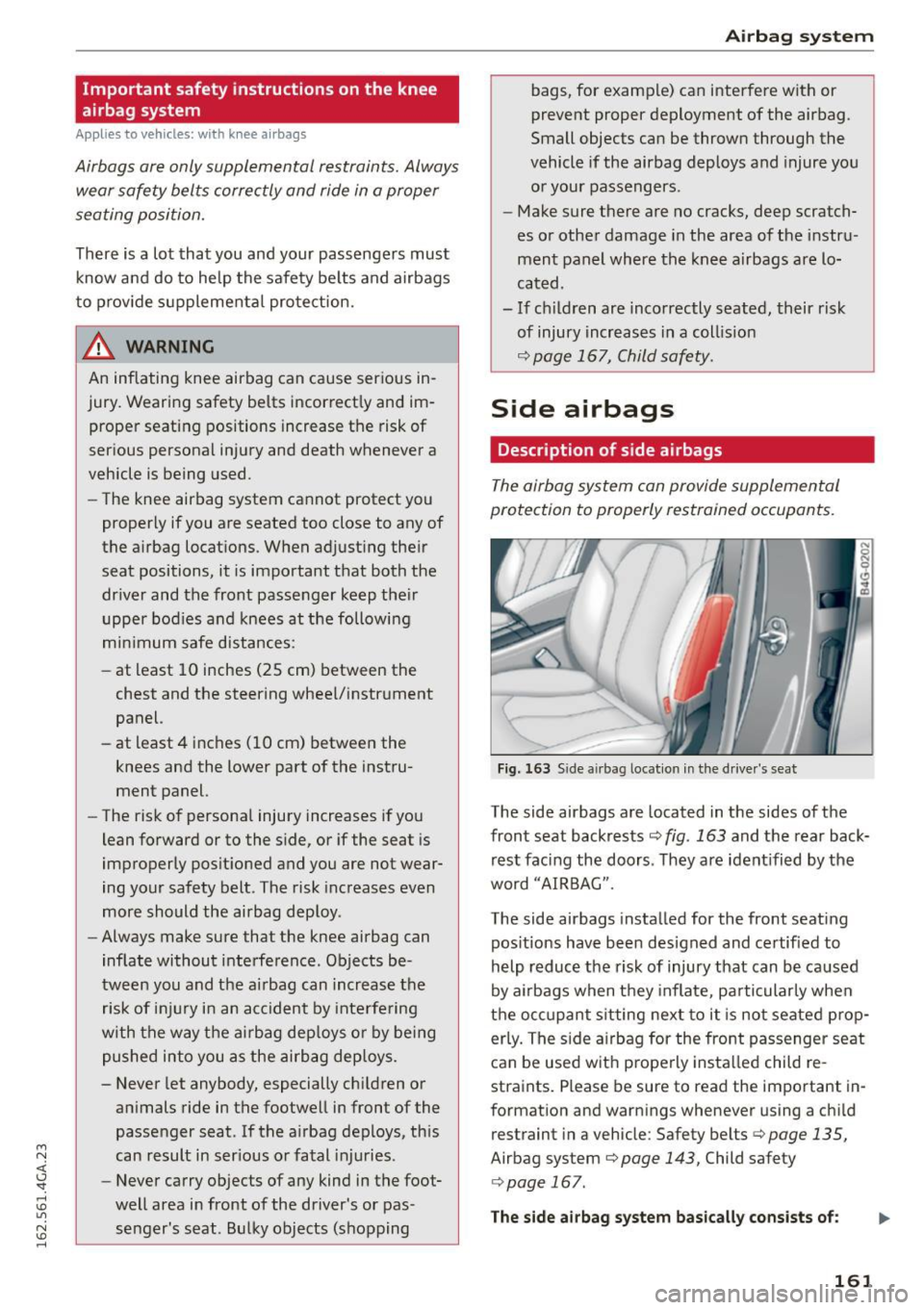
Fi g. 163 Sid e airbag location in the driver's seat
The side airbags are located in the sides of the
front seat backrests
c::> fig. 163 and the rear back
rest facing the doors . They are ident ified by the
word "AIRBAG".
The side airbags insta lled for the front seat ing
pos it ions have been des igned and certified to
help reduc e the r isk of injury that can be caused
by a irbags when they inflate, particularly when
t h e occ upant s itting next to it is not seated p rop
erly. The s ide a irbag for the front passenger seat
can be used with properly insta lled child re
straints. P lease be sure to read the important in
formation and warn ings whenever using a ch ild
restraint in a vehicle : Safety be lts
c::> page 135,
Airbag system c::> page 143, Child safety
<=>page 167.
The side airbag sy stem basi cally consi st s of: ..,.
161
Page 165 of 294
M N <( I.J "". rl I.O
"' N I.O rl
How supplemental side airbags work
Side airbags deploy instantly and can help reduce the risk of upper torso injuries for occu
pants who are properly restrained.
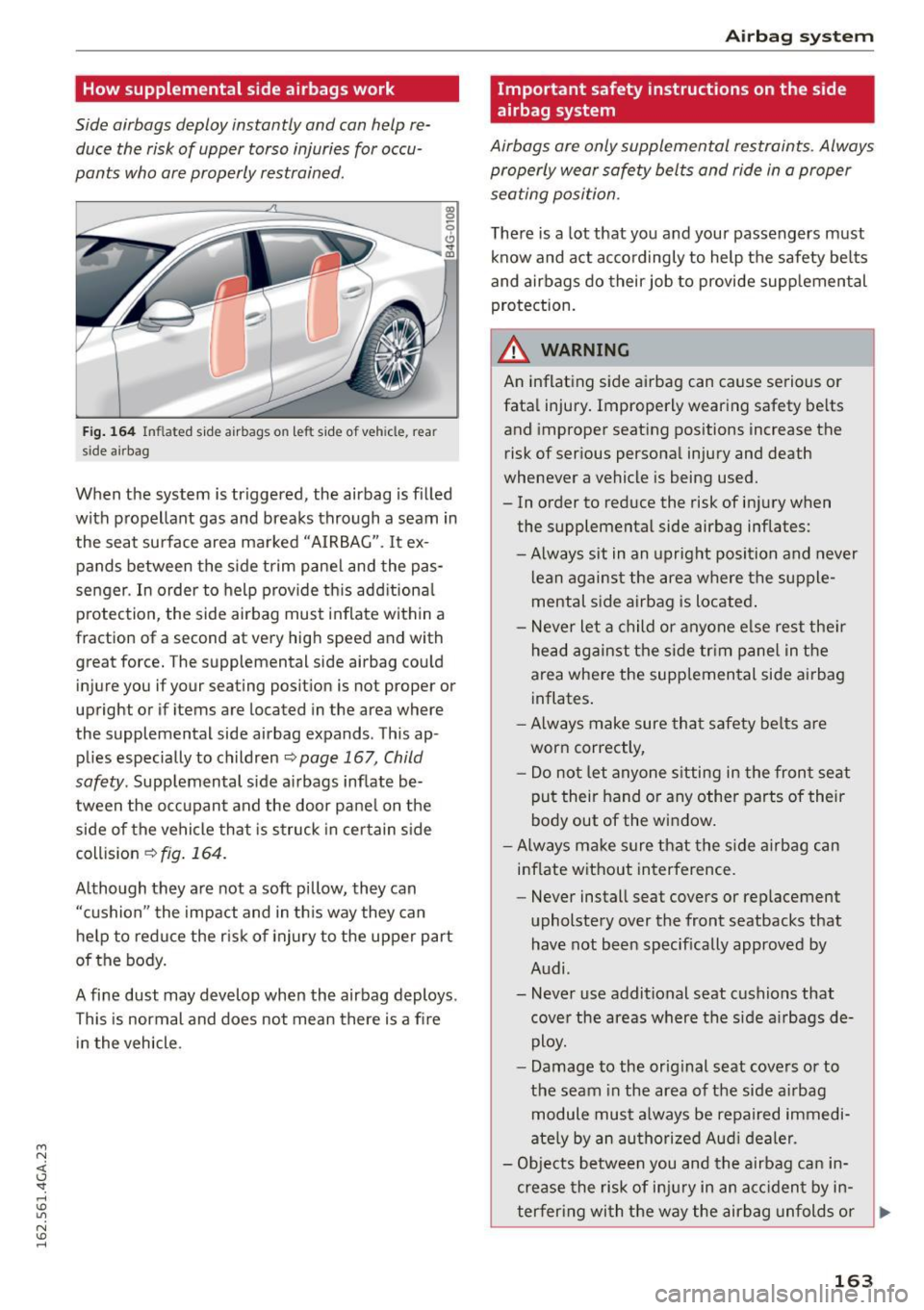
Fig. 164 Inflated side a irbags on left side of veh icle, rea r
side airbag
When the system is triggered, the airbag is filled
with propellant gas and breaks through a seam in
the seat surface area marked "AIRBAG". It ex
pands between the side trim panel and the pas
senger . In order to help provide this additional
protection, the side airbag must inflate within a
fraction of a second at very high speed and with
great force. The supplemental side airbag could
injure you if your seating position is not proper or
upright or if items are located in the area where
the supplemental side airbag expands. This ap
plies especially to children
r:::.>page 167, Child
safety.
Supplemental side airbags inflate be
tween the occupant and the door panel on the
side of the vehicle that is struck in certain side
coll ision
r:::.> fig. 164.
Although they are not a soft pillow, they can
"c ushion " the impact and in this way they can
help to reduce the risk of injury to the upper part
of the body.
A fine dust may develop when the airbag deploys .
This is normal and does not mean there is a fire
in the vehicle .
Airbag system
Important safety instructions on the side
airbag system
Airbags are only supplemental restraints. Always
properly wear safety belts and ride in a proper seating position .
There is a lot that you and your passengers must
know and act accordingly to help the safety belts
and airbags do their job to provide supplemental
protection.
A WARNING
An inflating side airbag can cause serious or
fatal injury. Improperly wearing safety belts
and improper seating positions increase the
risk of serious personal injury and death
whenever a vehicle is being used.
- In order to reduce the risk of injury when
the supplemental side airbag inflates:
- Always sit in an upright position and never
lean against the area where the supple
mental side airbag is located.
- Never let a child or anyone else rest their
head against the side trim panel in the
area where the supplemental side airbag
inflates.
- Always make sure that safety belts are
worn correctly,
- Do not let anyone sitting in the front seat
put their hand or any other parts of their
body out of the window.
- Always make sure that the side airbag can
inflate without interference.
- Never install seat covers or replacemen t
upholstery over the front seatbacks that
have not been specifically approved by
Audi.
- Never use additional seat cushions that cover the areas where the side airbags deploy.
- Damage to the original seat covers or to
the seam in the area of the side airbag
module must always be repaired immedi
ately by an authorized Audi dealer.
-
- Objects between you and the airbag can in
crease the risk of injury in an accident by in
terfering with the way the airbag unfolds or
~
163
Page 168 of 294

Airbag syste m
to help provide this additiona l protection, the
side curtain airbag must inflate within the blink
of an eye at very high speed and with great force .
The side curtain airbag could injure you if your seating position is not p roper or upright or if
items are located in the area where the supp le
mental side curta in a irbag inflates . Th is applies
especia lly to children
c::> page 167 .
Although they a re not a soft pillow, side curtain
airbags can "cushion" the impact and in this way
they can help to reduce the risk of injury to the
head and the upper part of the body.
A fine dust may develop when the airbag deploys.
This is quite normal and does not mean there is a
fire in the veh icle .
Important safety instructions on the side
curtain airbag system
Airbags are only supplemental restraints . Always
properly wear safety belts and ride in a proper
seating position.
There is a lot that you and your passengers must
know and do to help the safety be lts and airbags
do their job to provide supp lemental p rotection.
,& WARNING
Improperly wear ing safe ty belts and imp roper
seating positions increase the risk of serious
perso nal injury and death whenever a vehicle
is being used.
- Never let occ upants p lace any parts of their
bodies in the area from which the side cur
ta in a irbag inflate.
- Always make sure that the side curtain air
bags can inflate witho ut interference .
- Use the built-in coat hooks only for lig ht
weight clothing. Never leave any heavy or
sharp-edged objects in the pockets that may
interfere with airbag deployment and can
cause personal injury in a co llision.
- Never use hangers to hang clothes on the hooks.
- Only use factory- insta lled sun shades or, if
shades installed after the vehicle leaves the
factory, use on ly genu ine Audi su n shades.
166
- Never swing the sun visors over to the s ide
w indows if things such as pens, garage door
openers, hands-free speakers, etc. are at
tached to the sun v isors. They could come
loose and cause serious injury if the side cur
tain airbag inflates.
- A deploying airbag inflates in a fraction of a second and with great force.
- Never attach objects to the cover or in the
deployment zone of a s ide curtain airbag .
- The a irbag deployment zones must be kept
clear at al l times. Make sure there are no ob
jects, pets, or other persons in the space be
tween any vehicle occupant and any a irbag
at anyti me.
- Do not attach any accesso ries to the doors.
,& WARNING
- The a irbag system can deploy on ly once. If
the airbag has been t rigge red, the system
m ust be repl aced by an aut ho rized Aud i
dea le r o r qualified wor kshop.
- Always have wor k involving the side cu rtain
ai rbag system, removal and installation o f
the airbag componen ts, or other rep air s per
formed by a qualified dea le rship . Othe rwise
the airbag system may not work correctly .
- Never attempt to mod ify any components of
the airbag system in any way .
Page 169 of 294

M N <( (.J
'SI: ,...., \!) 1.1'1
N \!) ,....,
Child safety
Important information
Introduction
The rear seat is generally the safest place in a
collision .
The physical principles of what happens when
your veh icle is in a crash apply also to children
c:> page 136, What happens to occupants not
wearing safety belts? .
But unlike adults and
teenagers, the ir muscles and bones are not fu lly
developed. In many respe cts c hildren are at
g reater risk of serio us i njur y in crashes than
a d ul ts.
Because ch ildren's bod ies are not fully deve loped,
they requ ire rest ra int systems especially de
signed fo r their size, weight, and body st ru ct ure.
M any countr ies and a ll states of the Uni ted
States and p rovinces of Canada have laws requi r
ing the use of approved c hil d restraint systems
for infants and small chi ldren.
I n a front al crash at a speed o f 20 -35 mph
(30 -56 km/h) the forces acting on a 13 -po und
(6 kg) infa nt wi ll be more than 20 t imes t he
weight of the child . Th is means the weight of the
chi ld would sudden ly be more than 260 pounds
(120 kg). Under these conditions, only an appro
p riate ch ild restra int properly used can reduce
the r isk of se rious i nju ry. Ch ild restra ints, like
ad ult safety belts, must be used prop erly to be
effective . U sed improperly, they can increa se the
ris k of serious injury in an accident.
Consult the child safety seat manufacturer's in
structions in orde r to be s ure the seat is right fo r
your chi ld's si ze
c:> page 170, Important safety
instructions for using child safety seats .
Please
be sure to read an d heed a ll of th e importa nt in
formation and WAR NINGS about c hild safety, Ad
vanced Ai rbags, and the installation of child re
straints in th is chapter.
There is a lot you need to know abou t the Ad
vanced Airbags in yo ur vehicle and how they work
when infa nts and children in child rest raints a re
on the front passenger seat. Because of the large
amo unt of important informat ion, we cannot re-
Child sa fety
pea t it all he re . We urge you to read the detailed
information in this owner's ma nual about airbags
and the Advanced Airbag System in yo ur veh icle
and the very important information about trans
porting children on the front passenger seat.
Please be sure to heed the WARNINGS -they are
extremely importa nt for your safety and t he safe
ty of you r passengers, especially infants and
small ch ild ren .
& WARNING
-Accident st atistics have shown th at children
a re generally safer in the rear sea t area than
in the front seatin g position. Always restra in
any child age 12 and under in the rea r.
- All vehicle occupants and es pecially children
m ust be restrained properly whenever ri ding
in a vehicle. An un rest rained or improperly
restrained ch ild could be injured by striking
the inter ior or by be ing ejected from the ve
h icle dur ing a sudden maneuve r or impact .
An unrestra ined o r improperly restrained
child is a lso at greate r risk of in ju ry or death
through conta ct with an inflating airbag .
- A suitable ch ild restraint properly installed
an d used at one of the rear seating posit ions
p rovi des the highest deg ree of prote ction
for infan ts and small children in most a cci
dent situat ions.
& WARNING f"-"----
Children on the front sea t of any car even with
Advanced Air bags can be ser iously injured or
even kil led when an a irbag inflates. A chi ld in
a rearward-facing child safety seat installed
on the front passenger seat will be serious ly
i njured and can be k illed if the front a irbag in
flates .
- The inflating airbag will h it the ch ild safety
seat or infant carr ier with great force and
will smash the child safety seat and child aga inst the backrest, cent er armrest, o r
door.
- Always install rear-fac ing ch ild safety seats
on the rear sea t.
- If you must ins tall a rearwa rd fac ing child
safety seat on th e front passenger s eat in
167
Page 171 of 294
M N <( (.J
'SI: ,...., \!) 1.1'1
N \!) ,....,
Advanced front airbag system and children
Your vehicle is equipped wit h a front "Advanced
A irbag System" i n compliance w it h United States
F ederal Motor Vehicle Safe ty Standard ( FMVSS)
208 as applicable at the time your vehicle was
manufactured .
The Advanced Airbag system in your ve hicl e has
been certified to mee t the " low -risk" requ ire
ments for 3 -and 6-year o ld children on the pas
senger side and small adults on the driver side.
T he low risk deployment criteria are intended to
reduce the r isk of injury through interaction with
the airbag that can occur, for example, by being
too close to the steering whee l and instrument
panel when the a irbag inflates . In add it io n, the
system has been cert ified to comply with the
"suppression" requiremen ts of the Safety Stand
ar d, to turn off t he front airbag for infa nts up to
12 months who are restra ined on the front pas
senger seat in child restraints that are listed i n
the Standard.
E ven though yo ur vehicle is equ ip ped with an Ad
vanced A irbag sys tem, all children, especia lly
those 12 years and younger, should always ride in
the back seat properly restrained for their age
and size. The airbag on the passenger side makes
the front seat a potent ially dangerous p lace for
a
chi ld to r ide. The fro nt seat is not the safes t place
for a child in a forward-facing child safety seat . It
can be a very dangerous place for a n infant or a
l arger child in a rea rward-facing seat .
T he vehicle's Advanced Airbag System has a ca
pacitive passenger detect ion system in the front
passenger seat cush ion that ca n detec t the p res
e n ce of a baby o r a child in a c hild restra int sys
tem on this seat.
The capacit ive passenger detection system regis
ters the changes that result in an electrical field
when a ch ild, a child rest raint, and a baby b la nk et
a re on the fron t passenger sea t. T he change in
the meas ured c apac it a nce due to the presence of
a child,
a chi ld restraint, and a baby blanket on
the front passenger seat is re lated to the child re
straint system resting on the seat . The measu red
capacitance of a chi ld restraint system va ries de-
Child sa fety
pending on the type of sys tem and specific make
and mode l.
T he elec trical c apacit a nce of the va rious types,
makes, and mo dels o f child restra ints specifie d
by the U.S.National Highway Traff ic Sa fety Ad
ministration (NH TSA) in the relevant safety
standard are stored in the Advanced Airbag Sys
tem control unit together w it h the capacitances
typ ica l of infants and a 1-year old child. When a
c h ild restra int is used on the front passenger seat
with
a typ ica l 1 year-old in fant, the Advanced Air
bag System compa res the capacitance measu red
by the capacitive passenge r dete ction system
wi th t he dat a stored in the elec tronic con trol
u ni t.
Child restraints and Advanced front airbag
system
Regardless of the c hild restra int that you use,
make sure that it has been cert ified to meet Unit
ed States Federa l Moto r Veh icle Safety Standa rds
and has been ce rtified by its manufacture r fo r
u se with an a irbag. Always b e sur e t hat t he c hild
r est rain t is prope rly insta lled a t one of the rear
sea ting pos itions. If in excep tional circ ums tan ces
yo u m ust use it on the front passenge r seat, care
fully read a ll of the information on chi ld safety
and Advanced Airbags and heed all of the appli
cable WARNINGS. Make certain that the child
and child restra int are correctly recogni zed by the
capacit ive passenger detection system i n the
front passenger seat, that the front passe nger
airbag is turned off, and that the a irbag status is
always cor rect ly signa led by the
PASSENGER AIR
BAG OFF
light .
Many types and models of child rest raints have
been available ove r the years, new mode ls a re in
t rod uced regu larly in co rporating new and im
proved de signs and older mode ls are take n ou t of
produ ct io n. Ch ild restra ints are not s tandar dized.
Child rest rain ts of the same type typ ically have
different weights and sizes and different "foot
prints", the size and shape of t he bottom of the
c hi ld restra int that sits on the seat, when they
are installed on
a vehicle seat. These d ifferences
make it virtua lly impossib le to cert ify compliance
with the requirements for advanced airbags with .,.
169
Page 172 of 294
Child safety
each and every child restraint that has ever been
sold in the past or will be sold over the course of
the useful life of your vehicle.
F or this reason, the Uni ted States Nat iona l H igh
way Traffic Sa fety Administration has p ublished a
list of specific type, makes and models of c hild
restraints that m ust be used to certify comp li
ance of the Advanced Airbag System in your vehi
cle with the suppression requirements of Federal
Motor Vehicle Safety Standard 208 . These ch ild
restra ints are:
Subpart A - Car bed child restr aint s
Model Manufactured on or
after
Angel Guard Angel September 25, 2007
Ride AA2403FOF
Subpa rt B -Rear-facing child restraints
Model Manufactured on or
after
Century SmartFit 4543 December 1, 1999
C osco Arriva
September 25, 2007
22-013PAW and base
22-999WHO
E venflo Discovery Ad -
December 1, 1 999
jus t Right 2 12
Evenflo F irst Cho ice December 1, 1999
204
Graco Infant 8457 December
1, 1999
G raco Snugride Sept ember 25, 2007
Peg Perego P rimo V iag- September 25, 2007
gio SIP IMU NOOUS
Subp art C - Forward-facing and convertible
child restraints
Model Manufactured on or
after
Brit ax Ro undabout September 25, 2007
E9L 02xx
Cosco Tour iva 02519 December 1, 1999
C osco Summ it Del uxe September 25, 200 7
H igh Back Booste r
22- 262
170
Model Manufactured on or
after
Cosco H igh Back Boos- September 25 , 2007
ter 22-209
E ven flo Tribute V September 25, 20 07
379xxxx
Evenflo Meda llion 254 December 1, 1999
Evenf lo Generations September 25, 2007
352xxxx
Graco Comfo rtSport September 25 , 2007
Graco Todd ler Safety September 25, 2007
Seat Step 2
Gr aco Platinu m Cargo Se pte mber 25, 200 7
_& WARNING
To reduce the risk of ser io us injury , ma ke s ure
that the
PASSENGER AIR BAG OFF lig ht
comes on and stays on whenever a ch ild re
straint is installed on the front passenger seat
and the ig nition is switched o n.
- Ta ke the child restraint off the front passen
ger seat and install it properly at o ne of the
rea r seat positions if the
PASSENG ER AIR
BAG OFF ligh t does not s tay on.
- Have the airbag system inspected by your
author ized Audi dealer immed iate ly.
(D Tips
The child seats listed in categor ies A to C have
been statically tested by Audi only for the Ad
vanced A irbag function.
Important safety instructions for using
child safety seats
Correct use of child safety seats substantially re
duces the risk of injury in an accident!
As the dr iver, you are responsib le for the safety of
everybody in the veh icle, especially ch ildren:
.. Always use the right ch ild safety seat for each
child and always use it properly
c::;, page 173 .
.. Always carefully fo llow the child safety seat
manufact urer's instructions on how to ro ute
the saf ety belt properly through the c hild safe
ty seat.
Page 173 of 294
M N <( (.J
'SI: ,...., \!) ..,.,
N \!) ,....,
~ When using the vehicle safety belt to install a child safety seat , you must first activate th e
convertible locking retractor on the safety belt
to prevent the child safety seat from moving
¢ page 177.
~ Push the child safety seat down with your full
weight to get the safety belt really tight so that
the seat cannot move forward or sideways more
than one inch (2.5 cm).
~ Secure unused safety belts on the rear seat
¢page 172.
Always remember: Even though your vehicle is
equipped with an Advanced Airbag system, all
children , especially those 12 years and younger,
should always ride in the back seat properly re
strained for their age and size.
A WARNING
Not using a child safety seat, using the wrong
child safety seat or improperly installing a
child restraint increases the risk of serious
personal injury and death.
- All vehicle occupants and especially children
mus t be restrained properly whenever riding
in a vehicle. An unrestrained or improperly
restrained child could be injured by striking
the interior or by being ejected from the ve
hicle during a sudden maneuver or impact.
An unrestrained or improperly restrained child is also at greater risk of injury or death
through contact with an inflating airbag.
- Commercially available child safety seats
are required to comply with U.S. Federal Mo
tor Vehicle Safety Standard (FMVSS) 213 (in
Canada CMVSS 213).
- When buying a child restraint, select one
that fits your child and the vehicle .
- Only use child restraint systems that fully contact the flat portion of the seat cush
ion. The child restraint must not tip or
lean to either side. Audi does not recom
mend using child safety seats that rest on
legs or tube-like frames. They do not pro
vide adequate contact with the seat.
- Always heed all legal requirements per
taining to the installation and use of child
safety seats and carefully follow the in-
Child safety
structions provided by the manufacturer
of the seat you are using .
- Never allow children under 57 inches
(1.45 meters) to wear a normal safety belt.
They must always be restrained by a proper
child restraint system. Otherwise, they
could sustain injuries to the abdomen and
neck areas during sudden braking maneu
vers or accidents.
- Never let more than one child occupy a child safety seat.
- Never let babies or older children ride in a
vehicle while sitting on the lap of another
passenger .
- Holding a child in your arms is never a sub
stitute for a child restraint system.
- The strongest person could not hold the child with the forces that exist in an acci
dent. The child will strike the interior of
the vehicle and can also be struck by the
passenger.
- The child and the passenger can also in
jure each other in an accident.
- Never install rear -facing child safety seats or
infant carriers on the front passenger seat.
A child will be seriously injured and can be
killed when the passenger airbag inflates -
even with an Advanced Airbag System .
- The inflating airbag will hit the child safety
seat or infant carrier with great force and
will smash the child safety seat and child
against the backrest, center armrest, door
or roof.
- Always install rear-facing child safety seats
or infant carriers on the rear seat.
- Forward-facing child safety seats installed
on the front passenger's seat can interfere
with the airbag when it inflates and cause serious injury to the child. Always install for
ward-facing child safety seats on the rear
seat.
- If exceptional circumstances require the use
of a forward-facing child restraint on the
front passenger's seat, the child's safety and well-being require that the following
special precautions be taken:
Ill>
171