acc AUDI A7 2018 Manual Online
[x] Cancel search | Manufacturer: AUDI, Model Year: 2018, Model line: A7, Model: AUDI A7 2018Pages: 274, PDF Size: 42.77 MB
Page 141 of 274
a co ,...,
N
" N ,...,
0 00 <.,;) '
that come on, could lead to personal injury.
Why use safety belts?
Frontal collisions and the law of physics
Frontal crashes create very strong forces for peo
ple riding in vehicles .
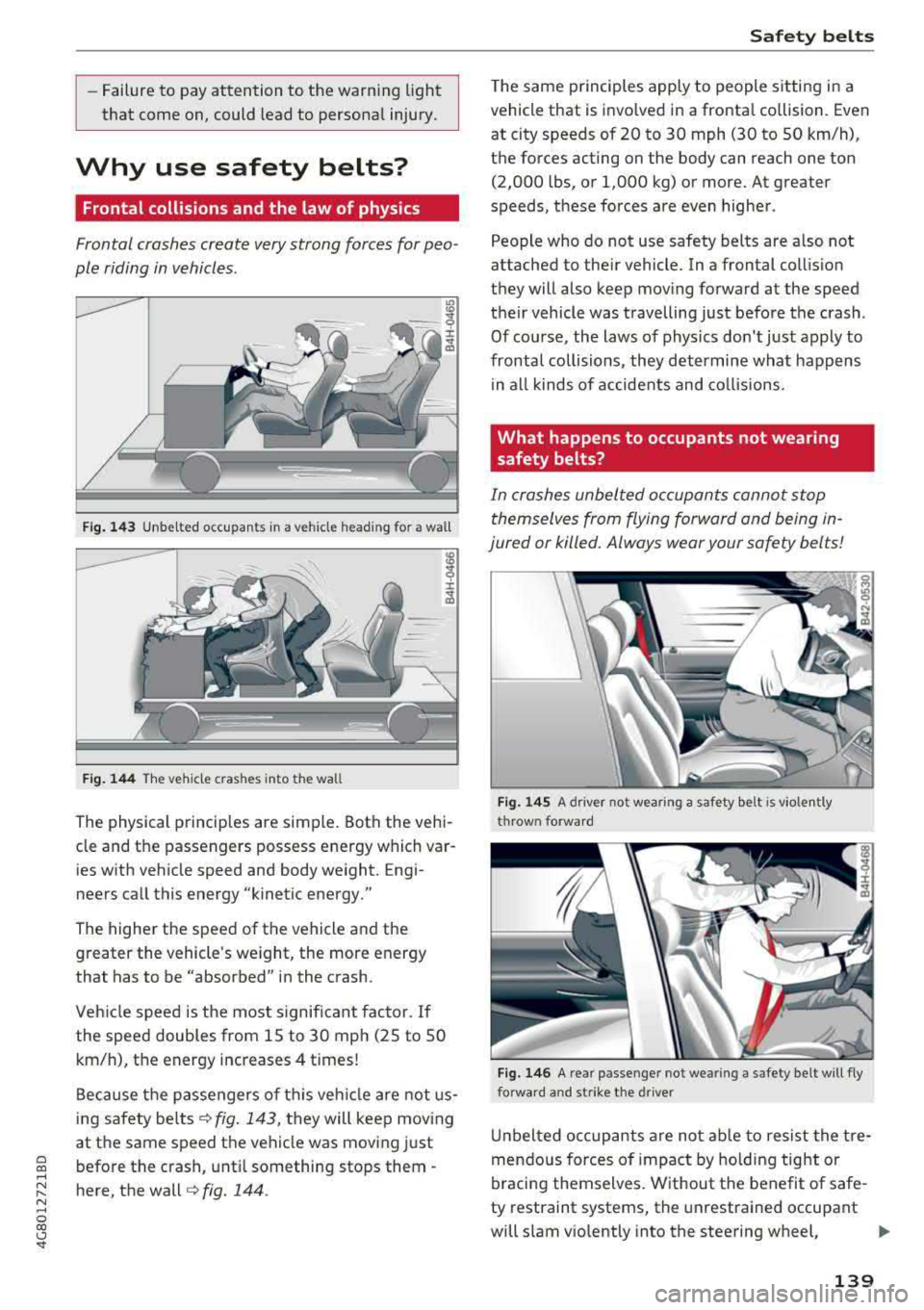
Fig. 143 Unbelted occupants in a vehicle heading for a wall
Fig. 144 The vehicle crashes into the wall
The physical principles are simple. Both the vehi
cle and the passengers possess energy which var ies with vehicle speed and body weight. Engi
neers ca ll this energy "k inetic energy."
The higher the speed of the vehicle and the greater the vehicle's we ight, the more energy
that has to be "absorbed" in the crash.
Veh icle speed is the most significant factor. If
the speed doubles from 15 to 30 mph (25 to 50
km/h), the energy increases 4 t imes!
Because the passengers of this vehicle are not us
ing safety belts¢
fig. 143, they will keep moving
at the same speed the vehicle was moving just
before the crash, until something stops them -
here, the wall¢
fig. 144.
Safety belts
T he same p rinciples apply to people s itting in a
vehicle that is invo lved in a fronta l co llision. Even
at city speeds of 20 to 30 mph (30 to SO km/h),
the forces acting on the body can reach one ton
(2,000 lbs, or 1,000 kg) or more. At greater
speeds, these forces are even higher.
People who do not use safety belts are a lso not
attached to the ir vehicle. In a frontal collis ion
they will also keep moving forward at the speed
their vehicle was travelling just before the crash .
Of course, the laws of physics don't just apply to
frontal collisions, they determine what happens in all kinds of accidents and collisions .
What happens to occupants not wea ring
safety belts?
In crashes unbelted occupants cannot stop
themselves from flying forward and being in
jured or killed. Always wear your safety belts!
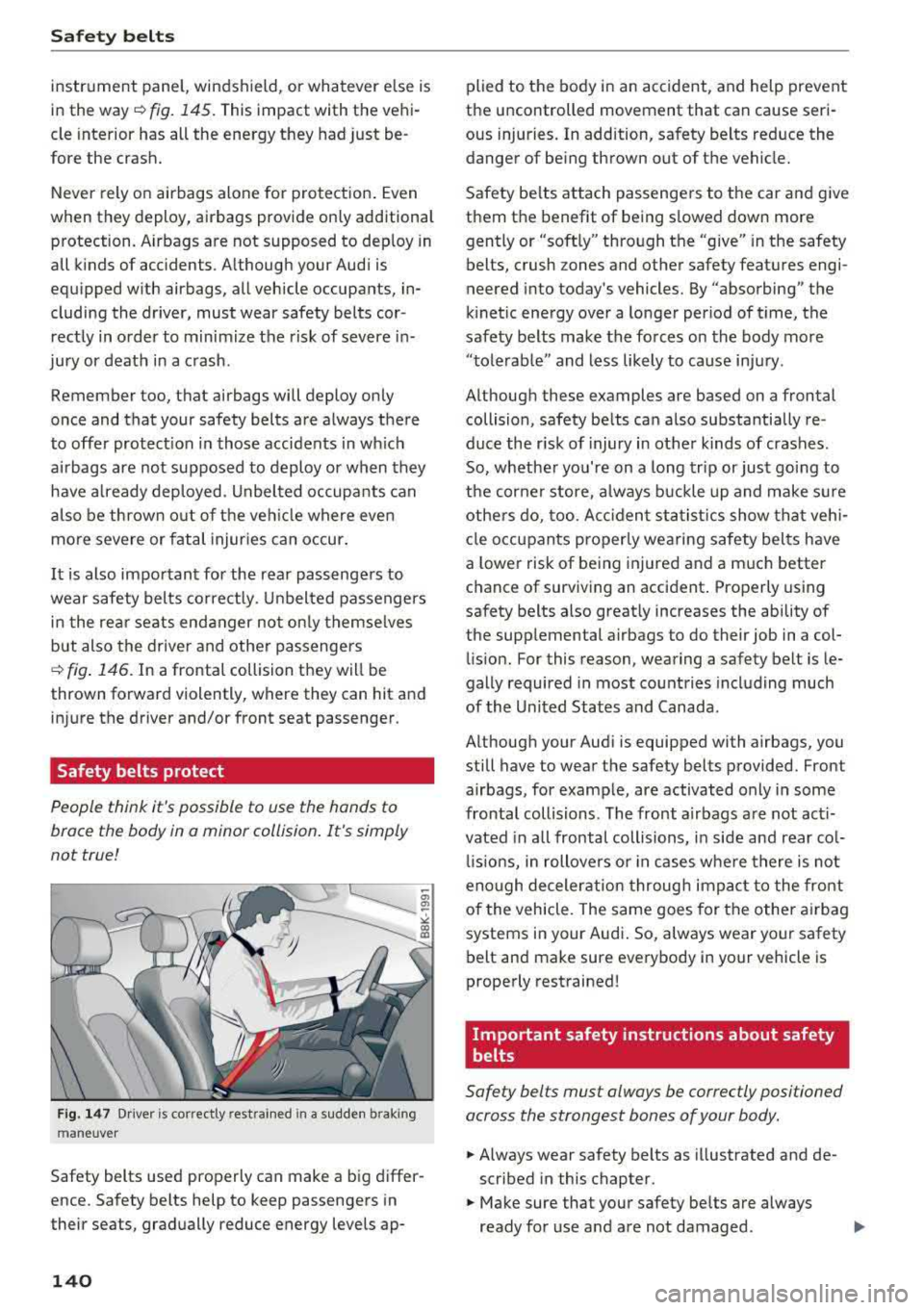
Fig. 14S A driver not wearing a safety belt is violently
thrown forward
Fig . 146 A rear passe nger not wearing a safety belt will fly
forwa rd and strike the driver
Unbelted occupants are not able to resist the tre
mendous forces of impact by holding tight or
bracing themselves . Without the benefit of safe
ty restraint systems, the unrestrained occupant
will slam violently into the steering wheel,
IJI,,-
139
Page 142 of 274
Safe ty belts
instrument panel, windshield, or whatever e lse is
in the way
r:!> fig. 145. This impact with the vehi
cle interior has all the energy they had just be
fore the crash.
Never rely on airbags alone for protection . Even
when they deploy, airbags provide only additiona l
protection. A irbags are not supposed to dep loy in
all kinds of accidents. A lthough your Audi is
equipped w ith airbags, all vehicle occupants, in
cluding the dr iver, must wear safety belts cor
rectly in order to minimize the risk of severe in
jury or death in a crash .
Remember too, that airbags will deploy only
once and that your safety belts are always there
to offer protect ion in those accidents in w hich
airbags are not supposed to deploy or when they
have a lready deployed . Unbel ted occupants can
a lso be thrown o ut of the veh icle where eve n
mo re severe or fatal injur ies can occur .
It is also important for the rear passenge rs to
wear safety belts correctly. Unbel ted passengers
i n t he re ar seats endanger no t on ly themse lves
but also the drive r and other passengers
c::> fig . 146 . In a frontal collision they will be
thrown forward violently, where they can hit and
in jure the driver and/or front seat passenger .
Safety belts protect
People think it's possible to use the hands to
brace the body in a minor collision . It's simply
not true!
F ig . 14 7 Driver is co rrectly restrai ned in a sudde n brak ing
m aneu ver
Safety belts used properly can make a b ig d iffer
ence. Safety belts help to keep passengers in
their seats, gradually reduce energy levels ap-
140
plied to the body in an accident, and help prevent
the uncontrolled movement that can cause seri
ous injuries. In addition, sa fety belts reduce the
danger of being thrown out of the vehicle.
Safety be lts attach passengers to the car and give
them the benefit of being s lowed down more
gently or "soft ly" through the "give" in the safety
belts, crush zones and other safety features engi
neered into today's vehicles. By "absorbing" the
k inet ic energy over a longer per iod of t ime, the
safety belts make the forces on the body more "tole rab le" and less likely to cause inju ry .
Although these examples are based on a frontal
collision, safety be lts ca n also substantially re
duce the r isk o f injury in ot her kinds of crashes .
So, whethe r you're on a long trip or just going to
the cor ne r store, a lways b uckle up and make s ure
othe rs do, too. Ac ciden t st at istic s show that veh i
cl e occupants prope rly wearing safety bel ts have
a lowe r risk of be ing injured and a m uch better
chance of surviving an acc ident . Properly using
safety be lts also great ly increases the ability of
the supp lemental airbags to do their job in a col
li sion. For this reason , wearing a safety belt is le
gally required in most countries including much
of the United States and Canada.
Although your Aud i is equipped with airbags, you
still have to wear the safety belts provided. Front
airbags, for examp le, are activated only in some
frontal collisions. The front airbags are not act i
vated in a ll frontal collisions, in side and rear co l
li sio ns, in rollovers or in cases whe re there is not
eno ugh decelerat ion throug h impa ct to the front
of the vehicle . The same goes for the other a irbag
systems in your Audi. So, always wear your safety
belt and make sure everybody in your vehicle is
properly rest rained!
Important safety instructions about safety
belts
Safety belts must always be correctly positioned
across the strongest bones of your body .
.,. Always wear safety belts as illustrated and de
scribed in this chapter.
.,. Make sure that your safety be lts are always
ready for use a nd a re not damaged .
Page 143 of 274
a co ,...,
N
" N ,...,
0 00 <.,;) '
Not wearing safety belts or wearing them im
properly increases the risk of serious personal
injury and death . Safety belts can work only
when used correctly.
-Always fasten your safety belts correctly be fore driving off and make sure all passen
gers are cor rectly restrained.
-For maximum protection, safety belts must
always be posit ioned properly on the body .
-Never strap more than one person, includ
ing small ch ildren, into any belt .
-Never place a safety belt over a child sitt ing
on your lap.
- Always keep feet in the footwell in front of
the seat wh ile the vehicle is being driven.
- Never let any person ride w ith their feet on
the instrument panel or st icki ng out the
window or on the seat.
- Never remove a safety belt while the vehicle
is moving . Do ing so will increase your risk of
being injured or k illed.
- Never wear belts twisted.
- Never wear belts over rigid or breakable ob-
jects in or on your clothing, such as eye
glasses, pens, keys, etc ., as these may cause
injury.
- Never allow safety belts to become dam
aged by being caught in door or seat hard
ware.
- Do not wear the shoulder part of the belt
under your arm or otherwise out of position .
- Several layers of heavy clothing may inter
fere with correct positioning of belts and re
duce the overall effectiveness of the system.
- Always keep belt buckles free of anything
that may prevent the buckle from latching
securely .
-Never use comfort clips or devices that cre
ate slack in the shoulder be lt . However, spe
c ial clips may be requ ired for the proper use
of some child restraint systems.
-Torn or frayed safety belts can tear, and
damaged belt hardware can break in an acc i
dent. Inspect belts regularly .
If webbing,
bind ings, buckles, or retractors are dam-
Safety bel ts
aged, have belts rep laced by an authorized
Aud i dea ler or qualified workshop.
- Safety belts that have been worn and loaded
in an accident must be replaced with the
correct replacement safety belt by an au
thor ized Audi dealer. Replacement may be
necessary even if damage cannot be clearly
seen. Anchorages that were loaded must al
so be inspected.
- Never remove, mod ify, d isassemble, or try
to repair the safety belts yourse lf.
-Always keep the belts clean . Dirty belts may
not work properly and can impair the func
tion of the inert ia reel
q table on page 230 .
Safety belts
Fastening safety belts
Safety first -everybody buckle up!
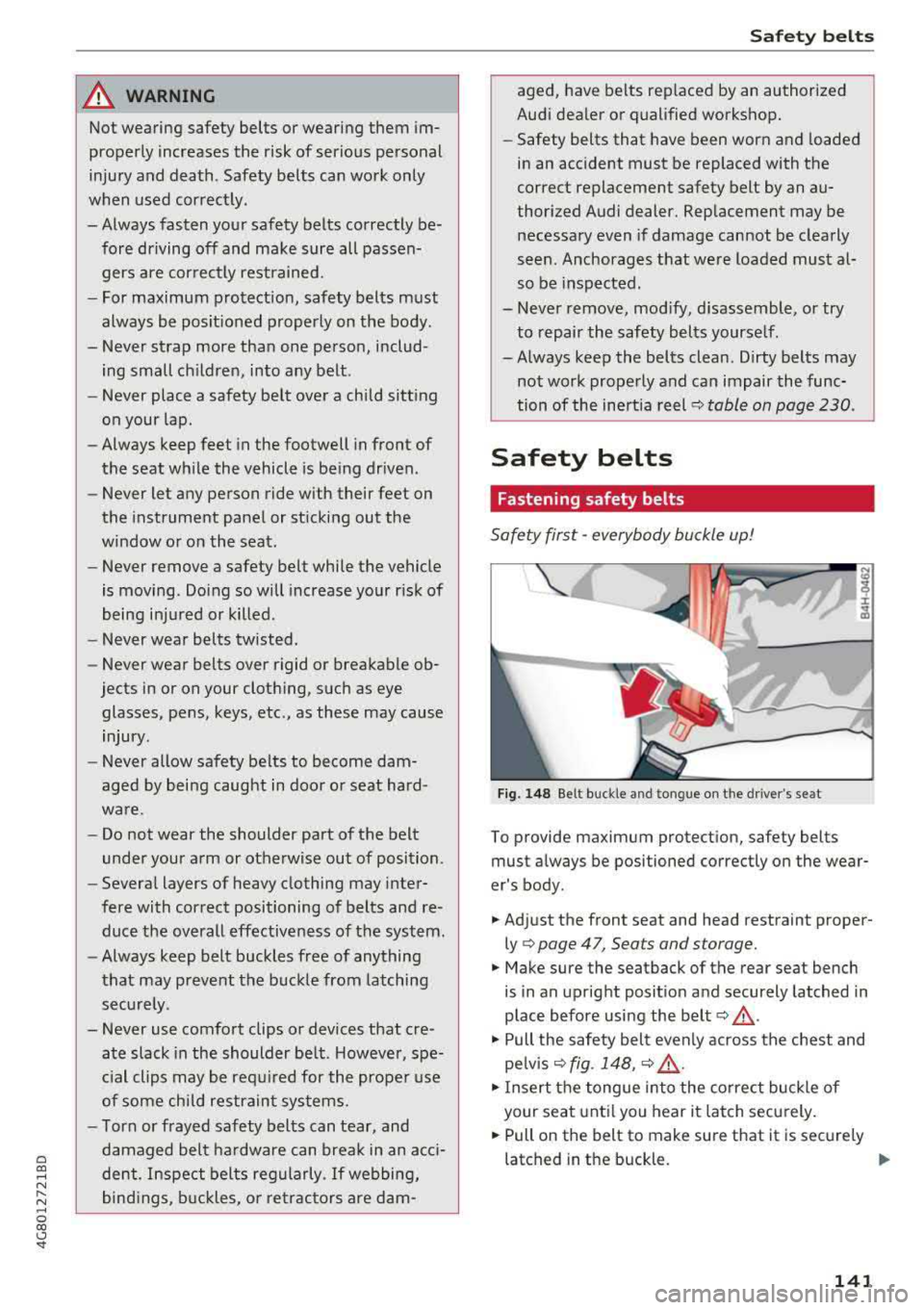
Fig. 148 Be lt buckle and to ngue on t he d river' s se at
To provide maximum protection, safety belts
must always be positioned correctly on the wear
er 's body .
.. Adjust the front seat and head restra int proper
ly
q page 47, Sea ts and storage.
.. Make sure the seatback of the rear seat bench
is in an upright posit ion and securely latched in
p lace before using the belt
q ,&. .
.. Pull the safety belt evenly across the chest and
pe lvis
q fig . 148, q ,&. .
.. Insert the tongue in to the correct buckle of
your seat until you hear it latch securely.
.. Pull on the belt to make sure that it is securely
latched in the buckle.
..,
141
Page 144 of 274
Safe ty belts
Autom ati c s afet y belt retractors
Every safety be lt is equ ipped with an automatic
be lt retractor on the shoulder belt. This feature
locks the belt when the belt is pu lled out fast,
during hard braking and in an accident. The belt may a lso lock when you drive up or down a steep
hill or through a sharp curve. Dur ing normal driv
ing the belt lets you move freely.
Safety belt p ret en sione rs
Safety belts w ith pretensioners he lp to tighten
the safety belt and remove s lack when the pre
tensioners are activated
c;, page 144 . The func
tion of the pretensioner is monitored by a warn
ing light
c;, page 16 .
Convertibl e loc king r etracto r
Every safety belt except the one on the driver
seat is equipped w ith a convertible locking retrac
tor that
must be used when the safety belt is
used to attach a child seat. Be sure to read the
important information about this feature
¢ page 181 .
.&_ WARNING
Improperly pos itioned safety be lts can cause
ser ious injury in an
accident ¢ page 142,
Safety belt position.
- Safety belts offer optimum protection only
when the seatback is upright and belts are
properly positioned on the body.
- Always make sure that the rear seat bac k
rest to which the center rea r safety belt* is
attached is securely latched whenever the
rear center safety belt is being used. If the
backrest is not securely latched, the passen
ger will move forward with the backrest dur
ing sudden braking, in a sudden maneuver
and especially in a crash.
- Never attach the safety belt to the buckle for another seat. Attaching the belt to the
wrong b uckle wi ll reduce safety belt effec
t iveness and can cause serious person-a l in
jury.
- A passenger who is not properly restrained can be seriously in jured by the safety be lt it
self when it
moves from the stronger parts
142
of the body into critical areas like the abdo men.
- Always lock the convertible locking retractor
when you are securing a child seat in the ve
hicle
,=;, page 183.
(D Tips
For information on safety belt pretensioners,
refer to
c;, page 144 .
Safety belt position
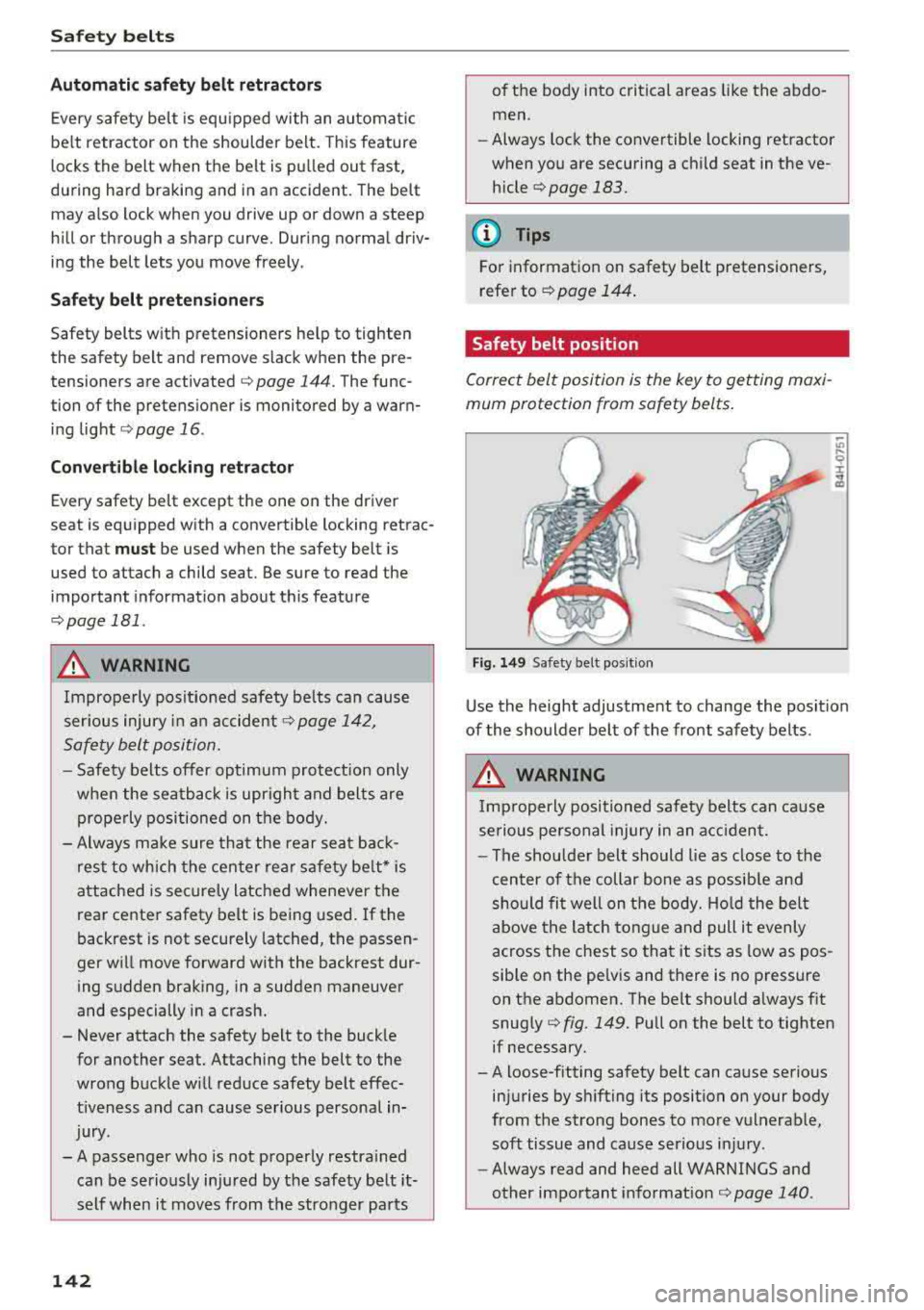
Correct belt position is the key to getting maxi
mum protection from safety belts .
Fig. 149 Safety belt posit ion
Use the height adjustment to change the posit ion
of the shoulder belt of the front safety belts .
.&_ WARNING
Imp roperly positioned safety belts can cause
serio us pe rsonal injury in an a cc ident.
- The shou lde r belt should lie as close to the
center of the collar bone as possib le and
should fi t well on the body. Ho ld the belt
above the latch to ngue and pull it evenly
across the chest so that it sits as low as pos
sible on the pe lvis and there is no pressure
on the abdomen. The belt should a lways f it
snug ly
c;, fig. 149. Pull on the belt to tighten
if necessary.
- A loose-fitting safety belt can cause serious
injuries by sh ifting its position on your body
from the strong bones to more vulnerable,
soft tissue and cause serious i nju ry .
- Always read and heed all WARNINGS and
other important informat ion
c;, page 140 .
Page 145 of 274
a co ,...,
N
" N ,...,
0 00 <..:l '
restrained
The best way to protect the fetus is to make sure
that expectant mothers always wear safety belts
correctly
-throughout the pregnan cy.
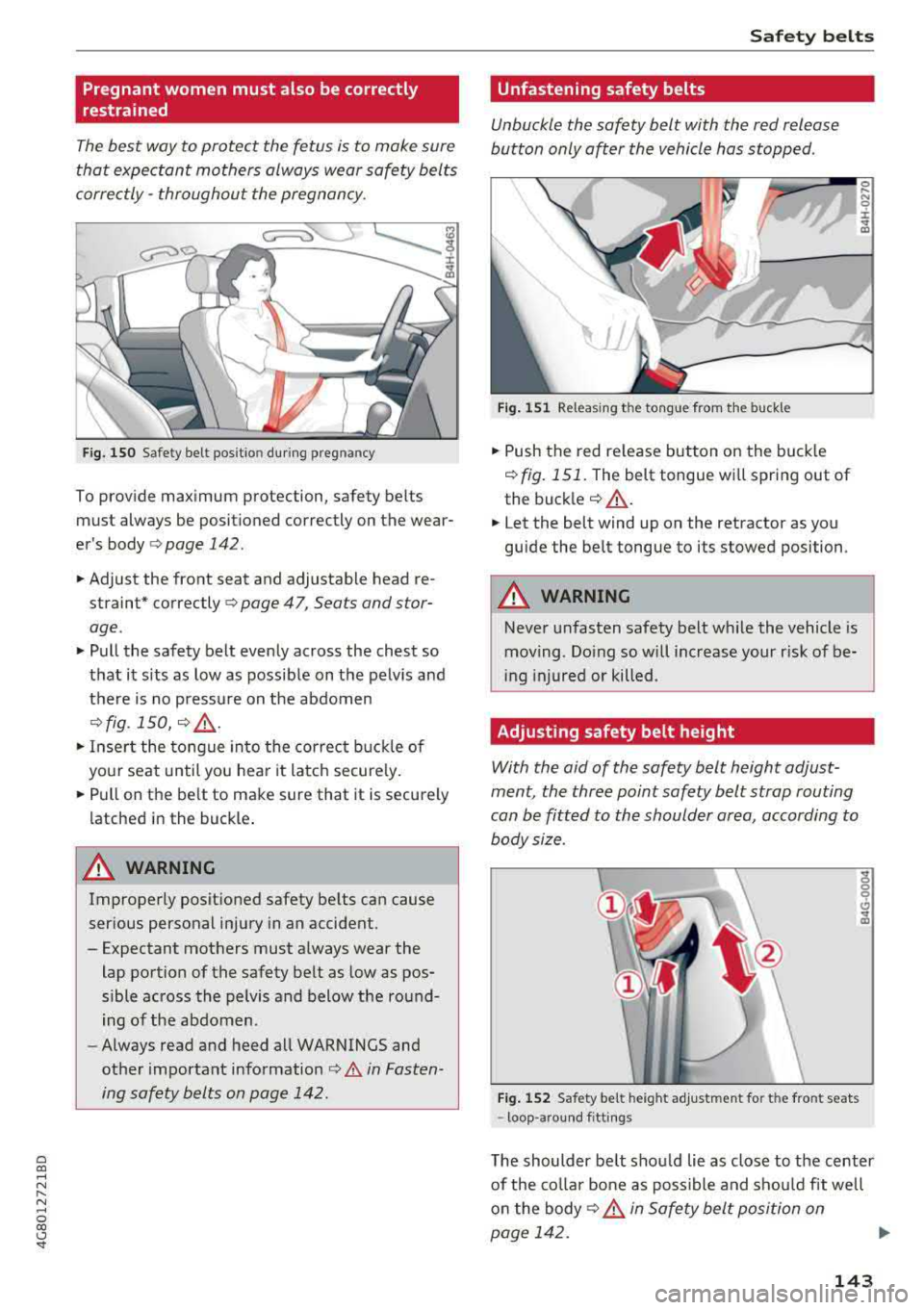
F ig. 150 Safety belt pos itio n during pregnancy
To prov ide max imum protection, safety belts
must always be posit ioned correctly on the wear
er 's body
r=> poge 142.
.,. Adjust the front seat and adjustable head re
straint* correctly ¢
page 47, Seats and stor
age .
.,. Pull the safety belt evenly across the chest so
that it sits as low as poss ib le on the pelv is and
there is no pressure on the ab domen
¢fig. 150, ¢ .(D..
.,. Inse rt the tongue into the cor rec t buckle of
your seat until you hea r it latch secure ly .
.. Pull on the be lt to make sure that it is securely
latched in the buck le .
A WARNING
Improperly posit ioned safety be lts can cause
ser ious personal injury in an accident.
- Expectant mothers must always wear the lap portion of the safety belt as low as pos
sible across the pelvis and below the round
ing of the abdomen.
- Always read a nd heed all WARN INGS and
other important information
c:> .&. in Fasten
ing safety belts on page 142.
Safet y bel ts
Unfastening safety belts
Unbuckle the safety belt with the red release
button only
o~er the vehicle hos stopped.
F ig . 1 51 Releasing th e to ngue from the buckle
.. Push the red re lease button on the buck le
r=> fig . 151. The belt tongue w ill spring out of
the
buck ler=> .(D. .
.. Let the belt wind up on the retractor as you
guide the belt tongue to its stowed position .
A WARNING
Never unfasten safety belt wh ile the vehicle is
moving . Do ing so will increase your r isk of be
i ng injured or killed .
Adjusting safety belt height
With the aid of the safety belt height adjust
ment, the three point safety belt strop routing
con be fitted to the shoulder area, according to
body size.
Fi g. 1 52 Safety belt height adj ust m ent fo r th e fro nt seats
-loop -arou nd fitt ings
0 ..... N 0 :i:
of the co ll ar bo ne as possible and shou ld fit well
o n the body
c:> LD. in Safe ty belt position on
page 142.
..,.
143
Page 150 of 274
Airbag syste m
about children and Advanced Airbags
¢page 170 .
Even tho ugh yo ur vehicle is equ ipped with an Ad
vanced Ai rbag System, make certain that all chi l
dren, especially those 12 years and younger, al
ways ride in the back seat properly restrained for
their age and size. The airbag on the passenger
side makes the front seat a potentially dangerous
place for a child to ride. The front seat is not the
safest place for a child in a forward-facing child
seat . It ca n be a very dangerous place for an in
fant or a c hild in a rea rwa rd-fac ing seat.
The Advanced Airbag System in your veh icle has
been cert ified to comply with the requ irements
of United States Federal Moto r Vehicle Safety
Standard ( FMVSS) 208, as well as Canada Motor
Ve hicle Safety Standa rd (CMVSS) 208 as applica
b le at the time your veh icle was ma nufactu red.
Acco rding to requi rements, the front Advanced
Airbag System on the passenger side has been
certifi ed for "suppression" for infants of about
12 month old and younger and for "low risk de
p loyment" for children aged 3 to 6 years o ld (as
defined in the standard) .
Th e
PASSENGER AIR BAG O FF light in the instru
ment panel tells you when the front Advanced
Airbag on the passenger side has been turned off by the electronic control un it .
Each time yo u switch on the ignition, the
PAS·
S ENGER AIR BAG OFF
light will come on for a
few seconds and:
- will stay on if the front passenger seat is not
occupied,
- will stay on if the electrical capacitance meas
u red by the capacitive passenger detection sys
tem for the front passenger seat equals the combined capacitance of an infant up to about
one year of age and one of the rearward-facing
or forward-facing child restraints listed in Fed
eral Motor Vehicle Safety Standard (FMVSS)
208 with wh ich the Advanced Airbag System in
yo ur vehicle was ce rt ified. For a listing of the
c hi ld rest raints t hat we re used to ce rtify yo ur
vehicle 's compliance with the Safety Standard
¢ page 172 .
148
-w ill stay on if there is a sma ll child o r chil d re
straint on the front passenger seat,
- w ill go off if the front passenger seat is occu
pied by an adu lt as registered by the capacitive
passenger detection system ¢
page 158, Mon
itoring the Advanced Airbag System.
The PASSENGER AIR BAG OFF lig ht comes on
when e lectrica l capacitance registered on the
front passenger seat is equal to or less t han the
combined capacitance of a typical
1 year-old in
fant and one of the rearward-facing or forward
facing child restrai nts listed in Federa l Motor Ve
hicle Safety Standard (FMVSS) 208 with which
the Advanced A irbag System in yo ur vehicle was
ce rt ified.
If the to tal e lectr ica l capacitance registered o n
the front passenger seat is more than that of a
typ ical 1 yea r-old ch ild but less than the weight
of a sma ll adult, the front airbag on the passen
ger side can deploy (the
PASSENGER AIR BAG
OFF
light does no t come on).
If the
PASSENGER AIR BAG OFF light does not
come on, the front airbag on the passenger s ide
has not been turned off by the electroni c con trol
u nit a nd can dep loy if the con trol unit senses an
i mpact t hat meets the cond itions stored in its
memory.
For exampl e, the airbag ma y deplo y if:
- a small ch ild that is heav ier than a typ ical 1
year-old child is on the front passenger seat (regard less of whethe r the child is in one of t he
child seats listed
¢ page 172), or
- a child who has outgrown c hild rest raints is on
the front passenge r seat.
If the front passenger a irbag is turned off, the
PASSENGER AIR BAG OFF light comes on in the
i nst rument cluster and stays on .
If the front passenger a irbag deploys, the Feder
al Standard requires the airbag to meet the "low
risk" deployment cr iteria to reduce the r isk of in
j u ry th rough interact ion w ith the airbag .
"Low
risk " dep loyment oc curs in t hose crashes tha t
t a ke place at lowe r decele ra tions as defined in
t h e e lec tronic co ntro l unit
¢ page 158 , PASSEN-
GER AIR BAG OFF light.
..,_
Page 151 of 274
a co .... N
" N .... 0 00 \,;J '
insta lled on the front seat may be struck and
knocked out of position by the rapidly inflating
passenger's a irbag in a frontal collision . The air
bag could greatly reduce the effectiveness of the
child restraint and even seriously i njure the ch ild
during inflation .
For this reason, and because the back seat is the
safest place for children - when properly restra in
ed according to the ir age and size
-we strongly
recommend that children always sit in t he back
seat
¢ page 170, Child safety.
.&_ WARNING
A child in a rearward-facing chi ld seat insta l
led on the front passenger seat will be ser i
ously in jured and can be k illed if the front air
bag inflates -even with an Advanced Airbag
System.
- The inflating a irbag w ill hit the child sea t or
infant carrier with great force and will
smash the child seat and child against the
backrest, cente r arm rest, door or roof.
- Always install rear-facin g child seats on t he
rea r seat.
- If you must install a rearward facing chil d
seat on the front passenger seat because of
exceptiona l circumstances and the
PASSEN
GER AIR BAG OFF
light does not come on
and stay on, immediately insta ll the rear
facing child seat in a rea r seat ing position
and have the airbag system inspected by
yo ur Audi dealer.
- Forward-fac ing ch ild seats installed on the
front passenge r's seat may interfere with
t h e deployment of the airbag and cause se
rious person al injury to the child.
.&_ WARNING
If, in e xcept ional circumstan ces, you mus t in
stall a forward-facing chi ld restraint on the
front passenger's seat:
- Always ma ke sure the forwar d-f a ci ng seat
has been designed and ce rtified by its man
ufact urer for use on a front seat with a pas
senger front and s ide air bag .
Airbag syste m
- Never put the fo rwa rd-facing child restraint
up aga inst or very nea r the instr ument pan
el.
- Always move the front passenger seat to
the highest posit ion in the up and down ad
justment range and move it back to the
rearmost posit ion in the seat's fore and aft
ad justmen t range , as far away from the air
bag as possible, before installing the for
ward-fa cing ch ild restraint.
- Always make sure that the safety be lt upper
anchorage is behind the c hild rest raint and
not next to o r in front of the child res tra int
so th at the s afety be lt will be p roperly posi
tioned.
- Make sure th at the
PASSENGER AIR BAG
OFF
li ght comes on and stays on all the time
wheneve r the ignit ion is switched on .
.&_ WARNING
= -
To reduce the risk of serious injury, make sure
that the
PASSENGER AIR BAG OFF light will
be d isplayed whenever a child rest raint is in
stalled on the front passenger seat and the i gnition is switched on.
- If the
PASSENGER AIR BAG OFF light does
not stay on, perform the checks described
¢ page 158, Monitoring the Advanced Air
bag System.
- Take the child restra int off the front passen
ge r seat and install it properly at one of the
rear sea t positions if the
PASSENGER AIR
BAG OFF
light does no t stay o n.
- Have the ai rbag system inspected by your
Au di deale r immediately.
- Always carefully follow ins tructions from
child restrain t manufacture rs when instal
ling child restra ints .
.&_ WARNING
-
If, in exceptional c ircums tances, you must in
st all a forw ard or re arw ard-fa cing child re
stra int on t he fron t passenger 's seat:
- I mp roper installat ion of child res traints can
reduce the ir effectiveness or even preven t
them from provi ding any pro tect ion .
149
Page 153 of 274
a co .... N
" N .... 0 00 \,;J '
o'clock position or with your hands any
where inside the steering wheel or on the steering wheel hub . Holding the steering
wheel the wrong way increases the risk of severe injury to the arms, hands, and head if
the driver airbag deploys.
A WARNING
Objects between you and the airbag will in
crease the risk of injury in a crash by interfer
ing with the way the airbag unfolds and/or by
being pushed into you as the airbag inflates.
- Always make sure nothing is in the front air-
bag deployment zone that could be struck
by the airbag when it inflates.
-
- Objects in the zone of a deploying airbag
can become projectiles when the airbag de
ploys and cause serious personal injury.
- Never hold things in your hands or on your
lap when the vehicle is in use.
- Never place accessories or other objects
(such as cup holders, telephone brackets,
note pads, navigation systems, or things
that are large, heavy, or bulky) on the doors;
never attach then to the doors or the wind
shield; never place them over or near or at
tach them to the area marked
,,AIRBAG" on
the steering wheel, instrument panel or the seat backrests; never place them between
these areas and you or any other person in
the vehicle.
- Never attach objects to the windshield
above the passenger front airbag, such as
accessory GPS navigation units or music
players. Such objects could cause serious in
jury in a collision, especially when the air bags inflate.
- Never recline the front passenger seat to
transport objects. Items can also move into
the deployment area of the side airbags or
the front airbag during breaking or in a sud den maneuver. Objects near the airbags can
fly dangerously through the passenger com partment and cause injury, particularly
when the seat is reclined and the airbags in
flate.
Airbag system
A WARNING
r--
A person on the front passenger seat, espe-
cially infants and small children, will receive
serious injuries and can even be killed by be ing too close to the airbag when it inflates .
- Although the Advanced Airbag System in your vehicle is designed to turn off the front
passenger airbag if an infant or a small child
is on the front passenger seat, nobody can
absolutely guarantee that deployment un
der these special conditions is impossible in
all conceivable situations that may happen
during the useful life of your vehicle.
- The Advanced Airbag System can deploy in accordance with the
.,low risk" option for 3-
and 6-year-old children under the U.S. Fed
eral Standard if a child with electrical capac itance greater than the combined capaci
tance of a typical one-year old infant re
strained in one of the forward facing or rear
ward-facing child seats with which your ve hicle was certified is on the front passenger
seat and the other conditions for airbag de-
ployment are met.
- Accident statistics have shown that children
are generally safer in the rear seat area than
in the front seating position.
- For their own safety, all children, especially
12 years and younger, should always ride in
the back properly restrained for their age
and size.
Advanced front airbag system
Your vehicle is equipped with a front Advanced
Airbag System in compliance with United States Federal Motor Vehicle Safety Standard 208, as
well as Canada Motor Vehicle Safety Standard (CMVSS) 208 as applicable at the time your vehi
cle was manufactured.
The front Advanced Airbag System supplements
the safety belts to provide additional protection
for the driver's and front passenger's heads and
upper bodies in frontal crashes . The airbags in
flate only in frontal impacts when the vehicle de-
celeration is high enough.
.,.
151
Page 156 of 274

Airbag syste m
Airbag System for the front passenger seat from
doing its job in a crash.
The front Advanced Airbag S ystem con sists
of the follo wing :
-Crash sensors in the front of the vehicle that
measure vehicle acceleration/deceleration to
provide information to the Advanced Airbag
System about the severity of the crash.
- An electronic control unit, with integrated
crash sensors for front and side impacts. The
control unit "decides" whether to fire the front
airbags based on the information received from
the crash sensors . The control unit also "de
c ides" whether the safety belt pretens ioners
shou ld be activated .
- An Advanced Airbag with gas generator and
contro l valve for the driver ins ide the steer ing
whee l hub.
- An Advanced Airbag with gas generator and
contro l valve inside the instrument pane l for
the front passenger.
- A capacitive passenger detect io n system under
neath t he front passenger seat cover. This sys
tem measures the elect rical capac ita nce of the
person in the seat. The info rm ation registe red
is sent continuous ly to the e lectronic control
unit to regulate deployment of the front Ad
vanced Airbag on the passenger side .
- An airbag monitoring system and indicator
light in the instrument cluster
Q page 158 .
-A sensor in each front seat registers the dis
tance between the respective seat and the
steering wheel or instrument pane l. The infor
mation reg istered is sent continuously to the
electronic control un it to regulate deployment
of the front Advanced Airbags .
- The
PASS ENGER AIR BA G OFF light comes on
and stays on in the center of the instrument
panel
Q page 158, fig . 156 and tells you when
the front Advanced A irbag on the passenger
s ide has been turned off .
- A sensor in the safety belt latch for the driver
and for the front seat passenge r that senses
whethe r th at safety belt is latched or not and
t ransm its this info rmat ion to the electronic
contro l unit.
154
_&. WARNING
Damage to the front passenger seat can pre
vent the front airbag from work ing properly.
- Improper repair or disassembly of the front
passenger and driver seat will prevent the
Advanced A irbag System from function ing
properly.
- Repairs to the front passenger seat must be
performed by qualified and properly trained
wo rkshop personne l.
- Never remove the front passenger or driver seat from the vehicle .
- Never remove the upholstery from the front
passenger seat.
- Never d isassemble or remove parts from the
seat or disconnect wires from it.
- Never carry sharp objects in your pockets or
put them on the seat. The capacit ive pas
senger detect ion mat in the front passenger
seat will not function p roperly if it is punc
tured.
- Never carry things on your lap or carry ob
jects on the front passenger seat. Such ob
jects can influence the capacitance regis
tered by the capaci tive passenger detection
system, so that incorrect in format ion is pro
vided to the airbag control unit.
- Never store i tems under the front passenger
seat. Parts of the Advanced Airbag System
under the passenger seat could be dam
aged, p reventing them and the airbag sys
tem from working p roper ly.
- Never p lace seat covers or replacement up
holstery that have not been specifically ap
proved by Audi on the front seats.
- Seat covers can prevent the Advanced Air
bag System from recognizing child re
straints or occupants on the front passenger
seat and prevent the side airbag in the seat
backrest from deploying properly.
- If a seat heater has been retrofitted or oth
erwise added to the front passenger seat,
never install any child res tra int system on
this seat.
- Never use cushions, p illows, blankets, or
sim ila r items on the front passenge r seat.
The additional laye rs prevent the capac it ive
Page 157 of 274
a co .... N
" N .... 0 00 \,;J '
measu ring the ca pac itance of t he ch ild safe
ty seat and/or the perso n on the seat and
t h us ke ep the Advanc ed Airbag Syst em fr om
working properly .
- Never place or use any electrical device
(suc h as a laptop, CD player, electronic
games dev ice, power inverte r or seat heater
for child seats) on the front passenger seat
if the devi ce is conne cted to the 12-volt
socket o r the cigarette lighter socket. Such
devices can in fluence the capacitance regis
tered by the capacitive passenger detection system, so that incorrect information is pro
vided to the airbag control unit.
- If you must use a child restraint on the front
passenge r seat and the child restraint man
ufact urer 's instructions require the use of a
towel, foam cushion or something else to
properly pos ition the ch ild restraint, make
certain tha t the
PASSENGER AIR BAG OFF
ligh t comes on and stays on whenever the
c h ild restraint is installed on the front pas
senger seat.
- If the PASSENGER AIR BAG OFF light does
not come on and st ay on, immedia tely in
st all child res traint in a re a r se ating position
and have the airbag system inspected by
yo ur Audi dealer .
A WARNING
If the front passenger seat gets wet, dry it im
mediately .
- If liquid soaks into the front passenger seat,
this can keep the airbag system from work
ing properly and may, for instance, deact i
vate the passenger frontal airbag. If this
happens, the
PASSENGER AIR BAG OFF
light will come on and stay on togethe r with
the a irbag indicator light
II (USA models)/
El (Canada models) in the instrument clus
ter.
- If liquid is poo led on the seat, bu t has not
soa ked in, this may also keep the airbag sys
tem from wo rking pro perly and ca use the
passenge r frontal airb ag to be enabled
(tu rned on), even though the re is a properly
Airbag syste m
installed child restraint system on the seat .
Wet towels or other wet things on the seat
cushion can have the same effect. If the
front passenger fronta l airbag is turned on,
the
PASSENGER AIR BAG OFF light ligh t
will go out .
How the Advanced Airbag System
components work together
T he front Advance d Airb ag Sys tem and the side
airbags supp lement the protection offered by the
front t hree-point safety be lts and the adjustable
head restraints * to help red uce the risk of in jury
i n a w ide range of accident and c rash situat ions.
Be sure to read the important information about
safety and heed the WARNINGS in this chapte r.
Deployment of the Advanced A irbag System and
the activation of the safety belt pretensioners de
pend on the dece leration measured by the crash
senso rs and reg istered by the electronic co ntro l
u nit . Crash severity depe nds on speed and dece l
eration as well as the mass and stiffness of the
vehicle or object involved in the cras h.
On the passenger side, regard less of safety be lt
u se, the front passenge r frontal a irbag will be
tu rned off if the e lectr ica l capacitance measured
by the capacitive passenge r detect ion sys tem on
t h e fron t passenger se at is less th an the amou nt
programmed in t he e lectronic contro l unit . The
front passenge r frontal airbag wi ll also be turned
off if the capacitance measured by the system for
the front passenger seat equals that of an infant
of about one year of age in one of the chi ld seats
that was used to certify the Advanced Airbag Sys
tem under Federa l Motor Vehicle Safety Standard
208 . The
PASSENGER AIR BAG OFF lig ht comes
o n and stays o n to tell you when the front Ad
vanced Airbag Sys tem on t he passenger side has
been turned off
q page 15 8.
To reduce the risk of injury when an air bag in
flates, always wear safety belts properly.
- If you are un res tra ined, leaning forwar d, si t
ting sideways or out of position in any way,
your r is k of injury is much higher .
~
155