warning light AUDI A8 2015 Service Manual
[x] Cancel search | Manufacturer: AUDI, Model Year: 2015, Model line: A8, Model: AUDI A8 2015Pages: 312, PDF Size: 79.18 MB
Page 73 of 312

Pass-through with ski
sack
Preparing the pass-through
Applies to vehicles: with pass-through and ski sack
Long objects such as skis can be transported
in the ski sack.
Fig. 73 Rear bench seat: removing the protect ive cover
Fig. 74 Rear center armrest: attaching the protective
cover
.,. Fold the rear center armrest and the cover
located behind it down.
.,. Press the button to remove the protective
cover
¢fig. 73.
.,. To protect the front area of the center arm
rest, position the cover as illustrated
¢ fig. 74 and press the suction cups down so
they adhere.
.,. Slide the loaded ski sack* from the luggage
compartment out through the opening . The
zipper must face toward the rear .
.,. Secure the ski sack*
¢page 71.
Seats and storage 71
Securing the ski sack
Applies to vehicles: with pass -through and ski sack
Fig. 75 Luggage compartment: securing the ski sack *
Fig. 76 Rear be nch seat: tying down the item
There are two straps with hooks@on the
sides of the ski sack*¢
fig. 75. There is also a
sec uring strap@¢
fig. 76 on the sack .
.,. To secure the ski sack in the luggage com
partment, hang the hooks in the rear tie
downs ¢
fig. 75 .
.,. Tighten the strap on the ski sack to prevent
the objects in the sack from sliding
¢ fig. 76 .
A WARNING ... -
-The ski sack is intended only for the
transportation of skis and other light ob
jects. To reduce the risk of ser io us per
sonal injury, never transport heavy or
pointed objects in the ski sack.
- When braking rapidly or during an acci
dent, the load could be disp laced and
cause injury to occupants.
- Sharp edges o n the load must be covered
for protection. Always fasten the belt
tightly around the sack and its contents. _...
Page 78 of 312
76 Seats and storage
become a hazard for vehicle occupants in
the event of sudden braking or a crash.
- Always remove objects from the instru
ment panel. Any items not stored could
slide around inside the vehicle while driv
ing or when accelerating or when apply
ing the brakes or when driving around a
corner.
- When you are driving make sure that
anything you may have placed in the cen
ter console or other storage locations cannot fall out into the footwells. In case
of sudden braking you would not be able
to brake or accelerate.
- Any articles of clothing that you have
hung up must not interfere with the driv
er's view. The coat hooks are designed
only for lightweight clothing. Never hang
any clothing with hard, pointed or heavy
objects in the pockets on the coat hooks.
During sudden braking or in an accident -
especially if the airbag is deployed -
these objects could injure any passen gers inside the vehicle .
- To reduce the risk of personal injury in an
accident or sudden stop, always keep the
glove compartment closed while driving .
- Read and follow all WARNINGS
¢ page 170, Important safety instruc
tions on the side airbag system.
- Hang clothes in such a way that they do
not impair the driver's vision.
- The coat hooks must only be used for lightweight clothing . Do not leave any
heavy or sharp edged objects in the pock
ets which may interfere with the side cur
tain airbag deployment and can cause
personal injury in a crash.
- Do not use coat hangers for hanging
clothing on the coat hooks as this can in
terfere with proper deployment of the
side curtain airbags in an accident.
- Do not hang heavy objects on the coat
hooks, as they could cause personal in
jury in a sudden stop.
(D Note
Objects located on the rear shelf that rub
against the rear window could damage the
heating wires for the rear window defog
ger.
@ Tips
- A vent slot is located between the shelf
and the rear window. Do not block the
vent with any items you may place on the
rear window shelf.
- Do not place bulky items on the rear win
dow shelf as they could restrict or block
the driver's vision in the rear view mirror.
Cooler
Introduction
Applies to vehicles: wi th coo ler
Please clean the cooler before using it for the
first time ¢
table on page 216.
You can only switch on the cooler if
- the temperature in the luggage compart
ment is below 131 °F (55 °C). The cooler
switches off automatically if the tempera
ture in the luggage compartment exceeds
131 °F (55 °C). Once the temperature falls
below 131 °F (55 °C) again, the cooler
switches on again automatically.
- the battery is adequately charged. The cool
er switches off automatically if the vehicle
battery voltage falls below a minimum lev
el. This prevents the battery from discharg ing. The cooler switches back on again auto
matically when the battery voltage increases
again (e .g. after starting the engine).
The cooler cools to 42.8 °F
(+ 6 °C) and the
freezer cools to 21.2 °F (-6 °C) in optimum
cooling conditions. The cooling performance
is affected by the temperature in the luggage
compartment . The temperature inside the
cooler will be higher if the luggage compart-
ment is hot. .,.
Page 85 of 312
the stored position as soon as you switch on
the ignition.
Starting and stopping
the engine
Starting the engine
This button switches on the ignition and
starts the engine .
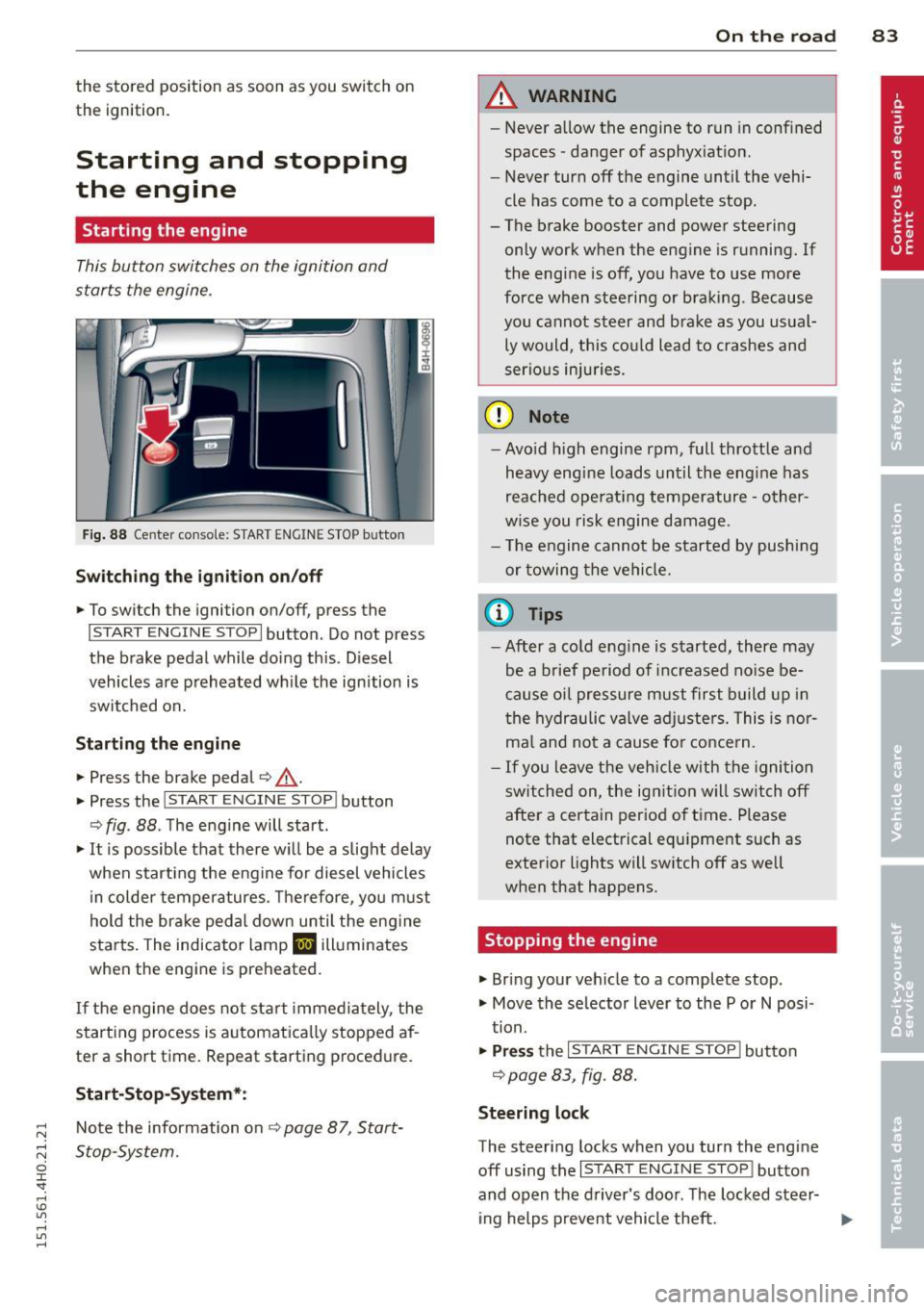
Fig. 88 Cente r console: S TART ENGINE S TOP b utto n
Swi tc hin g the i gni tion on/off
• To switch the ignition on/off, press the
I START ENGINE STOPI button . Do not press
the brake pedal while doing this . D iesel
vehicles are preheated wh ile the ignition is
switched on.
St art in g the engine
• Press the brake pedal~,&. .
• Press the
!START E NGINE STOPI button
~ fig . 88 . The engine will start.
• It is possible that there w ill be a slight delay
when start ing the engine for diesel vehicles
in colder temperatures. Therefore, you must
hold the brake peda l down until the eng ine
starts. The indicator lamp
II illuminates
when the engine is preheated.
If the engine does not start immediately , the
starting process is automatica lly stopped af
ter a short time . Repeat starting procedure.
Start -Stop -System *:
Note the information on ¢ page 87, Start
Stop-System.
On th e road 83
A WARNING
- Never allow the engine to run in confined
spaces -danger of asphyxiat ion.
- Never turn off the engine until the vehi
cle has come to a complete stop.
- The brake booster and power steering
only work when the engine is running. If
the engine is off, you have to use more
force when steering or braking . Because
you cannot steer and brake as you usual ly would, this could lead to crashes and
serious injuries.
(D Note
- Avo id h igh engine rpm, full throttle and
heavy engine loads until the eng ine has
reached operating temperature -other
w ise you risk engine damage .
- T he engine cannot be started by pushing
or towing the vehicle.
(0 Tips
- After a co ld eng ine is started, there may
be a brief period of inc reased no ise be
cause oil pressure must first build up i n
the hydraulic valve adjusters. This is nor
ma l and not a cause for conce rn.
- If you leave the veh icle with the ignition
switched on , the ign ition w ill switch off
after a certain period of time . Please
note that electrical equ ipment such as
exterior lights will sw itch off as well
when that happens.
Stopping the engine
• Bring your vehicle to a complete stop.
• Move the selector lever to the P or
N posi
tion.
• Pr ess the I START ENGINE STO P I button
¢ page 83 , fig. 88.
Steerin g lock
The steering locks when you turn the engine
off using the
I START ENGINE STOP I button
and open the d river's door. The locked steer-
ing helps prevent vehicle theft.
11-
Page 86 of 312

84 On th e road
Emerg ency off
If necessary, the engine can be sw itched off
with the selector lever in the R, Dor S posi
tions . The engine stops if you press the
I START ENGINE STOP ! button at speeds below
6 mph (10 km/h).
A WARNING
- Never turn off the eng ine before the ve
hicle has come to a complete stop . The
full function of the brake booster and the
power steering is not quaranteed. You
must use more force to turn or brake if
necessary. Because you cannot steer and
brake as you usual ly would, this could
lead to crashes and serious injur ies.
- For safety reasons, you should always
park your vehicle with the se lector lever
in P. Otherwise, the vehicle co uld inad
vertent ly roll away .
- After the engine has been switched off, the radiator fan can continue to run for
up to 10 min utes - even with the ign it ion
switched off. It can a lso switch on aga in
after some time if the coolant tempera
ture rises as the result of a heat buildup or if the engine is hot and the engine
compartment is addit ionally heated by
the sun's rays.
(D Note
Do not stop the engine immed iate ly afte r
ha rd or extended dr iving. Keep the engine
r u nning for approx imately two m inutes to
prevent excessive heat build-up.
Driver message in the instrument
cluster display
T urn off ignition before le aving car
This message appears and a war ning tone
sounds if you open the driver's door when the
ignitio n is switched on.
Pr ess brake p edal t o start engin e
This message appears if you press the
I STAR T ENGINE S TOP ! button to start the en- gine and do not depress the brake pedal.
The
engine can only be started if the brake pedal
is depressed.
Ill I s key in th e vehi cle?
If the indicato r light turns on and the mes
sage appears, the remote control key was re
moved from the vehicle whi le the engine was
runn ing .
If the igni tion key is not in the veh i
cle you will not be able to switch on the igni
tion or restart the engine after it has been switched off. You will a lso not be able to lock
the vehicle from the outs ide.
Shift to P, othe rwi se vehicle can roll away.
Door s do not lock if lever i s not in P.
T h is dr iver message appears for safety rea
sons if the transmission has not been shifted
to the P position when you switch the ignition
off. Move the selector lever to the P position.
Otherwise the vehicle is not protected from
ro lling and cannot be locked.
II Key i s not recognized . Hold b ack of key
again st m arked are a. See ow ner' s m anual.
If the indicator l ight turns on and this mes
sage appe ars, there is a ma lfunct ion
¢ page 85.
Tu rn off i gnition before leaving car. Ba ttery
i s di sc harging
Th is message appears if the driver's door is
opened wh ile the ignition is switched on. Al
ways switch off the ign it ion if you a re leav ing
the vehi cle. See also
¢page 89 .
Shift to P and turn off ignition before l eav
ing car, otherwi se vehicle c an roll away
This message appears if the driver's door is
opened wh ile the ignition is switched on and
the selecto r lever is not in the P position. Shift
the selector lever into the P pos ition and
switch off the ignit ion when you exit the vehi
cl e. Otherw ise the vehicle cou ld rol l. See also
¢page 89.
Page 88 of 312

86 On the road
driving force has been built up at the
wheels.
E mergency brake function
An emergency brake ensures t hat the vehicle
can be slowed down even if the
normal brakes
fail
c::> page 87, Emergency braking .
&_ WARNING
Do not press the accelerator peda l inadver
tently if the vehicle is stationary but the
engine is running and a gear is selected.
Otherw ise the vehicle will start to move
immediately and could result in a crash.
- If the parking brake is applied with the
ignition switched off, the indicator lights
in the sw itch and . (USA models) .
(Canada models) in the instrument clus
ter will go out after a certain per iod of
time.
- Occas iona l noises when the park ing
brake is applied and released are normal
and are not a cause for concern.
- When the vehicle is parked, the parking brake goes through a self-test cycle at
regular intervals. Any assoc iated noises
are no rma l.
Parking
.. Press the bra ke peda l to stop the vehicle .
.. Pull the switch© to set the parking brake .
.. Se lect the P selector lever position
c::> page 114.
.. Turn the eng ine off c::> ,& .
.. When on incl ines or declines, turn the steer
ing wheel so that your vehicle will roll into
the curb if it begins to move.
&_ WARNING
- When you leave your veh icle - even if on
ly b riefly - always take the ignition key
with you. This applies par tic u larly when
children remain in the veh icle . Otherw ise
the chi ldren could start the engine, re-
'
lease the parking brake or operate elec
tr ica l equipment (e.g. power windows).
There is the r isk of an accident.
- When the veh icle is locked, no one - par
ticularly not children should rema in in
the vehicle. Locked doors make it more difficult for emergency workers to get in
to the vehicle - putting lives at risk.
Starting from rest
The starting assist function ensures that the
parking brake is released automatically upon
starting.
Stopping and applying par king brake
.. Pull the sw itch<®> to apply the parking
brake.
Sta rting and automaticall y rel easing the
park ing bra ke
.. When you start to drive as usual, the park
ing brake is automat ically released and your
veh icle beg ins to move.
When stopping at a traffic signal or stopping in city traffic, the parking brake can be ap
plied . The vehicle does not have to be held
with the footbrake. The parking brake elimi nates the tendency to creep w ith a dr ive range
engaged . As soon as you drive off as usual,
t h e pa rking brake is re leased automatically
and the vehicle s tarts to move .
Sta rting on slopes
When starting on inclines, the starting assist
prevents the vehicle from u nintent ionally roll
i ng back. The braking force of the parki ng
brake is not re leased unti l suffic ient d riving
force has been built up at the w heels.
(D Tips
Fo r safety reasons, the pa rking brake is re
l eased automatically on ly when the d riv
er's safety belt is engaged in the buckle.
Page 89 of 312

,....,
N ,....,
N
0 J:
'SI: ,...., \!) 1.1'1 ,...., 1.1'1 ,....,
Starting off with a trailer
To prevent rolling back unintentionally on an
incline, do the following:
11-Keep the switch© pulled and depress the
accelerator. The parking brake stays applied
and prevents the vehicle from rolling back
ward .
11-You can release the switch<®> once you are
su re that you a re develop ing enough for
ward momentum at the wheels as you de
press the accelerator.
D epending on the weight of the r ig (vehicle
and tra ile r) and the severi ty of the incl ine, you
may roll backwards as you start. Yo u can pre
vent rolling backwards by holding the parking brake switch<®) p ulled out and acce lerating -
just as you would when starting on a hill with
a conventional hand brake.
Emergency braking
In the event that the conventional brake sys
tem fails or locks.
11-In an emergency, pull the switch(®) and
contin ue to p ull it to slow your vehicle down
with the parking brake.
11-As soon as you release the switch (®) or ac-
ce lerate, the braking process stops.
If you pull the switch<®> and hold it above a
speed of about 5 mph (8 km/h), the emergen
cy braking function is initiated. The vehicle is
braked at all four wheels by activating the hy
draulic brake system. Th e brake performance
i s similar to making an emergency stop
~ &..
In order not to activate the emergency brak
ing by m istake, an audible warning tone (buz
ze r) sou nds when the switch C®> is pulled. As
soon as the switch(®) is released, or the accel
e rator pedal is dep ressed, emergency b ra ki ng
stops.
_& WARNING
Emergency braking should only be used i n
an emergency, when the normal foot brake
has failed or the brake pedal is obstructed .
On the ro ad 87
Using the parking b rake to pe rform emer
gency brak ing will slow your vehicle down
as if you had made a full brake application.
The laws of physics cannot be suspended
even with ESC and i ts associated compo
nents (ABS, ASR, EDL). In corners and
when road o r weathe r cond itions are bad,
a full brake appl ication can ca use the vehi
cle to sk id or the re ar end to break away -
risking an acciden t.
Start-Stop-System
' Description
Applies to vehicles: wit h Start -Stop-System
The Start-Stop-System can help increase fuel
economy and reduce CO2 emissions .
In the Start-Stop-mode, the engine shuts off
automat ica lly w hen the vehicle is stopped,
such as at a traffic light. The ignition remains
switched on du ring this stop phase. The en
gine wi ll be automat ica lly restarted when
needed.
The last Start-Stop-System sett ing (on/off us
ing the button
I O\l ~I) will be restored when the
i gnition is turned on. The L ED in the
1(7() .. 1 but
ton turns on when the Star t-Stop-System is
swi tched off man ually.
Basic requirements for the Start -Stop
mode
- The d rive r's doo r is closed.
- The d river ' seat belt is latched .
- The hood is closed .
- The vehicle must have been driven faster
than
2.5 mph (4 km/h) since the last stop.
- A trailer is not hitched to the vehicle.
_& WARNING
-Never let the vehicle roll with the eng ine
sw itched off. You cou ld lose control over
the vehicle. Th is can lead to a collision
and serio us in ju ries.
- The brake booster and the steering sup port do not work while the engine is
Page 91 of 312

The@j indicator light appears in the informa
tion line in the instrument cluster display
<:!)fig. 92 .
Engine automatically restarts
The stop phase is interrupted in the following
situations, for examp le. The engi ne restarts
without any action by the driver.
- Th e interior temperature varies from the
temperatu re selected in the A/C system.
- The windshield is being defrosted
r::!) page 81 .
-The brake pedal is pressed several times in a
row.
- The battery charge level becomes too low.
- High power consumption .
Switching the ignition off automatically
To prevent the battery from draining, the igni
tion will switch off
automatically when all of
the following conditions have been met:
- The vehicle has al ready been driven.
- The eng ine has been turned off by the Start-
Stop-System*.
- The driver's door is opened.
- The driver's seat belt is removed .
- The brake pedal is not pressed down.
- The vehicle is stationary .
In this case, the activated low beam will be re
placed by the side marker lights. The side
marker lights will switch off after approxi
mately 30 minutes or when you lock the vehi
cle .
If the Start-Stop System has
not turned off
the engine or if you have switched the Start
Stop system off manually, the ignition w ill
not
be automatically switched off and the engine
will cont inue to run
r::!) .&. .
A WARNING
Never allow the engine to run in confined
spaces - danger of asphyxiation.
(D Tips
If you shift into the D, N or S positions af
ter shift ing into reverse, the veh icle must
On the road 89
be driven faster than 6 mph (10 km/h) in
order for the engine to switch off again.
Switching the Start-Stop-System on/off
manually
App lies to vehicles: wit h Start -Stop -System
If you do not wish to use the system, you can
switch it off manually.
Fig. 93 Center console: Start -Stop -System button
.,. To switch the Sta rt-Stop-System off/on
manually, p ress the
ICA.> ••I button. The L ED in
the button turns on when the system is
sw itched off.
(D Tips
If you switch the system off during a stop
phase, the engine will start again auto
ma tically .
Messages in the instrument cluster
display
Applies to vehicles: wit h Start-Stop-Syste m
Start-Stop system deactivated: Please re
start engine manually
This message appears when specific condi
tions are not met during a stop phase and the
Start-Stop-System will
not be able to restart
the engine. If the Dor R selector lever posi
tions were engaged, P will be selected auto
matically . The engine must be started with
the
I START ENGINE ST OP ! button.
Start-Stop system: System fault! Function
unavailable
There is a malfunction in the Start-Stop-Sys
tem. Drive the vehicle to an authorized repair .,.
Page 92 of 312
90 On the road
facility for servicing as soon as possib le to
correct the malfunction.
Speed warning system
Introduction
The speed warning system helps you to stay
under a specified maximum speed.
The speed warning system warns you if you
are exceeding the maximum speed that you
have set . You will hear a warn ing tone when
your speed exceeds the stored value by ap proximately 3 mph (3 km/h). An indicator
light. (USA models) . (Canada models) in
the instrument cluster display also turns on at
the same time. The indicator light./.
turns off when the speed decreases below the
stored maximum speed.
Sett ing a threshold is recommended if you
wo uld like to be reminded when you reach a
certain maximum speed . Situations where you
may want to do so include driving in a country
with a general speed limit or if there is a
specif ied maximum speed for winter tires.
@ Tips
Even though your vehicle is equipped with
a speed warning system, you should still
watch the speedometer to make sure you
are not driving faster than the speed lim it.
Setting the threshold
You can set, change and delete the threshold
in the MMI.
.. Se lect : ICAR lfunction button> Car systems
control button > Driver assist > Speed warn
ing.
You can set any threshold between 20 mph
(30 km/h) and 150 mph (240 km/h). Settings
can each be adjusted in increments of S mph
(10 km/h).
Cruise control
Switching on
The cruise control system makes it possible to
drive at a constant speed starting at 20 mph (30kmlh) .
0
•
~
0
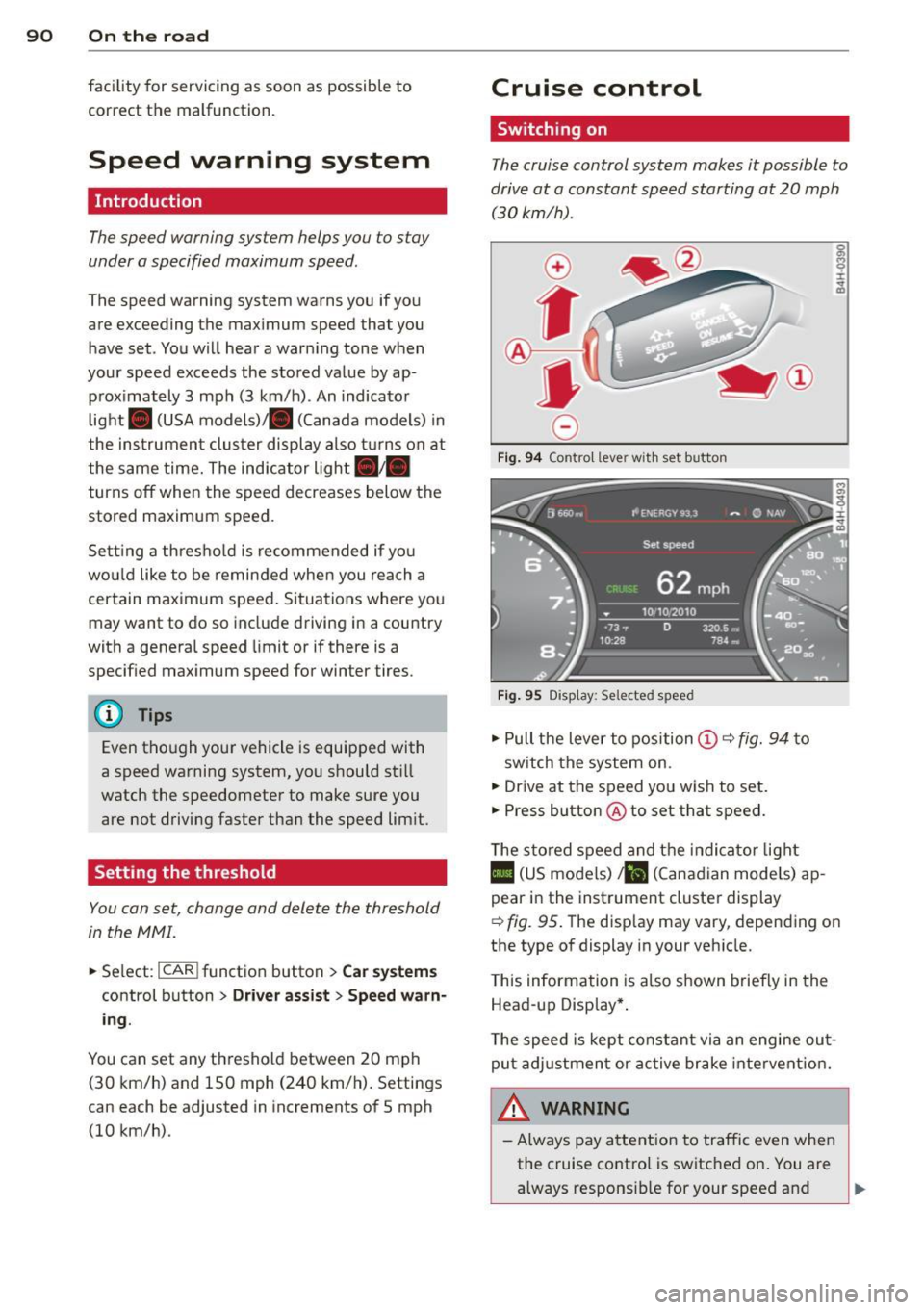
Fig. 94 Control leve r with set b utton
Fig. 95 Display: Se lected speed
.. Pull the lever to position (D c::> fig. 94 to
sw itch the system on.
.. Drive at the speed you wish to set.
.. Press button @ to set that speed.
T he stored speed and the indicator light
II (US models) ;El (Canadian mode ls) ap
pear in the instrument cluster display
c::> fig. 95 . The display may vary, depending on
the type of display in your veh icle .
T his information is also shown briefly in the
Head-up Display*.
Th e speed is kept constant via an engine out
put adjustment or active brake intervent ion.
WARNING
-Always pay attention to traffic even when
the cruise control is switched on. You are
a.lways respons ible for your speed and
Ill-
Page 93 of 312

,....,
N ,....,
N
0 J:
'SI: ,...., \!) ..,.,
,...., ..,., ,....,
the distance between your vehicle and
other vehicles.
- For safety reasons, the cruise control
should not be used in the city, in stop
and-go traffic, on twisting roads and
when road conditions are poor (such as
ice, fog, grave l, heavy rain and hydro
planing) -risk of acc ident .
- Turn off the cruise control temporari ly
when entering turn lanes, highway exit lanes or in construction zones .
- Please note that inadvertent ly "rest ing"
yo ur foot on the accelerator peda l causes
the cruise control not to brake. This is
because t he cr uise con trol is overr idden
by the driver's acce le rat ion.
- If a brake system malfunction such as
overheat ing occurs when the cruise con
t ro l system is sw itched on, the braking
f unction in the system may be switched
off. The other cr uise control f unctions re
main active as long as the indicator light
II (US models) !Iii (Canadian mode ls)
is on.
The brake lights illuminate as soon as the brakes decelerate automat ica lly.
Changing speed
.,. To increase/decrease the speed in incre
ments, tap the lever in the
010 d irection
i=> page 90, fig . 94 .
... To increase/dec rease the speed qu ickly, hold
the leve r in the
G) /0 direction unt il the de
s ired speed is d isplayed.
You can also press the accelerato r pedal down
to increase your speed, e .g . if you want to
pass someone. The speed yo u saved earlier
will resume as soon as yo u release the acceler
ator peda l.
I f, however, you exceed your saved speed by
6 mp h (1 0 km/h) fo r longe r th an 5 mi nutes,
the cruise cont ro l will tu rn off tempor arily.
The green symbo l
II (US models) !Iii i n the
On th e ro ad 91
display is rep laced w ith a wh ite symbo l. The
saved speed remains the same .
' Presetting your speed
You can preset your desired speed while the
vehicle is not moving .
.,. Switch o n the ign ition.
.,. Pull lever into posi tion
(D c:> page 90,
fig. 94 .
... Press the leve r in the 0 or 0 direction to
increase or decrease your speed.
.,. Release the lever to save that speed.
This function makes it possib le, for examp le,
to save the speed you want before driving on
the h ighway. Once on the highway, activate
the cru ise control by pulling the lever toward
(D.
' Switching the system off
Temporary deactivation
.,. Press the brake pedal, or
... Press the leve r in to position @(not clicked
into place)
~ page 90, fig . 94, or
.,. Dr ive fo r longe r than 5 mi nutes at mo re
t han 5 mph (10 km/h) above the stored
speed.
Switching off completely
.,. Press lever into position @(clicked into
place), or
.,. Switch t he ignit ion off.
T he system retains the saved speed if you de
activate the c ruise control temporar ily. To re
sume t he saved speed, re lease the brake ped
al and p ull the leve r to po sition
(D .
Swi tch ing the ignit ion off e rases the saved
speed.
A WARNING
You sho uld only ret urn to the saved speed
if it is not too fast for the cur rent traffic
conditions -ris k of an accident!
Page 97 of 312

Audi adaptive cruise control and braking guard 95
tachometer @and is also shown briefly in
thedisplay @c::>fig.101.
.. You must also press the brake pedal when
the vehicle is stopped.
Switching adaptive cruise control off
.. Push the lever away from you into position
@ until it clicks into place. The message
ACC off appears.
@ Indicator lights
II-Adaptive cru ise contro l is switched on.
No vehicles are detec ted up ahead. The stored
speed is ma intained.
• -A moving vehicle is detected up ahead.
The adaptive cruise control system regulates
the speed and distance to the moving vehicle
ahead and acce lerates/brakes automatical ly.
fit -Adaptive cruise contro l is switched on. A
mov ing vehicle up ahead was detected. Your
vehicle remains stopped.
• -When automatic brak ing is not able to
keep enough distance to a previously detected
moving vehicle up ahead, you must take con
trol and brake
c::> page 97, Prompt for driver
intervention.
© Display
If adaptive cruise control is not shown in the
d isp lay, you can call it up with the multifunc
tion steering wheel buttons c::>
page 23.
Based on the symbols in the d isplay, you can
determine if the system is maintaining a dis
tance to the vehicle ahead and what that d is
tance is.
No vehicle · No veh icle ahead was detected .
White vehicle -A vehicle ahead was detected.
Red vehicle -Prompt for the driver to take ac
tion
<=:> page 97.
Both
arrow s on the scale© indicate the dis
tance to the vehicle ahead. No arrow appears
when the vehicle is on an open road and there
is no object ahead . If an object is detected
:;, ahead , the arrow moves on the scale .
"' ,....,
"' ,....,
The green zone on the scale shows the stored
distance. For information on changing the
stored distance, refer to
c::> page 96. If the
distance selected is too close or may soon be
come too close, the arrows move into the red
zone on the sca le .
A WARNING
Improper use of the adaptive cruise con
trol can cause collisions, other accidents
and serious personal injur ies .
- Pressing the
!SET ! button when driv ing at
speeds below 20 mph (30 km/h), will au
tomatically accelerate the vehicle to 20
mph (30 km/h), which is the minimum
speed that can be set.
(D Tips
-If you switch the ignit ion or the adaptive
cruise control off, the set speed is erased
from the system memory.
- You cannot switch the Electronic Stabili
zation Control (ESC) to the SPORT mode
when adaptive cruise control is switched
on.
Changing the speed
Applies to vehicles: with Aud i adapt ive crui se control
0
f
• 0
Fig. 102 Selector lever: ch ang ing the speed
.. To increase or reduce the speed in incre
ments,
tap the lever up or down.
-0:, N 0 ± ... a)
.. To increase or reduce the speed quickly, hold
the lever up or down until the red LED @
reaches the desired speed
c::> page 94,
fig.101. ~