light AUDI A8 2018 Owners Manual
[x] Cancel search | Manufacturer: AUDI, Model Year: 2018, Model line: A8, Model: AUDI A8 2018Pages: 356, PDF Size: 54.71 MB
Page 211 of 356
lL t:0 ....
"' ......
"' .... 0 0 :c '
weather conditions.
~ Take frequent breaks on long trips. Do not drive
for more than two hours at a stretch.
~ Do NOT drive when you are tired, under pres
s ure or when you are stressed .
A WARNING
Impaired driv ing safety increases the risk of
ser ious personal inj ury and death whenever a
vehicle is being used .
Correct passenger
seating positions
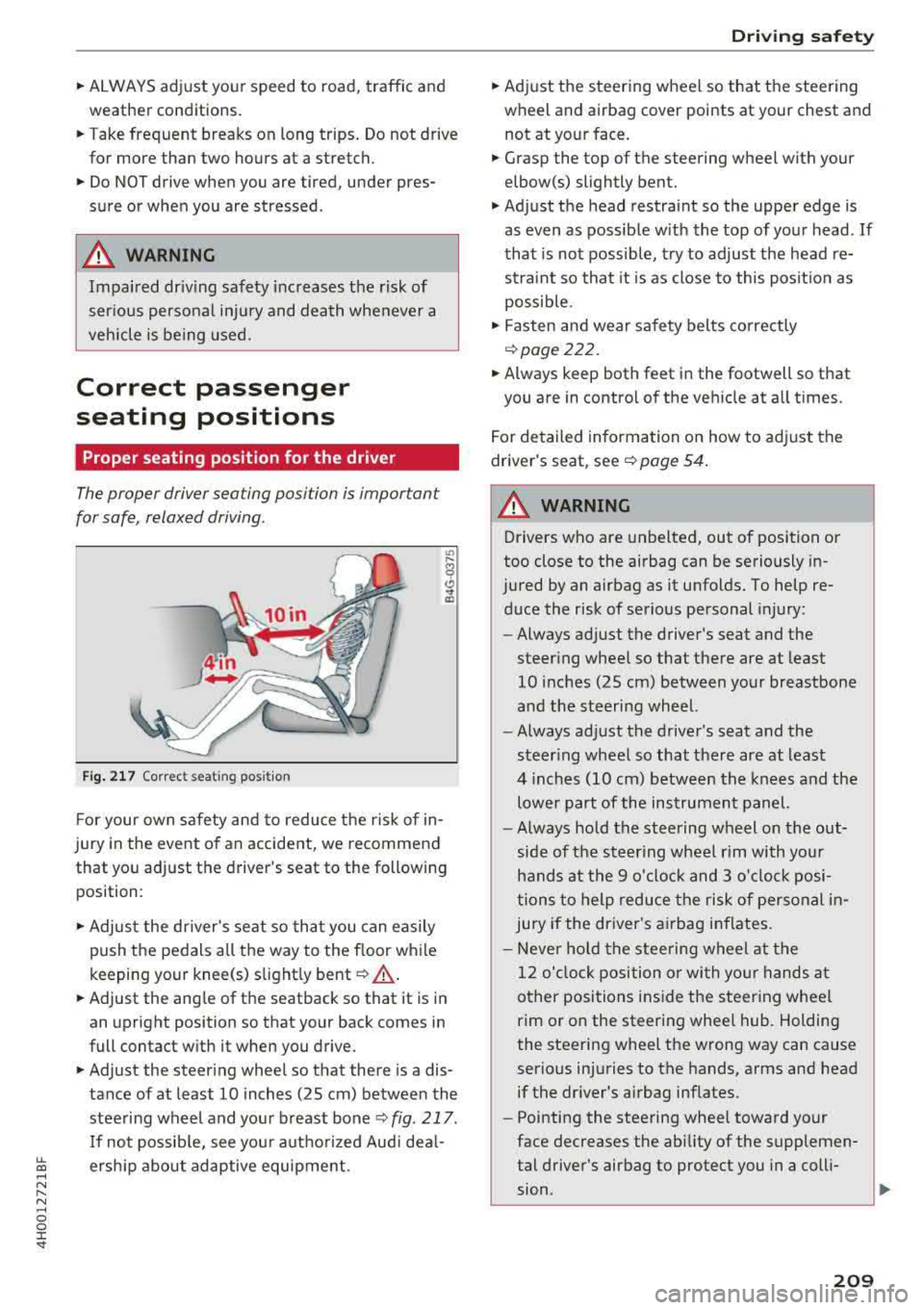
Proper seating position for the driver
The proper driver sea ting po sit ion is impor tan t
for safe, relaxed driving .
Fig. 217 Correc t seat ing posit ion
F or your own s afety and to reduce the risk of in
jury in the event of an accident, we recommend
that you adjust the driver 's seat to the following
position :
~ Adjust the dr iver's seat so tha t you can easily
push the pedals all the way to the f loor wh ile
keeping your knee(s) s light ly bent
c:!;> _& .
~ Adjust the ang le of the seatback so that it is in
an upright position so that your back comes in
full contact w ith it when you drive.
~ Adjust the steering wheel so that there is a dis
tance of at least 10 inches (25 cm) between the
stee ring wheel and you r breast bone
<:!;> fig . 217 .
If no t possib le, see you r autho riz ed Aud i dea l
ersh ip about adaptive equipment .
Driving safety
~ Adjust the steering wheel so that the steering
wheel and airbag
cover points at your chest and
not at yo ur face.
~ Grasp the top of the steering wheel with you r
elbow(s) slightly bent.
~ Adjust the head restraint so the upper edge is
as
even as possible w ith the top of your head . If
that is not possible, t ry to adjust the head re
s traint so that it is as close to this posit ion as
possible .
~ Fasten and wear safety belts correctly
c:!;> page 2 2 2.
~ Always keep both feet in the footwell so that
you are in contro l of the ve hicle at a ll times .
F or detailed information on how to adj ust the
driver's seat,
see r:!;> page 54 .
A WARNING
-
Drivers who are unbelted, out of position or
too close to the airbag can be se riously in
jured by an airbag as it unfolds. To help re duce the risk of serious personal injury:
- Always ad just the driver's seat and the
steer ing whee l so that there are at least
10 inc hes (25 cm) between you r breastbone
and the steer ing wheel.
- Always ad just the d river's seat and the
steer ing wheel so that there are at least
4 inches (10 cm) between the knees and the
lowe r part of the instrument panel.
- Always hold the steering w heel on the out
side of the steering wheel r im with yo ur
hands at the 9 o'clock and 3 o'clock posi
tions to help reduce the risk of personal in
jury if the driver's airbag inflates.
- N ever hold the stee ring wheel at the
12 o' clock position o r wi th yo ur hands at
other posi tions i nside the steer ing whee l
rim or on the steering wheel hub . Holding
the steering wheel the wrong way can cause
serio us injuries to the hands, arms and head
if the dr iver's airbag inf lates .
- Pointing the steering wheel toward your
face decreases the abi lity of the supplemen
tal driver's airbag to protect you in a coll i-
sion .
..,
209
Page 219 of 356
Audi pre sense Preventative passenger
protection
Applies to: ve hicles with Audi pre sense
Pre sense can initiate steps to protect vehicle oc
cupants in certain dangerous situations. The
functions descr ibed are available depending on
veh icle equ ipment:
Audi pre sense ba sic
The fo llowing functions can be triggered in cer
tain driving situat ions:
- Tightening of the safety belts (for examp le,
during heavy braking) : the front safety belts
have reversible belt tensioners. If a collision
does not occur, the safety belts loosen slightly
and are ready to trigger again.
- Closing the w indows and the sunroof*
The function of the pre sense basic is activated at
a speed of 20 mph (30 km/h) or hig her . The de
p loyment time is adapted in the drive select dy
namic mode .
Audi pre se ns e front ( vehicl es with adapti ve
cruise contr ol* }
Pre sense front contains the f unctions of pre
sense basic. In add ition, the likelihood of a rear
end collis ion with the vehicle ahead is also calcu
lated, within the limits of the system . If the risk
of a collision is detected, t he following functions
can t rigger:
- Audi braking guard
¢page 100
-Tensioning of the safety belts
- Closing the windows and the sunroof *
Audi pre sense rear (vehicles with side
a ss is t*)
Pre sense rear contains t he functions of pre sense
basic. In addition, the like lihood of a rear-end
col lision from t he vehicle behind is a lso ca lculat
ed, w ith in the lim its of the system. If the risk of a
collis ion is detected, the following functions can
~ tr igger :
.... N
~ -Tensioning of the safety belts
g -Closing the windows and the sunroof *
:c '
-Adjusting the seats : the settings for the powe r
head restrains, the upper sections of the backr
ests and the pne umatic side bolsters* change
on the front seats and the outer rear seats*. If
a co llision does not occur, the seat sett ings
that were previously used are restored .
Audi pre sen se plus
Pre sense plus contains the f unctions of pre
sense front and pre sense rear .
Error messag e
Audi pre sens e: Unavailable
Preventative passenger protect ion is not ava ila
ble. Drive to an autho rized Aud i deale r or author
ized Audi Se rvice Facility immed iately to have the
malfunction corrected.
& WARNING
--
Pr e sense cannot overcome natural p hys ica l
l aws .
It is a system designed to assist and it
cannot prevent a co llision. Do not let the in
creased safety provided tempt you into tak ing
risks. This could inc rease your r isk of a colli
sion.
- The system can dep loy incorrectly.
- Please note that t he sensors do not a lways
detect a ll objects. T his increases the r isk of
a co llision.
- Pre sense does not react to peop le or ani
mals or objects that are cross ing the vehi
cle's path or are difficu lt to detect
¢page 95.
- Reflective objects such as gua rd ra ils or the
entrance to a tunnel, heavy ra in and ice can
affect the funct io n of the radar sensors and
the system's ab ility to detect a collision risk.
@ Note
The sensors can be d isplaced by impacts or
damage to the bumper, wheel housi ng and
underbody. Pre sense can be impaired by this .
Have an autho rized Aud i deale r or au tho rized
A udi Se rvice Fac ility check the ir funct io n.
.,.
217
Page 221 of 356
u. co .... N
" N .... 0 0 :c '
General information
Always wear safety belts!
Wearing safety belts correctly saves lives!
This chapter explains why safety be lts are neces
sary, how they work and how to adjust and wear
them correctly.
~ Read all the information that follows and heed
all of the instructions and WARNINGS.
A WARNING
Not wearing safety belts or wearing them im
properly increases the risk of serious personal
injury and death.
- Safety belts are the s ingle most effective
means ava ilable to reduce the risk of serious
injury and death in automobi le accidents.
For your protection and that of your passen
gers, always co rrect ly wea r safety be lts
w hen the veh icle is mov ing.
- Pregnant wome n, in ju red, o r physically im
paired persons mus t also use safety be lts.
Lik e al l vehicle oc cupan ts, they are mo re
li kely to be serio usly injured i f th ey do no t
wear safety be lts . The best way to protect a
fetus is to protect the mothe r -throug hout
the ent ire pregnancy.
Number of seats
Your Aud i has a total of five seating positions:
two in the front and three in t he rear. In some
veh icles, there are four seat ing positions: two in
the fro nt and two in the rear . Each seati ng posi
tion has a safety belt.
A WARNING
N ot we aring safety bel ts or wear ing them im
pro perly in cre ases the risk of ser io us pe rsonal
inju ry and dea th.
- Never st rap more th an one pe rso n, includ
ing sm all c hildr en, in to any be lt.
It is espe
c ially dangerous to place a safety belt over a
child sitting on your lap .
Safet y be lts
- Never let more peop le r ide in the vehicle
than there are safety be lts available.
- Be s ure everyone riding in the vehicle is
proper ly restrained w ith a separate safety
be lt or ch ild restraint.
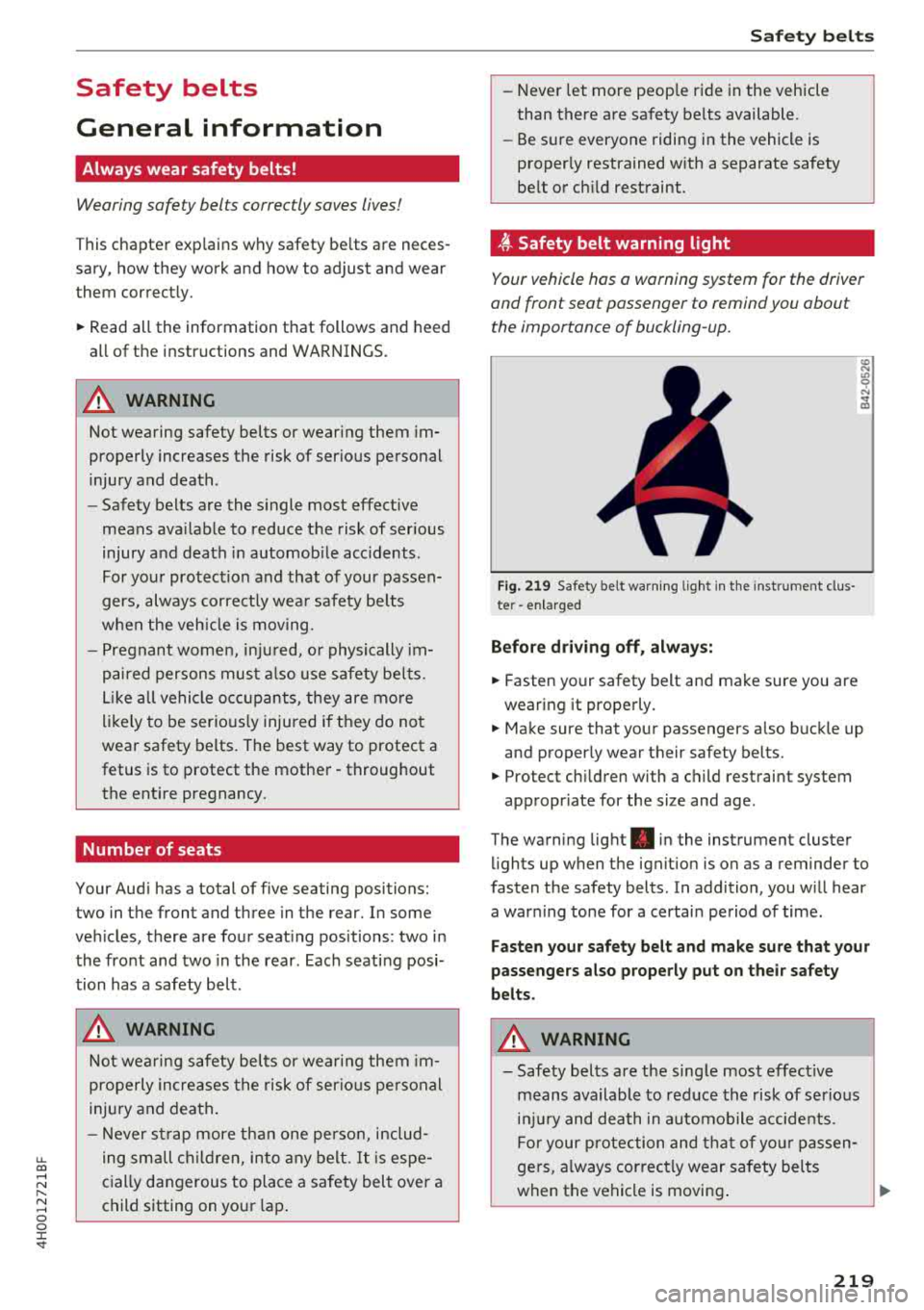
,ff. Safety belt warning light
Your vehicle has a warning system for the driver
and front seat passenger to remind you about
the importance of buckling-up.
F ig. 21 9 Safety belt warnin g lig ht in t he inst rument clus·
te r -en larged
Befor e dr ivi ng off , always :
~ Fasten your safety belt and make sure you are
wearing it properly.
~
~ Make sure that your passengers a lso buckle up
and properly wear their safety belts.
~ Protect ch ildren with a c hild restraint system
appropr iate for the size and age .
The warning lig ht . in the instrument cluster
lights up when the ignit ion is on as a reminder to
fasten the safety belts . In addition, you will hear
a war ning tone for a certai n period of time .
Fasten your safet y belt and make su re that your
passengers also properly put on their safety
b e lts .
A WARNING
-
-Safety bel ts are the sing le m ost effec tive
means available to red uce the risk of ser io u s
i njur y and death in a utomob ile accidents.
F or your p rotection and that of yo ur passen
ge rs, always correc tly wear safety bel ts
when the vehicle is moving .
~
219
Page 222 of 356
Safe ty belts
-Failure to pay attention to the warning light
that come on, could lead to personal injury.
Why use safety belts?
Frontal collisions and the law of physics
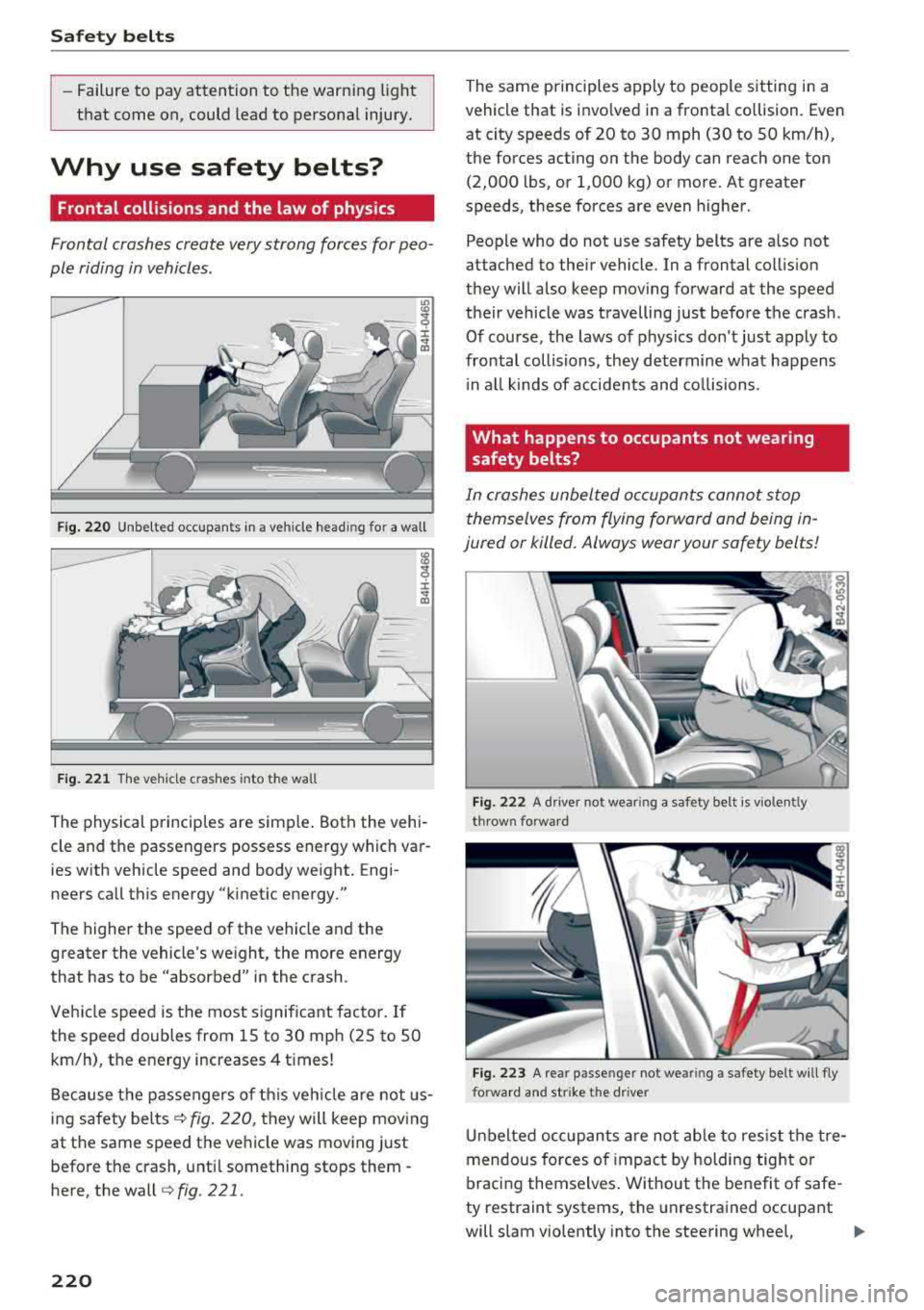
Frontal crashes create very strong forces for peo
ple riding in vehicles.
F ig. 220 Unbe lted occupants in a vehicle heading for a wall
Fig . 221 The veh icle crashes into the wall
The physical principles are simple . Both the vehi
cle and the passengers possess energy which var
ies with vehicle speed and body weight. Engi
neers call this energy "kinet ic energy."
The higher the speed of the vehicle and the greater the vehicle 's we ight, the more energy
that has to be "absorbed" in the crash.
Vehicle speed is the most significant fac tor. If
the speed doubles from 15 to 30 mph (25 to SO
km/h), the energy increases 4 times!
Because the passengers of th is veh icle are not us
ing safety
belts<=> fig. 220, they will keep mov ing
at the same speed the ve hicle was moving just
before the crash, u nti l something stops them -
here, the wall<=>
fig. 221.
220
The same principles apply to people s itting in a
vehicle that is involved in a fronta l collision. Even
at city speeds of 20 to 30 mph (30 to 50 km/h),
the forces acting on the body can reach one ton
(2,000 lbs, or 1,000 kg) or more. At greater
speeds, these forces are even higher.
People who do not use safety belts are a lso not
attached to their vehicle. In a frontal coll is ion
they will also keep mov ing forward at the speed
their vehicle was travelling just befo re the crash.
Of course, the laws of physics don't just apply to
frontal collisions, they determine what happens
i n a ll kinds of accide nts and co lli sions.
What happens to occupants not wearing
safety belts?
In crashes unbelted occupants cannot stop
themselves from flying forward and being in
jured or killed. Always wear your safety belts!
Fig. 222 A driver not wearing a safety belt is violently
thrown forward
F ig. 223 A rear passenger not wearing a safety belt will fly
forwa rd a nd strike the driver
Unbelted occ upants are not ab le to res ist the tre
mendous forces of impact by holding tight or
braci ng themselves . Without the benefit of safe
ty restraint systems, the unrestra ined occupant
will slam violently into the steering wheel,
liJJ,,
Page 225 of 356
lL t:0 ....
"' ......
"' .... 0 0 :c '
may a lso lock when you drive up or down a ste ep
h ill or through a sharp curve . Dur ing normal driv
ing the belt lets you move freely .
Safety belt pretension ers
The safety belts are equipped with a belt pre ten
sioner that helps to tighten the safety belt and remove slack when the pretens ioner is activated
c:> page 225. The function of the p retensioner is
monitored by a warn ing light
c:> page 23.
Conv ert ible loc king retractor
Every safety belt except the one on the driver
seat is equipped with a convertible locking retrac
tor that
must be used when the safety belt is
used to attach a child seat. Be sure to read the important information about this feature
c:> page 259 .
A WARNING
Improperly posit ioned safety belts ca n cause
ser ious injury in an accident
c:> page 223 ,
Safety belt position.
- Safety belts offer optimum protection only
when the seatback is upright and belts are
prope rly pos itioned on the body.
- Never attach the safety belt to the buckle
for another seat . Attaching the belt to the
wrong bu ckle w ill reduce safety belt effec
t iveness and can cause serious persona l in
jury .
- A passenger who is not p roperly restrained
can be seriously injured by the safety be lt it
sel f when it moves from the stronger parts
of the body into critical areas like the abdo
men.
- Always lock the convert ible lock ing retractor
when you are secur ing a child seat in the ve
hicle
c> page 261.
@ Tips
For information on safety be lt pretensione rs,
refer to
c:> page 225.
Safet y bel ts
Safety belt position
Correct belt position is the key to getting maxi
mum protection from safety belts .
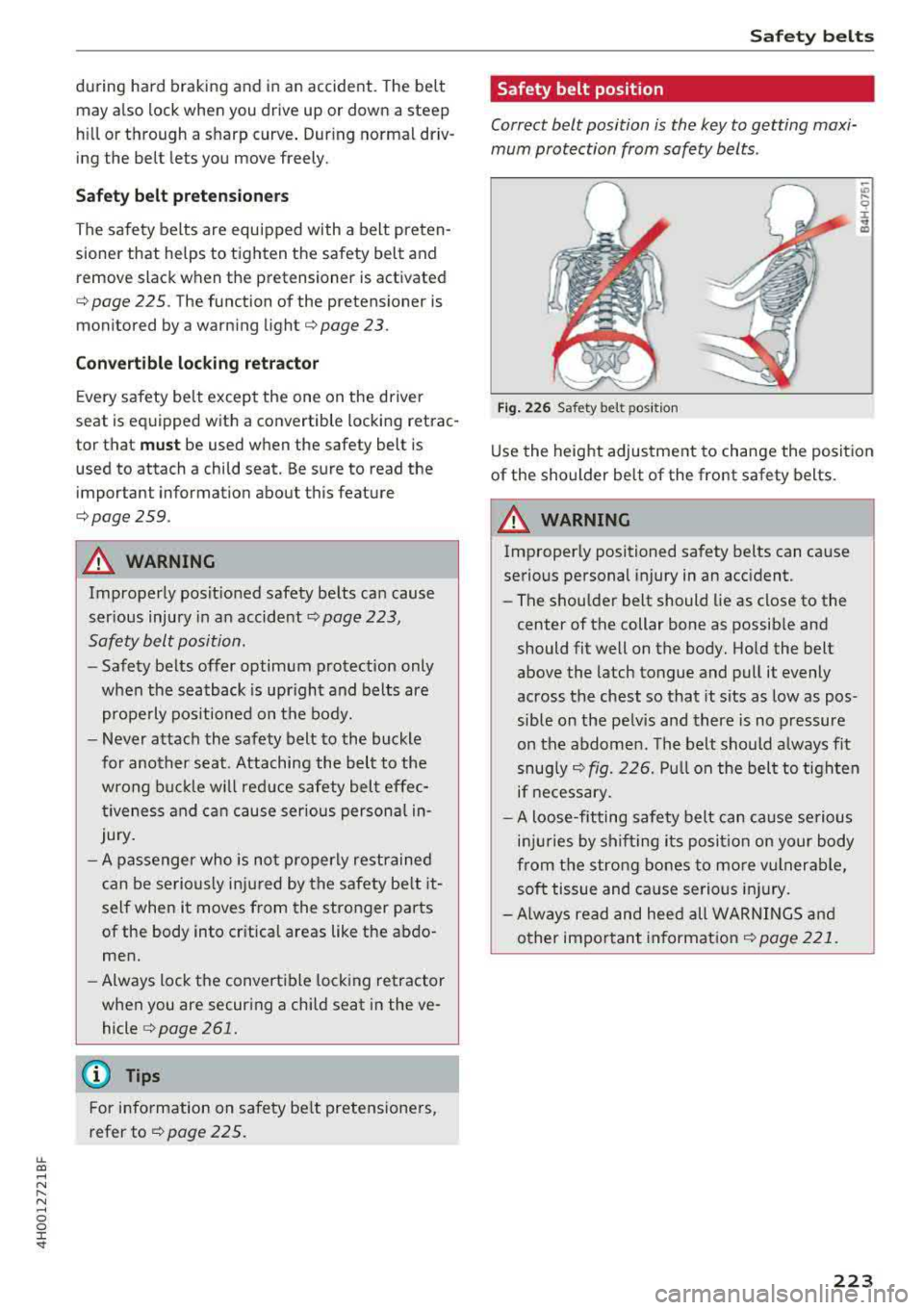
Fig . 2 26 Safet y be lt po sit ion
U se the height adjustment to change the position
of the shoulder belt of the front safety belts.
.&_ WARNING ~
Improperly positioned safety belts can ca use
serious personal injury in an acc ident.
- The shou lder belt should l ie as close to the
center of the collar bone as possib le and
should fit well on the body. Ho ld the belt
above the latch tongue and pull it evenly
across the chest so that it sits as low as pos
sible on the pelvis and there is no pressure
on the abdomen. The belt should a lways fit
snug ly
c:> fig. 226. Pu ll on the bel t to tighten
if necessary.
- A loose-fit ting safety belt can cause serious
in jur ies by shi fting its position on your body
from the strong bones to mo re v ulnerable,
soft tissue and cause se rious in jury.
- Always read and heed all WARN INGS and
o ther impor tant informat ion
c:> page 221.
223
Page 231 of 356
seat. It ca n be a very dangerous place fo r an
infant or a child in a rearward-facing seat .
The Advanced Airbag System in your ve hicle has
been ce rt ified to comp ly with the requ irements
of United States Federa l Motor Vehicle Safety
Standard (FMVSS) 208, as well as Canada Motor
Ve hicle Safety Standard (CMVSS) 208 as applica
b le at the time your veh icle was man ufactu red.
Accord ing to requ irements, the front Advanced
Airbag System o n the passenger s ide has been
cert ified for "suppression" for infants of about
12 month old and yo unger and fo r
"low risk de
p loyment " for children aged 3 to 6 years o ld (as
defined in the standa rd).
The
PASSENGER AIR BAG OFF light in the instru
ment panel tells you w hen the front Advanced
A irbag on t he passenger side has been tu rned off
by the elect ronic con trol unit.
E ach t ime you sw itch on t he ignit ion, the
PAS
SENGER AIR BAG OFF
l ight will come on fo r a
few seconds a nd:
- wi ll stay on if the front passenger seat is not
occup ied,
- will stay on if there is a small c hild or chi ld re
straint on the front passenge r seat,
- will go off if the front passenger seat is occu
pied by an adult as reg istered by the weight
sensing mat
c> page 23 7, Monitoring the Ad
vanced Airbag System .
The PASSENGER AIR BAG OFF light comes on
when the control unit detects a total we ight on
the fro nt passenge r seat that requ ires the front
a ir bag to be t urn ed off .
If the total weigh t on the front passenger seat is
mo re t han that of a typical 1 year -old child but
less t han the weight of a small adult , the front
a ir bag on the passenger side can deploy (the
PASSENGER AIR BAG OFF light does no t come
on). If the
PASSENGER AIR BAG OFF light does
no t come on, the front a irb ag on the passenger
side has not been turned o ff by the e lectronic
control unit and can dep loy if the control unit
~ senses an impact that meets the condit ions sto r-
.... ~ ed in its memory.
N ....
g For e xample, the airbag may deploy if:
:c '
- a sma ll ch ild that is heav ier than a typ ica l 1
year -o ld child is on the front passenger seat
(regard less o f whethe r the child is in one o f the
child seats listed
c> page 251), or
- a child who has outgrown c hild rest raints is on
the front passenge r seat.
If the front passenge r airb ag is t urned off, the
PASSENGER AIR BAG OFF light comes on in the
inst rument cluste r and stays on.
T he front airbag on the p assenger side may
not
deploy (the PASSENGER AIR BAG OFF light does
not ill uminate and stay lit) even if a small adu lt
o r teenager, or a passenge r who is not sitting up
right w ith their bac k against a non-recl ined back
res t with the ir feet on the vehicle floor i n front of
the seat is on the fron t passenger seat
c> page 209, Proper seating position for the driv
er .
If the front passenger a irbag deploys, the Feder
al Standard requires t he airbag to meet the
"low
risk" deployment cr iteria to reduce the r isk of in
j ury throug h interact ion w it h the airbag . "Low
risk" deployment occurs in t hose cr'1s hes th'1t
tak e place at lowe r decele rations as defined in
t h e e lec tron ic co ntrol un it
c>page 237, PASSEN
GER A IR BAG O FF light.
Always remembe r, a ch ild seat o r infant ca rr ie r
i n sta lled on the front seat m ay be s truck and
k nocked out of pos it io n by the rap idly inf lat ing
passenge r's airbag in a fron tal coll is ion . The a ir
bag cou ld great ly reduce the effectiveness of the
c h ild rest raint and even seriously injure the child
during inflat ion.
F o r thi s reason, an d beca use the back seat is the
safest p lace for children
-w hen proper ly restrain
ed according to their age and size
-we strongly
recommend that chi ldren always sit in the back
seat
c> page 249, Child safety .
A WARNING "---
A child in a rearward-fac ing child seat instal
l ed on the fron t passenger seat will be se ri
ously injured a nd ca n be killed if the fron t air
b ag inflates
-even with an Advanced Airbag
S ys tem.
229
Page 232 of 356
Airbag syste m
-The inflating airbag will hit the child seat or
infant carrier w ith great force and will
smash the ch ild seat and c hild against the
backrest, center armrest , door or roof .
- Always install rear-facing child seats on the
rear seat.
- If you must install a rearward fac ing ch ild
seat on the front passenger seat because of exceptional c ircumstances and the
PA SSEN
GER AIR BAG OFF
light does not come on
and stay on, immediately insta ll the rear
facing child seat in a rea r seating position
and have the airbag system inspected by
yo ur Audi dealer.
- Forward-facing ch ild seats insta lled on the
front passenge r's sea t may in terfe re with
the deployment of the airbag and cause se
rious persona l injury to the child.
A WARNING
If, in exceptional circumstances, you must in
stall a forward-facing chi ld restraint on the
front passenger's seat :
- Always make sure the forward -facing seat
has been designed and cert ified by its man
ufact urer for use on a front seat with a pas
senger front and side a irbag.
- Never put the forward-facing child restraint up against or very near the instrument pan
el.
- Always move the front passenger seat to the h ighest position in the up and down ad
justment range and move it back to the
rearmost position in the seat's fore and aft
adjustment range, as fa r away from the air
bag as possib le, before insta lling the for
ward-facing child res trai nt.
- Always make sure that the safety belt upper
anchorage is beh ind the child restraint and
not next to or in front o f the child restrain t
so tha t the safety belt will be properly pos i
tioned.
- Make s ure tha t the
PASSENGER AIR BAG
OFF
light comes on and stays on all the time
whenever the ignition is switched on.
230
A WARNING
To reduce the risk of serious injury, make sure
that the
PASSENGER AIR BAG OFF light will
be d isplayed whenever a ch ild restraint is in
stalled on the front passenge r seat and the
ignit ion is switched on.
- If the
PASSENGER AIR BAG OFF light does
not stay on, perform the checks desc ribed
~ page 23 7, Monitoring the Advan ced Air
bag System.
- Take the child restra int off the front passen
ge r seat an d install it prope rly at one of the
rear sea t positions if the
PASSENGER AIR
BAG OFF
light does not stay on .
- Have the ai rb ag system inspec ted by your
Aud i dea ler immediately.
- Always carefully follow ins truc tions from
child restrain t manufacture rs when instal
ling child restra ints .
A WARNING
If, in exceptional ci rcumstances, you must in
stall a forward or rearward-fac ing child re
stra int on the front passenger's seat:
- Improper installat ion of child restraints can
reduce the ir effectiveness or even prevent
them from provid ing any protect ion.
- An improperly installed child restra int can
inter fere with the airbag as it deploys and
serious ly injure or even kill the child - even
w ith an Advanced A irbag System.
- Always carefully follow the manufacturer's instructions provided with the child seat or
car rier.
- Never p lace add itiona l items on the seat
that can increase the tota l weight registered
by the weight -sensing mat and can cause in
jury in a crash.
Page 234 of 356
Airbag syste m
The front Advanced Airbag System supp lements
the safety belts to provide additional protection
for the dr iver's and front passenger's heads and
upper bodies in frontal crashes. The airbags in
flate only in frontal impacts when the veh icle de
celerat ion is high enough.
The front Advanced Airbag System for the front
seat occupants is not a substitute for your safety belts. Rather, it is part of the overall occupant re
stra int system in your vehicle. Always remember
that the a irbag system can only help to protect
you, if you are sitt ing upr ight, wear ing your safe
ty belt and wear ing it prope rly. This is why you
and your passengers must always be prope rly re
stra ined, not just because the law req uires yo u to
be .
The Advanced Airbag System i n your veh icle has
been ce rt ified to meet the " low r isk" requ ire
men ts for 3 and 6 yea r-old children on the pas
senger side and very sma ll adults on the driver
side . The low risk dep loyment criteria are intend
ed to he lp reduce the risk of injury through inter
action with the front airbag that can occur, for
examp le, by being too close to the steering wheel
and instrument panel when the airbag inflates .
In addition, the system has been certified to
comp ly w ith the "suppression" requirements of
the Safety Standard, to turn
off the front a irbag
for infants 12 months old and younger who are
restrained on the front passenger seat in c hild re
stra ints that are listed in the Standa rd
¢ page 251, Child restraints and Advanced Air
bags.
"Suppress ion" requ ires t he front a irbag on the
passenger side to be turned
off if:
- a chi ld up to about one year of age is restra ined
on the front passenger seat in one of the rear
facing o r fo rward-fac ing infant restra ints listed
i n Federal Motor Vehicle Safety Standard
208
with wh ic h the Advanced Airbag System in your
vehicle was ce rt ified. For a l isting of the c hild
restra ints that were used to certify your veh i
cle's compliance with the US Safety Standard
¢ page 251,
232
-weight less than a threshold leve l stored in t he
control unit is detected on the front passenger
seat.
When a person is detected on the fron t passen
ger seat, weig hing more than the total weight of
a chi ld that is about 1 year old restrained in one
of the rea r-facing or forward-fac ing infant re
straints (listed in Federal Motor Vehicle Safety
Standard
208 with w hich the Advanced Airbag
System in your vehicle was certified), the front
a irbag on the passenger s ide may or may not de
ploy.
The
PASSENGER AIR BA G OFF light comes on
whe n the electronic control unit detects a tota l
weight on t he front passenger seat that requ ires
t h e front a irbag to be tur ned
off . If t he PASSEN
GER AIR BAG OFF
light does not come on, the
front a irbag on the passenge r side has no t been
tu rne d
off by t he control unit and can dep loy if
the control unit senses an impact t hat meets the
conditions stored in its memory.
If the total weig ht on the front passe nger sea t is
more than that of a typ ica l 1 year-o ld, but less
than the weight of a small adult, the front airbag
on the passenger side may dep loy (the
PASSEN
GER AIR BAG O FF
light does not come on).
For example , the airbag ma y deplo y if:
- a small ch ild that is heav ier than a typ ica l 1
year-old child is on the front passenger seat (regard less of whethe r the child is in one of t he
child seats listed
¢ page 251),
-a child who has outgrown c hild res traints is on
the front passenge r seat.
If the front passenger a irbag is tu rned
off, the
PA SSENGER AIR BAG OFF light in the center of
t h e i nstr ument pane l w ill come on and s tay on.
The front airbag on the passenger side may
not
deploy (the PASSENGER AIR BAG OFF light does
not ill uminate and stay lit) if:
- a small adult or teenager is on the front pas
senger seat
- a passenger who is not s itting upright with
their back against a no n-reclined backrest with
their feet on the veh icle floor in front of the
seat is on the front passenger seat .
Page 235 of 356
u. co .... N
" N .... 0 0 :c '
a l Standard requires the airbag to meet the "low
risk" deployment criteria to help reduce the risk
of injury through interaction with the airbag.
"Low risk" dep loyment occurs in those crashes
that take place at lower decelerations as defined in the electronic control unit
r;:;. page 23 7.
Al way s remember: Even though your vehicle is
equ ipped w ith Advanced A irbags, the s afest p lace
for children is properly restrained on the back
seat . Please be sure to read the important infor
mat io n in the sect ions that follow and be su re to
h eed a ll of the WARN INGS.
A WARNING
T o red uce the r isk of injury when an airbag in
flates, a lways wear safety be lts properly .
- If you are unrest rained, lean ing fo rwa rd, s it
t ing s idew ays or o ut of pos it ion in any way,
yo ur risk of in jury is much higher .
- Yo u will also receive se rious injur ies a nd
cou ld even be killed if you are up aga inst the
airbag or too close to it when it inflates
-
even with an Advanced Airbag I!!> page 22 7.
A WARNING
A child in a rearward-facing chi ld seat insta l
led on the front passenger seat will be ser i
ously injured and can be k illed if the front air
bag inflates - even with an Advanced Airbag
System .
- Although the Advanced A irbag System in
yo ur vehicle is designed to turn off t he front
airbag when a rearward-facing ch ild re
straint has been insta lled on the front pas
senger seat, nobody can abso lutely g uara n
tee that deployment is impossible in a ll con
c e ivable s ituat ions that may happen dur ing
the usefu l life o f yo ur vehicle .
- T he inf lat ing air bag w ill hit th e chi ld sea t or
infant carrier w it h great fo rce and will
smash the c hild seat and child against the
backrest , center a rmrest, door, or roof.
- Always install rearward -fac ing c hild re
straints on the rear seat .
- If you must install a rearwar d fac ing c hild
seat on the front passenger seat because of
Airbag syste m
except io n al circumstances and the PASSEN
GER AIR BAG OFF
li ght does not come on
and stay on, immed iate ly install the rea r
faci ng chi ld seat in a rear seating pos it io n
a nd have the airbag system inspected by
your Aud i dea le r.
A WARNING
-
If, in exceptional c ircu mstances, you must in
stall a forward-fa cing child rest ra in t on the
fron t passenger's seat:
- Always make su re the forward-facing seat
has bee n des igned and certified by its man
uf acture r for use o n a front sea t with a pas
senge r front and side airbag.
- N eve r put the fo rw ar d-faci ng chi ld restra in t
up ag ainst o r very ne ar th e i nstr ument pan
el.
- Always move the fro nt passenge r seat to
the hig hest posit io n in the up and down ad
justment range and move it bac k to the
rearmost positio n in the seat's fo re and aft
ad justment range, as far away from the a ir
bag as poss ible, before install ing the for
ward-facing ch ild restraint .
- Always make sure that the safety be lt upper
anchorage is behind the c hild restraint and
not next to o r in front of the ch ild restraint
so that the safety be lt will be p roperly posi
tioned .
- Make sure that t he
PASSENGER AIR BAG
OFF
l ight comes on and stays on a ll the time
wheneve r th e ignit ion is switched o n.
Advanced Airbag System components
The front passenge r seat in your ve hicle has a lo t
of ve ry important parts of t he Advanced A irb ag
System in it. These parts incl ude the weight
sensing mat, sensors, wiring, brackets, and
more . The f unction of th e system in the front
passenger seat is checked by the electronic con
trol unit when the ign ition is on. The control unit
moni tors the Advanced Airbag System and turns
the a irbag ind icator light on when a malfunction
i n the system compone nts is detected . The func
t ion of the a irbag ind icator light is described in
greate r deta il be low. Because t he front
233
Page 236 of 356
Airbag syste m
passenger seat contains important parts of the
Advanced Airbag System, you must take care to
prevent it from being damaged . Damage to the
seat may prevent the Advanced A irbag for the
front passenger seat from doing its job in a
crash .
The front Ad vanced Airb ag S ystem con sist s
o f the follo wing :
-Crash sensors in the front of the vehicle that
measure vehicle acceleration/decelerat ion to
provide information to the Advanced Airbag
System about the severity of the crash .
- An electron ic control un it, with integrated
crash sensors for front and side impacts . The
contro l unit "decides " whether to fire the front
airbags based on the information received from
the crash sensors. The contro l unit also "de
cides" whether the safety be lt pretensioners
sho uld be activated.
-An Advanced Airbag with gas generator and
contro l valve for the driver inside the steering
whee l hub .
-An Advanced Airbag with gas generator and
contro l valve inside the instrument pane l for
the front passenger.
- A weight -sensing mat unde r th e upho lstery
padding of the front passenger seat cushion
that meas ures the tota l weight on the seat . T he
information registered is sent continuously to
the e lec tronic control unit to regu la te dep loy
ment of the front Adva need A irbag on the pas
senger side .
- An airbag monitoring system and indicator
light in the instrument cluster
c> page 23 7 .
- A sensor in each front sea t registers the dis
tance between the respective seat and the
steering wheel or instrument panel. The infor
mation reg istered is sent continuously to the
electronic cont rol u nit to regulate deployment
of the fro nt Advanced A irbags.
- T he
PASSENGER AIR BAG OFF light comes on
and stays on in the center of the instr ument
pane l
c> page 23 7, fig. 232 and tells you w hen
the front Advanced Airbag on the passenger side has been turned off.
-A sensor be low the safety belt latch fo r the
front seat passenger to meas ure the tension on
234
the sa fety be lt. The tension on the safety belt
and the weight registered by the weight -sens
ing mat he lp the contro l unit "decide" whether
the front airbag for the front passenger seat
should be turned
off or not c> page 228, Child
restraints on the front seat -some important
things to know .
-A sensor in the safety belt latch for the driver
and for the front seat passenger that senses
whether that safety belt is latched or not and
transmits this informat ion to the e lectronic
cont rol u nit.
_&, WARNING
Da mage to the front passenge r seat can pre
vent the front airbag from work ing prope rly .
- I mp roper repair or disassembly of the front
passenger and driver seat will p revent the
Advanced Airbag System from functioning
proper ly.
-Repairs to the front passenger seat mus t be
performed by qualified and proper ly trained
workshop personne l.
- Never remove the front passenger or driver seat from the vehicle.
-Never remove the upholstery from the front
passenger seat.
-N ever d is a ssemble o r remove pa rts from the
seat or disconnect wi res from it.
- N ever carry sharp objects in your pocke ts or
p lace them on the seat. If the weight-sens
ing mat in the passenger seat is p unctured
it ca nnot work proper ly.
- Never carry things on your lap or carry ob
jects on the passenger seat. S uch items can
increase t he weight reg istered by the
weight-sensing mat and send the wrong in formation to the a irbag control u nit.
- Never store items under the front passenger
seat . Parts of the Advanced Airbag System
under the passenger seat cou ld be dam
aged, preventing them and the airbag sys
tem from worki ng p roperly.
- Never place seat covers or replacement up
holstery that have not been specifically ap
proved by A ud i on the front seats.
- Seat covers can prevent the Advanced A ir
bag System from recognizi ng ch ild